China Industrial AR Market Size & Growth Rate
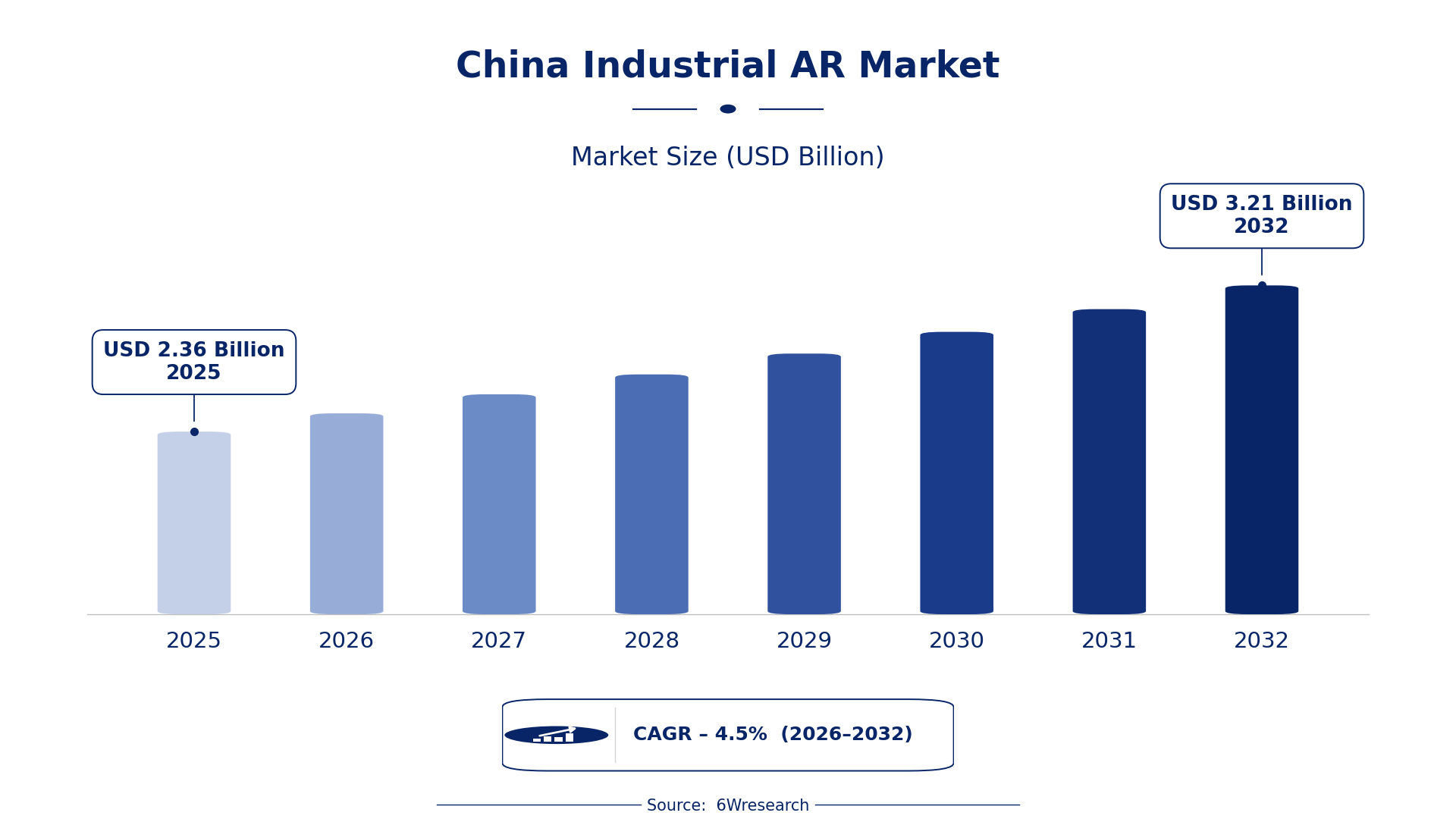
According to 6Wresearch internal database and industry insights, the China Industrial AR Market was valued at USD 2.36 billion in 2025 and is projected to reach USD 3.21 billion by 2032, growing at a CAGR of approximately 4.5% during 2026–2032.
China Industrial AR Market Highlights
| Report Metric | Details |
| Report Name | China Industrial AR Market |
| Market Size 2025 | USD 2.36 billion |
| Market Size 2032 | USD 3.21 billion |
| Absolute Growth 2025–2032 | USD 0.85 billion |
| CAGR 2026–2032 | 4.5% |
| Peak Annual Growth | 6.9% in 2028 |
| Forecast Period | 2026–2032 |
| Historical Data | 2022–2025 |
| Base Year | 2025 |
| Leading AR Type, 2025 | Smart Glasses AR (42% share) |
| Leading Display Mode, 2025 | See-through Overlay (34% share) |
| Leading Functionality, 2025 | Real-Time Guidance (42% share) |
| Leading End User, 2025 | Assembly Line Workers (44% share) |
| Fastest-Growing AR Type | Head-Mounted AR (6.3% CAGR) |
| Fastest-Growing Functionality | Training Simulation (6.2% CAGR) |
| Fastest-Growing End User | Technical Training Centers (5.7% CAGR) |
| Growing Sector | manufacturing |
| Key End Users | assembly line workers, field technicians, technical training centers, industrial R&D teams |
China Industrial AR Market Year-wise Growth Rate and Key Drivers (2022–2032)
This graph illustrates the annual growth rates of the market from 2022 to 2032, highlighting a steady upward trajectory and projected market expansion over the forecast period.
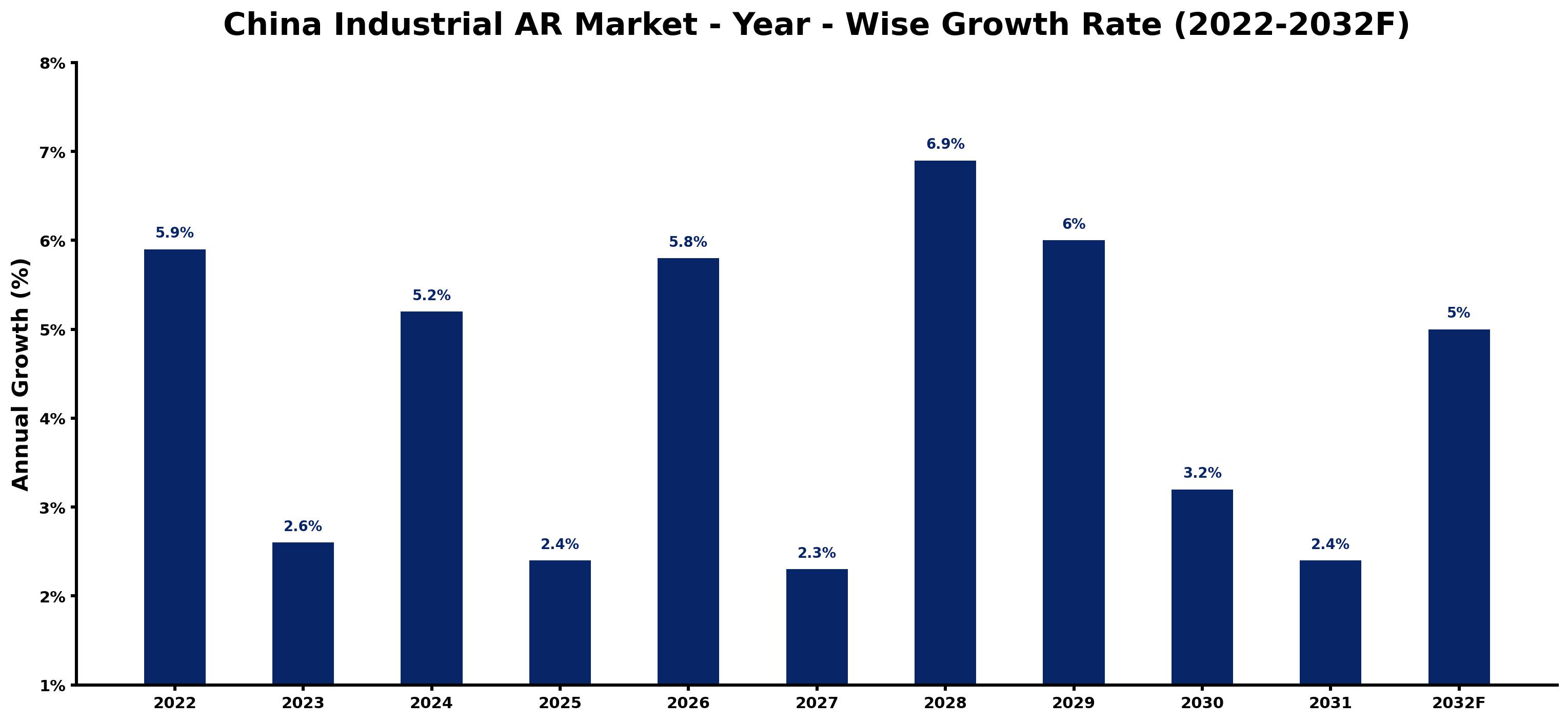
Below, each year's estimated growth is shown next to the factor that most influenced it.
| Year | Estimated Annual Growth (%) | Market Rationale |
| 2022 | 5.9 | The market experienced strong demand from manufacturing sectors adopting new technologies. |
| 2023 | 2.6 | Growth slowed as companies adjusted to previous investments and market conditions. |
| 2024 | 5.2 | Increased focus on smart manufacturing drove a resurgence in AR adoption. |
| 2025 | 2.4 | Market growth decelerated as companies faced integration challenges with existing systems. |
| 2026 | 5.8 | A renewed interest in efficiency will lead to a rise in AR applications across industries. |
| 2027 | 2.3 | Demand is expected to slow as companies evaluate the effectiveness of their AR investments. |
| 2028 | 6.9 | The peak growth year will see investments in AR technologies for operational improvements. |
| 2029 | 6.0 | Growth is projected to moderate as the market matures and adoption rates stabilise. |
| 2030 | 3.2 | A slowdown will occur as companies reassess their technology strategies and budgets. |
| 2031 | 2.4 | Demand is anticipated to continue slowing as firms focus on optimising existing AR systems. |
| 2032 | 5.0 | Growth will accelerate again as new applications in training and maintenance gain traction. |
Note: Market size estimations and growth projections presented in this report are based on 6Wresearch's proprietary forecasting methodology, utilizing the latest available industry data, government publications, and primary research inputs.
China Industrial AR Market Synopsis
Industrial AR in China refers to augmented reality technologies used in manufacturing and industrial settings, improving operational efficiency and safety. It is created through software development and hardware integration, utilizing devices like smart glasses and mobile applications. The China Industrial AR Market is growing due to significant investments in smart manufacturing initiatives and the ongoing demand from over 100 million workers in the manufacturing sector. The 'Made in China 2025' initiative is a key driver, promoting AR adoption across various industrial applications.
Market Dynamics Impact Analysis (2026–2032)
| Factor | Type | Impact | Primary Segment Affected |
| Significant investments in smart manufacturing technologies drive demand for AR solutions. | Driver | High | Smart Glasses AR |
| The growing workforce in manufacturing sectors increases the need for AR training solutions. | Driver | High | Technical Training Centers |
| The Guangdong province is expanding its tech ecosystem, creating opportunities for AR suppliers. | Opportunity | High | Head-Mounted AR |
| The integration of AR in training programs is gaining traction among educational institutions. | Opportunity | Medium | Technical Training Centers |
| Integration challenges with existing systems can hinder AR adoption in manufacturing. | Restraint | High | Real-Time Guidance |
| Limited awareness of AR benefits among smaller manufacturers restricts market growth. | Restraint | Medium | Maintenance Instructions |
| High initial investment costs for AR technologies can deter potential buyers. | Challenge | High | Smart Glasses AR |
| The rapid pace of technological change makes it difficult for firms to keep up. | Challenge | Medium | Head-Mounted AR |
Evaluation of Drivers in China Industrial AR Market (2026–2032)
Below mentioned are some major drivers and their influence on market dynamics.
| Drivers | Primary Segment Affected | Why It Matters (Evidence) |
| Investment in smart manufacturing technologies drives AR adoption. | Smart Glasses AR | The total investment in smart manufacturing technologies in China is expected to reach $500 billion by 2025, prompting increased AR integration. |
| A large workforce in manufacturing creates demand for AR training solutions. | Technical Training Centers | China's manufacturing sector employs over 100 million workers, many of whom could benefit from AR technologies. |
| The 'Made in China 2025' initiative promotes AR technologies in manufacturing. | Real-Time Guidance | This initiative encourages AR adoption, leading to improved operational efficiency in factories. |
| The Guangdong province is a hub for AR technology development. | Head-Mounted AR | Numerous tech companies in Guangdong are investing in AR solutions, increasing market opportunities. |
| The China Augmented Reality Industry Alliance promotes collaboration among stakeholders. | Maintenance Instructions | This alliance supports AR development, encouraging manufacturers to adopt AR technologies for maintenance. |
Growth across the Industrial AR market in China is anchored in investments in smart manufacturing technologies, which improve operational efficiency and safety. The total investment in these technologies is projected to reach $500 billion by 2025, prompting increased AR integration in manufacturing processes. The workforce in China's manufacturing sector, exceeding 100 million, creates strong demand for effective training solutions. AR applications in maintenance can reduce downtime by up to 30%, improving operational efficiency in factories.
Evaluation of Restraints in China Industrial AR Market
The following restraints limit how fast demand can grow.
| Market Restraint | Primary Segment Affected | Why It Matters (Evidence) |
| Integration challenges with existing systems can hinder AR adoption in manufacturing. | Real-Time Guidance | Many manufacturers face difficulties incorporating AR technologies into their established workflows, limiting effectiveness. |
| Limited awareness of AR benefits among smaller manufacturers restricts market growth. | Maintenance Instructions | Smaller firms often lack knowledge about AR's potential, resulting in slower adoption rates. |
| High initial investment costs for AR technologies can deter potential buyers. | Smart Glasses AR | The upfront costs associated with AR implementation can be prohibitive for many companies. |
| Technological complexity may lead to resistance among traditional manufacturers. | Head-Mounted AR | Some manufacturers are hesitant to adopt new technologies due to fears of operational disruptions. |
| Inconsistent standards for AR implementation can create confusion in the market. | See-through Overlay | The lack of clear guidelines may hinder manufacturers from fully embracing AR solutions. |
China Industrial AR Market Challenges
The China Industrial AR market still has to solve a few problems, and the first is supply chain disruptions. These disruptions arise from dependence on specific hardware components, which can delay project timelines for manufacturers by up to six months. Buyers in the market face rising costs due to limited competition among AR software providers, leading to price increases of around 20% annually. Technological integration remains a hurdle, as many existing systems lack compatibility with new AR solutions, forcing manufacturers to invest heavily in upgrades. Skills shortages in AR development can further delay projects, impacting operational efficiency for companies employing over 100 million workers.
Trends in the China Industrial AR Market
Below mentioned are some of the trends shaping the China Industrial AR Market growth.
- Guangdong Leading AR Development: The Guangdong province is emerging as a key region for industrial AR development, hosting numerous tech companies. In 2023, the province accounted for over 30% of AR technology investments in China.
- Rise of Real-Time Guidance: The adoption of Real-Time Guidance applications is increasing among assembly line workers, improving productivity. In 2022, these applications reduced operational errors by 25% in major manufacturing hubs.
- Shift Towards Training Simulations: Technical Training Centers are increasingly integrating AR into curricula for hands-on training. In 2023, over 40% of such centers adopted AR technologies to improve learning outcomes.
- Focus on Maintenance Instructions: Manufacturers are prioritising AR for Maintenance Instructions to improve repair accuracy. In 2022, AR applications in maintenance reduced downtime by up to 30%.
Investment Opportunities in the China Industrial AR Market
The following opportunities in the China Industrial AR Market pair current demand with a clear way in.
- Partnerships with Technical Training Centers: Collaborating with Technical Training Centers can drive AR technology adoption. With over 100 million workers in manufacturing, this sector presents a strong opportunity for AR solutions.
- Growing Demand for Smart Glasses: There is an increasing demand for Smart Glasses in manufacturing environments. Total investments in smart manufacturing technologies are expected to reach $500 billion by 2025, creating a substantial market.
- Expansion in the Beijing-Tianjin-Hebei Region: Investing in AR solutions for the Beijing-Tianjin-Hebei region can yield considerable returns. This area is a hub for AR technology research and development, attracting significant investments.
- Certification for AR Standards: Obtaining certifications for AR technologies can unlock new markets. The GB/T 35273-2020 standard guides the implementation of AR technologies in industrial applications.
Government Initiatives in the China Industrial AR Market
The Ministry of Industry and Information Technology launched the 'Smart Manufacturing Development Plan' in 2021, promoting AR technologies with a focus on innovation and efficiency. This plan encourages manufacturers to adopt AR solutions to enhance productivity and operational safety. By aligning with this plan, companies can access resources and support for integrating AR into their processes. The plan aims to boost AR adoption across various manufacturing sectors by 2025.
The National Development and Reform Commission oversees the 'Digital Economy Development Strategy', approved in 2022, which includes AR as a key component for industrial transformation. This strategy provides funding and support for AR projects, encouraging collaboration between developers and manufacturers. The Ministry of Science and Technology's 'Artificial Intelligence and Augmented Reality Integration Program', initiated in 2023, further promotes partnerships, aiming to strengthen AR capabilities in manufacturing.
Future Insight of the China Industrial AR Market
Several promising factors should support the China Industrial AR market in the coming years. The 'Made in China 2025' initiative will drive AR adoption, enhancing productivity in manufacturing. Total investments in smart manufacturing technologies are expected to reach $500 billion by 2025, creating opportunities for AR advancements. Technical training centres will increasingly adopt AR for immersive learning experiences, equipping workers with essential skills. Standards like GB/T 35273-2020 will facilitate smoother AR implementation, promoting collaboration among tech companies.
Market Segmentation Analysis
The analysis below covers each segmentation, its leading category in 2025 and its fastest-growing category through 2032.
By AR Type – Smart Glasses AR Dominated, Head-Mounted AR Expected to Grow Fastest
According to Sachin Kumar Rai, Senior Research Analyst at 6Wresearch, Smart Glasses AR accounted for a 42% market share by ar type in 2025. Smart Glasses AR commands the largest share because they facilitate hands-free operations and provide real-time data access, which are essential in the manufacturing sector. With over 100 million workers in China's manufacturing industry, the demand for these devices is substantial and growing. Head-Mounted AR is set to record the highest CAGR in this split, 6.3% over 2026–2032. Head-Mounted AR is experiencing rapid growth as it delivers immersive training experiences that are vital for complex assembly tasks. As the manufacturing sector adopts smart technologies, the need for effective training solutions will continue to expand, reinforcing its growth trajectory. Suppliers should focus on developing advanced smart glasses and head-mounted AR solutions to meet the increasing demand in China.
By Display Mode – See-through Overlay Dominated and Is Expected to Record the Fastest Growth
With a 34% revenue share in 2025, See-through Overlay was the largest display mode category. See-through Overlay holds the largest market share as it allows workers to view digital information superimposed on physical objects, significantly improving operational efficiency. This display mode is particularly beneficial in manufacturing environments where real-time data is crucial for decision-making processes. The same category is also set to grow fastest, at a CAGR of 6.0% during 2026–2032. The growth of See-through Overlay is set to accelerate because its effectiveness in providing immediate information to workers drives widespread adoption. As more companies invest in smart manufacturing, the relevance of this display mode will continue to rise. Buyers should prioritise solutions that utilise see-through overlays to enhance productivity and operational efficiency.
By Functionality – Real-Time Guidance Dominated, Training Simulation Expected to Grow Fastest
Real-Time Guidance held a 42% share of the China Industrial AR Market by functionality in 2025. Real-Time Guidance captures the largest market share owing to its critical role in improving efficiency and safety within manufacturing processes. This functionality is extensively implemented across various sectors, ensuring its strong presence in the market. Over 2026–2032, Training Simulation is expected to post the fastest growth, at a CAGR of 6.2%. Training Simulation is rapidly growing as companies recognise the significance of immersive training for new employees managing complex tasks. This trend is expected to persist as the demand for skilled workers in the industrial sector continues to increase. Suppliers should enhance their offerings in real-time guidance and training simulation to secure a larger market share.
By End User – Assembly Line Workers Dominated, Technical Training Centers Expected to Grow Fastest
Assembly Line Workers took a 44% share of end user in 2025, more than any other category. Assembly Line Workers represent the largest share, utilising AR to improve productivity and accuracy in assembly tasks. Their critical role in the manufacturing process drives the demand for effective AR solutions tailored to their needs. Technical Training Centers are projected to grow fastest, at a CAGR of 5.7% during 2026–2032. Technical Training Centers are experiencing the fastest growth as they integrate AR into curricula for hands-on training, responding to the urgent need for skilled workers. This trend will likely expand as educational institutions seek to modernise their training methods. Suppliers should target technical training centres with tailored AR solutions to capitalise on this growing segment.
Key Attractiveness of the Report
- 10 Years of Market Numbers
- Historical Data Starting from 2022 to 2025
- Base Year 2025
- Forecast Data until 2032
- Key Performance Indicators Impacting the Market
- Major Upcoming Developments and Projects
Key Highlights of the Report:
- China Industrial AR Market Outlook
- Market Size of China Industrial AR Market, 2025
- Forecast of China Industrial AR Market, 2032
- Historical Data and Forecast of China Industrial AR Revenues & Volume for the Period 2022 - 2032F
- China Industrial AR Market Trend Evolution
- China Industrial AR Market Drivers and Challenges
- China Industrial AR Price Trends
- China Industrial AR Porter's Five Forces
- China Industrial AR Industry Life Cycle
- Historical Data and Forecast of China Industrial AR Market Revenues & Volume By AR Type for the Period 2022 - 2032F
- Historical Data and Forecast of China Industrial AR Market Revenues & Volume By Smart Glasses AR for the Period 2022 - 2032F
- Historical Data and Forecast of China Industrial AR Market Revenues & Volume By Tablet/Mobile AR for the Period 2022 - 2032F
- Historical Data and Forecast of China Industrial AR Market Revenues & Volume By Head-Mounted AR for the Period 2022 - 2032F
- Historical Data and Forecast of China Industrial AR Market Revenues & Volume By Projection-Based AR for the Period 2022 - 2032F
- Historical Data and Forecast of China Industrial AR Market Revenues & Volume By Display Mode for the Period 2022 - 2032F
- Historical Data and Forecast of China Industrial AR Market Revenues & Volume By See-through Overlay for the Period 2022 - 2032F
- Historical Data and Forecast of China Industrial AR Market Revenues & Volume By Screen-Based for the Period 2022 - 2032F
- Historical Data and Forecast of China Industrial AR Market Revenues & Volume By Wearable HMD for the Period 2022 - 2032F
- Historical Data and Forecast of China Industrial AR Market Revenues & Volume By Surface Projection for the Period 2022 - 2032F
- Historical Data and Forecast of China Industrial AR Market Revenues & Volume By Functionality for the Period 2022 - 2032F
- Historical Data and Forecast of China Industrial AR Market Revenues & Volume By Real-Time Guidance for the Period 2022 - 2032F
- Historical Data and Forecast of China Industrial AR Market Revenues & Volume By Maintenance Instructions for the Period 2022 - 2032F
- Historical Data and Forecast of China Industrial AR Market Revenues & Volume By Training Simulation for the Period 2022 - 2032F
- Historical Data and Forecast of China Industrial AR Market Revenues & Volume By Object Tagging for the Period 2022 - 2032F
- Historical Data and Forecast of China Industrial AR Market Revenues & Volume By End User for the Period 2022 - 2032F
- Historical Data and Forecast of China Industrial AR Market Revenues & Volume By Assembly Line Workers for the Period 2022 - 2032F
- Historical Data and Forecast of China Industrial AR Market Revenues & Volume By Field Technicians for the Period 2022 - 2032F
- Historical Data and Forecast of China Industrial AR Market Revenues & Volume By Technical Training Centers for the Period 2022 - 2032F
- Historical Data and Forecast of China Industrial AR Market Revenues & Volume By Industrial R&D Teams for the Period 2022 - 2032F
- China Industrial AR Import Export Trade Statistics
- Market Opportunity Assessment By AR Type
- Market Opportunity Assessment By Display Mode
- Market Opportunity Assessment By Functionality
- Market Opportunity Assessment By End User
- China Industrial AR Top Companies Market Share
- China Industrial AR Competitive Benchmarking By Technical and Operational Parameters
- China Industrial AR Company Profiles
- China Industrial AR Key Strategic Recommendations
Market Covered
The report offers an extensive study of the following market segments.
By AR Type
- Smart Glasses AR
- Tablet/Mobile AR
- Head-Mounted AR
- Projection-Based AR
By Display Mode
- See-through Overlay
- Screen-Based
- Wearable HMD
- Surface Projection
By Functionality
- Real-Time Guidance
- Maintenance Instructions
- Training Simulation
- Object Tagging
By End User
- Assembly Line Workers
- Field Technicians
- Technical Training Centers
- Industrial R&D Teams































