China Industrial Cooling Fluids Market Size & Growth Rate
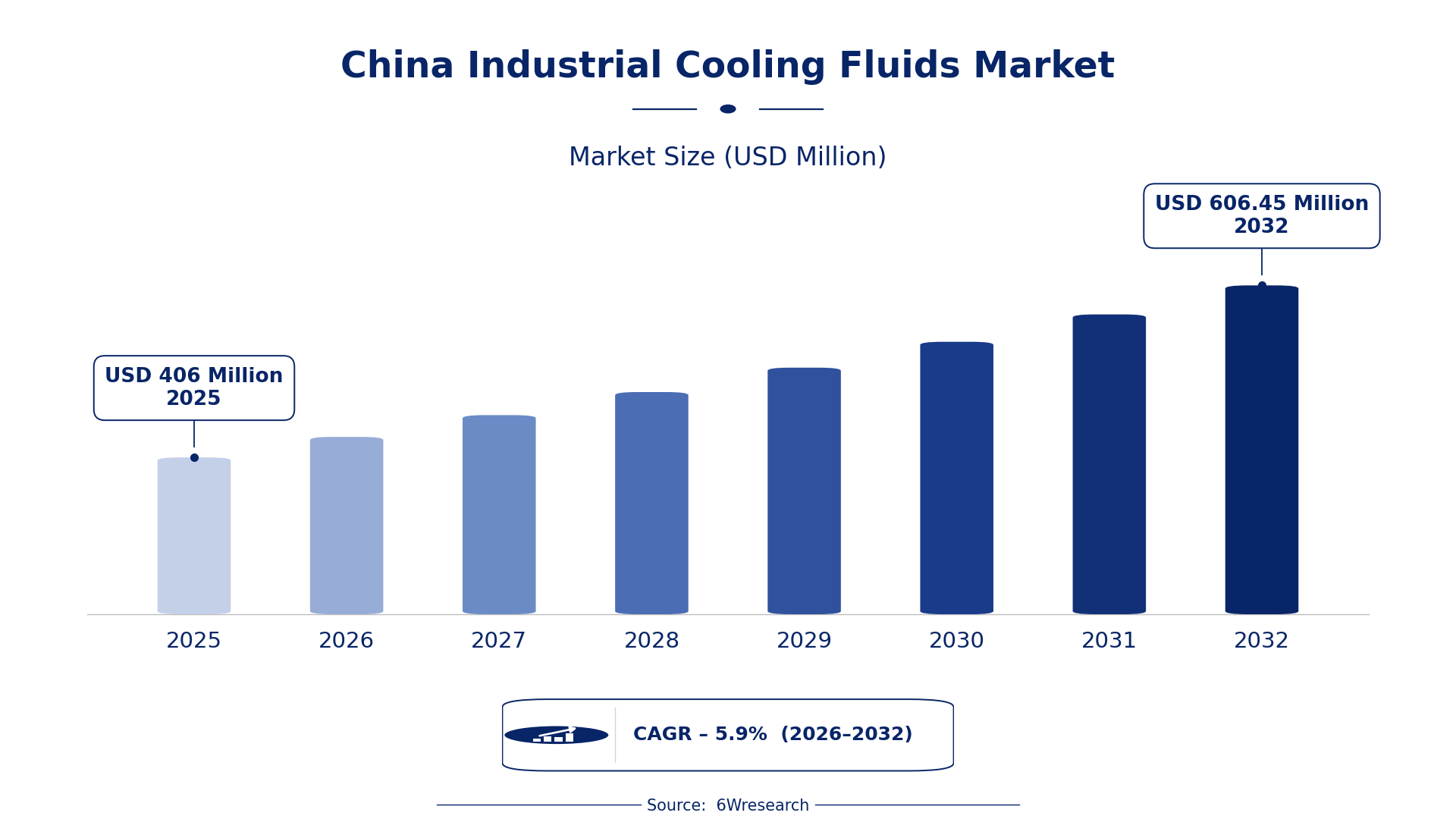
According to 6Wresearch internal database and industry insights, the China Industrial Cooling Fluids Market was valued at USD 406.0 million in 2025 and is projected to reach USD 606.45 million by 2032, growing at a CAGR of approximately 5.9% during 2026–2032.
China Industrial Cooling Fluids Market Highlights
| Report Metric | Details |
| Report Name | China Industrial Cooling Fluids Market |
| Market Size 2025 | USD 406.0 million |
| Market Size 2032 | USD 606.45 million |
| Absolute Growth 2025–2032 | USD 200.45 million |
| CAGR 2026–2032 | 5.9% |
| Peak Annual Growth | 8.5% in 2030 |
| Forecast Period | 2026–2032 |
| Historical Data | 2022–2025 |
| Base Year | 2025 |
| Leading Fluid Type, 2025 | Water-Based Coolants (42% share) |
| Leading Base Material, 2025 | Glycol/Water Blend (52% share) |
| Leading Cooling Application, 2025 | HVAC & Process Cooling (48% share) |
| Leading End User, 2025 | HVAC Systems (47% share) |
| Fastest-Growing Fluid Type | Synthetic Coolants (8.5% CAGR) |
| Fastest-Growing Cooling Application | Electronics Cooling (8.2% CAGR) |
| Fastest-Growing End User | Semiconductor Industry (8.0% CAGR) |
| Growing Sector | Semiconductor Industry |
| Key End Users | HVAC Systems, Metalworking Industry, Semiconductor Industry |
China Industrial Cooling Fluids Market Year-wise Growth Rate and Key Drivers (2022–2032)
This graph illustrates the annual growth rates of the market from 2022 to 2032, highlighting a steady upward trajectory and projected market expansion over the forecast period.
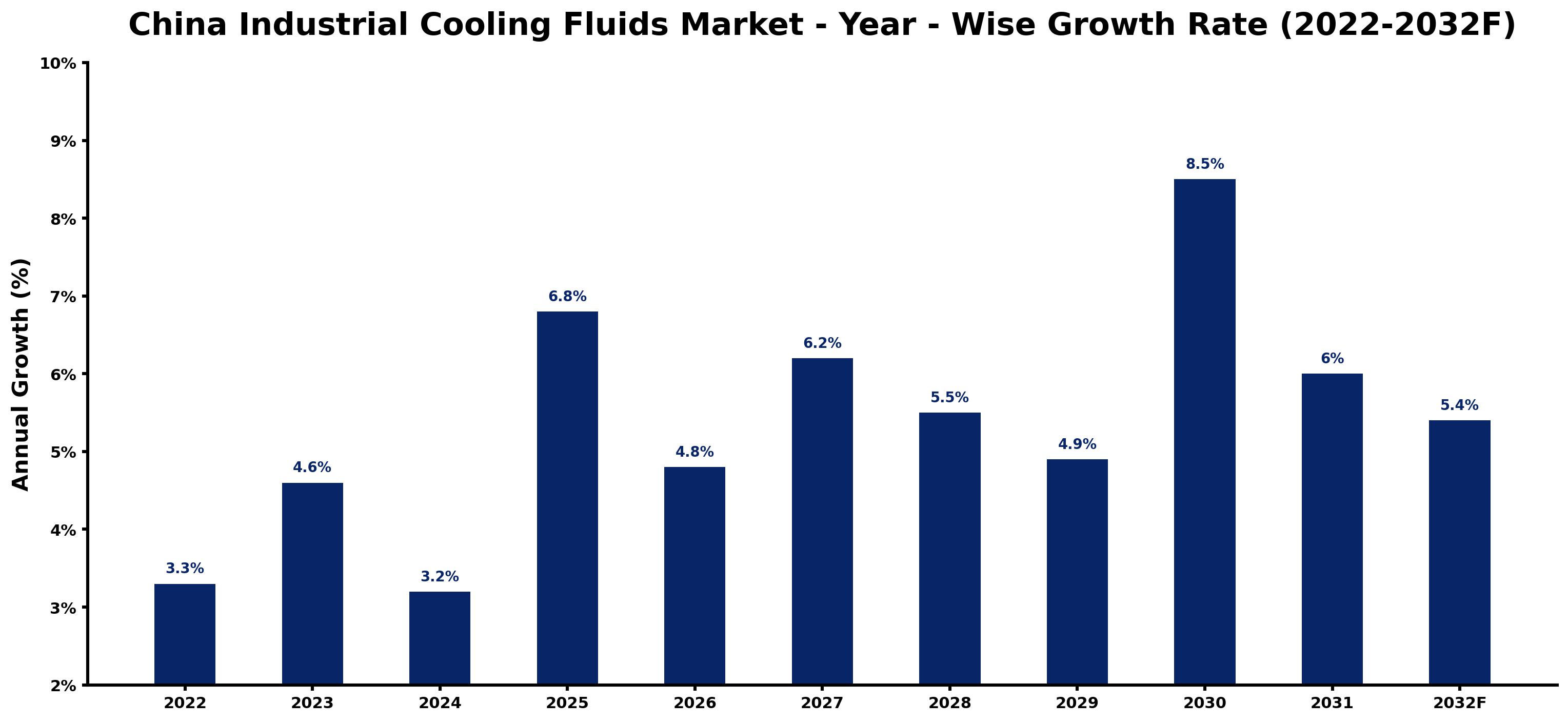
Annual growth estimates for each year appear below with the principal reason behind them, explaining the shifts that set the pace of the market.
| Year | Estimated Annual Growth (%) | Market Rationale |
| 2022 | 3.3 | The market experienced steady growth due to ongoing industrial activities and demand for effective cooling solutions. |
| 2023 | 4.6 | Increased production of industrial cooling fluids supported by the expanding metalworking industry drove faster growth. |
| 2024 | 3.2 | Growth slowed as the market adjusted to previous high levels of production and demand. |
| 2025 | 6.8 | A surge in demand from HVAC applications propelled growth to a historical peak. |
| 2026 | 4.8 | The market is expected to experience a slowdown as the 'Made in China 2025' plan drives innovation. |
| 2027 | 6.2 | Demand will rise again, driven by the semiconductor industry's increasing cooling fluid requirements. |
| 2028 | 5.5 | A slight slowdown is projected as growth rates normalise after the previous surge in demand. |
| 2029 | 4.9 | The market will continue to grow, albeit at a slower pace, as demand from HVAC systems remains strong. |
| 2030 | 8.5 | A notable increase in demand is anticipated, driven by new energy-efficient technologies in HVAC systems. |
| 2031 | 6.0 | Growth will slow as market conditions stabilise following the peak demand year. |
| 2032 | 5.4 | The market is expected to continue growing, supported by ongoing investments in sustainable cooling technologies. |
Note: Market size estimations and growth projections presented in this report are based on 6Wresearch's proprietary forecasting methodology, utilizing the latest available industry data, government publications, and primary research inputs.
China Industrial Cooling Fluids Market Synopsis
Industrial Cooling Fluids in China are vital for effective heat transfer in various industrial applications, primarily made from water, oils, or synthetic materials. These fluids are formulated to enhance thermal conductivity and prevent corrosion, supporting sectors like HVAC, metalworking, and electronics. The China Industrial Cooling Fluids Market is growing due to increasing demand from domestic users and downstream processing industries. The semiconductor industry's projected growth to 1 trillion CNY by 2025 is a key driver. The 'Green Manufacturing' program launched in 2023 promotes sustainable cooling solutions, further boosting market potential.
Market Dynamics Impact Analysis (2026–2032)
| Factor | Type | Impact | Primary Segment Affected |
| Growing demand for HVAC systems due to rising temperatures and industrial expansion. | Driver | High | HVAC Systems |
| Increasing adoption of energy-efficient cooling solutions in industrial applications. | Driver | High | Glycol/Water Blend |
| Investment in sustainable cooling technologies is on the rise, creating new opportunities. | Opportunity | High | Bio-Based Cooling Fluids |
| The semiconductor industry's rapid growth necessitates specialized cooling fluids. | Opportunity | High | Semiconductor Industry |
| Stricter regulations on cooling fluid disposal may increase compliance costs for producers. | Restraint | Medium | Oil-Based Cooling Fluids |
| Limited adoption of bio-based cooling fluids restricts market expansion. | Restraint | Medium | Bio-Based Cooling Fluids |
| The Industrial Cooling Fluids market in China faces challenges from fluctuating raw material prices. | Challenge | High | Synthetic Coolants |
| Competition from alternative cooling technologies may hinder market growth. | Challenge | Medium | Water-Based Coolants |
Evaluation of Drivers in China Industrial Cooling Fluids Market (2026–2032)
The table below links each growth driver to the segment it affects and the evidence for it.
| Drivers | Primary Segment Affected | Why It Matters (Evidence) |
| Increased HVAC installations are driving demand for cooling fluids, particularly glycol/water blends, which represent 52% of the base material market in 2025. | Glycol/Water Blend | The widespread use of glycol/water blends in HVAC systems ensures efficient heat transfer and freeze protection. |
| The metalworking industry employs over 30 million workers, boosting demand for oil-based cooling fluids. | Oil-Based Cooling Fluids | Oil-based fluids are essential for lubrication and cooling during machining processes. |
| The semiconductor industry is projected to grow to 1 trillion CNY by 2025, increasing the need for specialized cooling fluids. | Semiconductor Industry | Advanced manufacturing processes require effective thermal management, driving demand for high-performance cooling solutions. |
| The 'Green Manufacturing' program launched in 2023 promotes sustainable practices in cooling fluid production. | Bio-Based Cooling Fluids | This initiative encourages manufacturers to invest in eco-friendly cooling solutions, expanding market opportunities. |
| The National Energy Administration's initiatives promote energy-efficient cooling technologies, enhancing market growth. | HVAC & Process Cooling | Energy-efficient technologies reduce operational costs and improve system performance, driving higher adoption rates. |
Market growth for Industrial Cooling Fluids in China is underpinned by increasing HVAC installations, which drive demand for glycol/water blends projected to hold a 52% share in 2025. The metalworking industry, employing over 30 million workers, boosts demand for oil-based cooling fluids essential for machining processes. The semiconductor industry, projected to grow to 1 trillion CNY by 2025, necessitates specialized cooling fluids for effective thermal management.
Evaluation of Restraints in China Industrial Cooling Fluids Market
Below mentioned are some major restraints and their influence on market dynamics.
| Market Restraint | Primary Segment Affected | Why It Matters (Evidence) |
| Fluctuating raw material prices for cooling fluids can affect production costs. | Synthetic Coolants | Volatility in raw material prices can lead to increased production costs, impacting profitability for manufacturers. |
| Stricter regulations on cooling fluid disposal may increase compliance costs for producers. | Oil-Based Cooling Fluids | Compliance with new environmental regulations requires investment in waste management systems, raising operational expenses. |
| Limited adoption of bio-based cooling fluids restricts market expansion. | Bio-Based Cooling Fluids | While there is interest in eco-friendly solutions, the current market share remains low, limiting growth potential. |
| Competition from alternative cooling technologies may hinder market growth. | Water-Based Coolants | Emerging technologies may offer more efficient cooling solutions, diverting demand away from traditional cooling fluids. |
| The market faces challenges from the high costs of developing advanced cooling technologies. | Synthetic Coolants | Investments in R&D for new cooling solutions can strain financial resources for manufacturers. |
China Industrial Cooling Fluids Market Challenges
The China Industrial Cooling Fluids market struggles with intense competition, forcing producers to reduce prices and risking profit margins for many. This challenge stems from the rise of low-cost alternatives that threaten established manufacturers, potentially leading to compromised product quality. Regulatory pressures are tightening, especially with the Ministry of Ecology and Environment implementing stricter disposal and recycling standards, which can increase operational costs for producers by up to 15%. Skills shortages in advanced cooling technologies limit innovation, particularly affecting buyers in the semiconductor sector who require specialised cooling solutions. Supply chain disruptions from inconsistent raw material availability can delay production timelines, impacting timely deliveries to critical sectors like HVAC and metalworking.
Trends in the China Industrial Cooling Fluids Market
Several trends are reshaping the China Industrial Cooling Fluids Market; the most important are set out below.
- Shift towards Sustainable Cooling Solutions: In 2023, the focus on sustainable cooling solutions has intensified, driven by the 'Green Manufacturing' program. This initiative encourages the adoption of eco-friendly cooling fluids, with the market for bio-based fluids expected to grow significantly.
- Transition to Advanced Cooling Technologies: The demand for advanced cooling technologies has surged, particularly in the semiconductor industry. By 2025, the sector is set to require specialized cooling fluids to manage heat in advanced manufacturing processes.
- Emergence of Energy-Efficient Cooling Systems: In 2021, the National Energy Administration initiated the 'Energy Efficiency Improvement Plan', targeting a 20% reduction in energy consumption in HVAC systems by 2025. This shift promotes the adoption of energy-efficient cooling technologies.
- Growing Importance of Electronics Cooling: The electronics cooling segment is expected to grow at a CAGR of 8.2% from 2026 to 2032. This trend reflects the increasing need for effective thermal management solutions in the rapidly expanding electronics sector.
Investment Opportunities in the China Industrial Cooling Fluids Market
Several openings in the China Industrial Cooling Fluids Market merit attention from investors.
- Investment in Bio-Based Cooling Fluids: With the 'Circular Economy Development Strategy' advocating for bio-based fluids, there exists an opportunity to supply eco-friendly cooling solutions. The market is expected to grow as manufacturers seek sustainable alternatives.
- Expansion in Semiconductor Cooling Solutions: The semiconductor industry offers a promising opportunity for suppliers of specialised cooling fluids. With growth anticipated to reach 1 trillion CNY by 2025, entering this market necessitates partnerships with local manufacturers.
- Development of Energy-Efficient HVAC Systems: The ongoing push for energy-efficient HVAC systems creates opportunities for suppliers of advanced cooling technologies. Collaborating with HVAC manufacturers can facilitate market entry and growth.
- Supply of Advanced Cooling Technologies: The demand for advanced cooling technologies in the semiconductor sector is on the rise. Suppliers can penetrate this market by forming joint ventures with local firms to meet specific cooling requirements.
Government Initiatives in the China Industrial Cooling Fluids Market
The Ministry of Industry and Information Technology initiated the 'Green Manufacturing' program in 2023, promoting sustainable practices in industrial cooling fluid production. This initiative encourages manufacturers to adopt eco-friendly materials and processes, boosting the market for bio-based cooling fluids. Additionally, the 'Energy Efficiency Improvement Plan' launched by the National Energy Administration in 2021 aims for a 20% reduction in energy consumption in HVAC systems by 2025, driving demand for energy-efficient cooling solutions.
The State Administration for Market Regulation oversees the implementation of updated standards for industrial cooling fluids, ensuring compliance with quality and safety regulations. This agency also approves new cooling fluid formulations, supporting innovation in the market. The Ministry of Ecology and Environment introduced stricter regulations on the disposal of industrial cooling fluids in 2021, promoting responsible practices among producers. These measures enhance environmental protection and support sustainable development in the industry.
Future Insight of the China Industrial Cooling Fluids Market
By 2032, the China Industrial Cooling Fluids market will undergo transformative changes, driven by the 'Green Manufacturing' program that advocates for sustainable solutions. The semiconductor sector will grow, necessitating advanced cooling fluids to effectively manage heat in manufacturing processes. The 'Energy Efficiency Labeling Program' will encourage buyers to choose eco-friendly options, reflecting a shift towards sustainability. With annual demand expected to reach 2 million tons by 2025, suppliers must innovate to meet the diverse and growing needs across various industrial applications.
Market Segmentation Analysis
The report offers a comprehensive study of the following market segments and their leading categories in the market.
By Fluid Type – Water-Based Coolants Dominated, Synthetic Coolants Expected to Grow Fastest
According to Sachin Kumar Rai, Senior Research Analyst at 6Wresearch, Water-Based Coolants accounted for a 42% market share by fluid type in 2025. Water-based coolants dominate the market due to their widespread use in HVAC systems, which are critical for effective heat transfer. This segment benefits from the large installed base of over 200,000 HVAC systems across various sectors in China. The quickest growth will come from Synthetic Coolants, forecast to expand at a CAGR of 8.5% between 2026 and 2032. Synthetic coolants are gaining traction because they offer superior properties for high-performance applications, particularly in sectors like electronics. The projected growth of the semiconductor industry, expected to reach 1 trillion CNY by 2025, will further drive this demand. Suppliers should focus on developing synthetic cooling solutions to capitalise on the growing demand from high-performance applications.
By Base Material – Glycol/Water Blend Dominated and Is Expected to Record the Fastest Growth
Glycol/Water Blend held a 52% share of the China Industrial Cooling Fluids Market by base material in 2025. The glycol/water blend is the leading base material as it is the standard choice in HVAC applications, providing essential freeze protection. Its widespread adoption across various sectors ensures a strong market share. Glycol/Water Blend is also forecast to expand faster than any other category, at a CAGR of 7.0% over 2026–2032. The glycol/water blend is also the fastest-growing base material, driven by its critical role in HVAC systems where energy efficiency is increasingly prioritised. The ongoing investment in energy-efficient technologies will support its continued growth. Buyers should consider the glycol/water blend for its proven effectiveness and alignment with energy efficiency goals.
By Cooling Application – HVAC & Process Cooling Dominated, Electronics Cooling Expected to Grow Fastest
In 2025, HVAC & Process Cooling led the cooling application split with a 48% share. HVAC and process cooling represent the largest application area for industrial cooling fluids, essential for maintaining optimal temperatures in various industrial settings. This segment's dominance is underscored by the substantial number of HVAC systems installed in China. Electronics Cooling is set to record the highest CAGR in this split, 8.2% over 2026–2032. Electronics cooling is emerging as the fastest-growing application, driven by the rising importance of thermal management in the rapidly expanding electronics sector. As the semiconductor industry grows, the demand for effective cooling solutions will accelerate. Suppliers must innovate in electronics cooling solutions to meet the increasing thermal management needs of the electronics sector.
By End User – HVAC Systems Dominated, Semiconductor Industry Expected to Grow Fastest
The largest end user category in 2025 was HVAC Systems, with a 47% share of total revenue. HVAC systems dominate the market for industrial cooling fluids due to their essential function in maintaining temperature control across various sectors. The widespread installation of over 200,000 HVAC systems in China highlights the substantial demand for these cooling solutions. Over 2026–2032, Semiconductor Industry is expected to post the fastest growth, at a CAGR of 8.0%. The semiconductor industry is experiencing rapid growth, with projections indicating it will reach a value of 1 trillion CNY by 2025, driving the need for advanced cooling fluids. This sector's expansion will further increase the demand for effective cooling technologies. Suppliers must focus on developing tailored cooling fluid solutions to cater to the specific requirements of the semiconductor industry as it continues to grow.
Key Attractiveness of the Report
- 10 Years of Market Numbers
- Historical Data Starting from 2022 to 2025
- Base Year 2025
- Forecast Data until 2032
- Key Performance Indicators Impacting the Market
- Major Upcoming Developments and Projects
Key Highlights of the Report:
- China Industrial Cooling Fluids Market Outlook
- Market Size of China Industrial Cooling Fluids Market, 2025
- Forecast of China Industrial Cooling Fluids Market, 2032
- Historical Data and Forecast of China Industrial Cooling Fluids Revenues & Volume for the Period 2022 - 2032F
- China Industrial Cooling Fluids Market Trend Evolution
- China Industrial Cooling Fluids Market Drivers and Challenges
- China Industrial Cooling Fluids Price Trends
- China Industrial Cooling Fluids Porter's Five Forces
- China Industrial Cooling Fluids Industry Life Cycle
- Historical Data and Forecast of China Industrial Cooling Fluids Market Revenues & Volume By Fluid Type for the Period 2022 - 2032F
- Historical Data and Forecast of China Industrial Cooling Fluids Market Revenues & Volume By Water-Based Coolants for the Period 2022 - 2032F
- Historical Data and Forecast of China Industrial Cooling Fluids Market Revenues & Volume By Oil-Based Cooling Fluids for the Period 2022 - 2032F
- Historical Data and Forecast of China Industrial Cooling Fluids Market Revenues & Volume By Synthetic Coolants for the Period 2022 - 2032F
- Historical Data and Forecast of China Industrial Cooling Fluids Market Revenues & Volume By Bio-Based Cooling Fluids for the Period 2022 - 2032F
- Historical Data and Forecast of China Industrial Cooling Fluids Market Revenues & Volume By Base Material for the Period 2022 - 2032F
- Historical Data and Forecast of China Industrial Cooling Fluids Market Revenues & Volume By Glycol/Water Blend for the Period 2022 - 2032F
- Historical Data and Forecast of China Industrial Cooling Fluids Market Revenues & Volume By Mineral/Synthetic Oil for the Period 2022 - 2032F
- Historical Data and Forecast of China Industrial Cooling Fluids Market Revenues & Volume By PAG, Silicates for the Period 2022 - 2032F
- Historical Data and Forecast of China Industrial Cooling Fluids Market Revenues & Volume By Vegetable Oil Derivatives for the Period 2022 - 2032F
- Historical Data and Forecast of China Industrial Cooling Fluids Market Revenues & Volume By Cooling Application for the Period 2022 - 2032F
- Historical Data and Forecast of China Industrial Cooling Fluids Market Revenues & Volume By HVAC & Process Cooling for the Period 2022 - 2032F
- Historical Data and Forecast of China Industrial Cooling Fluids Market Revenues & Volume By CNC and Machine Tools for the Period 2022 - 2032F
- Historical Data and Forecast of China Industrial Cooling Fluids Market Revenues & Volume By Electronics Cooling for the Period 2022 - 2032F
- Historical Data and Forecast of China Industrial Cooling Fluids Market Revenues & Volume By Eco Applications for the Period 2022 - 2032F
- Historical Data and Forecast of China Industrial Cooling Fluids Market Revenues & Volume By End User for the Period 2022 - 2032F
- Historical Data and Forecast of China Industrial Cooling Fluids Market Revenues & Volume By HVAC Systems for the Period 2022 - 2032F
- Historical Data and Forecast of China Industrial Cooling Fluids Market Revenues & Volume By Metalworking Industry for the Period 2022 - 2032F
- Historical Data and Forecast of China Industrial Cooling Fluids Market Revenues & Volume By Semiconductor Industry for the Period 2022 - 2032F
- Historical Data and Forecast of China Industrial Cooling Fluids Market Revenues & Volume By Sustainable Facilities for the Period 2022 - 2032F
- China Industrial Cooling Fluids Import Export Trade Statistics
- Market Opportunity Assessment By Fluid Type
- Market Opportunity Assessment By Base Material
- Market Opportunity Assessment By Cooling Application
- Market Opportunity Assessment By End User
- China Industrial Cooling Fluids Top Companies Market Share
- China Industrial Cooling Fluids Competitive Benchmarking By Technical and Operational Parameters
- China Industrial Cooling Fluids Company Profiles
- China Industrial Cooling Fluids Key Strategic Recommendations
Market Covered
The report offers an extensive study of the following market segments.
By Fluid Type
- Water-Based Coolants
- Oil-Based Cooling Fluids
- Synthetic Coolants
- Bio-Based Cooling Fluids
By Base Material
- Glycol/Water Blend
- Mineral/Synthetic Oil
- PAG
- Silicates
- Vegetable Oil Derivatives
By Cooling Application
- HVAC & Process Cooling
- CNC and Machine Tools
- Electronics Cooling
- Eco Applications
By End User
- HVAC Systems
- Metalworking Industry
- Semiconductor Industry
- Sustainable Facilities































