China Industrial Emission Control Market Size & Growth Rate
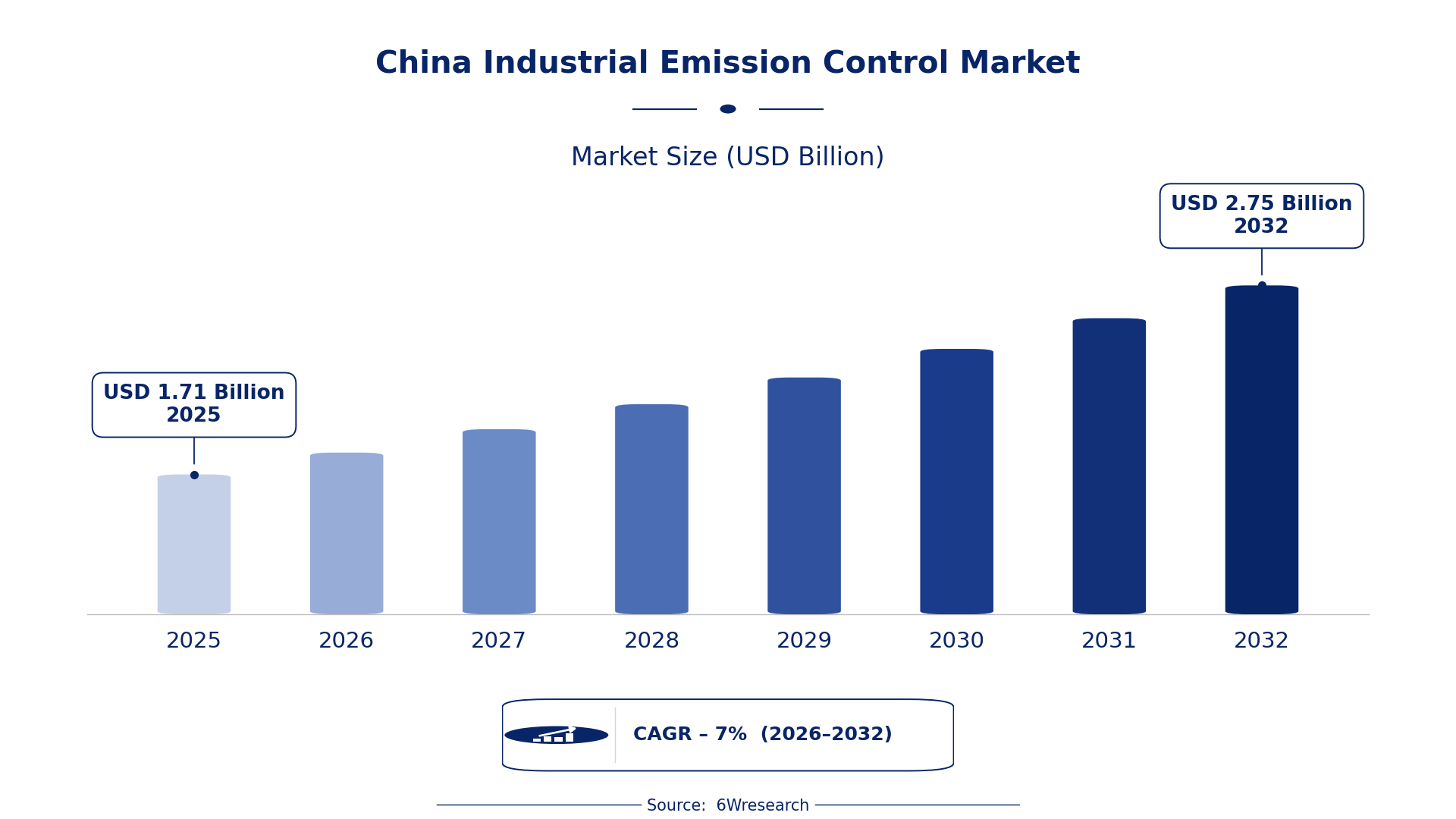
According to 6Wresearch internal database and industry insights, the China Industrial Emission Control Market was valued at USD 1.71 billion in 2025 and is projected to reach USD 2.75 billion by 2032, growing at a CAGR of approximately 7% during 2026–2032.
China Industrial Emission Control Market Highlights
| Report Metric | Details |
| Report Name | China Industrial Emission Control Market |
| Market Size 2025 | USD 1.71 billion |
| Market Size 2032 | USD 2.75 billion |
| Absolute Growth 2025–2032 | USD 1.04 billion |
| CAGR 2026–2032 | 7% |
| Peak Annual Growth | 9.4% in 2032 |
| Forecast Period | 2026–2032 |
| Historical Data | 2022–2025 |
| Base Year | 2025 |
| Leading Control Technology, 2025 | Scrubbers (46% share) |
| Leading Pollutant Targeted, 2025 | SO₂ (42% share) |
| Leading Integration Location, 2025 | Stack-Mounted (47% share) |
| Leading End User, 2025 | Coal Power Plants (49% share) |
| Fastest-Growing Control Technology | Electrostatic Precipitators (8.4% CAGR) |
| Fastest-Growing Pollutant Targeted | VOCs (9.0% CAGR) |
| Fastest-Growing Integration Location | Flue Gas Systems (9.2% CAGR) |
| Fastest-Growing End User | Chemical Manufacturing (8.2% CAGR) |
| Growing Sector | Chemical Manufacturing |
| Key End Users | Coal Power Plants, Chemical Manufacturers, Metal Smelting Units, Incineration Plants |
China Industrial Emission Control Market Year-wise Growth Rate and Key Drivers (2022–2032)
This graph illustrates the annual growth rates of the market from 2022 to 2032, highlighting a steady upward trajectory and projected market expansion over the forecast period.
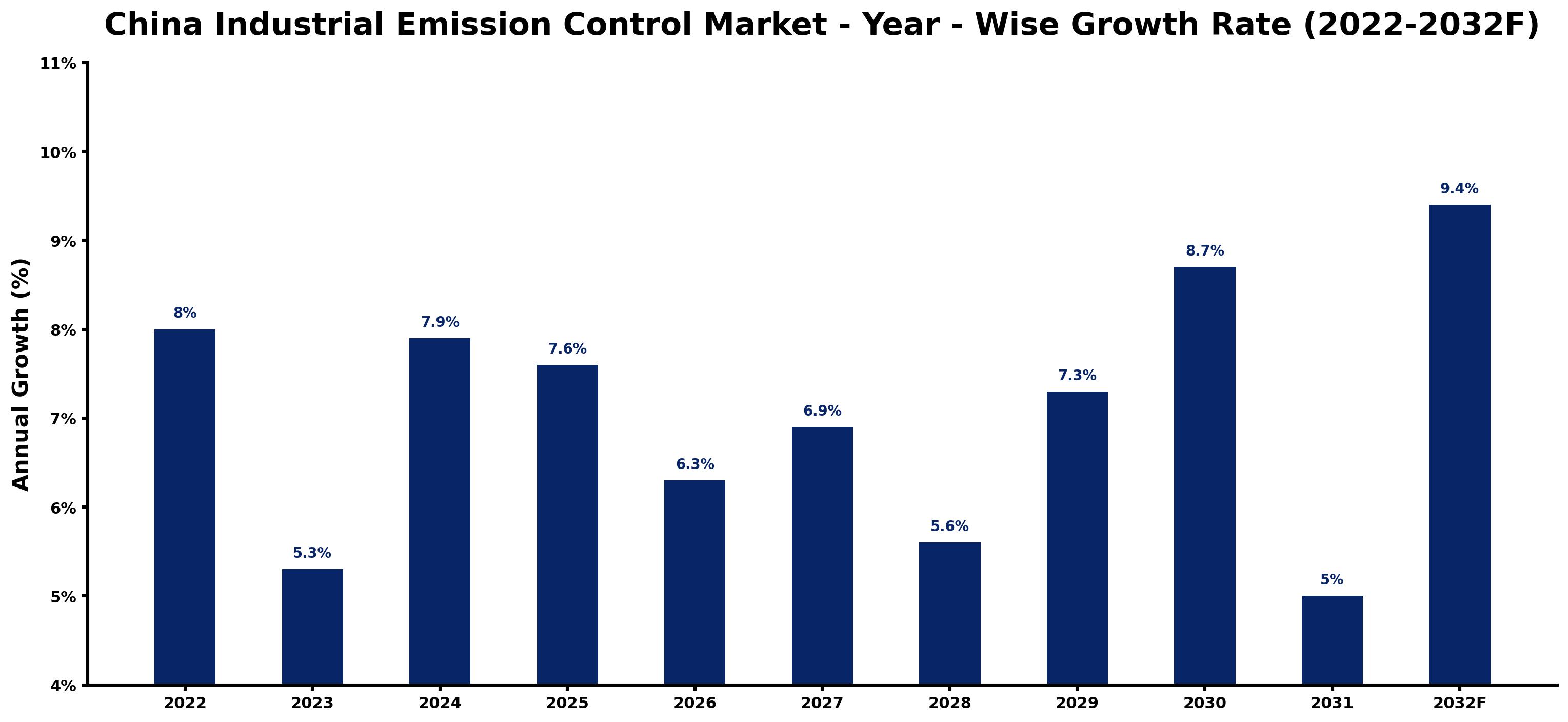
The following table presents the estimated annual growth rate for each year together with the principal factor influencing market performance.
| Year | Estimated Annual Growth (%) | Market Rationale |
| 2022 | 8.0 | The market exhibited strong growth due to heightened environmental regulations and investments in emission control technologies. |
| 2023 | 5.3 | Growth slowed as industries adjusted to the updated emission standards introduced by the Ministry of Ecology and Environment. |
| 2024 | 7.9 | Demand increased as companies adopted advanced emission control technologies to comply with stricter regulations. |
| 2025 | 7.6 | Growth moderated as the market reached a transitional phase in technology adoption and integration challenges. |
| 2026 | 6.3 | The market is expected to continue growing as companies face integration challenges with existing systems and seek compliance. |
| 2027 | 6.9 | Demand is projected to pick up as industries improve their emission control systems and compliance measures following regulatory updates. |
| 2028 | 5.6 | Growth is expected to slow again as market saturation begins to affect new investments in emission control technologies across various sectors. |
| 2029 | 7.3 | Demand will rise as companies seek to upgrade existing systems to meet stricter standards set by the updated regulations. |
| 2030 | 8.7 | Growth is projected to accelerate as new initiatives aimed at air quality improvement gain traction across various sectors. |
| 2031 | 5.0 | The market is expected to experience slower growth as companies consolidate their emission control strategies and technologies. |
| 2032 | 9.4 | Demand will surge as advanced technologies become mainstream, driven by regulatory pressures and compliance needs. |
Note: Market size estimations and growth projections presented in this report are based on 6Wresearch's proprietary forecasting methodology, utilizing the latest available industry data, government publications, and primary research inputs.
China Industrial Emission Control Market Synopsis
The China Industrial Emission Control Market centres on technologies that minimise harmful pollutants from industrial processes. These technologies play a crucial role in filtering gases and particulates from power plants and manufacturing facilities.
Market Dynamics Impact Analysis (2026–2032)
| Factor | Type | Impact | Primary Segment Affected |
| Increased investment in pollution control technologies | Driver | High | Electrostatic Precipitators |
| Growing regulatory pressure for emission reductions | Driver | High | Scrubbers |
| Expansion of chemical manufacturing facilities | Opportunity | High | Chemical Manufacturing |
| Need for compliance with air quality standards | Opportunity | High | Coal Power Plants |
| High initial investment costs for emission control systems | Restraint | High | Catalytic Converters |
| Complex integration of new technologies into existing systems | Restraint | Medium | Activated Carbon Filters |
| Limited availability of skilled workforce for installation and maintenance | Challenge | High | Scrubbers |
| Technological advancements outpacing regulatory updates | Challenge | Medium | Electrostatic Precipitators |
Evaluation of Drivers in China Industrial Emission Control Market (2026–2032)
The factors lifting demand, and the evidence behind each, are summarised below.
| Drivers | Primary Segment Affected | Why It Matters (Evidence) |
| Increased investment in pollution control technologies | Electrostatic Precipitators | In 2023, China invested 50 billion CNY in improving air quality, resulting in higher demand for electrostatic precipitators. |
| Growing regulatory pressure for emission reductions | Scrubbers | New regulations mandate stricter emission limits, prompting coal power plants to adopt scrubbers for compliance. |
| Expansion of chemical manufacturing facilities | Chemical Manufacturing | As of 2023, the chemical manufacturing sector is rapidly growing, increasing the need for emission control technologies to meet regulations. |
| Rising population leading to higher industrial output | Coal Power Plants | With a population of approximately 1.4 billion, demand for energy drives investments in coal power plants and their emission controls. |
| Technological advancements in emission control systems | Catalytic Converters | New catalytic converter technologies are being developed to meet evolving environmental standards, boosting market demand for compliance. |
The Industrial Emission Control market in China is expanding as investment in pollution control technologies, regulatory requirements for emission reductions, and the growth of the chemical manufacturing sector drive demand. In 2023, China allocated 50 billion CNY to improve air quality, which has led to increased adoption of electrostatic precipitators across various industries. Stricter emission limits mandated by new regulations are prompting coal power plants to implement scrubbers to meet compliance standards. The chemical manufacturing sector is rapidly expanding, increasing the need for advanced emission control technologies to adhere to environmental regulations. With a population of approximately 1.4 billion, the demand for energy continues to drive investments in coal power plants and their emission control systems.
Evaluation of Restraints in China Industrial Emission Control Market
The key brakes on demand, and where they bite hardest, are shown below.
| Market Restraint | Primary Segment Affected | Why It Matters (Evidence) |
| High operational costs associated with compliance measures | Scrubbers | Compliance with the National Standard GB 13223-2011 increases operational expenses by up to 20% for coal power plants. |
| Delays in project approvals due to regulatory scrutiny | Electrostatic Precipitators | Strict regulations from the Ministry of Ecology and Environment can extend project timelines by up to six months for manufacturers. |
| Limited availability of advanced technologies for emission control | Catalytic Converters | Some producers struggle to implement modern systems, risking fines for non-compliance. |
| Increased competition leading to pricing pressures | Activated Carbon Filters | Local firms prioritising R&D over production create delays for buyers seeking new technologies. |
| Challenges in integrating new technologies into existing systems | Flue Gas Systems | Producers face difficulties in adopting advanced emission control technologies, impacting their market position. |
China Industrial Emission Control Market Challenges
Strict regulations from the Ministry of Ecology and Environment create supply challenges for producers in the China Industrial Emission Control market. These regulations can delay project approvals, extending timelines by up to six months for manufacturers. Rising costs arise as companies invest heavily in compliance with the National Standard GB 13223-2011, increasing operational expenses by as much as 20%. Competition escalates as local firms prioritise R&D over production, resulting in delays for buyers seeking new technologies. Technology integration poses difficulties, with some producers unable to implement modern systems, risking fines for non-compliance and impacting their market position.
Trends in the China Industrial Emission Control Market
Buyers and suppliers in the China Industrial Emission Control Market are adjusting to the following trends.
- Shift from Traditional to Advanced Emission Control Technologies: Since 2021, industries in Hebei province have increasingly adopted advanced electrostatic precipitators, with a total installed capacity reaching 200 GW in 2023. This shift indicates a growing preference for more efficient systems that meet regulatory standards.
- Transition from Coal to Cleaner Energy Sources: In 2022, coal power plants in Jiangsu began integrating activated carbon filters, reflecting a broader trend towards cleaner energy solutions. This change is essential for meeting the Clean Air Action Plan targets for air quality.
- Emergence of Updated Emission Standards: The introduction of the updated 'Emission Standards for Air Pollutants' in 2023 has prompted many facilities to upgrade their emission control systems. Stricter limits on NOx and SO₂ emissions are reshaping industry compliance practices.
- Increased Focus on VOC Control in Chemical Manufacturing: Since 2021, chemical manufacturing sectors have prioritised the implementation of activated carbon filters for VOC control, driven by rising environmental awareness and the need for regulatory compliance.
Investment Opportunities in the China Industrial Emission Control Market
Some of the investment opportunities in the China Industrial Emission Control Market are mentioned below.
- Hebei Province's Industrial Growth: Hebei province is experiencing rapid industrial growth, creating a demand gap for advanced emission control technologies. The need for compliance with new standards presents an opportunity for suppliers to provide innovative solutions.
- Supply of Advanced Electrostatic Precipitators: With the total installed capacity reaching 200 GW in 2023, there is a growing need for advanced electrostatic precipitators. Suppliers can enter the market by collaborating with local manufacturers to meet demand.
- Investment in Chemical Manufacturing Facilities: The chemical manufacturing sector is expanding, with a projected investment of 50 billion CNY in emission control technologies. This presents opportunities for suppliers to offer tailored solutions that align with industry needs.
- Coal Power Plants Upgrading Emission Controls: Coal power plants are under pressure to upgrade their emission control systems to meet stricter standards, creating a demand for new technologies and solutions that enhance compliance.
Government Initiatives in the China Industrial Emission Control Market
The 'Air Pollution Prevention and Control Action Plan' launched in 2021 by the Ministry of Ecology and Environment aims to improve emission control measures across various industries. This plan sets ambitious targets for reducing air pollutants and mandates the adoption of advanced technologies to ensure compliance. The 'Green Development Action Plan' initiated by the National Development and Reform Commission in 2022 focuses on reducing industrial emissions by 30% by 2030, encouraging industries to invest in cleaner technologies and operational efficiencies. The updated 'Emission Standards for Air Pollutants' in 2023 introduced stricter limits on NOx and SO₂ emissions, further tightening regulations for industrial sources.
The National Energy Administration promotes the use of advanced emission control technologies in new power plants, providing funding for research and development projects. The Ministry of Industry and Information Technology supports the development of green manufacturing standards, ensuring that industries comply with environmental regulations while maintaining competitiveness. These agencies play a crucial role in approving projects and allocating resources for emission control upgrades, facilitating compliance and technological advancements in the sector.
Future Insight of the China Industrial Emission Control Market
The China Industrial Emission Control market is set for substantial advancements by 2032, driven by the National Energy Administration's push for advanced technologies in power plants. The Clean Air Action Plan aims to cut PM2.5 levels by 20% by 2025, prompting further investments in emission control solutions. With activated carbon production expected to reach 2 million tons annually, suppliers will enhance their capabilities for managing pollutants effectively. Support for green manufacturing standards will encourage the adoption of cleaner technologies, presenting new opportunities for both buyers and suppliers.
Market Segmentation Analysis
Each segment group is reviewed below, with the leader by share and the fastest grower by CAGR.
By Control Technology – Scrubbers Dominated, Electrostatic Precipitators Expected to Grow Fastest
According to Sachin Kumar Rai, Senior Research Analyst at 6Wresearch, Scrubbers took a 46% share of control technology in 2025, more than any other category. Scrubbers hold the largest market share due to their critical function in coal power plants, which are essential for meeting stringent emission standards. The reliance on scrubbers is underscored by the presence of over 1,000 operational coal power plants in China, necessitating effective pollutant removal. Electrostatic Precipitators are projected to grow fastest, at a CAGR of 8.4% during 2026–2032. Electrostatic precipitators are experiencing rapid growth, especially in the steel manufacturing sector in Hebei province, where their efficiency in removing particulate matter is highly valued. The total installed capacity of electrostatic precipitators reached 200 GW in 2023, showcasing their increasing adoption in the market. Suppliers should focus on enhancing scrubber technologies while also expanding their electrostatic precipitator solutions to meet the growing market demand.
By Pollutant Targeted – SO₂ Dominated, VOCs Expected to Grow Fastest
With a 42% revenue share in 2025, SO₂ was the largest pollutant targeted category. SO₂ captures the largest market share as it is a primary target for reduction in coal-fired power plants, which significantly contribute to air pollution in China. The enforcement of the National Standard GB 13223-2011, which sets strict emission limits, drives the demand for SO₂ control technologies. The quickest growth will come from VOCs, forecast to expand at a CAGR of 9.0% between 2026 and 2032. VOCs are experiencing the fastest growth due to stringent regulations in the chemical manufacturing sector, where effective management of volatile organic compounds is essential. The Clean Air Action Plan's goal to reduce PM2.5 levels by 20% by 2025 highlights the urgent need for effective VOC control solutions. Buyers in the chemical manufacturing sector must prioritise VOC control technologies to comply with increasingly rigorous environmental regulations.
By Integration Location – Stack-Mounted Dominated, Flue Gas Systems Expected to Grow Fastest
Stack-Mounted accounted for a 47% market share by integration location in 2025. Stack-mounted systems lead the market share as they are commonly used for emission control in industrial stacks, providing a straightforward solution for many facilities. Their integration into existing infrastructure allows for effective pollutant management without extensive modifications. Flue Gas Systems are set to record the highest CAGR in this split, 9.2% over 2026–2032. Flue gas systems are rapidly gaining traction as they offer integrated solutions for effective treatment of emissions directly within exhaust systems. This trend aligns with the push for advanced emission control technologies in new power plants as promoted by the National Energy Administration. Suppliers should consider developing flue gas systems to cater to the increasing demand for integrated emission control solutions.
By End User – Coal Power Plants Dominated, Chemical Manufacturing Expected to Grow Fastest
In 2025, Coal Power Plants led the end user split with a 49% share. Coal power plants represent the largest market share as they are the primary users of emission control technologies necessary for regulatory compliance. The extensive number of coal power plants in operation in China creates a continuous demand for effective emission control solutions. Over 2026–2032, Chemical Manufacturing is expected to post the fastest growth, at a CAGR of 8.2%. Chemical manufacturing is experiencing the fastest growth in demand for emission control technologies as companies strive to meet rigorous environmental standards. Ongoing investments in pollution control technologies reflect the critical need for compliance within this sector. Suppliers must adapt their products to meet the specific requirements of the chemical manufacturing sector to seize this growth opportunity.
Key Attractiveness of the Report
- 10 Years of Market Numbers
- Historical Data Starting from 2022 to 2025
- Base Year 2025
- Forecast Data until 2032
- Key Performance Indicators Impacting the Market
- Major Upcoming Developments and Projects
Key Highlights of the Report:
- China Industrial Emission Control Market Outlook
- Market Size of China Industrial Emission Control Market, 2025
- Forecast of China Industrial Emission Control Market, 2032
- Historical Data and Forecast of China Industrial Emission Control Revenues & Volume for the Period 2022 - 2032F
- China Industrial Emission Control Market Trend Evolution
- China Industrial Emission Control Market Drivers and Challenges
- China Industrial Emission Control Price Trends
- China Industrial Emission Control Porter's Five Forces
- China Industrial Emission Control Industry Life Cycle
- Historical Data and Forecast of China Industrial Emission Control Market Revenues & Volume By Control Technology for the Period 2022 - 2032F
- Historical Data and Forecast of China Industrial Emission Control Market Revenues & Volume By Scrubbers for the Period 2022 - 2032F
- Historical Data and Forecast of China Industrial Emission Control Market Revenues & Volume By Electrostatic Precipitators for the Period 2022 - 2032F
- Historical Data and Forecast of China Industrial Emission Control Market Revenues & Volume By Catalytic Converters for the Period 2022 - 2032F
- Historical Data and Forecast of China Industrial Emission Control Market Revenues & Volume By Activated Carbon Filters for the Period 2022 - 2032F
- Historical Data and Forecast of China Industrial Emission Control Market Revenues & Volume By Pollutant Targeted for the Period 2022 - 2032F
- Historical Data and Forecast of China Industrial Emission Control Market Revenues & Volume By SO , Particulates for the Period 2022 - 2032F
- Historical Data and Forecast of China Industrial Emission Control Market Revenues & Volume By Dust/Fine Ash for the Period 2022 - 2032F
- Historical Data and Forecast of China Industrial Emission Control Market Revenues & Volume By NOx, VOCs for the Period 2022 - 2032F
- Historical Data and Forecast of China Industrial Emission Control Market Revenues & Volume By Mercury, Dioxins for the Period 2022 - 2032F
- Historical Data and Forecast of China Industrial Emission Control Market Revenues & Volume By Integration Location for the Period 2022 - 2032F
- Historical Data and Forecast of China Industrial Emission Control Market Revenues & Volume By Stack-Mounted for the Period 2022 - 2032F
- Historical Data and Forecast of China Industrial Emission Control Market Revenues & Volume By Flue Gas Systems for the Period 2022 - 2032F
- Historical Data and Forecast of China Industrial Emission Control Market Revenues & Volume By Process Outlets for the Period 2022 - 2032F
- Historical Data and Forecast of China Industrial Emission Control Market Revenues & Volume By Inline/End-of-Line for the Period 2022 - 2032F
- Historical Data and Forecast of China Industrial Emission Control Market Revenues & Volume By End User for the Period 2022 - 2032F
- Historical Data and Forecast of China Industrial Emission Control Market Revenues & Volume By Coal Power Plants for the Period 2022 - 2032F
- Historical Data and Forecast of China Industrial Emission Control Market Revenues & Volume By Metal Smelting Units for the Period 2022 - 2032F
- Historical Data and Forecast of China Industrial Emission Control Market Revenues & Volume By Chemical Manufacturing for the Period 2022 - 2032F
- Historical Data and Forecast of China Industrial Emission Control Market Revenues & Volume By Incineration Plants for the Period 2022 - 2032F
- China Industrial Emission Control Import Export Trade Statistics
- Market Opportunity Assessment By Control Technology
- Market Opportunity Assessment By Pollutant Targeted
- Market Opportunity Assessment By Integration Location
- Market Opportunity Assessment By End User
- China Industrial Emission Control Top Companies Market Share
- China Industrial Emission Control Competitive Benchmarking By Technical and Operational Parameters
- China Industrial Emission Control Company Profiles
- China Industrial Emission Control Key Strategic Recommendations
Market Covered
The report offers an extensive study of the following market segments.
By Control Technology
- Scrubbers
- Electrostatic Precipitators
- Catalytic Converters
- Activated Carbon Filters
By Pollutant Targeted
- SO₂
- Particulates
- Dust/Fine Ash
- NOx
- VOCs
- Mercury
- Dioxins
By Integration Location
- Stack-Mounted
- Flue Gas Systems
- Process Outlets
- Inline/End-of-Line
By End User
- Coal Power Plants
- Metal Smelting Units
- Chemical Manufacturing
- Incineration Plants































