India Industrial Emission Control Market Size & Growth Rate
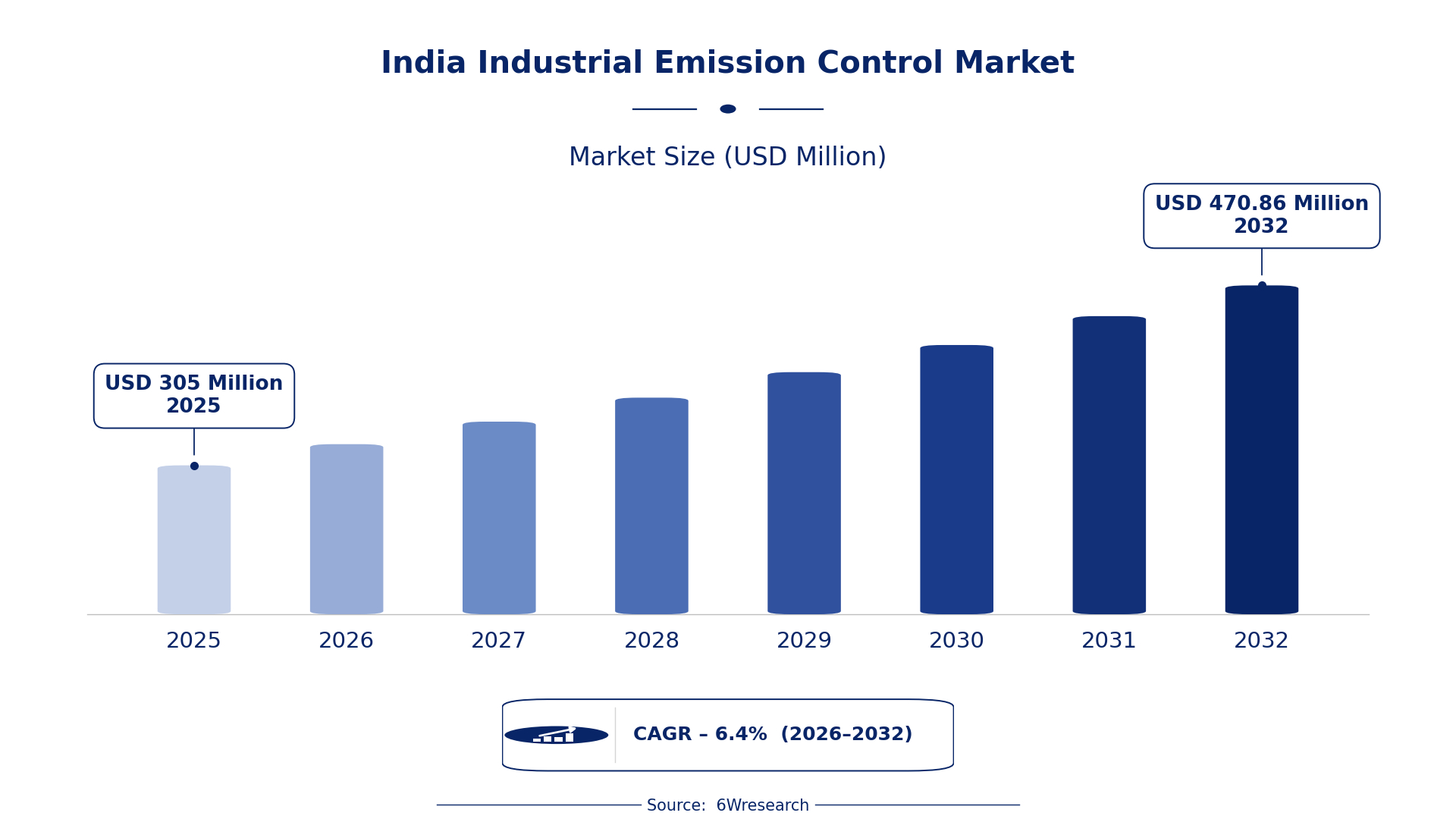
According to 6Wresearch internal database and industry insights, the India Industrial Emission Control Market was valued at USD 305.0 million in 2025 and is projected to reach USD 470.86 million by 2032, growing at a CAGR of approximately 6.4% during 2026–2032.
India Industrial Emission Control Market Highlights
| Report Metric | Details |
| Report Name | India Industrial Emission Control Market |
| Market Size 2025 | USD 305.0 million |
| Market Size 2032 | USD 470.86 million |
| Absolute Growth 2025–2032 | USD 165.86 million |
| CAGR 2026–2032 | 6.4% |
| Peak Annual Growth | 8.9% in 2031 |
| Forecast Period | 2026–2032 |
| Historical Data | 2022–2025 |
| Base Year | 2025 |
| Leading Control Technology, 2025 | Scrubbers (50% share) |
| Leading Pollutant Targeted, 2025 | SO₂ (39% share) |
| Leading Integration Location, 2025 | Stack-Mounted (54% share) |
| Leading End User, 2025 | Coal Power Plants (38% share) |
| Fastest-Growing Control Technology | Electrostatic Precipitators (7.5% CAGR) |
| Fastest-Growing Pollutant Targeted | Particulates (9.0% CAGR) |
| Fastest-Growing Integration Location | Flue Gas Systems (7.8% CAGR) |
| Fastest-Growing End User | Metal Smelting Units (8.5% CAGR) |
| Growing Sector | Coal Power Plants |
| Key End Users | Coal Power Plants, Chemical Manufacturing, Metal Smelting Units, Incineration Plants |
India Industrial Emission Control Market Year-wise Growth Rate and Key Drivers (2022–2032)
This graph illustrates the annual growth rates of the market from 2022 to 2032, highlighting a steady upward trajectory and projected market expansion over the forecast period.
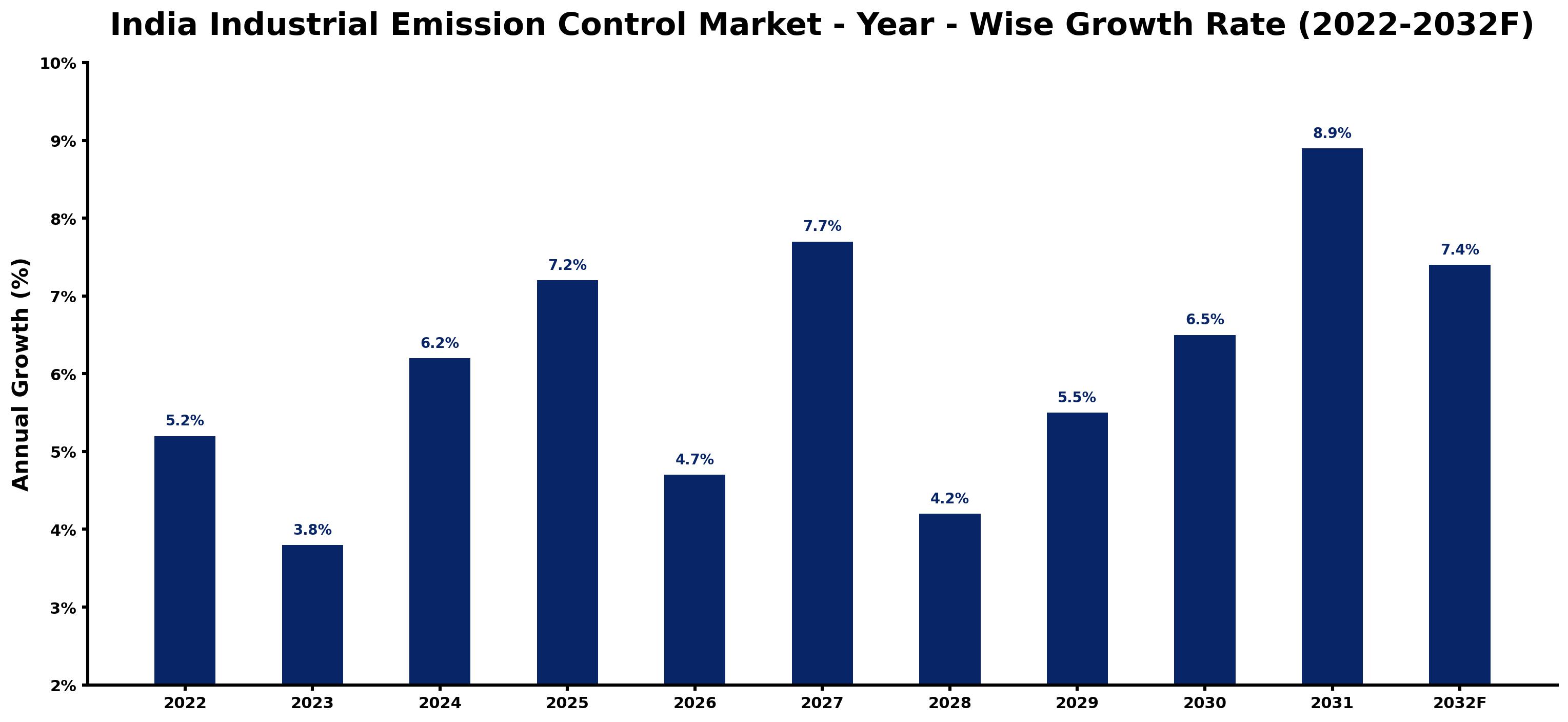
Below, each year's estimated growth is shown next to the factor that most influenced it.
| Year | Estimated Annual Growth (%) | Market Rationale |
| 2022 | 5.2 | The market experienced steady growth with increasing regulatory pressures from the Ministry of Environment, Forest and Climate Change. |
| 2023 | 3.8 | Growth slowed due to temporary setbacks in industrial production and emissions reporting requirements. |
| 2024 | 6.2 | Demand increased as industries ramped up compliance efforts with the National Clean Air Programme. |
| 2025 | 7.2 | The market peaked due to substantial investments in emission control technologies by coal power plants. |
| 2026 | 4.7 | Growth slowed as some sectors faced challenges in upgrading outdated emission control systems. |
| 2027 | 7.7 | Demand rose again as metal smelting units invested in advanced particulate capture technologies. |
| 2028 | 4.2 | Growth slowed as industries adjusted to new regulatory requirements and standards. |
| 2029 | 5.5 | Increased investments in emission control technologies drove demand higher once more. |
| 2030 | 6.5 | Growth continued as industries sought to improve compliance with environmental regulations. |
| 2031 | 8.9 | The market reached its peak growth as the National Clean Air Programme spurred investments in emission control technologies. |
| 2032 | 7.4 | Growth slowed as the market stabilised after rapid expansion in previous years. |
Note: Market size estimations and growth projections presented in this report are based on 6Wresearch's proprietary forecasting methodology, utilizing the latest available industry data, government publications, and primary research inputs.
India Industrial Emission Control Market Synopsis
The India Industrial Emission Control Market centres on technologies aimed at minimising pollutants from industrial operations. Systems such as scrubbers and electrostatic precipitators play a crucial role in meeting environmental regulations and safeguarding public health. The market is growing due to rigorous regulatory frameworks and heightened investments in pollution control technologies. Demand is particularly strong from sectors like coal power plants and chemical manufacturing, which are implementing advanced emission control systems to adhere to compliance standards and mitigate environmental impact.
Market Dynamics Impact Analysis (2026–2032)
| Factor | Type | Impact | Primary Segment Affected |
| Increasing regulatory compliance requirements drive demand for advanced emission control technologies. | Driver | High | Scrubbers |
| Growing investments in pollution control technologies enhance operational efficiency. | Driver | High | Electrostatic Precipitators |
| The need for upgrading outdated systems presents opportunities for new entrants. | Opportunity | High | Catalytic Converters |
| Rising awareness of environmental issues creates demand for innovative solutions. | Opportunity | Medium | Activated Carbon Filters |
| High initial investment costs can deter smaller manufacturers from upgrading systems. | Restraint | High | Coal Power Plants |
| Limited access to advanced technologies can hinder compliance efforts in some regions. | Restraint | Medium | Chemical Manufacturing |
| The challenge of integrating new technologies into existing systems can delay upgrades. | Challenge | High | Metal Smelting Units |
| Competition among suppliers can lead to price wars, affecting profitability. | Challenge | Medium | Incineration Plants |
Evaluation of Drivers in India Industrial Emission Control Market (2026–2032)
Below mentioned are some major drivers and their influence on market dynamics.
| Drivers | Primary Segment Affected | Why It Matters (Evidence) |
| Stringent emission regulations compel industries to adopt advanced technologies. | Scrubbers | In 2022, over 200 coal power plants required emission control technologies to comply with new standards. |
| Increased investments in pollution control systems improve operational efficiency. | Electrostatic Precipitators | In 2022, the Central Pollution Control Board reported a rise in NOx emissions, prompting upgrades across sectors. |
| Rising public health concerns motivate industries to adopt better emission controls. | Catalytic Converters | The National Clean Air Programme aims to reduce particulate matter by 20-30% by 2024. |
| Technological advancements in emission control systems create new market opportunities. | Activated Carbon Filters | Activated carbon filters are widely used in chemical manufacturing to control VOCs. |
| Government funding for pollution control upgrades supports market growth. | Flue Gas Systems | In 2023, the government allocated funds for upgrading pollution control systems in urban areas. |
Market growth for Industrial Emission Control in India is driven by escalating regulatory compliance, increasing public health concerns, and investments in pollution control technologies. In 2022, more than 200 coal power plants required emission control technologies to meet new standards, fuelling demand. The rise in NOx emissions has led to upgrades in electrostatic precipitators across multiple sectors. The National Clean Air Programme aims to cut particulate matter by 20-30% by 2024, prompting industries to adopt superior emission controls. Government funding for pollution control upgrades in urban areas further supports market growth, encouraging industries to invest in advanced systems.
Evaluation of Restraints in India Industrial Emission Control Market
The following restraints limit how fast demand can grow.
| Market Restraint | Primary Segment Affected | Why It Matters (Evidence) |
| High initial investment costs deter smaller manufacturers from upgrading systems. | Coal Power Plants | The financial burden can limit adoption of necessary technologies, with costs exceeding 30% of operational budgets. |
| Limited access to advanced technologies hinders compliance efforts in some regions. | Chemical Manufacturing | Some manufacturers struggle to source the latest emission control systems, affecting their compliance capabilities. |
| Integration challenges with existing systems can delay upgrades. | Metal Smelting Units | Older infrastructure complicates the implementation of new technologies, slowing down necessary upgrades. |
| Regulatory compliance can be complex and time-consuming for industries. | Incineration Plants | Navigating regulatory requirements can slow down necessary upgrades, impacting operational efficiency. |
| Market fragmentation leads to inconsistent technology adoption across sectors. | Electrostatic Precipitators | Smaller players may lack the resources to invest in advanced systems, limiting overall market growth. |
India Industrial Emission Control Market Challenges
Buyers in the India Industrial Emission Control market face immediate challenges from rising compliance costs, as the Ministry of Environment, Forest and Climate Change has tightened emission standards, resulting in increased expenses for industries. A shortage of skilled workers hampers the effective implementation of advanced emission control technologies, delaying project timelines and heightening operational risks for buyers. Outdated technology remains a pressing issue, hindering industries from achieving the National Clean Air Programme's goal of reducing particulate matter by 20-30% by 2024. Upgrading to modern emission control systems incurs substantial costs, with urban pollution control upgrades projected to exceed 30% of current operational budgets for many facilities.
Trends in the India Industrial Emission Control Market
Buyers and suppliers in the India Industrial Emission Control Market are adjusting to the following trends.
- Shift from Traditional to Advanced Emission Control Technologies: In 2023, the adoption of advanced emission control technologies increased, with a 50% share of scrubbers in the market. This shift is prompted by stricter regulations and the need for compliance.
- Emerging Focus on VOC Control in Chemical Manufacturing: The chemical manufacturing sector is increasingly prioritising VOC control, with activated carbon filters gaining traction. In 2022, VOC emissions prompted a rise in demand for these systems.
- Growing Investment in Pollution Control Upgrades: The Indian government allocated substantial funds for upgrading pollution control systems in urban areas in 2023. This investment is expected to improve compliance and reduce emissions.
- Increased Regulatory Scrutiny on Emissions: The National Clean Air Programme launched in 2021 has heightened scrutiny on emissions across industries. This initiative aims for a 20-30% reduction in particulate matter by 2024.
Investment Opportunities in the India Industrial Emission Control Market
Several openings in the India Industrial Emission Control Market merit attention from investors.
- Timing for Investment in Emission Control Technologies: With the National Clean Air Programme targeting a 20-30% reduction in particulate matter by 2024, there is a prime opportunity for investment in emission control technologies. Industries, especially coal power plants, are actively seeking advanced solutions.
- Gap in Compliance Technologies: As of 2023, numerous industries still require upgrades to meet emission standards, creating a market gap. Suppliers of advanced emission control systems can focus on coal power plants and chemical manufacturers.
- Partnerships for Technology Integration: Collaborating with local firms can ease entry into the emission control market. The growing demand for advanced systems presents opportunities for joint ventures and partnerships.
- Supply of Advanced Filtration Systems: The increasing need for effective filtration systems offers a chance for suppliers. With an emphasis on VOC control, activated carbon filters are sought after by chemical manufacturers.
Government Initiatives in the India Industrial Emission Control Market
The National Clean Air Programme (2021) aims to reduce particulate matter by 20-30% by 2024, urging industries to adopt advanced emission control technologies. This initiative builds on existing regulations by imposing stricter emission standards across various sectors, propelling compliance efforts among producers and buyers.
The Central Pollution Control Board supervises compliance and approves funding for pollution control upgrades. In 2023, the agency allocated substantial resources to support the implementation of advanced emission control systems across diverse sectors, enabling industries to meet regulatory requirements and enhance their operational efficiency.
Future Insight of the India Industrial Emission Control Market
The India Industrial Emission Control market will experience substantial changes by 2032, driven by regulatory advancements and technological progress. The National Clean Air Programme will continue to encourage industries to adopt more efficient emission control systems, while the ISO 14001 standard will promote improved environmental management practices. Government funding for upgrading pollution control systems in urban areas will stimulate investment in new technologies. By 2024, the anticipated reduction of particulate matter by 20-30% will contribute to a cleaner environment, benefiting public health and ensuring compliance for buyers.
Market Segmentation Analysis
The report offers a comprehensive study of the following market segments and their leading categories in the market.
By Control Technology – Scrubbers Dominated, Electrostatic Precipitators Expected to Grow Fastest
According to Sachin Kumar Rai, Senior Research Analyst at 6Wresearch, the largest control technology category in 2025 was Scrubbers, with a 50% share of total revenue. Scrubbers hold the largest share in the India Industrial Emission Control Market because they are extensively used in coal power plants, which are significant contributors to air pollution. Their capability to effectively remove pollutants from exhaust gases is essential for compliance with environmental regulations. The quickest growth will come from Electrostatic Precipitators, forecast to expand at a CAGR of 7.5% between 2026 and 2032. Electrostatic Precipitators are rapidly gaining traction as industries seek efficient methods for capturing particulate matter, particularly in metal smelting units. This growth is driven by increasing regulatory demands for improved air quality, which will further solidify the dominance of scrubbers in the market. Suppliers should focus on advancing scrubber technologies to meet the rising demand for effective emission control solutions.
By Pollutant Targeted – SO₂ Dominated, Particulates Expected to Grow Fastest
With a 39% revenue share in 2025, SO₂ was the largest pollutant targeted category. SO₂ is the leading pollutant targeted in India, largely due to its significant contribution to acid rain and stringent regulations governing its emissions. The national commitment to reducing SO₂ aligns with broader initiatives aimed at improving urban air quality. Particulates are set to record the highest CAGR in this split, 9.0% over 2026–2032. Particulates are the fastest-growing pollutant category as rising awareness of health impacts pushes industries to implement stricter controls. The National Clean Air Programme's goal of reducing particulate matter by 20-30% by 2024 serves as a major catalyst for this growth. Buyers must prioritise technologies that effectively mitigate SO₂ and particulate emissions to remain compliant with evolving regulations.
By Integration Location – Stack-Mounted Dominated, Flue Gas Systems Expected to Grow Fastest
Stack-Mounted held a 54% share of the India Industrial Emission Control Market by integration location in 2025. Stack-Mounted systems dominate the market as they represent the most common installation location for emission control technologies in coal power plants. Their efficiency in managing emissions directly from the source makes them a preferred choice across various industries. Flue Gas Systems are projected to grow fastest, at a CAGR of 7.8% during 2026–2032. Flue Gas Systems are experiencing rapid growth due to their critical role in managing emissions from combustion processes, especially within coal power and metal smelting sectors. As industries upgrade their facilities, the demand for integrated flue gas solutions is significantly on the rise. Suppliers should invest in developing flue gas systems to capture the increasing market share in emission control solutions.
By End User – Coal Power Plants Dominated, Metal Smelting Units Expected to Grow Fastest
Coal Power Plants took a 38% share of end user in 2025, more than any other category. Coal Power Plants account for the largest share of the market as they represent a major source of emissions requiring advanced control technologies. The ongoing operation of over 200 coal power plants in India ensures consistent demand for emission control solutions. Over 2026–2032, Metal Smelting Units are expected to post the fastest growth, at a CAGR of 8.5%. Metal Smelting Units are the fastest-growing end user segment due to their considerable emissions of various pollutants and the necessity for compliance with environmental regulations. The growth in industrial activity in this sector is driving the demand for effective emission control technologies. Buyers in the metal smelting sector should pursue tailored emission control solutions to meet regulatory standards and improve operational efficiency.
Key Attractiveness of the Report
- 10 Years of Market Numbers
- Historical Data Starting from 2022 to 2025
- Base Year 2025
- Forecast Data until 2032
- Key Performance Indicators Impacting the Market
- Major Upcoming Developments and Projects
Key Highlights of the Report:
- India Industrial Emission Control Market Outlook
- Market Size of India Industrial Emission Control Market, 2025
- Forecast of India Industrial Emission Control Market, 2032
- Historical Data and Forecast of India Industrial Emission Control Revenues & Volume for the Period 2022 - 2032F
- India Industrial Emission Control Market Trend Evolution
- India Industrial Emission Control Market Drivers and Challenges
- India Industrial Emission Control Price Trends
- India Industrial Emission Control Porter's Five Forces
- India Industrial Emission Control Industry Life Cycle
- Historical Data and Forecast of India Industrial Emission Control Market Revenues & Volume By Control Technology for the Period 2022 - 2032F
- Historical Data and Forecast of India Industrial Emission Control Market Revenues & Volume By Scrubbers for the Period 2022 - 2032F
- Historical Data and Forecast of India Industrial Emission Control Market Revenues & Volume By Electrostatic Precipitators for the Period 2022 - 2032F
- Historical Data and Forecast of India Industrial Emission Control Market Revenues & Volume By Catalytic Converters for the Period 2022 - 2032F
- Historical Data and Forecast of India Industrial Emission Control Market Revenues & Volume By Activated Carbon Filters for the Period 2022 - 2032F
- Historical Data and Forecast of India Industrial Emission Control Market Revenues & Volume By Pollutant Targeted for the Period 2022 - 2032F
- Historical Data and Forecast of India Industrial Emission Control Market Revenues & Volume By SO , Particulates for the Period 2022 - 2032F
- Historical Data and Forecast of India Industrial Emission Control Market Revenues & Volume By Dust/Fine Ash for the Period 2022 - 2032F
- Historical Data and Forecast of India Industrial Emission Control Market Revenues & Volume By NOx, VOCs for the Period 2022 - 2032F
- Historical Data and Forecast of India Industrial Emission Control Market Revenues & Volume By Mercury, Dioxins for the Period 2022 - 2032F
- Historical Data and Forecast of India Industrial Emission Control Market Revenues & Volume By Integration Location for the Period 2022 - 2032F
- Historical Data and Forecast of India Industrial Emission Control Market Revenues & Volume By Stack-Mounted for the Period 2022 - 2032F
- Historical Data and Forecast of India Industrial Emission Control Market Revenues & Volume By Flue Gas Systems for the Period 2022 - 2032F
- Historical Data and Forecast of India Industrial Emission Control Market Revenues & Volume By Process Outlets for the Period 2022 - 2032F
- Historical Data and Forecast of India Industrial Emission Control Market Revenues & Volume By Inline/End-of-Line for the Period 2022 - 2032F
- Historical Data and Forecast of India Industrial Emission Control Market Revenues & Volume By End User for the Period 2022 - 2032F
- Historical Data and Forecast of India Industrial Emission Control Market Revenues & Volume By Coal Power Plants for the Period 2022 - 2032F
- Historical Data and Forecast of India Industrial Emission Control Market Revenues & Volume By Metal Smelting Units for the Period 2022 - 2032F
- Historical Data and Forecast of India Industrial Emission Control Market Revenues & Volume By Chemical Manufacturing for the Period 2022 - 2032F
- Historical Data and Forecast of India Industrial Emission Control Market Revenues & Volume By Incineration Plants for the Period 2022 - 2032F
- India Industrial Emission Control Import Export Trade Statistics
- Market Opportunity Assessment By Control Technology
- Market Opportunity Assessment By Pollutant Targeted
- Market Opportunity Assessment By Integration Location
- Market Opportunity Assessment By End User
- India Industrial Emission Control Top Companies Market Share
- India Industrial Emission Control Competitive Benchmarking By Technical and Operational Parameters
- India Industrial Emission Control Company Profiles
- India Industrial Emission Control Key Strategic Recommendations
Market Covered
This report examines the market across the segments below.
By Control Technology
- Scrubbers
- Electrostatic Precipitators
- Catalytic Converters
- Activated Carbon Filters
By Pollutant Targeted
- SO₂
- Particulates
- Dust/Fine Ash
- NOx
- VOCs
- Mercury
- Dioxins
By Integration Location
- Stack-Mounted
- Flue Gas Systems
- Process Outlets
- Inline/End-of-Line
By End User
- Coal Power Plants
- Metal Smelting Units
- Chemical Manufacturing
- Incineration Plants































