China Industrial Process Additives Market Size & Growth Rate
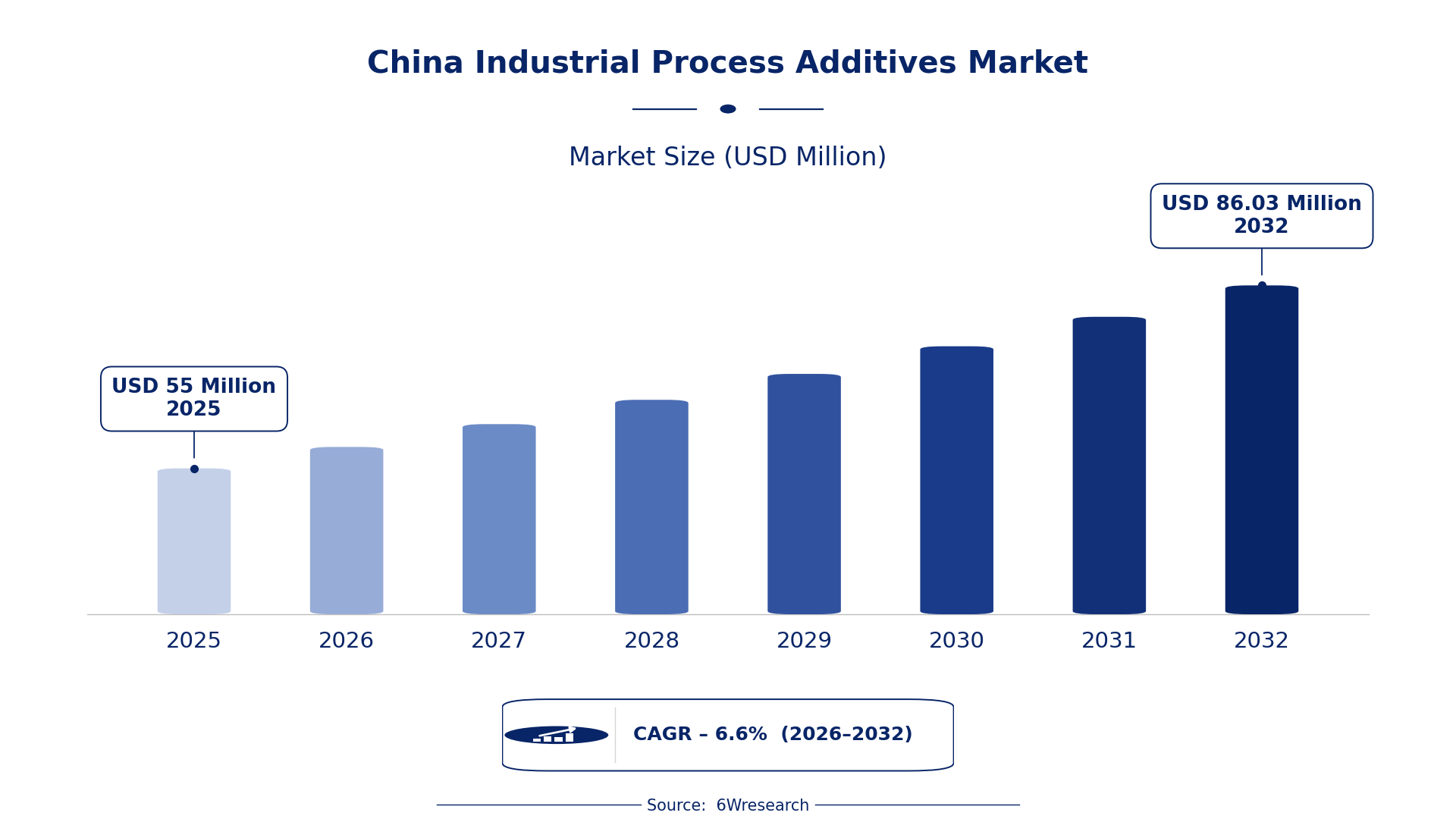
According to 6Wresearch internal database and industry insights, the China Industrial Process Additives Market was valued at USD 55.0 million in 2025 and is projected to reach USD 86.03 million by 2032, growing at a CAGR of approximately 6.6% during 2026–2032.
China Industrial Process Additives Market Highlights
| Report Metric | Details |
| Report Name | China Industrial Process Additives Market |
| Market Size 2025 | USD 55.0 million |
| Market Size 2032 | USD 86.03 million |
| Absolute Growth 2025–2032 | USD 31.03 million |
| CAGR 2026–2032 | 6.6% |
| Peak Annual Growth | 8.9% in 2032 |
| Forecast Period | 2026–2032 |
| Historical Data | 2022–2025 |
| Base Year | 2025 |
| Leading Additive Type, 2025 | Dispersing Agents (49% share) |
| Leading Function, 2025 | Foam Suppression (38% share) |
| Leading Physical Form, 2025 | Liquid (44% share) |
| Leading Application, 2025 | Paints & Coatings (41% share) |
| Leading End User Industry, 2025 | Manufacturing (54% share) |
| Fastest-Growing Function | Particle Distribution (9.0% CAGR) |
| Fastest-Growing Physical Form | Powder (8.8% CAGR) |
| Fastest-Growing Application | Water Treatment (9.2% CAGR) |
| Fastest-Growing End User Industry | Construction (8.1% CAGR) |
| Growing Sector | Manufacturing |
| Key End Users | Manufacturers, Automotive sector, Construction industry, Water treatment facilities |
China Industrial Process Additives Market Year-wise Growth Rate and Key Drivers (2022–2032)
This graph illustrates the annual growth rates of the market from 2022 to 2032, highlighting a steady upward trajectory and projected market expansion over the forecast period.
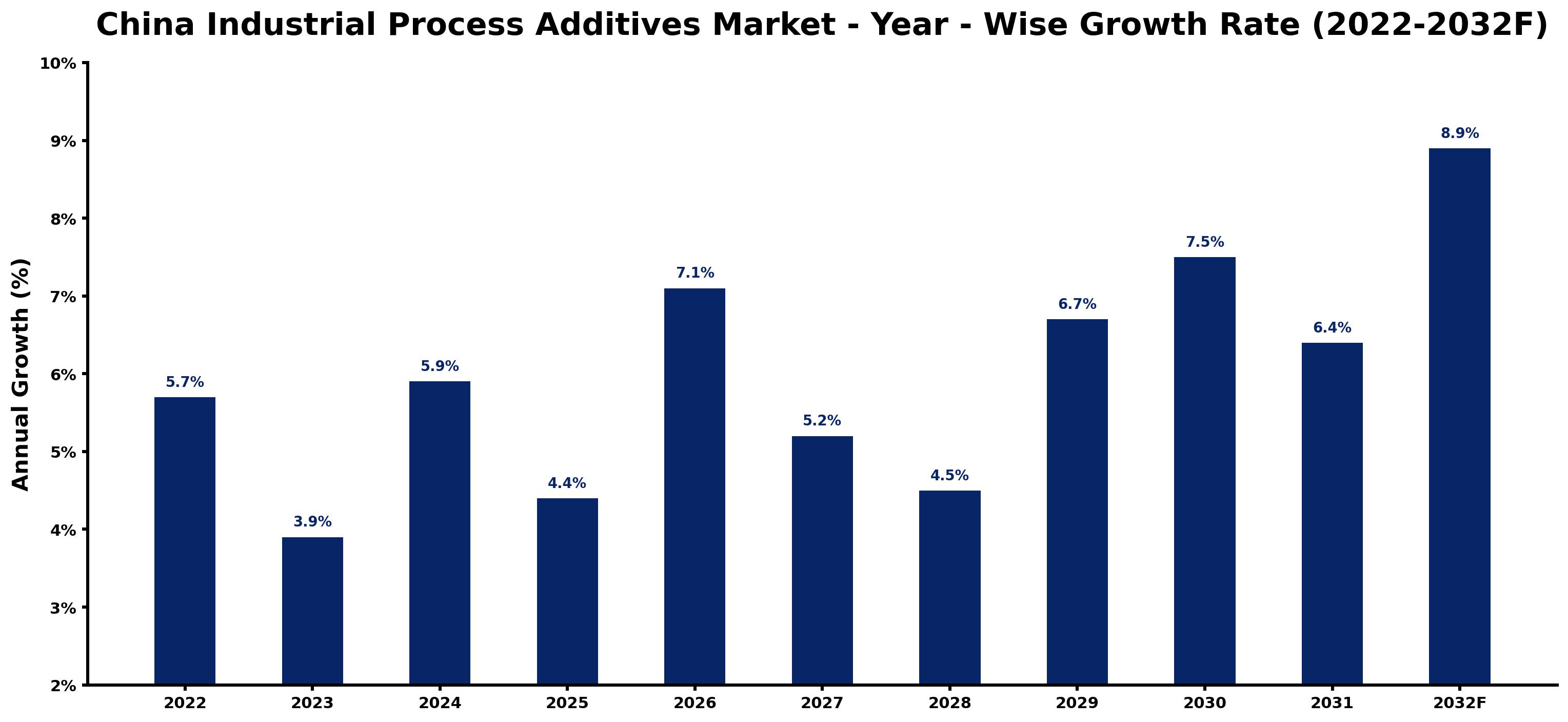
Annual growth estimates for each year appear below with the principal reason behind them, explaining the shifts that set the pace of the market.
| Year | Estimated Annual Growth (%) | Market Rationale |
| 2022 | 5.7 | The market experienced steady growth due to strong demand from the manufacturing sector. |
| 2023 | 3.9 | Growth slowed as manufacturers adjusted to rising costs and supply chain disruptions. |
| 2024 | 5.9 | Demand increased as the automotive sector sought improved fuel efficiency through additives. |
| 2025 | 4.4 | A slight slowdown occurred as the construction industry began adopting advanced additives. |
| 2026 | 7.1 | Growth accelerated with rising investments in eco-friendly additives across industries. |
| 2027 | 5.2 | Demand growth slowed as manufacturers faced challenges in sourcing raw materials. |
| 2028 | 4.5 | The market continued to grow, driven by the water treatment industry's expansion. |
| 2029 | 6.7 | A resurgence in demand was noted as construction projects ramped up. |
| 2030 | 7.5 | Growth remained strong as manufacturers focused on enhancing product performance. |
| 2031 | 6.4 | The market saw a slowdown as competition intensified among additive suppliers. |
| 2032 | 8.9 | Demand surged as the construction sector adopted new advanced additives. |
Note: Market size estimations and growth projections presented in this report are based on 6Wresearch's proprietary forecasting methodology, utilizing the latest available industry data, government publications, and primary research inputs.
China Industrial Process Additives Market Synopsis
Industrial Process Additives in China are chemical substances that improve the performance of industrial processes, primarily used in paints, coatings, and manufacturing. These additives enhance product quality and process efficiency, with the paints and coatings industry consuming approximately 1.5 million tons in 2022. The China Industrial Process Additives Market is expanding due to strong demand from domestic users and the manufacturing sector. Key drivers include the automotive industry's need for viscosity modifiers and the construction sector's adoption of advanced additives. Government initiatives to promote eco-friendly solutions further support this growth.
Market Dynamics Impact Analysis (2026–2032)
| Factor | Type | Impact | Primary Segment Affected |
| Strong demand from the manufacturing sector drives the need for various additives. | Driver | High | Manufacturing |
| The automotive industry's push for improved fuel efficiency increases the consumption of viscosity modifiers. | Driver | High | Automotive |
| The construction sector's shift towards advanced materials creates opportunities for innovative additives. | Opportunity | High | Construction |
| The water treatment industry's growth presents a significant demand for pH modifiers and dispersing agents. | Opportunity | Medium | Water Treatment |
| Rising raw material costs can limit the affordability of additives for manufacturers. | Restraint | High | Dispersing Agents |
| Stricter regulations on harmful additives may restrict certain formulations in the market. | Restraint | Medium | Dispersing Agents |
| Industrial Process Additives in China face challenges from fluctuating raw material availability. | Challenge | High | Dispersing Agents |
| Competition among suppliers can lead to price wars, affecting profitability for smaller manufacturers. | Challenge | Medium | Dispersing Agents |
Evaluation of Drivers in China Industrial Process Additives Market (2026–2032)
Below mentioned are some major drivers and their influence on market dynamics.
| Drivers | Primary Segment Affected | Why It Matters (Evidence) |
| Increased investment in manufacturing capabilities boosts demand for industrial process additives. | Manufacturing | In 2022, the manufacturing sector consumed approximately 1.5 million tons of additives, improving product quality. |
| The automotive sector's focus on fuel efficiency drives the need for viscosity modifiers. | Automotive | In 2022, demand for viscosity modifiers surged as automotive manufacturers sought to improve fuel efficiency. |
| The construction industry's adoption of advanced materials increases the use of industrial additives. | Construction | By 2025, the construction industry will implement advanced additives to improve material performance. |
| The growth of the water treatment sector leads to higher demand for pH modifiers and dispersing agents. | Water Treatment | As the water treatment industry expands, the need for effective additives rises significantly. |
| The push for eco-friendly solutions in manufacturing drives the adoption of sustainable additives. | Manufacturing | The Ministry of Ecology and Environment's 2021 programme promotes eco-friendly additives, shaping market dynamics. |
Growth across the Industrial Process Additives market in China is anchored in rising investments in manufacturing capabilities, expanding automotive requirements, and the construction sector's shift towards advanced materials. In 2022, the manufacturing sector consumed approximately 1.5 million tons of additives, improving product quality. The automotive sector's focus on fuel efficiency drives the need for viscosity modifiers, with demand increasing significantly. By 2025, the construction industry will implement advanced additives to improve material performance, further boosting demand. As the water treatment industry expands, the need for effective pH modifiers and dispersing agents rises sharply.
Evaluation of Restraints in China Industrial Process Additives Market
The key brakes on demand, and where they bite hardest, are shown below.
| Market Restraint | Primary Segment Affected | Why It Matters (Evidence) |
| Fluctuating raw material costs can limit the affordability of additives for manufacturers. | Dispersing Agents | In 2022, rising costs impacted the pricing strategies of various manufacturers, affecting profitability. |
| Stricter regulations on harmful additives may restrict certain formulations in the market. | Dispersing Agents | The updated Pollution Prevention and Control Action Plan in 2022 enforced stricter compliance, limiting options. |
| Supply chain disruptions can delay the availability of essential additives for production. | Dispersing Agents | Manufacturers faced challenges in sourcing materials during recent disruptions, impacting production timelines. |
| Intense competition among suppliers can lead to price wars, affecting profitability for smaller manufacturers. | Dispersing Agents | Increased competition has resulted in price reductions, impacting smaller players and their market viability. |
| Limited awareness of eco-friendly additives may hinder market growth in certain sectors. | Manufacturing | Some manufacturers remain hesitant to adopt new formulations despite government incentives promoting sustainability. |
China Industrial Process Additives Market Challenges
The China Industrial Process Additives Market faces strict regulations from the Ministry of Ecology and Environment, which can delay product approvals by up to six months and increase compliance costs for producers. Intense competition among local manufacturers leads to price wars, reducing profit margins and limiting financial stability for suppliers. Raw material costs have risen by 15% in the past year, impacting pricing strategies for distributors and forcing them to increase prices for buyers. A lack of skilled professionals in advanced formulation techniques restricts innovation, hampering producers' ability to create competitive products.
Trends in the China Industrial Process Additives Market
The trends below show where the China Industrial Process Additives Market is heading.
- Shift in Construction Practices: Construction companies are increasingly adopting advanced materials to improve performance, driven by sustainability needs. By 2025, the construction industry will implement advanced additives to enhance material quality, reflecting a growing trend towards innovation.
- Emergence of Eco-Friendly Additives: The Ministry of Ecology and Environment's 2021 initiative promotes the use of environmentally friendly additives, aiming for a 20% increase in adoption by 2025. This shift is reshaping the market, encouraging manufacturers to invest in sustainable solutions.
- Increased Focus on Water Treatment: The water treatment industry is expanding its use of pH modifiers and dispersing agents to improve treatment processes. This trend will grow as the demand for efficient water treatment solutions rises, enhancing operational effectiveness.
- Adoption of Quality Standards: ISO 9001 has become a widely adopted quality management standard among manufacturers using industrial process additives in China. This trend ensures that products meet high-quality benchmarks, improving market competitiveness and consumer trust.
Investment Opportunities in the China Industrial Process Additives Market
Several openings in the China Industrial Process Additives Market merit attention from investors.
- Growing Demand from Manufacturing: Manufacturers are increasingly seeking advanced additives to improve product quality, with the market for these additives projected to reach USD 55.0 million by 2025. Collaborating with local manufacturers can facilitate market entry and enhance distribution.
- Expansion in Water Treatment Facilities: The water treatment sector is set to grow, creating a demand for pH modifiers and dispersing agents. Investing in production facilities in regions with high water treatment needs can yield substantial returns and meet market demand.
- Construction Sector Growth: With the construction industry expected to adopt advanced additives, there is a notable gap in supply. Investing in additive production tailored for construction can effectively meet this demand and strengthen market position.
- Eco-Friendly Additives Market: The shift towards eco-friendly additives presents an opportunity for manufacturers to innovate. Partnering with local entities to develop sustainable solutions can strengthen market presence and align with regulatory trends.
Government Initiatives in the China Industrial Process Additives Market
In 2023, the Ministry of Science and Technology announced the 'Innovation in Chemical Additives Programme', aiming to boost R&D funding for sustainable additives by 300 million RMB. This initiative complements previous efforts, such as the 2021 'Green Manufacturing System', which promotes environmentally friendly additives, targeting a 20% increase in adoption by 2025. Together, these measures improve the regulatory framework, encouraging manufacturers to adopt sustainable practices and enhance compliance.
In 2023, the National Development and Reform Commission approved the '2023 Industrial Development Plan', which includes incentives for manufacturers adopting advanced process additives, with a budget of 500 million RMB. This plan aims to improve the efficiency of industrial processes, ensuring compliance with national standards. The State Administration for Market Regulation oversees the implementation of these incentives, ensuring that manufacturers adhere to quality benchmarks and can access funding for innovation.
Future Insight of the China Industrial Process Additives Market
The China Industrial Process Additives Market will undergo significant transformations by 2032, driven by the government's goal to cut industrial emissions by 30%, which will boost demand for eco-friendly solutions. The automotive sector will increasingly rely on viscosity modifiers to improve fuel efficiency, reflecting global sustainability efforts. By 2025, the construction industry will adopt advanced additives to enhance material performance, while the water treatment sector will see a growing need for pH modifiers and dispersing agents. These shifts will open new avenues for both buyers and suppliers.
Market Segmentation Analysis
Each segment group is reviewed below, with the leader by share and the fastest grower by CAGR.
By Additive Type – Dispersing Agents Dominated and Is Expected to Record the Fastest Growth
According to Sachin Kumar Rai, Senior Research Analyst at 6Wresearch, the largest additive type category in 2025 was Dispersing Agents, with a 49% share of total revenue. Dispersing agents lead the China Industrial Process Additives Market due to their critical role in ensuring uniform particle distribution in formulations. Their widespread application in the paints and coatings industry, which consumed approximately 1.5 million tons, reinforces their dominant market share. Dispersing Agents are also forecast to expand faster than any other category, at a CAGR of 8.1% over 2026–2032. The growth of dispersing agents is driven by their increasing use in the ceramics industry to enhance product quality and consistency. This trend, coupled with the rising demand for eco-friendly additives, will further solidify their market position. Suppliers should focus on developing dispersing agents to satisfy the growing demand across various industrial applications.
By Function – Foam Suppression Dominated, Particle Distribution Expected to Grow Fastest
Foam Suppression accounted for a 38% market share by function in 2025. Foam suppression leads the market as it is vital for reducing foam in production processes, ensuring operational efficiency. Its widespread application across various sectors contributes to its substantial market share. Particle Distribution is projected to grow fastest, at a CAGR of 9.0% during 2026–2032. While foam suppression is the market leader, particle distribution is rapidly gaining traction as manufacturers strive for consistency in their products. The growing importance of this function in diverse applications will drive its growth rate. Buyers should focus on suppliers that excel in foam suppression technologies to optimise production efficiency.
By Physical Form – Liquid Dominated, Powder Expected to Grow Fastest
With a 44% revenue share in 2025, Liquid was the largest physical form category. Liquid additives command the largest market share because they are easy to apply across various industries, making them the preferred choice for manufacturers. Their direct applicability in numerous processes strengthens their leading position in the market. The quickest growth will come from Powder, forecast to expand at a CAGR of 8.8% between 2026 and 2032. While liquid additives dominate, powder forms are gaining traction in specific applications due to their unique advantages. This shift suggests a diversification in user preferences that could reshape market dynamics. Suppliers should consider expanding their product lines to include powder forms to meet the evolving preferences of specific applications.
By Application – Paints & Coatings Dominated, Water Treatment Expected to Grow Fastest
Paints & Coatings took a 41% share of application in 2025, more than any other category. Paints and coatings serve as the largest application area for industrial process additives, significantly enhancing product quality. This robust demand ensures a substantial market share for additives used in these applications. Water Treatment is set to record the highest CAGR in this split, 9.2% over 2026–2032. Water treatment is emerging as the fastest-growing application, crucial for improving treatment processes as the industry expands. This growth reflects a broader trend towards environmental sustainability and efficiency in industrial practices. Buyers in the water treatment sector should seek suppliers that specialise in advanced additives to enhance their treatment processes.
By End User Industry – Manufacturing Dominated, Construction Expected to Grow Fastest
In 2025, Manufacturing led the end user industry split with a 54% share. The manufacturing sector is the largest consumer of industrial process additives, utilising them to improve product quality and process efficiency. This extensive usage across various manufacturing processes secures its leading market share. Over 2026–2032, Construction is expected to post the fastest growth, at a CAGR of 8.1%. The construction industry is rapidly becoming the fastest-growing end user, as advanced additives are increasingly adopted to enhance materials. This trend indicates a shift towards higher performance standards in construction. Suppliers should align their strategies to cater to the growing demands of the construction sector for advanced industrial process additives.
Key Attractiveness of the Report
- 10 Years of Market Numbers
- Historical Data Starting from 2022 to 2025
- Base Year 2025
- Forecast Data until 2032
- Key Performance Indicators Impacting the Market
- Major Upcoming Developments and Projects
Key Highlights of the Report:
- China Industrial Process Additives Market Outlook
- Market Size of China Industrial Process Additives Market, 2025
- Forecast of China Industrial Process Additives Market, 2032
- Historical Data and Forecast of China Industrial Process Additives Revenues & Volume for the Period 2022 - 2032F
- China Industrial Process Additives Market Trend Evolution
- China Industrial Process Additives Market Drivers and Challenges
- China Industrial Process Additives Price Trends
- China Industrial Process Additives Porter's Five Forces
- China Industrial Process Additives Industry Life Cycle
- Historical Data and Forecast of China Industrial Process Additives Market Revenues & Volume By Additive Type for the Period 2022 - 2032F
- Historical Data and Forecast of China Industrial Process Additives Market Revenues & Volume By Defoamers for the Period 2022 - 2032F
- Historical Data and Forecast of China Industrial Process Additives Market Revenues & Volume By Dispersing Agents for the Period 2022 - 2032F
- Historical Data and Forecast of China Industrial Process Additives Market Revenues & Volume By pH Modifiers for the Period 2022 - 2032F
- Historical Data and Forecast of China Industrial Process Additives Market Revenues & Volume By Viscosity Modifiers for the Period 2022 - 2032F
- Historical Data and Forecast of China Industrial Process Additives Market Revenues & Volume By Function for the Period 2022 - 2032F
- Historical Data and Forecast of China Industrial Process Additives Market Revenues & Volume By Foam Suppression for the Period 2022 - 2032F
- Historical Data and Forecast of China Industrial Process Additives Market Revenues & Volume By Particle Distribution for the Period 2022 - 2032F
- Historical Data and Forecast of China Industrial Process Additives Market Revenues & Volume By Acidity Control for the Period 2022 - 2032F
- Historical Data and Forecast of China Industrial Process Additives Market Revenues & Volume By Flow Control for the Period 2022 - 2032F
- Historical Data and Forecast of China Industrial Process Additives Market Revenues & Volume By Physical Form for the Period 2022 - 2032F
- Historical Data and Forecast of China Industrial Process Additives Market Revenues & Volume By Liquid for the Period 2022 - 2032F
- Historical Data and Forecast of China Industrial Process Additives Market Revenues & Volume By Powder for the Period 2022 - 2032F
- Historical Data and Forecast of China Industrial Process Additives Market Revenues & Volume By Liquid for the Period 2022 - 2032F
- Historical Data and Forecast of China Industrial Process Additives Market Revenues & Volume By Granules for the Period 2022 - 2032F
- Historical Data and Forecast of China Industrial Process Additives Market Revenues & Volume By Application for the Period 2022 - 2032F
- Historical Data and Forecast of China Industrial Process Additives Market Revenues & Volume By Paints & Coatings for the Period 2022 - 2032F
- Historical Data and Forecast of China Industrial Process Additives Market Revenues & Volume By Ceramics for the Period 2022 - 2032F
- Historical Data and Forecast of China Industrial Process Additives Market Revenues & Volume By Water Treatment for the Period 2022 - 2032F
- Historical Data and Forecast of China Industrial Process Additives Market Revenues & Volume By Lubricants for the Period 2022 - 2032F
- Historical Data and Forecast of China Industrial Process Additives Market Revenues & Volume By End User Industry for the Period 2022 - 2032F
- Historical Data and Forecast of China Industrial Process Additives Market Revenues & Volume By Automotive for the Period 2022 - 2032F
- Historical Data and Forecast of China Industrial Process Additives Market Revenues & Volume By Construction for the Period 2022 - 2032F
- Historical Data and Forecast of China Industrial Process Additives Market Revenues & Volume By Power Plants for the Period 2022 - 2032F
- Historical Data and Forecast of China Industrial Process Additives Market Revenues & Volume By Manufacturing for the Period 2022 - 2032F
- China Industrial Process Additives Import Export Trade Statistics
- Market Opportunity Assessment By Additive Type
- Market Opportunity Assessment By Function
- Market Opportunity Assessment By Physical Form
- Market Opportunity Assessment By Application
- Market Opportunity Assessment By End User Industry
- China Industrial Process Additives Top Companies Market Share
- China Industrial Process Additives Competitive Benchmarking By Technical and Operational Parameters
- China Industrial Process Additives Company Profiles
- China Industrial Process Additives Key Strategic Recommendations
Market Covered
This report examines the market across the segments below.
By Additive Type
- Defoamers
- Dispersing Agents
- pH Modifiers
- Viscosity Modifiers
By Function
- Foam Suppression
- Particle Distribution
- Acidity Control
- Flow Control
By Physical Form
- Liquid
- Powder
- Granules
By Application
- Paints & Coatings
- Ceramics
- Water Treatment
- Lubricants
By End User Industry
- Automotive
- Construction
- Power Plants
- Manufacturing































