China Industrial Simulation Market Size & Growth Rate
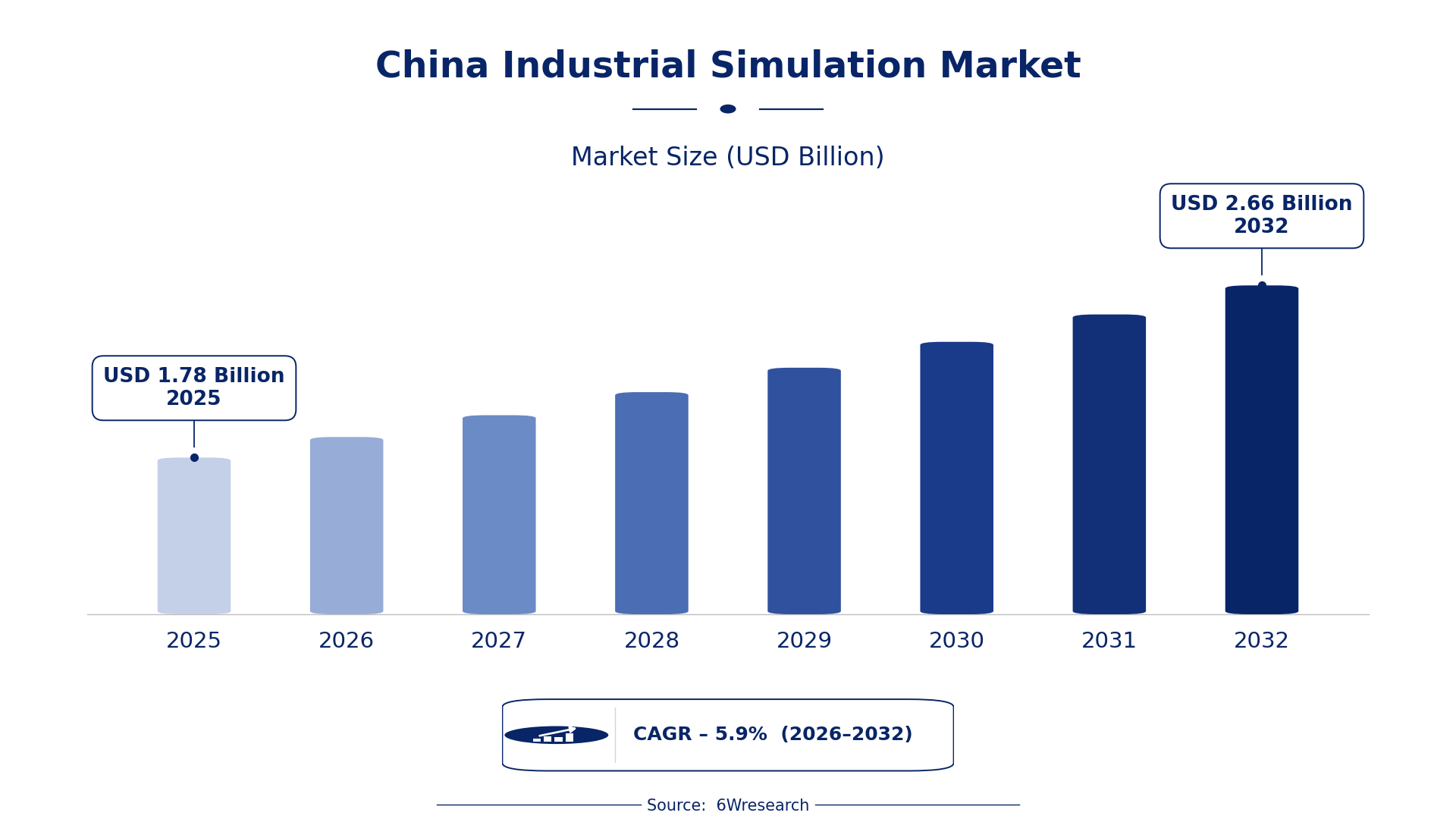
According to 6Wresearch internal database and industry insights, the China Industrial Simulation Market was valued at USD 1.78 billion in 2025 and is projected to reach USD 2.66 billion by 2032, growing at a CAGR of approximately 5.9% during 2026–2032.
China Industrial Simulation Market Highlights
| Report Metric | Details |
| Report Name | China Industrial Simulation Market |
| Market Size 2025 | USD 1.78 billion |
| Market Size 2032 | USD 2.66 billion |
| Absolute Growth 2025–2032 | USD 0.88 billion |
| CAGR 2026–2032 | 5.9% |
| Peak Annual Growth | 8.1% in 2027 |
| Forecast Period | 2026–2032 |
| Historical Data | 2022–2025 |
| Base Year | 2025 |
| Leading Simulation Type, 2025 | Process Simulation (52% share) |
| Leading Application, 2025 | Manufacturing Optimization (42% share) |
| Leading End User, 2025 | Aerospace Manufacturing (53% share) |
| Leading Distribution Channel, 2025 | Direct Software Licenses (46% share) |
| Fastest-Growing Simulation Type | Fluid Simulation (7.4% CAGR) |
| Fastest-Growing Application | Robot Design (7.8% CAGR) |
| Fastest-Growing End User | Aerospace R&D Labs (8.5% CAGR) |
| Fastest-Growing Distribution Channel | Cloud-Based Platforms (8.4% CAGR) |
| Growing Sector | Aerospace Manufacturing |
| Key End Users | Aerospace Manufacturers, Defense Contractors, R&D Labs, Robotics Manufacturers |
China Industrial Simulation Market Year-wise Growth Rate and Key Drivers (2022–2032)
This graph illustrates the annual growth rates of the market from 2022 to 2032, highlighting a steady upward trajectory and projected market expansion over the forecast period.
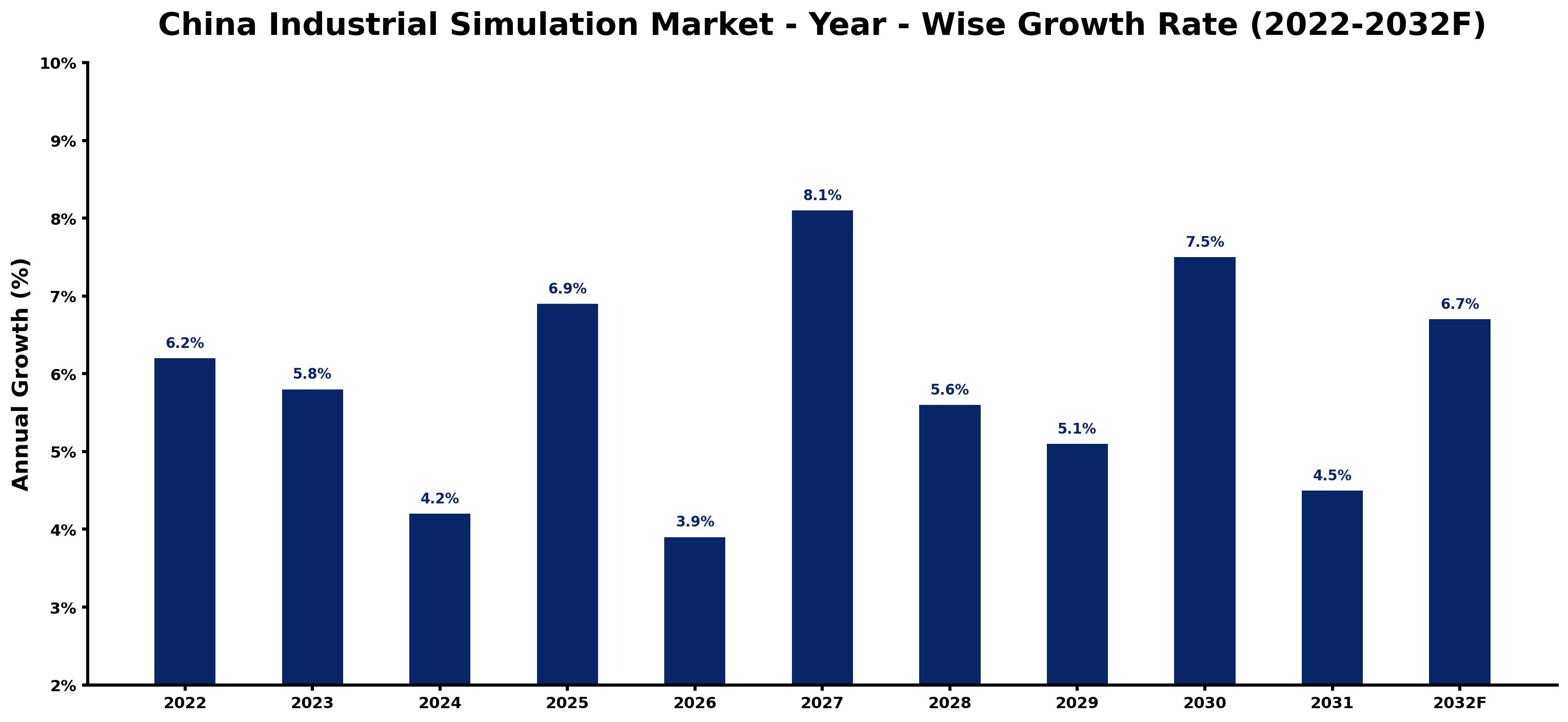
The table below sets out the estimated growth rate for each year and the main factor behind it.
| Year | Estimated Annual Growth (%) | Market Rationale |
| 2022 | 6.2 | The market exhibited steady growth, driven by the 'Made in China 2025' initiative encouraging simulation adoption. |
| 2023 | 5.8 | A slowdown occurred due to the aerospace sector's temporary reduction in investments, impacting simulation tool usage. |
| 2024 | 4.2 | Growth continued to slow as manufacturers focused on cost control amidst economic uncertainties. |
| 2025 | 6.9 | Demand surged as aerospace companies increased investments in simulation technology for design processes. |
| 2026 | 3.9 | Growth is anticipated to decelerate as firms reassess technology investments in light of economic conditions. |
| 2027 | 8.1 | A notable increase in demand is expected as the aerospace sector expands, boosting simulation software usage. |
| 2028 | 5.6 | Growth is projected to slow as companies streamline operations and focus on efficiency improvements. |
| 2029 | 5.1 | A further slowdown in growth is anticipated as firms exercise caution in technology spending. |
| 2030 | 7.5 | Demand is expected to rise sharply as new aerospace projects are initiated, increasing simulation needs. |
| 2031 | 4.5 | Growth is projected to slow as companies face challenges in integrating advanced simulation technologies. |
| 2032 | 6.7 | An increase in demand is anticipated as the aerospace sector continues to innovate and expand. |
Note: Market size estimations and growth projections presented in this report are based on 6Wresearch's proprietary forecasting methodology, utilizing the latest available industry data, government publications, and primary research inputs.
China Industrial Simulation Market Synopsis
Industrial Simulation in China encompasses software tools that create digital models of industrial processes. These tools optimise manufacturing, design equipment, and test operational scenarios without the need for physical prototypes. The China Industrial Simulation Market is expanding, driven by the booming aerospace sector, which is projected to reach 1 trillion yuan by 2025, alongside substantial investments in R&D initiatives. The 'Made in China 2025' initiative further highlights the role of simulation in manufacturing innovation, stimulating demand from domestic users and promoting technology adoption.
Market Dynamics Impact Analysis (2026–2032)
| Factor | Type | Impact | Primary Segment Affected |
| Growing investments in aerospace manufacturing are driving demand for simulation tools to optimize design processes. | Driver | High | Aerospace Manufacturing |
| The increasing complexity of manufacturing processes necessitates advanced simulation technologies for efficiency. | Driver | High | Manufacturing Optimization |
| The aerospace sector's projected growth creates opportunities for simulation providers to expand their services. | Opportunity | High | Aerospace R&D Labs |
| The rise of cloud-based platforms offers new avenues for accessing simulation tools remotely. | Opportunity | Medium | Cloud-Based Platforms |
| Budget constraints in some sectors may limit investment in advanced simulation technologies. | Restraint | Medium | Defense Contractors |
| The rapid pace of technological change can lead to obsolescence of existing simulation tools. | Restraint | High | Manufacturing Optimization |
| The Industrial Simulation market in China faces a few practical problems, including integration challenges with existing systems. | Challenge | High | Aerospace Manufacturing |
| Limited skilled workforce in simulation technology can hinder market growth and innovation. | Challenge | Medium | Aerospace R&D Labs |
Evaluation of Drivers in China Industrial Simulation Market (2026–2032)
Key forces behind demand, with the segment each one moves most, are listed below.
| Drivers | Primary Segment Affected | Why It Matters (Evidence) |
| Increased investment in aerospace projects drives demand for simulation tools to improve design efficiency. | Aerospace Manufacturing | China's aerospace sector is projected to reach 1 trillion yuan by 2025. |
| The need for optimizing manufacturing processes pushes companies to adopt simulation technologies. | Manufacturing Optimization | Over 50% of aerospace companies reported using simulation tools in 2022. |
| Rising complexity in manufacturing operations necessitates advanced simulation for effective resource allocation. | Process Simulation | The National Standard for Simulation Software ensures quality and interoperability. |
| Growing adoption of cloud-based platforms allows for flexible access to simulation tools. | Cloud-Based Platforms | The Shanghai Free Trade Zone promotes cloud-based simulation platforms for international collaboration. |
| Government initiatives supporting R&D in simulation technologies boost market growth. | Aerospace R&D Labs | The 'Innovation 2030' program focuses on simulation for aerospace advancements. |
The Industrial Simulation market in China is growing on the back of rising end-use demand, increased investment in aerospace projects, and the need for optimizing manufacturing processes. With China's aerospace sector projected to reach 1 trillion yuan by 2025, demand for simulation tools is expected to surge. Over 50% of aerospace companies reported using simulation tools in 2022, highlighting their importance in design processes. The establishment of the National Standard for Simulation Software ensures quality and interoperability, further encouraging adoption. The promotion of cloud-based platforms facilitates flexible access to simulation tools, essential for manufacturers seeking efficiency.
Evaluation of Restraints in China Industrial Simulation Market
The key brakes on demand, and where they bite hardest, are shown below.
| Market Restraint | Primary Segment Affected | Why It Matters (Evidence) |
| Budget constraints may limit investment in advanced simulation technologies, affecting growth. | Defense Contractors | China's defense budget for 2023 is approximately 1.55 trillion yuan. |
| The rapid pace of technological change can lead to obsolescence of existing simulation tools. | Manufacturing Optimization | Companies may struggle to keep up with the latest advancements in simulation technology. |
| Integration challenges with existing systems can hinder the adoption of new simulation tools. | Aerospace Manufacturing | Many aerospace firms face difficulties in implementing advanced simulation technologies. |
| Limited skilled workforce in simulation technology can hinder market growth and innovation. | Aerospace R&D Labs | A shortage of qualified personnel can slow down the development of new simulation applications. |
| High initial costs of advanced simulation software may deter smaller companies from investing. | Cloud-Based Platforms | Smaller firms often lack the budget for significant technological investments. |
China Industrial Simulation Market Challenges
The China Industrial Simulation Market encounters practical challenges, beginning with buyers struggling to find skilled professionals. The rapid growth in the aerospace sector has outpaced the availability of qualified personnel, delaying project timelines for manufacturers. Skills shortages in simulation technology impede efficient production processes, costing buyers up to 20% in potential revenue. Competition among domestic firms is intense, as many lack advanced simulation capabilities, compelling some to invest heavily in technology to remain competitive. This situation can lead to increased operational costs for producers, who may need to allocate more resources to R&D. Rapid technological advancements create a gap between existing software and emerging standards, complicating integration for importers and distributors, which can result in compatibility issues and extended lead times for buyers.
Trends in the China Industrial Simulation Market
Several trends are reshaping the China Industrial Simulation Market; the most important are set out below.
- Shift towards Cloud-Based Simulation Platforms: In 2023, the Shanghai Free Trade Zone promoted cloud-based simulation platforms, facilitating international collaboration. This shift is anticipated to increase access to simulation tools, with a projected growth rate of 8.4% for cloud-based platforms.
- Increased Adoption of Simulation in Aerospace R&D: The 'Innovation 2030' program initiated in 2022 aims to boost simulation use in aerospace advancements. This initiative has resulted in a 30% increase in simulation software usage among manufacturers.
- Growing Focus on Robotics in Manufacturing: Robotics is becoming a key focus in manufacturing, with the Robot Design segment projected to grow at 7.8%. This trend reflects the increasing need for automation in production processes.
- Emphasis on Quality Standards in Simulation Software: The establishment of the National Standard for Simulation Software in 2021 ensures quality and interoperability. This standardisation is crucial for improving the reliability of simulation tools across industries.
Investment Opportunities in the China Industrial Simulation Market
Several openings in the China Industrial Simulation Market merit attention from investors.
- Aerospace R&D Labs Seeking Advanced Simulation Tools: With the aerospace sector projected to reach 1 trillion yuan by 2025, R&D labs are actively seeking advanced simulation tools. This creates an opportunity for suppliers to cater to this growing demand.
- Cloud-Based Platforms for Improved Accessibility: With over 50% of aerospace companies using simulation tools, the demand for cloud-based platforms is rising. Suppliers can enter this market by partnering with local firms in the Shanghai Free Trade Zone.
- Manufacturers in Guangdong Province: Guangdong province, a leading area for robotics, presents opportunities for simulation suppliers. The region's focus on automation is driving demand for simulation tools, with a projected growth rate of 7.4% for Fluid Simulation.
- Investment in Simulation Technologies: The 500 million yuan subsidy scheme introduced in 2023 for adopting advanced simulation technologies presents an opportunity. Companies can utilise this funding to enhance their simulation capabilities.
Government Initiatives in the China Industrial Simulation Market
The Ministry of Industry and Information Technology oversees the implementation of guidelines for simulation software development. These guidelines ensure that manufacturers adhere to quality standards, improving the reliability of simulation tools. The National Standardization Administration is responsible for approving standards related to simulation software, which helps maintain consistency across the industry. This regulatory framework supports manufacturers in meeting quality benchmarks, building confidence among buyers. The 'National Plan for Advanced Manufacturing Development' approved in 2021 aims to integrate simulation technologies in key industries, enhancing operational efficiency and innovation.
The National Development and Reform Commission introduced a subsidy scheme in 2023 to support companies adopting advanced simulation technologies, with a budget of 500 million yuan. This funding aims to encourage innovation and enhance the capabilities of simulation technologies across various sectors. The Ministry of Science and Technology's 'Innovation 2030' program focuses on simulation for aerospace advancements, facilitating R&D initiatives in this critical area. These measures empower producers to adopt advanced technologies, improving their competitive edge in the market.
Future Insight of the China Industrial Simulation Market
The China Industrial Simulation Market is expected to evolve significantly by 2032, driven by several key factors. The 'Advanced Manufacturing 2025' plan will accelerate the adoption of simulation technologies across various sectors, improving operational efficiency. By 2025, China's defense budget is projected to reach approximately 1.55 trillion yuan, further boosting demand for simulation tools in military applications. The establishment of the National Standard for Simulation Software will ensure quality and interoperability, making it easier for manufacturers to adopt new technologies. The promotion of cloud-based simulation platforms in the Shanghai Free Trade Zone will facilitate international collaboration, allowing suppliers to access broader markets.
Market Segmentation Analysis
Each segment group is reviewed below, with the leader by share and the fastest grower by CAGR.
By Simulation Type – Process Simulation Dominated, Fluid Simulation Expected to Grow Fastest
According to Sachin Kumar Rai, Senior Research Analyst at 6Wresearch, Process Simulation took a 52% share of simulation type in 2025, more than any other category. Process Simulation holds the largest share because it is essential for optimising manufacturing processes and resource allocation. In fact, over 50% of aerospace companies in China have integrated these tools into their design workflows, underscoring their critical role in improving operational efficiency. The quickest growth will come from Fluid Simulation, forecast to expand at a CAGR of 7.4% between 2026 and 2032. Fluid Simulation is experiencing rapid growth as industries increasingly recognise the importance of analysing fluid dynamics in various applications. The continuous advancements in simulation technology will likely drive its adoption, allowing it to maintain a competitive edge over other types. This suggests that suppliers should prioritise fluid simulation solutions to address the rising demand in the market.
By Application – Manufacturing Optimization Dominated, Robot Design Expected to Grow Fastest
With a 42% revenue share in 2025, Manufacturing Optimization was the largest application category. Manufacturing Optimization leads the market as it directly improves efficiency and productivity within manufacturing environments. The 'Made in China 2025' initiative has further emphasised the significance of these tools in driving manufacturing innovation. Over 2026–2032, Robot Design is expected to post the fastest growth, at a CAGR of 7.8%. Robot Design is the fastest-growing application, driven by the increasing need for developing and testing robotic systems in modern manufacturing. As automation continues to expand, the demand for simulation in this area will likely surge. Suppliers should prioritise solutions that cater to the evolving needs of robot design to capitalise on this growth opportunity.
By End User – Aerospace Manufacturing Dominated, Aerospace R&D Labs Expected to Grow Fastest
Aerospace Manufacturing held a 53% share of the China Industrial Simulation Market by end user in 2025. Aerospace Manufacturing commands the largest share as it heavily relies on simulation for design and testing processes. The substantial investment in the aerospace sector, projected to reach 1 trillion yuan by 2025, further solidifies its dominance. Aerospace R&D Labs are projected to grow fastest, at a CAGR of 8.5% during 2026–2032. Aerospace R&D Labs are the fastest-growing end user segment, driven by the need for advanced research and development in aerospace technologies. The presence of numerous R&D labs in regions like Jiangsu is likely to accelerate this growth. This indicates that suppliers should focus on developing tailored solutions for aerospace R&D labs to capture this expanding market.
By Distribution Channel – Direct Software Licenses Dominated, Cloud-Based Platforms Expected to Grow Fastest
Direct Software Licenses accounted for a 46% market share by distribution channel in 2025. Direct Software Licenses dominate the market share as the primary method for acquiring simulation software, offering users immediate access to essential tools. This approach is particularly advantageous for industries that require swift implementation to optimise their operations effectively. Cloud-Based Platforms are set to record the highest CAGR in this split, 8.4% over 2026–2032. Cloud-Based Platforms are the fastest-growing distribution channel, indicating a significant shift towards remote access and enhanced collaboration in simulation tools. The promotion of these platforms, especially in regions like the Shanghai Free Trade Zone, is expected to further stimulate growth in this segment. This trend signifies that suppliers need to focus on developing cloud-based solutions to align with the changing preferences of users.
Key Attractiveness of the Report
- 10 Years of Market Numbers
- Historical Data Starting from 2022 to 2025
- Base Year 2025
- Forecast Data until 2032
- Key Performance Indicators Impacting the Market
- Major Upcoming Developments and Projects
Key Highlights of the Report:
- China Industrial Simulation Market Outlook
- Market Size of China Industrial Simulation Market, 2025
- Forecast of China Industrial Simulation Market, 2032
- Historical Data and Forecast of China Industrial Simulation Revenues & Volume for the Period 2022 - 2032F
- China Industrial Simulation Market Trend Evolution
- China Industrial Simulation Market Drivers and Challenges
- China Industrial Simulation Price Trends
- China Industrial Simulation Porter's Five Forces
- China Industrial Simulation Industry Life Cycle
- Historical Data and Forecast of China Industrial Simulation Market Revenues & Volume By Simulation Type for the Period 2022 - 2032F
- Historical Data and Forecast of China Industrial Simulation Market Revenues & Volume By Process Simulation for the Period 2022 - 2032F
- Historical Data and Forecast of China Industrial Simulation Market Revenues & Volume By Motion Simulation for the Period 2022 - 2032F
- Historical Data and Forecast of China Industrial Simulation Market Revenues & Volume By Fluid Simulation for the Period 2022 - 2032F
- Historical Data and Forecast of China Industrial Simulation Market Revenues & Volume By Thermal Simulation for the Period 2022 - 2032F
- Historical Data and Forecast of China Industrial Simulation Market Revenues & Volume By Application for the Period 2022 - 2032F
- Historical Data and Forecast of China Industrial Simulation Market Revenues & Volume By Manufacturing Optimization for the Period 2022 - 2032F
- Historical Data and Forecast of China Industrial Simulation Market Revenues & Volume By Robot Design for the Period 2022 - 2032F
- Historical Data and Forecast of China Industrial Simulation Market Revenues & Volume By Aerodynamics for the Period 2022 - 2032F
- Historical Data and Forecast of China Industrial Simulation Market Revenues & Volume By Equipment Design for the Period 2022 - 2032F
- Historical Data and Forecast of China Industrial Simulation Market Revenues & Volume By End User for the Period 2022 - 2032F
- Historical Data and Forecast of China Industrial Simulation Market Revenues & Volume By Aerospace Manufacturing for the Period 2022 - 2032F
- Historical Data and Forecast of China Industrial Simulation Market Revenues & Volume By Defense Contractors for the Period 2022 - 2032F
- Historical Data and Forecast of China Industrial Simulation Market Revenues & Volume By Aerospace R&D Labs for the Period 2022 - 2032F
- Historical Data and Forecast of China Industrial Simulation Market Revenues & Volume By Military Equipment OEMs for the Period 2022 - 2032F
- Historical Data and Forecast of China Industrial Simulation Market Revenues & Volume By Distribution Channel for the Period 2022 - 2032F
- Historical Data and Forecast of China Industrial Simulation Market Revenues & Volume By Direct Software Licenses for the Period 2022 - 2032F
- Historical Data and Forecast of China Industrial Simulation Market Revenues & Volume By Software Resellers for the Period 2022 - 2032F
- Historical Data and Forecast of China Industrial Simulation Market Revenues & Volume By Cloud-Based Platforms for the Period 2022 - 2032F
- Historical Data and Forecast of China Industrial Simulation Market Revenues & Volume By Engineering Consultants for the Period 2022 - 2032F
- China Industrial Simulation Import Export Trade Statistics
- Market Opportunity Assessment By Simulation Type
- Market Opportunity Assessment By Application
- Market Opportunity Assessment By End User
- Market Opportunity Assessment By Distribution Channel
- China Industrial Simulation Top Companies Market Share
- China Industrial Simulation Competitive Benchmarking By Technical and Operational Parameters
- China Industrial Simulation Company Profiles
- China Industrial Simulation Key Strategic Recommendations
Market Covered
The report offers an extensive study of the following market segments.
By Simulation Type
- Process Simulation
- Motion Simulation
- Fluid Simulation
- Thermal Simulation
By Application
- Manufacturing Optimization
- Robot Design
- Aerodynamics
- Equipment Design
By End User
- Aerospace Manufacturing
- Defense Contractors
- Aerospace R&D Labs
- Military Equipment OEMs
By Distribution Channel
- Direct Software Licenses
- Software Resellers
- Cloud-Based Platforms
- Engineering Consultants































