China Infant Clothing Market Size & Growth Rate
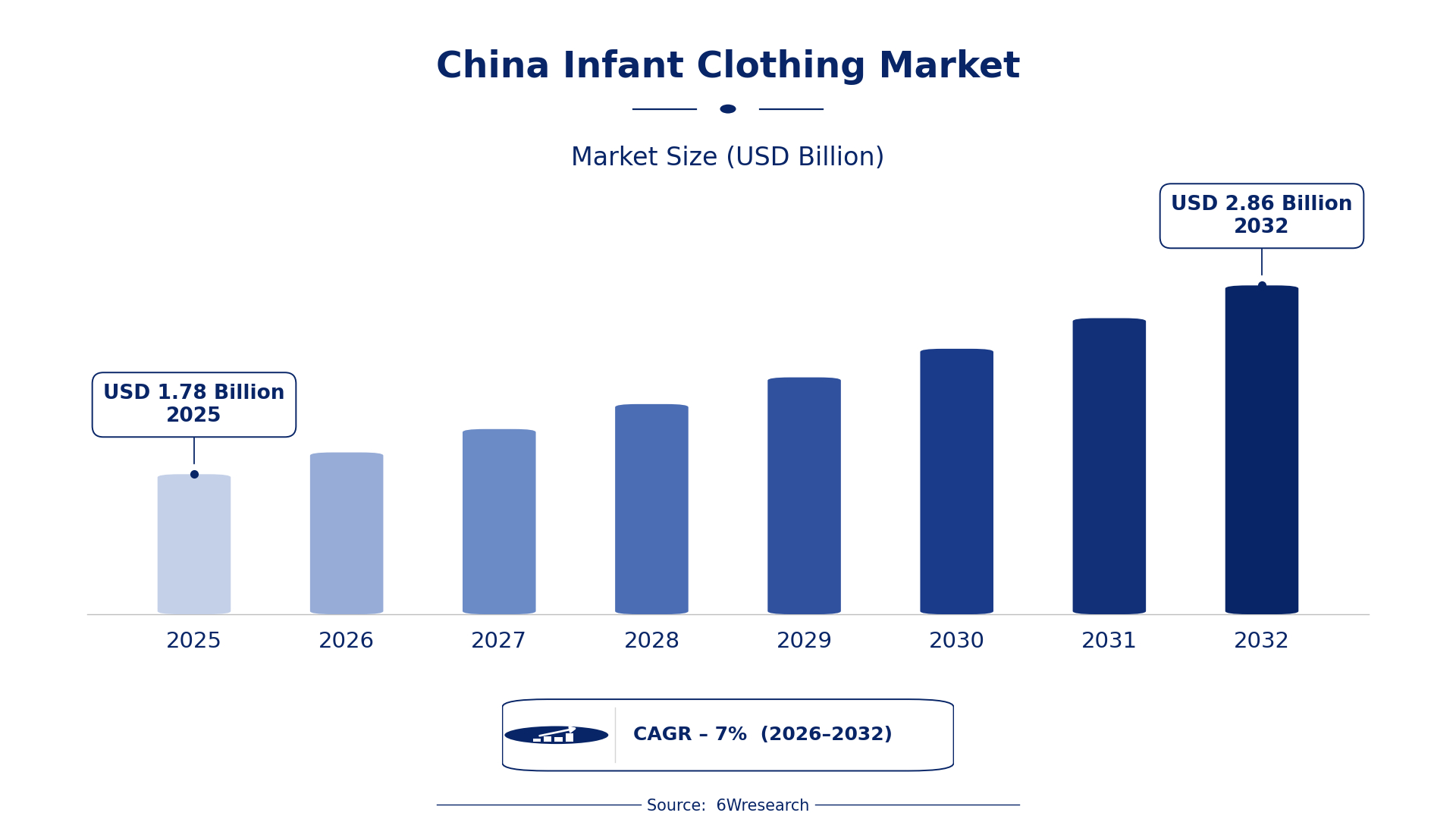
According to 6Wresearch internal database and industry insights, the China Infant Clothing Market was valued at USD 1.78 billion in 2025 and is projected to reach USD 2.86 billion by 2032, growing at a CAGR of approximately 7% during 2026–2032.
China Infant Clothing Market Highlights
| Report Metric | Details |
| Report Name | China Infant Clothing Market |
| Market Size 2025 | USD 1.78 billion |
| Market Size 2032 | USD 2.86 billion |
| Absolute Growth 2025–2032 | USD 1.08 billion |
| CAGR 2026–2032 | 7% |
| Peak Annual Growth | 8.5% in 2027 |
| Forecast Period | 2026–2032 |
| Historical Data | 2022–2025 |
| Base Year | 2025 |
| Leading Clothing Type, 2025 | Onesies (49% share) |
| Leading Fabric Type, 2025 | Organic Cotton (51% share) |
| Leading Age Group, 2025 | 0–12 Months (45% share) |
| Leading Distribution Channel, 2025 | Online Retailers (54% share) |
| Fastest-Growing Clothing Type | Sleepwear (8.1% CAGR) |
| Fastest-Growing Fabric Type | Fleece / Flannel (8.9% CAGR) |
| Fastest-Growing Age Group | 6–18 Months (8.8% CAGR) |
| Fastest-Growing Distribution Channel | Department Stores (8.7% CAGR) |
| Growing Sector | Infant Clothing |
| Key End Users | Parents, Online Retailers, Baby Clothing Chains |
China Infant Clothing Market Year-wise Growth Rate and Key Drivers (2022–2032)
This graph illustrates the annual growth rates of the market from 2022 to 2032, highlighting a steady upward trajectory and projected market expansion over the forecast period.
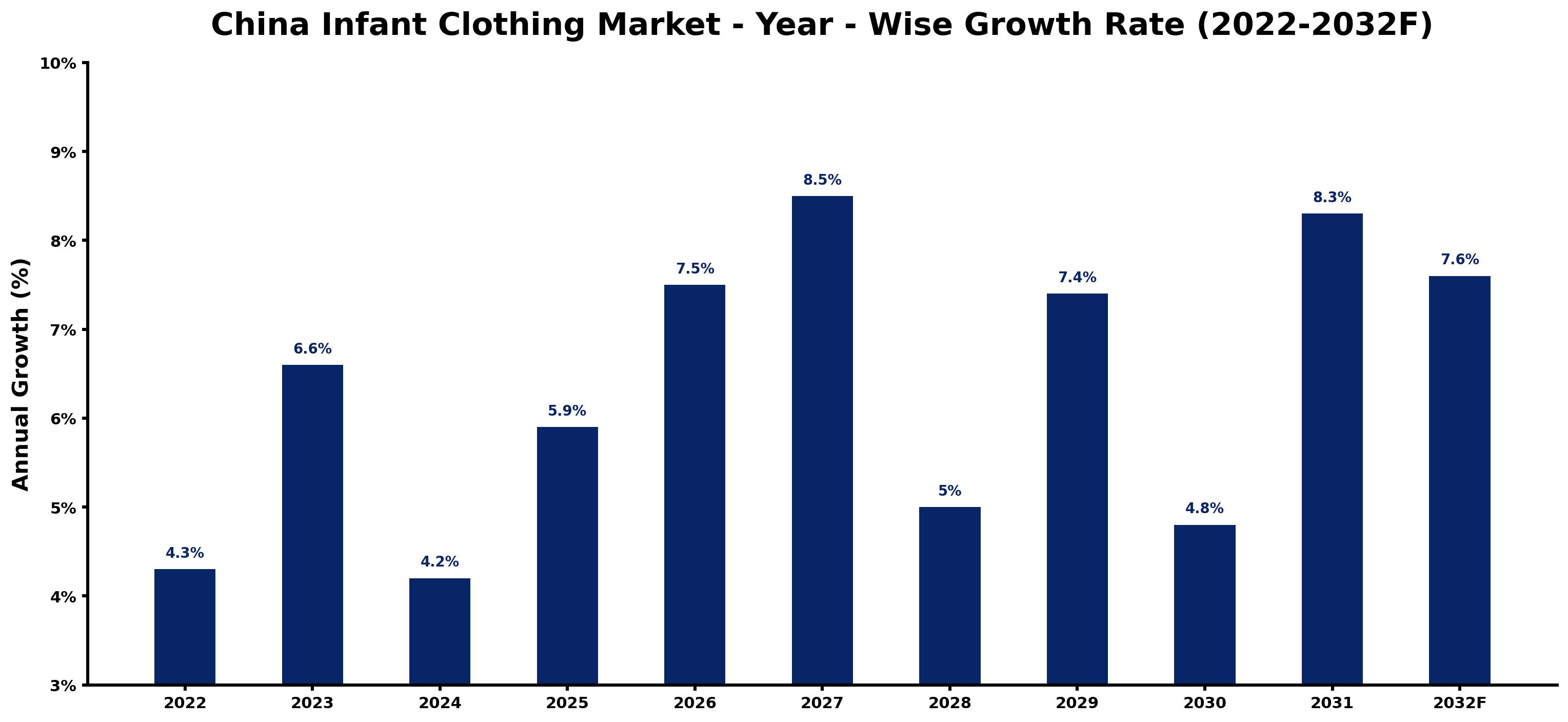
Each row of the following table gives one year's estimated growth and the event or demand shift that explains it.
| Year | Estimated Annual Growth (%) | Market Rationale |
| 2022 | 4.3 | The infant population was approximately 10 million, driving demand for clothing. |
| 2023 | 6.6 | Online retail sales for infant clothing grew by 20%, boosting market activity. |
| 2024 | 4.2 | Growth slowed slightly as demand stabilised after the surge in online purchases from the previous year. |
| 2025 | 5.9 | The average spending on infant clothing reached 1,500 CNY annually, supporting sales. |
| 2026 | 7.5 | Health-conscious parents increasingly preferred organic cotton due to rising safety concerns. |
| 2027 | 8.5 | The market peaked with a surge in demand for sleepwear driven by heightened health awareness. |
| 2028 | 5.0 | Growth slowed as the market adjusted to previous high demand levels following the peak. |
| 2029 | 7.4 | The shift towards eco-friendly fabrics gained momentum, encouraging purchases among environmentally conscious parents. |
| 2030 | 4.8 | Growth slowed again as buyers became more selective in their purchasing decisions. |
| 2031 | 8.3 | A rise in first-time parents aged 30 increased demand for infant clothing. |
| 2032 | 7.6 | Sustainable practices in textile production are expected to influence purchasing decisions. |
Note: Market size estimations and growth projections presented in this report are based on 6Wresearch's proprietary forecasting methodology, utilizing the latest available industry data, government publications, and primary research inputs.
China Infant Clothing Market Synopsis
Infant Clothing in China includes garments crafted for comfort and safety, utilising various fabrics such as organic cotton and blends. Key buyers consist of parents and online retailers, with 60% of parents opting for online purchases. The China Infant Clothing Market is expanding due to heightened health awareness and a surge in online shopping. Annual spending on infant clothing per child is estimated at 1,500 CNY, which supports the market's growth.
Market Dynamics Impact Analysis (2026–2032)
| Factor | Type | Impact | Primary Segment Affected |
| Increasing health awareness among parents drives demand for organic cotton and safe materials. | Driver | High | Organic Cotton |
| The rise of online shopping platforms expands access to a wider range of infant clothing. | Driver | High | Online Retailers |
| Growing interest in eco-friendly fabrics presents opportunities for sustainable production. | Opportunity | High | Organic Cotton |
| The expanding Baby Clothing Chains segment indicates a shift towards specialised retail. | Opportunity | Medium | Baby Clothing Chains |
| High production costs for eco-friendly fabrics may limit market growth. | Restraint | High | Organic Cotton |
| Competition from traditional retail channels can hinder online sales growth. | Restraint | Medium | Online Retailers |
| Supply chain disruptions affect timely delivery of infant clothing to retailers. | Challenge | High | All Infant Ages |
| Fluctuating raw material prices can impact production costs for manufacturers. | Challenge | Medium | Blended Fabrics |
Evaluation of Drivers in China Infant Clothing Market (2026–2032)
Below mentioned are some major drivers and their influence on market dynamics.
| Drivers | Primary Segment Affected | Why It Matters (Evidence) |
| Health-conscious parents prefer organic cotton for its safety and softness. | Organic Cotton | The organic cotton segment has gained popularity due to health concerns among parents. |
| The average spending on infant clothing is estimated at 1,500 CNY annually. | All Infant Ages | Higher spending translates to increased demand across all infant clothing categories. |
| Online retail sales for infant clothing grew by 20% in 2023. | Online Retailers | This growth reflects a shift in consumer buying habits towards online platforms. |
| The demand for sleepwear is expected to grow due to increased awareness of infant health. | Sleepwear | Parents are prioritising comfort during sleep, leading to higher purchases. |
| The Baby Clothing Chains segment is expanding rapidly with new entrants. | Baby Clothing Chains | This expansion indicates a growing preference for specialised infant apparel stores. |
Market growth in China for Infant Clothing hinges on rising health consciousness among parents, the expansion of online shopping, and increased expenditure on infant apparel. In 2023, online retail sales for infant clothing rose by 20%, demonstrating a shift in consumer preferences towards e-commerce. The average spending on infant clothing per child is estimated at 1,500 CNY annually, propelling demand across all categories. The organic cotton segment has gained traction due to health concerns, resulting in more purchases from health-conscious parents. Demand for sleepwear is also set to rise as parents prioritise comfort during sleep, further stimulating market activity.
Evaluation of Restraints in China Infant Clothing Market
Below mentioned are some major restraints and their influence on market dynamics.
| Market Restraint | Primary Segment Affected | Why It Matters (Evidence) |
| High production costs for eco-friendly fabrics may limit market growth. | Organic Cotton | Producers face increased costs, which can deter price-sensitive consumers. |
| Competition from traditional retail channels can hinder online sales growth. | Online Retailers | Many consumers still prefer physical stores for immediate purchases. |
| Supply chain disruptions affect timely delivery of infant clothing to retailers. | All Infant Ages | Delays can lead to stock shortages, impacting sales opportunities. |
| Fluctuating raw material prices can impact production costs for manufacturers. | Blended Fabrics | Increased costs can lead to higher retail prices, reducing demand. |
| Limited awareness of sustainable practices may slow the adoption of eco-friendly fabrics. | Organic Cotton | Consumers may not prioritise sustainability, affecting purchasing decisions. |
China Infant Clothing Market Challenges
Buyers in the China infant clothing market face rising costs due to the growing demand for organic cotton, which can inflate prices by 15% in major cities. Skills shortages in textile manufacturing create production inefficiencies, delaying deliveries to retailers and increasing operational expenses for suppliers. Intense competition from online retailers forces traditional stores to lower prices, squeezing their profit margins and impacting their financial viability. Compliance with national safety standards like GB/T 22702-2008 complicates operations for producers, as they must invest in quality assurance processes that add considerable costs.
Trends in the China Infant Clothing Market
Buyers and suppliers in the China Infant Clothing Market are adjusting to the following trends.
- Shift towards Eco-Friendly Fabrics: There is a notable trend towards using eco-friendly fabrics in infant clothing. The 2021 programme by the Ministry of Industry and Information Technology promotes sustainable textile practices, resulting in a 15% increase in organic cotton usage.
- Transition from Traditional Retail to Online Shopping: The transition from traditional retail to online shopping for infant clothing is pronounced. In 2022, 60% of parents preferred online shopping, reflecting a major shift in consumer behaviour, with online sales increasing by 20%.
- Emergence of Baby Clothing Chains: The Baby Clothing Chains segment is rapidly expanding, indicating a move towards specialised retail. This segment is growing as new entrants address the unique needs of parents and infants, with a 10% increase in new stores.
- Increased Demand for Sleepwear: The demand for sleepwear has risen as parents become more conscious of infant health. This trend is anticipated to persist, with a projected growth rate of 8.5% in the sleepwear segment.
Investment Opportunities in the China Infant Clothing Market
Below are the investment opportunities with the strongest case in the China Infant Clothing Market.
- Timing for Sustainable Fabric Production: With rising health awareness, now presents an opportunity to invest in sustainable fabric production. The organic cotton segment is expanding, and local partnerships can facilitate market entry.
- Entry through Baby Clothing Chains: Investing in Baby Clothing Chains provides a chance to connect with a targeted audience. Collaborating with local chains can enhance market presence and boost sales.
- Expansion in Online Retail Channels: The online retail channel is experiencing rapid growth. Focusing on e-commerce platforms can capture the increasing number of parents shopping online.
- Investment in Sleepwear Production: The growing demand for sleepwear offers an opportunity for investment. Targeting the sleepwear segment can yield substantial returns as parents prioritise comfort.
Government Initiatives in the China Infant Clothing Market
The Ministry of Industry and Information Technology initiated a programme in 2021 to promote sustainable textile practices, building on the national standard GB/T 22702-2008 for infant clothing safety. This initiative encourages manufacturers to adopt eco-friendly materials and processes, improving product safety and environmental responsibility. The programme aims to elevate the overall quality of infant clothing, ensuring compliance with safety standards while addressing health concerns among parents.
In 2023, a subsidy programme for eco-friendly fabric production was launched, overseen by the China National Textile and Apparel Council. This initiative provides financial support to manufacturers adopting sustainable practices, enabling them to lower production costs and enhance product offerings. The programme aims to increase the availability of eco-friendly infant clothing, aligning with consumer preferences for health-conscious products.
Future Insight of the China Infant Clothing Market
The China infant clothing market is poised for evolution by 2032, driven by several transformative factors. The government subsidy programme for eco-friendly fabric production will motivate suppliers to embrace sustainable practices, strengthening their market position. Online retail sales are expected to grow by 25%, facilitating easier access for buyers to a broader range of products. Increased awareness of infant health will elevate demand for sleepwear, prompting producers to innovate and expand their offerings to meet consumer needs.
Market Segmentation Analysis
The analysis below covers each segmentation, its leading category in 2025 and its fastest-growing category through 2032.
By Clothing Type – Onesies Dominated, Sleepwear Expected to Grow Fastest
According to Shubham Deep, Research Manager at 6Wresearch, Onesies took a 49% share of clothing type in 2025, more than any other category. Onesies command the largest market share in China as they are essential for daily infant wear, reflecting parents' preference for comfort and practicality. The average price of a onesie, around 100 CNY in major cities, highlights its significance in the infant clothing market. Sleepwear is set to record the highest CAGR in this split, 8.1% over 2026–2032. The sleepwear segment is growing rapidly, driven by increased awareness of infant health and the necessity for comfort during sleep. The market for sleepwear is expected to expand further as parents increasingly seek specialised options for their infants. Suppliers should prioritise enhancing their sleepwear collections to meet the rising consumer demand.
By Fabric Type – Organic Cotton Dominated, Fleece / Flannel Expected to Grow Fastest
Organic Cotton accounted for a 51% market share by fabric type in 2025. Organic cotton dominates the market share as it is preferred by parents for its safety and softness, addressing health concerns for infants. The growing emphasis on sustainable practices further solidifies its position among environmentally conscious consumers. The quickest growth will come from Fleece / Flannel, forecast to expand at a CAGR of 8.9% between 2026 and 2032. Fleece and flannel are gaining traction due to their warmth and comfort, particularly in colder regions. This growth is likely to continue as parents prioritise fabric quality for their infants' well-being. Suppliers should consider expanding their product lines to include more fleece and flannel options to capitalise on this growing trend.
By Age Group – 0–12 Months Dominated, 6–18 Months Expected to Grow Fastest
0–12 Months held a 45% share of the China Infant Clothing Market by age group in 2025. The 0–12 months age group holds the largest share as it specifically caters to the youngest infants who require specialised clothing. This segment benefits from the approximately 10 million infants in China, underscoring the focus on comfort and safety for newborns. Over 2026–2032, 6–18 Months are expected to post the fastest growth, at a CAGR of 8.8%. The 6–18 months segment is experiencing rapid growth as it targets infants who are becoming more active and need versatile clothing. This increase is supported by parents' demand for adaptable clothing that accommodates their infants' developmental stages. Suppliers should tailor their offerings to meet the unique needs of the 6–18 months age group to capture this expanding market.
By Distribution Channel – Online Retailers Dominated, Department Stores Expected to Grow Fastest
The largest distribution channel category in 2025 was Online Retailers, with a 54% share of total revenue. Online retailers lead the market share, appealing to the 60% of parents who prefer online shopping for its convenience and variety. This channel's growth is evident as online retail sales for infant clothing grew by 20% in 2023, reflecting the increasing reliance on e-commerce. Department Stores are projected to grow fastest, at a CAGR of 8.7% during 2026–2032. Department stores are experiencing the fastest growth as they provide a traditional retail presence that appeals to parents seeking a tactile shopping experience. This trend is bolstered by the desire for immediate access to products without waiting for delivery. Suppliers should strengthen partnerships with department stores to enhance visibility and accessibility for consumers.
Key Attractiveness of the Report
- 10 Years of Market Numbers
- Historical Data Starting from 2022 to 2025
- Base Year 2025
- Forecast Data until 2032
- Key Performance Indicators Impacting the Market
- Major Upcoming Developments and Projects
Key Highlights of the Report:
- China Infant Clothing Market Outlook
- Market Size of China Infant Clothing Market, 2025
- Forecast of China Infant Clothing Market, 2032
- Historical Data and Forecast of China Infant Clothing Revenues & Volume for the Period 2022 - 2032F
- China Infant Clothing Market Trend Evolution
- China Infant Clothing Market Drivers and Challenges
- China Infant Clothing Price Trends
- China Infant Clothing Porter's Five Forces
- China Infant Clothing Industry Life Cycle
- Historical Data and Forecast of China Infant Clothing Market Revenues & Volume By Clothing Type for the Period 2022 - 2032F
- Historical Data and Forecast of China Infant Clothing Market Revenues & Volume By Onesies for the Period 2022 - 2032F
- Historical Data and Forecast of China Infant Clothing Market Revenues & Volume By Sleepwear for the Period 2022 - 2032F
- Historical Data and Forecast of China Infant Clothing Market Revenues & Volume By Outerwear for the Period 2022 - 2032F
- Historical Data and Forecast of China Infant Clothing Market Revenues & Volume By Formal Wear for the Period 2022 - 2032F
- Historical Data and Forecast of China Infant Clothing Market Revenues & Volume By Fabric Type for the Period 2022 - 2032F
- Historical Data and Forecast of China Infant Clothing Market Revenues & Volume By Organic Cotton for the Period 2022 - 2032F
- Historical Data and Forecast of China Infant Clothing Market Revenues & Volume By Fleece / Flannel for the Period 2022 - 2032F
- Historical Data and Forecast of China Infant Clothing Market Revenues & Volume By Wool / Polyester for the Period 2022 - 2032F
- Historical Data and Forecast of China Infant Clothing Market Revenues & Volume By Blended Fabrics for the Period 2022 - 2032F
- Historical Data and Forecast of China Infant Clothing Market Revenues & Volume By Age Group for the Period 2022 - 2032F
- Historical Data and Forecast of China Infant Clothing Market Revenues & Volume By 0 12 Months for the Period 2022 - 2032F
- Historical Data and Forecast of China Infant Clothing Market Revenues & Volume By 6 18 Months for the Period 2022 - 2032F
- Historical Data and Forecast of China Infant Clothing Market Revenues & Volume By All Infant Ages for the Period 2022 - 2032F
- Historical Data and Forecast of China Infant Clothing Market Revenues & Volume By 0 24 Months for the Period 2022 - 2032F
- Historical Data and Forecast of China Infant Clothing Market Revenues & Volume By Distribution Channel for the Period 2022 - 2032F
- Historical Data and Forecast of China Infant Clothing Market Revenues & Volume By Online Retailers for the Period 2022 - 2032F
- Historical Data and Forecast of China Infant Clothing Market Revenues & Volume By Department Stores for the Period 2022 - 2032F
- Historical Data and Forecast of China Infant Clothing Market Revenues & Volume By Baby Clothing Chains for the Period 2022 - 2032F
- Historical Data and Forecast of China Infant Clothing Market Revenues & Volume By Boutiques for the Period 2022 - 2032F
- China Infant Clothing Import Export Trade Statistics
- Market Opportunity Assessment By Clothing Type
- Market Opportunity Assessment By Fabric Type
- Market Opportunity Assessment By Age Group
- Market Opportunity Assessment By Distribution Channel
- China Infant Clothing Top Companies Market Share
- China Infant Clothing Competitive Benchmarking By Technical and Operational Parameters
- China Infant Clothing Company Profiles
- China Infant Clothing Key Strategic Recommendations
Market Covered
This report examines the market across the segments below.
By Clothing Type
- Onesies
- Sleepwear
- Outerwear
- Formal Wear
By Fabric Type
- Organic Cotton
- Fleece / Flannel
- Wool / Polyester
- Blended Fabrics
By Age Group
- 0–12 Months
- 6–18 Months
- All Infant Ages
- 0–24 Months
By Distribution Channel
- Online Retailers
- Department Stores
- Baby Clothing Chains
- Boutiques































