India Infant Clothing Market Size & Growth Rate
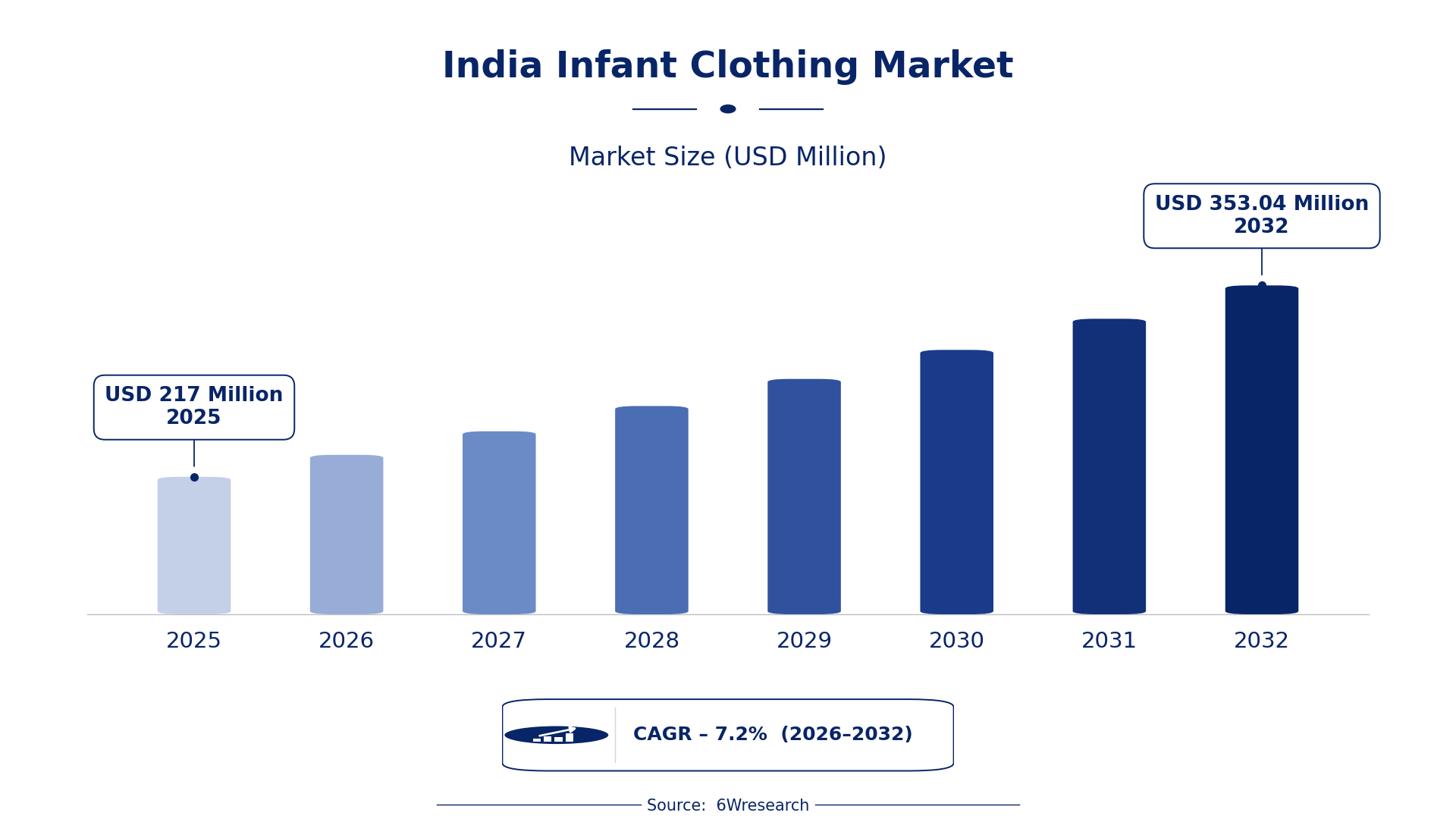
According to 6Wresearch internal database and industry insights, the India Infant Clothing Market was valued at USD 217.0 million in 2025 and is projected to reach USD 353.04 million by 2032, growing at a CAGR of approximately 7.2% during 2026–2032.
India Infant Clothing Market Highlights
| Report Metric | Details |
| Report Name | India Infant Clothing Market |
| Market Size 2025 | USD 217.0 million |
| Market Size 2032 | USD 353.04 million |
| Absolute Growth 2025–2032 | USD 136.04 million |
| CAGR 2026–2032 | 7.2% |
| Peak Annual Growth | 9.2% in 2030 |
| Forecast Period | 2026–2032 |
| Historical Data | 2022–2025 |
| Base Year | 2025 |
| Leading Clothing Type, 2025 | Onesies (39% share) |
| Leading Fabric Type, 2025 | Organic Cotton (52% share) |
| Leading Age Group, 2025 | 0–12 Months (41% share) |
| Leading Distribution Channel, 2025 | Online Retailers (54% share) |
| Fastest-Growing Clothing Type | Sleepwear (9.2% CAGR) |
| Fastest-Growing Age Group | 0–24 Months (8.3% CAGR) |
| Fastest-Growing Distribution Channel | Department Stores (9.8% CAGR) |
| Growing Sector | Online Retail |
| Key End Users | Parents, Retailers, Textile Manufacturers, Online Platforms |
India Infant Clothing Market Year-wise Growth Rate and Key Drivers (2022–2032)
This graph illustrates the annual growth rates of the market from 2022 to 2032, highlighting a steady upward trajectory and projected market expansion over the forecast period.
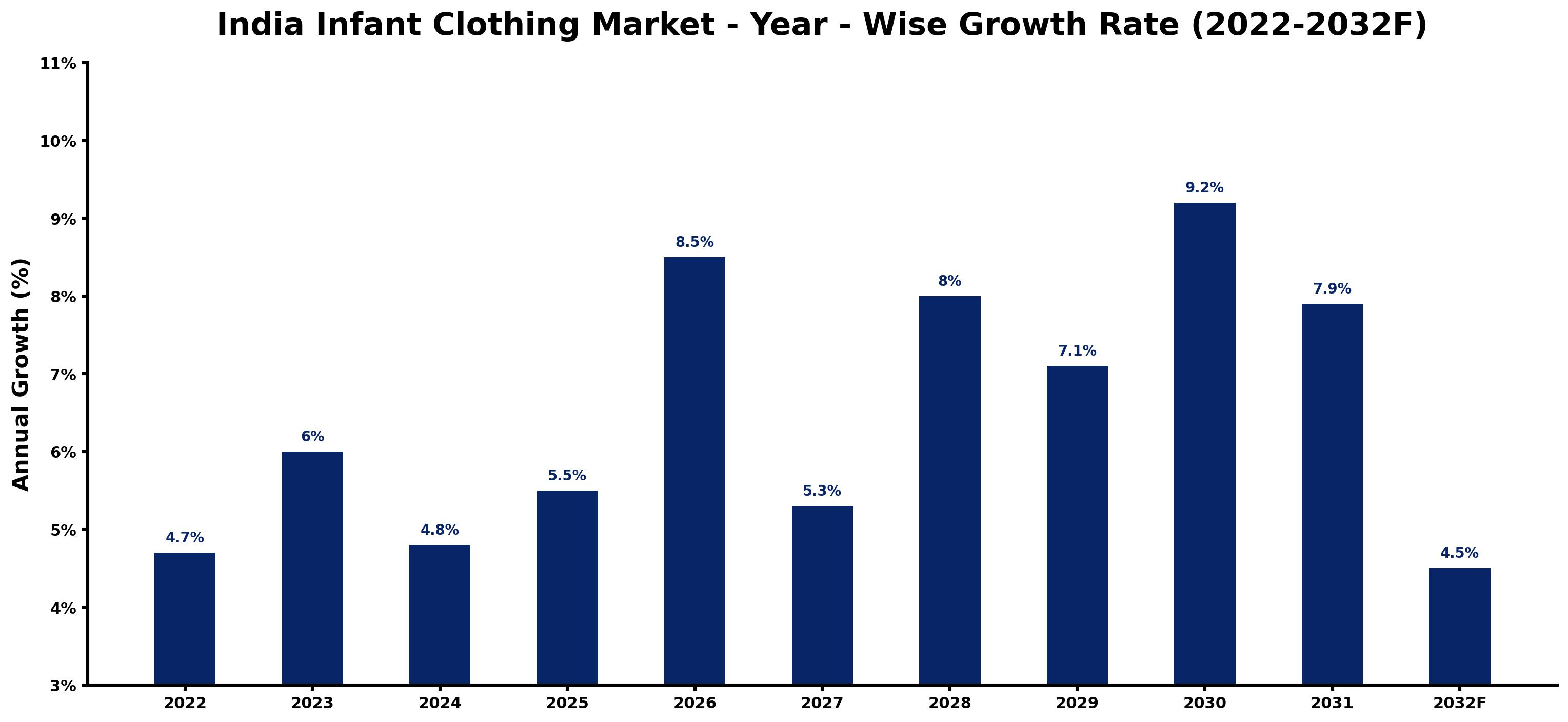
Year by year, the estimates below pair each growth rate with the development that shaped it.
| Year | Estimated Annual Growth (%) | Market Rationale |
| 2022 | 4.7 | The market showed steady demand due to a high birth rate in India. |
| 2023 | 6.0 | Growth accelerated as consumer preferences shifted towards organic cotton clothing. |
| 2024 | 4.8 | Demand growth slowed slightly as the market adjusted to previous high rates. |
| 2025 | 5.5 | An increase in online shopping contributed to faster growth in infant clothing sales. |
| 2026 | 8.5 | The introduction of new eco-friendly fabrics spurred significant market expansion. |
| 2027 | 5.3 | Growth decelerated as competition among retailers intensified in the online space. |
| 2028 | 8.0 | A resurgence in demand for sleepwear boosted market growth once again. |
| 2029 | 7.1 | The market experienced a slowdown as consumers became more price-sensitive. |
| 2030 | 9.2 | A peak in growth was driven by rising disposable incomes and changing lifestyles. |
| 2031 | 7.9 | Growth moderated as the market began to stabilise after rapid expansion. |
| 2032 | 4.5 | The market is expected to grow steadily as sustainable practices gain traction. |
Note: Market size estimations and growth projections presented in this report are based on 6Wresearch's proprietary forecasting methodology, utilizing the latest available industry data, government publications, and primary research inputs.
India Infant Clothing Market Synopsis
The India Infant Clothing Market includes garments tailored specifically for babies and toddlers, such as onesies, sleepwear, and outerwear crafted from various fabrics. As of 2023, the market is valued at approximately 30 billion INR. The sector's growth is largely attributed to a high birth rate and an increasing shift towards online retail. The rising demand for organic cotton, which represents 15% of the market, further drives this trend. The ongoing 'Make in India' initiative bolsters local textile manufacturing, positively influencing market conditions.
Market Dynamics Impact Analysis (2026–2032)
| Factor | Type | Impact | Primary Segment Affected |
| High birth rate driving consistent demand for infant clothing. | Driver | High | All Infant Ages |
| Growing online retail channel facilitating easier access to products. | Driver | High | Online Retailers |
| Increasing consumer preference for organic cotton clothing presents a significant opportunity. | Opportunity | High | Organic Cotton |
| Expansion of baby clothing chains is creating new market avenues. | Opportunity | Medium | Baby Clothing Chains |
| Intense competition among retailers may limit profit margins. | Restraint | Medium | Department Stores |
| Price sensitivity among consumers could hinder purchasing decisions. | Restraint | Medium | All Infant Ages |
| Supply chain disruptions can delay product availability. | Challenge | High | All Infant Ages |
| Fluctuating raw material prices affect production costs. | Challenge | Medium | Organic Cotton |
Evaluation of Drivers in India Infant Clothing Market (2026–2032)
The main growth drivers and the segments they affect most are set out below.
| Drivers | Primary Segment Affected | Why It Matters (Evidence) |
| High birth rate leading to increased demand for infant clothing. | All Infant Ages | With an average birth rate of about 22 births per 1,000 people, more infants require clothing. |
| Rising online retail sales expanding market access. | Online Retailers | The online retail segment for infant clothing has seen a 25% increase in 2023. |
| Growing preference for organic cotton clothing among parents. | Organic Cotton | Organic cotton is gaining popularity, accounting for 15% of the infant clothing market. |
| Expansion of baby clothing chains catering to specific needs. | Baby Clothing Chains | This segment is projected to grow by 20% in the next few years, attracting more consumers. |
| Increased investment in textile manufacturing capabilities. | Department Stores | Government initiatives like 'Make in India' support local textile production. |
Growth in the Infant Clothing market in India is rooted in a high birth rate, the expansion of online retail, and a growing preference for organic cotton. With an average birth rate of about 22 births per 1,000 people, demand for infant clothing remains steady. The online retail segment has experienced a 25% surge in 2023, providing parents with easier access to a wide range of products. The introduction of new eco-friendly fabrics is likely to appeal to parents seeking safer options for their infants. Increased investment in textile manufacturing capabilities is expected to improve supply chain efficiency.
Evaluation of Restraints in India Infant Clothing Market
The key brakes on demand, and where they bite hardest, are shown below.
| Market Restraint | Primary Segment Affected | Why It Matters (Evidence) |
| Intense competition among retailers affecting profit margins. | Department Stores | Increased competition can create price wars, reducing profitability for retailers. |
| Price sensitivity among consumers hindering purchases. | All Infant Ages | As consumers become more price-conscious, they may choose lower-cost alternatives. |
| Supply chain disruptions affecting product availability. | All Infant Ages | Disruptions can delay shipments, resulting in stock shortages in stores. |
| Fluctuating raw material prices impacting production costs. | Organic Cotton | Rising costs of organic cotton can result in higher retail prices for consumers. |
| Limited awareness of sustainable practices among consumers. | Organic Cotton | Consumers may not fully understand the benefits of organic cotton, which can affect demand. |
India Infant Clothing Market Challenges
The India infant clothing market faces rising production costs, primarily due to increasing prices of raw materials like cotton and polyester, which can raise production expenses by up to 15% for manufacturers. This situation pressures producers to increase retail prices, potentially alienating budget-conscious buyers who make up a significant portion of the market. Intense competition from both local and international brands complicates matters, forcing producers to lower prices, which can erode profit margins. Compliance with ISO 9001 standards adds to operational costs, delaying product launches and reducing profitability for manufacturers, which can lead to a 10% decrease in market responsiveness.
Trends in the India Infant Clothing Market
Several trends are reshaping the India Infant Clothing Market; the most important are set out below.
- Shift Towards Organic Cotton: Organic cotton clothing is gaining traction among parents, accounting for 15% of the market. This trend reflects a growing awareness of sustainability and safety in infant products.
- Rise of Online Retail: Online retailers are capturing an increasing share of the infant clothing market, with a 25% rise in 2023. This shift enables parents to conveniently access a diverse array of infant clothing options.
- Expansion of Baby Clothing Chains: The Baby Clothing Chains segment is rapidly expanding, projected to grow by 20% in the coming years. This trend indicates a move towards specialised retail experiences for parents.
- Increased Demand for Sleepwear: Sleepwear is becoming more popular in the infant clothing market, with a projected CAGR of 9.2% from 2026 to 2032. This trend underscores the importance of comfort for infants during nighttime.
Investment Opportunities in the India Infant Clothing Market
Below are the investment opportunities with the strongest case in the India Infant Clothing Market.
- Growing Demand for Organic Cotton: With organic cotton comprising 15% of the market, there exists an opportunity to invest in sustainable fabric production. Local textile producers can fulfil this demand through eco-friendly practices.
- Expansion of Online Retail Channels: The online retail segment has experienced a 25% increase, presenting opportunities for new entrants. Collaborating with established online platforms can enhance market reach for suppliers.
- Investment in Baby Clothing Chains: The Baby Clothing Chains segment is projected to grow by 20%, indicating a ripe opportunity for investment. Establishing partnerships with existing chains can facilitate market entry.
- Development of Innovative Sleepwear: As sleepwear demand rises, investing in innovative designs and materials can capture consumer interest. Targeting parents looking for comfort and safety will drive sales.
Government Initiatives in the India Infant Clothing Market
The 'National Textile Policy 2020' promotes sustainable practices in textile manufacturing, enhancing competitiveness and eco-friendly materials. This policy builds on earlier measures like the 'Make in India' initiative, which has supported local textile production since 2014, creating jobs and improving skill development for the infant clothing sector. The 'Production Linked Incentive Scheme' launched in 2021 encourages domestic manufacturing in textiles, with a budget of 10,683 crore INR allocated to boost production capabilities.
The 'Textiles Sector Skill Council' aims to elevate workforce skills in the textile industry. This council funds training programs and initiatives to enhance the skill set of workers, ensuring they meet the evolving demands of the infant clothing market. The council has approved numerous training programs, benefiting thousands of workers in the sector. The 'Sustainable Cotton Initiative' launched in 2022 promotes organic cotton farming, increasing its share in the textile industry.
Future Insight of the India Infant Clothing Market
Several forward-looking factors should support growth in the India infant clothing market over the coming years. The 'Make in India' initiative will strengthen local manufacturing capabilities, improving supply chain resilience. The online retail segment is expected to see a substantial increase, providing buyers with greater accessibility and variety. Government programs promoting sustainable fabric production will drive innovation, attracting environmentally conscious consumers. This shift will likely lead to more diverse and eco-friendly product offerings, aligning with the preferences of Indian families.
Market Segmentation Analysis
Each segment group is reviewed below, with the leader by share and the fastest grower by CAGR.
By Clothing Type – Onesies Dominated, Sleepwear Expected to Grow Fastest
According to Shubham Deep, Research Manager at 6Wresearch, the largest clothing type category in 2025 was Onesies, with a 39% share of total revenue. Onesies are the leading clothing type in the India infant clothing market as they are essential for everyday wear, providing comfort and ease for both infants and parents. Their widespread use across various regions underscores their status as a staple in infant wardrobes. The quickest growth will come from Sleepwear, forecast to expand at a CAGR of 9.2% between 2026 and 2032. Sleepwear is experiencing rapid growth, primarily due to the increasing emphasis on comfort during infants' sleep hours. This segment's rise reflects parents' desire for high-quality sleepwear options, indicating a shift towards prioritising better sleep solutions for their children. Suppliers should enhance their sleepwear offerings to meet the growing demand and capture a larger market share.
By Fabric Type – Organic Cotton Dominated and Is Expected to Record the Fastest Growth
In 2025, Organic Cotton led the fabric type split with a 52% share. Organic cotton holds the largest share in the infant clothing market as it is increasingly preferred for its safety and comfort, appealing to health-conscious parents. The growing consumer awareness about sustainable materials further strengthens its position in the market. Organic Cotton is also forecast to expand faster than any other category, at a CAGR of 8.8% over 2026–2032. Organic cotton is also the fastest-growing segment, as more parents are opting for eco-friendly and safe clothing options for their infants. This rising demand for sustainable fabrics is expected to solidify its market position even further. Suppliers should focus on expanding their organic cotton product lines to meet the rising consumer preference for sustainable options.
By Age Group – 0–12 Months Dominated, 0–24 Months Expected to Grow Fastest
With a 41% revenue share in 2025, 0–12 Months was the largest age group category. The 0–12 months age group commands the largest share in the infant clothing market, representing the primary stage for purchasing infant garments. This segment's dominance is driven by the high birth rate in India, leading to consistent demand for clothing tailored to this age range. 0–24 Months are set to record the highest CAGR in this split, 8.3% over 2026–2032. The 0–24 months age group is the fastest-growing segment, encompassing a broader range of infant clothing needs. This growth is fuelled by parents seeking versatile clothing options that cater to their infants' developmental stages, indicating a shift in purchasing behaviour. Suppliers should adapt their product offerings to cater to the expanding needs of the 0–24 months age group to capture emerging opportunities.
By Distribution Channel – Online Retailers Dominated, Department Stores Expected to Grow Fastest
Online Retailers took a 54% share of distribution channel in 2025, more than any other category. Online retailers lead the distribution channel segment, capturing a significant share due to the convenience and accessibility they offer to parents. The increasing trend towards online shopping has solidified this channel's position in the market. Over 2026–2032, Department Stores are expected to post the fastest growth, at a CAGR of 9.8%. Department stores are the fastest-growing distribution channel, providing a traditional shopping experience that many parents still prefer. This growth is driven by the resurgence of in-person shopping, allowing parents to physically inspect products before purchase. This indicates that suppliers should strengthen their partnerships with department stores to leverage the growing preference for traditional retail experiences.
Key Attractiveness of the Report
- 10 Years of Market Numbers
- Historical Data Starting from 2022 to 2025
- Base Year 2025
- Forecast Data until 2032
- Key Performance Indicators Impacting the Market
- Major Upcoming Developments and Projects
Key Highlights of the Report:
- India Infant Clothing Market Outlook
- Market Size of India Infant Clothing Market, 2025
- Forecast of India Infant Clothing Market, 2032
- Historical Data and Forecast of India Infant Clothing Revenues & Volume for the Period 2022 - 2032F
- India Infant Clothing Market Trend Evolution
- India Infant Clothing Market Drivers and Challenges
- India Infant Clothing Price Trends
- India Infant Clothing Porter's Five Forces
- India Infant Clothing Industry Life Cycle
- Historical Data and Forecast of India Infant Clothing Market Revenues & Volume By Clothing Type for the Period 2022 - 2032F
- Historical Data and Forecast of India Infant Clothing Market Revenues & Volume By Onesies for the Period 2022 - 2032F
- Historical Data and Forecast of India Infant Clothing Market Revenues & Volume By Sleepwear for the Period 2022 - 2032F
- Historical Data and Forecast of India Infant Clothing Market Revenues & Volume By Outerwear for the Period 2022 - 2032F
- Historical Data and Forecast of India Infant Clothing Market Revenues & Volume By Formal Wear for the Period 2022 - 2032F
- Historical Data and Forecast of India Infant Clothing Market Revenues & Volume By Fabric Type for the Period 2022 - 2032F
- Historical Data and Forecast of India Infant Clothing Market Revenues & Volume By Organic Cotton for the Period 2022 - 2032F
- Historical Data and Forecast of India Infant Clothing Market Revenues & Volume By Fleece / Flannel for the Period 2022 - 2032F
- Historical Data and Forecast of India Infant Clothing Market Revenues & Volume By Wool / Polyester for the Period 2022 - 2032F
- Historical Data and Forecast of India Infant Clothing Market Revenues & Volume By Blended Fabrics for the Period 2022 - 2032F
- Historical Data and Forecast of India Infant Clothing Market Revenues & Volume By Age Group for the Period 2022 - 2032F
- Historical Data and Forecast of India Infant Clothing Market Revenues & Volume By 0 12 Months for the Period 2022 - 2032F
- Historical Data and Forecast of India Infant Clothing Market Revenues & Volume By 6 18 Months for the Period 2022 - 2032F
- Historical Data and Forecast of India Infant Clothing Market Revenues & Volume By All Infant Ages for the Period 2022 - 2032F
- Historical Data and Forecast of India Infant Clothing Market Revenues & Volume By 0 24 Months for the Period 2022 - 2032F
- Historical Data and Forecast of India Infant Clothing Market Revenues & Volume By Distribution Channel for the Period 2022 - 2032F
- Historical Data and Forecast of India Infant Clothing Market Revenues & Volume By Online Retailers for the Period 2022 - 2032F
- Historical Data and Forecast of India Infant Clothing Market Revenues & Volume By Department Stores for the Period 2022 - 2032F
- Historical Data and Forecast of India Infant Clothing Market Revenues & Volume By Baby Clothing Chains for the Period 2022 - 2032F
- Historical Data and Forecast of India Infant Clothing Market Revenues & Volume By Boutiques for the Period 2022 - 2032F
- India Infant Clothing Import Export Trade Statistics
- Market Opportunity Assessment By Clothing Type
- Market Opportunity Assessment By Fabric Type
- Market Opportunity Assessment By Age Group
- Market Opportunity Assessment By Distribution Channel
- India Infant Clothing Top Companies Market Share
- India Infant Clothing Competitive Benchmarking By Technical and Operational Parameters
- India Infant Clothing Company Profiles
- India Infant Clothing Key Strategic Recommendations
Market Covered
The report offers an extensive study of the following market segments.
By Clothing Type
- Onesies
- Sleepwear
- Outerwear
- Formal Wear
By Fabric Type
- Organic Cotton
- Fleece / Flannel
- Wool / Polyester
- Blended Fabrics
By Age Group
- 0–12 Months
- 6–18 Months
- All Infant Ages
- 0–24 Months
By Distribution Channel
- Online Retailers
- Department Stores
- Baby Clothing Chains
- Boutiques































