China Infant Health Monitoring Market Size & Growth Rate
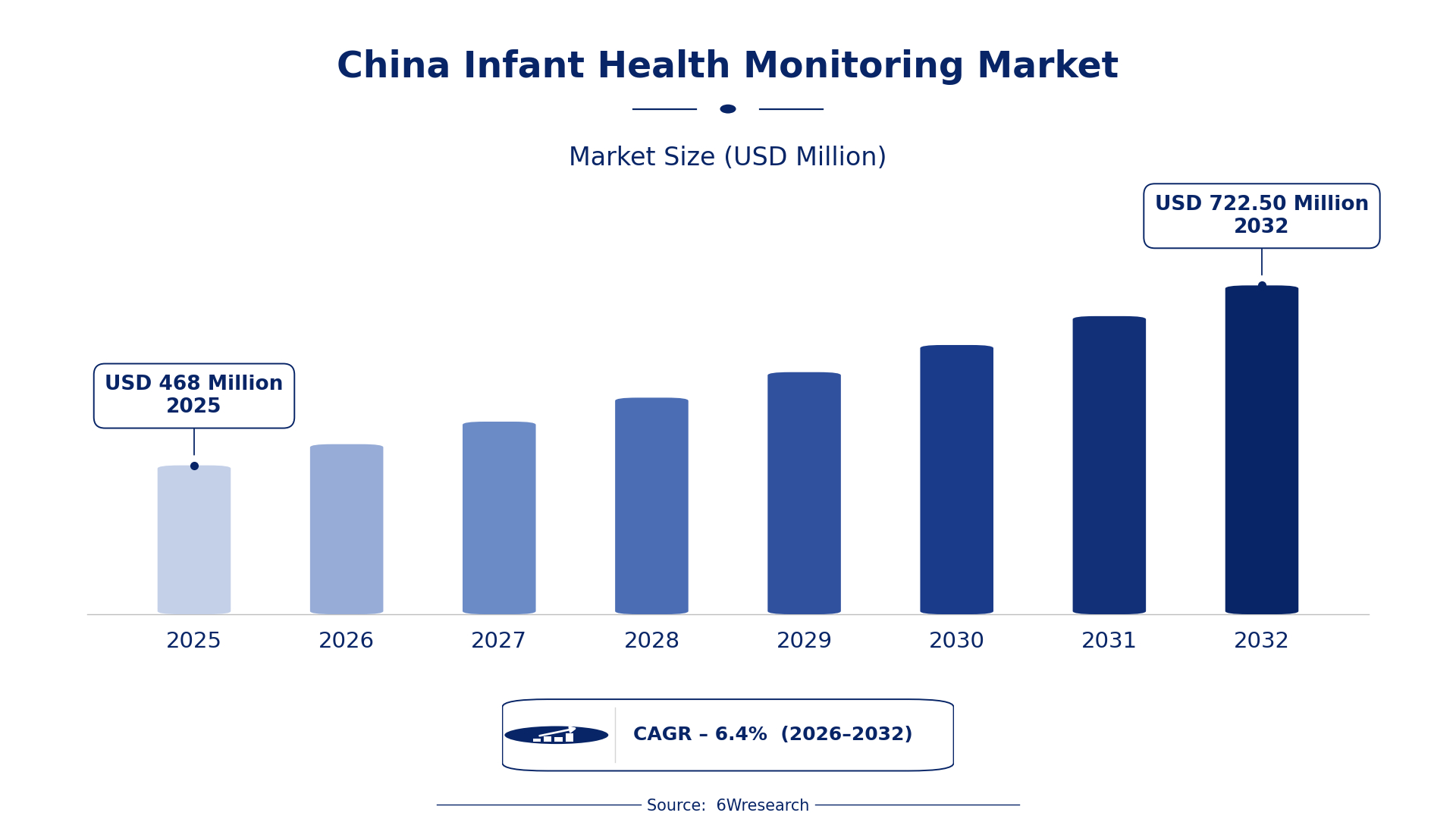
According to 6Wresearch internal database and industry insights, the China Infant Health Monitoring Market was valued at USD 468.0 million in 2025 and is projected to reach USD 722.50 million by 2032, growing at a CAGR of approximately 6.4% during 2026–2032.
China Infant Health Monitoring Market Highlights
| Report Metric | Details |
| Report Name | China Infant Health Monitoring Market |
| Market Size 2025 | USD 468.0 million |
| Market Size 2032 | USD 722.50 million |
| Absolute Growth 2025–2032 | USD 254.50 million |
| CAGR 2026–2032 | 6.4% |
| Peak Annual Growth | 8.3% in 2032 |
| Forecast Period | 2026–2032 |
| Historical Data | 2022–2025 |
| Base Year | 2025 |
| Leading Monitoring System, 2025 | Smart Monitors (37% share) |
| Leading Sensor Technology, 2025 | Wearable Sensors (35% share) |
| Leading Application, 2025 | Sleep / Heart Rate (50% share) |
| Leading Distribution Channel, 2025 | Online Retailers (37% share) |
| Fastest-Growing Monitoring System | Contactless Trackers (8.1% CAGR) |
| Fastest-Growing Application | Health Insights (8.0% CAGR) |
| Fastest-Growing Distribution Channel | Mobile App Stores (7.5% CAGR) |
| Growing Sector | Health Insights |
| Key End Users | parents, hospitals, healthcare providers |
China Infant Health Monitoring Market Year-wise Growth Rate and Key Drivers (2022–2032)
This graph illustrates the annual growth rates of the market from 2022 to 2032, highlighting a steady upward trajectory and projected market expansion over the forecast period.
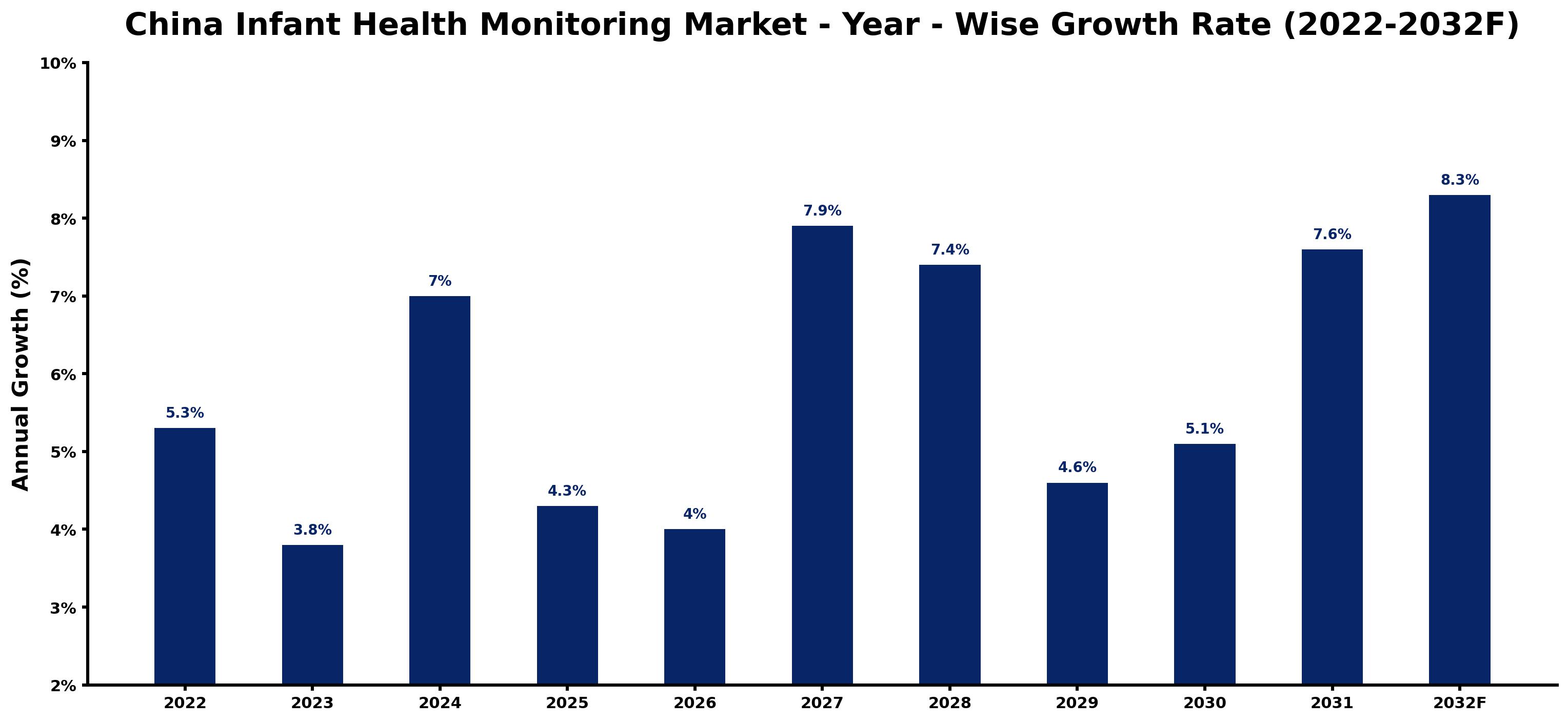
Below, each year's estimated growth is shown next to the factor that most influenced it.
| Year | Estimated Annual Growth (%) | Market Rationale |
| 2022 | 5.3 | The birth rate in China was approximately 9.56 births per 1,000 people, influencing demand for monitoring devices. |
| 2023 | 3.8 | Growth slowed as the 'Smart Health for Infants' initiative faced initial adoption challenges. |
| 2024 | 7.0 | The market experienced faster growth as hospitals increasingly adopted smart monitors for newborn care. |
| 2025 | 4.3 | Growth slowed again as the market adjusted to the updated safety standards for monitoring devices. |
| 2026 | 4.0 | Demand growth is expected to slow due to the implementation of new regulations affecting product approvals. |
| 2027 | 7.9 | Growth is projected to accelerate due to increased investment in health technology innovation for infants. |
| 2028 | 7.4 | The market growth rate is expected to slow slightly as consumer preferences shift towards integrated apps. |
| 2029 | 4.6 | Demand growth is projected to slow as competition among monitoring device brands intensifies. |
| 2030 | 5.1 | Growth is expected to accelerate again as awareness of health insights from devices increases among parents. |
| 2031 | 7.6 | The market is projected to see faster growth as the installed base of health monitoring devices expands. |
| 2032 | 8.3 | The market peaks with strong growth driven by the national campaign promoting health monitoring. |
Note: Market size estimations and growth projections presented in this report are based on 6Wresearch's proprietary forecasting methodology, utilizing the latest available industry data, government publications, and primary research inputs.
China Infant Health Monitoring Market Synopsis
Infant Health Monitoring products in China track vital signs and behaviours of infants using advanced sensor technology. These devices monitor sleep patterns, heart rates, and overall health status, providing real-time insights for parents. The China Infant Health Monitoring Market is expanding due to rising birth rates in urban areas and increased adoption of digital health technologies. In 2023, over 70% of new parents in urban regions utilised some form of health monitoring technology, reflecting a shift towards informed infant care.
Market Dynamics Impact Analysis (2026–2032)
| Factor | Type | Impact | Primary Segment Affected |
| Rising birth rates in urban areas drive demand for monitoring solutions. | Driver | High | Smart Monitors |
| Increased hospital adoption of smart monitors enhances market growth. | Driver | High | Smart Monitors |
| Growing urban population creates a demand for advanced monitoring solutions. | Opportunity | High | Wearable Sensors |
| The need for integrated health insights presents investment opportunities. | Opportunity | High | Integrated Apps |
| Regulatory compliance costs can hinder market entry for new products. | Restraint | High | Camera-Based Systems |
| Consumer price sensitivity limits the adoption of premium monitoring devices. | Restraint | Medium | Smart Monitors |
| Supply chain disruptions affect availability of monitoring devices. | Challenge | High | Wearable Sensors |
| Technological integration challenges slow down product development. | Challenge | Medium | Integrated Apps |
Evaluation of Drivers in China Infant Health Monitoring Market (2026–2032)
The table below links each growth driver to the segment it affects and the evidence for it.
| Drivers | Primary Segment Affected | Why It Matters (Evidence) |
| Increased birth rates in urban areas drive demand for monitoring solutions. | Smart Monitors | In 2022, the birth rate was approximately 9.56 births per 1,000 people, leading to higher demand. |
| Adoption of smart monitors in hospitals boosts market growth. | Smart Monitors | Smart monitors are increasingly adopted in hospitals for newborn care units, enhancing sales. |
| Growing urban population creates a demand for advanced monitoring solutions. | Wearable Sensors | As of 2023, the total population of infants under one year in China is estimated at around 14 million. |
| The need for integrated health insights presents investment opportunities. | Integrated Apps | Over 60% of parents with monitoring devices use integrated apps for health insights. |
| Online retail sales of infant health monitors grew significantly. | Online Retailers | Online retail sales grew by 15% in 2023 compared to the previous year, indicating strong demand. |
The Infant Health Monitoring market in China is expanding as rising birth rates, increased hospital adoption of smart monitors, and growing urban populations drive demand for advanced monitoring solutions. In 2023, the total population of infants under one year in China is estimated at around 14 million, further supporting market growth. Smart monitors are increasingly adopted in hospitals for newborn care units, boosting sales. Over 60% of parents with monitoring devices use integrated apps for health insights, showcasing the shift towards technology-driven infant care. This trend reflects a growing investment in health technology, which is expected to boost future demand for monitoring devices.
Evaluation of Restraints in China Infant Health Monitoring Market
The main factors holding the market back are set out below.
| Market Restraint | Primary Segment Affected | Why It Matters (Evidence) |
| Regulatory compliance costs can hinder market entry for new products. | Camera-Based Systems | The updated safety standards for infant monitoring devices increase compliance costs for manufacturers. |
| Consumer price sensitivity limits the adoption of premium monitoring devices. | Smart Monitors | The average price of smart monitors ranges from 500 to 2000 RMB, affecting affordability. |
| Supply chain disruptions affect availability of monitoring devices. | Wearable Sensors | Global supply chain issues have delayed the availability of essential components for production. |
| Technological integration challenges slow down product development. | Integrated Apps | Integration with existing health systems complicates development timelines. |
| Market saturation in urban areas limits growth potential. | Smart Monitors | High penetration of monitoring devices in urban provinces like Guangdong and Beijing restricts new sales. |
China Infant Health Monitoring Market Challenges
The China Infant Health Monitoring Market faces regulatory hurdles that delay product approvals, affecting suppliers who must navigate intricate compliance processes. Buyers encounter limited access to advanced monitoring technologies due to these regulations, which can lead to a 20% increase in time-to-market for new devices. Skills shortages in the healthcare sector impede effective integration of these technologies, causing hospitals to struggle with fully implementing monitoring systems in pediatric care. The average cost of smart monitors, ranging from 500 to 2000 RMB, creates a financial burden for many new parents, restricting adoption rates in a market where over 70% of urban parents seek such solutions.
Trends in the China Infant Health Monitoring Market
Several trends are reshaping the China Infant Health Monitoring Market; the most important are set out below.
- Shift Towards Integrated Health Insights: In 2023, a national campaign was launched to educate parents on the benefits of health monitoring for infants. This initiative aims for a 30% increase in adoption by 2025, encouraging parents to utilise monitoring devices.
- Growth of Wearable Technology: Wearable Sensors are becoming increasingly popular, with their market share projected to reach 35% by 2025. This growth is driven by technological advancements and increasing consumer awareness of health monitoring benefits.
- Rise of Online Retail Channels: Online Retailers are leading distribution channels, holding a 37% market share in 2025. The shift towards e-commerce is evident as parents prefer convenient purchasing options for monitoring devices.
- Increased Hospital Adoption of Smart Monitors: Smart monitors are being increasingly adopted in hospitals for newborn care units, reflecting a growing trend in infant health monitoring. This shift is expected to enhance the installed base of health monitoring devices significantly.
Investment Opportunities in the China Infant Health Monitoring Market
Investors looking at the China Infant Health Monitoring Market should consider the following areas.
- Urban Health Technology Initiatives: Urban areas like Beijing are prioritising health technology initiatives, creating a demand for monitoring solutions. The market for infant health monitoring devices is projected to reach USD 468 million by 2025.
- Investment in Integrated Health Apps: With over 60% of parents using integrated apps, there is a strong opportunity to develop advanced applications. Collaborating with healthcare providers can enhance product offerings and meet market needs.
- Expansion of Online Retail Channels: Online Retailers are experiencing rapid growth, with a 15% increase in sales in 2023. Partnering with e-commerce platforms can facilitate market entry and expansion for monitoring devices.
- Development of Smart Monitoring Solutions: The need for advanced monitoring solutions is clear as hospitals adopt smart monitors. Investing in R&D for new features can capture market share and meet consumer demands.
Government Initiatives in the China Infant Health Monitoring Market
The 'Smart Health for Infants' initiative, launched by the National Health Commission in 2022, aims to promote digital health solutions among parents. This initiative targets a 30% increase in adoption by 2025, encouraging the use of monitoring devices. Additionally, the Ministry of Industry and Information Technology approved the 'Infant Health Monitoring Technology Development Plan' in 2021, which aims to increase R&D funding by 50 million RMB, directly benefiting manufacturers in the sector.
In 2023, the State Administration for Market Regulation updated safety standards for infant monitoring devices, ensuring compliance with national regulations. This measure is intended to enhance safety and efficacy for buyers, ensuring that products meet the required standards. Furthermore, the Ministry of Health introduced a subsidy program for families purchasing infant health monitoring devices, benefiting over 1 million households.
Future Insight of the China Infant Health Monitoring Market
The China Infant Health Monitoring Market will undergo significant changes by 2032, driven by advancements in sensor technology and the launch of national health initiatives. The installed base of health monitoring devices in hospitals is projected to reach 100,000 units by 2025, enhancing access for healthcare providers. Increased government funding for health technology innovation will facilitate the development of new monitoring solutions. As awareness of the advantages of infant health monitoring rises through national campaigns, demand for these products will likely increase, creating fresh opportunities for suppliers.
Market Segmentation Analysis
Each segment group is reviewed below, with the leader by share and the fastest grower by CAGR.
By Monitoring System – Smart Monitors Dominated, Contactless Trackers Expected to Grow Fastest
According to Shubham Deep, Research Manager at 6Wresearch, with a 37% revenue share in 2025, Smart Monitors was the largest monitoring system category. Smart monitors hold the largest market share in China due to their ability to provide real-time health data for infants, which is crucial for new parents. With over 70% of urban parents using this technology, it effectively meets the demands of modern infant care. Contactless Trackers are projected to grow fastest, at a CAGR of 8.1% during 2026–2032. Contactless trackers are experiencing rapid growth because they offer non-invasive health tracking solutions that appeal to parents prioritising their infants' comfort. The national campaigns promoting the benefits of health monitoring are significantly boosting this segment's expansion. This trend indicates that suppliers should prioritise the development of advanced features in contactless trackers to meet the increasing demand from parents.
By Sensor Technology – Wearable Sensors Dominated and Is Expected to Record the Fastest Growth
The largest sensor technology category in 2025 was Wearable Sensors, with a 35% share of total revenue. Wearable sensors dominate the market share as they effectively monitor vital signs through wearable technology, making them indispensable for infant health monitoring. Their anticipated integration into hospitals, projected to reach 100,000 units by 2025, reflects strong institutional backing. Its lead should widen, with a projected CAGR of 8.1% during 2026–2032, the highest in this split. The wearable sensors segment is also the fastest-growing, propelled by technological advancements that improve their functionality and reliability. As parents increasingly value health insights, the demand for these sensors will likely continue to rise, further solidifying their market lead. Suppliers must invest in R&D to innovate wearable sensors and maintain a competitive edge.
By Application – Sleep / Heart Rate Dominated, Health Insights Expected to Grow Fastest
Sleep / Heart Rate accounted for a 50% market share by application in 2025. The sleep and heart rate application segment commands the largest share as it is critical for assessing infant health, a primary concern for parents. With the average age of first-time parents rising, the focus on monitoring these vital signs has intensified. Health Insights are set to record the highest CAGR in this split, 8.0% over 2026–2032. Health insights are the fastest-growing application, providing analytical data on infant health that parents find invaluable. This trend is supported by government initiatives promoting digital health technologies, ensuring sustained growth in this area. Suppliers should consider expanding their product offerings to include advanced health insight features to meet evolving parent expectations.
By Distribution Channel – Online Retailers Dominated, Mobile App Stores Expected to Grow Fastest
In 2025, Online Retailers led the distribution channel split with a 37% share. Online retailers dominate the market share as the primary channel for consumer purchases of infant health monitoring devices, reflecting the convenience sought by today’s parents. The 15% growth in online sales in 2023 underscores the strong preference for this purchasing method. Over 2026–2032, Mobile App Stores are expected to post the fastest growth, at a CAGR of 7.5%. Mobile app stores are the fastest-growing distribution channel, as they enable the distribution of health monitoring applications that enhance the functionality of devices. The increasing reliance on digital solutions for infant care is propelling this rapid growth. Suppliers should focus on strengthening their online presence and app distribution to effectively reach the expanding digital consumer base.
Key Attractiveness of the Report
- 10 Years of Market Numbers
- Historical Data Starting from 2022 to 2025
- Base Year 2025
- Forecast Data until 2032
- Key Performance Indicators Impacting the Market
- Major Upcoming Developments and Projects
Key Highlights of the Report:
- China Infant Health Monitoring Market Outlook
- Market Size of China Infant Health Monitoring Market, 2025
- Forecast of China Infant Health Monitoring Market, 2032
- Historical Data and Forecast of China Infant Health Monitoring Revenues & Volume for the Period 2022 - 2032F
- China Infant Health Monitoring Market Trend Evolution
- China Infant Health Monitoring Market Drivers and Challenges
- China Infant Health Monitoring Price Trends
- China Infant Health Monitoring Porter's Five Forces
- China Infant Health Monitoring Industry Life Cycle
- Historical Data and Forecast of China Infant Health Monitoring Market Revenues & Volume By Monitoring System for the Period 2022 - 2032F
- Historical Data and Forecast of China Infant Health Monitoring Market Revenues & Volume By Smart Monitors for the Period 2022 - 2032F
- Historical Data and Forecast of China Infant Health Monitoring Market Revenues & Volume By Camera-Based Systems for the Period 2022 - 2032F
- Historical Data and Forecast of China Infant Health Monitoring Market Revenues & Volume By Contactless Trackers for the Period 2022 - 2032F
- Historical Data and Forecast of China Infant Health Monitoring Market Revenues & Volume By Integrated Apps for the Period 2022 - 2032F
- Historical Data and Forecast of China Infant Health Monitoring Market Revenues & Volume By Sensor Technology for the Period 2022 - 2032F
- Historical Data and Forecast of China Infant Health Monitoring Market Revenues & Volume By Wearable Sensors for the Period 2022 - 2032F
- Historical Data and Forecast of China Infant Health Monitoring Market Revenues & Volume By Motion Detection for the Period 2022 - 2032F
- Historical Data and Forecast of China Infant Health Monitoring Market Revenues & Volume By Radar / Thermal Sensing for the Period 2022 - 2032F
- Historical Data and Forecast of China Infant Health Monitoring Market Revenues & Volume By Cloud Connectivity for the Period 2022 - 2032F
- Historical Data and Forecast of China Infant Health Monitoring Market Revenues & Volume By Application for the Period 2022 - 2032F
- Historical Data and Forecast of China Infant Health Monitoring Market Revenues & Volume By Sleep / Heart Rate for the Period 2022 - 2032F
- Historical Data and Forecast of China Infant Health Monitoring Market Revenues & Volume By Remote Surveillance for the Period 2022 - 2032F
- Historical Data and Forecast of China Infant Health Monitoring Market Revenues & Volume By Breathing Rate for the Period 2022 - 2032F
- Historical Data and Forecast of China Infant Health Monitoring Market Revenues & Volume By Health Insights for the Period 2022 - 2032F
- Historical Data and Forecast of China Infant Health Monitoring Market Revenues & Volume By Distribution Channel for the Period 2022 - 2032F
- Historical Data and Forecast of China Infant Health Monitoring Market Revenues & Volume By Online Retailers for the Period 2022 - 2032F
- Historical Data and Forecast of China Infant Health Monitoring Market Revenues & Volume By Electronics Retailers for the Period 2022 - 2032F
- Historical Data and Forecast of China Infant Health Monitoring Market Revenues & Volume By Baby Monitor Brands for the Period 2022 - 2032F
- Historical Data and Forecast of China Infant Health Monitoring Market Revenues & Volume By Mobile App Stores for the Period 2022 - 2032F
- China Infant Health Monitoring Import Export Trade Statistics
- Market Opportunity Assessment By Monitoring System
- Market Opportunity Assessment By Sensor Technology
- Market Opportunity Assessment By Application
- Market Opportunity Assessment By Distribution Channel
- China Infant Health Monitoring Top Companies Market Share
- China Infant Health Monitoring Competitive Benchmarking By Technical and Operational Parameters
- China Infant Health Monitoring Company Profiles
- China Infant Health Monitoring Key Strategic Recommendations
Market Covered
The report offers an extensive study of the following market segments.
By Monitoring System
- Smart Monitors
- Camera-Based Systems
- Contactless Trackers
- Integrated Apps
By Sensor Technology
- Wearable Sensors
- Motion Detection
- Radar / Thermal Sensing
- Cloud Connectivity
By Application
- Sleep / Heart Rate
- Remote Surveillance
- Breathing Rate
- Health Insights
By Distribution Channel
- Online Retailers
- Electronics Retailers
- Baby Monitor Brands
- Mobile App Stores































