China Infectious Disease Control Market Size & Growth Rate
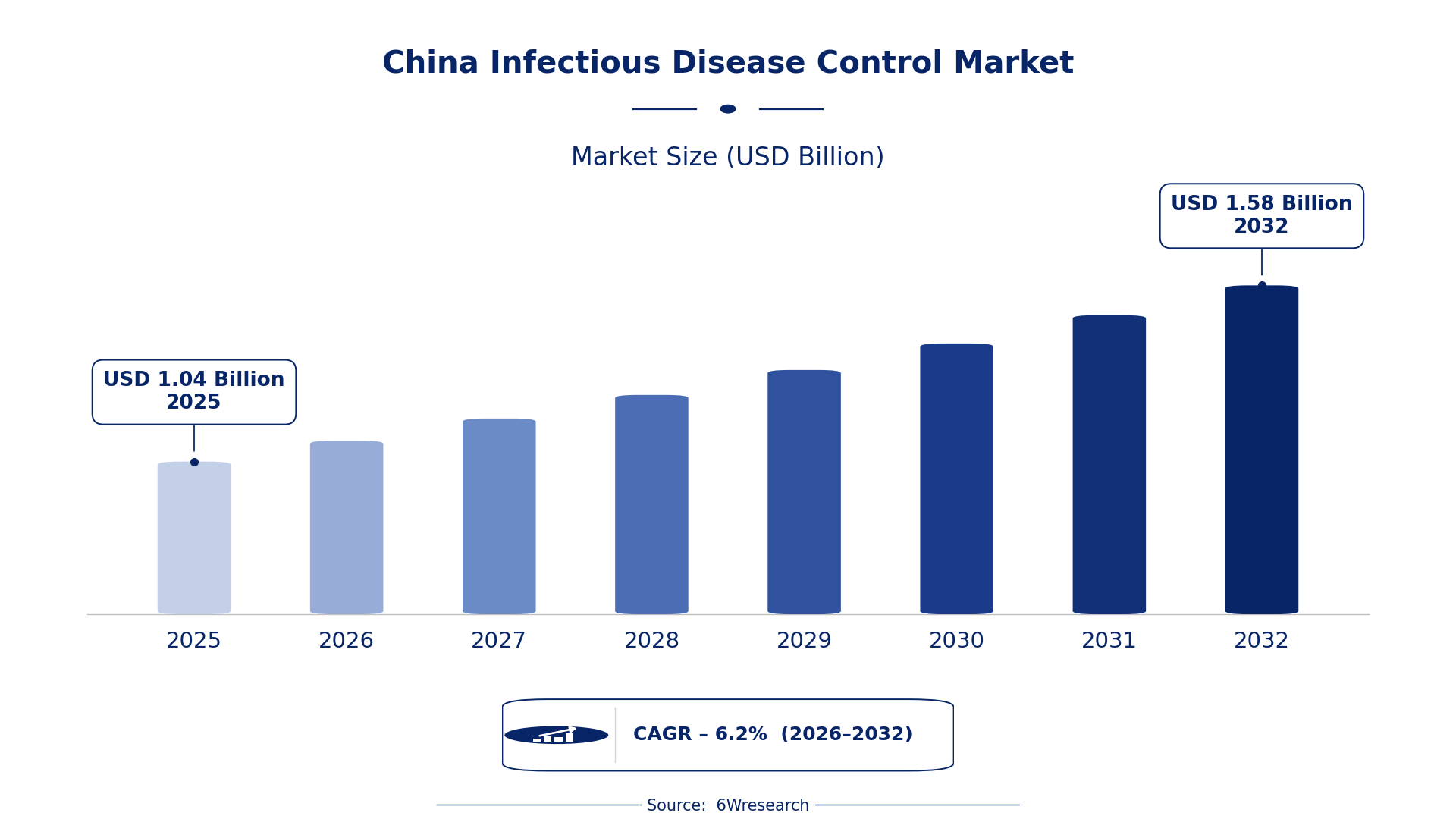
According to 6Wresearch internal database and industry insights, the China Infectious Disease Control Market was valued at USD 1.04 billion in 2025 and is projected to reach USD 1.58 billion by 2032, growing at a CAGR of approximately 6.2% during 2026–2032.
China Infectious Disease Control Market Highlights
| Report Metric | Details |
| Report Name | China Infectious Disease Control Market |
| Market Size 2025 | USD 1.04 billion |
| Market Size 2032 | USD 1.58 billion |
| Absolute Growth 2025–2032 | USD 0.54 billion |
| CAGR 2026–2032 | 6.2% |
| Peak Annual Growth | 8.4% in 2032 |
| Forecast Period | 2026–2032 |
| Historical Data | 2022–2025 |
| Base Year | 2025 |
| Leading Control Strategy, 2025 | Mass Vaccination (41% share) |
| Leading Level of Intervention, 2025 | Public Health Programs (37% share) |
| Leading Target Area, 2025 | Population Outbreaks (43% share) |
| Leading Distribution Channel, 2025 | Government Contracts (48% share) |
| Fastest-Growing Control Strategy | Community Sanitation (8.1% CAGR) |
| Fastest-Growing Level of Intervention | Immunization Programs (9.0% CAGR) |
| Fastest-Growing Target Area | Disease Prevention (8.4% CAGR) |
| Fastest-Growing Distribution Channel | NGO / Public Health Units (8.0% CAGR) |
| Growing Sector | Public Health Programs |
| Key End Users | Government agencies, healthcare facilities, public health units, NGOs |
China Infectious Disease Control Market Year-wise Growth Rate and Key Drivers (2022–2032)
This graph illustrates the annual growth rates of the market from 2022 to 2032, highlighting a steady upward trajectory and projected market expansion over the forecast period.
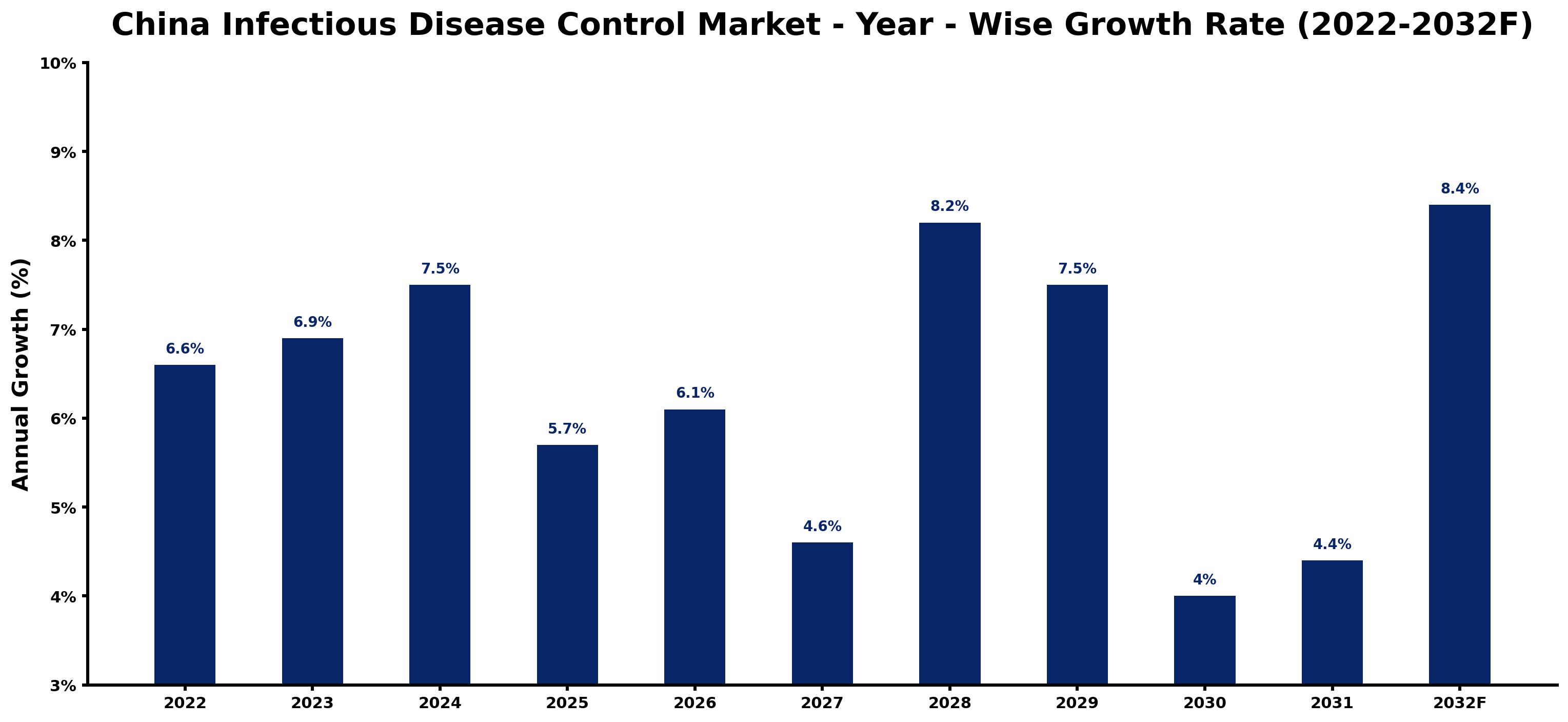
Below, each year's estimated growth is shown next to the factor that most influenced it.
| Year | Estimated Annual Growth (%) | Market Rationale |
| 2022 | 6.6 | The market showed steady growth due to ongoing public health initiatives. |
| 2023 | 6.9 | Demand increased as vaccination efforts expanded across urban centres. |
| 2024 | 7.5 | Heightened awareness of disease control led to faster growth rates. |
| 2025 | 5.7 | Growth slowed as the market adjusted to prior high levels of demand. |
| 2026 | 6.1 | Investment in public health infrastructure spurred renewed growth. |
| 2027 | 4.6 | A slowdown occurred as the market stabilised after rapid expansion. |
| 2028 | 8.2 | Increased focus on community sanitation drove faster growth rates. |
| 2029 | 7.5 | Growth slowed again as vaccination coverage reached high levels. |
| 2030 | 4.0 | The market faced a slowdown as priorities shifted to other health areas. |
| 2031 | 4.4 | Renewed investments in immunization programs boosted growth rates. |
| 2032 | 8.4 | The market peaked as new health initiatives were launched. |
Note: Market size estimations and growth projections presented in this report are based on 6Wresearch's proprietary forecasting methodology, utilizing the latest available industry data, government publications, and primary research inputs.
China Infectious Disease Control Market Synopsis
Infectious Disease Control in China encompasses strategies to prevent and manage outbreaks. This includes vaccination, sanitation, and protective equipment distribution, primarily for public health initiatives. The Infectious Disease Control Market is expanding due to increased government funding and public health programs. Demand is particularly strong in urban areas, where outbreaks are more likely. Major vaccination efforts and infrastructure improvements are key growth drivers, with over 1 billion vaccine doses administered in 2022.
Market Dynamics Impact Analysis (2026–2032)
| Factor | Type | Impact | Primary Segment Affected |
| Increased government funding for public health programs | Driver | High | Public Health Programs |
| Growing urban populations requiring extensive disease control measures | Driver | High | Population Outbreaks |
| Rising demand for community sanitation initiatives in rural areas | Opportunity | Medium | Community Sanitation |
| Increased investment in cold chain logistics for vaccine distribution | Opportunity | Medium | Cold Chain Distributors |
| Challenges in maintaining high vaccination coverage | Restraint | High | Immunization Programs |
| Limited resources for public health units in underserved areas | Restraint | Medium | NGO / Public Health Units |
| The Infectious Disease Control market in China faces funding shortages | Challenge | High | Public Health Programs |
| Technological barriers in implementing digital health solutions | Challenge | Medium | Healthcare + Frontline |
Evaluation of Drivers in China Infectious Disease Control Market (2026–2032)
The factors lifting demand, and the evidence behind each, are summarised below.
| Drivers | Primary Segment Affected | Why It Matters (Evidence) |
| Increased government funding for public health initiatives | Public Health Programs | In 2023, the government allocated 10 billion yuan for public health infrastructure improvements, leading to more resources for disease control. |
| Growing urban populations necessitating disease control measures | Population Outbreaks | China's population density in urban areas like Beijing drives higher demand for infectious disease control resources, increasing procurement. |
| Expansion of immunization programs targeting children | Immunization Programs | The National Immunization Program aims for over 90% vaccination coverage, increasing demand for vaccines and related supplies. |
| Investment in community sanitation initiatives | Community Sanitation | Community sanitation efforts in rural areas received 5 billion yuan in funding to improve health outcomes and prevent disease spread. |
| Development of cold chain logistics for vaccine distribution | Cold Chain Distributors | The Cold Chain Logistics Program ensures vaccines are stored correctly, facilitating wider distribution and accessibility. |
The Infectious Disease Control market in China is expanding as increased government funding, growing urban populations, and the expansion of immunization programs drive demand. In 2023, the government allocated 10 billion yuan for public health infrastructure improvements, enhancing disease control resources. Urban areas require extensive disease control measures due to their population density, which increases procurement. The National Immunization Program targets over 90% vaccination coverage, boosting the need for vaccines. Investment in community sanitation initiatives in rural areas is prioritised, improving health outcomes and further stimulating demand.
Evaluation of Restraints in China Infectious Disease Control Market
The table below lists the restraints and the evidence behind each.
| Market Restraint | Primary Segment Affected | Why It Matters (Evidence) |
| Funding shortages for public health initiatives | Public Health Programs | Limited budgets restrict the implementation of essential disease control measures, affecting outreach and effectiveness. |
| Resource constraints for NGOs in underserved areas | NGO / Public Health Units | Many public health units lack the necessary resources to effectively manage disease outbreaks, limiting their impact. |
| Challenges in maintaining high vaccination coverage | Immunization Programs | Vaccine hesitancy and logistical issues hinder achieving vaccination targets, which affects public health outcomes. |
| Technological barriers in implementing digital health solutions | Healthcare + Frontline | Limited access to technology affects the efficiency of disease monitoring and response, complicating outbreak management. |
| Inconsistent community sanitation efforts across regions | Community Sanitation | Rural areas often lack the necessary infrastructure for effective sanitation, resulting in increased disease spread. |
China Infectious Disease Control Market Challenges
The China Infectious Disease Control market incurs substantial costs for government health agencies, primarily due to the need for extensive resources in a population of approximately 1.4 billion. This high demand arises from the necessity of public health initiatives, which can delay the implementation of crucial disease control measures. Regulatory compliance adds to the burden, as healthcare facilities must adhere to updated national sanitation standards, increasing operational expenses and slowing response times. A shortage of skilled healthcare workers further complicates outbreak management, resulting in inefficiencies that can hinder effective disease control efforts.
Trends in the China Infectious Disease Control Market
Four trends stand out in the China Infectious Disease Control Market.
- Shift towards Enhanced Disease Surveillance Systems: The National Health Commission implemented the Infectious Disease Surveillance System in 2023, improving outbreak detection capabilities. This initiative enhances response times and resource allocation during outbreaks, ensuring better management of infectious diseases.
- Transition from Traditional to Digital Health Technologies: In 2023, the government promoted digital health technologies for disease monitoring, aiming to streamline response efforts. This shift is expected to improve efficiency in public health management, particularly in urban areas.
- Emergence of Community Sanitation as a Priority: Community sanitation initiatives have gained prominence, especially in rural areas, with 5 billion yuan allocated in 2023. This focus aims to prevent disease spread and improve health outcomes, benefiting local populations.
- Increased Emphasis on Cold Chain Logistics for Vaccines: The Cold Chain Logistics Program, initiated in 2022, has enhanced the distribution of vaccines across urban and rural areas. This ensures that vaccines are stored at required temperatures, improving accessibility.
Investment Opportunities in the China Infectious Disease Control Market
Several openings in the China Infectious Disease Control Market merit attention from investors.
- Timing for Investment in Public Health Programs: With increased government funding in 2023, there is an opportunity to invest in public health programs targeting urban areas, where demand is high due to population density and the need for disease control.
- Need for Enhanced Community Sanitation Solutions: Public health units require innovative solutions for community sanitation, particularly in rural areas, presenting opportunities for suppliers to provide effective sanitation technologies and improve health outcomes.
- Expansion of Immunization Programs: The National Immunization Program is targeting over 90% vaccination coverage, creating opportunities for suppliers of vaccines and related medical supplies to meet growing demand.
- Entry into Cold Chain Logistics: With the Cold Chain Logistics Program enhancing vaccine distribution, partnerships with local distributors can facilitate entry into this growing market, ensuring proper storage and distribution.
Government Initiatives in the China Infectious Disease Control Market
The Healthy China 2030 initiative, launched by the National Health Commission in 2016, aims to improve public health infrastructure and disease prevention strategies across the country. This initiative focuses on enhancing healthcare facilities and ensuring compliance with national sanitation standards. The program has allocated significant funding to support public health initiatives, which directly impacts the effectiveness of infectious disease control measures. The initiative also promotes community engagement in health education, further strengthening disease prevention efforts. In 2023, the government allocated 10 billion yuan for these improvements, benefiting various public health programs.
The Ministry of Health oversees the implementation of various health programs, including the Infectious Disease Surveillance System initiated in 2023. This system enhances outbreak detection and response capabilities, ensuring that public health units are well-equipped to manage infectious diseases. Additionally, the Ministry of Health funds training programs for healthcare workers, improving their preparedness for outbreak situations. These agencies play a vital role in approving health initiatives and allocating resources for effective disease management, with a focus on enhancing public health outcomes.
Future Insight of the China Infectious Disease Control Market
By 2032, the China Infectious Disease Control market will undergo significant changes, driven by government initiatives like the Healthy China 2030 programme. Enhanced disease surveillance systems will facilitate quicker outbreak detection and response, while increased funding for public health infrastructure will enable better allocation of resources. Ongoing training for healthcare workers by the China CDC will bolster outbreak management capabilities. These developments will equip buyers and suppliers to address infectious disease challenges more effectively and improve overall health outcomes nationwide.
Market Segmentation Analysis
Each segment group is reviewed below, with the leader by share and the fastest grower by CAGR.
By Control Strategy – Mass Vaccination Dominated, Community Sanitation Expected to Grow Fastest
According to Shubham Deep, Research Manager at 6Wresearch, Mass Vaccination took a 41% share of control strategy in 2025, more than any other category. Mass vaccination holds the largest share in China's infectious disease control market due to its critical role in immunizing over 1 billion individuals annually. This strategy is particularly effective in urban areas like Beijing and Shanghai, where the risk of outbreaks is heightened. Community Sanitation is set to record the highest CAGR in this split, 8.1% over 2026–2032. Community sanitation is experiencing rapid growth as urban areas increasingly prioritise public health initiatives to prevent disease spread. For instance, recent campaigns have focused on improving sanitation in densely populated regions, reflecting a shift towards holistic health strategies. Suppliers must align their offerings with government initiatives to effectively tap into the growing demand for community sanitation resources.
By Level of Intervention – Public Health Programs Dominated, Immunization Programs Expected to Grow Fastest
In 2025, Public Health Programs led the level of intervention split with a 37% share. Public health programs command the largest market share as they are integral to national strategies for controlling infectious diseases across China. The National Health Commission ensures these programs receive robust funding and are effectively executed nationwide, especially in urban centres. The quickest growth will come from Immunization Programs, forecast to expand at a CAGR of 9.0% between 2026 and 2032. Immunization programs are witnessing rapid growth, driven by the government's commitment to achieving over 90% vaccination coverage among children. This focus on vaccination reflects a proactive approach to preventing infectious diseases and will likely strengthen the lead of public health programs. Suppliers should concentrate on developing solutions related to immunization to meet the rising demand from public health initiatives.
By Target Area – Population Outbreaks Dominated, Disease Prevention Expected to Grow Fastest
Population Outbreaks accounted for a 43% market share by target area in 2025. Population outbreaks represent the largest share as they are the primary focus during infectious disease emergencies, particularly in densely populated cities. The government's strategic interventions during these outbreaks underscore the need for targeted measures to effectively control the spread of diseases. Disease Prevention is projected to grow fastest, at a CAGR of 8.4% during 2026–2032. Disease prevention is emerging as a rapidly growing focus within infectious disease control, with substantial investments directed towards preventive strategies. This trend is evident in government initiatives aimed at enhancing disease surveillance and public awareness campaigns. Suppliers should prioritise solutions that bolster disease prevention strategies to capitalise on the increasing emphasis on proactive health measures.
By Distribution Channel – Government Contracts Dominated, NGO / Public Health Units Expected to Grow Fastest
Government Contracts held a 48% share of the China Infectious Disease Control Market by distribution channel in 2025. Government contracts lead the distribution channel, serving as the primary source of funding for infectious disease control efforts. This reliance on government support highlights the necessity of complying with national health standards for effective resource allocation. Over 2026–2032, NGO / Public Health Units are expected to post the fastest growth, at a CAGR of 8.0%. NGOs and public health units are experiencing the fastest growth as they collaborate closely with government agencies to enhance outreach and effectiveness in disease management. Their expanding role in underserved communities is driving increased demand for their services. Suppliers must cultivate relationships with NGOs and public health units to strengthen their market presence and improve service delivery.
Key Attractiveness of the Report
- 10 Years of Market Numbers
- Historical Data Starting from 2022 to 2025
- Base Year 2025
- Forecast Data until 2032
- Key Performance Indicators Impacting the Market
- Major Upcoming Developments and Projects
Key Highlights of the Report:
- China Infectious Disease Control Market Outlook
- Market Size of China Infectious Disease Control Market, 2025
- Forecast of China Infectious Disease Control Market, 2032
- Historical Data and Forecast of China Infectious Disease Control Revenues & Volume for the Period 2022 - 2032F
- China Infectious Disease Control Market Trend Evolution
- China Infectious Disease Control Market Drivers and Challenges
- China Infectious Disease Control Price Trends
- China Infectious Disease Control Porter's Five Forces
- China Infectious Disease Control Industry Life Cycle
- Historical Data and Forecast of China Infectious Disease Control Market Revenues & Volume By Control Strategy for the Period 2022 - 2032F
- Historical Data and Forecast of China Infectious Disease Control Market Revenues & Volume By Quarantine Infrastructure for the Period 2022 - 2032F
- Historical Data and Forecast of China Infectious Disease Control Market Revenues & Volume By Community Sanitation for the Period 2022 - 2032F
- Historical Data and Forecast of China Infectious Disease Control Market Revenues & Volume By Mass Vaccination for the Period 2022 - 2032F
- Historical Data and Forecast of China Infectious Disease Control Market Revenues & Volume By PPE Distribution for the Period 2022 - 2032F
- Historical Data and Forecast of China Infectious Disease Control Market Revenues & Volume By Level of Intervention for the Period 2022 - 2032F
- Historical Data and Forecast of China Infectious Disease Control Market Revenues & Volume By Facility-Based for the Period 2022 - 2032F
- Historical Data and Forecast of China Infectious Disease Control Market Revenues & Volume By Public Health Programs for the Period 2022 - 2032F
- Historical Data and Forecast of China Infectious Disease Control Market Revenues & Volume By Immunization Programs for the Period 2022 - 2032F
- Historical Data and Forecast of China Infectious Disease Control Market Revenues & Volume By Healthcare + Frontline for the Period 2022 - 2032F
- Historical Data and Forecast of China Infectious Disease Control Market Revenues & Volume By Target Area for the Period 2022 - 2032F
- Historical Data and Forecast of China Infectious Disease Control Market Revenues & Volume By Population Outbreaks for the Period 2022 - 2032F
- Historical Data and Forecast of China Infectious Disease Control Market Revenues & Volume By Urban / Rural Areas for the Period 2022 - 2032F
- Historical Data and Forecast of China Infectious Disease Control Market Revenues & Volume By Disease Prevention for the Period 2022 - 2032F
- Historical Data and Forecast of China Infectious Disease Control Market Revenues & Volume By Personal Protection for the Period 2022 - 2032F
- Historical Data and Forecast of China Infectious Disease Control Market Revenues & Volume By Distribution Channel for the Period 2022 - 2032F
- Historical Data and Forecast of China Infectious Disease Control Market Revenues & Volume By Government Contracts for the Period 2022 - 2032F
- Historical Data and Forecast of China Infectious Disease Control Market Revenues & Volume By NGO / Public Health Units for the Period 2022 - 2032F
- Historical Data and Forecast of China Infectious Disease Control Market Revenues & Volume By Cold Chain Distributors for the Period 2022 - 2032F
- Historical Data and Forecast of China Infectious Disease Control Market Revenues & Volume By Medical Suppliers for the Period 2022 - 2032F
- China Infectious Disease Control Import Export Trade Statistics
- Market Opportunity Assessment By Control Strategy
- Market Opportunity Assessment By Level of Intervention
- Market Opportunity Assessment By Target Area
- Market Opportunity Assessment By Distribution Channel
- China Infectious Disease Control Top Companies Market Share
- China Infectious Disease Control Competitive Benchmarking By Technical and Operational Parameters
- China Infectious Disease Control Company Profiles
- China Infectious Disease Control Key Strategic Recommendations
Market Covered
This report examines the market across the segments below.
By Control Strategy
- Quarantine Infrastructure
- Community Sanitation
- Mass Vaccination
- PPE Distribution
By Level of Intervention
- Facility-Based
- Public Health Programs
- Immunization Programs
- Healthcare + Frontline
By Target Area
- Population Outbreaks
- Urban / Rural Areas
- Disease Prevention
- Personal Protection
By Distribution Channel
- Government Contracts
- NGO / Public Health Units
- Cold Chain Distributors
- Medical Suppliers































