China Infectious Disease Market Size & Growth Rate
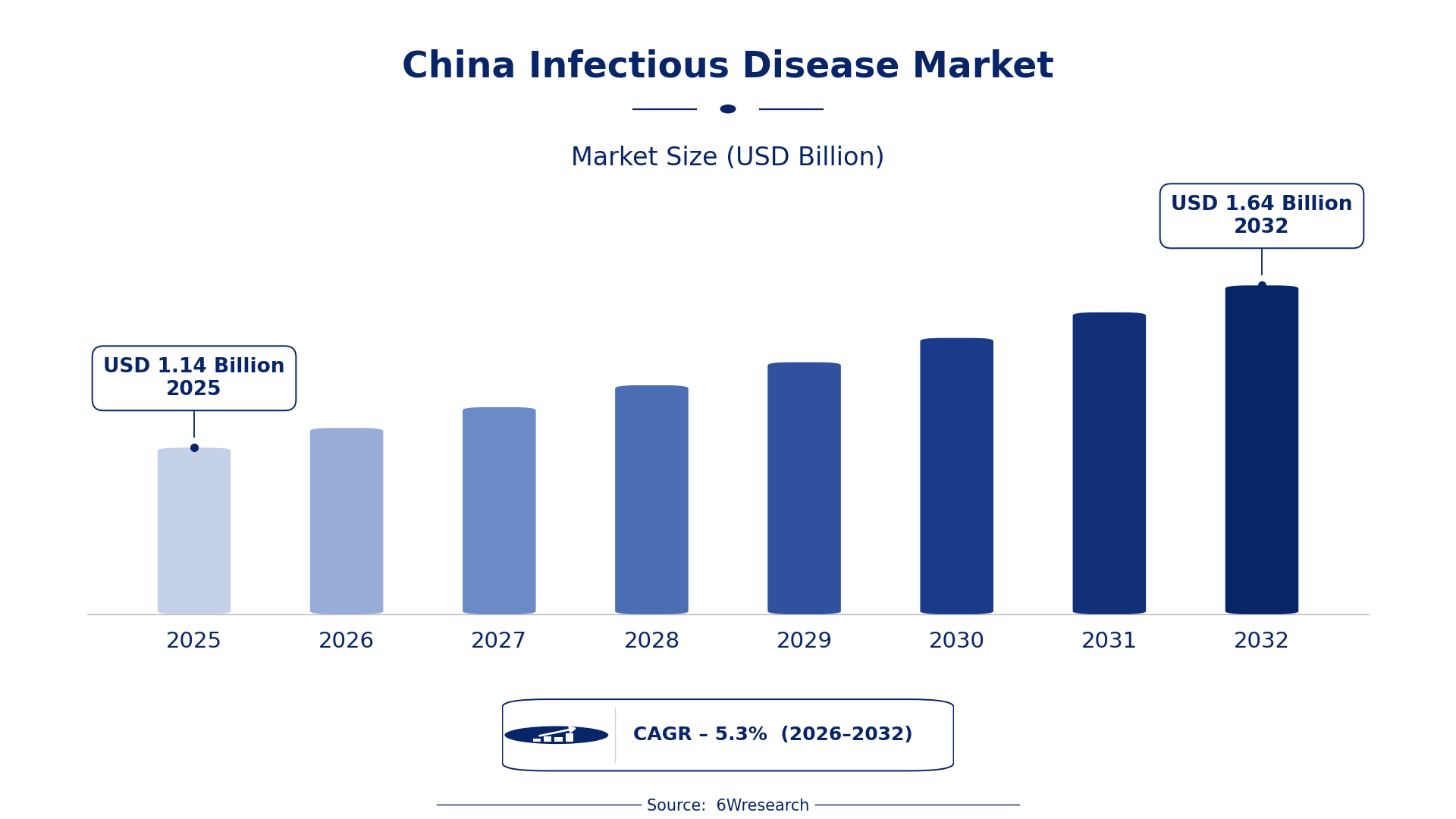
According to 6Wresearch internal database and industry insights, the China Infectious Disease Market was valued at USD 1.14 billion in 2025 and is projected to reach USD 1.64 billion by 2032, growing at a CAGR of approximately 5.3% during 2026–2032.
China Infectious Disease Market Highlights
| Report Metric | Details |
| Report Name | China Infectious Disease Market |
| Market Size 2025 | USD 1.14 billion |
| Market Size 2032 | USD 1.64 billion |
| Absolute Growth 2025–2032 | USD 0.50 billion |
| CAGR 2026–2032 | 5.3% |
| Peak Annual Growth | 7.1% in 2026 |
| Forecast Period | 2026–2032 |
| Historical Data | 2022–2025 |
| Base Year | 2025 |
| Leading Disease Type, 2025 | Viral Infections (39% share) |
| Leading Transmission Mode, 2025 | Airborne / Bloodborne (36% share) |
| Leading Healthcare Impact, 2025 | Epidemics / Pandemics (50% share) |
| Leading Distribution Channel, 2025 | Hospital Drug Suppliers (39% share) |
| Fastest-Growing Disease Type | Fungal Infections (7.4% CAGR) |
| Fastest-Growing Transmission Mode | Vector-Borne (7.1% CAGR) |
| Fastest-Growing Healthcare Impact | Community Acquired (7.9% CAGR) |
| Fastest-Growing Distribution Channel | Government Supply Chains (6.4% CAGR) |
| Growing Sector | Healthcare |
| Key End Users | Healthcare providers, Government agencies, Pharmaceutical manufacturers |
China Infectious Disease Market Year-wise Growth Rate and Key Drivers (2022–2032)
This graph illustrates the annual growth rates of the market from 2022 to 2032, highlighting a steady upward trajectory and projected market expansion over the forecast period.
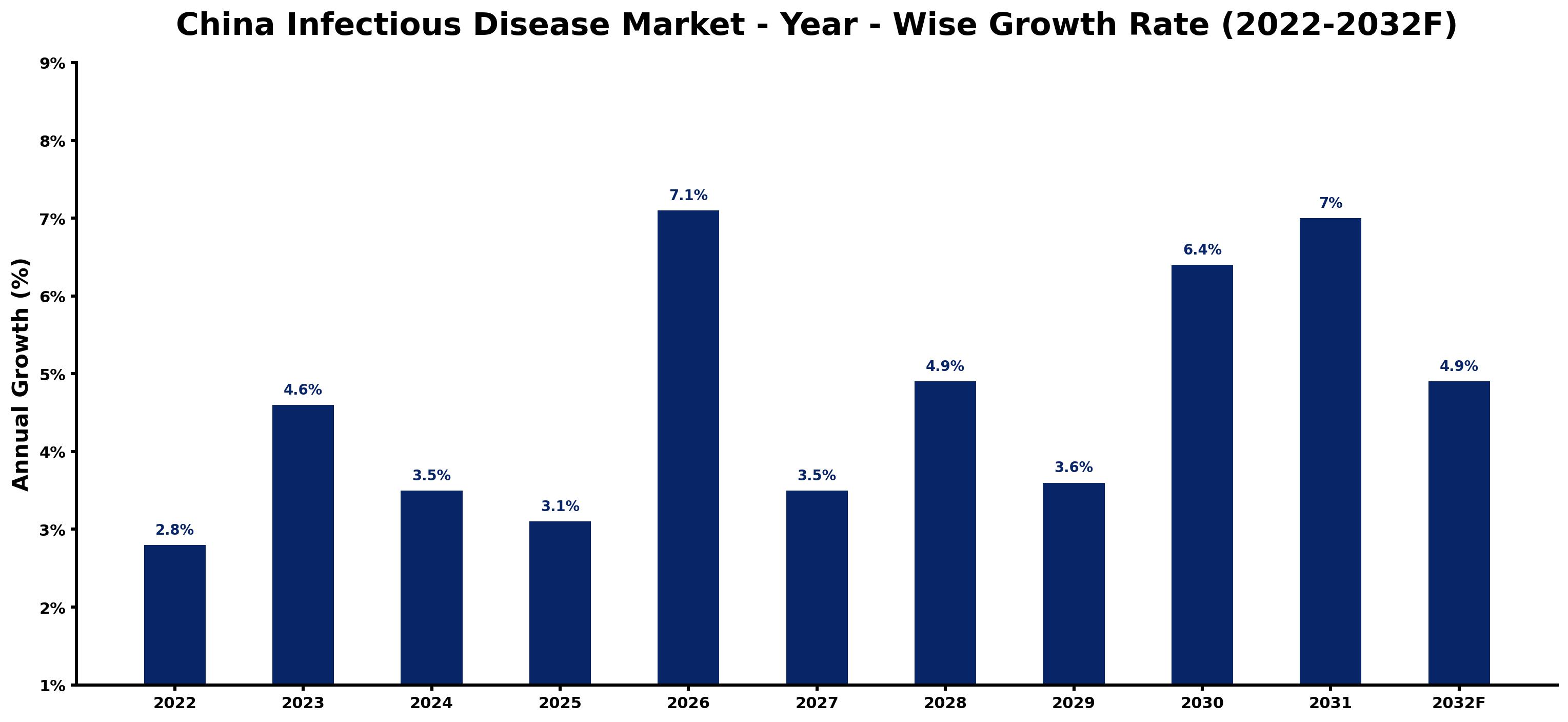
Each row of the following table gives one year's estimated growth and the event or demand shift that explains it.
| Year | Estimated Annual Growth (%) | Market Rationale |
| 2022 | 2.8 | The market experienced steady growth due to ongoing healthcare investments in infectious disease management. |
| 2023 | 4.6 | Demand increased as the government implemented the 'Infectious Disease Prevention Strategy' to bolster disease control measures. |
| 2024 | 3.5 | Growth slowed as the market adapted to new healthcare policies introduced in previous years. |
| 2025 | 3.1 | Investment in healthcare infrastructure continued to support growth in infectious disease products. |
| 2026 | 7.1 | A surge in funding for infectious disease research is projected to lead to peak growth. |
| 2027 | 3.5 | Growth is expected to slow as the market stabilises after rapid expansion in prior years. |
| 2028 | 4.9 | Public health initiatives are anticipated to drive demand for infectious disease products. |
| 2029 | 3.6 | Growth is likely to slow again as the market normalises after heightened activity. |
| 2030 | 6.4 | Demand is expected to surge as new health strategies are rolled out nationwide. |
| 2031 | 7.0 | A heightened focus on epidemic preparedness will contribute to strong growth. |
| 2032 | 4.9 | Growth is projected to slow as the market matures and demand stabilises. |
Note: Market size estimations and growth projections presented in this report are based on 6Wresearch's proprietary forecasting methodology, utilizing the latest available industry data, government publications, and primary research inputs.
China Infectious Disease Market Synopsis
Infectious disease products in China include diagnostics, therapeutics, and vaccines aimed at various pathogens. These products undergo thorough research and regulatory approvals, facilitating the prevention, diagnosis, and treatment of infections. The China Infectious Disease Market is growing due to strong demand from domestic healthcare providers and international partnerships. The 'Infectious Disease Prevention Strategy', introduced in 2023, seeks to enhance disease management and response capabilities. The 'Healthy China 2030' initiative emphasises infectious disease management, propelling market expansion.
Market Dynamics Impact Analysis (2026–2032)
| Factor | Type | Impact | Primary Segment Affected |
| Increased funding for infectious disease research and development | Driver | High | Viral Infections |
| Growing demand for diagnostics and therapeutics among healthcare providers | Driver | High | Bacterial Infections |
| Expansion of public health initiatives targeting rural healthcare access | Opportunity | High | Community Acquired |
| Rising need for vaccines in response to emerging infectious diseases | Opportunity | High | Epidemics / Pandemics |
| Regulatory challenges in product approvals and market entry | Restraint | High | Hospital Drug Suppliers |
| Limited access to advanced diagnostic technologies in rural areas | Restraint | Medium | Pharmacy Chains |
| High costs associated with research and clinical trials | Challenge | High | Online Prescription Stores |
| Supply chain disruptions affecting product availability | Challenge | Medium | Government Supply Chains |
Evaluation of Drivers in China Infectious Disease Market (2026–2032)
The main growth drivers and the segments they affect most are set out below.
| Drivers | Primary Segment Affected | Why It Matters (Evidence) |
| Increased government funding for infectious disease research | Viral Infections | This funding, which increased by 30% in 2023, enables the development of advanced diagnostics and therapeutics, driving demand from healthcare providers. |
| Expansion of healthcare infrastructure | Hospital Drug Suppliers | With over 2,500 hospitals equipped for infectious disease treatment, the capacity to manage outbreaks effectively increases, leading to higher procurement of necessary products. |
| Public health campaigns prioritising vaccination | Epidemics / Pandemics | These campaigns enhance awareness and uptake of vaccines, resulting in increased demand for related infectious disease products. |
| International collaborations in healthcare | Government Supply Chains | Collaborations improve access to treatment solutions, facilitating procurement processes and increasing the volume of products supplied to government health initiatives. |
| Adoption of ISO 15189:2012 standards | Viral Infections | This standard enhances the accuracy of diagnostic testing, leading to greater trust and demand from healthcare providers and patients alike. |
In 2023, funding for infectious disease research rose by 30%, resulting in more diagnostics being developed. With over 2,500 hospitals equipped for infectious disease treatment, healthcare providers are now better prepared to manage outbreaks. Public health campaigns that prioritise vaccination are boosting demand for related products. International collaborations improve access to treatment solutions, while telehealth services enhance care delivery for patients needing ongoing management.
Evaluation of Restraints in China Infectious Disease Market
The main factors holding the market back are set out below.
| Market Restraint | Primary Segment Affected | Why It Matters (Evidence) |
| Regulatory hurdles delaying product approvals | Hospital Drug Suppliers | The National Medical Products Administration's stringent approval processes can extend timelines for new product launches. |
| Insufficient diagnostic technology in rural healthcare settings | Pharmacy Chains | Limited access to advanced diagnostic tools hampers effective treatment in underserved areas. |
| High research and development costs for new therapeutics | Online Prescription Stores | The substantial investment needed for clinical trials can deter smaller firms from entering the market. |
| Supply chain disruptions affecting product distribution | Government Supply Chains | Logistical challenges can delay the availability of essential infectious disease products. |
| Limited awareness of infectious disease management protocols | Community Acquired | Healthcare providers may lack training on the latest guidelines, affecting treatment efficacy. |
China Infectious Disease Market Challenges
The China Infectious Disease Market encounters supply chain disruptions, particularly in sourcing essential components for diagnostics and therapeutics. These disruptions can delay product availability, affecting over 5,000 pharmaceutical companies that depend on timely inputs. Rising regulatory compliance costs place a burden on suppliers, leading to increased prices for healthcare providers and restricting access to necessary treatments. In 2022, China recorded over 1 million cases of viral infections, yet a shortage of skilled healthcare professionals hampers effective patient management, straining hospitals already under pressure to serve a large population.
Trends in the China Infectious Disease Market
Buyers and suppliers in the China Infectious Disease Market are adjusting to the following trends.
- Shift towards Integrated Disease Management: Healthcare providers are increasingly adopting integrated approaches to manage infectious diseases, as seen in the 'Health China Initiative' launched in 2022. This initiative aims to improve treatment access across rural areas, positively impacting patient care.
- Transition from Traditional to Telehealth Services: The adoption of telehealth services has risen, providing greater access to infectious disease management for patients. In 2022, telemedicine usage increased by 40%, enabling remote consultations and follow-ups.
- Emergence of Rapid Diagnostic Technologies: Rapid diagnostic technologies are gaining traction in China, driven by the need for timely disease detection. The implementation of ISO 15189:2012 standards ensures quality in diagnostic testing, improving healthcare outcomes.
- Prioritisation of Vaccination Programs: The focus on vaccination programs has intensified, particularly after the launch of the 'Infectious Disease Prevention Strategy' in 2023. This strategy aims to increase vaccination rates, effectively addressing public health concerns.
Investment Opportunities in the China Infectious Disease Market
The following opportunities in the China Infectious Disease Market pair current demand with a clear way in.
- Investment in Rural Healthcare Facilities: With over 1.4 billion people, China has a notable gap in healthcare access, particularly in rural areas. Investing in rural healthcare facilities can address the growing demand for infectious disease treatments.
- Supply of Advanced Diagnostic Tools: The market for diagnostic tools is set to expand, with a projected growth of 30% over the next five years. Suppliers can target hospital drug suppliers to enhance diagnostic capabilities.
- Development of Innovative Vaccines: The government is increasing funding for infectious disease management, with a 30% increase planned over five years. Suppliers can engage with government supply chains to meet public health needs.
- Enhancement of Public Health Education: There is a rising need for public health education initiatives, particularly concerning infectious disease management. Targeting community health programs can effectively raise awareness and improve treatment outcomes.
Government Initiatives in the China Infectious Disease Market
The 'Infectious Disease Control Law', revised in 2020, strengthens regulatory measures for outbreak management, ensuring that producers comply with stringent standards. This law mandates reporting and testing protocols for infectious disease products, improving overall market integrity. Additionally, the 'National Plan for Infectious Disease Prevention and Control', updated in 2021, aims to enhance surveillance and response capabilities, directly impacting how healthcare providers manage infectious diseases. The 'Health China Initiative', launched in 2022, focuses on improving access to treatments in rural areas, further supporting producers and buyers.
The Chinese Center for Disease Control and Prevention oversees infectious disease control and funding initiatives. It approves various health programs, including the 'Health China Initiative', which aims to improve access to treatments across rural areas. The National Health Commission also supports outbreak response efforts, ensuring that resources are allocated effectively to combat infectious diseases. Their funding initiatives are vital for improving healthcare infrastructure and ensuring timely access to necessary treatments. In 2023, funding for infectious disease research is expected to increase by 30% over five years, benefiting both producers and buyers.
Future Insight of the China Infectious Disease Market
Several forward-looking factors are expected to support the China Infectious Disease Market over the coming years. The 'Infectious Disease Prevention Strategy' will strengthen national response capabilities, ensuring better management of outbreaks. By 2032, the 'Healthy China 2030' initiative will improve healthcare infrastructure, enabling hospitals to respond more effectively to infectious disease challenges. The adoption of ISO 15189:2012 standards will enhance diagnostic accuracy, benefiting both healthcare providers and patients, while community health programs will focus on addressing the specific needs of vulnerable populations.
Market Segmentation Analysis
The analysis below covers each segmentation, its leading category in 2025 and its fastest-growing category through 2032.
By Disease Type – Viral Infections Dominated, Fungal Infections Expected to Grow Fastest
According to Shubham Deep, Research Manager at 6Wresearch, Viral Infections took a 39% share of disease type in 2025, more than any other category. Viral infections lead the market share due to the over 1 million cases reported annually in China, prompting a strong demand for diagnostics and treatments. Hospitals and healthcare providers are particularly focused on addressing these prevalent infections, ensuring a robust market presence. Fungal Infections are set to record the highest CAGR in this split, 7.4% over 2026–2032. Fungal infections are witnessing rapid growth, driven by heightened awareness and targeted health initiatives for specific populations. This increasing focus on fungal health issues is expected to expand their market share significantly in the coming years. Suppliers should consider diversifying their product lines to include solutions for fungal infections to capitalise on the growing demand.
By Transmission Mode – Airborne / Bloodborne Dominated, Vector-Borne Expected to Grow Fastest
The largest transmission mode category in 2025 was Airborne / Bloodborne, with a 36% share of total revenue. Airborne and bloodborne transmission modes account for a large share of infectious disease cases, making them critical for controlling outbreaks. Their significance in managing diseases like influenza and HIV contributes to their leading position in the market. Over 2026–2032, Vector-Borne is expected to post the fastest growth, at a CAGR of 7.1%. Vector-borne transmission is growing swiftly, particularly due to increased efforts in controlling diseases such as malaria through public health initiatives. This heightened focus on vector control is likely to accelerate its market share in the near future. Buyers should prioritise products targeting vector-borne diseases as they become increasingly vital in public health strategies.
By Healthcare Impact – Epidemics / Pandemics Dominated, Community Acquired Expected to Grow Fastest
In 2025, Epidemics / Pandemics led the healthcare impact split with a 50% share. Epidemics and pandemics represent the largest share in the market due to their critical role in national health security, especially highlighted by recent global health events. The pressing need for effective outbreak responses reinforces their dominant position in the infectious disease market. Community Acquired is projected to grow fastest, at a CAGR of 7.9% during 2026–2032. Community-acquired infections are experiencing swift growth as they tackle prevalent health issues affecting a wide demographic. This increased emphasis on common infections is projected to significantly enhance their market share. Suppliers must prioritise the development of products targeting community-acquired infections to meet the escalating healthcare needs.
By Distribution Channel – Hospital Drug Suppliers Dominated, Government Supply Chains Expected to Grow Fastest
Hospital Drug Suppliers accounted for a 39% market share by distribution channel in 2025. Hospital drug suppliers maintain the largest market share, essential for ensuring the availability of infectious disease products within healthcare facilities. Their established networks and strong relationships with hospitals solidify their leading role in the distribution landscape. The quickest growth will come from Government Supply Chains, forecast to expand at a CAGR of 6.4% between 2026 and 2032. Government supply chains are rapidly expanding, influenced by initiatives such as the 'Infectious Disease Prevention Strategy' that emphasise public health priorities. This strategic focus is likely to markedly increase their market share. Suppliers should engage proactively with government supply chains to enhance their distribution capabilities and align with public health strategies.
Key Attractiveness of the Report
- 10 Years of Market Numbers
- Historical Data Starting from 2022 to 2025
- Base Year 2025
- Forecast Data until 2032
- Key Performance Indicators Impacting the Market
- Major Upcoming Developments and Projects
Key Highlights of the Report:
- China Infectious Disease Market Outlook
- Market Size of China Infectious Disease Market, 2025
- Forecast of China Infectious Disease Market, 2032
- Historical Data and Forecast of China Infectious Disease Revenues & Volume for the Period 2022 - 2032F
- China Infectious Disease Market Trend Evolution
- China Infectious Disease Market Drivers and Challenges
- China Infectious Disease Price Trends
- China Infectious Disease Porter's Five Forces
- China Infectious Disease Industry Life Cycle
- Historical Data and Forecast of China Infectious Disease Market Revenues & Volume By Disease Type for the Period 2022 - 2032F
- Historical Data and Forecast of China Infectious Disease Market Revenues & Volume By Viral Infections for the Period 2022 - 2032F
- Historical Data and Forecast of China Infectious Disease Market Revenues & Volume By Bacterial Infections for the Period 2022 - 2032F
- Historical Data and Forecast of China Infectious Disease Market Revenues & Volume By Fungal Infections for the Period 2022 - 2032F
- Historical Data and Forecast of China Infectious Disease Market Revenues & Volume By Parasitic Infections for the Period 2022 - 2032F
- Historical Data and Forecast of China Infectious Disease Market Revenues & Volume By Transmission Mode for the Period 2022 - 2032F
- Historical Data and Forecast of China Infectious Disease Market Revenues & Volume By Airborne / Bloodborne for the Period 2022 - 2032F
- Historical Data and Forecast of China Infectious Disease Market Revenues & Volume By Contact / Waterborne for the Period 2022 - 2032F
- Historical Data and Forecast of China Infectious Disease Market Revenues & Volume By Environmental for the Period 2022 - 2032F
- Historical Data and Forecast of China Infectious Disease Market Revenues & Volume By Vector-Borne for the Period 2022 - 2032F
- Historical Data and Forecast of China Infectious Disease Market Revenues & Volume By Healthcare Impact for the Period 2022 - 2032F
- Historical Data and Forecast of China Infectious Disease Market Revenues & Volume By Epidemics / Pandemics for the Period 2022 - 2032F
- Historical Data and Forecast of China Infectious Disease Market Revenues & Volume By Community Acquired for the Period 2022 - 2032F
- Historical Data and Forecast of China Infectious Disease Market Revenues & Volume By Immunocompromised Patients for the Period 2022 - 2032F
- Historical Data and Forecast of China Infectious Disease Market Revenues & Volume By Developing Nations for the Period 2022 - 2032F
- Historical Data and Forecast of China Infectious Disease Market Revenues & Volume By Distribution Channel for the Period 2022 - 2032F
- Historical Data and Forecast of China Infectious Disease Market Revenues & Volume By Hospital Drug Suppliers for the Period 2022 - 2032F
- Historical Data and Forecast of China Infectious Disease Market Revenues & Volume By Pharmacy Chains for the Period 2022 - 2032F
- Historical Data and Forecast of China Infectious Disease Market Revenues & Volume By Online Prescription Stores for the Period 2022 - 2032F
- Historical Data and Forecast of China Infectious Disease Market Revenues & Volume By Government Supply Chains for the Period 2022 - 2032F
- China Infectious Disease Import Export Trade Statistics
- Market Opportunity Assessment By Disease Type
- Market Opportunity Assessment By Transmission Mode
- Market Opportunity Assessment By Healthcare Impact
- Market Opportunity Assessment By Distribution Channel
- China Infectious Disease Top Companies Market Share
- China Infectious Disease Competitive Benchmarking By Technical and Operational Parameters
- China Infectious Disease Company Profiles
- China Infectious Disease Key Strategic Recommendations
Market Covered
The report offers an extensive study of the following market segments.
By Disease Type
- Viral Infections
- Bacterial Infections
- Fungal Infections
- Parasitic Infections
By Transmission Mode
- Airborne / Bloodborne
- Contact / Waterborne
- Environmental
- Vector-Borne
By Healthcare Impact
- Epidemics / Pandemics
- Community Acquired
- Immunocompromised Patients
- Developing Nations
By Distribution Channel
- Hospital Drug Suppliers
- Pharmacy Chains
- Online Prescription Stores
- Government Supply Chains































