China Influenza Therapeutics Market Size & Growth Rate
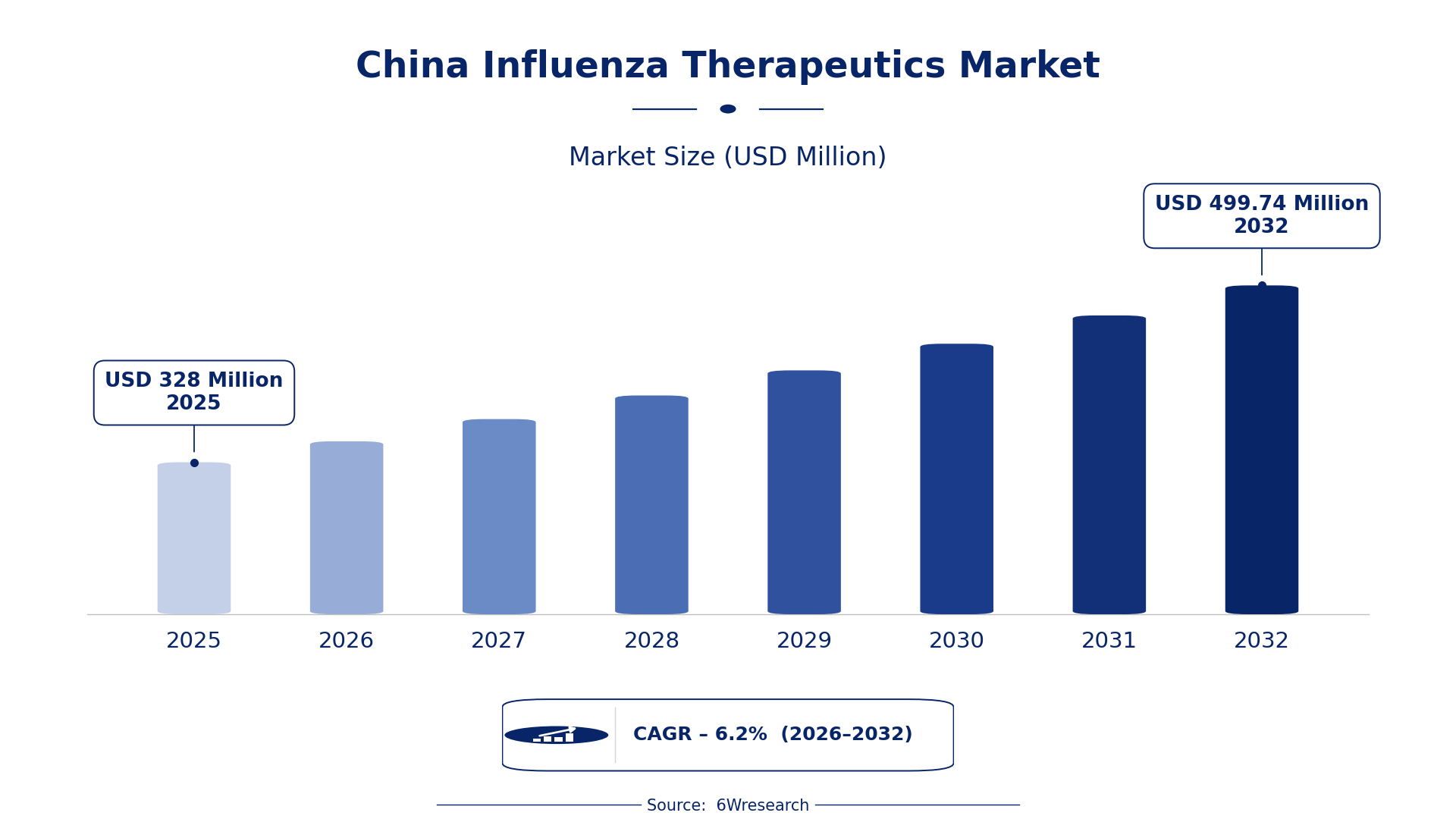
According to 6Wresearch internal database and industry insights, the China Influenza Therapeutics Market was valued at USD 328.0 million in 2025 and is projected to reach USD 499.74 million by 2032, growing at a CAGR of approximately 6.2% during 2026–2032.
China Influenza Therapeutics Market Highlights
| Report Metric | Details |
| Report Name | China Influenza Therapeutics Market |
| Market Size 2025 | USD 328.0 million |
| Market Size 2032 | USD 499.74 million |
| Absolute Growth 2025–2032 | USD 171.74 million |
| CAGR 2026–2032 | 6.2% |
| Peak Annual Growth | 8.7% in 2027 |
| Forecast Period | 2026–2032 |
| Historical Data | 2022–2025 |
| Base Year | 2025 |
| Leading Therapy Type, 2025 | Antivirals (41% share) |
| Leading Drug Type, 2025 | Neuraminidase Inhibitors (43% share) |
| Leading Target Influenza Strain, 2025 | Influenza A & B (40% share) |
| Leading Distribution Channel, 2025 | Hospital Pharmacies (51% share) |
| Fastest-Growing Therapy Type | Monoclonal Antibodies (8.4% CAGR) |
| Fastest-Growing Drug Type | Biologics (8.5% CAGR) |
| Fastest-Growing Target Influenza Strain | Severe Influenza (8.9% CAGR) |
| Fastest-Growing Distribution Channel | Drugstores (8.3% CAGR) |
| Growing Sector | Healthcare |
| Key End Users | Hospitals, healthcare providers, pharmacies, public health agencies |
China Influenza Therapeutics Market Year-wise Growth Rate and Key Drivers (2022–2032)
This graph illustrates the annual growth rates of the market from 2022 to 2032, highlighting a steady upward trajectory and projected market expansion over the forecast period.
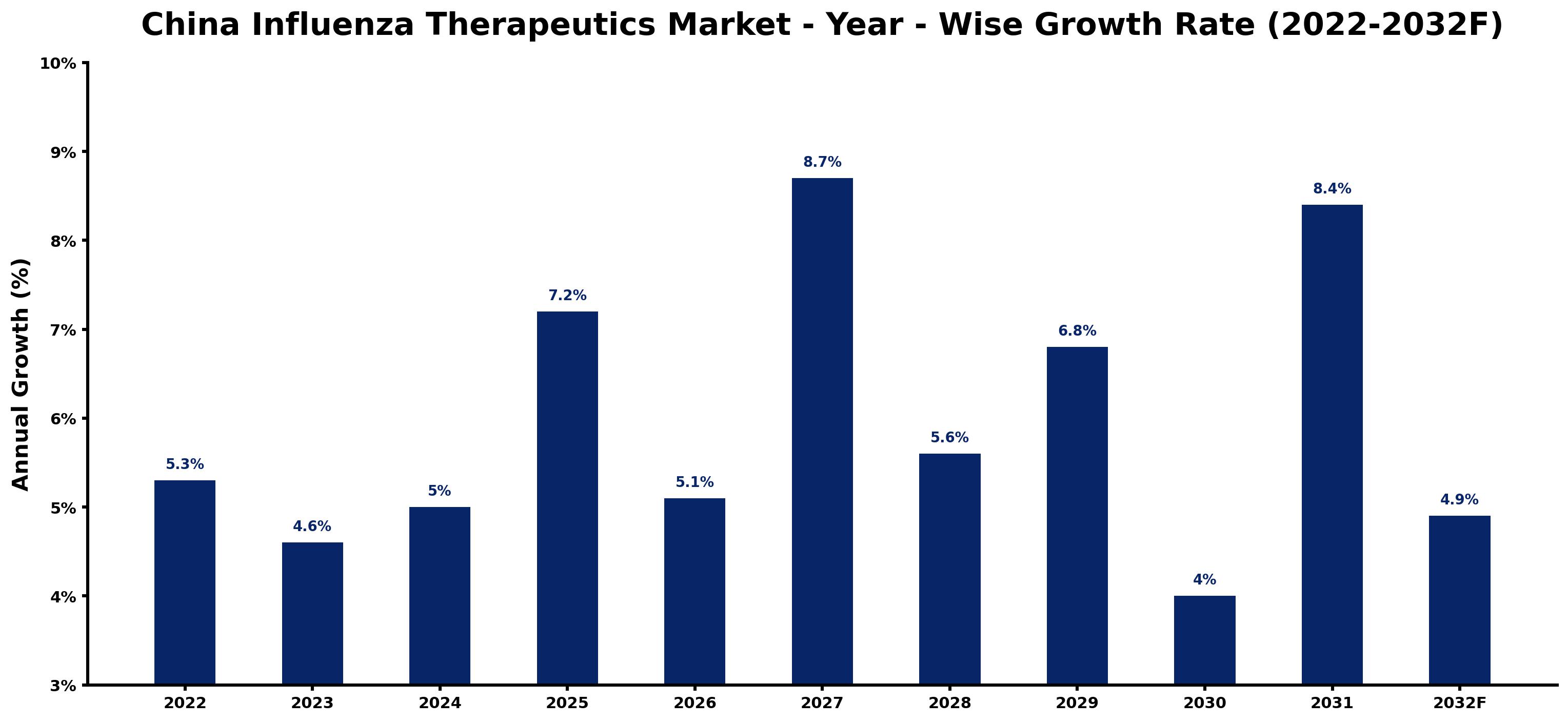
The table below sets out the estimated growth rate for each year and the main factor behind it.
| Year | Estimated Annual Growth (%) | Market Rationale |
| 2022 | 5.3 | The market experienced steady growth, driven by increasing influenza cases and healthcare initiatives. |
| 2023 | 4.6 | Demand slowed due to a temporary decrease in influenza cases compared to the previous year. |
| 2024 | 5.0 | Healthcare providers expanded antiviral treatment options and public awareness increased, driving demand. |
| 2025 | 7.2 | Vaccination rates improved, and hospitals enhanced their treatment capabilities, leading to market peak. |
| 2026 | 5.1 | Growth slowed as the market adjusted to previous peaks and antiviral stockpiles stabilised. |
| 2027 | 8.7 | Demand surged with the introduction of new antiviral therapies and increased hospitalisation rates. |
| 2028 | 5.6 | Market stabilisation followed the peak in antiviral demand, leading to slower growth. |
| 2029 | 6.8 | A resurgence in influenza cases drove higher demand as hospitals prepared for seasonal outbreaks. |
| 2030 | 4.0 | Growth slowed as the market faced saturation with existing antiviral products and treatments. |
| 2031 | 8.4 | Healthcare providers adopted combination therapies for more effective treatment, increasing demand. |
| 2032 | 4.9 | The market stabilised, reflecting a mature phase of influenza therapeutics. |
Note: Market size estimations and growth projections presented in this report are based on 6Wresearch's proprietary forecasting methodology, utilizing the latest available industry data, government publications, and primary research inputs.
China Influenza Therapeutics Market Synopsis
Influenza Therapeutics in China encompasses antiviral medications and monoclonal antibodies designed to combat influenza viruses. These products are developed through chemical processes and biotechnological methods, primarily aimed at treating infections and alleviating symptoms. The China Influenza Therapeutics Market is expanding due to a rise in influenza cases and increased healthcare investment, with around 1.5 million confirmed cases reported in 2022. A national initiative launched in 2023 seeks to boost antiviral stockpiles by 30%, further stimulating demand. Hospitals and healthcare providers are the primary purchasers in this effort.
Market Dynamics Impact Analysis (2026–2032)
| Factor | Type | Impact | Primary Segment Affected |
| Increasing influenza cases drive demand for effective treatments. | Driver | High | Antivirals |
| Healthcare providers are adopting combination therapies to enhance treatment efficacy. | Driver | High | Combination Therapies |
| The need for improved antiviral stockpiles creates opportunities for suppliers. | Opportunity | High | Antivirals |
| Growing public awareness campaigns increase demand for influenza therapeutics. | Opportunity | High | Monoclonal Antibodies |
| Limited availability of certain antiviral drugs may restrict treatment options. | Restraint | Medium | Neuraminidase Inhibitors |
| Stringent regulatory requirements can delay the approval of new therapeutics. | Restraint | Medium | Biologics |
| Supply chain disruptions can hinder the availability of essential medications. | Challenge | High | OTC Symptomatic Relief |
| Rising production costs may affect pricing strategies for therapeutics. | Challenge | Medium | Prescription Retailers |
Evaluation of Drivers in China Influenza Therapeutics Market (2026–2032)
The main growth drivers and the segments they affect most are set out below.
| Drivers | Primary Segment Affected | Why It Matters (Evidence) |
| Rising influenza cases increase the demand for antiviral medications. | Antivirals | In 2022, approximately 1.5 million confirmed influenza cases prompted healthcare providers to purchase more antiviral treatments. |
| Combination therapies improve treatment efficacy against influenza. | Combination Therapies | The increasing trend of using combination therapies in clinical settings boosts demand for multiple drug types. |
| Public health initiatives increase awareness and demand for influenza treatments. | Monoclonal Antibodies | A public awareness campaign in 2023 encouraged more patients to seek antiviral treatments. |
| Increased hospitalisation rates during peak influenza seasons drive demand for therapeutics. | Neuraminidase Inhibitors | Over 300 hospitals in China have specialized infectious disease departments, leading to higher purchases of antiviral medications. |
| Improvements in vaccination rates support the need for effective treatments. | OTC Symptomatic Relief | With around 20% of the population vaccinated, there remains a strong demand for symptomatic relief options. |
Growth in the Influenza Therapeutics market in China is driven by an increase in influenza cases, heightened healthcare investment, and the adoption of combination therapies. In 2022, the approximately 1.5 million confirmed influenza cases prompted healthcare providers to ramp up their antiviral purchases. A public awareness campaign initiated in 2023 encouraged patients to seek treatments, resulting in increased demand for monoclonal antibodies. With over 300 hospitals featuring specialized infectious disease departments, purchases of neuraminidase inhibitors have risen. The trend towards combination therapies in clinical settings is also boosting demand for various drug types, as healthcare providers aim to improve patient outcomes.
Evaluation of Restraints in China Influenza Therapeutics Market
The main factors holding the market back are set out below.
| Market Restraint | Primary Segment Affected | Why It Matters (Evidence) |
| Limited availability of certain antiviral drugs restricts treatment options for patients. | Neuraminidase Inhibitors | The Chinese Pharmacopoeia sets strict standards, which can limit the number of approved antiviral medications. |
| Stringent regulatory requirements delay the approval of new therapeutics. | Biologics | The National Medical Products Administration's guidelines can prolong the registration process for new influenza treatments. |
| Supply chain disruptions hinder the availability of essential medications. | OTC Symptomatic Relief | Recent global supply chain issues have affected the distribution of over-the-counter influenza treatments. |
| High production costs may limit the affordability of therapeutics. | Prescription Retailers | Rising costs of raw materials impact the pricing strategies of antiviral medications. |
| Market saturation with existing antiviral products may limit growth opportunities. | Antivirals | The market has many established antiviral medications, making it challenging for new entrants. |
China Influenza Therapeutics Market Challenges
Hospitals in China encounter delays in acquiring antiviral medications due to stringent approval processes. The National Medical Products Administration can prolong approval times by up to six months, limiting treatment options for around 1.5 million confirmed influenza cases annually. Furthermore, the slow adoption of advanced technologies in healthcare facilities hampers the development of effective combination therapies, resulting in fewer choices for patients with severe influenza. A skills gap among healthcare professionals remains, with only 20% of the population vaccinated, leading to longer hospital stays averaging seven days for severe cases, which strains hospital resources.
Trends in the China Influenza Therapeutics Market
Buyers and suppliers in the China Influenza Therapeutics Market are adjusting to the following trends.
- Shift from Traditional to Combination Therapies: In 2023, hospitals increasingly adopted combination therapies to improve treatment efficacy against influenza. This shift is reflected in the growing usage of these therapies across major cities, enhancing patient outcomes.
- Increase in Public Awareness Campaigns: The public awareness campaign launched in 2023 significantly boosted influenza prevention efforts. With a target of increasing vaccination rates by 25% by 2025, healthcare providers are seeing a rise in demand for therapeutics.
- Growth of Monoclonal Antibodies: Monoclonal antibodies are gaining traction in influenza treatment, with a projected CAGR of 8.4% from 2026 to 2032. This trend reflects a broader shift towards targeted therapies in clinical settings, improving treatment options for patients.
- Rise in Hospital Pharmacies: Hospital pharmacies remain the leading distribution channel, holding a 51% market share in 2025. This dominance is driven by the increasing number of specialized infectious disease departments in hospitals across China.
Investment Opportunities in the China Influenza Therapeutics Market
Some of the investment opportunities in the China Influenza Therapeutics Market are mentioned below.
- Timing for Increased Antiviral Stockpiles: With a national program aimed at increasing antiviral stockpiles by 30% in 2023, there is an opportunity for suppliers to meet this demand. Hospitals and healthcare providers are key buyers in this initiative.
- Demand for Combination Therapies: The rising trend of combination therapies presents an opportunity for pharmaceutical companies to invest in developing new products. Healthcare providers in urban areas are increasingly seeking these therapies to improve treatment outcomes.
- Expansion of OTC Symptomatic Relief Products: The demand for OTC symptomatic relief products is increasing, driven by rising influenza cases. Drugstores are key distribution points, and suppliers can enter this market through local partnerships.
- Need for Enhanced Public Awareness: Ongoing public awareness campaigns highlight the need for effective influenza treatments. Suppliers can collaborate with healthcare providers to develop targeted marketing strategies that address this growing demand.
Government Initiatives in the China Influenza Therapeutics Market
The 'Influenza Prevention and Control Plan' launched by the National Health Commission in 2021 aims to improve national preparedness against influenza outbreaks. This plan establishes guidelines for treatment and prevention, ensuring that healthcare providers are equipped with the necessary resources. The 'National Influenza Vaccination Campaign' initiated in 2022 targets a 25% increase in vaccination rates by 2025, which will further drive demand for influenza therapeutics. These initiatives are instrumental in shaping the market and ensuring effective treatment options are available.
In 2023, the State Council approved the 'National Strategy for Antiviral Drug Development', allocating funding to boost domestic production and innovation in antiviral drugs. The Ministry of Science and Technology oversees this initiative, aiming to improve the availability and effectiveness of influenza therapeutics. This strategy is expected to streamline the development process for new drugs, ultimately benefiting healthcare providers and patients. The National Medical Products Administration updated guidelines in 2022 to facilitate the registration of new influenza therapeutics, expediting the approval process.
Future Insight of the China Influenza Therapeutics Market
The China Influenza Therapeutics Market will evolve by 2032, with advancements in antiviral technologies and a national program aimed at increasing antiviral stockpiles by 30%. Enhanced public awareness campaigns will likely boost vaccination rates, potentially reducing hospital admissions. The establishment of more specialized infectious disease departments in hospitals will expand treatment options and improve patient outcomes. The growing use of combination therapies in clinical settings across major cities will facilitate more effective management of influenza cases.
Market Segmentation Analysis
The analysis below covers each segmentation, its leading category in 2025 and its fastest-growing category through 2032.
By Therapy Type – Antivirals Dominated, Monoclonal Antibodies Expected to Grow Fastest
According to Shubham Deep, Research Manager at 6Wresearch, the largest therapy type category in 2025 was Antivirals, with a 41% share of total revenue. Antivirals dominate the market due to their critical role in directly treating influenza infections, with hospitals relying heavily on these medications. For instance, over 300 hospitals in China have specialized infectious disease departments that primarily utilise antiviral therapies. Monoclonal Antibodies are projected to grow fastest, at a CAGR of 8.4% during 2026–2032. Monoclonal antibodies are experiencing rapid growth as they target specific strains of influenza, which is increasingly important given the rise in severe cases. The national programme aimed at increasing antiviral stockpiles by 30% is likely to further boost this segment's prominence. Suppliers should focus on expanding their monoclonal antibody offerings to meet the growing demand in hospitals.
By Drug Type – Neuraminidase Inhibitors Dominated, Biologics Expected to Grow Fastest
With a 43% revenue share in 2025, Neuraminidase Inhibitors was the largest drug type category. Neuraminidase inhibitors hold the largest market share as they are crucial in treating influenza by effectively inhibiting viral replication. Their established presence in over 300 hospitals with specialized infectious disease departments highlights their importance in managing influenza cases. The quickest growth will come from Biologics, forecast to expand at a CAGR of 8.5% between 2026 and 2032. Biologics are witnessing the fastest growth due to their ability to provide targeted therapies for influenza, which appeals to healthcare providers aiming for more effective treatments. The national programme to increase antiviral stockpiles reflects a rising demand for advanced therapeutic options. This trend indicates that suppliers should prioritise research and development of biologics to meet the increasing demand for specialised influenza treatments.
By Target Influenza Strain – Influenza A & B Dominated, Severe Influenza Expected to Grow Fastest
Influenza A & B held a 40% share of the China Influenza Therapeutics Market by target influenza strain in 2025. Influenza A and B are the primary strains targeted by therapeutics, accounting for the majority of confirmed cases in hospitals across China. This focus is reflected in the treatment guidelines set by the National Health Commission. Severe Influenza is set to record the highest CAGR in this split, 8.9% over 2026–2032. Severe influenza is emerging as the fastest-growing segment, driven by the increasing number of severe cases reported in recent years. The average hospital stay of approximately 7 days for these cases highlights the need for effective treatment options. Suppliers must prioritise the development of therapies specifically aimed at treating severe influenza cases.
By Distribution Channel – Hospital Pharmacies Dominated, Drugstores Expected to Grow Fastest
In 2025, Hospital Pharmacies led the distribution channel split with a 51% share. Hospital pharmacies command the largest market share as they are the primary distribution point for influenza therapeutics, ensuring that patients receive timely treatment. Their integration within healthcare systems allows for efficient management of antiviral medications during outbreaks. Over 2026–2032, Drugstores are expected to post the fastest growth, at a CAGR of 8.3%. Drugstores are quickly becoming a preferred channel for over-the-counter influenza treatments, reflecting a growing consumer trend towards accessible healthcare solutions. This shift indicates an opportunity for suppliers to expand their product offerings in retail settings. Suppliers should consider strengthening their distribution strategies with drugstores to capture the expanding market of OTC influenza treatments.
Key Attractiveness of the Report
- 10 Years of Market Numbers
- Historical Data Starting from 2022 to 2025
- Base Year 2025
- Forecast Data until 2032
- Key Performance Indicators Impacting the Market
- Major Upcoming Developments and Projects
Key Highlights of the Report:
- China Influenza Therapeutics Market Outlook
- Market Size of China Influenza Therapeutics Market, 2025
- Forecast of China Influenza Therapeutics Market, 2032
- Historical Data and Forecast of China Influenza Therapeutics Revenues & Volume for the Period 2022 - 2032F
- China Influenza Therapeutics Market Trend Evolution
- China Influenza Therapeutics Market Drivers and Challenges
- China Influenza Therapeutics Price Trends
- China Influenza Therapeutics Porter's Five Forces
- China Influenza Therapeutics Industry Life Cycle
- Historical Data and Forecast of China Influenza Therapeutics Market Revenues & Volume By Therapy Type for the Period 2022 - 2032F
- Historical Data and Forecast of China Influenza Therapeutics Market Revenues & Volume By Antivirals for the Period 2022 - 2032F
- Historical Data and Forecast of China Influenza Therapeutics Market Revenues & Volume By Monoclonal Antibodies for the Period 2022 - 2032F
- Historical Data and Forecast of China Influenza Therapeutics Market Revenues & Volume By Combination Therapies for the Period 2022 - 2032F
- Historical Data and Forecast of China Influenza Therapeutics Market Revenues & Volume By OTC Symptomatic Relief for the Period 2022 - 2032F
- Historical Data and Forecast of China Influenza Therapeutics Market Revenues & Volume By Drug Type for the Period 2022 - 2032F
- Historical Data and Forecast of China Influenza Therapeutics Market Revenues & Volume By Neuraminidase Inhibitors for the Period 2022 - 2032F
- Historical Data and Forecast of China Influenza Therapeutics Market Revenues & Volume By Biologics for the Period 2022 - 2032F
- Historical Data and Forecast of China Influenza Therapeutics Market Revenues & Volume By Antiviral + Antibiotic for the Period 2022 - 2032F
- Historical Data and Forecast of China Influenza Therapeutics Market Revenues & Volume By Decongestant / Analgesic for the Period 2022 - 2032F
- Historical Data and Forecast of China Influenza Therapeutics Market Revenues & Volume By Target Influenza Strain for the Period 2022 - 2032F
- Historical Data and Forecast of China Influenza Therapeutics Market Revenues & Volume By Influenza A & B for the Period 2022 - 2032F
- Historical Data and Forecast of China Influenza Therapeutics Market Revenues & Volume By Severe Influenza for the Period 2022 - 2032F
- Historical Data and Forecast of China Influenza Therapeutics Market Revenues & Volume By Complicated Cases for the Period 2022 - 2032F
- Historical Data and Forecast of China Influenza Therapeutics Market Revenues & Volume By Mild Seasonal Flu for the Period 2022 - 2032F
- Historical Data and Forecast of China Influenza Therapeutics Market Revenues & Volume By Distribution Channel for the Period 2022 - 2032F
- Historical Data and Forecast of China Influenza Therapeutics Market Revenues & Volume By Hospital Pharmacies for the Period 2022 - 2032F
- Historical Data and Forecast of China Influenza Therapeutics Market Revenues & Volume By Biotech Distributors for the Period 2022 - 2032F
- Historical Data and Forecast of China Influenza Therapeutics Market Revenues & Volume By Prescription Retailers for the Period 2022 - 2032F
- Historical Data and Forecast of China Influenza Therapeutics Market Revenues & Volume By Drugstores for the Period 2022 - 2032F
- China Influenza Therapeutics Import Export Trade Statistics
- Market Opportunity Assessment By Therapy Type
- Market Opportunity Assessment By Drug Type
- Market Opportunity Assessment By Target Influenza Strain
- Market Opportunity Assessment By Distribution Channel
- China Influenza Therapeutics Top Companies Market Share
- China Influenza Therapeutics Competitive Benchmarking By Technical and Operational Parameters
- China Influenza Therapeutics Company Profiles
- China Influenza Therapeutics Key Strategic Recommendations
Market Covered
The report offers an extensive study of the following market segments.
By Therapy Type
- Antivirals
- Monoclonal Antibodies
- Combination Therapies
- OTC Symptomatic Relief
By Drug Type
- Neuraminidase Inhibitors
- Biologics
- Antiviral + Antibiotic
- Decongestant / Analgesic
By Target Influenza Strain
- Influenza A & B
- Severe Influenza
- Complicated Cases
- Mild Seasonal Flu
By Distribution Channel
- Hospital Pharmacies
- Biotech Distributors
- Prescription Retailers
- Drugstores































