China Infrastructure Development Market Size & Growth Rate
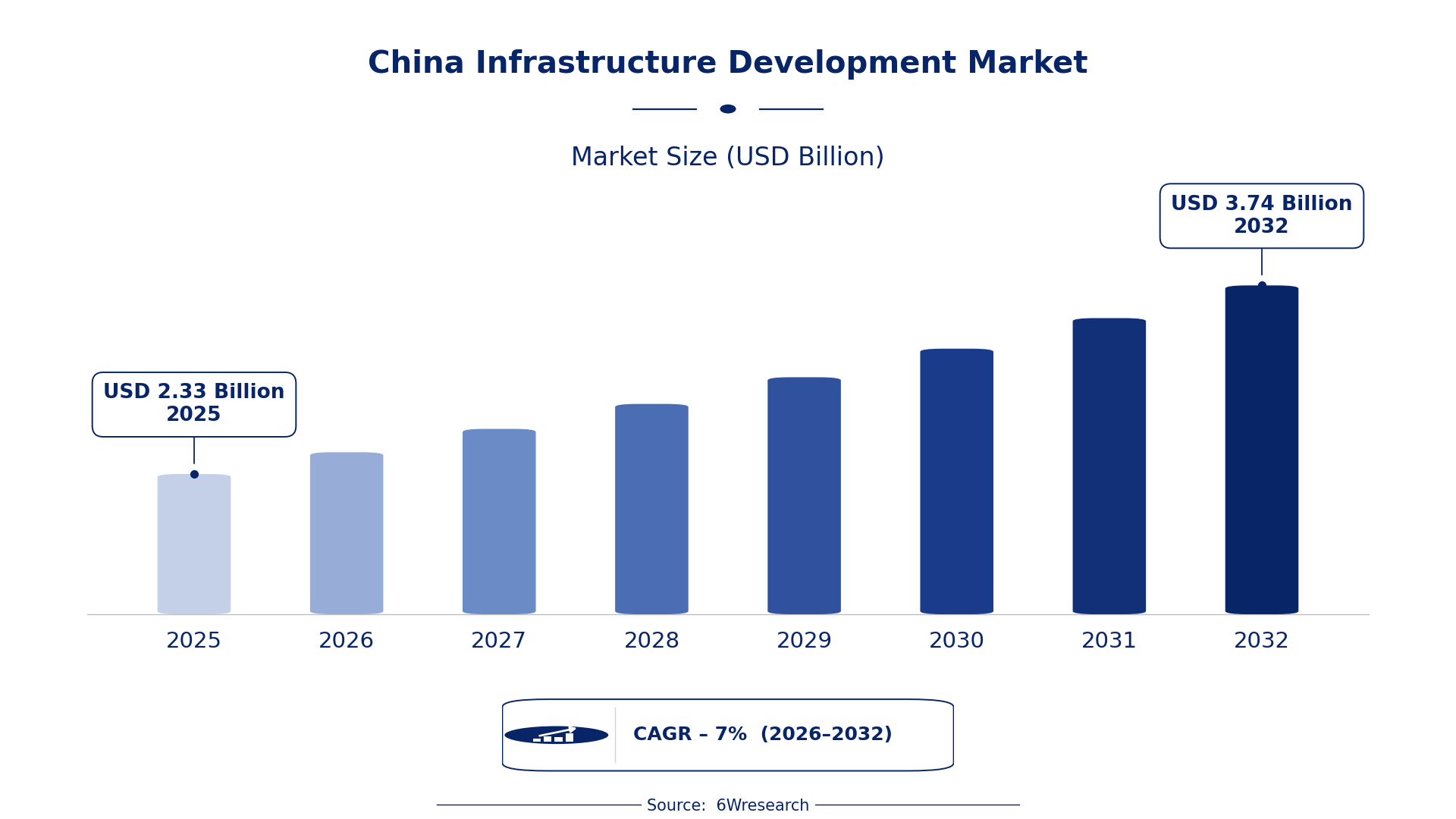
According to 6Wresearch internal database and industry insights, the China Infrastructure Development Market was valued at USD 2.33 billion in 2025 and is projected to reach USD 3.74 billion by 2032, growing at a CAGR of approximately 7% during 2026–2032.
China Infrastructure Development Market Highlights
| Report Metric | Details |
| Report Name | China Infrastructure Development Market |
| Market Size 2025 | USD 2.33 billion |
| Market Size 2032 | USD 3.74 billion |
| Absolute Growth 2025–2032 | USD 1.41 billion |
| CAGR 2026–2032 | 7% |
| Peak Annual Growth | 9.1% in 2031 |
| Forecast Period | 2026–2032 |
| Historical Data | 2022–2025 |
| Base Year | 2025 |
| Leading Development Type, 2025 | Transport Infrastructure (48% share) |
| Leading Project Type, 2025 | Roads / Airports (49% share) |
| Leading End Use Sector, 2025 | Public Sector (50% share) |
| Leading Distribution Channel, 2025 | Govt Tenders (43% share) |
| Fastest-Growing Development Type | Energy Infrastructure (8.6% CAGR) |
| Fastest-Growing Project Type | Smart Cities / Housing (9.2% CAGR) |
| Fastest-Growing End Use Sector | Municipalities (9.8% CAGR) |
| Fastest-Growing Distribution Channel | EPC Contractors (8.6% CAGR) |
| Growing Sector | Public Sector |
| Key End Users | Government agencies, Municipalities, Private investors, EPC contractors |
China Infrastructure Development Market Year-wise Growth Rate and Key Drivers (2022–2032)
This graph illustrates the annual growth rates of the market from 2022 to 2032, highlighting a steady upward trajectory and projected market expansion over the forecast period.
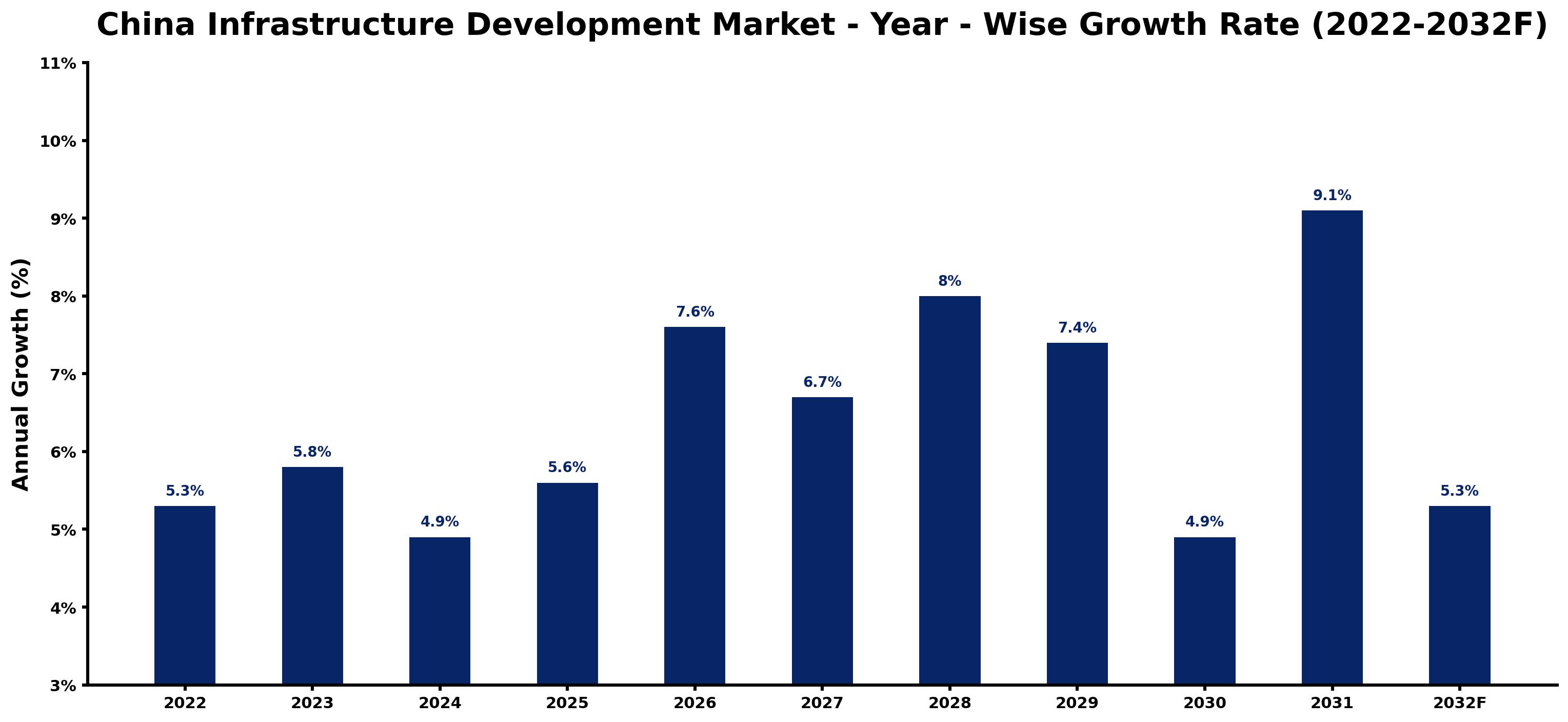
Year by year, the estimates below pair each growth rate with the development that shaped it.
| Year | Estimated Annual Growth (%) | Market Rationale |
| 2022 | 5.3 | Infrastructure development saw moderate growth due to ongoing government projects and private investments. |
| 2023 | 5.8 | Investment in infrastructure projects accelerated, driven by the National Development and Reform Commission's approvals. |
| 2024 | 4.9 | Growth slowed as some projects faced delays in execution and funding allocation. |
| 2025 | 5.6 | Infrastructure investment increased again, supported by the National Development and Reform Commission's focus on transport and energy projects. |
| 2026 | 7.6 | A surge in energy infrastructure projects is expected to contribute to a faster growth rate this year. |
| 2027 | 6.7 | Growth will decelerate slightly as some urban projects encounter regulatory hurdles. |
| 2028 | 8.0 | Demand for smart city initiatives will boost growth as urbanization continues to rise. |
| 2029 | 7.4 | Infrastructure development is projected to experience a slowdown as funding for some sectors tightens. |
| 2030 | 4.9 | Growth will moderate due to a shift in focus towards sustainable energy projects. |
| 2031 | 9.1 | A peak in growth will occur as infrastructure investments reach new heights, driven by government initiatives. |
| 2032 | 5.3 | Growth is expected to slow as the market stabilises after a period of rapid expansion. |
Note: Market size estimations and growth projections presented in this report are based on 6Wresearch's proprietary forecasting methodology, utilizing the latest available industry data, government publications, and primary research inputs.
China Infrastructure Development Market Synopsis
Infrastructure Development in China includes the construction and improvement of vital physical structures, such as transport and energy facilities. This sector receives funding primarily from government initiatives and private investments. The China Infrastructure Development Market is growing due to extensive government projects, an increasing urbanisation rate, and heightened private sector involvement. The National Development and Reform Commission's approval of new infrastructure projects drives this growth, alongside ambitious targets set in the 14th Five-Year Plan, which allocates $1.4 trillion for infrastructure by 2025.
Market Dynamics Impact Analysis (2026–2032)
| Factor | Type | Impact | Primary Segment Affected |
| Increased government funding for transport infrastructure projects | Driver | High | Transport Infrastructure |
| Growing urbanization leading to higher demand for urban facilities | Driver | High | Urban Infrastructure |
| Investment in smart city initiatives across multiple regions | Opportunity | Medium | Smart Cities / Housing |
| Rising demand for renewable energy infrastructure development | Opportunity | High | Power / Renewable |
| Delays in project approvals affecting timely execution | Restraint | High | Transport Infrastructure |
| Funding constraints for private investments in infrastructure | Restraint | Medium | Energy Infrastructure |
| Regulatory hurdles impacting project timelines | Challenge | High | Urban Infrastructure |
| Competition for government tenders among contractors | Challenge | Medium | Govt Tenders |
Evaluation of Drivers in China Infrastructure Development Market (2026–2032)
The table below links each growth driver to the segment it affects and the evidence for it.
| Drivers | Primary Segment Affected | Why It Matters (Evidence) |
| Government investment in infrastructure projects | Transport Infrastructure | In 2023, the government allocated $300 billion for public infrastructure projects nationwide, boosting demand for transport facilities. |
| Urbanization driving demand for housing and facilities | Urban Infrastructure | China's urbanization rate is projected to reach 65% by 2035, increasing the need for urban infrastructure. |
| Investment in renewable energy initiatives | Power / Renewable | The renewable energy sector aims for 1,200 GW of installed capacity by 2030, driving infrastructure development. |
| Smart city projects improving urban living standards | Smart Cities / Housing | Smart city initiatives are being implemented in over 100 cities, creating demand for modern infrastructure. |
| Expansion of transport networks to support economic growth | Roads / Airports | China's investment in transport infrastructure is expected to exceed $500 billion by 2025, facilitating trade. |
Market growth in China for Infrastructure Development rests on substantial government funding, rising urbanization, and increasing investments in renewable energy. The government allocated $300 billion for public infrastructure projects in 2023, enhancing transport facilities. Urbanization is projected to reach 65% by 2035, driving demand for urban infrastructure. The renewable energy sector aims for 1,200 GW of installed capacity by 2030, further boosting energy infrastructure development. Smart city initiatives in over 100 cities are creating a need for modern infrastructure, leading to increased purchases from various sectors.
Evaluation of Restraints in China Infrastructure Development Market
The following restraints limit how fast demand can grow.
| Market Restraint | Primary Segment Affected | Why It Matters (Evidence) |
| Delays in project approvals due to regulatory compliance | Transport Infrastructure | In 2023, several projects faced delays as they awaited compliance with new regulations, hindering progress. |
| Limited funding for private sector investments | Energy Infrastructure | In 2023, funding constraints have restricted private investors from participating in energy infrastructure projects. |
| Regulatory hurdles affecting project timelines | Urban Infrastructure | New regulations have slowed down the approval process for urban infrastructure projects, delaying execution. |
| Competition for government tenders reducing profit margins | Govt Tenders | Increased competition among contractors for government tenders has led to tighter profit margins. |
| Economic fluctuations impacting investment confidence | Industrial Infrastructure | Economic uncertainties have made investors cautious, affecting funding for industrial infrastructure projects. |
China Infrastructure Development Market Challenges
The China Infrastructure Development Market contends with rising material costs, which have surged due to global supply chain disruptions, causing delays for buyers reliant on timely project completions. Technology adoption remains uneven, with many areas still employing outdated construction methods, resulting in inefficiencies that prolong project timelines for contractors. Heightened competition among local firms has pressured profit margins, compelling suppliers to reduce costs, which risks compromising quality. A shortage of approximately 1 million skilled workers in the construction sector continues to hinder project execution, inflating labour costs for developers and extending timelines.
Trends in the China Infrastructure Development Market
Below mentioned are some of the trends shaping the China Infrastructure Development Market growth.
- Shift towards Sustainable Urban Development: China is prioritising sustainable urban development practices, with the China Urban Planning Society promoting these initiatives. As of 2023, over 100 cities are implementing smart city strategies, indicating a shift in urban planning.
- Expansion of Renewable Energy Infrastructure: The push for renewable energy is transforming infrastructure development, with the National Energy Administration targeting 1,200 GW of installed capacity by 2030. This shift is driving investments in energy infrastructure across the country.
- Increase in Smart City Initiatives: Smart city initiatives are being implemented in over 100 cities, reflecting a growing trend towards modern urban living. This development is supported by government funding and aims to improve living standards and connectivity.
- Growth in Transport Infrastructure Projects: The construction of new highways and airports is a priority, with the Ministry of Transport's plan for 10,000 km of new highways by 2025. This expansion is vital for improving connectivity and supporting economic growth.
Investment Opportunities in the China Infrastructure Development Market
Some of the investment opportunities in the China Infrastructure Development Market are mentioned below.
- Municipalities investing in urban infrastructure: With China's urbanisation rate projected to reach 65% by 2035, municipalities are heavily investing in urban infrastructure projects. This presents an opportunity for suppliers to engage in public sector contracts.
- $1.4 trillion allocated for infrastructure projects: The 14th Five-Year Plan allocates $1.4 trillion for infrastructure by 2025, creating opportunities for investment and supply across various sectors, particularly transport and energy.
- Growing demand for affordable housing: The Ministry of Housing and Urban-Rural Development launched a programme for affordable housing in 2023, creating a pressing need for construction materials and services.
- Investment in renewable energy infrastructure: With the renewable energy sector aiming for 1,200 GW capacity by 2030, there is strong demand for infrastructure development in this area, offering opportunities for contractors and suppliers.
Government Initiatives in the China Infrastructure Development Market
The 14th Five-Year Plan for Economic and Social Development, issued by the State Council in 2021, allocates $1.4 trillion for infrastructure projects by 2025, focusing on transport and energy. This funding is essential for advancing infrastructure across the country, ensuring that projects align with national development goals. The National Development and Reform Commission's Infrastructure Investment Plan 2022 aims to boost investment in transport and urban infrastructure, targeting $500 billion in new projects. This initiative is designed to stimulate economic growth and improve public services.
The 2023 National Highway Network Plan outlines the construction of 10,000 km of new highways by 2025 to improve connectivity. This plan is expected to enhance transportation networks, benefiting both urban and rural areas. Additionally, the Renewable Energy Law, updated in 2020 by the National Energy Administration, promotes investments in renewable energy infrastructure, aiming for 1,200 GW capacity by 2030. This law encourages participation in renewable energy projects.
Future Insight of the China Infrastructure Development Market
The China Infrastructure Development Market is set to evolve significantly by 2032, driven by robust government investment and urbanisation initiatives. By 2025, the government aims to invest $1.4 trillion in infrastructure, improving transport networks and urban facilities. Smart city projects will expand, enhancing urban management in over 100 cities. The goal of achieving 1,200 GW of renewable energy capacity by 2030 will further stimulate energy infrastructure development, creating abundant opportunities for buyers and suppliers in the market.
Market Segmentation Analysis
Each segment group is reviewed below, with the leader by share and the fastest grower by CAGR.
By Development Type – Transport Infrastructure Dominated, Energy Infrastructure Expected to Grow Fastest
According to Shubham Deep, Research Manager at 6Wresearch, the largest development type category in 2025 was Transport Infrastructure, with a 48% share of total revenue. Transport infrastructure holds the largest share due to its essential role in connectivity and mobility across China. With over 160,000 km of highways, it supports both economic activities and daily commuting needs. The quickest growth will come from Energy Infrastructure, forecast to expand at a CAGR of 8.6% between 2026 and 2032. Energy infrastructure is experiencing rapid growth, propelled by the ambitious target of achieving 1,200 GW of installed capacity by 2030. This focus on renewable energy sources is vital for meeting increasing energy demands and sustainability goals. Suppliers should prioritise transport infrastructure while also exploring opportunities in the rapidly expanding energy sector.
By Project Type – Roads / Airports Dominated, Smart Cities / Housing Expected to Grow Fastest
Roads / Airports accounted for a 49% market share by project type in 2025. Roads and airports dominate the market share as they are vital for transportation and trade facilitation, crucial for China's economic landscape. The government's commitment to invest over $500 billion in transport infrastructure by 2025 underscores this importance. Smart Cities / Housing is set to record the highest CAGR in this split, 9.2% over 2026–2032. Smart cities and housing projects are growing quickly, reflecting the need for modern urban development and improved living standards. Initiatives in over 100 cities highlight the urgency for innovative urban solutions. Investors should focus on roads and airports while also capitalising on the burgeoning smart cities and housing projects.
By End Use Sector – Public Sector Dominated, Municipalities Expected to Grow Fastest
With a 50% revenue share in 2025, Public Sector was the largest end use sector category. The public sector leads in market share as government projects significantly drive infrastructure investment in China. The allocation of $300 billion for public infrastructure projects in 2023 illustrates the scale of public sector involvement. Over 2026–2032, Municipalities are expected to post the fastest growth, at a CAGR of 9.8%. Municipalities are the fastest-growing segment, as local governments increasingly invest in infrastructure to enhance services and meet urbanisation demands. This trend is expected to accelerate as urbanisation rates rise, further increasing the need for local infrastructure improvements. Suppliers must engage with public sector projects while also targeting municipalities for growth opportunities.
By Distribution Channel – Govt Tenders Dominated, EPC Contractors Expected to Grow Fastest
Govt Tenders took a 43% share of distribution channel in 2025, more than any other category. Government tenders command the largest share since they are a major source of infrastructure projects funded by public investment. The reliance on government contracts ensures a steady flow of projects in the infrastructure development market. EPC Contractors are projected to grow fastest, at a CAGR of 8.6% during 2026–2032. EPC contractors are rapidly gaining ground, as they are the primary executors of infrastructure projects, streamlining the construction process. Their crucial role in delivering projects efficiently aligns with government priorities for timely completions. Suppliers should focus on securing government tenders while also establishing strong partnerships with EPC contractors.
Key Attractiveness of the Report
- 10 Years of Market Numbers
- Historical Data Starting from 2022 to 2025
- Base Year 2025
- Forecast Data until 2032
- Key Performance Indicators Impacting the Market
- Major Upcoming Developments and Projects
Key Highlights of the Report:
- China Infrastructure Development Market Outlook
- Market Size of China Infrastructure Development Market, 2025
- Forecast of China Infrastructure Development Market, 2032
- Historical Data and Forecast of China Infrastructure Development Revenues & Volume for the Period 2022 - 2032F
- China Infrastructure Development Market Trend Evolution
- China Infrastructure Development Market Drivers and Challenges
- China Infrastructure Development Price Trends
- China Infrastructure Development Porter's Five Forces
- China Infrastructure Development Industry Life Cycle
- Historical Data and Forecast of China Infrastructure Development Market Revenues & Volume By Development Type for the Period 2022 - 2032F
- Historical Data and Forecast of China Infrastructure Development Market Revenues & Volume By Transport Infrastructure for the Period 2022 - 2032F
- Historical Data and Forecast of China Infrastructure Development Market Revenues & Volume By Energy Infrastructure for the Period 2022 - 2032F
- Historical Data and Forecast of China Infrastructure Development Market Revenues & Volume By Urban Infrastructure for the Period 2022 - 2032F
- Historical Data and Forecast of China Infrastructure Development Market Revenues & Volume By Industrial Infrastructure for the Period 2022 - 2032F
- Historical Data and Forecast of China Infrastructure Development Market Revenues & Volume By Project Type for the Period 2022 - 2032F
- Historical Data and Forecast of China Infrastructure Development Market Revenues & Volume By Roads / Airports for the Period 2022 - 2032F
- Historical Data and Forecast of China Infrastructure Development Market Revenues & Volume By Power / Renewable for the Period 2022 - 2032F
- Historical Data and Forecast of China Infrastructure Development Market Revenues & Volume By Smart Cities / Housing for the Period 2022 - 2032F
- Historical Data and Forecast of China Infrastructure Development Market Revenues & Volume By Factories / Parks for the Period 2022 - 2032F
- Historical Data and Forecast of China Infrastructure Development Market Revenues & Volume By End Use Sector for the Period 2022 - 2032F
- Historical Data and Forecast of China Infrastructure Development Market Revenues & Volume By Public Sector for the Period 2022 - 2032F
- Historical Data and Forecast of China Infrastructure Development Market Revenues & Volume By Utilities for the Period 2022 - 2032F
- Historical Data and Forecast of China Infrastructure Development Market Revenues & Volume By Municipalities for the Period 2022 - 2032F
- Historical Data and Forecast of China Infrastructure Development Market Revenues & Volume By Private Enterprises for the Period 2022 - 2032F
- Historical Data and Forecast of China Infrastructure Development Market Revenues & Volume By Distribution Channel for the Period 2022 - 2032F
- Historical Data and Forecast of China Infrastructure Development Market Revenues & Volume By EPC Contractors for the Period 2022 - 2032F
- Historical Data and Forecast of China Infrastructure Development Market Revenues & Volume By Govt Tenders for the Period 2022 - 2032F
- Historical Data and Forecast of China Infrastructure Development Market Revenues & Volume By Infrastructure Firms for the Period 2022 - 2032F
- Historical Data and Forecast of China Infrastructure Development Market Revenues & Volume By Private Investors for the Period 2022 - 2032F
- China Infrastructure Development Import Export Trade Statistics
- Market Opportunity Assessment By Development Type
- Market Opportunity Assessment By Project Type
- Market Opportunity Assessment By End Use Sector
- Market Opportunity Assessment By Distribution Channel
- China Infrastructure Development Top Companies Market Share
- China Infrastructure Development Competitive Benchmarking By Technical and Operational Parameters
- China Infrastructure Development Company Profiles
- China Infrastructure Development Key Strategic Recommendations
Market Covered
Segments analysed in this report are listed below.
By Development Type
- Transport Infrastructure
- Energy Infrastructure
- Urban Infrastructure
- Industrial Infrastructure
By Project Type
- Roads / Airports
- Power / Renewable
- Smart Cities / Housing
- Factories / Parks
By End Use Sector
- Public Sector
- Utilities
- Municipalities
- Private Enterprises
By Distribution Channel
- EPC Contractors
- Govt Tenders
- Infrastructure Firms
- Private Investors































