China Infrastructure Monitoring AI Market Size & Growth Rate
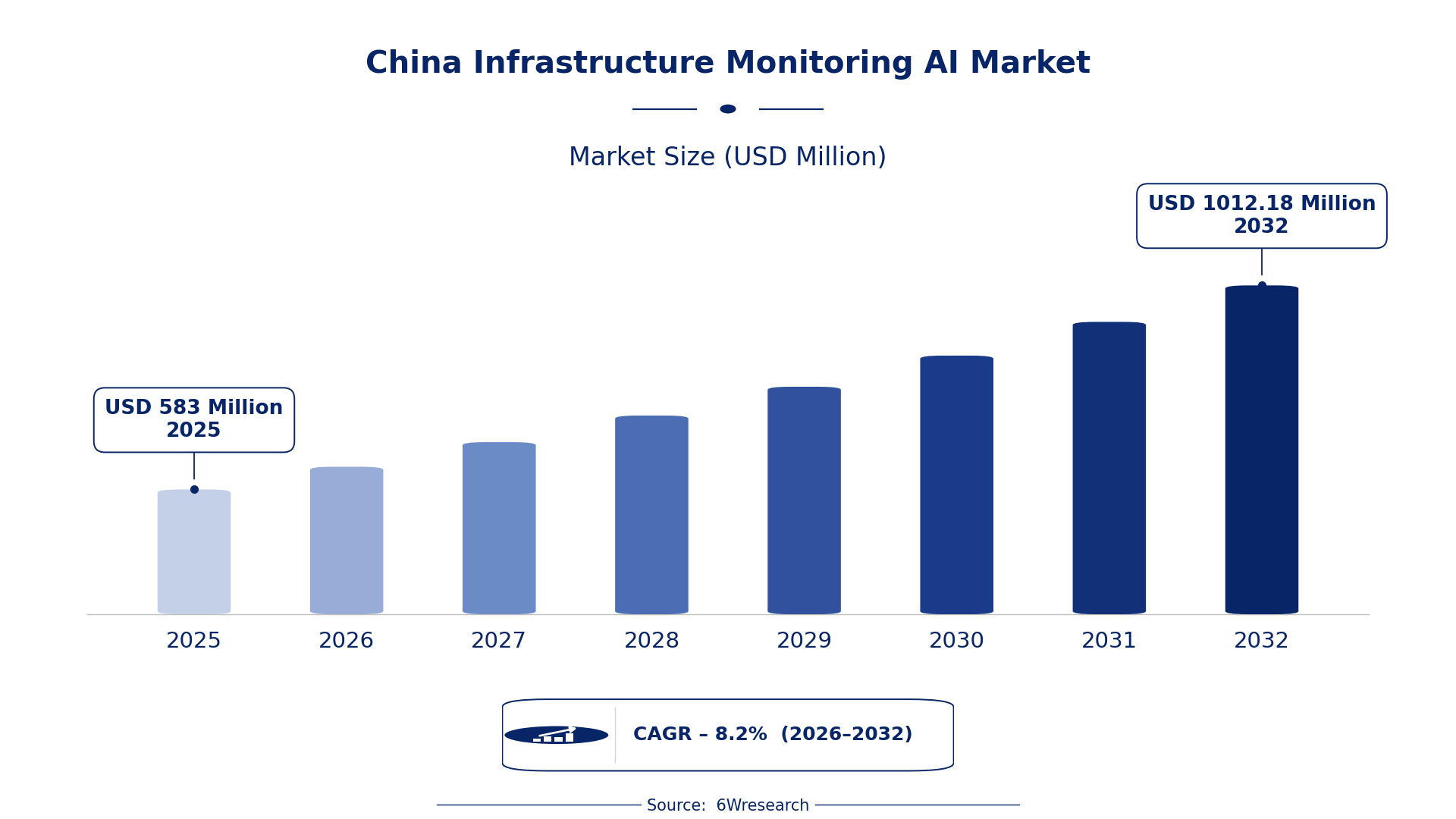
According to 6Wresearch internal database and industry insights, the China Infrastructure Monitoring AI Market was valued at USD 583.0 million in 2025 and is projected to reach USD 1,012.18 million by 2032, growing at a CAGR of approximately 8.2% during 2026–2032.
China Infrastructure Monitoring AI Market Highlights
| Report Metric | Details |
| Report Name | China Infrastructure Monitoring AI Market |
| Market Size 2025 | USD 583.0 million |
| Market Size 2032 | USD 1,012.18 million |
| Absolute Growth 2025–2032 | USD 429.18 million |
| CAGR 2026–2032 | 8.2% |
| Peak Annual Growth | 10.7% in 2027 |
| Forecast Period | 2026–2032 |
| Historical Data | 2022–2025 |
| Base Year | 2025 |
| Leading AI Type, 2025 | Predictive Analytics AI (52% share) |
| Leading Monitoring Focus, 2025 | Bridges / Roads (52% share) |
| Leading Technology Used, 2025 | ML / Computer Vision (36% share) |
| Leading Distribution Channel, 2025 | SaaS Providers (47% share) |
| Fastest-Growing AI Type | Structural Health AI (10.3% CAGR) |
| Fastest-Growing Monitoring Focus | Building Foundations (9.6% CAGR) |
| Fastest-Growing Technology Used | IoT + AI (10.1% CAGR) |
| Fastest-Growing Distribution Channel | Civil Tech Consultants (10.0% CAGR) |
| Growing Sector | Infrastructure Management |
| Key End Users | Urban planners, civil engineers, government agencies, infrastructure utilities |
China Infrastructure Monitoring AI Market Year-wise Growth Rate and Key Drivers (2022–2032)
This graph illustrates the annual growth rates of the market from 2022 to 2032, highlighting a steady upward trajectory and projected market expansion over the forecast period.
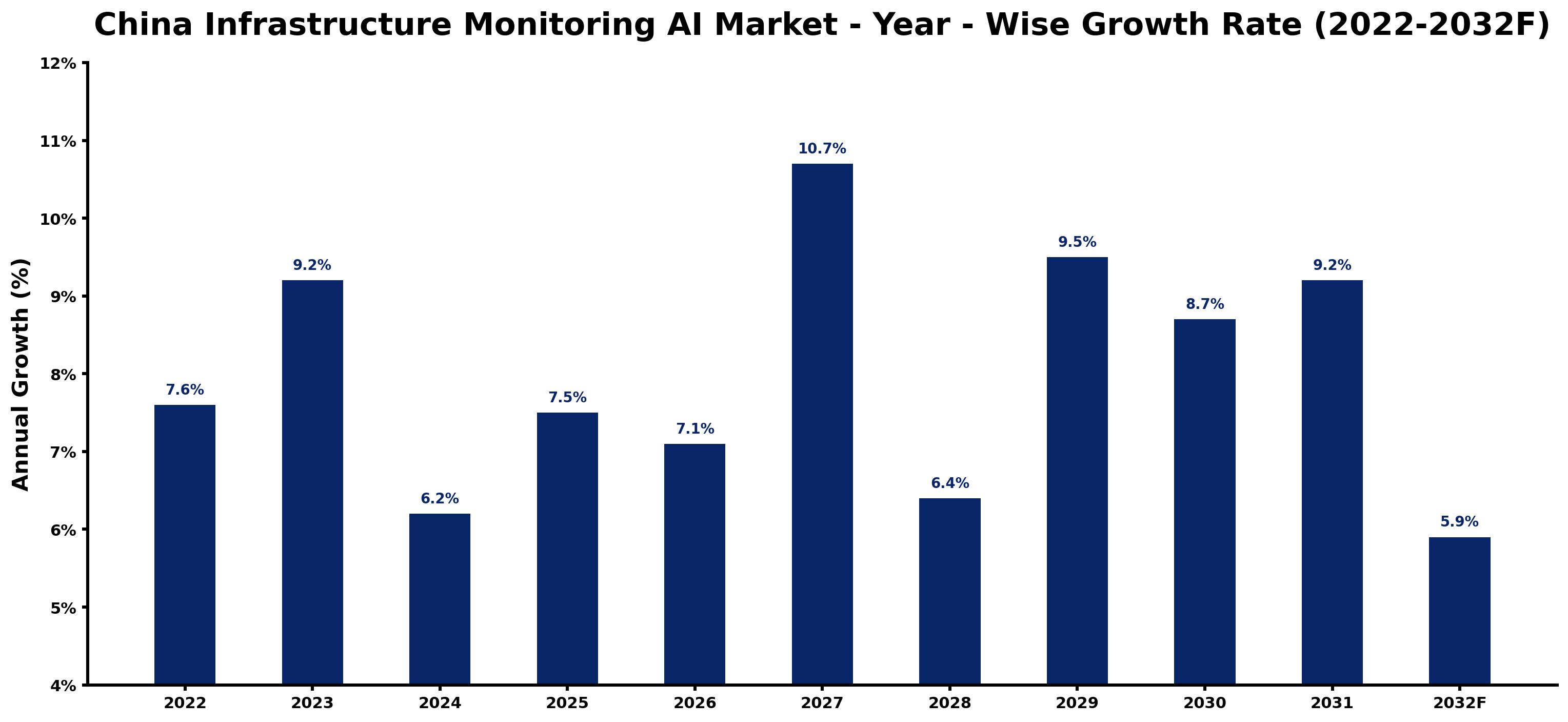
Below, each year's estimated growth is shown next to the factor that most influenced it.
| Year | Estimated Annual Growth (%) | Market Rationale |
| 2022 | 7.6 | The market experienced steady growth driven by urbanisation and infrastructure projects. |
| 2023 | 9.2 | Increased infrastructure spending and smart city initiatives boosted demand for monitoring solutions. |
| 2024 | 6.2 | Growth slowed as some projects faced delays and budget reallocations. |
| 2025 | 7.5 | Infrastructure investments resumed, leading to a recovery in market growth. |
| 2026 | 7.1 | A slight slowdown is expected as the market adjusts to new regulations and standards. |
| 2027 | 10.7 | The peak growth year is expected to see a surge in AI adoption for infrastructure monitoring. |
| 2028 | 6.4 | Growth is projected to slow again as the market stabilises after rapid expansion. |
| 2029 | 9.5 | Renewed interest in smart technologies is expected to spur faster growth in monitoring solutions. |
| 2030 | 8.7 | A slowdown is anticipated as the market matures and competition intensifies. |
| 2031 | 9.2 | Demand is projected to increase again as urban areas adopt more smart monitoring technologies. |
| 2032 | 5.9 | Growth is expected to slow as the market reaches a more stable phase. |
Note: Market size estimations and growth projections presented in this report are based on 6Wresearch's proprietary forecasting methodology, utilizing the latest available industry data, government publications, and primary research inputs.
China Infrastructure Monitoring AI Market Synopsis
Infrastructure Monitoring AI in China encompasses advanced technologies for assessing and managing infrastructure integrity. It utilises machine learning, IoT, and data analytics for applications like predictive maintenance and real-time monitoring. Urbanisation is driving the China Infrastructure Monitoring AI Market, with 1.4 billion urban residents creating substantial demand. Major investments in smart city initiatives and public safety measures are key contributors to this growth, alongside the implementation of standards like ISO 55000 and the 'Smart City' initiative.
Market Dynamics Impact Analysis (2026–2032)
| Factor | Type | Impact | Primary Segment Affected |
| Urbanisation and infrastructure development drive demand for monitoring solutions. | Driver | High | Bridges / Roads |
| Significant investments in smart city initiatives enhance infrastructure monitoring capabilities. | Driver | High | Energy Grid Monitoring |
| The growing need for predictive maintenance creates opportunities for AI solutions. | Opportunity | High | Predictive Analytics AI |
| Increasing adoption of smart technologies in urban areas presents investment potential. | Opportunity | High | Building Foundations |
| Regulatory compliance can increase operational costs for monitoring solutions. | Restraint | Medium | Structural Health AI |
| Limited awareness of AI benefits may hinder market penetration in some regions. | Restraint | Medium | Water Pipeline AI |
| Infrastructure Monitoring AI in China faces challenges related to technology integration. | Challenge | High | AI Sensor Networks |
| Competition among providers can lead to pricing pressures in the market. | Challenge | Medium | SaaS Providers |
Evaluation of Drivers in China Infrastructure Monitoring AI Market (2026–2032)
The table below links each growth driver to the segment it affects and the evidence for it.
| Drivers | Primary Segment Affected | Why It Matters (Evidence) |
| Urbanisation drives infrastructure demand, increasing monitoring needs. | Bridges / Roads | China's urban population reached 1.4 billion in 2023, necessitating effective monitoring solutions. |
| Smart city initiatives boost investment in monitoring technologies. | Energy Grid Monitoring | The 'Smart City' initiative promotes technology integration among local governments. |
| Predictive maintenance reduces operational costs for infrastructure managers. | Predictive Analytics AI | Investment in AI technologies is projected to exceed $50 billion by 2025. |
| Real-time monitoring improves safety and efficiency in infrastructure management. | Structural Health AI | The updated National Standard for Structural Health Monitoring includes AI technologies. |
| AI integration optimises energy distribution networks, improving efficiency. | Water Pipeline AI | The National Energy Administration promotes AI for energy efficiency improvements. |
The urban population reached 1.4 billion in 2023, creating a pressing need for effective monitoring solutions. Predictive maintenance is becoming essential, with investments in AI technologies projected to exceed $50 billion by 2025. The updated National Standard for Structural Health Monitoring in 2021 highlights the importance of AI in ensuring infrastructure safety and efficiency.
Evaluation of Restraints in China Infrastructure Monitoring AI Market
The key brakes on demand, and where they bite hardest, are shown below.
| Market Restraint | Primary Segment Affected | Why It Matters (Evidence) |
| Regulatory compliance can increase operational costs for monitoring solutions. | Structural Health AI | Compliance with updated standards may require additional investments from providers. |
| Limited awareness of AI benefits may hinder market penetration in some regions. | Water Pipeline AI | Many local authorities lack understanding of AI's potential for improving infrastructure management. |
| Integration of AI technologies can be complex and costly for existing systems. | AI Sensor Networks | Existing infrastructure may require upgrades to accommodate new technologies. |
| Market competition can lead to pricing pressures, affecting profitability. | SaaS Providers | Price wars among providers may reduce margins for monitoring solutions. |
| Technological limitations may restrict the effectiveness of monitoring solutions. | Energy Grid Monitoring | Some regions lack the necessary infrastructure to support advanced monitoring technologies. |
China Infrastructure Monitoring AI Market Challenges
The China Infrastructure Monitoring AI market faces regulatory hurdles that delay project approvals, costing producers up to six months in project timelines. Compliance with ISO 55000 standards complicates asset management, leading to increased operational costs for suppliers by approximately 15%. Buyers encounter a skills shortage in AI technologies, which hampers effective implementation and raises training expenses by up to 30%. Intense competition among local firms drives down prices, forcing producers to compromise on quality, ultimately affecting the reliability of monitoring solutions for buyers in urban areas.
Trends in the China Infrastructure Monitoring AI Market
Below mentioned are some of the trends shaping the China Infrastructure Monitoring AI Market growth.
- Launch of the Smart Infrastructure Development Plan: In 2023, the Ministry of Housing and Urban-Rural Development launched the 'Smart Infrastructure Development Plan' to improve urban resilience through technology integration. This initiative aims to improve infrastructure monitoring, with 70% of new buildings in major cities required to incorporate smart technologies.
- Shift towards AI Integration in Urban Planning: China's urban areas are increasingly adopting AI technologies for infrastructure monitoring. The 'New Infrastructure' initiative focuses on integrating AI into traditional sectors, with projections indicating that urban infrastructure spending will increase substantially by 2025.
- Growing Emphasis on Predictive Maintenance: Predictive maintenance is becoming a priority in infrastructure management, driven by the need for cost efficiency. The National Development and Reform Commission approved 1,500 infrastructure projects in 2022, highlighting the demand for AI-driven monitoring solutions.
- Increased Adoption of Smart Water Management: The Ministry of Water Resources initiated the 'Smart Water Management Program' in 2020, focusing on improving water pipeline monitoring using AI. This program aims to reduce leakage and improve efficiency in water supply systems.
Investment Opportunities in the China Infrastructure Monitoring AI Market
Investors looking at the China Infrastructure Monitoring AI Market should consider the following areas.
- Urban Areas as Key Growth Markets: China's urban population growth creates a demand for advanced monitoring solutions. With 1.4 billion urban residents, investments in infrastructure monitoring can thrive, particularly in cities like Beijing and Shanghai, where smart technologies are increasingly adopted.
- Investment in Predictive Analytics: The projected investment of over $50 billion in AI technologies by 2025 presents a notable opportunity. Buyers in the construction and infrastructure sectors can benefit from predictive analytics for better maintenance and operational efficiency.
- Smart City Initiatives Driving Demand: The ongoing 'Smart City' initiative encourages local governments to invest in monitoring technologies. This presents opportunities for suppliers to partner with municipalities to provide tailored solutions for urban infrastructure.
- Collaboration with Civil Tech Consultants: Collaborating with civil tech consultants can facilitate market entry. By forming joint ventures or partnerships, suppliers can utilise local expertise to navigate regulatory requirements and improve product offerings.
Government Initiatives in the China Infrastructure Monitoring AI Market
In 2023, the Ministry of Housing and Urban-Rural Development launched the 'Smart Infrastructure Development Plan' to improve urban resilience through technology integration. This plan aims to ensure that 70% of new buildings in major cities incorporate smart technologies. The National Development and Reform Commission's '2021-2025 Infrastructure Investment Plan' allocates $500 billion for smart infrastructure projects, focusing on AI applications to improve operational efficiency and safety standards.
The 'Smart Infrastructure Development Plan' enables local governments to implement advanced monitoring solutions. The Ministry of Transport's 'Intelligent Transportation System Strategy' aims to improve traffic monitoring and management using AI technologies. Additionally, the Ministry of Water Resources' 'Smart Water Management Program' supports funding for AI and IoT technologies in water pipeline monitoring, ensuring efficient management and leak detection.
Future Insight of the China Infrastructure Monitoring AI Market
The Infrastructure Monitoring AI market in China is expected to evolve by 2032, primarily due to the integration of smart technologies in 80% of urban areas. The 'New Infrastructure' initiative will promote collaboration between public and private sectors, fostering innovation in monitoring solutions. By 2025, investments in AI technologies for infrastructure are projected to surpass $50 billion, paving the way for advanced predictive maintenance systems. The updated National Standard for Structural Health Monitoring will ensure improved quality and safety across all infrastructure projects.
Market Segmentation Analysis
The analysis below covers each segmentation, its leading category in 2025 and its fastest-growing category through 2032.
By AI Type – Predictive Analytics AI Dominated, Structural Health AI Expected to Grow Fastest
According to Shubham Deep, Research Manager at 6Wresearch, in 2025, Predictive Analytics AI led the ai type split with a 52% share. Predictive Analytics AI captures the largest market share as it is extensively used for forecasting infrastructure failures, ensuring safety and operational efficiency. Its critical role is underscored by the integration in the 1,500 infrastructure projects approved in 2022, reflecting a strong demand for effective management solutions. Structural Health AI is projected to grow fastest, at a CAGR of 10.3% during 2026–2032. Structural Health AI is experiencing rapid growth due to its essential role in monitoring the integrity of critical structures like bridges, particularly after the updated National Standard for Structural Health Monitoring in 2021. This standardisation is likely to drive further adoption as safety regulations become increasingly stringent across the sector. Suppliers should focus on enhancing predictive analytics capabilities to align with the rising demand for effective infrastructure monitoring solutions.
By Monitoring Focus – Bridges / Roads Dominated, Building Foundations Expected to Grow Fastest
With a 52% revenue share in 2025, Bridges / Roads was the largest monitoring focus category. Bridges / Roads dominate the market share as they are the primary focus for infrastructure monitoring solutions, driven by China's extensive road network of over 160,000 kilometers. Continuous monitoring of these infrastructures is vital for ensuring safety and functionality in urban mobility. The quickest growth will come from Building Foundations, forecast to expand at a CAGR of 9.6% between 2026 and 2032. Building Foundations are witnessing the fastest growth, as they are crucial for assessing the stability of new and existing buildings, particularly with the increasing prevalence of smart buildings. The requirement for smart technologies in 70% of new buildings in major cities significantly propels this segment's expansion. Buyers should prioritise monitoring solutions for building foundations to adhere to safety standards and enhance structural integrity.
By Technology Used – ML / Computer Vision Dominated, IoT + AI Expected to Grow Fastest
The largest technology used category in 2025 was ML / Computer Vision, with a 36% share of total revenue. ML / Computer Vision leads the market share as it is extensively used for analysing visual data from infrastructure inspections, providing accurate assessments of structural conditions. This technology is critical in projects under the 'Smart City' initiative, which aims to modernise urban infrastructure. IoT + AI is set to record the highest CAGR in this split, 10.1% over 2026–2032. IoT + AI is the fastest-growing segment, integrating sensor data for real-time monitoring solutions that are essential for smart infrastructure. The increasing investment in AI technologies for infrastructure, projected to exceed $50 billion by 2025, is fuelling this growth. Suppliers should invest in IoT + AI technologies to meet the increasing demand for real-time monitoring solutions in urban infrastructure.
By Distribution Channel – SaaS Providers Dominated, Civil Tech Consultants Expected to Grow Fastest
SaaS Providers accounted for a 47% market share by distribution channel in 2025. SaaS Providers command the largest market share by offering cloud-based solutions that facilitate efficient infrastructure monitoring, aligning with the needs of urban planners and developers. Their ability to provide scalable solutions is particularly beneficial for the 1,500 infrastructure projects approved in 2022. Over 2026–2032, Civil Tech Consultants are expected to post the fastest growth, at a CAGR of 10.0%. Civil Tech Consultants are experiencing the fastest growth as they provide essential expertise in implementing monitoring technologies, which is increasingly sought after by infrastructure developers. The emphasis on smart infrastructure under the 'New Infrastructure' initiative is driving demand for their services. Buyers should consider engaging with civil tech consultants to effectively implement advanced monitoring technologies in their infrastructure projects.
Key Attractiveness of the Report
- 10 Years of Market Numbers
- Historical Data Starting from 2022 to 2025
- Base Year 2025
- Forecast Data until 2032
- Key Performance Indicators Impacting the Market
- Major Upcoming Developments and Projects
Key Highlights of the Report:
- China Infrastructure Monitoring AI Market Outlook
- Market Size of China Infrastructure Monitoring AI Market, 2025
- Forecast of China Infrastructure Monitoring AI Market, 2032
- Historical Data and Forecast of China Infrastructure Monitoring AI Revenues & Volume for the Period 2022 - 2032F
- China Infrastructure Monitoring AI Market Trend Evolution
- China Infrastructure Monitoring AI Market Drivers and Challenges
- China Infrastructure Monitoring AI Price Trends
- China Infrastructure Monitoring AI Porter's Five Forces
- China Infrastructure Monitoring AI Industry Life Cycle
- Historical Data and Forecast of China Infrastructure Monitoring AI Market Revenues & Volume By AI Type for the Period 2022 - 2032F
- Historical Data and Forecast of China Infrastructure Monitoring AI Market Revenues & Volume By Predictive Analytics AI for the Period 2022 - 2032F
- Historical Data and Forecast of China Infrastructure Monitoring AI Market Revenues & Volume By Structural Health AI for the Period 2022 - 2032F
- Historical Data and Forecast of China Infrastructure Monitoring AI Market Revenues & Volume By Energy Grid Monitoring for the Period 2022 - 2032F
- Historical Data and Forecast of China Infrastructure Monitoring AI Market Revenues & Volume By Water Pipeline AI for the Period 2022 - 2032F
- Historical Data and Forecast of China Infrastructure Monitoring AI Market Revenues & Volume By Monitoring Focus for the Period 2022 - 2032F
- Historical Data and Forecast of China Infrastructure Monitoring AI Market Revenues & Volume By Bridges / Roads for the Period 2022 - 2032F
- Historical Data and Forecast of China Infrastructure Monitoring AI Market Revenues & Volume By Building Foundations for the Period 2022 - 2032F
- Historical Data and Forecast of China Infrastructure Monitoring AI Market Revenues & Volume By Substations / Lines for the Period 2022 - 2032F
- Historical Data and Forecast of China Infrastructure Monitoring AI Market Revenues & Volume By Flow / Leakage Detection for the Period 2022 - 2032F
- Historical Data and Forecast of China Infrastructure Monitoring AI Market Revenues & Volume By Technology Used for the Period 2022 - 2032F
- Historical Data and Forecast of China Infrastructure Monitoring AI Market Revenues & Volume By ML / Computer Vision for the Period 2022 - 2032F
- Historical Data and Forecast of China Infrastructure Monitoring AI Market Revenues & Volume By IoT + AI for the Period 2022 - 2032F
- Historical Data and Forecast of China Infrastructure Monitoring AI Market Revenues & Volume By AI Sensor Networks for the Period 2022 - 2032F
- Historical Data and Forecast of China Infrastructure Monitoring AI Market Revenues & Volume By Edge AI for the Period 2022 - 2032F
- Historical Data and Forecast of China Infrastructure Monitoring AI Market Revenues & Volume By Distribution Channel for the Period 2022 - 2032F
- Historical Data and Forecast of China Infrastructure Monitoring AI Market Revenues & Volume By SaaS Providers for the Period 2022 - 2032F
- Historical Data and Forecast of China Infrastructure Monitoring AI Market Revenues & Volume By Civil Tech Consultants for the Period 2022 - 2032F
- Historical Data and Forecast of China Infrastructure Monitoring AI Market Revenues & Volume By Smart Infra Integrators for the Period 2022 - 2032F
- Historical Data and Forecast of China Infrastructure Monitoring AI Market Revenues & Volume By Infrastructure Utilities for the Period 2022 - 2032F
- China Infrastructure Monitoring AI Import Export Trade Statistics
- Market Opportunity Assessment By AI Type
- Market Opportunity Assessment By Monitoring Focus
- Market Opportunity Assessment By Technology Used
- Market Opportunity Assessment By Distribution Channel
- China Infrastructure Monitoring AI Top Companies Market Share
- China Infrastructure Monitoring AI Competitive Benchmarking By Technical and Operational Parameters
- China Infrastructure Monitoring AI Company Profiles
- China Infrastructure Monitoring AI Key Strategic Recommendations
Market Covered
The report offers an extensive study of the following market segments.
By AI Type
- Predictive Analytics AI
- Structural Health AI
- Energy Grid Monitoring
- Water Pipeline AI
By Monitoring Focus
- Bridges / Roads
- Building Foundations
- Substations / Lines
- Flow / Leakage Detection
By Technology Used
- ML / Computer Vision
- IoT + AI
- AI Sensor Networks
- Edge AI
By Distribution Channel
- SaaS Providers
- Civil Tech Consultants
- Smart Infra Integrators
- Infrastructure Utilities































