China Inhalational Devices Market Size & Growth Rate
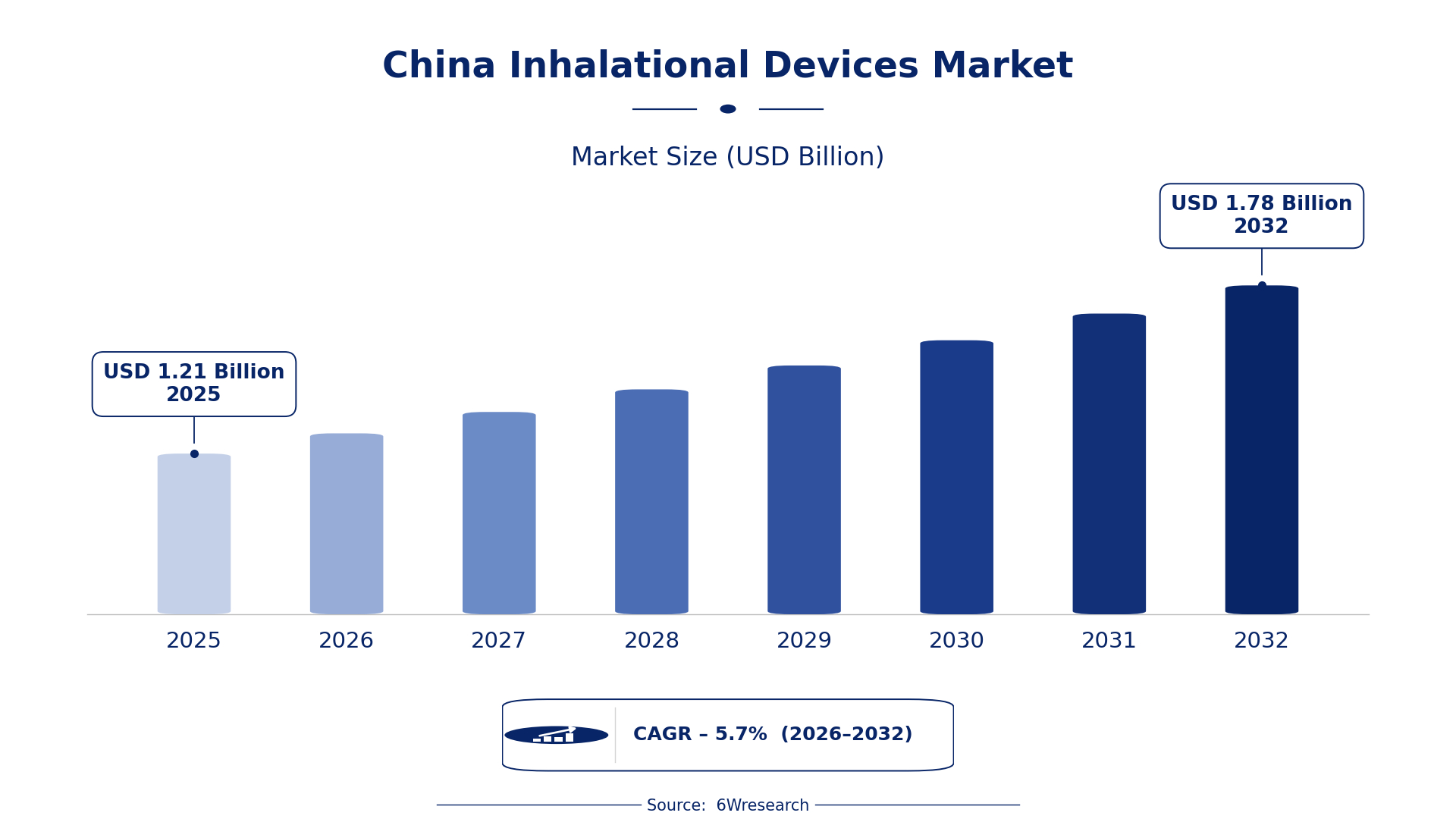
According to 6Wresearch internal database and industry insights, the China Inhalational Devices Market was valued at USD 1.21 billion in 2025 and is projected to reach USD 1.78 billion by 2032, growing at a CAGR of approximately 5.7% during 2026–2032.
China Inhalational Devices Market Highlights
| Report Metric | Details |
| Report Name | China Inhalational Devices Market |
| Market Size 2025 | USD 1.21 billion |
| Market Size 2032 | USD 1.78 billion |
| Absolute Growth 2025–2032 | USD 0.57 billion |
| CAGR 2026–2032 | 5.7% |
| Peak Annual Growth | 8.0% in 2030 |
| Forecast Period | 2026–2032 |
| Historical Data | 2022–2025 |
| Base Year | 2025 |
| Leading Device Form, 2025 | Handheld Inhalers (55% share) |
| Leading Technology Base, 2025 | MDI / DPI (47% share) |
| Leading Portability, 2025 | High (45% share) |
| Leading Distribution Channel, 2025 | Pharmacy / OTC (43% share) |
| Fastest-Growing Device Form | Smart Inhalers (8.1% CAGR) |
| Fastest-Growing Technology Base | IoT Connected (7.9% CAGR) |
| Fastest-Growing Distribution Channel | Hospital Procurement (6.7% CAGR) |
| Growing Sector | Hospital Procurement |
| Key End Users | Pharmacy / OTC, Hospital Procurement, Medical Equipment Stores, Health Tech Suppliers |
China Inhalational Devices Market Year-wise Growth Rate and Key Drivers (2022–2032)
This graph illustrates the annual growth rates of the market from 2022 to 2032, highlighting a steady upward trajectory and projected market expansion over the forecast period.
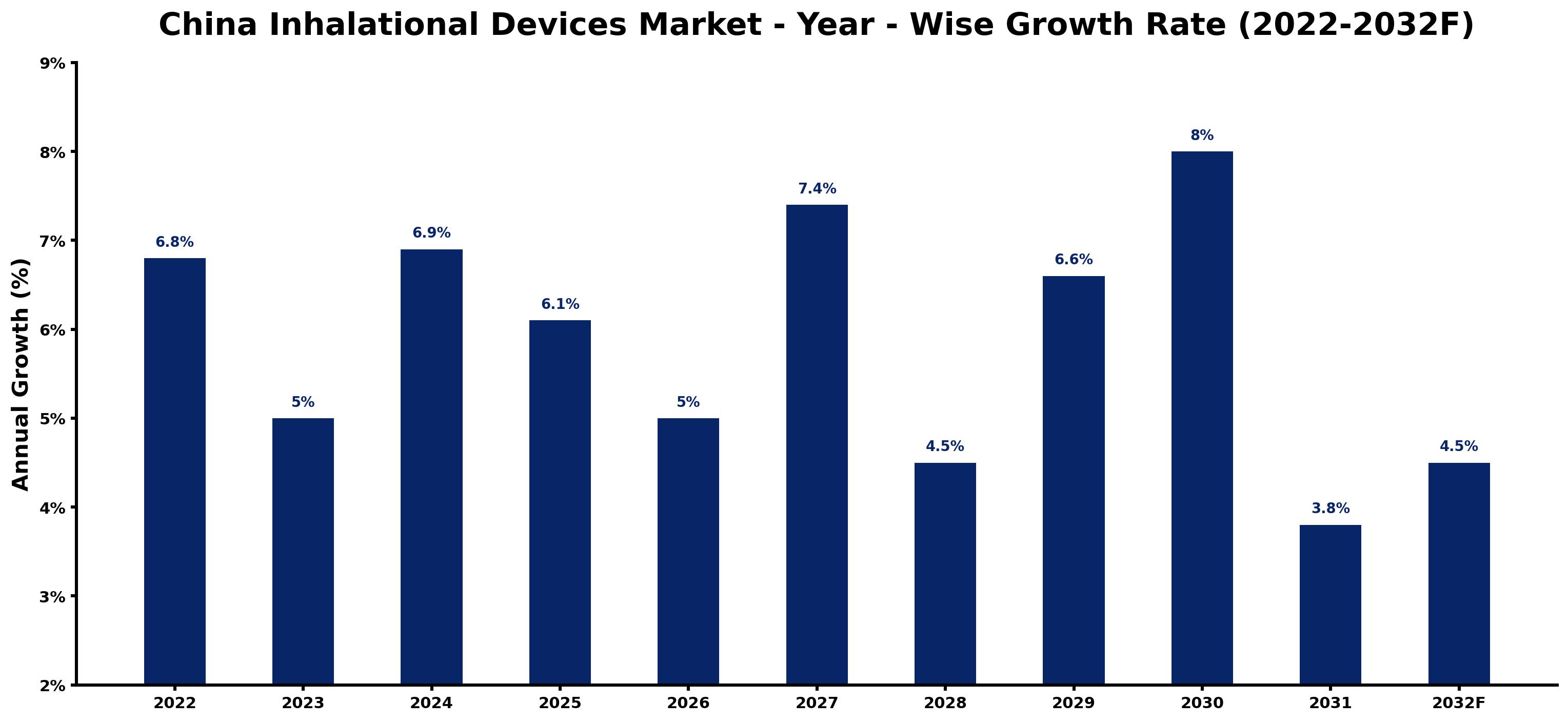
The table below sets out the estimated growth rate for each year and the main factor behind it.
| Year | Estimated Annual Growth (%) | Market Rationale |
| 2022 | 6.8 | The market experienced steady growth with over 300 million asthma patients requiring inhalational devices. |
| 2023 | 5.0 | Demand slowed as the National Health Commission's initiatives faced implementation challenges in the handheld inhaler segment. |
| 2024 | 6.9 | A rise in COPD patients contributed to faster growth as hospitals expanded their respiratory care units. |
| 2025 | 6.1 | Demand remained strong, but growth slowed as the market began to stabilise after rapid expansion. |
| 2026 | 5.0 | Continued demand for nebulizers is anticipated as patients seek effective at-home treatment options. |
| 2027 | 7.4 | An increase in home nebulizer usage will spur growth as patients prefer at-home treatment options. |
| 2028 | 4.5 | Growth is projected to slow as the market adjusts to increased supply and competition among device manufacturers. |
| 2029 | 6.6 | The introduction of smart inhalers will revitalise interest, leading to faster growth in the market. |
| 2030 | 8.0 | The peak growth rate is expected to be driven by heightened awareness of respiratory health and increased healthcare spending. |
| 2031 | 3.8 | Growth is projected to slow as the market begins to stabilise after reaching a peak in the previous year. |
| 2032 | 4.5 | The market is expected to see renewed interest as the population continues to grow and healthcare access improves. |
Note: Market size estimations and growth projections presented in this report are based on 6Wresearch's proprietary forecasting methodology, utilizing the latest available industry data, government publications, and primary research inputs.
China Inhalational Devices Market Synopsis
Inhalational devices in China are medical instruments designed to deliver medication directly to the lungs, primarily for respiratory conditions such as asthma and COPD. These devices, including metered-dose inhalers and nebulizers, are crucial for effective treatment. The China Inhalational Devices Market is growing due to a large patient population, with over 300 million asthma patients. Initiatives like the 'Respiratory Health Action Plan' are driving demand by improving treatment access and promoting new technologies. This combination of factors is expected to fuel market growth through 2032.
Market Dynamics Impact Analysis (2026–2032)
| Factor | Type | Impact | Primary Segment Affected |
| Increasing prevalence of asthma and COPD among the population | Driver | High | Handheld Inhalers |
| Government initiatives promoting respiratory health and treatment access | Driver | High | Home Nebulizers |
| Rising demand for home-based treatment options | Opportunity | High | Home Nebulizers |
| Growth in the elderly population requiring respiratory care | Opportunity | Medium | Hospital-Based Units |
| Regulatory compliance costs for new devices | Restraint | High | Smart Inhalers |
| Limited adoption of IoT-connected devices in the market | Restraint | Medium | IoT Connected |
| Challenges in ensuring consistent quality across manufacturers | Challenge | High | MDI / DPI |
| Competition from alternative treatment methods | Challenge | Medium | Electric Compressor |
Evaluation of Drivers in China Inhalational Devices Market (2026–2032)
Below mentioned are some major drivers and their influence on market dynamics.
| Drivers | Primary Segment Affected | Why It Matters (Evidence) |
| Increased focus on chronic disease management | MDI / DPI | The growing emphasis on managing chronic respiratory conditions is boosting MDI and DPI sales, with over 300 million asthma patients driving demand. |
| Rising healthcare expenditure | Hospital-Based Units | Increased investment in hospital infrastructure leads to more advanced respiratory care units, enhancing device purchases. |
| Growing demand for home-based treatments | Home Nebulizers | The annual demand for home nebulizers is projected to reach 5 million units by 2025, reflecting a shift towards home care. |
| Technological advancements in inhalational devices | Smart Inhalers | The 'Smart Health Initiative' is promoting smart inhalers, attracting tech-savvy patients and expanding market reach. |
| Expansion of distribution channels | Pharmacy / OTC | Widespread availability in pharmacies increases consumer access, driving sales of inhalational devices. |
Market growth in China for Inhalational Devices rests on increasing end-use demand from a large patient base and a supportive healthcare environment. The population of over 300 million asthma patients drives the need for effective management solutions, particularly handheld inhalers. The annual demand for home nebulizers is projected to reach 5 million units by 2025, reflecting a shift towards home-based care. Rising healthcare expenditure encourages hospitals to invest in advanced hospital-based units, ensuring effective respiratory care.
Evaluation of Restraints in China Inhalational Devices Market
The table below lists the restraints and the evidence behind each.
| Market Restraint | Primary Segment Affected | Why It Matters (Evidence) |
| Supply chain disruptions affecting timely deliveries | Home Nebulizers | These disruptions can delay deliveries, costing hospitals up to 15% more in emergency procurement. |
| Competition from imported devices with advanced features | Handheld Inhalers | Local manufacturers struggle against imported devices, forcing buyers to pay 20% higher prices for comparable quality. |
| Rising costs of raw materials impacting pricing | Hospital-Based Units | This leads to a 10% increase in device prices for clinics, affecting affordability. |
| Compliance with GB/T 19633-2019 standard | MDI / DPI | This creates additional regulatory burdens, delaying product launches and limiting options for buyers. |
| Limited adoption of smart inhalers in the market | Smart Inhalers | The technology is still emerging, leading to slower uptake among patients. |
China Inhalational Devices Market Challenges
The China inhalational devices market still faces several challenges, with supply chain disruptions being a primary concern. These disruptions can delay deliveries, costing hospitals up to 15% more in emergency procurement. Competition also presents a hurdle; local manufacturers contend with imported devices that often feature advanced technologies, resulting in buyers paying 20% higher prices for similar quality. Rising raw material costs further strain suppliers, leading to a 10% increase in device prices for clinics. Compliance with the GB/T 19633-2019 standard imposes additional regulatory burdens, delaying product launches and limiting options for buyers.
Trends in the China Inhalational Devices Market
Four trends stand out in the China Inhalational Devices Market.
- Increase in Home-Based Treatment Solutions: The annual demand for home nebulizers is projected to reach 5 million units by 2025, reflecting a shift towards home-based care. This trend is driven by the increasing number of patients seeking convenient treatment options.
- Growth of Smart Inhalers: Smart inhalers are gaining traction in China, particularly among tech-savvy patients. The 'Smart Health Initiative' promotes their use, with a projected CAGR of 8.1% for this segment by 2032.
- Expansion of Hospital-Based Units: The use of hospital-based units is increasing, with 70% of hospitals reporting their utilisation for respiratory care. This trend highlights the growing need for advanced respiratory treatment options.
- Focus on Chronic Disease Management: There is a growing emphasis on managing chronic respiratory conditions, leading to increased sales of MDIs and DPIs. This trend is supported by rising healthcare expenditure and awareness.
Investment Opportunities in the China Inhalational Devices Market
Investors looking at the China Inhalational Devices Market should consider the following areas.
- Investment in Home Nebulizers: With an annual demand projected to reach 5 million units by 2025, there is a significant opportunity to supply home nebulizers. Targeting patients in urban areas will be essential for market entry.
- Development of Smart Inhalers: The smart inhaler segment is set to grow rapidly, driven by the 'Smart Health Initiative'. Investing in IoT-connected devices will appeal to tech-savvy consumers looking for innovative solutions.
- Expansion of Hospital Procurement Channels: With hospital procurement projected to grow at a rate of 6.7%, suppliers should focus on establishing relationships with hospitals to secure contracts for advanced respiratory devices.
- Enhancing Compliance with Standards: Investing in compliance solutions for GB/T 19633-2019 will help manufacturers streamline product launches and improve market access, benefiting both producers and buyers.
Government Initiatives in the China Inhalational Devices Market
The inhalational devices market in China is influenced by several key policies. The 'National Respiratory Disease Prevention and Control Plan' launched by the National Health Commission in 2021 aims to enhance treatment access and awareness for respiratory diseases. In 2022, the 'Regulations on Medical Device Supervision' were updated by the State Administration for Market Regulation to improve safety and efficacy standards in device manufacturing. Additionally, the 'Smart Health Technology Development Plan' initiated by the Ministry of Industry and Information Technology in 2023 promotes IoT-connected inhalational devices, ensuring compliance with modern healthcare needs. The Ministry of Health allocated a budget of 500 million CNY for respiratory health initiatives in 2023, focusing on increasing access to inhalational therapies.
Buyers of inhalational devices benefit from various government schemes aimed at improving healthcare access. The National Medical Products Administration oversees a streamlined approval pathway for innovative inhalational devices, significantly reducing time to market for new products. Hospitals and clinics can utilise funding from the Ministry of Health's respiratory health initiatives to acquire advanced devices, enhancing patient care capabilities. The 'Smart Health Initiative' encourages the adoption of smart inhalers, allowing patients to track medication adherence effectively. These measures support the healthcare infrastructure, ensuring that patients receive timely and effective respiratory treatments.
Future Insight of the China Inhalational Devices Market
The inhalational devices market in China is set to evolve by 2032, primarily due to the widespread adoption of smart inhalers under the 'Smart Health Initiative'. By 2025, annual demand for home nebulizers will reach 5 million units, reflecting a shift towards home-based care. The introduction of advanced medical technology in the Shanghai region will improve product offerings and accessibility for buyers. The 'Respiratory Health Action Plan' will also increase treatment access, benefiting both patients and healthcare providers.
Market Segmentation Analysis
Each segment group is reviewed below, with the leader by share and the fastest grower by CAGR.
By Device Form – Handheld Inhalers Dominated, Smart Inhalers Expected to Grow Fastest
According to Shubham Deep, Research Manager at 6Wresearch, Handheld Inhalers accounted for a 55% market share by device form in 2025. Handheld inhalers command the largest market share as they are extensively used by over 300 million asthma patients across China. Their effectiveness in managing respiratory conditions makes them indispensable in both personal and clinical settings. Over 2026–2032, Smart Inhalers are expected to post the fastest growth, at a CAGR of 8.1%. Smart inhalers are experiencing rapid growth, particularly due to the government's 'Smart Health Initiative' which encourages the adoption of technology in healthcare. This initiative is likely to drive higher adoption rates as patients increasingly seek solutions for medication adherence. Suppliers should focus on enhancing smart inhalers to meet the rising demand for advanced respiratory management tools.
By Technology Base – MDI / DPI Dominated, IoT Connected Expected to Grow Fastest
In 2025, MDI / DPI led the technology base split with a 47% share. MDI and DPI technologies hold the largest market share as they are the standard devices for delivering inhaled medications effectively. Their established presence in hospitals and clinics ensures a steady demand from healthcare providers and patients alike. The quickest growth will come from IoT Connected, forecast to expand at a CAGR of 7.9% between 2026 and 2032. The rise of IoT connected devices is spurred by increasing interest in monitoring medication adherence, aligning with government health initiatives. As healthcare technology advances, these devices are expected to see a rapid increase in adoption rates. Manufacturers should invest in IoT technology to capture the emerging market segment focused on connected health solutions.
By Portability – High Dominated and Is Expected to Record the Fastest Growth
High took a 45% share of portability in 2025, more than any other category. High portability inhalers lead the market due to their convenience for users requiring frequent doses, particularly among asthma and COPD patients. Their compact design facilitates easy transport, catering to active lifestyles and on-the-go needs. Its lead should widen, with a projected CAGR of 6.9% during 2026–2032, the highest in this split. The high portability segment is also the fastest-growing, indicating that the demand for portable devices will push manufacturers to enhance usability and convenience further. This trend solidifies the dominant position of high portability inhalers in the market. Suppliers must prioritise the development of portable inhalers to align with the increasing consumer preference for convenience.
By Distribution Channel – Pharmacy / OTC Dominated, Hospital Procurement Expected to Grow Fastest
Pharmacy / OTC held a 43% share of the China Inhalational Devices Market by distribution channel in 2025. Pharmacy and OTC channels capture the largest market share as they provide easy access for consumers to purchase inhalational devices. This widespread availability meets the immediate needs of patients seeking solutions for their respiratory conditions. Hospital Procurement is set to record the highest CAGR in this split, 6.7% over 2026–2032. Hospital procurement is experiencing rapid growth as hospitals increasingly recognise the importance of reliable sources for acquiring inhalational devices. This trend is driven by the rising number of hospitalised patients requiring effective respiratory treatments. Distributors should strengthen partnerships with hospitals to ensure a reliable supply of inhalational devices in healthcare settings.
Key Attractiveness of the Report
- 10 Years of Market Numbers
- Historical Data Starting from 2022 to 2025
- Base Year 2025
- Forecast Data until 2032
- Key Performance Indicators Impacting the Market
- Major Upcoming Developments and Projects
Key Highlights of the Report:
- China Inhalational Devices Market Outlook
- Market Size of China Inhalational Devices Market, 2025
- Forecast of China Inhalational Devices Market, 2032
- Historical Data and Forecast of China Inhalational Devices Revenues & Volume for the Period 2022 - 2032F
- China Inhalational Devices Market Trend Evolution
- China Inhalational Devices Market Drivers and Challenges
- China Inhalational Devices Price Trends
- China Inhalational Devices Porter's Five Forces
- China Inhalational Devices Industry Life Cycle
- Historical Data and Forecast of China Inhalational Devices Market Revenues & Volume By Device Form for the Period 2022 - 2032F
- Historical Data and Forecast of China Inhalational Devices Market Revenues & Volume By Handheld Inhalers for the Period 2022 - 2032F
- Historical Data and Forecast of China Inhalational Devices Market Revenues & Volume By Home Nebulizers for the Period 2022 - 2032F
- Historical Data and Forecast of China Inhalational Devices Market Revenues & Volume By Hospital-Based Units for the Period 2022 - 2032F
- Historical Data and Forecast of China Inhalational Devices Market Revenues & Volume By Smart Inhalers for the Period 2022 - 2032F
- Historical Data and Forecast of China Inhalational Devices Market Revenues & Volume By Technology Base for the Period 2022 - 2032F
- Historical Data and Forecast of China Inhalational Devices Market Revenues & Volume By MDI / DPI for the Period 2022 - 2032F
- Historical Data and Forecast of China Inhalational Devices Market Revenues & Volume By Electric Compressor for the Period 2022 - 2032F
- Historical Data and Forecast of China Inhalational Devices Market Revenues & Volume By High Volume Nebulizers for the Period 2022 - 2032F
- Historical Data and Forecast of China Inhalational Devices Market Revenues & Volume By IoT Connected for the Period 2022 - 2032F
- Historical Data and Forecast of China Inhalational Devices Market Revenues & Volume By Portability for the Period 2022 - 2032F
- Historical Data and Forecast of China Inhalational Devices Market Revenues & Volume By High for the Period 2022 - 2032F
- Historical Data and Forecast of China Inhalational Devices Market Revenues & Volume By Low for the Period 2022 - 2032F
- Historical Data and Forecast of China Inhalational Devices Market Revenues & Volume By Non-portable for the Period 2022 - 2032F
- Historical Data and Forecast of China Inhalational Devices Market Revenues & Volume By Moderate for the Period 2022 - 2032F
- Historical Data and Forecast of China Inhalational Devices Market Revenues & Volume By Distribution Channel for the Period 2022 - 2032F
- Historical Data and Forecast of China Inhalational Devices Market Revenues & Volume By Pharmacy / OTC for the Period 2022 - 2032F
- Historical Data and Forecast of China Inhalational Devices Market Revenues & Volume By Medical Equipment Stores for the Period 2022 - 2032F
- Historical Data and Forecast of China Inhalational Devices Market Revenues & Volume By Hospital Procurement for the Period 2022 - 2032F
- Historical Data and Forecast of China Inhalational Devices Market Revenues & Volume By Health Tech Suppliers for the Period 2022 - 2032F
- China Inhalational Devices Import Export Trade Statistics
- Market Opportunity Assessment By Device Form
- Market Opportunity Assessment By Technology Base
- Market Opportunity Assessment By Portability
- Market Opportunity Assessment By Distribution Channel
- China Inhalational Devices Top Companies Market Share
- China Inhalational Devices Competitive Benchmarking By Technical and Operational Parameters
- China Inhalational Devices Company Profiles
- China Inhalational Devices Key Strategic Recommendations
Market Covered
The report offers an extensive study of the following market segments.
By Device Form
- Handheld Inhalers
- Home Nebulizers
- Hospital-Based Units
- Smart Inhalers
By Technology Base
- MDI / DPI
- Electric Compressor
- High Volume Nebulizers
- IoT Connected
By Portability
- High
- Low
- Non-portable
- Moderate
By Distribution Channel
- Pharmacy / OTC
- Medical Equipment Stores
- Hospital Procurement
- Health Tech Suppliers































