China Inherited Enzyme Deficiency Market Size & Growth Rate
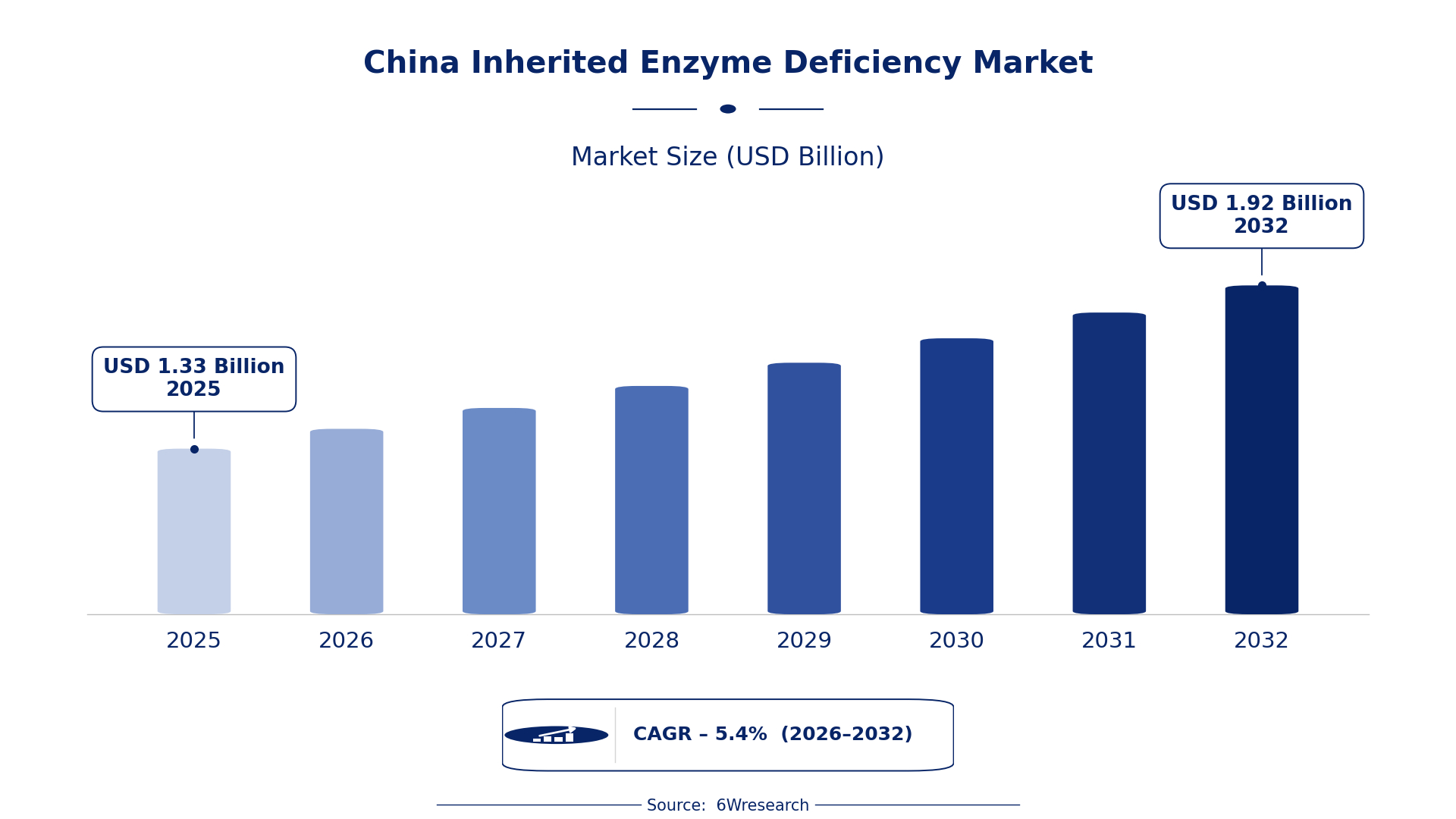
According to 6Wresearch internal database and industry insights, the China Inherited Enzyme Deficiency Market was valued at USD 1.33 billion in 2025 and is projected to reach USD 1.92 billion by 2032, growing at a CAGR of approximately 5.4% during 2026–2032.
China Inherited Enzyme Deficiency Market Highlights
| Report Metric | Details |
| Report Name | China Inherited Enzyme Deficiency Market |
| Market Size 2025 | USD 1.33 billion |
| Market Size 2032 | USD 1.92 billion |
| Absolute Growth 2025–2032 | USD 0.59 billion |
| CAGR 2026–2032 | 5.4% |
| Peak Annual Growth | 7.6% in 2030 |
| Forecast Period | 2026–2032 |
| Historical Data | 2022–2025 |
| Base Year | 2025 |
| Leading Enzyme Deficiency, 2025 | G6PD Deficiency (42% share) |
| Leading Disease Name, 2025 | Hemolytic Anemia (47% share) |
| Leading Treatment Strategy, 2025 | ERT / Gene Therapy (41% share) |
| Leading Distribution Channel, 2025 | Genetic Clinics (48% share) |
| Fastest-Growing Enzyme Deficiency | PKU (7.0% CAGR) |
| Fastest-Growing Disease Name | Lysosomal Storage (7.0% CAGR) |
| Fastest-Growing Distribution Channel | Hospital-Based Delivery (6.9% CAGR) |
| Growing Sector | Genetic Testing and Treatment |
| Key End Users | Healthcare Providers, Genetic Clinics, Pediatric Nutrition Centers |
China Inherited Enzyme Deficiency Market Year-wise Growth Rate and Key Drivers (2022–2032)
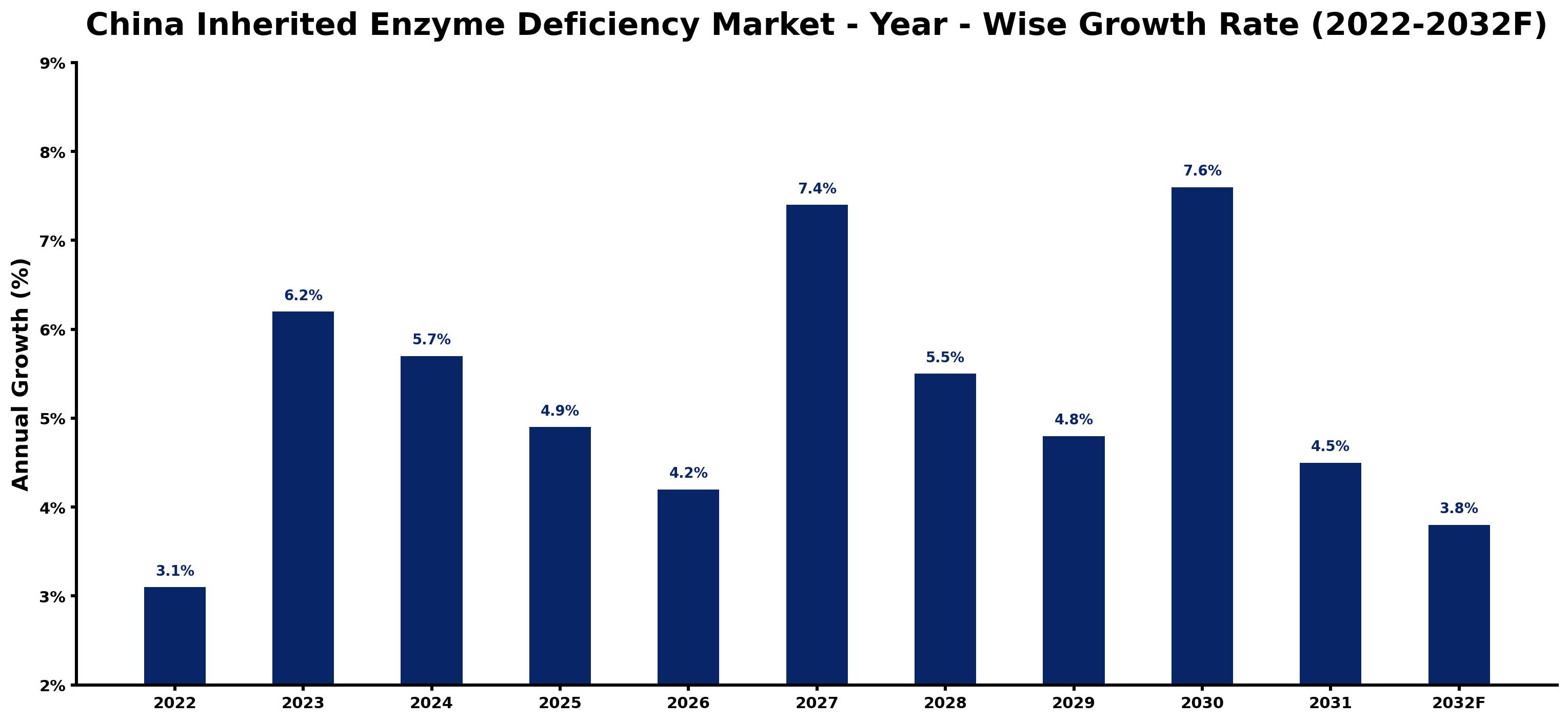
This graph illustrates the annual growth rates of the market from 2022 to 2032, highlighting a steady upward trajectory and projected market expansion over the forecast period.
Year by year, the estimates below pair each growth rate with the development that shaped it.
| Year | Estimated Annual Growth (%) | Market Rationale |
| 2022 | 3.1 | The market experienced modest growth due to existing healthcare infrastructure and awareness. |
| 2023 | 6.2 | Demand surged as genetic testing became more accessible across healthcare facilities. |
| 2024 | 5.7 | Growth slowed as the National Health Commission's Newborn Screening Program expanded coverage. |
| 2025 | 4.9 | The market continued to grow, but at a slower rate as competition intensified. |
| 2026 | 4.2 | Demand growth is expected to decelerate due to market saturation in certain regions. |
| 2027 | 7.4 | A resurgence in growth is projected as new treatment options become available to patients. |
| 2028 | 5.5 | Growth is expected to moderate as healthcare providers adapt to updated treatment protocols. |
| 2029 | 4.8 | The market will see further slowdown as the focus shifts to patient education initiatives. |
| 2030 | 7.6 | A peak in growth is anticipated as enzyme replacement therapies gain wider acceptance. |
| 2031 | 4.5 | Growth is expected to slow again as the market stabilises after rapid expansions. |
| 2032 | 3.8 | The market is projected to grow steadily as awareness and treatment options continue to improve. |
Note: Market size estimations and growth projections presented in this report are based on 6Wresearch's proprietary forecasting methodology, utilizing the latest available industry data, government publications, and primary research inputs.
China Inherited Enzyme Deficiency Market Synopsis
Inherited Enzyme Deficiency in China includes genetic disorders resulting from enzyme malfunction, primarily identified through genetic testing. Management typically involves dietary changes and enzyme replacement therapies. The China Inherited Enzyme Deficiency Market is growing due to more frequent diagnoses and better access to healthcare. Approximately 1 in 500 newborns are diagnosed with G6PD deficiency, which fuels the demand for effective treatments. The rise of genetic clinics and government initiatives further drives this expansion.
Market Dynamics Impact Analysis (2026–2032)
| Factor | Type | Impact | Primary Segment Affected |
| Growing prevalence of G6PD deficiency among newborns driving treatment demand. | Driver | High | G6PD Deficiency |
| Expansion of genetic clinics providing specialized care and testing. | Driver | High | Genetic Clinics |
| Increasing funding for research on enzyme deficiencies enhances treatment options. | Opportunity | High | G6PD Deficiency |
| Rising awareness of enzyme deficiencies among healthcare providers boosts demand. | Opportunity | High | G6PD Deficiency |
| Limited access to treatments in rural areas hampers market growth. | Restraint | High | G6PD Deficiency |
| High costs associated with enzyme replacement therapies restrict patient access. | Restraint | Medium | ERT / Gene Therapy |
| The Inherited Enzyme Deficiency market in China faces regulatory hurdles that delay treatment access. | Challenge | High | G6PD Deficiency |
| Competition among treatment providers can lead to pricing pressures in the market. | Challenge | Medium | G6PD Deficiency |
Evaluation of Drivers in China Inherited Enzyme Deficiency Market (2026–2032)
The table below links each growth driver to the segment it affects and the evidence for it.
| Drivers | Primary Segment Affected | Why It Matters (Evidence) |
| Increased diagnoses of G6PD deficiency. | G6PD Deficiency | 1 in 500 newborns in China are diagnosed, leading to higher treatment demand. |
| Expansion of genetic clinics across China. | Genetic Clinics | Over 300 genetic clinics provide essential services, increasing patient access to treatments. |
| Government funding for enzyme therapy access. | ERT / Gene Therapy | In 2022, funding was allocated to improve access to enzyme therapies in rural areas. |
| Awareness initiatives by healthcare providers. | PKU | The Ministry of Education implemented a Health Education Program to raise awareness about metabolic disorders, reaching millions. |
| Research funding for enzyme deficiencies. | G6PD Deficiency | The initiative was approved in 2023 with a budget of 500 million yuan to support innovative therapies. |
The Inherited Enzyme Deficiency market in China is growing on the back of increased diagnoses and healthcare access. Demand is rising as 1 in 500 newborns are diagnosed with G6PD deficiency, creating a need for effective treatments. The expansion of over 300 genetic clinics across the country improves patient access to specialized care.
Evaluation of Restraints in China Inherited Enzyme Deficiency Market
The following restraints limit how fast demand can grow.
| Market Restraint | Primary Segment Affected | Why It Matters (Evidence) |
| Limited access to enzyme replacement therapies in rural areas. | ERT / Gene Therapy | In 2022, many rural patients still lack access to essential treatments, impacting health outcomes. |
| High costs associated with enzyme replacement therapies restrict patient access. | Gaucher Disease | Treatment costs can exceed 30% of annual income for many families, limiting options. |
| Regulatory hurdles delaying treatment approvals. | G6PD Deficiency | The lengthy approval process for new therapies can take over a year, affecting patient access. |
| Competition leading to pricing pressures among providers. | G6PD Deficiency | Increased competition forces providers to lower prices, impacting their profitability and service quality. |
| Limited public awareness of enzyme deficiencies. | PKU | Despite initiatives, many patients remain unaware of available treatments and management options. |
China Inherited Enzyme Deficiency Market Challenges
The inherited enzyme deficiency market in China faces a pressing skills shortage in genetic counselling, which hampers healthcare providers' ability to deliver timely care. This gap exists due to insufficient specialised training programs, resulting in diagnosis delays for patients, particularly those with G6PD deficiency, affecting 1 in 500 newborns. Technological limitations also plague many clinics, as outdated diagnostic tools can lead to misdiagnosis, complicating treatment plans for buyers. Regulatory hurdles further slow the approval process for new therapies, extending wait times for enzyme replacement therapies, while high treatment costs burden families, with some facing out-of-pocket expenses exceeding 30% of their annual income.
Trends in the China Inherited Enzyme Deficiency Market
Several trends are reshaping the China Inherited Enzyme Deficiency Market; the most important are set out below.
- Shift Towards Improved Genetic Testing: China is witnessing a shift towards enhanced genetic testing capabilities, particularly in urban areas. The establishment of over 300 genetic clinics since 2022 has improved access to genetic testing, facilitating early diagnosis and intervention for enzyme deficiencies.
- Transition to Comprehensive Newborn Screening: Since 2021, the Newborn Screening Program has expanded, aiming for 95% coverage by 2025. This initiative is vital for early detection of metabolic disorders, including enzyme deficiencies, ensuring timely treatment for affected newborns.
- Emergence of Telemedicine for Enzyme Deficiencies: Telemedicine is becoming increasingly popular for managing enzyme deficiencies, especially in remote areas. This trend is supported by initiatives to improve healthcare access, allowing patients to consult specialists without the need for travel.
- Growing Focus on Dietary Management: Healthcare providers are increasingly focusing on dietary management for conditions like PKU. This shift is evident in pediatric nutrition centers, which are expanding their services to cater to the dietary needs of affected children.
Investment Opportunities in the China Inherited Enzyme Deficiency Market
Several openings in the China Inherited Enzyme Deficiency Market merit attention from investors.
- Investing in Partnerships with Genetic Clinics: Collaborating with genetic clinics can improve service delivery and patient access. With over 300 clinics across China, partnerships can enhance the reach of enzyme therapies to underserved populations.
- Expansion into Pediatric Nutrition Centers: Pediatric nutrition centers are in need of specialized dietary management solutions for enzyme deficiencies. With a pediatric population of approximately 300 million, this presents a significant opportunity for suppliers to meet dietary needs.
- Investment in Rural Healthcare Facilities: There is a growing need for investment in rural healthcare facilities to improve access to enzyme therapies. The government has allocated funding to enhance services in these areas, creating opportunities for new providers.
- Development of New Treatment Options: Investing in the development of new treatment options for enzyme deficiencies is essential. The Rare Disease Research Initiative provides funding for innovative therapies, creating opportunities for researchers and healthcare providers.
Government Initiatives in the China Inherited Enzyme Deficiency Market
Recent measures affecting inherited enzyme deficiencies in China include the 'Health Education Program' implemented by the Ministry of Education in 2020, which aims to raise awareness about metabolic disorders. Following this, the National Health Commission launched the 'Newborn Screening Program' in 2021, targeting 95% coverage by 2025 to ensure early detection of enzyme deficiencies. In 2022, the Ministry of Health updated the 'Guidelines for the Management of Inherited Metabolic Disorders' to standardise treatment protocols across hospitals. These measures collectively improve the management of enzyme deficiencies in the country, benefiting both patients and healthcare providers.
The National Health Commission plays a critical role in approving and funding initiatives related to enzyme deficiencies. In 2023, the Commission approved the 'Rare Disease Research Initiative' with a budget of 500 million yuan to support research funding for enzyme deficiencies. Additionally, the National Medical Products Administration introduced a fast-track approval pathway for enzyme replacement therapies in 2022, expediting patient access. These efforts are designed to improve treatment availability and support ongoing research into enzyme deficiencies, ultimately enhancing patient care.
Future Insight of the China Inherited Enzyme Deficiency Market
The inherited enzyme deficiency market in China is set to transform by 2032, propelled by advancements in genetic testing technologies and the expansion of newborn screening initiatives. The National Rare Diseases Registry will improve patient tracking and data collection, enhancing healthcare outcomes. Increased government funding for rural healthcare will facilitate timely access to treatments for more patients, while the introduction of updated diagnostic standards will simplify the identification of enzyme deficiencies. These developments will create a more supportive environment for both buyers and suppliers, ultimately elevating patient care.
Market Segmentation Analysis
The analysis below covers each segmentation, its leading category in 2025 and its fastest-growing category through 2032.
By Enzyme Deficiency – G6PD Deficiency Dominated, PKU Expected to Grow Fastest
According to Shubham Deep, Research Manager at 6Wresearch, G6PD Deficiency held a 42% share of the China Inherited Enzyme Deficiency Market by enzyme deficiency in 2025. G6PD deficiency holds the largest share due to its high prevalence, affecting approximately 1 in 500 newborns in China. The widespread need for direct management and treatment in healthcare facilities supports its dominant position in the market. The quickest growth will come from PKU, forecast to expand at a CAGR of 7.0% between 2026 and 2032. PKU is experiencing rapid growth as it affects 1 in 10,000 births, necessitating early dietary intervention. This increasing awareness and the government's initiatives for newborn screening are driving its growth rate. Suppliers should focus on expanding their offerings for G6PD and PKU to meet the rising demand in China's inherited enzyme deficiency market.
By Disease Name – Hemolytic Anemia Dominated, Lysosomal Storage Expected to Grow Fastest
Hemolytic Anemia took a 47% share of disease name in 2025, more than any other category. Hemolytic anemia holds a substantial market share as it is frequently linked to various conditions that necessitate enzyme therapies. The high incidence of G6PD deficiency, diagnosed in approximately 1 in 500 newborns, underscores its significance for healthcare providers. Lysosomal Storage is projected to grow fastest, at a CAGR of 7.0% during 2026–2032. Lysosomal storage disorders are experiencing rapid growth, with a prevalence of 1 in 7,500 individuals highlighting the urgent need for effective treatments. The increasing focus on these disorders within genetic clinics is driving this segment's expansion. Buyers must ensure access to targeted treatments for lysosomal storage disorders as awareness and diagnosis continue to rise in China.
By Treatment Strategy – ERT / Gene Therapy Dominated and Is Expected to Record the Fastest Growth
ERT / Gene Therapy accounted for a 41% market share by treatment strategy in 2025. ERT and gene therapy dominate the market share as essential treatments for specific enzyme deficiencies, providing critical management options for patients. Their established role in therapy ensures a strong demand from healthcare providers. Its lead should widen, with a projected CAGR of 7.5% during 2026–2032, the highest in this split. ERT and gene therapy are also the fastest-growing strategies, driven by advancements in treatment protocols and increasing patient access. As more patients receive these therapies, their market share will continue to expand. Suppliers must invest in ERT and gene therapy innovations to capitalise on the growing demand in the inherited enzyme deficiency market.
By Distribution Channel – Genetic Clinics Dominated, Hospital-Based Delivery Expected to Grow Fastest
With a 48% revenue share in 2025, Genetic Clinics was the largest distribution channel category. Genetic clinics hold the largest market share as they provide essential diagnostic and treatment services for inherited enzyme deficiencies. Their direct engagement with patients ensures a steady demand for enzyme therapies, particularly in urban areas where access to specialised care is more prevalent. Over 2026–2032, Hospital-Based Delivery is expected to post the fastest growth, at a CAGR of 6.9%. Hospital-based delivery is experiencing the fastest growth, driven by its critical role as the primary setting for administering treatments. The integration of enzyme therapies into hospital protocols is accelerating this segment's expansion, ensuring timely interventions for patients. This trend indicates that suppliers must focus on strengthening partnerships with genetic clinics and hospitals to enhance the distribution and accessibility of enzyme therapies.
Key Attractiveness of the Report
- 10 Years of Market Numbers
- Historical Data Starting from 2022 to 2025
- Base Year 2025
- Forecast Data until 2032
- Key Performance Indicators Impacting the Market
- Major Upcoming Developments and Projects
Key Highlights of the Report:
- China Inherited Enzyme Deficiency Market Outlook
- Market Size of China Inherited Enzyme Deficiency Market, 2025
- Forecast of China Inherited Enzyme Deficiency Market, 2032
- Historical Data and Forecast of China Inherited Enzyme Deficiency Revenues & Volume for the Period 2022 - 2032F
- China Inherited Enzyme Deficiency Market Trend Evolution
- China Inherited Enzyme Deficiency Market Drivers and Challenges
- China Inherited Enzyme Deficiency Price Trends
- China Inherited Enzyme Deficiency Porter's Five Forces
- China Inherited Enzyme Deficiency Industry Life Cycle
- Historical Data and Forecast of China Inherited Enzyme Deficiency Market Revenues & Volume By Enzyme Deficiency for the Period 2022 - 2032F
- Historical Data and Forecast of China Inherited Enzyme Deficiency Market Revenues & Volume By G6PD Deficiency for the Period 2022 - 2032F
- Historical Data and Forecast of China Inherited Enzyme Deficiency Market Revenues & Volume By PKU for the Period 2022 - 2032F
- Historical Data and Forecast of China Inherited Enzyme Deficiency Market Revenues & Volume By Fabry Disease for the Period 2022 - 2032F
- Historical Data and Forecast of China Inherited Enzyme Deficiency Market Revenues & Volume By Gaucher Disease for the Period 2022 - 2032F
- Historical Data and Forecast of China Inherited Enzyme Deficiency Market Revenues & Volume By Disease Name for the Period 2022 - 2032F
- Historical Data and Forecast of China Inherited Enzyme Deficiency Market Revenues & Volume By Hemolytic Anemia for the Period 2022 - 2032F
- Historical Data and Forecast of China Inherited Enzyme Deficiency Market Revenues & Volume By Metabolism Disorder for the Period 2022 - 2032F
- Historical Data and Forecast of China Inherited Enzyme Deficiency Market Revenues & Volume By Lysosomal Storage for the Period 2022 - 2032F
- Historical Data and Forecast of China Inherited Enzyme Deficiency Market Revenues & Volume By Lipid Metabolism Disorder for the Period 2022 - 2032F
- Historical Data and Forecast of China Inherited Enzyme Deficiency Market Revenues & Volume By Treatment Strategy for the Period 2022 - 2032F
- Historical Data and Forecast of China Inherited Enzyme Deficiency Market Revenues & Volume By Avoidance + Monitoring for the Period 2022 - 2032F
- Historical Data and Forecast of China Inherited Enzyme Deficiency Market Revenues & Volume By Low-Phenylalanine Diet for the Period 2022 - 2032F
- Historical Data and Forecast of China Inherited Enzyme Deficiency Market Revenues & Volume By ERT / Gene Therapy for the Period 2022 - 2032F
- Historical Data and Forecast of China Inherited Enzyme Deficiency Market Revenues & Volume By IV Enzyme Therapy for the Period 2022 - 2032F
- Historical Data and Forecast of China Inherited Enzyme Deficiency Market Revenues & Volume By Distribution Channel for the Period 2022 - 2032F
- Historical Data and Forecast of China Inherited Enzyme Deficiency Market Revenues & Volume By Genetic Clinics for the Period 2022 - 2032F
- Historical Data and Forecast of China Inherited Enzyme Deficiency Market Revenues & Volume By Pediatric Nutrition Centers for the Period 2022 - 2032F
- Historical Data and Forecast of China Inherited Enzyme Deficiency Market Revenues & Volume By Biopharma Distributors for the Period 2022 - 2032F
- Historical Data and Forecast of China Inherited Enzyme Deficiency Market Revenues & Volume By Hospital-Based Delivery for the Period 2022 - 2032F
- China Inherited Enzyme Deficiency Import Export Trade Statistics
- Market Opportunity Assessment By Enzyme Deficiency
- Market Opportunity Assessment By Disease Name
- Market Opportunity Assessment By Treatment Strategy
- Market Opportunity Assessment By Distribution Channel
- China Inherited Enzyme Deficiency Top Companies Market Share
- China Inherited Enzyme Deficiency Competitive Benchmarking By Technical and Operational Parameters
- China Inherited Enzyme Deficiency Company Profiles
- China Inherited Enzyme Deficiency Key Strategic Recommendations
Market Covered
Segments analysed in this report are listed below.
By Enzyme Deficiency
- G6PD Deficiency
- PKU
- Fabry Disease
- Gaucher Disease
By Disease Name
- Hemolytic Anemia
- Metabolism Disorder
- Lysosomal Storage
- Lipid Metabolism Disorder
By Treatment Strategy
- Avoidance + Monitoring
- Low-Phenylalanine Diet
- ERT / Gene Therapy
- IV Enzyme Therapy
By Distribution Channel
- Genetic Clinics
- Pediatric Nutrition Centers
- Biopharma Distributors
- Hospital-Based Delivery































