China Insect Biocontrol Market Size & Growth Rate
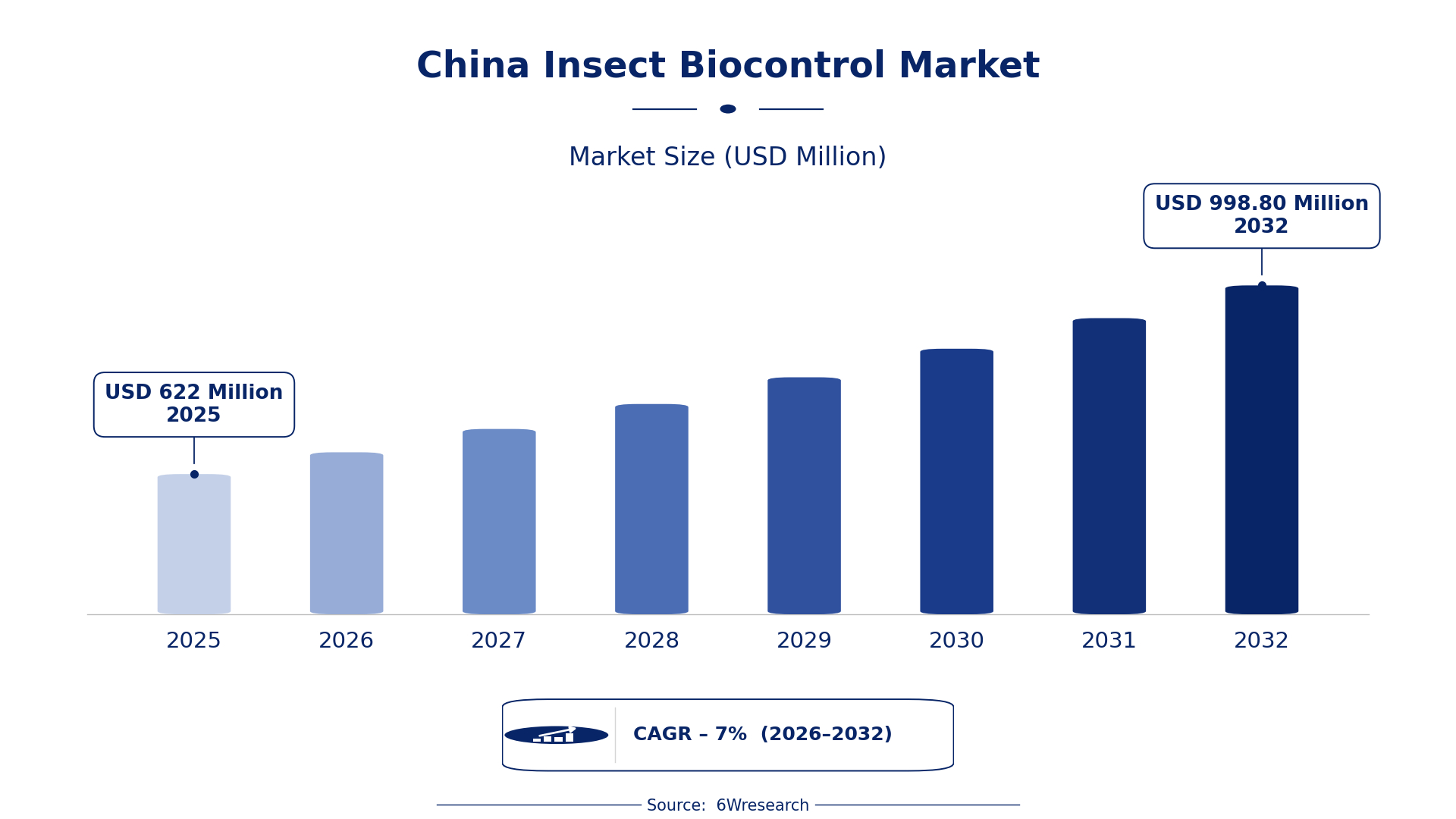
According to 6Wresearch internal database and industry insights, the China Insect Biocontrol Market was valued at USD 622.0 million in 2025 and is projected to reach USD 998.80 million by 2032, growing at a CAGR of approximately 7% during 2026–2032.
China Insect Biocontrol Market Highlights
| Report Metric | Details |
| Report Name | China Insect Biocontrol Market |
| Market Size 2025 | USD 622.0 million |
| Market Size 2032 | USD 998.80 million |
| Absolute Growth 2025–2032 | USD 376.80 million |
| CAGR 2026–2032 | 7% |
| Peak Annual Growth | 8.9% in 2026 |
| Forecast Period | 2026–2032 |
| Historical Data | 2022–2025 |
| Base Year | 2025 |
| Leading Control Type, 2025 | Predators (38% share) |
| Leading Biocontrol Agent, 2025 | Lady Beetles (46% share) |
| Leading Target Pest, 2025 | Aphids (42% share) |
| Leading Formulation Type, 2025 | Liquid Suspension (42% share) |
| Leading Distribution Channel, 2025 | Agri Retailers (42% share) |
| Fastest-Growing Control Type | Parasitoids (9.8% CAGR) |
| Fastest-Growing Biocontrol Agent | Trichogramma Wasps (8.3% CAGR) |
| Fastest-Growing Target Pest | Caterpillars (8.3% CAGR) |
| Fastest-Growing Formulation Type | Wettable Powder (9.4% CAGR) |
| Fastest-Growing Distribution Channel | Direct to Farms (8.8% CAGR) |
| Growing Sector | Agriculture |
| Key End Users | Farmers, Agricultural Cooperatives, Horticulturists, Government Agencies |
China Insect Biocontrol Market Year-wise Growth Rate and Key Drivers (2022–2032)
This graph illustrates the annual growth rates of the market from 2022 to 2032, highlighting a steady upward trajectory and projected market expansion over the forecast period.
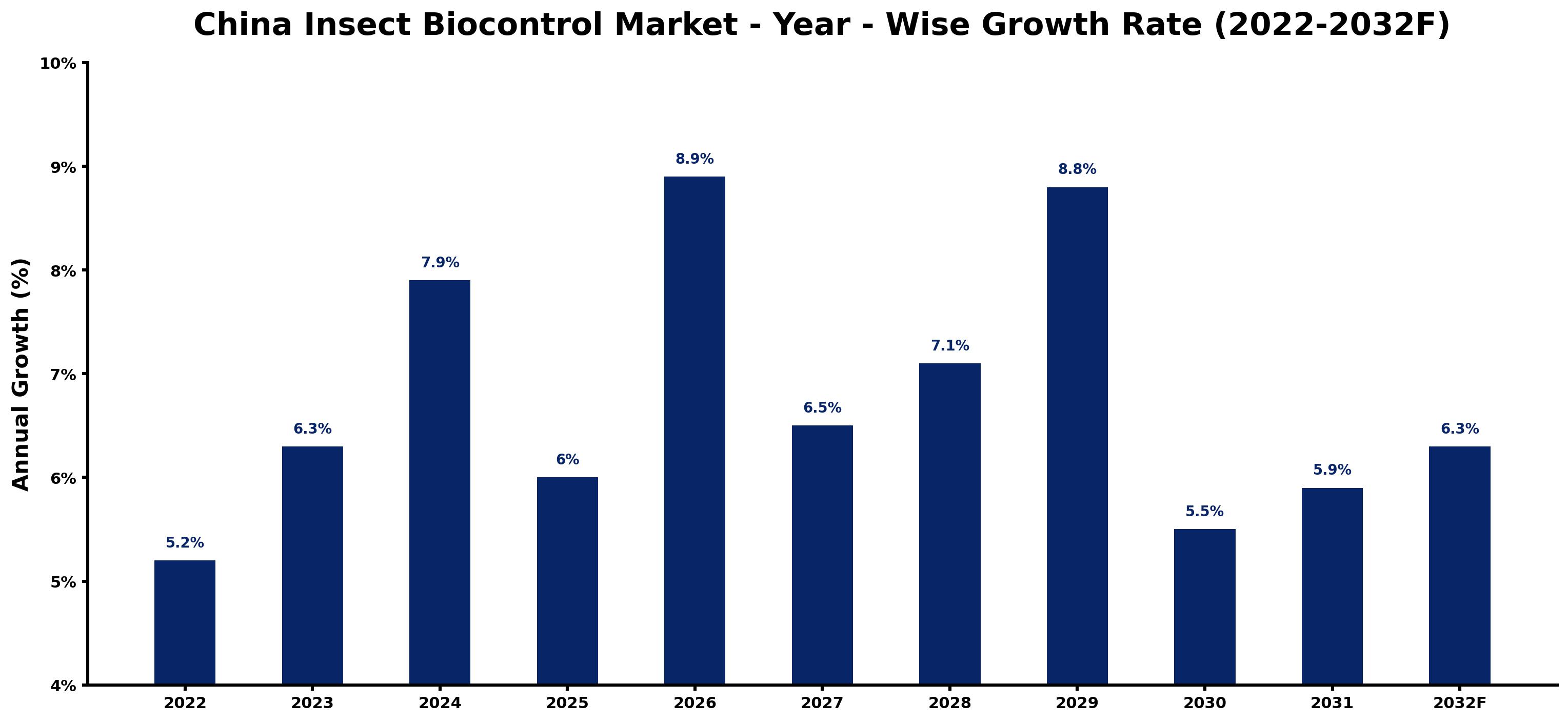
The following table presents the estimated annual growth rate for each year together with the principal factor influencing market performance.
| Year | Estimated Annual Growth (%) | Market Rationale |
| 2022 | 5.2 | The market showed steady growth as awareness of biocontrol methods increased among farmers. |
| 2023 | 6.3 | Demand for biocontrol solutions rose due to the successful implementation of the 'Green Agriculture Development Plan'. |
| 2024 | 7.9 | Growth accelerated as more farmers adopted biocontrol methods for sustainable pest management. |
| 2025 | 6.0 | A slight slowdown occurred as some farmers faced challenges in transitioning from chemical pesticides. |
| 2026 | 8.9 | The market is expected to peak as investments in biocontrol technologies surge, driven by government initiatives. |
| 2027 | 6.5 | Growth is projected to slow slightly as market maturity begins to set in, but demand will remain strong. |
| 2028 | 7.1 | Increased adoption of biocontrol in horticulture is expected to lead to a rise in market activity. |
| 2029 | 8.8 | The market is anticipated to experience renewed growth as awareness of pest management solutions expands. |
| 2030 | 5.5 | A slowdown is projected as the market stabilises, but demand for biocontrol will persist. |
| 2031 | 5.9 | Growth is expected to pick up again as more farmers recognise the benefits of biocontrol methods. |
| 2032 | 6.3 | Demand will continue to rise as sustainable practices become more mainstream in agriculture. |
Note: Market size estimations and growth projections presented in this report are based on 6Wresearch's proprietary forecasting methodology, utilizing the latest available industry data, government publications, and primary research inputs.
China Insect Biocontrol Market Synopsis
The China Insect Biocontrol Market refers to the use of natural predators, parasitoids, and pathogens to manage pest populations sustainably. This method reduces reliance on chemical pesticides and promotes biodiversity. The market is growing due to increasing awareness among agricultural users and government-supported initiatives such as the 'Green Agriculture Development Plan'. With over 300 million people employed in agriculture, the demand for effective pest management solutions is substantial.
Market Dynamics Impact Analysis (2026–2032)
| Factor | Type | Impact | Primary Segment Affected |
| Growing awareness of sustainable farming practices among agricultural users | Driver | High | Predators |
| Government initiatives promoting biocontrol methods | Driver | High | Government Initiatives |
| Increased funding for research on sustainable pest management | Opportunity | High | Predators |
| Expansion of biocontrol adoption in horticulture | Opportunity | High | Predators |
| Challenges in transitioning from chemical pesticides to biocontrol methods | Restraint | Medium | Predators |
| Limited awareness among smallholder farmers about biocontrol options | Restraint | Medium | Predators |
| Insect Biocontrol in China faces regulatory hurdles that slow market entry | Challenge | High | Predators |
| Competition from chemical pesticide manufacturers affects market growth | Challenge | High | Predators |
Evaluation of Drivers in China Insect Biocontrol Market (2026–2032)
Key forces behind demand, with the segment each one moves most, are listed below.
| Drivers | Primary Segment Affected | Why It Matters (Evidence) |
| Increased adoption of biocontrol methods among farmers | Predators | Over 60% of farmers in major agricultural provinces are aware of biocontrol options, resulting in higher purchases. |
| Government support for sustainable agriculture | Predators | The 'Green Agriculture Development Plan' promotes biocontrol methods, encouraging farmers to invest in these solutions. |
| Growing market for organic produce | Lady Beetles | As organic farming expands, demand for biocontrol agents like lady beetles increases, boosting sales. |
| Research funding for biocontrol technologies | Predators | In 2023, the government allocated 500 million CNY for research on sustainable pest management, improving product availability. |
| Training programs for farmers on biocontrol practices | Predators | The 'Biological Control Technology Promotion Plan' improves knowledge, leading to increased use of effective formulations. |
Market growth for Insect Biocontrol in China is underpinned by rising adoption among agricultural users and a growing market for organic produce. Awareness of biocontrol options among farmers exceeds 60%, prompting increased purchases. In 2023, 500 million CNY was allocated for research on sustainable pest management, enhancing product availability. These developments contribute to the increasing demand for biocontrol solutions in agriculture.
Evaluation of Restraints in China Insect Biocontrol Market
The table below lists the restraints and the evidence behind each.
| Market Restraint | Primary Segment Affected | Why It Matters (Evidence) |
| Regulatory hurdles slow market entry for new biocontrol products | Predators | Complex approval processes delay the introduction of new solutions, affecting availability. |
| Limited awareness among smallholder farmers about biocontrol options | Predators | Many smallholders remain unaware of the benefits of biocontrol, restricting market growth. |
| Transition challenges from chemical pesticides to biocontrol methods | Predators | Farmers face difficulties adapting to new methods, slowing the shift towards biocontrol. |
| Competition from established chemical pesticide manufacturers | Predators | Chemical alternatives are often more familiar to farmers, hindering biocontrol adoption. |
| Inconsistent quality of biocontrol products in the market | Predators | Variability in product effectiveness can lead to farmer scepticism and reduced purchases. |
China Insect Biocontrol Market Challenges
Buyers in the China insect biocontrol market encounter strong competition from conventional chemical pesticides, which are cheaper and more accessible. This price advantage stems from the long-standing use of chemical solutions in agriculture, delaying farmers' acceptance of biocontrol alternatives. A lack of trained agricultural workers exacerbates this issue, as many lack the skills to implement biocontrol techniques effectively, leading to subpar pest management outcomes. Furthermore, regulatory requirements linked to the 'National Standard for Biological Control Agents' can prolong product development times and raise costs, limiting options for farmers seeking pest control solutions.
Trends in the China Insect Biocontrol Market
Four trends stand out in the China Insect Biocontrol Market.
- Shift from Chemical to Biological Pest Control: Since 2021, China has experienced a marked shift towards biological pest control methods, influenced by government policies. The 'Pesticide Reduction Strategy' aims to cut chemical pesticide use by 30% by 2025, encouraging biocontrol alternatives.
- Increased Investment in Biocontrol Research: In 2023, the government allocated 500 million CNY for research on sustainable pest management. This funding supports the development of effective biocontrol solutions, enhancing their availability.
- Growth of Organic Farming Practices: The rise in organic farming practices is apparent in regions like Guangdong, where biocontrol methods are increasingly embraced. Over 40% of farmers in this area now utilise biocontrol agents to manage pests.
- Expansion of Training Programs for Farmers: Since the launch of the 'Biological Control Technology Promotion Plan' in 2023, training programmes for farmers have expanded significantly. This initiative seeks to improve knowledge and skills in biocontrol practices.
Investment Opportunities in the China Insect Biocontrol Market
Some of the investment opportunities in the China Insect Biocontrol Market are mentioned below.
- Partnerships with Local Agricultural Cooperatives: With over 300 million people employed in agriculture, collaborating with local cooperatives can enhance distribution. This strategy provides better access to biocontrol products, tapping into a market valued at over 100 billion CNY.
- Investment in Biocontrol Product Development: The market gap for effective biocontrol solutions is considerable, with demand on the rise. Investing in the creation of new products can capture the increasing interest among farmers in sustainable practices.
- Supply of Training Resources for Farmers: As awareness of biocontrol methods grows, providing training materials and resources can satisfy the demand. Initiatives like the 'Biological Control Technology Promotion Plan' highlight the need for educational support.
- Expansion into Horticultural Biocontrol Solutions: The horticultural sector is swiftly adopting biocontrol methods, presenting a promising opportunity. Focusing on this sector can yield substantial returns as demand for sustainable practices increases.
Government Initiatives in the China Insect Biocontrol Market
The 'National Action Plan for Sustainable Agriculture', launched by the Ministry of Agriculture in 2021, promotes biocontrol methods with a budget of 300 million CNY. This initiative aims to boost the adoption of sustainable practices among farmers, ensuring they have access to effective pest management solutions. The 'Pesticide Reduction Strategy', enacted in 2022, seeks to reduce chemical pesticide use by 30% by 2025, facilitating the transition to biocontrol alternatives. These measures create a supportive environment for producers and users alike.
In 2023, the 'Biological Control Technology Promotion Plan' was initiated to enhance the adoption of biocontrol technologies among farmers. This programme is overseen by the Ministry of Agriculture, which provides funding for training and resources. The 'Green Food Certification Program' encourages the use of biocontrol agents in certified organic farming, ensuring that farmers meet the standards required for organic produce. These initiatives collectively support the growth of the biocontrol market.
Future Insight of the China Insect Biocontrol Market
In the China insect biocontrol market, buyers and suppliers can anticipate substantial changes by 2032, driven by initiatives like the 'Green Agriculture Development Plan'. The annual production of lady beetles will surpass 1 billion individuals, broadening pest control options for agricultural users. Increased funding for sustainable pest management research will lead to advancements in biocontrol technologies, improving their effectiveness. The growth of the 'Integrated Pest Management (IPM) Program' will further integrate biocontrol methods into agricultural practices across key regions.
Market Segmentation Analysis
The analysis below covers each segmentation, its leading category in 2025 and its fastest-growing category through 2032.
By Control Type – Predators Dominated, Parasitoids Expected to Grow Fastest
According to Shubham Deep, Research Manager at 6Wresearch, the largest control type category in 2025 was Predators, with a 38% share of total revenue. Predators hold the largest market share in China as they are essential for sustainable agriculture, especially in regions where pest control is critical. Their effectiveness in managing aphid populations has made them a preferred choice among farmers in significant agricultural areas. Parasitoids are set to record the highest CAGR in this split, 9.8% over 2026–2032. The parasitoids segment is experiencing rapid growth due to their increasing adoption in pest management, particularly in provinces implementing the Integrated Pest Management Program. This initiative has led to a notable rise in the use of Trichogramma wasps, recognised for their efficiency against various caterpillar pests. Suppliers should focus on enhancing predator-based solutions to meet the growing demand from agricultural users.
By Biocontrol Agent – Lady Beetles Dominated, Trichogramma Wasps Expected to Grow Fastest
Lady Beetles held a 46% share of the China Insect Biocontrol Market by biocontrol agent in 2025. Lady beetles dominate the market share owing to their widespread use in controlling aphids, a common pest in Chinese agriculture. The remarkable annual production of over 1 billion individuals underscores their crucial role in pest management strategies across the country. Trichogramma Wasps are projected to grow fastest, at a CAGR of 8.3% during 2026–2032. Trichogramma wasps are rapidly gaining traction as they effectively address caterpillar pests, which significantly threaten crop yields. Their increasing utilisation aligns with government initiatives promoting sustainable pest management practices. Buyers should incorporate Trichogramma wasps into their pest control strategies to capitalise on the growing trend towards biocontrol solutions.
By Target Pest – Aphids Dominated, Caterpillars Expected to Grow Fastest
Aphids took a 42% share of target pest in 2025, more than any other category. Aphids are the leading target pest as they pose a primary challenge for farmers, particularly in major agricultural provinces. The awareness of biocontrol options among over 60% of farmers highlights the focus on effectively managing aphid populations. The quickest growth will come from Caterpillars, forecast to expand at a CAGR of 8.3% between 2026 and 2032. Caterpillars are the fastest-growing target pest segment, driven by their substantial impact on crop protection and the rising adoption of biocontrol methods. The government's support for sustainable practices has intensified efforts to control caterpillar infestations. Suppliers should develop solutions specifically targeting caterpillars to align with the market's rapid growth in this area.
By Formulation Type – Liquid Suspension Dominated, Wettable Powder Expected to Grow Fastest
With a 42% revenue share in 2025, Liquid Suspension was the largest formulation type category. Liquid suspension formulations command the largest market share due to their popularity and ease of application among farmers. Their effectiveness in delivering biocontrol agents directly to crops has made them a go-to choice in agricultural practices. Over 2026–2032, Wettable Powder is expected to post the fastest growth, at a CAGR of 9.4%. Wettable powders are the fastest-growing formulation type, favoured for their convenience and ease of use in the field. This trend is likely to continue as farmers seek efficient solutions for pest management. Manufacturers should focus on improving the formulation of wettable powders to cater to the increasing demand for user-friendly pest control options.
By Distribution Channel – Agri Retailers Dominated, Direct to Farms Expected to Grow Fastest
In 2025, Agri Retailers led the distribution channel split with a 42% share. Agri retailers are the leading distribution channel, providing farmers with crucial access to biocontrol solutions. Their established networks and strong relationships with agricultural users make them the primary source for purchasing these products. Direct to Farms are set to record the highest CAGR in this split, 8.8% over 2026–2032. Direct to farms is the fastest-growing distribution channel, ensuring that farmers have immediate access to biocontrol solutions. This trend reflects the increasing demand for timely pest management interventions in agriculture, indicating a shift towards more direct purchasing methods. Suppliers should enhance direct distribution strategies to meet the immediate needs of farmers seeking biocontrol solutions.
Key Attractiveness of the Report
- 10 Years of Market Numbers
- Historical Data Starting from 2022 to 2025
- Base Year 2025
- Forecast Data until 2032
- Key Performance Indicators Impacting the Market
- Major Upcoming Developments and Projects
Key Highlights of the Report:
- China Insect Biocontrol Market Outlook
- Market Size of China Insect Biocontrol Market, 2025
- Forecast of China Insect Biocontrol Market, 2032
- Historical Data and Forecast of China Insect Biocontrol Revenues & Volume for the Period 2022 - 2032F
- China Insect Biocontrol Market Trend Evolution
- China Insect Biocontrol Market Drivers and Challenges
- China Insect Biocontrol Price Trends
- China Insect Biocontrol Porter's Five Forces
- China Insect Biocontrol Industry Life Cycle
- Historical Data and Forecast of China Insect Biocontrol Market Revenues & Volume By Control Type for the Period 2022 - 2032F
- Historical Data and Forecast of China Insect Biocontrol Market Revenues & Volume By Predators for the Period 2022 - 2032F
- Historical Data and Forecast of China Insect Biocontrol Market Revenues & Volume By Parasitoids for the Period 2022 - 2032F
- Historical Data and Forecast of China Insect Biocontrol Market Revenues & Volume By Pathogens for the Period 2022 - 2032F
- Historical Data and Forecast of China Insect Biocontrol Market Revenues & Volume By Competitors for the Period 2022 - 2032F
- Historical Data and Forecast of China Insect Biocontrol Market Revenues & Volume By Biocontrol Agent for the Period 2022 - 2032F
- Historical Data and Forecast of China Insect Biocontrol Market Revenues & Volume By Lady Beetles for the Period 2022 - 2032F
- Historical Data and Forecast of China Insect Biocontrol Market Revenues & Volume By Trichogramma Wasps for the Period 2022 - 2032F
- Historical Data and Forecast of China Insect Biocontrol Market Revenues & Volume By Fungi/Nematodes for the Period 2022 - 2032F
- Historical Data and Forecast of China Insect Biocontrol Market Revenues & Volume By Sterile Insects for the Period 2022 - 2032F
- Historical Data and Forecast of China Insect Biocontrol Market Revenues & Volume By Target Pest for the Period 2022 - 2032F
- Historical Data and Forecast of China Insect Biocontrol Market Revenues & Volume By Aphids for the Period 2022 - 2032F
- Historical Data and Forecast of China Insect Biocontrol Market Revenues & Volume By Caterpillars for the Period 2022 - 2032F
- Historical Data and Forecast of China Insect Biocontrol Market Revenues & Volume By Soil Pests for the Period 2022 - 2032F
- Historical Data and Forecast of China Insect Biocontrol Market Revenues & Volume By Mosquitoes for the Period 2022 - 2032F
- Historical Data and Forecast of China Insect Biocontrol Market Revenues & Volume By Formulation Type for the Period 2022 - 2032F
- Historical Data and Forecast of China Insect Biocontrol Market Revenues & Volume By Liquid Suspension for the Period 2022 - 2032F
- Historical Data and Forecast of China Insect Biocontrol Market Revenues & Volume By Capsules for the Period 2022 - 2032F
- Historical Data and Forecast of China Insect Biocontrol Market Revenues & Volume By Wettable Powder for the Period 2022 - 2032F
- Historical Data and Forecast of China Insect Biocontrol Market Revenues & Volume By Live Organisms for the Period 2022 - 2032F
- Historical Data and Forecast of China Insect Biocontrol Market Revenues & Volume By Distribution Channel for the Period 2022 - 2032F
- Historical Data and Forecast of China Insect Biocontrol Market Revenues & Volume By Agri Retailers for the Period 2022 - 2032F
- Historical Data and Forecast of China Insect Biocontrol Market Revenues & Volume By Direct to Farms for the Period 2022 - 2032F
- Historical Data and Forecast of China Insect Biocontrol Market Revenues & Volume By Cooperatives for the Period 2022 - 2032F
- Historical Data and Forecast of China Insect Biocontrol Market Revenues & Volume By Government Initiatives for the Period 2022 - 2032F
- China Insect Biocontrol Import Export Trade Statistics
- Market Opportunity Assessment By Control Type
- Market Opportunity Assessment By Biocontrol Agent
- Market Opportunity Assessment By Target Pest
- Market Opportunity Assessment By Formulation Type
- Market Opportunity Assessment By Distribution Channel
- China Insect Biocontrol Top Companies Market Share
- China Insect Biocontrol Competitive Benchmarking By Technical and Operational Parameters
- China Insect Biocontrol Company Profiles
- China Insect Biocontrol Key Strategic Recommendations
Market Covered
The report offers an extensive study of the following market segments.
By Control Type
- Predators
- Parasitoids
- Pathogens
- Competitors
By Biocontrol Agent
- Lady Beetles
- Trichogramma Wasps
- Fungi/Nematodes
- Sterile Insects
By Target Pest
- Aphids
- Caterpillars
- Soil Pests
- Mosquitoes
By Formulation Type
- Liquid Suspension
- Capsules
- Wettable Powder
- Live Organisms
By Distribution Channel
- Agri Retailers
- Direct to Farms
- Cooperatives
- Government Initiatives































