China Integrated Air Defense Market Size & Growth Rate
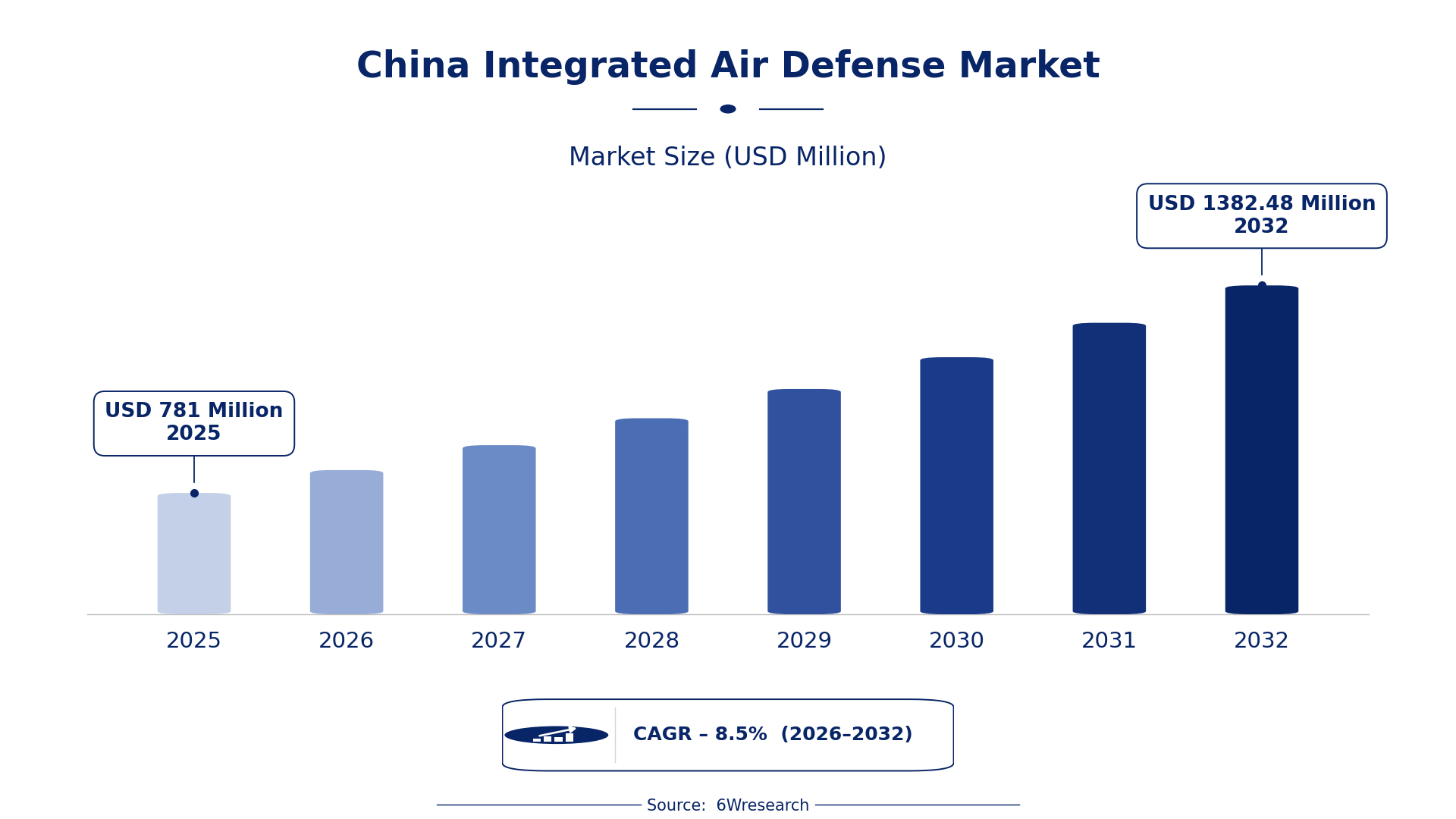
According to 6Wresearch internal database and industry insights, the China Integrated Air Defense Market was valued at USD 781.0 million in 2025 and is projected to reach USD 1,382.48 million by 2032, growing at a CAGR of approximately 8.5% during 2026–2032.
China Integrated Air Defense Market Highlights
| Report Metric | Details |
| Report Name | China Integrated Air Defense Market |
| Market Size 2025 | USD 781.0 million |
| Market Size 2032 | USD 1,382.48 million |
| Absolute Growth 2025–2032 | USD 601.48 million |
| CAGR 2026–2032 | 8.5% |
| Peak Annual Growth | 10.9% in 2030 |
| Forecast Period | 2026–2032 |
| Historical Data | 2022–2025 |
| Base Year | 2025 |
| Leading System Type, 2025 | Long-Range Systems (48% share) |
| Leading Component Type, 2025 | Radar + Missile Launcher (50% share) |
| Leading Range Category, 2025 | Multi-tier (66% share) |
| Leading End User, 2025 | Military Forces (38% share) |
| Leading Deployment Mode, 2025 | Land-based (47% share) |
| Fastest-Growing System Type | Medium-Range Systems (10.0% CAGR) |
| Fastest-Growing Component Type | Integration Software (9.8% CAGR) |
| Fastest-Growing End User | Homeland Security (11.0% CAGR) |
| Fastest-Growing Deployment Mode | Mobile/Vehicle-based (9.6% CAGR) |
| Growing Sector | Homeland Security |
| Key End Users | Military Forces, Defense Organizations, Homeland Security, Border Security |
China Integrated Air Defense Market Year-wise Growth Rate and Key Drivers (2022–2032)
This graph illustrates the annual growth rates of the market from 2022 to 2032, highlighting a steady upward trajectory and projected market expansion over the forecast period.
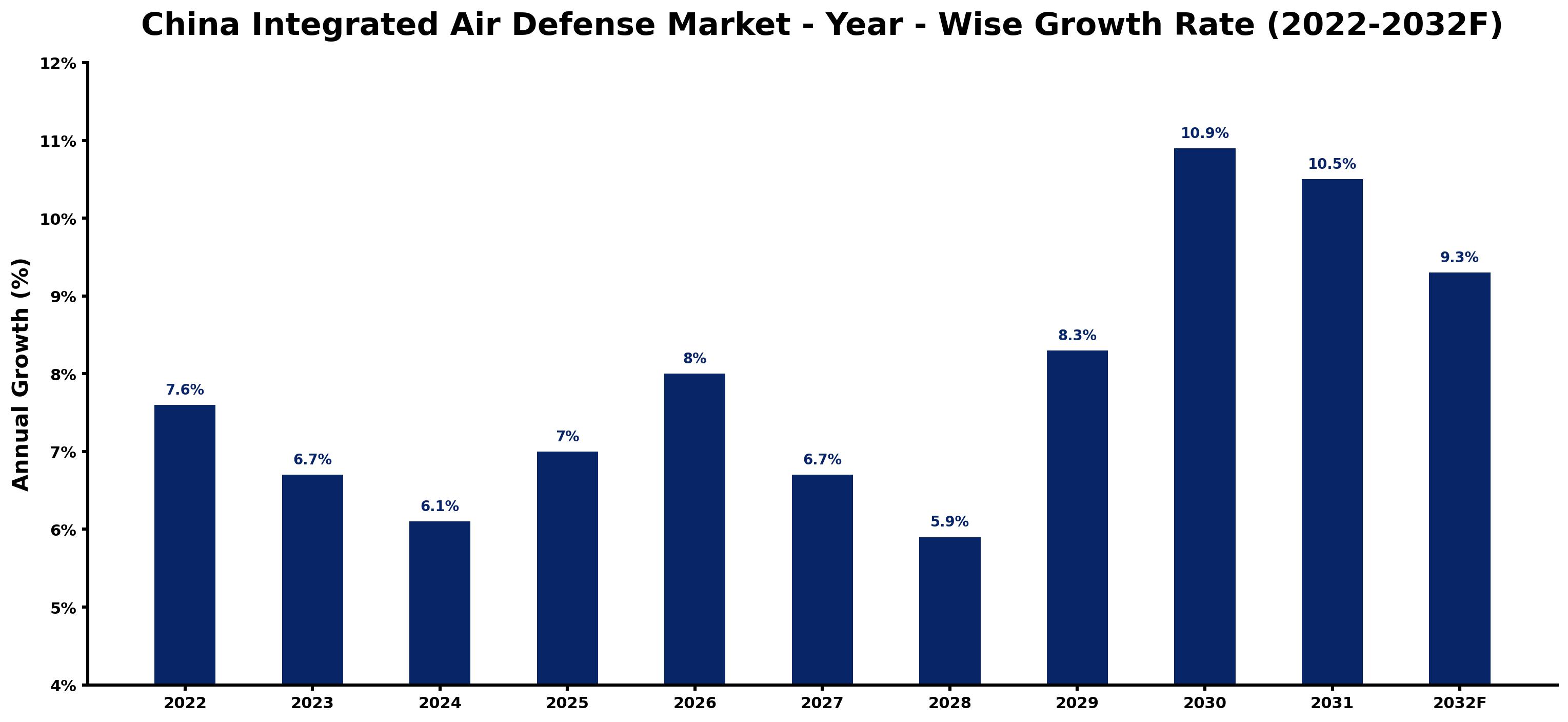
Annual growth estimates for each year appear below with the principal reason behind them, explaining the shifts that set the pace of the market.
| Year | Estimated Annual Growth (%) | Market Rationale |
| 2022 | 7.6 | The market experienced a strong growth phase due to increased military spending. |
| 2023 | 6.7 | Investment in integrated air defense systems is expected to slow compared to the previous year due to budget adjustments. |
| 2024 | 6.1 | Continued focus on modernization efforts will contribute to a further slowdown in growth as priorities shift. |
| 2025 | 7.0 | The market is projected to rebound with increased demand for advanced defense technologies driven by military exercises. |
| 2026 | 8.0 | Growth is expected to accelerate as military forces expand their air defense capabilities through new initiatives. |
| 2027 | 6.7 | The market will see a slowdown as military budgets face tighter constraints due to economic factors. |
| 2028 | 5.9 | Growth is projected to continue slowing due to shifting priorities in defense spending towards other sectors. |
| 2029 | 8.3 | Demand is expected to surge as military exercises involving air defense systems increase, improving operational readiness. |
| 2030 | 10.9 | The market will peak as investments are made in air defense technologies to enhance national security. |
| 2031 | 10.5 | Growth is projected to slow slightly as the market adjusts to previous peaks in military spending. |
| 2032 | 9.3 | The market continues to grow, driven by ongoing modernization initiatives and regional security concerns. |
Note: Market size estimations and growth projections presented in this report are based on 6Wresearch's proprietary forecasting methodology, utilizing the latest available industry data, government publications, and primary research inputs.
China Integrated Air Defense Market Synopsis
Integrated Air Defense systems in China are advanced military technologies designed to detect, track, and intercept aerial threats. These systems combine radar technology, missile systems, and command units for national defense and border security. The China Integrated Air Defense Market is expanding, driven by a military budget of approximately 1.55 trillion yuan focused on modernization and the 'Defense Modernization Plan' launched in 2022. Increased military exercises and regional security concerns further fuel demand for these systems, leading to substantial investments in air defense capabilities.
Market Dynamics Impact Analysis (2026–2032)
| Factor | Type | Impact | Primary Segment Affected |
| Increased military budget allocations for modernization programs | Driver | High | Short-Range Systems |
| Growing need for border security and national defense | Driver | High | Medium-Range Systems |
| Rising demand for integrated air defense technologies | Opportunity | High | Long-Range Systems |
| Investment in regional defense infrastructure improvements | Opportunity | Medium | Layered Defense System |
| Challenges in integrating advanced technologies into existing systems | Restraint | High | Radar + Missile Launcher |
| Limited domestic production capabilities for certain components | Restraint | Medium | Command & Control Unit |
| Shortage of skilled workforce in defense technology sectors | Challenge | High | Fire Control System |
| Increasing competition from international defense manufacturers | Challenge | Medium | Integration Software |
Evaluation of Drivers in China Integrated Air Defense Market (2026–2032)
Key forces behind demand, with the segment each one moves most, are listed below.
| Drivers | Primary Segment Affected | Why It Matters (Evidence) |
| Increased military budget for modernization | Short-Range Systems | China's military budget for 2023 is approximately 1.55 trillion yuan, driving demand for advanced defense systems. |
| Growing need for enhanced border security measures | Medium-Range Systems | The PLA Air Force operates various integrated air defense systems across multiple provinces, increasing regional demand. |
| Focus on indigenous development of air defense technologies | Long-Range Systems | The 'National Defense Science and Technology Innovation Program' aims to boost local production by 2025, enhancing capabilities. |
| Increased military exercises improving operational readiness | Layered Defense System | The PLA has increased military exercises involving integrated air defense systems since 2021, improving response capabilities. |
| Rising regional security concerns driving investments | Radar + Missile Launcher | The 2023 Defense White Paper emphasizes integrated air defense's role in national security, prompting further investments. |
Growth across the Integrated Air Defense market in China is anchored in rising military budgets, increasing regional security concerns, and a focus on local technology development. The military budget for 2023 is approximately 1.55 trillion yuan, which fuels demand for advanced defense systems. The PLA operates various integrated air defense systems across multiple provinces, enhancing regional security and operational readiness. Increased military exercises since 2021 have further driven investments in these technologies, demonstrating the commitment to modernizing defense capabilities. The emphasis on indigenous development is expected to boost local production and reduce reliance on foreign technology.
Evaluation of Restraints in China Integrated Air Defense Market
The key brakes on demand, and where they bite hardest, are shown below.
| Market Restraint | Primary Segment Affected | Why It Matters (Evidence) |
| Integration challenges with advanced technologies | Radar + Missile Launcher | Integrating AI and big data into existing systems requires substantial investment and expertise, complicating deployment. |
| Limited domestic production capabilities for advanced components | Command & Control Unit | China's reliance on foreign technology for certain components hinders local production efforts, impacting supply chains. |
| Shortage of skilled workforce in defense technology sectors | Fire Control System | The defense industry employs over 1 million people, but skilled labor shortages persist, affecting project timelines. |
| Regulatory hurdles for new technology adoption | Integration Software | New guidelines from the Central Military Commission complicate the integration of emerging technologies into existing systems. |
| High costs associated with R&D for new systems | Layered Defense System | The 'Defense Technology Innovation Initiative' requires substantial funding for research and development, straining budgets. |
China Integrated Air Defense Market Challenges
China's integrated air defense market still has to solve a few problems, starting with intense competition among domestic manufacturers, which can trigger price wars and squeeze profit margins for suppliers. The rapid pace of technological advancements requires constant upgrades to systems, delaying deployment for military forces and hindering operational readiness. High research and development costs for integrated air defense systems can consume up to 20% of military budgets, forcing buyers to divert funds from other critical areas. Adhering to national standards, such as GB/T 12345-2020, complicates the approval process, resulting in implementation delays across multiple provinces.
Trends in the China Integrated Air Defense Market
Four trends stand out in the China Integrated Air Defense Market.
- National Defense Modernization Plan Driving Advancements: The 'National Defense Modernization Plan', approved in 2021, is driving advancements in integrated air defense technologies. This initiative allocates substantial resources for system upgrades, aiming to improve operational effectiveness across military forces.
- Adoption of Multi-tier Defense Systems: China is increasingly adopting multi-tier defense systems to improve airspace protection. With a projected 66% market share by 2025, this approach strengthens capabilities against aerial threats and reflects a strategic shift in defense planning.
- Military-Civil Fusion Strategy Encouraging Collaboration: The 'Military-Civil Fusion Strategy' promotes collaboration between military and civilian sectors in developing air defense technologies. This initiative is anticipated to drive innovation and efficiency, benefiting both sectors considerably.
- Intensified Military Exercises Improving Readiness: Since 2021, the PLA has intensified military exercises involving integrated air defense systems. This trend boosts operational readiness and demonstrates China's commitment to strengthening its defense capabilities.
Investment Opportunities in the China Integrated Air Defense Market
Several openings in the China Integrated Air Defense Market merit attention from investors.
- Military Forces Seeking Advanced Systems: Military Forces in China are actively seeking advanced integrated air defense systems to enhance national security. With a military budget of 1.55 trillion yuan, there is a substantial opportunity for suppliers to meet this demand.
- Shanghai Region as a Key Development Hub: The Shanghai region is an essential hub for research and development of air defense systems. Investing in R&D facilities here can lead to valuable partnerships and access to the expanding market.
- Partnerships for Technology Development: Local partnerships for technology development are essential for entering the integrated air defense market. Collaborating with established defense organizations can facilitate access to resources and expertise, improving project outcomes.
- Current Demand for Layered Defense Solutions: Ongoing modernization efforts create a pressing need for layered defense solutions. Suppliers can capitalize on this opportunity by providing innovative technologies that improve airspace protection.
Government Initiatives in the China Integrated Air Defense Market
The 'National Defense Modernization Plan', approved in 2021, allocates substantial resources for upgrading air defense systems and improving operational capabilities. This initiative focuses on integrating advanced technologies and enhancing the overall effectiveness of military forces. The Ministry of National Defense oversees these developments, ensuring that the integrated air defense systems meet national security requirements. Additionally, the plan aims to foster domestic production capabilities, reducing reliance on foreign technology. By 2025, the program is projected to significantly enhance the country's air defense readiness.
The 'Defense Technology Innovation Initiative', launched by the Ministry of Industry and Information Technology in 2022, promotes advancements in integrated air defense technologies. This initiative supports research and development projects that focus on indigenous capabilities. The program aims to facilitate collaboration between military and civilian sectors, improving innovation and efficiency in defense technology. By fostering partnerships, the initiative is set to improve the overall quality and effectiveness of air defense systems. This collaborative approach is vital for meeting the evolving security challenges faced by the country.
Future Insight of the China Integrated Air Defense Market
Several forward-looking factors should support the integrated air defense market in China over the coming years. The 2023 Defense White Paper highlights a strategic focus on air defense capabilities, which will drive demand for advanced systems. The 'National Defense Science and Technology Innovation Program' aims to boost local production by 30% by 2025, promoting self-sufficiency. Increased military exercises involving integrated systems will enhance operational readiness, while the 'Military-Civil Fusion Strategy' will encourage collaboration between military and civilian sectors, driving technological innovation.
Market Segmentation Analysis
The report offers a comprehensive study of the following market segments and their leading categories in the market.
By System Type – Long-Range Systems Dominated, Medium-Range Systems Expected to Grow Fastest
According to Shubham Deep, Research Manager at 6Wresearch, Long-Range Systems accounted for a 48% market share by system type in 2025. Long-Range Systems hold the largest market share as they are vital for national defense strategy, particularly in safeguarding extensive areas from aerial threats. The reliance of the PLA Air Force on these systems in regions like Guangdong and Shandong highlights their critical importance. Over 2026–2032, Medium-Range Systems are expected to post the fastest growth, at a CAGR of 10.0%. Medium-Range Systems are experiencing rapid growth due to their recognised effectiveness in regional airspace control, with military exercises showcasing their capabilities. This increased focus on regional security is driving demand, suggesting that Long-Range Systems will maintain their lead. Suppliers should enhance Medium-Range Systems to capitalise on their growing market share.
By Component Type – Radar + Missile Launcher Dominated, Integration Software Expected to Grow Fastest
Radar + Missile Launcher held a 50% share of the China Integrated Air Defense Market by component type in 2025. Radar + Missile Launcher components dominate the market share as they are essential for effective target engagement in integrated air defense systems. Their crucial role in operational readiness makes them a primary focus for the Ministry of National Defense's development initiatives. Integration Software is set to record the highest CAGR in this split, 9.8% over 2026–2032. Integration Software is witnessing the fastest growth due to its significant role in supporting system interoperability, which is increasingly vital as air defense technologies advance. The demand for seamless integration within military operations is driving interest in this component, reinforcing the dominance of Radar + Missile Launcher systems. Suppliers should invest in advanced Integration Software to meet the rising needs of modern air defense systems.
By Range Category – Multi-tier Dominated and Is Expected to Record the Fastest Growth
Multi-tier took a 66% share of range category in 2025, more than any other category. The Multi-tier category leads in market share as it greatly enhances overall defense capabilities, allowing for a layered approach to aerial threats. This strategy aligns with the PLA's focus on comprehensive air defense solutions across various operational scenarios, ensuring robust protection. The same category is also set to grow fastest, at a CAGR of 10.0% during 2026–2032. Multi-tier systems are also the fastest-growing segment, as their ability to provide extensive protection against diverse threats is increasingly acknowledged. The integration of multiple layers in defense strategies is likely to continue driving this growth, solidifying the position of Multi-tier systems. Suppliers should prioritise the development of Multi-tier systems to align with military strategies and ensure competitive advantage.
By End User – Military Forces Dominated, Homeland Security Expected to Grow Fastest
The largest end user category in 2025 was Military Forces, with a 38% share of total revenue. Military Forces account for the largest market share as they are the primary end-users of integrated air defense systems, utilising them for national security and operational readiness. The ongoing modernisation of the PLA further solidifies this segment's dominance in the market. The quickest growth will come from Homeland Security, forecast to expand at a CAGR of 11.0% between 2026 and 2032. Homeland Security is the fastest-growing end user as the focus on internal security measures intensifies, particularly in response to evolving threats. Increased collaboration between military and civilian sectors is fostering this growth, indicating a shift in demand dynamics. Suppliers should consider expanding their offerings to cater to the growing needs of the Homeland Security sector.
By Deployment Mode – Land-based Dominated, Mobile/Vehicle-based Expected to Grow Fastest
In 2025, Land-based led the deployment mode split with a 47% share. Land-based systems hold the largest market share as they represent the most common deployment mode for integrated air defense, ensuring widespread coverage and operational effectiveness. Their established presence in military operations underpins their market leadership and reliability. Over 2026–2032, Mobile/Vehicle-based is expected to post the fastest growth, at a CAGR of 9.6%. Mobile/Vehicle-based systems are growing rapidly due to their flexibility in response options, allowing for quick deployment in various scenarios. The military's emphasis on adaptability in operations is propelling this segment forward, indicating a shift towards more versatile solutions. This indicates a need for suppliers to innovate and enhance the capabilities of Mobile/Vehicle-based systems to meet the demands of modern military operations.
Key Attractiveness of the Report
- 10 Years of Market Numbers
- Historical Data Starting from 2022 to 2025
- Base Year 2025
- Forecast Data until 2032
- Key Performance Indicators Impacting the Market
- Major Upcoming Developments and Projects
Key Highlights of the Report:
- China Integrated Air Defense Market Outlook
- Market Size of China Integrated Air Defense Market, 2025
- Forecast of China Integrated Air Defense Market, 2032
- Historical Data and Forecast of China Integrated Air Defense Revenues & Volume for the Period 2022 - 2032F
- China Integrated Air Defense Market Trend Evolution
- China Integrated Air Defense Market Drivers and Challenges
- China Integrated Air Defense Price Trends
- China Integrated Air Defense Porter's Five Forces
- China Integrated Air Defense Industry Life Cycle
- Historical Data and Forecast of China Integrated Air Defense Market Revenues & Volume By System Type for the Period 2022 - 2032F
- Historical Data and Forecast of China Integrated Air Defense Market Revenues & Volume By Short-Range Systems for the Period 2022 - 2032F
- Historical Data and Forecast of China Integrated Air Defense Market Revenues & Volume By Medium-Range Systems for the Period 2022 - 2032F
- Historical Data and Forecast of China Integrated Air Defense Market Revenues & Volume By Long-Range Systems for the Period 2022 - 2032F
- Historical Data and Forecast of China Integrated Air Defense Market Revenues & Volume By Layered Defense System for the Period 2022 - 2032F
- Historical Data and Forecast of China Integrated Air Defense Market Revenues & Volume By Component Type for the Period 2022 - 2032F
- Historical Data and Forecast of China Integrated Air Defense Market Revenues & Volume By Radar Missile Launcher for the Period 2022 - 2032F
- Historical Data and Forecast of China Integrated Air Defense Market Revenues & Volume By Command & Control Unit for the Period 2022 - 2032F
- Historical Data and Forecast of China Integrated Air Defense Market Revenues & Volume By Fire Control System for the Period 2022 - 2032F
- Historical Data and Forecast of China Integrated Air Defense Market Revenues & Volume By Integration Software for the Period 2022 - 2032F
- Historical Data and Forecast of China Integrated Air Defense Market Revenues & Volume By Range Category for the Period 2022 - 2032F
- Historical Data and Forecast of China Integrated Air Defense Market Revenues & Volume By 50 km for the Period 2022 - 2032F
- Historical Data and Forecast of China Integrated Air Defense Market Revenues & Volume By 50 150 km for the Period 2022 - 2032F
- Historical Data and Forecast of China Integrated Air Defense Market Revenues & Volume By 150 km for the Period 2022 - 2032F
- Historical Data and Forecast of China Integrated Air Defense Market Revenues & Volume By Multi-tier for the Period 2022 - 2032F
- Historical Data and Forecast of China Integrated Air Defense Market Revenues & Volume By End User for the Period 2022 - 2032F
- Historical Data and Forecast of China Integrated Air Defense Market Revenues & Volume By Military Forces for the Period 2022 - 2032F
- Historical Data and Forecast of China Integrated Air Defense Market Revenues & Volume By Border Security for the Period 2022 - 2032F
- Historical Data and Forecast of China Integrated Air Defense Market Revenues & Volume By Defense Organizations for the Period 2022 - 2032F
- Historical Data and Forecast of China Integrated Air Defense Market Revenues & Volume By Homeland Security for the Period 2022 - 2032F
- Historical Data and Forecast of China Integrated Air Defense Market Revenues & Volume By Deployment Mode for the Period 2022 - 2032F
- Historical Data and Forecast of China Integrated Air Defense Market Revenues & Volume By Land-based for the Period 2022 - 2032F
- Historical Data and Forecast of China Integrated Air Defense Market Revenues & Volume By Mobile/Vehicle-based for the Period 2022 - 2032F
- Historical Data and Forecast of China Integrated Air Defense Market Revenues & Volume By Stationary for the Period 2022 - 2032F
- Historical Data and Forecast of China Integrated Air Defense Market Revenues & Volume By Hybrid for the Period 2022 - 2032F
- China Integrated Air Defense Import Export Trade Statistics
- Market Opportunity Assessment By System Type
- Market Opportunity Assessment By Component Type
- Market Opportunity Assessment By Range Category
- Market Opportunity Assessment By End User
- Market Opportunity Assessment By Deployment Mode
- China Integrated Air Defense Top Companies Market Share
- China Integrated Air Defense Competitive Benchmarking By Technical and Operational Parameters
- China Integrated Air Defense Company Profiles
- China Integrated Air Defense Key Strategic Recommendations
Market Covered
This report examines the market across the segments below.
By System Type
- Short-Range Systems
- Medium-Range Systems
- Long-Range Systems
- Layered Defense System
By Component Type
- Radar + Missile Launcher
- Command & Control Unit
- Fire Control System
- Integration Software
By Range Category
- 150 km
- Multi-tier
By End User
- Military Forces
- Border Security
- Defense Organizations
- Homeland Security
By Deployment Mode
- Land-based
- Mobile/Vehicle-based
- Stationary
- Hybrid































