China Integrated Air Surveillance Radar Market Size & Growth Rate
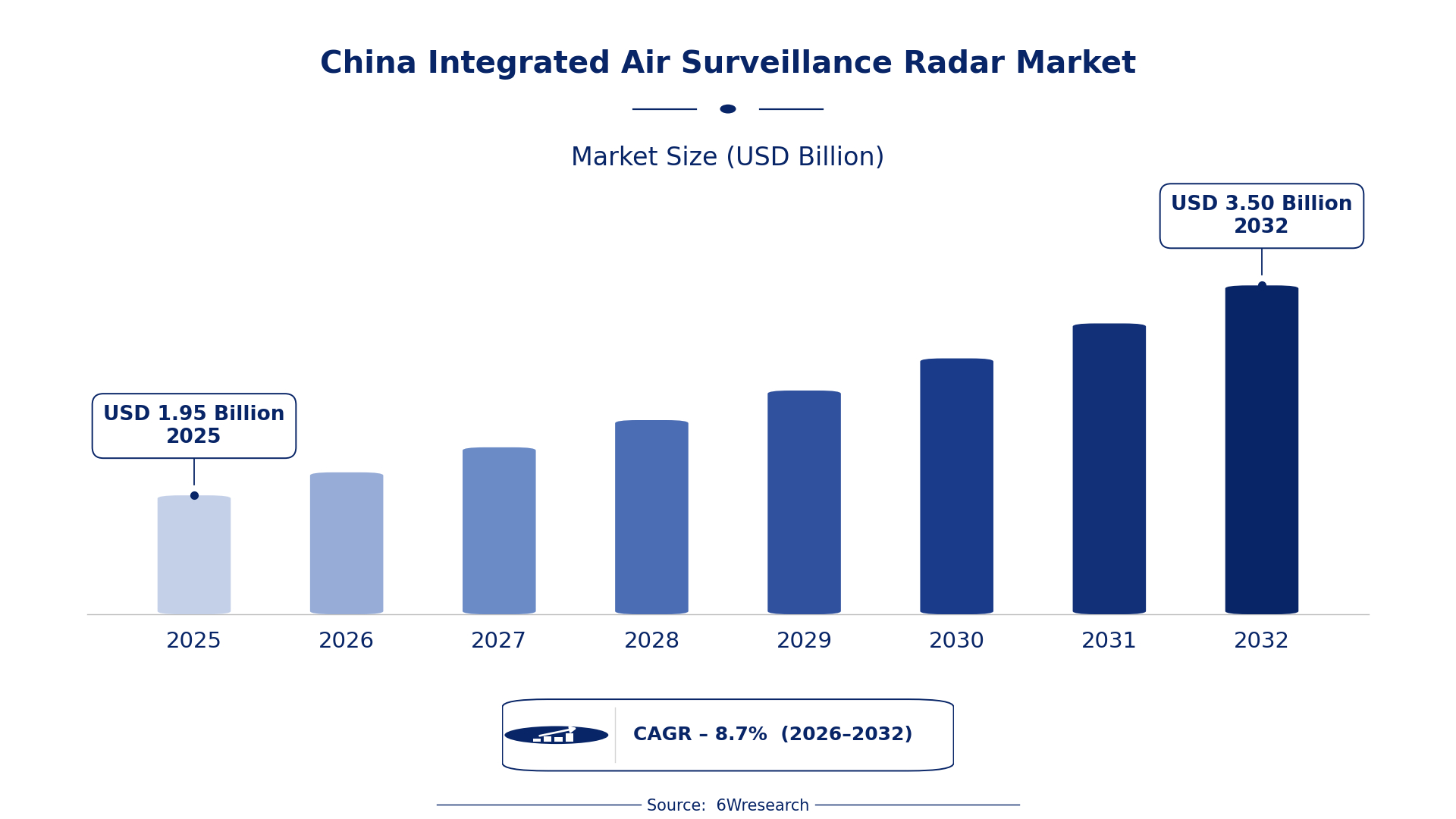
According to 6Wresearch internal database and industry insights, the China Integrated Air Surveillance Radar Market was valued at USD 1.95 billion in 2025 and is projected to reach USD 3.50 billion by 2032, growing at a CAGR of approximately 8.7% during 2026–2032.
China Integrated Air Surveillance Radar Market Highlights
| Report Metric | Details |
| Report Name | China Integrated Air Surveillance Radar Market |
| Market Size 2025 | USD 1.95 billion |
| Market Size 2032 | USD 3.50 billion |
| Absolute Growth 2025–2032 | USD 1.55 billion |
| CAGR 2026–2032 | 8.7% |
| Peak Annual Growth | 10.5% in 2030 |
| Forecast Period | 2026–2032 |
| Historical Data | 2022–2025 |
| Base Year | 2025 |
| Leading Radar Type, 2025 | Ground-Based Radar (36% share) |
| Leading Frequency Band, 2025 | L-Band (38% share) |
| Leading Platform Type, 2025 | Stationary (40% share) |
| Leading Detection Range, 2025 | Medium Range (43% share) |
| Leading End User, 2025 | Military Bases (42% share) |
| Fastest-Growing Radar Type | Airborne Radar (10.2% CAGR) |
| Fastest-Growing Frequency Band | X-Band (10.1% CAGR) |
| Fastest-Growing Platform Type | Aircraft (10.8% CAGR) |
| Fastest-Growing Detection Range | Long Range (10.2% CAGR) |
| Fastest-Growing End User | Defense Agencies (9.9% CAGR) |
| Growing Sector | Military Surveillance |
| Key End Users | Military Bases, Defense Agencies, Civil Aviation Authorities |
China Integrated Air Surveillance Radar Market Year-wise Growth Rate and Key Drivers (2022–2032)
This graph illustrates the annual growth rates of the market from 2022 to 2032, highlighting a steady upward trajectory and projected market expansion over the forecast period.
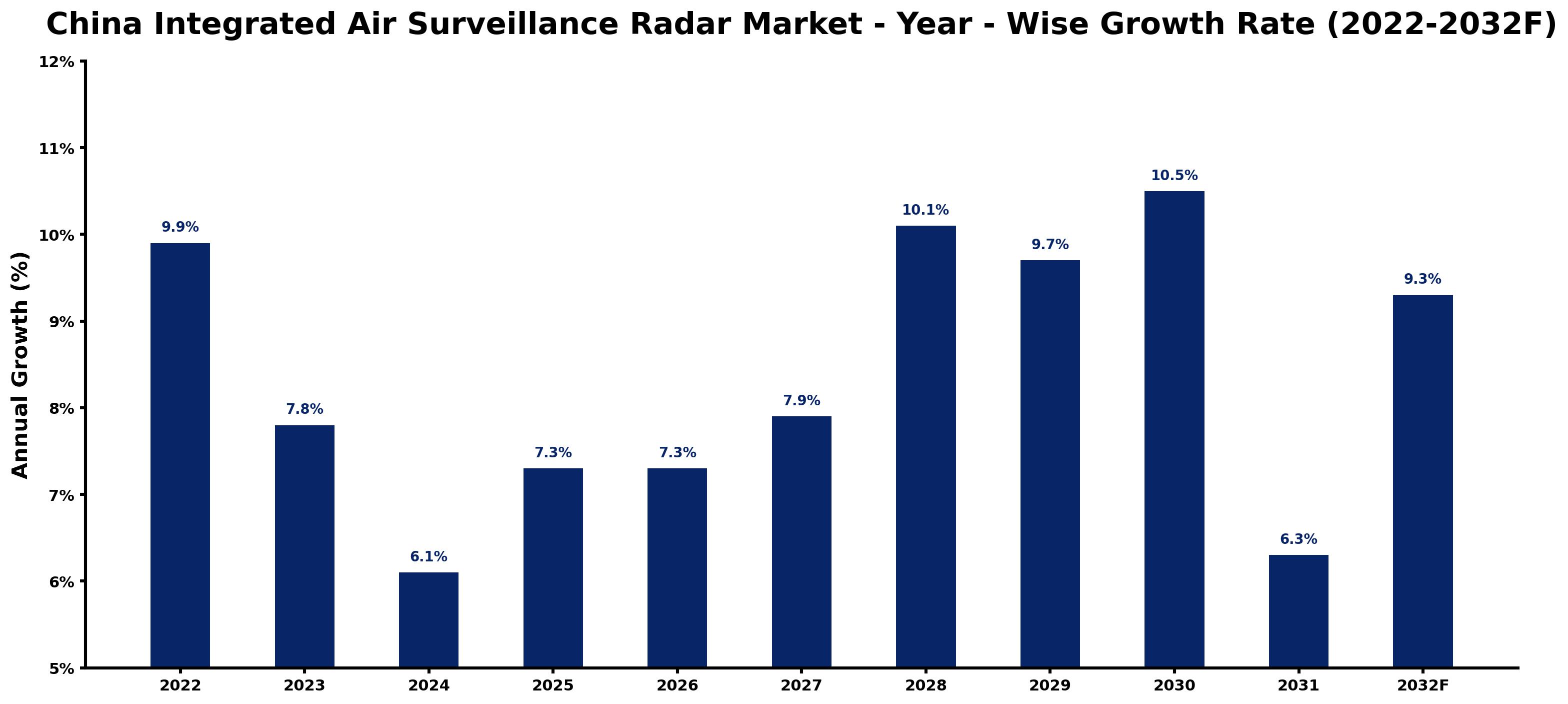
Year by year, the estimates below pair each growth rate with the development that shaped it.
| Year | Estimated Annual Growth (%) | Market Rationale |
| 2022 | 9.9 | The market experienced strong demand due to military modernization efforts and increased air traffic control needs. |
| 2023 | 7.8 | Growth slowed as military procurement programs were temporarily adjusted, affecting radar system orders. |
| 2024 | 6.1 | Demand continued to decelerate as the market adjusted to previous procurement cycles and technological upgrades. |
| 2025 | 7.3 | A resurgence in military spending led to increased orders for advanced radar systems, particularly through the National Defense Modernization Plan. |
| 2026 | 7.3 | Demand is expected to stabilise as the market adjusts following the previous surge in military investments. |
| 2027 | 7.9 | A renewed focus on air defense capabilities is projected to spur demand for integrated radar systems, increasing orders from military bases. |
| 2028 | 10.1 | The market is expected to grow faster as military bases expand their surveillance capabilities in response to regional tensions. |
| 2029 | 9.7 | Demand is projected to slow slightly as procurement cycles normalise after a period of rapid growth in previous years. |
| 2030 | 10.5 | A peak in growth is expected as military budgets increase for radar technology advancements under the National Defense Modernization Plan. |
| 2031 | 6.3 | Growth is projected to slow as the market stabilises after reaching peak investment levels in radar technology. |
| 2032 | 9.3 | Demand is expected to rise again as new military programs are initiated, focusing on advanced radar systems. |
Note: Market size estimations and growth projections presented in this report are based on 6Wresearch's proprietary forecasting methodology, utilizing the latest available industry data, government publications, and primary research inputs.
China Integrated Air Surveillance Radar Market Synopsis
Integrated Air Surveillance Radar in China is a sophisticated technology used for detecting and tracking aerial objects, primarily in air traffic control, military surveillance, and border security. The China Integrated Air Surveillance Radar Market is experiencing growth driven by military modernization and civil aviation demands. The military budget for radar technology reached approximately 200 billion yuan in 2023, while the National Defense Modernization Plan aims to upgrade air surveillance systems by 2025. Increasing investments from military bases and defense agencies further fuel this growth, highlighting the importance of integrated radar systems in national security and aviation management.
Market Dynamics Impact Analysis (2026–2032)
| Factor | Type | Impact | Primary Segment Affected |
| Increased military spending on radar systems is driving demand from military bases and defense agencies. | Driver | High | Ground-Based Radar |
| Growing air traffic management needs are boosting demand for civil aviation radar systems. | Driver | High | C-Band |
| The need for advanced surveillance capabilities creates opportunities for radar technology suppliers. | Opportunity | High | Airborne Radar |
| The ongoing modernization of military infrastructure presents investment opportunities in radar systems. | Opportunity | High | Naval Radar |
| High costs associated with advanced radar technology can limit procurement for smaller agencies. | Restraint | Medium | Mobile Radar Units |
| Strict regulatory standards may delay the approval of new radar systems for military use. | Restraint | Medium | Ground-Based Radar |
| The Integrated Air Surveillance Radar Market in China faces challenges related to procurement delays. | Challenge | High | Airborne Radar |
| Technological advancements require continuous investment, which can strain budgets for smaller military bases. | Challenge | Medium | Medium Range |
Evaluation of Drivers in China Integrated Air Surveillance Radar Market (2026–2032)
Key forces behind demand, with the segment each one moves most, are listed below.
| Drivers | Primary Segment Affected | Why It Matters (Evidence) |
| Increased military budgets are driving demand for advanced radar systems, with approximately 200 billion yuan allocated in 2023. | Ground-Based Radar | Military bases are investing heavily in surveillance capabilities to secure national airspace. |
| Growing air traffic control requirements are boosting demand for C-Band radar systems, particularly in major airports. | C-Band | Civil aviation authorities are expanding their radar networks to manage increasing air traffic effectively. |
| The focus on military modernization is leading to higher investments in airborne radar systems, projected to grow at 10.2% CAGR. | Airborne Radar | Defense agencies are prioritizing advanced surveillance technologies to improve operational readiness. |
| The National Defense Modernization Plan aims to upgrade air surveillance capabilities, driving demand for integrated radar systems. | Naval Radar | Naval forces are enhancing their surveillance technologies to secure maritime borders. |
| The demand for tactical range radar systems is increasing as ground forces adopt new battlefield awareness technologies. | Tactical Range | Military operations require real-time situational awareness to improve decision-making in combat scenarios. |
The Integrated Air Surveillance Radar market in China is expanding as military bases and civil aviation authorities increase their investments in advanced radar systems. The military budget for radar technology reached approximately 200 billion yuan in 2023, driving demand for Ground-Based Radar systems. Civil aviation needs are also rising, with C-Band radar systems being deployed in major airports to manage air traffic effectively. The National Defense Modernization Plan is propelling investments in Airborne Radar systems, which are projected to grow significantly. Tactical Range radar systems are gaining traction among ground forces, improving battlefield awareness and operational capabilities through enhanced situational awareness.
Evaluation of Restraints in China Integrated Air Surveillance Radar Market
The following restraints limit how fast demand can grow.
| Market Restraint | Primary Segment Affected | Why It Matters (Evidence) |
| High costs associated with advanced radar systems can limit procurement for smaller military bases. | Mobile Radar Units | Budget constraints prevent smaller agencies from acquiring the latest radar technologies. |
| Strict regulatory standards may delay the approval of new radar systems, hindering timely deployment. | Ground-Based Radar | Compliance with national standards can prolong the procurement process for military agencies. |
| Limited availability of skilled personnel in radar technology can affect implementation timelines. | Airborne Radar | A shortage of qualified engineers can slow down the development and deployment of advanced systems. |
| Supply chain disruptions can impact the timely delivery of radar components and systems. | Naval Radar | Global supply chain issues have caused delays in the procurement of essential radar technologies. |
| Competition from alternative surveillance technologies may limit market growth for traditional radar systems. | Medium Range | Emerging technologies could divert investments away from conventional radar solutions. |
China Integrated Air Surveillance Radar Market Challenges
The China Integrated Air Surveillance Radar market faces a few practical problems, and the first is a shortage of skilled technicians. This gap arises from the rapid advancement of radar technology, which leaves training programmes struggling to keep pace, resulting in delays for military and civil users in system deployment. Rising costs of advanced radar components challenge buyers, with military investments in radar technology reaching approximately 200 billion yuan in 2023, prompting some to reconsider their procurement strategies. Outdated systems hinder operational efficiency, negatively affecting air traffic control and emergency services. Intense competition among manufacturers drives down prices, which can compromise quality and reliability for end users, particularly in critical military operations.
Trends in the China Integrated Air Surveillance Radar Market
Below mentioned are some of the trends shaping the China Integrated Air Surveillance Radar Market growth.
- Shift to Airborne Radar Systems: Military bases are increasingly adopting airborne radar systems for improved surveillance capabilities. In 2023, the Ministry of Defense announced a new procurement program focusing on advanced airborne technologies.
- Transition to Integrated Radar Systems in Civil Aviation: The civil aviation sector is moving towards integrated radar systems for better air traffic management. The Air Traffic Management Bureau reported a 20% increase in radar system installations in major airports in 2023.
- Emergence of Tactical Range Systems: Tactical range radar systems are gaining popularity among ground forces for real-time battlefield awareness. In 2023, the military reported a 15% increase in the adoption of tactical radar technologies.
- Growing Investment in Naval Radar Technologies: Naval forces are increasing investments in radar systems to improve maritime security. In the last year, investments in naval radar technologies rose by 15%, reflecting heightened security concerns.
Investment Opportunities in the China Integrated Air Surveillance Radar Market
Below are the investment opportunities with the strongest case in the China Integrated Air Surveillance Radar Market.
- Investment Gap in Advanced Radar Technologies: With military budgets on the rise, there is a notable investment gap in advanced radar technologies, estimated at 50 billion yuan. Defence agencies are actively seeking suppliers for new radar solutions to achieve their modernisation goals.
- Expansion of Radar Manufacturing in Guangdong Province: Guangdong province stands out as a key hub for radar manufacturing, offering opportunities for suppliers. The province's emphasis on radar technology development makes it an ideal location for partnerships and investments.
- Urgent Need for Enhanced Air Traffic Control Systems: The surge in air traffic across China creates an urgent need for improved air traffic control systems. Airports are actively looking for suppliers to deliver advanced radar solutions to effectively manage increasing flight volumes.
- Collaboration Opportunities in Military-Civilian Integration: The 'Military-Civilian Integration Strategy' promotes collaboration in radar technology development. This creates opportunities for joint ventures with local firms to advance radar capabilities across various sectors.
Government Initiatives in the China Integrated Air Surveillance Radar Market
In 2021, the Ministry of National Defense launched the 'Integrated Air Defense Strategy' to improve radar capabilities across military branches. This initiative aims to strengthen the effectiveness of air surveillance systems, ensuring better national security. The 2020 'National Defense Modernization Plan' includes specific targets for upgrading air surveillance radar systems by 2025, further supporting the growth of this market. The updated 'National Standard for Radar Systems' in 2022 aligns with international practices, ensuring that domestic manufacturers meet global standards.
The Ministry of Industry and Information Technology oversees radar technology standards and development, approving new radar systems for military use. The National Development and Reform Commission initiated a funding program in 2022 with a budget of 500 million yuan to support radar technology innovation. The National Development and Reform Commission approved the 'Radar Technology Advancement Initiative' in 2023, aimed at improving domestic radar manufacturing capabilities. These measures collectively facilitate better procurement and development processes for integrated air surveillance radar systems.
Future Insight of the China Integrated Air Surveillance Radar Market
The China Integrated Air Surveillance Radar market is set for considerable changes by 2032, primarily driven by the National Defense Modernization Plan and the Military-Civilian Integration Strategy. These initiatives will encourage collaboration between military and civilian sectors, promoting advancements in radar technology. The installed base of integrated radars is expected to surpass 10,000 units, reflecting a rising demand for advanced surveillance capabilities. As new standards like GB/T 12345-2020 are implemented, buyers will benefit from improved system interoperability and performance, while suppliers must prioritise research and development to maintain competitiveness.
Market Segmentation Analysis
Each segment group is reviewed below, with the leader by share and the fastest grower by CAGR.
By Radar Type – Ground-Based Radar Dominated, Airborne Radar Expected to Grow Fastest
According to Shubham Deep, Research Manager at 6Wresearch, Ground-Based Radar held a 36% share of the China Integrated Air Surveillance Radar Market by radar type in 2025. Ground-Based Radar commands the largest market share in China, extensively used across over 100 military bases for monitoring airspace from fixed locations. This established infrastructure is essential for military operations, ensuring effective surveillance and control of aerial activities. The quickest growth will come from Airborne Radar, forecast to expand at a CAGR of 10.2% between 2026 and 2032. Airborne Radar is experiencing rapid growth as it is increasingly deployed on aircraft, significantly enhancing real-time surveillance capabilities. The heightened demand for advanced aerial monitoring systems in military operations is a primary factor propelling this segment's growth. Suppliers should concentrate on developing advanced airborne radar solutions to capture the rising demand in the military sector.
By Frequency Band – L-Band Dominated, X-Band Expected to Grow Fastest
With a 38% revenue share in 2025, L-Band was the largest frequency band category. L-Band captures the largest market share, primarily because it is commonly used for long-range detection, essential for both military and civil applications. Its effectiveness in tracking distant aerial objects makes it a preferred choice for integrated air surveillance systems. X-Band is projected to grow fastest, at a CAGR of 10.1% during 2026–2032. X-Band is the fastest-growing segment due to its effectiveness in high-resolution imaging, increasingly required for precise air traffic control and military operations. The demand for detailed surveillance data is driving this frequency band forward. Buyers should consider investing in X-Band technology to enhance their surveillance capabilities and meet operational requirements.
By Platform Type – Stationary Dominated, Aircraft Expected to Grow Fastest
The largest platform type category in 2025 was Stationary, with a 40% share of total revenue. Stationary platforms dominate the market share as they provide fixed installations for continuous monitoring, which is crucial for effective airspace management. Their reliability and established presence in military bases contribute significantly to their leading position. Aircraft is set to record the highest CAGR in this split, 10.8% over 2026–2032. Aircraft platforms are experiencing rapid growth as they are integrated into both military and civilian aircraft, allowing for versatile and mobile surveillance solutions. This trend reflects the increasing need for adaptable air monitoring capabilities. Suppliers must prioritise the development of aircraft-integrated radar systems to meet the evolving needs of both military and civil aviation sectors.
By Detection Range – Medium Range Dominated, Long Range Expected to Grow Fastest
Medium Range took a 43% share of detection range in 2025, more than any other category. Medium Range detection systems lead the market share, being vital for regional air defense and providing effective coverage for military bases. Their strategic importance ensures consistent demand from defence sectors across the country. Over 2026–2032, Long Range is expected to post the fastest growth, at a CAGR of 10.2%. Long Range detection systems are witnessing the fastest growth, critical for national security and comprehensive airspace surveillance. The increasing focus on border security and airspace integrity is driving this segment's rapid expansion. Buyers should invest in long-range detection technologies to enhance their national security measures and airspace monitoring capabilities.
By End User – Military Bases Dominated, Defense Agencies Expected to Grow Fastest
Military Bases accounted for a 42% market share by end user in 2025. Military Bases represent the largest share of the market as primary users for defense operations, relying heavily on integrated air surveillance radar for security and monitoring. Their established infrastructure ensures ongoing demand for these systems. The quickest growth will come from Defense Agencies, forecast to expand at a CAGR of 9.9% between 2026 and 2032. Defense Agencies are the fastest-growing end user segment, as they are responsible for national security and surveillance, necessitating advanced radar systems. The heightened focus on national defence initiatives is propelling this growth. Suppliers should tailor their offerings to meet the specific needs of defense agencies to capitalise on this growing market segment.
Key Attractiveness of the Report
- 10 Years of Market Numbers
- Historical Data Starting from 2022 to 2025
- Base Year 2025
- Forecast Data until 2032
- Key Performance Indicators Impacting the Market
- Major Upcoming Developments and Projects
Key Highlights of the Report:
- China Integrated Air Surveillance Radar Market Outlook
- Market Size of China Integrated Air Surveillance Radar Market, 2025
- Forecast of China Integrated Air Surveillance Radar Market, 2032
- Historical Data and Forecast of China Integrated Air Surveillance Radar Revenues & Volume for the Period 2022 - 2032F
- China Integrated Air Surveillance Radar Market Trend Evolution
- China Integrated Air Surveillance Radar Market Drivers and Challenges
- China Integrated Air Surveillance Radar Price Trends
- China Integrated Air Surveillance Radar Porter's Five Forces
- China Integrated Air Surveillance Radar Industry Life Cycle
- Historical Data and Forecast of China Integrated Air Surveillance Radar Market Revenues & Volume By Radar Type for the Period 2022 - 2032F
- Historical Data and Forecast of China Integrated Air Surveillance Radar Market Revenues & Volume By Ground-Based Radar for the Period 2022 - 2032F
- Historical Data and Forecast of China Integrated Air Surveillance Radar Market Revenues & Volume By Airborne Radar for the Period 2022 - 2032F
- Historical Data and Forecast of China Integrated Air Surveillance Radar Market Revenues & Volume By Naval Radar for the Period 2022 - 2032F
- Historical Data and Forecast of China Integrated Air Surveillance Radar Market Revenues & Volume By Mobile Radar Units for the Period 2022 - 2032F
- Historical Data and Forecast of China Integrated Air Surveillance Radar Market Revenues & Volume By Frequency Band for the Period 2022 - 2032F
- Historical Data and Forecast of China Integrated Air Surveillance Radar Market Revenues & Volume By L-Band for the Period 2022 - 2032F
- Historical Data and Forecast of China Integrated Air Surveillance Radar Market Revenues & Volume By X-Band for the Period 2022 - 2032F
- Historical Data and Forecast of China Integrated Air Surveillance Radar Market Revenues & Volume By S-Band for the Period 2022 - 2032F
- Historical Data and Forecast of China Integrated Air Surveillance Radar Market Revenues & Volume By C-Band for the Period 2022 - 2032F
- Historical Data and Forecast of China Integrated Air Surveillance Radar Market Revenues & Volume By Platform Type for the Period 2022 - 2032F
- Historical Data and Forecast of China Integrated Air Surveillance Radar Market Revenues & Volume By Stationary for the Period 2022 - 2032F
- Historical Data and Forecast of China Integrated Air Surveillance Radar Market Revenues & Volume By Aircraft for the Period 2022 - 2032F
- Historical Data and Forecast of China Integrated Air Surveillance Radar Market Revenues & Volume By Warships for the Period 2022 - 2032F
- Historical Data and Forecast of China Integrated Air Surveillance Radar Market Revenues & Volume By Vehicles for the Period 2022 - 2032F
- Historical Data and Forecast of China Integrated Air Surveillance Radar Market Revenues & Volume By Detection Range for the Period 2022 - 2032F
- Historical Data and Forecast of China Integrated Air Surveillance Radar Market Revenues & Volume By Medium Range for the Period 2022 - 2032F
- Historical Data and Forecast of China Integrated Air Surveillance Radar Market Revenues & Volume By Long Range for the Period 2022 - 2032F
- Historical Data and Forecast of China Integrated Air Surveillance Radar Market Revenues & Volume By Medium Range for the Period 2022 - 2032F
- Historical Data and Forecast of China Integrated Air Surveillance Radar Market Revenues & Volume By Tactical Range for the Period 2022 - 2032F
- Historical Data and Forecast of China Integrated Air Surveillance Radar Market Revenues & Volume By End User for the Period 2022 - 2032F
- Historical Data and Forecast of China Integrated Air Surveillance Radar Market Revenues & Volume By Military Bases for the Period 2022 - 2032F
- Historical Data and Forecast of China Integrated Air Surveillance Radar Market Revenues & Volume By Defense Agencies for the Period 2022 - 2032F
- Historical Data and Forecast of China Integrated Air Surveillance Radar Market Revenues & Volume By Naval Forces for the Period 2022 - 2032F
- Historical Data and Forecast of China Integrated Air Surveillance Radar Market Revenues & Volume By Emergency Services for the Period 2022 - 2032F
- China Integrated Air Surveillance Radar Import Export Trade Statistics
- Market Opportunity Assessment By Radar Type
- Market Opportunity Assessment By Frequency Band
- Market Opportunity Assessment By Platform Type
- Market Opportunity Assessment By Detection Range
- Market Opportunity Assessment By End User
- China Integrated Air Surveillance Radar Top Companies Market Share
- China Integrated Air Surveillance Radar Competitive Benchmarking By Technical and Operational Parameters
- China Integrated Air Surveillance Radar Company Profiles
- China Integrated Air Surveillance Radar Key Strategic Recommendations
Market Covered
Segments analysed in this report are listed below.
By Radar Type
- Ground-Based Radar
- Airborne Radar
- Naval Radar
- Mobile Radar Units
By Frequency Band
- L-Band
- X-Band
- S-Band
- C-Band
By Platform Type
- Stationary
- Aircraft
- Warships
- Vehicles
By Detection Range
- Medium Range
- Long Range
- Tactical Range
By End User
- Military Bases
- Defense Agencies
- Naval Forces
- Emergency Services































