China Integrated Avionics Market Size & Growth Rate
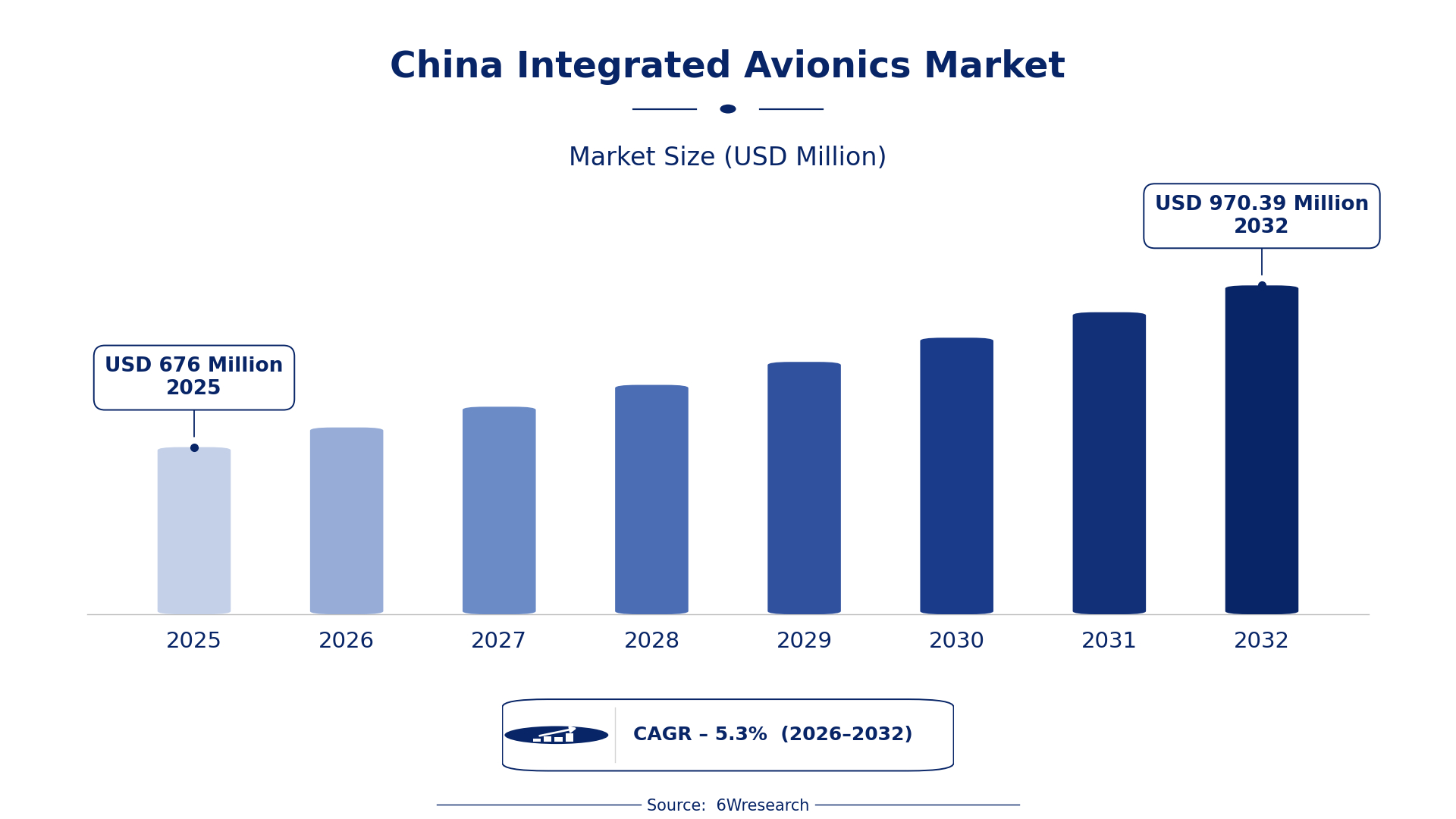
According to 6Wresearch internal database and industry insights, the China Integrated Avionics Market was valued at USD 676.0 million in 2025 and is projected to reach USD 970.39 million by 2032, growing at a CAGR of approximately 5.3% during 2026–2032.
China Integrated Avionics Market Highlights
| Report Metric | Details |
| Report Name | China Integrated Avionics Market |
| Market Size 2025 | USD 676.0 million |
| Market Size 2032 | USD 970.39 million |
| Absolute Growth 2025–2032 | USD 294.39 million |
| CAGR 2026–2032 | 5.3% |
| Peak Annual Growth | 7.4% in 2026 |
| Forecast Period | 2026–2032 |
| Historical Data | 2022–2025 |
| Base Year | 2025 |
| Leading Platform Type, 2025 | Commercial Aircraft (38% share) |
| Leading Integration Level, 2025 | Fully Integrated (44% share) |
| Leading System Type, 2025 | Navigation (48% share) |
| Leading End User, 2025 | OEMs (36% share) |
| Leading Distribution Channel, 2025 | Tier 1 Suppliers (36% share) |
| Fastest-Growing Platform Type | UAVs (7.5% CAGR) |
| Fastest-Growing System Type | Mission Systems (6.9% CAGR) |
| Fastest-Growing End User | Aerospace Startups (7.4% CAGR) |
| Fastest-Growing Distribution Channel | Direct Sales (7.1% CAGR) |
| Growing Sector | UAVs |
| Key End Users | OEMs, Defense Contractors, Avionics Manufacturers, Aerospace Startups |
China Integrated Avionics Market Year-wise Growth Rate and Key Drivers (2022–2032)
This graph illustrates the annual growth rates of the market from 2022 to 2032, highlighting a steady upward trajectory and projected market expansion over the forecast period.
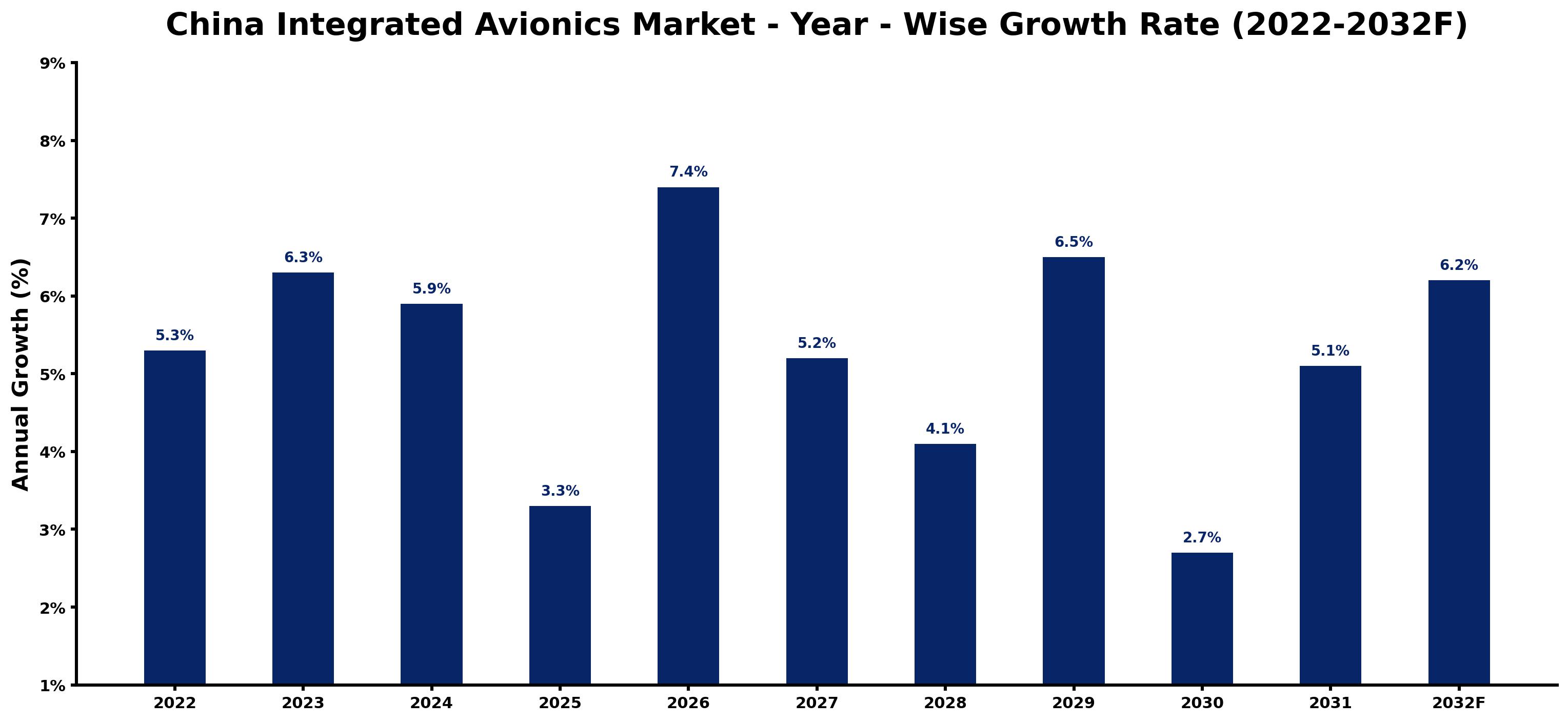
Year by year, the estimates below pair each growth rate with the development that shaped it.
| Year | Estimated Annual Growth (%) | Market Rationale |
| 2022 | 5.3 | The market experienced steady growth due to increasing demand from domestic manufacturers. |
| 2023 | 6.3 | Growth accelerated as the aerospace sector expanded with over 300 operational airports. |
| 2024 | 5.9 | A slowdown occurred as growth moderated amid ongoing supply chain adjustments. |
| 2025 | 3.3 | The market continued to grow, albeit at a slower pace, influenced by evolving technology standards. |
| 2026 | 7.4 | A surge in growth was driven by heightened military spending and modernization efforts. |
| 2027 | 5.2 | Growth slowed again as the market adjusted to new operational standards and regulations. |
| 2028 | 4.1 | The market saw further deceleration as competition intensified among suppliers. |
| 2029 | 6.5 | An uptick in growth was noted as UAV applications gained traction in various sectors. |
| 2030 | 2.7 | Growth slowed due to market saturation and increased focus on cost efficiency. |
| 2031 | 5.1 | The market rebounded with renewed interest in integrated systems and advanced functionalities. |
| 2032 | 6.2 | Growth accelerated again as the demand for commercial aircraft surged towards 7,000 units. |
Note: Market size estimations and growth projections presented in this report are based on 6Wresearch's proprietary forecasting methodology, utilizing the latest available industry data, government publications, and primary research inputs.
China Integrated Avionics Market Synopsis
Integrated Avionics in China includes the electronic systems essential for navigation, communication, and flight management in aircraft. These systems improve flight safety and operational efficiency through advanced engineering. The China Integrated Avionics Market is expanding due to rising investments in aerospace innovation and military applications. Domestic manufacturers are driving demand, supported by a projected aerospace industry value of $1 trillion by 2035. The ongoing development of UAV technologies further fuels this growth, creating new opportunities for suppliers and manufacturers alike.
Market Dynamics Impact Analysis (2026–2032)
| Factor | Type | Impact | Primary Segment Affected |
| Increased military budget allocations are driving demand for advanced avionics systems. | Driver | High | Military Aircraft |
| The rise in UAV applications is creating significant opportunities for integrated avionics. | Opportunity | High | UAVs |
| Growing commercial aircraft production necessitates advanced avionics systems for safety and efficiency. | Driver | High | Commercial Aircraft |
| The push for aerospace innovation programs is enhancing technology adoption in avionics. | Opportunity | Medium | Commercial Aircraft |
| Supply chain disruptions are limiting the availability of critical components for avionics systems. | Restraint | High | Commercial Aircraft |
| Stringent regulatory standards may delay product approvals and market entry. | Restraint | Medium | Commercial Aircraft |
| High development costs for integrated systems can limit investment from smaller firms. | Challenge | High | Commercial Aircraft |
| Technological advancements require continuous upgrades, increasing operational costs for manufacturers. | Challenge | Medium | Commercial Aircraft |
Evaluation of Drivers in China Integrated Avionics Market (2026–2032)
Below mentioned are some major drivers and their influence on market dynamics.
| Drivers | Primary Segment Affected | Why It Matters (Evidence) |
| Increased military spending drives demand for advanced avionics systems. | Military Aircraft | The Chinese military budget for 2023 is approximately $224 billion, driving procurement of advanced technologies. |
| Growing commercial aircraft production necessitates advanced avionics systems. | Commercial Aircraft | China aims to produce 1,000 new aircraft annually by 2030, increasing demand for integrated avionics. |
| Expansion of UAV applications is driving demand for integrated avionics. | UAVs | China's UAV market is projected to grow to $14 billion by 2025, necessitating advanced avionics for various applications. |
| Support from government innovation programs boosts technology adoption in avionics. | Commercial Aircraft | The National Development and Reform Commission supports aerospace innovation programs, enhancing capabilities. |
| The increasing number of operational airports drives demand for navigation and communication systems. | Commercial Aircraft | China has over 300 operational airports as of 2023, increasing the need for integrated avionics. |
Expansion of the Integrated Avionics market in China is backed by substantial military and commercial investments, alongside rising end-use demand for new technologies. The military budget for 2023 is approximately $224 billion, which drives procurement of advanced avionics systems. The aim to produce 1,000 new aircraft annually by 2030 increases demand for integrated avionics. The UAV market is projected to grow to $14 billion by 2025, necessitating advanced avionics for various applications.
Evaluation of Restraints in China Integrated Avionics Market
The main factors holding the market back are set out below.
| Market Restraint | Primary Segment Affected | Why It Matters (Evidence) |
| Supply chain disruptions limit the availability of critical components for avionics systems. | Commercial Aircraft | Manufacturers face challenges in sourcing essential electronic components, affecting production timelines. |
| Stringent regulatory standards may delay product approvals and market entry. | Commercial Aircraft | Compliance with the Civil Aviation Administration of China regulations can extend the approval process. |
| High development costs for integrated systems can limit investment from smaller firms. | Commercial Aircraft | Smaller manufacturers struggle to allocate sufficient resources for R&D in advanced avionics. |
| Competition among suppliers may lead to price wars, affecting profitability. | Commercial Aircraft | As more players enter the market, pricing pressures can impact margins for existing firms. |
| Technological advancements require continuous upgrades, increasing operational costs for manufacturers. | Commercial Aircraft | Staying competitive necessitates ongoing investments in new technologies, straining budgets. |
China Integrated Avionics Market Challenges
China's Integrated Avionics market faces several challenges, starting with outdated technology in some systems, which hampers operational efficiency for producers. This technological lag can delay product rollouts, costing manufacturers up to 15% in potential revenue. A shortage of skilled engineers restricts innovation and raises training costs for producers, consuming approximately 20% of project budgets. Compliance with regulations from the Civil Aviation Administration of China burdens importers, leading to delays in product availability and increasing prices for buyers. Supply chain disruptions due to geopolitical tensions can delay component deliveries, impacting production schedules for manufacturers.
Trends in the China Integrated Avionics Market
Buyers and suppliers in the China Integrated Avionics Market are adjusting to the following trends.
- Shift towards Fully Integrated Systems: China's aerospace industry is increasingly adopting fully integrated avionics systems to improve operational efficiency. The shift began in 2021 as manufacturers sought to modernise their fleets. By 2023, 44% of avionics systems were fully integrated, streamlining operations.
- Growth of UAV Applications: The UAV sector in China is rapidly expanding, with applications in surveillance and logistics gaining traction. This trend began in 2020, and the UAV market is expected to reach $14 billion by 2025, driving demand for advanced avionics.
- Emphasis on Aviation Safety Standards: The Civil Aviation Administration of China initiated the Aviation Safety Enhancement Program in 2022, focusing on improving avionics safety. This program aims to elevate safety standards across the industry, influencing manufacturers to enhance their systems.
- Increased Collaboration in Aerospace: The Aerospace Industry Association of China promotes collaboration among manufacturers to establish standards. This initiative, launched in 2021, is expected to improve interoperability and drive innovation in avionics systems.
Investment Opportunities in the China Integrated Avionics Market
Investors looking at the China Integrated Avionics Market should consider the following areas.
- Joint Ventures with Local Manufacturers: Now is the time for foreign firms to establish joint ventures with local manufacturers in China, as the aerospace market continues to grow. The Beijing-Tianjin-Hebei region is a major hub for aerospace manufacturing, presenting significant opportunities.
- Investment in UAV Technologies: Investing in advanced UAV avionics systems is critical as the sector is projected to grow to $14 billion by 2025. Targeting defense contractors will facilitate entry into this expanding market.
- Supply of Integrated Avionics Systems: With the push for fully integrated systems, suppliers should focus on providing advanced avionics solutions. The demand from OEMs is significant, particularly as they seek to improve safety and efficiency.
- Certification for ISO 9001 Compliance: Obtaining ISO 9001 certification is essential for avionics manufacturers to meet quality standards. This certification will enhance credibility and market access, particularly among defense contractors.
Government Initiatives in the China Integrated Avionics Market
The policy framework for integrated avionics in China has evolved with the introduction of the '14th Five-Year Plan for Aerospace Development' in 2021, which aims to enhance domestic avionics capabilities. Additionally, the 'Defense Avionics Development Strategy' issued by the State Administration for Science, Technology and Industry for National Defense in 2021 focuses on improving military avionics systems. These measures have established a strong foundation for growth in the integrated avionics sector, promoting innovation and collaboration among manufacturers. The 'Aviation Safety Enhancement Program' initiated by the Civil Aviation Administration of China in 2022 aims to improve avionics safety standards, ensuring compliance and enhancing overall safety.
In 2023, the National Development and Reform Commission approved funding for the 'Aerospace Innovation Fund', which supports new technologies in avionics. This initiative is vital for advancing integrated systems and enhancing capabilities. The Civil Aviation Administration of China oversees the implementation of safety standards through the 'Aviation Safety Enhancement Program', ensuring compliance and improving overall avionics safety. These measures enable manufacturers to innovate while adhering to regulatory requirements.
Future Insight of the China Integrated Avionics Market
The Integrated Avionics market in China will experience notable changes by 2032, primarily driven by the expected increase in the number of commercial aircraft to over 7,000. The National Development and Reform Commission's support for aerospace innovation programs will facilitate the introduction of new technologies. The establishment of the Aerospace Industry Association will promote collaboration and standardisation across the sector. As the Chinese military budget grows, defence avionics will benefit from increased funding, driving further innovation and operational efficiency.
Market Segmentation Analysis
The analysis below covers each segmentation, its leading category in 2025 and its fastest-growing category through 2032.
By Platform Type – Commercial Aircraft Dominated, UAVs Expected to Grow Fastest
According to Shubham Deep, Research Manager at 6Wresearch, Commercial Aircraft held a 38% share of the China Integrated Avionics Market by platform type in 2025. Commercial aircraft hold the largest market share in the China Integrated Avionics Market due to their essential role in passenger safety and navigation. With projections of over 7,000 commercial aircraft by 2035, the demand for advanced avionics systems is set to increase significantly. UAVs are set to record the highest CAGR in this split, 7.5% over 2026–2032. UAVs are experiencing the fastest growth, fuelled by their rising importance in surveillance and logistics operations. The UAV market in China is projected to reach $14 billion by 2025, showcasing robust demand for integrated avionics solutions. Suppliers should prioritise the development of advanced avionics tailored for UAV applications to capitalise on emerging market opportunities.
By Integration Level – Fully Integrated Dominated and Is Expected to Record the Fastest Growth
Fully Integrated took a 44% share of integration level in 2025, more than any other category. Fully integrated systems lead the market as they are the preferred choice for modern aircraft, ensuring efficiency and streamlined operations. Their integration is crucial for compliance with the regulatory standards set by the Civil Aviation Administration of China. Its lead should widen, with a projected CAGR of 7.0% during 2026–2032, the highest in this split. The growth of fully integrated systems will continue to accelerate, as they remain the top choice for new aircraft designs, ensuring manufacturers meet evolving operational requirements. Their efficiency is vital for both commercial and military applications. Suppliers must focus on developing fully integrated avionics to align with market preferences and regulatory standards.
By System Type – Navigation Dominated, Mission Systems Expected to Grow Fastest
The largest system type category in 2025 was Navigation, with a 48% share of total revenue. Navigation systems dominate the market share due to their fundamental role in all aircraft operations, ensuring safety and compliance with aviation regulations. Their critical importance in both commercial and military aircraft solidifies their position in the avionics sector. Over 2026–2032, Mission Systems are expected to post the fastest growth, at a CAGR of 6.9%. Mission systems are witnessing rapid growth as they are essential for military and specialised operations, reflecting increased investments in defence capabilities. The Chinese military budget of approximately $224 billion for 2023 underscores the rising demand for advanced mission systems. Suppliers should enhance their focus on mission systems to address the growing needs of military and specialised markets.
By End User – OEMs Dominated, Aerospace Startups Expected to Grow Fastest
OEMs accounted for a 36% market share by end user in 2025. OEMs command the largest market share as they are the primary users in manufacturing integrated avionics for new aircraft. Their established relationships with regulatory bodies and adherence to industry standards position them as key players in the market. The quickest growth will come from Aerospace Startups, forecast to expand at a CAGR of 7.4% between 2026 and 2032. Aerospace startups are driving the fastest growth by introducing innovative solutions and technologies that cater to niche markets. Their agility allows them to swiftly adapt to the changing demands within the aviation sector. Suppliers should explore partnerships with aerospace startups to leverage innovation and expand their market reach.
By Distribution Channel – Tier 1 Suppliers Dominated, Direct Sales Expected to Grow Fastest
With a 36% revenue share in 2025, Tier 1 Suppliers was the largest distribution channel category. Tier 1 suppliers dominate the market, being critical for supplying components to manufacturers and ensuring compliance with industry standards. Their established networks facilitate the efficient distribution of integrated avionics systems. Direct Sales is set to record the highest CAGR in this split, 7.1% over 2026–2032. Direct sales are rapidly expanding as they provide a common and efficient channel for transactions, allowing suppliers to engage directly with customers. This trend indicates a shift towards more personalised service in the avionics market. Suppliers should refine their direct sales strategies to enhance customer engagement and streamline transaction processes.
Key Attractiveness of the Report
- 10 Years of Market Numbers
- Historical Data Starting from 2022 to 2025
- Base Year 2025
- Forecast Data until 2032
- Key Performance Indicators Impacting the Market
- Major Upcoming Developments and Projects
Key Highlights of the Report:
- China Integrated Avionics Market Outlook
- Market Size of China Integrated Avionics Market, 2025
- Forecast of China Integrated Avionics Market, 2032
- Historical Data and Forecast of China Integrated Avionics Revenues & Volume for the Period 2022 - 2032F
- China Integrated Avionics Market Trend Evolution
- China Integrated Avionics Market Drivers and Challenges
- China Integrated Avionics Price Trends
- China Integrated Avionics Porter's Five Forces
- China Integrated Avionics Industry Life Cycle
- Historical Data and Forecast of China Integrated Avionics Market Revenues & Volume By Platform Type for the Period 2022 - 2032F
- Historical Data and Forecast of China Integrated Avionics Market Revenues & Volume By Commercial Aircraft for the Period 2022 - 2032F
- Historical Data and Forecast of China Integrated Avionics Market Revenues & Volume By Military Aircraft for the Period 2022 - 2032F
- Historical Data and Forecast of China Integrated Avionics Market Revenues & Volume By UAVs for the Period 2022 - 2032F
- Historical Data and Forecast of China Integrated Avionics Market Revenues & Volume By Business Jets for the Period 2022 - 2032F
- Historical Data and Forecast of China Integrated Avionics Market Revenues & Volume By Integration Level for the Period 2022 - 2032F
- Historical Data and Forecast of China Integrated Avionics Market Revenues & Volume By Federated to Integrated for the Period 2022 - 2032F
- Historical Data and Forecast of China Integrated Avionics Market Revenues & Volume By Fully Integrated for the Period 2022 - 2032F
- Historical Data and Forecast of China Integrated Avionics Market Revenues & Volume By Semi-Integrated for the Period 2022 - 2032F
- Historical Data and Forecast of China Integrated Avionics Market Revenues & Volume By Modular Integrated for the Period 2022 - 2032F
- Historical Data and Forecast of China Integrated Avionics Market Revenues & Volume By System Type for the Period 2022 - 2032F
- Historical Data and Forecast of China Integrated Avionics Market Revenues & Volume By Navigation for the Period 2022 - 2032F
- Historical Data and Forecast of China Integrated Avionics Market Revenues & Volume By Mission Systems for the Period 2022 - 2032F
- Historical Data and Forecast of China Integrated Avionics Market Revenues & Volume By Communication for the Period 2022 - 2032F
- Historical Data and Forecast of China Integrated Avionics Market Revenues & Volume By Flight Management for the Period 2022 - 2032F
- Historical Data and Forecast of China Integrated Avionics Market Revenues & Volume By End User for the Period 2022 - 2032F
- Historical Data and Forecast of China Integrated Avionics Market Revenues & Volume By OEMs for the Period 2022 - 2032F
- Historical Data and Forecast of China Integrated Avionics Market Revenues & Volume By Defense Contractors for the Period 2022 - 2032F
- Historical Data and Forecast of China Integrated Avionics Market Revenues & Volume By Aerospace Startups for the Period 2022 - 2032F
- Historical Data and Forecast of China Integrated Avionics Market Revenues & Volume By Avionics Manufacturers for the Period 2022 - 2032F
- Historical Data and Forecast of China Integrated Avionics Market Revenues & Volume By Distribution Channel for the Period 2022 - 2032F
- Historical Data and Forecast of China Integrated Avionics Market Revenues & Volume By Tier 1 Suppliers for the Period 2022 - 2032F
- Historical Data and Forecast of China Integrated Avionics Market Revenues & Volume By Direct Sales for the Period 2022 - 2032F
- Historical Data and Forecast of China Integrated Avionics Market Revenues & Volume By Online Platforms for the Period 2022 - 2032F
- Historical Data and Forecast of China Integrated Avionics Market Revenues & Volume By OEM Alliances for the Period 2022 - 2032F
- China Integrated Avionics Import Export Trade Statistics
- Market Opportunity Assessment By Platform Type
- Market Opportunity Assessment By Integration Level
- Market Opportunity Assessment By System Type
- Market Opportunity Assessment By End User
- Market Opportunity Assessment By Distribution Channel
- China Integrated Avionics Top Companies Market Share
- China Integrated Avionics Competitive Benchmarking By Technical and Operational Parameters
- China Integrated Avionics Company Profiles
- China Integrated Avionics Key Strategic Recommendations
Market Covered
This report examines the market across the segments below.
By Platform Type
- Commercial Aircraft
- Military Aircraft
- UAVs
- Business Jets
By Integration Level
- Federated to Integrated
- Fully Integrated
- Semi-Integrated
- Modular Integrated
By System Type
- Navigation
- Mission Systems
- Communication
- Flight Management
By End User
- OEMs
- Defense Contractors
- Aerospace Startups
- Avionics Manufacturers
By Distribution Channel
- Tier 1 Suppliers
- Direct Sales
- Online Platforms
- OEM Alliances































