China IoT Antenna Market Size & Growth Rate
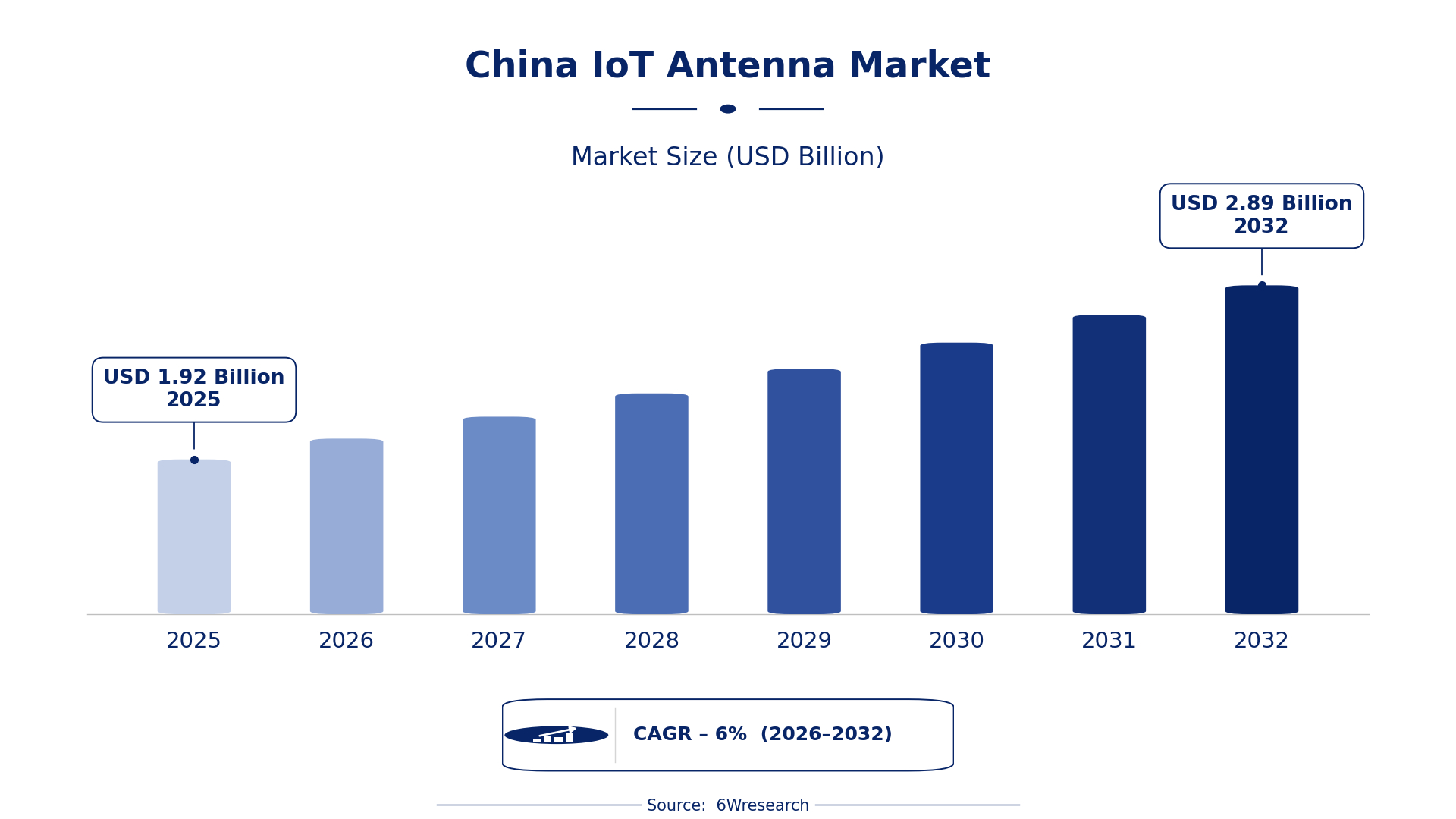
According to 6Wresearch internal database and industry insights, the China IoT Antenna Market was valued at USD 1.92 billion in 2025 and is projected to reach USD 2.89 billion by 2032, growing at a CAGR of approximately 6% during 2026–2032.
China IoT Antenna Market Highlights
| Report Metric | Details |
| Report Name | China IoT Antenna Market |
| Market Size 2025 | USD 1.92 billion |
| Market Size 2032 | USD 2.89 billion |
| Absolute Growth 2025–2032 | USD 0.97 billion |
| CAGR 2026–2032 | 6% |
| Peak Annual Growth | 7.5% in 2032 |
| Forecast Period | 2026–2032 |
| Historical Data | 2022–2025 |
| Base Year | 2025 |
| Leading Antenna Type, 2025 | PCB Antennas (53% share) |
| Leading Frequency Band, 2025 | Sub-GHz (43% share) |
| Leading Application Area, 2025 | Smart Meters (40% share) |
| Leading Connectivity Standard, 2025 | LoRaWAN (37% share) |
| Leading End User, 2025 | IoT Device Makers (47% share) |
| Fastest-Growing Antenna Type | Chip Antennas (7.1% CAGR) |
| Fastest-Growing Frequency Band | 2.4 GHz (8.0% CAGR) |
| Fastest-Growing Application Area | Wearables (8.3% CAGR) |
| Fastest-Growing Connectivity Standard | Bluetooth (7.9% CAGR) |
| Fastest-Growing End User | Consumer OEMs (8.7% CAGR) |
| Growing Sector | Wearables |
| Key End Users | Smart Meters, Wearables, Industrial IoT, Asset Tracking Devices |
China IoT Antenna Market Year-wise Growth Rate and Key Drivers (2022–2032)
This graph illustrates the annual growth rates of the market from 2022 to 2032, highlighting a steady upward trajectory and projected market expansion over the forecast period.
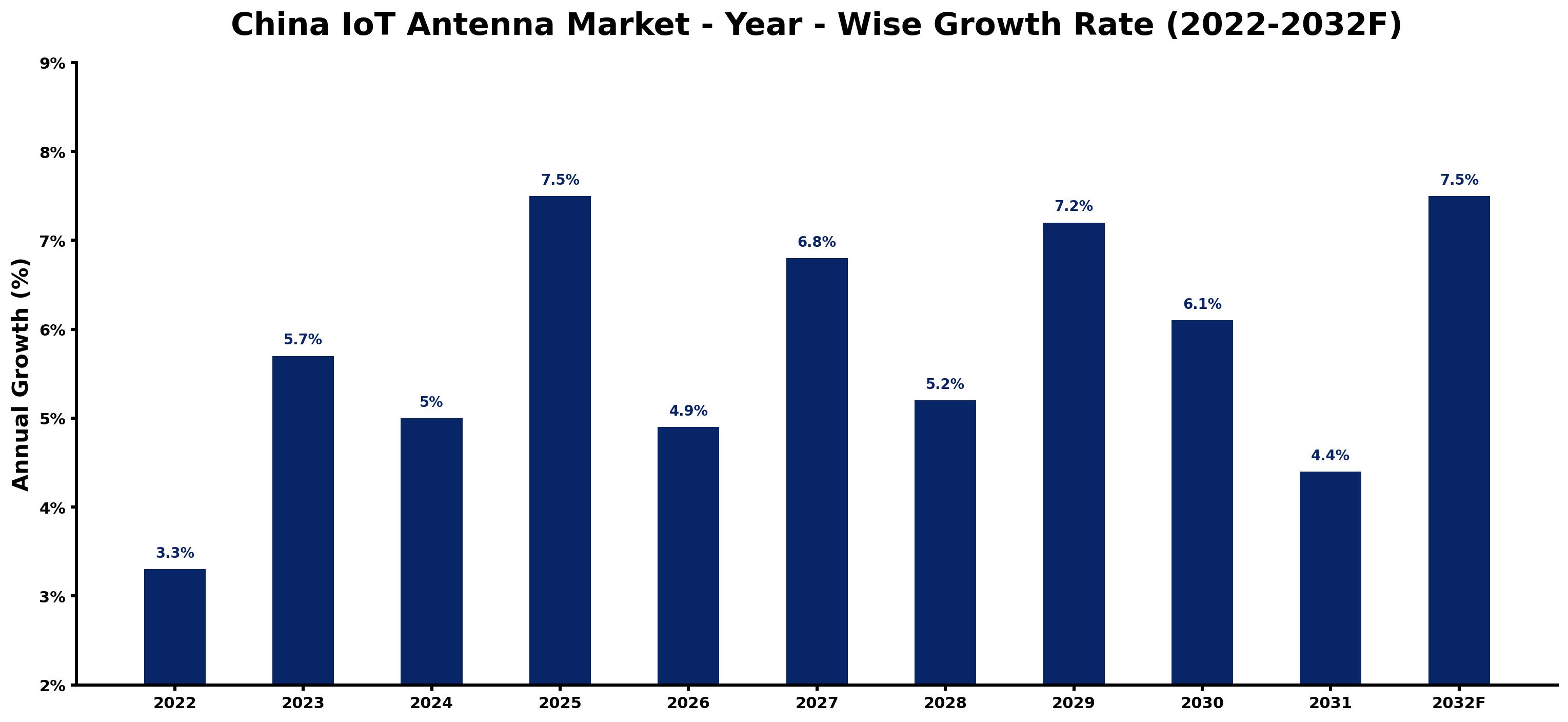
The table below sets out the estimated growth rate for each year and the main factor behind it.
| Year | Estimated Annual Growth (%) | Market Rationale |
| 2022 | 3.3 | The market experienced steady demand from IoT device makers and industrial integrators. |
| 2023 | 5.7 | Growth accelerated due to increased investments in IoT infrastructure and smart city initiatives. |
| 2024 | 5.0 | Demand slowed slightly as manufacturers adjusted to evolving technology standards. |
| 2025 | 7.5 | A surge in smart meter installations drove growth in the market. |
| 2026 | 4.9 | The National Development and Reform Commission's IoT Innovation and Development Action Plan is expected to decelerate growth as the market faces saturation in certain application areas. |
| 2027 | 6.8 | The expansion of wearables and industrial IoT applications will boost demand. |
| 2028 | 5.2 | Growth is projected to slow again as competition intensifies among manufacturers. |
| 2029 | 7.2 | A resurgence in demand for smart meters and asset tracking devices is expected to spur growth. |
| 2030 | 6.1 | The market will continue to grow, albeit at a slower pace due to competitive pressures. |
| 2031 | 4.4 | Growth is projected to slow as the market matures, with increased focus on security standards. |
| 2032 | 7.5 | A renewed push for smart city projects is expected to drive growth. |
Note: Market size estimations and growth projections presented in this report are based on 6Wresearch's proprietary forecasting methodology, utilizing the latest available industry data, government publications, and primary research inputs.
China IoT Antenna Market Synopsis
IoT Antenna in China encompasses devices that enable wireless communication for Internet of Things applications. These antennas, made from materials like copper and plastic, facilitate connections for smart devices and industrial data transmission. The China IoT Antenna Market is expanding due to rising investments in technology and a thriving IoT sector. Projections indicate 1.4 billion devices by 2025, with demand driven by domestic users and infrastructure investments. The Smart City Initiative and the National IoT Development Plan are key factors improving connectivity across urban areas.
Market Dynamics Impact Analysis (2026–2032)
| Factor | Type | Impact | Primary Segment Affected |
| Increased investments in IoT infrastructure drive demand for antennas. | Driver | High | IoT Device Makers |
| The growth of smart city projects creates a need for advanced connectivity solutions. | Driver | High | Smart Meters |
| The gap in high-performance antennas for wearables presents a significant opportunity. | Opportunity | High | Wearables |
| The push for energy-efficient solutions in industrial IoT creates demand for specific antenna types. | Opportunity | Medium | Industrial IoT |
| Competition among manufacturers may lead to price pressures affecting margins. | Restraint | High | Chip Antennas |
| The complexity of meeting national standards can delay product launches. | Restraint | Medium | PCB Antennas |
| Buyers face challenges in sourcing reliable antennas that meet evolving standards. | Challenge | High | Consumer OEMs |
| Suppliers struggle with the rapid pace of technological advancements in IoT. | Challenge | Medium | Industrial Integrators |
Evaluation of Drivers in China IoT Antenna Market (2026–2032)
The main growth drivers and the segments they affect most are set out below.
| Drivers | Primary Segment Affected | Why It Matters (Evidence) |
| Rising demand for smart meters increases the need for IoT antennas. | Smart Meters | China has over 400 million smart meters installed, driving antenna demand for connectivity. |
| The expansion of industrial IoT applications boosts antenna requirements. | Industrial IoT | The Industrial Internet of Things (IIoT) is a key focus area for manufacturers. |
| Growing adoption of LoRaWAN technology increases long-range communication needs. | LoRaWAN | LoRaWAN technology is widely adopted in smart agriculture projects across China, facilitating connectivity. |
| Increased consumer electronics production drives demand for compact antennas. | Chip Antennas | Consumer OEMs integrate antennas into products, reflecting the growing urban household connectivity. |
| The 5G rollout supports advanced IoT applications, increasing antenna demand. | Cellular IoT | The 5G rollout in China supports advanced IoT applications since 2020, boosting connectivity. |
Growth across the IoT Antenna market in China is anchored in end-use demand from smart meters, industrial applications, and the adoption of advanced connectivity standards. With over 400 million smart meters installed, reliable antennas are essential for connectivity. The focus on automation in industrial settings has led to increased antenna requirements, as manufacturers seek to improve efficiency. The widespread adoption of LoRaWAN technology in agriculture projects has created additional demand, enabling long-range communication. The ongoing 5G rollout is expected to drive investments in infrastructure, further expanding the market for IoT antennas.
Evaluation of Restraints in China IoT Antenna Market
Below mentioned are some major restraints and their influence on market dynamics.
| Market Restraint | Primary Segment Affected | Why It Matters (Evidence) |
| Intense competition among manufacturers leads to price pressures. | Chip Antennas | Price competition can reduce profit margins for suppliers, impacting their ability to invest in innovation. |
| Complexity in meeting national standards delays product launches. | PCB Antennas | Manufacturers must navigate stringent regulations, which can slow down time-to-market for new products. |
| Supply chain disruptions affect the availability of critical components. | Embedded Antennas | Global supply chain issues have led to shortages of materials needed for antenna production. |
| Technological advancements require constant adaptation from suppliers. | LoRaWAN | Suppliers must continuously innovate to keep pace with evolving technology standards. |
| Limited awareness of IoT standards among smaller manufacturers hampers growth. | Wearables | Smaller manufacturers may struggle to comply with standards, limiting their market entry. |
China IoT Antenna Market Challenges
Buyers and suppliers in the China IoT antenna market face rising costs due to increased material prices, which can inflate production expenses by up to 15%. A shortage of skilled workers limits the development of advanced IoT technologies, delaying product launches for manufacturers by an average of six months. Competition intensifies as numerous new entrants enter the market, compelling established players to lower prices, which can erode profit margins by as much as 20%. Supply chain disruptions, exacerbated by regulatory changes, lead to longer lead times for components, impacting delivery schedules for buyers and potentially causing project delays.
Trends in the China IoT Antenna Market
Buyers and suppliers in the China IoT Antenna Market are adjusting to the following trends.
- Shift Towards Smart City Applications: The Smart City Initiative launched in 2023 is driving the integration of IoT antennas into urban infrastructure. This initiative aims to improve urban management and connectivity, with over 100 cities expected to adopt IoT solutions by 2025.
- Increased Adoption of LoRaWAN in Agriculture: LoRaWAN technology is becoming increasingly prevalent in smart agriculture projects across China. With over 30% of agricultural IoT devices utilizing this standard, it is reshaping communication methods in rural areas.
- Rising Demand for Wearables: Wearables are seeing a surge in demand, particularly for health and fitness tracking. The market for wearables is projected to grow by 8.3% annually, reflecting a shift in consumer preferences towards connected health devices.
- Expansion of 5G Infrastructure: The rollout of 5G technology is enhancing IoT capabilities across various sectors. Since 2020, the infrastructure investment has exceeded $100 billion, significantly improving connectivity for IoT devices.
Investment Opportunities in the China IoT Antenna Market
Investors looking at the China IoT Antenna Market should consider the following areas.
- Investment in High-Performance Antennas: There is an opportunity to invest in high-performance antennas for wearables, with the market projected to grow by 8.3% annually. Consumer OEMs are looking for solutions to improve device connectivity.
- Focus on Smart Meter Technology: With over 400 million smart meters installed, the demand for advanced antennas is high. Suppliers can enter this market by partnering with utility companies to provide tailored solutions.
- Development of Energy-Efficient Antennas: The push for energy-efficient solutions in industrial IoT presents a unique opportunity. Manufacturers can target industrial integrators by providing antennas designed for low-power applications.
- Collaboration with IoT Device Makers: Collaborating with IoT device makers can open new avenues for antenna supply. The growing number of connected devices in urban households creates a substantial market for reliable antennas.
Government Initiatives in the China IoT Antenna Market
The Ministry of Industry and Information Technology's '14th Five-Year Plan for the Development of the Digital Economy', initiated in 2021, aims to enhance IoT infrastructure and applications, directly benefiting IoT antenna producers. This plan supports the growth of IoT technologies and connectivity across various sectors. In 2022, the National Development and Reform Commission introduced the 'IoT Innovation and Development Action Plan', promoting technology adoption across industries. This initiative encourages investment in IoT solutions and supports the development of national standards. The government continues to focus on improving the IoT framework to drive innovation and economic growth.
In 2023, the State Council approved the 'Smart City Development Strategy' to integrate IoT into urban planning and management. The Ministry of Science and Technology oversees the implementation of this strategy, which includes funding for IoT infrastructure projects and the establishment of standards. This initiative aims to enhance urban connectivity and improve the quality of life for citizens. The China Electronics Technology Standardization Institute published the 'Guidelines for IoT Security Standards' in 2022, further supporting the secure deployment of IoT devices.
Future Insight of the China IoT Antenna Market
Several forward-looking factors should drive growth in the China IoT antenna market by 2032. The National IoT Development Plan will enhance connectivity, boosting demand for IoT antennas. The ongoing rollout of 5G technology will facilitate advanced applications, expanding the market for connected devices. The Smart City Initiative, launched in 2023, is projected to increase urban IoT applications, with investments in infrastructure expected to exceed $100 billion by 2025. Additionally, the establishment of national standards for NB-IoT will ensure interoperability, benefiting both buyers and suppliers.
Market Segmentation Analysis
Each segment group is reviewed below, with the leader by share and the fastest grower by CAGR.
By Antenna Type – PCB Antennas Dominated, Chip Antennas Expected to Grow Fastest
According to Shubham Deep, Research Manager at 6Wresearch, with a 53% revenue share in 2025, PCB Antennas was the largest antenna type category. PCB antennas dominate the market due to their widespread use in various IoT devices, ensuring reliable communication across diverse applications. Their versatility makes them a preferred choice among manufacturers, particularly in Shenzhen, a key hub for IoT device production. Chip Antennas are projected to grow fastest, at a CAGR of 7.1% during 2026–2032. Chip antennas are rapidly gaining popularity as they are increasingly integrated into compact devices, catering to the demand for space-efficient solutions. The surge in smart device adoption, particularly in urban areas, is propelling this segment's swift growth. Suppliers should focus on ramping up chip antenna production to meet the rising demand for compact IoT solutions.
By Frequency Band – Sub-GHz Dominated, 2.4 GHz Expected to Grow Fastest
The largest frequency band category in 2025 was Sub-GHz, with a 43% share of total revenue. Sub-GHz frequencies capture the largest market share as they are commonly used for long-range IoT communications, making them ideal for applications like smart metering. This frequency band is crucial for maintaining reliable connectivity in both rural and urban settings. 2.4 GHz is set to record the highest CAGR in this split, 8.0% over 2026–2032. The 2.4 GHz band is experiencing rapid growth due to its extensive use in consumer and industrial IoT applications. The increasing adoption of smart home technologies is a key factor driving this segment's expansion. Buyers should consider the benefits of 2.4 GHz solutions for their IoT applications, as this frequency supports a wide range of devices.
By Application Area – Smart Meters Dominated, Wearables Expected to Grow Fastest
Smart Meters took a 40% share of application area in 2025, more than any other category. Smart meters lead the market, being essential for utility management and monitoring, with over 400 million units installed across China. Their critical role in promoting energy efficiency solidifies their position as a top choice for IoT applications. The quickest growth will come from Wearables, forecast to expand at a CAGR of 8.3% between 2026 and 2032. Wearables represent the fastest-growing application area, driven by rising consumer interest in health and fitness tracking technologies. The integration of IoT in personal health devices is significantly boosting this segment's growth. Suppliers should invest in wearable technology to capitalise on the increasing consumer demand for health monitoring solutions.
By Connectivity Standard – LoRaWAN Dominated, Bluetooth Expected to Grow Fastest
In 2025, LoRaWAN led the connectivity standard split with a 37% share. LoRaWAN is the leading connectivity standard, enabling long-range communication for IoT devices, essential for applications like smart agriculture. Its robust capabilities are well-recognised among IoT stakeholders across China. Over 2026–2032, Bluetooth is expected to post the fastest growth, at a CAGR of 7.9%. Bluetooth is rapidly gaining traction, particularly in consumer electronics for short-range connectivity. The rise of smart devices and wearables is significantly propelling this segment's growth in the market. Buyers should prioritise Bluetooth-enabled solutions for their IoT devices to ensure compatibility with a broad array of consumer products.
By End User – IoT Device Makers Dominated, Consumer OEMs Expected to Grow Fastest
IoT Device Makers held a 47% share of the China IoT Antenna Market by end user in 2025. IoT device makers hold the largest market share as they are the primary users of antennas for device production, ensuring their products meet the growing demand for connectivity. Their crucial role in the supply chain supports the overall market share. Consumer OEMs are projected to grow fastest, at a CAGR of 8.7% during 2026–2032. Consumer OEMs are the fastest-growing end user segment, integrating antennas into a variety of consumer products to meet market demands. The increasing trend of connected devices in households is driving this growth. Suppliers should tailor their offerings to address the specific needs of consumer OEMs, ensuring compatibility with emerging consumer technologies.
Key Attractiveness of the Report
- 10 Years of Market Numbers
- Historical Data Starting from 2022 to 2025
- Base Year 2025
- Forecast Data until 2032
- Key Performance Indicators Impacting the Market
- Major Upcoming Developments and Projects
Key Highlights of the Report:
- China IoT Antenna Market Outlook
- Market Size of China IoT Antenna Market, 2025
- Forecast of China IoT Antenna Market, 2032
- Historical Data and Forecast of China IoT Antenna Revenues & Volume for the Period 2022 - 2032F
- China IoT Antenna Market Trend Evolution
- China IoT Antenna Market Drivers and Challenges
- China IoT Antenna Price Trends
- China IoT Antenna Porter's Five Forces
- China IoT Antenna Industry Life Cycle
- Historical Data and Forecast of China IoT Antenna Market Revenues & Volume By Antenna Type for the Period 2022 - 2032F
- Historical Data and Forecast of China IoT Antenna Market Revenues & Volume By PCB Antennas for the Period 2022 - 2032F
- Historical Data and Forecast of China IoT Antenna Market Revenues & Volume By Chip Antennas for the Period 2022 - 2032F
- Historical Data and Forecast of China IoT Antenna Market Revenues & Volume By Patch Antennas for the Period 2022 - 2032F
- Historical Data and Forecast of China IoT Antenna Market Revenues & Volume By Embedded Antennas for the Period 2022 - 2032F
- Historical Data and Forecast of China IoT Antenna Market Revenues & Volume By Frequency Band for the Period 2022 - 2032F
- Historical Data and Forecast of China IoT Antenna Market Revenues & Volume By Sub-GHz for the Period 2022 - 2032F
- Historical Data and Forecast of China IoT Antenna Market Revenues & Volume By 2.4 GHz for the Period 2022 - 2032F
- Historical Data and Forecast of China IoT Antenna Market Revenues & Volume By 5 GHz for the Period 2022 - 2032F
- Historical Data and Forecast of China IoT Antenna Market Revenues & Volume By NB-IoT for the Period 2022 - 2032F
- Historical Data and Forecast of China IoT Antenna Market Revenues & Volume By Application Area for the Period 2022 - 2032F
- Historical Data and Forecast of China IoT Antenna Market Revenues & Volume By Smart Meters for the Period 2022 - 2032F
- Historical Data and Forecast of China IoT Antenna Market Revenues & Volume By Wearables for the Period 2022 - 2032F
- Historical Data and Forecast of China IoT Antenna Market Revenues & Volume By Industrial IoT for the Period 2022 - 2032F
- Historical Data and Forecast of China IoT Antenna Market Revenues & Volume By Asset Tracking Devices for the Period 2022 - 2032F
- Historical Data and Forecast of China IoT Antenna Market Revenues & Volume By Connectivity Standard for the Period 2022 - 2032F
- Historical Data and Forecast of China IoT Antenna Market Revenues & Volume By LoRaWAN for the Period 2022 - 2032F
- Historical Data and Forecast of China IoT Antenna Market Revenues & Volume By Bluetooth, Zigbee for the Period 2022 - 2032F
- Historical Data and Forecast of China IoT Antenna Market Revenues & Volume By Wi-Fi for the Period 2022 - 2032F
- Historical Data and Forecast of China IoT Antenna Market Revenues & Volume By Cellular IoT for the Period 2022 - 2032F
- Historical Data and Forecast of China IoT Antenna Market Revenues & Volume By End User for the Period 2022 - 2032F
- Historical Data and Forecast of China IoT Antenna Market Revenues & Volume By IoT Device Makers for the Period 2022 - 2032F
- Historical Data and Forecast of China IoT Antenna Market Revenues & Volume By Consumer OEMs for the Period 2022 - 2032F
- Historical Data and Forecast of China IoT Antenna Market Revenues & Volume By Industrial Integrators for the Period 2022 - 2032F
- Historical Data and Forecast of China IoT Antenna Market Revenues & Volume By GPS Equipment Vendors for the Period 2022 - 2032F
- China IoT Antenna Import Export Trade Statistics
- Market Opportunity Assessment By Antenna Type
- Market Opportunity Assessment By Frequency Band
- Market Opportunity Assessment By Application Area
- Market Opportunity Assessment By Connectivity Standard
- Market Opportunity Assessment By End User
- China IoT Antenna Top Companies Market Share
- China IoT Antenna Competitive Benchmarking By Technical and Operational Parameters
- China IoT Antenna Company Profiles
- China IoT Antenna Key Strategic Recommendations
Market Covered
The report offers an extensive study of the following market segments.
By Antenna Type
- PCB Antennas
- Chip Antennas
- Patch Antennas
- Embedded Antennas
By Frequency Band
- Sub-GHz
- 2.4 GHz
- 5 GHz
- NB-IoT
By Application Area
- Smart Meters
- Wearables
- Industrial IoT
- Asset Tracking Devices
By Connectivity Standard
- LoRaWAN
- Bluetooth
- Zigbee
- Wi-Fi
- Cellular IoT
By End User
- IoT Device Makers
- Consumer OEMs
- Industrial Integrators
- GPS Equipment Vendors































