China IoT Asset Tracking Market Size & Growth Rate
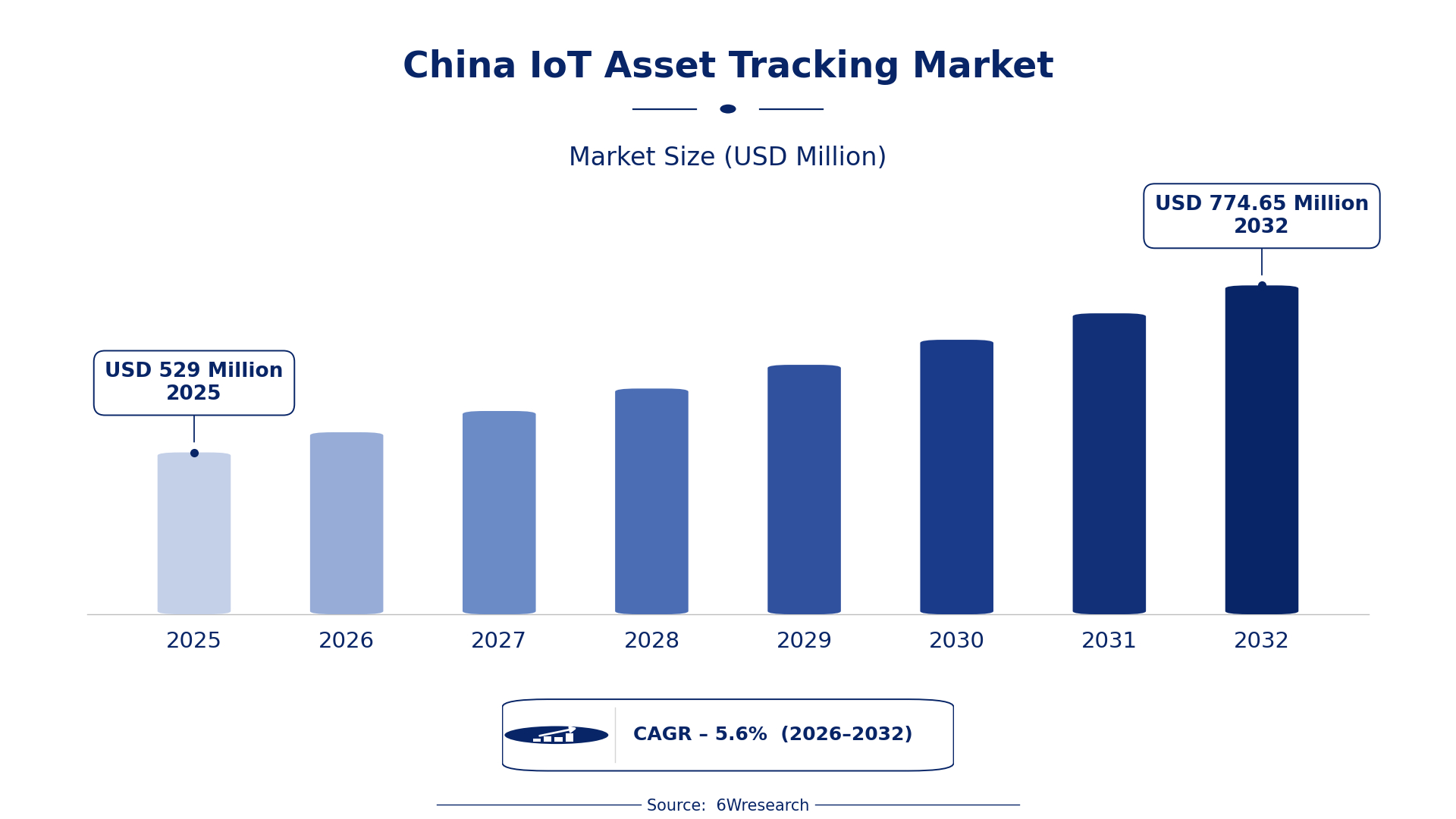
According to 6Wresearch internal database and industry insights, the China IoT Asset Tracking Market was valued at USD 529.0 million in 2025 and is projected to reach USD 774.65 million by 2032, growing at a CAGR of approximately 5.6% during 2026–2032.
China IoT Asset Tracking Market Highlights
| Report Metric | Details |
| Report Name | China IoT Asset Tracking Market |
| Market Size 2025 | USD 529.0 million |
| Market Size 2032 | USD 774.65 million |
| Absolute Growth 2025–2032 | USD 245.65 million |
| CAGR 2026–2032 | 5.6% |
| Peak Annual Growth | 8.1% in 2026 |
| Forecast Period | 2026–2032 |
| Historical Data | 2022–2025 |
| Base Year | 2025 |
| Leading Technology Type, 2025 | GPS-Based (42% share) |
| Leading Connectivity Type, 2025 | Cellular (LTE-M/NB-IoT) (37% share) |
| Leading Asset Type, 2025 | Vehicle Fleet (46% share) |
| Leading End User Industry, 2025 | Logistics (46% share) |
| Leading Distribution Channel, 2025 | SaaS Platforms (45% share) |
| Fastest-Growing Technology Type | LoRaWAN-Based (7.8% CAGR) |
| Fastest-Growing Connectivity Type | LPWAN (7.7% CAGR) |
| Fastest-Growing Asset Type | Agricultural Equipment (8.0% CAGR) |
| Fastest-Growing End User Industry | Agriculture (7.9% CAGR) |
| Growing Sector | Agriculture |
| Key End Users | Logistics, Retail, Shipping, Agriculture |
China IoT Asset Tracking Market Year-wise Growth Rate and Key Drivers (2022–2032)
This graph illustrates the annual growth rates of the market from 2022 to 2032, highlighting a steady upward trajectory and projected market expansion over the forecast period.
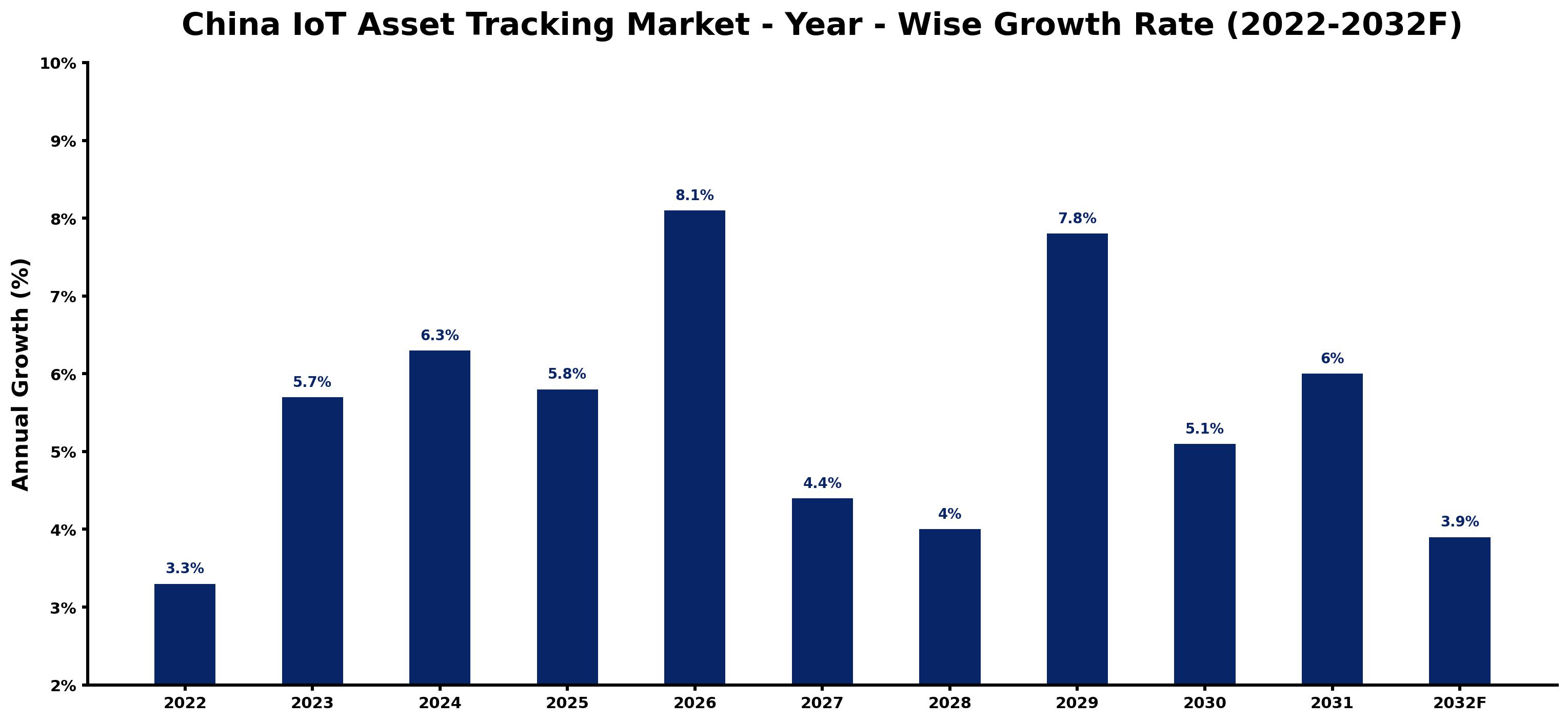
The following table presents the estimated annual growth rate for each year together with the principal factor influencing market performance.
| Year | Estimated Annual Growth (%) | Market Rationale |
| 2022 | 3.3 | The market experienced steady growth due to increasing adoption of IoT technologies across various sectors. |
| 2023 | 5.7 | Demand accelerated as logistics companies improved their operations with IoT asset tracking solutions. |
| 2024 | 6.3 | Growth continued as more industries recognised the benefits of real-time asset monitoring through IoT. |
| 2025 | 5.8 | A slight slowdown occurred as the market adjusted to rapid advancements in technology and integration. |
| 2026 | 8.1 | Growth surged again as the adoption of advanced tracking solutions became widespread in logistics and retail. |
| 2027 | 4.4 | A slowdown followed as market saturation began to affect growth rates in established sectors like logistics. |
| 2028 | 4.0 | Continued slowdown was noted as companies focused on optimising existing IoT systems and technologies. |
| 2029 | 7.8 | Growth rebounded as new applications for IoT asset tracking emerged in various industries, including agriculture. |
| 2030 | 5.1 | A slowdown was observed as the market stabilised after rapid expansions in previous years and integration efforts. |
| 2031 | 6.0 | Growth picked up again as new solutions attracted investments in the sector, particularly in logistics. |
| 2032 | 3.9 | A further slowdown is projected as the market matures and competition intensifies across various sectors. |
Note: Market size estimations and growth projections presented in this report are based on 6Wresearch's proprietary forecasting methodology, utilizing the latest available industry data, government publications, and primary research inputs.
China IoT Asset Tracking Market Synopsis
The China IoT Asset Tracking Market utilises various technologies to monitor and manage assets in real-time. It integrates sensors, connectivity solutions, and data analytics platforms for applications like supply chain optimisation and inventory management. The market is growing due to substantial demand from the logistics sector, which contributes approximately 14% of the national GDP. Initiatives such as the 'Smart Logistics Development Program' are driving further interest in IoT solutions, improving operational efficiency across industries.
Market Dynamics Impact Analysis (2026–2032)
| Factor | Type | Impact | Primary Segment Affected |
| Increasing adoption of IoT technologies in logistics and retail sectors | Driver | High | Logistics |
| Growing need for supply chain optimisation solutions | Driver | High | Retail |
| Expansion of IoT applications in agriculture | Opportunity | Medium | Agricultural Equipment |
| Investment in smart farming technologies | Opportunity | Medium | Agriculture |
| Challenges in interoperability among IoT devices | Restraint | High | IoT Providers |
| High initial investment costs for IoT infrastructure | Restraint | Medium | System Integrators |
| Limited skilled workforce in IoT technologies | Challenge | High | IoT Providers |
| Regulatory compliance requirements can delay deployment | Challenge | Medium | Network Operators |
Evaluation of Drivers in China IoT Asset Tracking Market (2026–2032)
The factors lifting demand, and the evidence behind each, are summarised below.
| Drivers | Primary Segment Affected | Why It Matters (Evidence) |
| Rising number of connected IoT devices | Cellular (LTE-M/NB-IoT) | In 2022, connected IoT devices surpassed 1 billion, increasing demand for tracking solutions in logistics. |
| Growth in logistics sector | Logistics | The logistics sector contributes approximately 14% to national GDP, driving investment in asset tracking technologies. |
| Government initiatives promoting IoT | SaaS Platforms | The 'Smart Logistics Development Program' launched in 2023 aims to improve supply chain efficiency through IoT. |
| Technological advancements in tracking solutions | GPS-Based | The adoption of IoT tracking solutions is growing as companies seek to enhance their operational capabilities. |
| Increasing focus on operational efficiency | Vehicle Fleet | IoT asset tracking improves operational efficiency, which is vital for logistics and retail sectors. |
In 2022, the number of connected IoT devices surpassed 1 billion, leading to increased demand for tracking solutions. The logistics sector, accounting for approximately 14% of national GDP, drives investment in asset tracking technologies. As companies increasingly adopt IoT solutions, the need for operational efficiency in logistics and retail sectors becomes critical.
Evaluation of Restraints in China IoT Asset Tracking Market
The following restraints limit how fast demand can grow.
| Market Restraint | Primary Segment Affected | Why It Matters (Evidence) |
| Interoperability issues among IoT devices | IoT Providers | The National Standard GB/T 32960-2016 governs interoperability, but compliance can be challenging and costly. |
| High initial investment costs for IoT infrastructure | System Integrators | Capital is required to implement IoT solutions, limiting adoption among smaller firms. |
| Limited skilled workforce in IoT technologies | IoT Providers | A shortage of qualified personnel can hinder the deployment and maintenance of IoT solutions. |
| Regulatory compliance requirements can delay deployment | Network Operators | Strict regulations can slow down the implementation of new IoT tracking systems, impacting timelines. |
| Market saturation in established sectors | Logistics | As the market matures, growth rates are slowing due to increased competition and limited new entrants. |
China IoT Asset Tracking Market Challenges
Buyers and suppliers in the China IoT Asset Tracking market encounter rising costs due to the substantial investment required for advanced technology integration. This financial burden arises from the need for extensive sensor deployment and data analytics, which can delay project timelines for logistics companies. Regulatory compliance with the National Standard GB/T 32960-2016 complicates operations, increasing costs by approximately 15% for suppliers who must ensure device interoperability. Supply chain disruptions from regulatory changes can postpone the delivery of IoT solutions, negatively impacting inventory management for retailers and potentially leading to stock shortages.
Trends in the China IoT Asset Tracking Market
Four trends stand out in the China IoT Asset Tracking Market.
- Shift from Traditional to Smart Logistics: Since 2023, logistics companies have increasingly embraced smart logistics solutions, improving operational efficiency. The adoption rate of IoT in logistics reached 60% in major cities, reflecting a change in industry practices.
- Transition from Manual to Automated Tracking: The move towards automated asset tracking solutions has gained momentum, especially in the retail sector. In 2023, total investment in IoT technologies in China surpassed 500 billion CNY, highlighting this transition.
- IoT Integration in Agriculture: The agricultural sector is progressively adopting IoT solutions, focusing on smart farming technologies. This trend is expected to grow, driven by the demand for precision farming practices and efficiency.
- Emergence of SaaS Platforms for Asset Management: SaaS Platforms have emerged as the primary distribution channel for IoT asset tracking solutions. By 2025, they are projected to capture a 45% market share, indicating a shift towards cloud-based solutions.
Investment Opportunities in the China IoT Asset Tracking Market
Below are the investment opportunities with the strongest case in the China IoT Asset Tracking Market.
- Local Partnerships for IoT Solutions: Forming joint ventures with local IoT providers can ease market entry. The Guangdong province stands out as a leading region for IoT asset tracking deployments, presenting significant investment opportunities.
- Investment in Smart Agriculture Technologies: Investing in smart farming technologies is crucial as the agricultural sector adopts IoT solutions. The agricultural sector is projected to expand, driven by precision farming practices.
- Supply Chain Solutions for Retailers: Retailers are increasingly pursuing IoT asset tracking solutions to enhance inventory management. The retail sector's demand for efficient inventory systems presents a valuable opportunity for suppliers.
- Expansion in Major Urban Areas: Targeting major urban areas for IoT asset tracking solutions is essential. The Beijing-Tianjin-Hebei region is a key area for IoT technology deployment, offering substantial growth potential.
Government Initiatives in the China IoT Asset Tracking Market
In 2021, the 'IoT Innovation Action Plan' was launched by the Ministry of Industry and Information Technology to promote IoT development with a focus on smart cities and logistics. This plan adds to previous regulations by establishing clearer guidelines for IoT integration across sectors. It aims to streamline processes and encourage innovation in IoT technologies, promoting overall market growth. In 2023, the 'Digital Economy Development Strategy' was released, emphasising the integration of IoT in various sectors to boost economic growth.
The National Development and Reform Commission oversees the 'Smart Logistics Development Program', which was approved in 2022. This program aims to improve logistics efficiency through IoT technologies by funding pilot projects and providing support for infrastructure improvements, thereby facilitating the adoption of IoT solutions in logistics. Additionally, the Ministry of Agriculture initiated the 'Smart Agriculture Promotion Program' in 2022 to encourage the adoption of IoT solutions in farming practices.
Future Insight of the China IoT Asset Tracking Market
By 2032, buyers and suppliers in the China IoT Asset Tracking market can anticipate considerable advancements driven by the 'Smart Logistics Development Program' and the 'Digital China' strategy. The number of connected IoT devices is expected to exceed 1.5 billion, enabling improved asset management across various sectors. Increased collaboration through the China Internet of Things Alliance will promote standardisation, enhancing interoperability. The agricultural sector will experience a surge in IoT applications, particularly in smart farming, opening new growth opportunities.
Market Segmentation Analysis
The analysis below covers each segmentation, its leading category in 2025 and its fastest-growing category through 2032.
By Technology Type – GPS-Based Dominated, LoRaWAN-Based Expected to Grow Fastest
According to Shubham Deep, Research Manager at 6Wresearch, the largest technology type category in 2025 was GPS-Based, with a 42% share of total revenue. GPS-Based technology holds a substantial share in China's IoT Asset Tracking market because it provides precise location tracking for assets, which is crucial for logistics operations. Its extensive use in logistics ensures accurate asset management and monitoring, reflecting the sector's demand for reliable tracking solutions. The quickest growth will come from LoRaWAN-Based, forecast to expand at a CAGR of 7.8% between 2026 and 2032. LoRaWAN-Based technology is rapidly gaining traction as it enables long-range communication in remote areas, making it particularly suitable for agricultural applications. The increasing focus on efficient asset tracking solutions in rural regions is driving this segment's growth. Suppliers should prioritise advancements in GPS and LoRaWAN technologies to meet the rising demand for effective asset tracking solutions.
By Connectivity Type – Cellular (LTE-M/NB-IoT) Dominated, LPWAN Expected to Grow Fastest
Cellular (LTE-M/NB-IoT) took a 37% share of connectivity type in 2025, more than any other category. Cellular (LTE-M/NB-IoT) technology captures a significant share of the market as it supports real-time tracking through cellular networks, essential for industries needing constant asset visibility. The established infrastructure for cellular networks in urban areas reinforces its leading position in the market. LPWAN is set to record the highest CAGR in this split, 7.7% over 2026–2032. LPWAN technology is experiencing swift growth due to its capability for low-power, long-range communication, which is advantageous for remote asset management. The increasing need for cost-effective tracking solutions across various sectors is set to boost LPWAN adoption. Buyers should explore LPWAN solutions to leverage their long-range capabilities for efficient asset tracking.
By Asset Type – Vehicle Fleet Dominated, Agricultural Equipment Expected to Grow Fastest
Vehicle Fleet held a 46% share of the China IoT Asset Tracking Market by asset type in 2025. The Vehicle Fleet segment dominates the market, critical for managing and tracking vehicle movements vital for logistics and transportation. The large number of vehicles in operation across China significantly contributes to its leading market share. Over 2026–2032, Agricultural Equipment is expected to post the fastest growth, at a CAGR of 8.0%. Agricultural Equipment is the fastest-growing segment, propelled by the rising adoption of IoT solutions in precision farming for equipment monitoring. The agricultural sector's shift towards smart farming practices is accelerating this segment's growth. Suppliers should customise their offerings to cater to the agricultural sector's specific needs as it increasingly embraces IoT asset tracking.
By End User Industry – Logistics Dominated, Agriculture Expected to Grow Fastest
Logistics accounted for a 46% market share by end user industry in 2025. The Logistics sector leads the market due to its extensive reliance on asset tracking to enhance operational efficiency, representing a considerable portion of the national GDP. The integration of IoT solutions in logistics is crucial for maintaining competitive advantages in this vital industry. Agriculture is projected to grow fastest, at a CAGR of 7.9% during 2026–2032. Agriculture is the fastest-growing end user industry, increasingly adopting IoT technologies for precision farming and equipment tracking. The sector's push for smart farming solutions is driving rapid growth in this area. Suppliers must focus on creating tailored solutions for the agriculture sector to capitalise on its expanding demand for IoT asset tracking.
By Distribution Channel – SaaS Platforms Dominated and Is Expected to Record the Fastest Growth
In 2025, SaaS Platforms led the distribution channel split with a 45% share. SaaS Platforms dominate the distribution channel segment by providing essential software solutions for asset management, enabling real-time tracking and data analysis. Their convenience and scalability make them highly appealing to businesses across various industries, solidifying their market share. SaaS Platforms are also forecast to expand faster than any other category, at a CAGR of 7.3% over 2026–2032. SaaS Platforms are also the fastest-growing channel, benefiting from the rising need for cloud-based solutions that support IoT asset tracking. The ongoing digital transformation in businesses is propelling the swift adoption of SaaS platforms. Suppliers should enhance their SaaS offerings to capture the growing market share in IoT asset tracking solutions.
Key Attractiveness of the Report
- 10 Years of Market Numbers
- Historical Data Starting from 2022 to 2025
- Base Year 2025
- Forecast Data until 2032
- Key Performance Indicators Impacting the Market
- Major Upcoming Developments and Projects
Key Highlights of the Report:
- China IoT Asset Tracking Market Outlook
- Market Size of China IoT Asset Tracking Market, 2025
- Forecast of China IoT Asset Tracking Market, 2032
- Historical Data and Forecast of China IoT Asset Tracking Revenues & Volume for the Period 2022 - 2032F
- China IoT Asset Tracking Market Trend Evolution
- China IoT Asset Tracking Market Drivers and Challenges
- China IoT Asset Tracking Price Trends
- China IoT Asset Tracking Porter's Five Forces
- China IoT Asset Tracking Industry Life Cycle
- Historical Data and Forecast of China IoT Asset Tracking Market Revenues & Volume By Technology Type for the Period 2022 - 2032F
- Historical Data and Forecast of China IoT Asset Tracking Market Revenues & Volume By GPS-Based for the Period 2022 - 2032F
- Historical Data and Forecast of China IoT Asset Tracking Market Revenues & Volume By RFID-Based for the Period 2022 - 2032F
- Historical Data and Forecast of China IoT Asset Tracking Market Revenues & Volume By LoRaWAN-Based for the Period 2022 - 2032F
- Historical Data and Forecast of China IoT Asset Tracking Market Revenues & Volume By Satellite-Linked for the Period 2022 - 2032F
- Historical Data and Forecast of China IoT Asset Tracking Market Revenues & Volume By Connectivity Type for the Period 2022 - 2032F
- Historical Data and Forecast of China IoT Asset Tracking Market Revenues & Volume By Cellular (LTE-M/NB-IoT) for the Period 2022 - 2032F
- Historical Data and Forecast of China IoT Asset Tracking Market Revenues & Volume By Wi-Fi/Bluetooth for the Period 2022 - 2032F
- Historical Data and Forecast of China IoT Asset Tracking Market Revenues & Volume By LPWAN for the Period 2022 - 2032F
- Historical Data and Forecast of China IoT Asset Tracking Market Revenues & Volume By GNSS for the Period 2022 - 2032F
- Historical Data and Forecast of China IoT Asset Tracking Market Revenues & Volume By Asset Type for the Period 2022 - 2032F
- Historical Data and Forecast of China IoT Asset Tracking Market Revenues & Volume By Vehicle Fleet for the Period 2022 - 2032F
- Historical Data and Forecast of China IoT Asset Tracking Market Revenues & Volume By Warehoused Goods for the Period 2022 - 2032F
- Historical Data and Forecast of China IoT Asset Tracking Market Revenues & Volume By Agricultural Equipment for the Period 2022 - 2032F
- Historical Data and Forecast of China IoT Asset Tracking Market Revenues & Volume By Maritime Assets for the Period 2022 - 2032F
- Historical Data and Forecast of China IoT Asset Tracking Market Revenues & Volume By End User Industry for the Period 2022 - 2032F
- Historical Data and Forecast of China IoT Asset Tracking Market Revenues & Volume By Logistics for the Period 2022 - 2032F
- Historical Data and Forecast of China IoT Asset Tracking Market Revenues & Volume By Retail for the Period 2022 - 2032F
- Historical Data and Forecast of China IoT Asset Tracking Market Revenues & Volume By Agriculture for the Period 2022 - 2032F
- Historical Data and Forecast of China IoT Asset Tracking Market Revenues & Volume By Shipping for the Period 2022 - 2032F
- Historical Data and Forecast of China IoT Asset Tracking Market Revenues & Volume By Distribution Channel for the Period 2022 - 2032F
- Historical Data and Forecast of China IoT Asset Tracking Market Revenues & Volume By SaaS Platforms for the Period 2022 - 2032F
- Historical Data and Forecast of China IoT Asset Tracking Market Revenues & Volume By IoT Providers for the Period 2022 - 2032F
- Historical Data and Forecast of China IoT Asset Tracking Market Revenues & Volume By Network Operators for the Period 2022 - 2032F
- Historical Data and Forecast of China IoT Asset Tracking Market Revenues & Volume By System Integrators for the Period 2022 - 2032F
- China IoT Asset Tracking Import Export Trade Statistics
- Market Opportunity Assessment By Technology Type
- Market Opportunity Assessment By Connectivity Type
- Market Opportunity Assessment By Asset Type
- Market Opportunity Assessment By End User Industry
- Market Opportunity Assessment By Distribution Channel
- China IoT Asset Tracking Top Companies Market Share
- China IoT Asset Tracking Competitive Benchmarking By Technical and Operational Parameters
- China IoT Asset Tracking Company Profiles
- China IoT Asset Tracking Key Strategic Recommendations
Market Covered
This report examines the market across the segments below.
By Technology Type
- GPS-Based
- RFID-Based
- LoRaWAN-Based
- Satellite-Linked
By Connectivity Type
- Cellular (LTE-M/NB-IoT)
- Wi-Fi/Bluetooth
- LPWAN
- GNSS
By Asset Type
- Vehicle Fleet
- Warehoused Goods
- Agricultural Equipment
- Maritime Assets
By End User Industry
- Logistics
- Retail
- Agriculture
- Shipping
By Distribution Channel
- SaaS Platforms
- IoT Providers
- Network Operators
- System Integrators































