China IoT-Based Trash Collection Market Size & Growth Rate
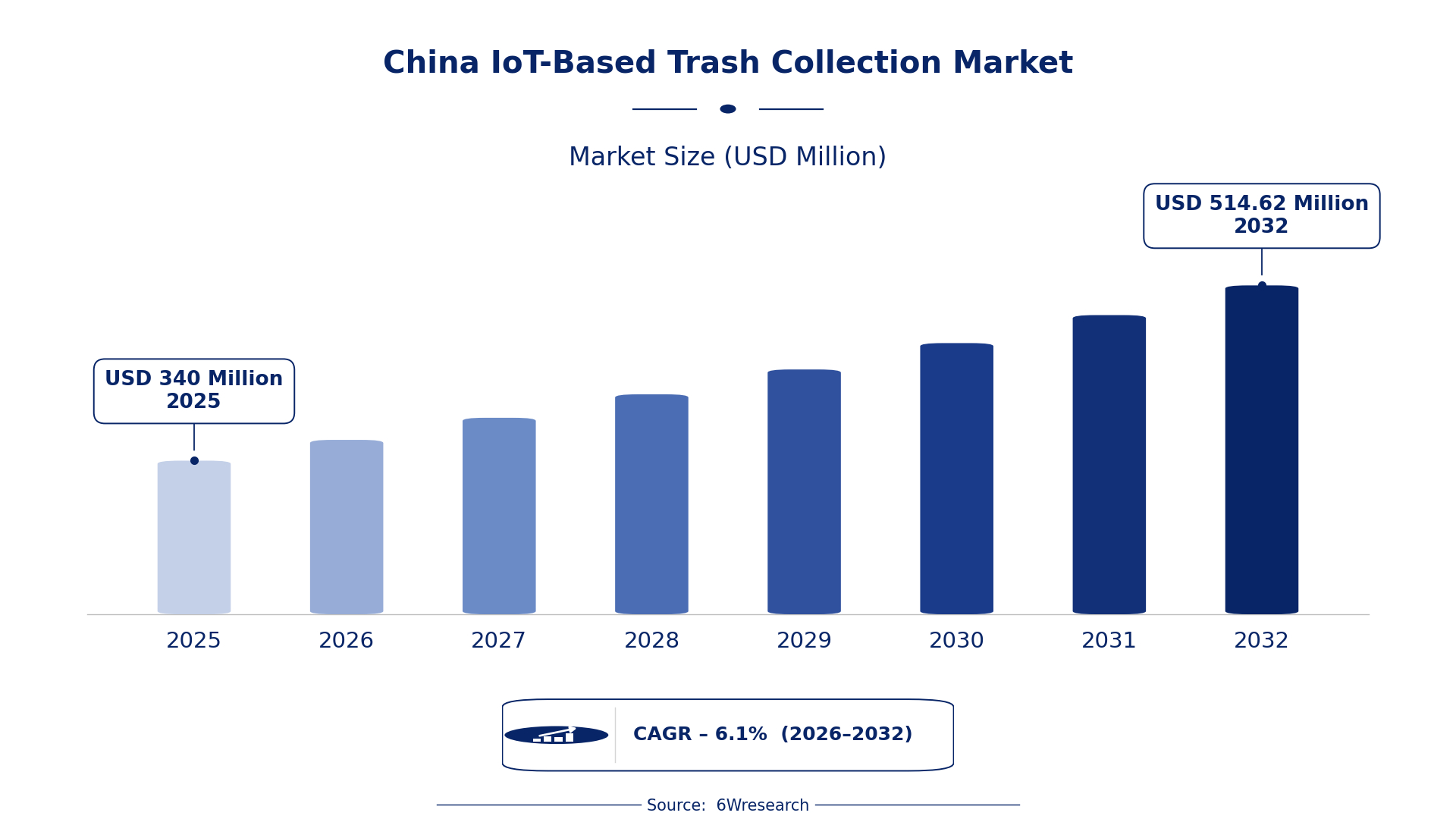
According to 6Wresearch internal database and industry insights, the China IoT-Based Trash Collection Market was valued at USD 340.0 million in 2025 and is projected to reach USD 514.62 million by 2032, growing at a CAGR of approximately 6.1% during 2026–2032.
China IoT-Based Trash Collection Market Highlights
| Report Metric | Details |
| Report Name | China IoT-Based Trash Collection Market |
| Market Size 2025 | USD 340.0 million |
| Market Size 2032 | USD 514.62 million |
| Absolute Growth 2025–2032 | USD 174.62 million |
| CAGR 2026–2032 | 6.1% |
| Peak Annual Growth | 8.1% in 2032 |
| Forecast Period | 2026–2032 |
| Historical Data | 2022–2025 |
| Base Year | 2025 |
| Leading System Type, 2025 | Smart Bin System (44% share) |
| Leading Sensor Type, 2025 | Ultrasonic Fill Sensors (46% share) |
| Leading Connectivity Type, 2025 | LPWAN (42% share) |
| Leading Application Area, 2025 | Urban Collection (47% share) |
| Leading End User, 2025 | Municipal Services (42% share) |
| Fastest-Growing System Type | Route Optimization (7.2% CAGR) |
| Fastest-Growing Sensor Type | GPS + Load Sensors (7.8% CAGR) |
| Fastest-Growing Application Area | Smart Waste Vehicles (8.7% CAGR) |
| Fastest-Growing End User | Waste Collection Firms (8.2% CAGR) |
| Growing Sector | Municipal Services |
| Key End Users | Municipal Services, Waste Collection Firms, City Councils |
China IoT-Based Trash Collection Market Year-wise Growth Rate and Key Drivers (2022–2032)
This graph illustrates the annual growth rates of the market from 2022 to 2032, highlighting a steady upward trajectory and projected market expansion over the forecast period.
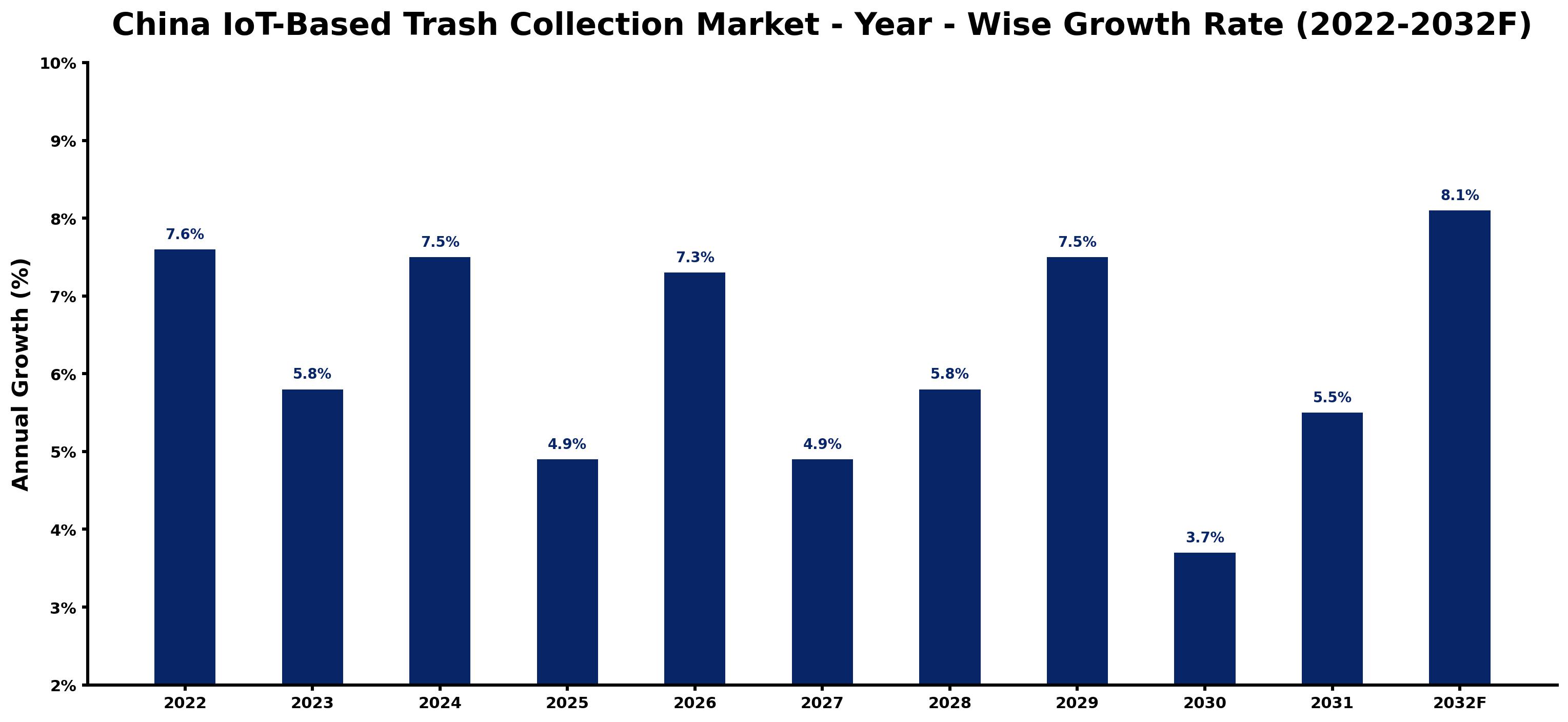
Below, each year's estimated growth is shown next to the factor that most influenced it.
| Year | Estimated Annual Growth (%) | Market Rationale |
| 2022 | 7.6 | The market showed strong demand due to urban population growth and smart city initiatives. |
| 2023 | 5.8 | Growth slowed as cities faced challenges in implementing new waste management technologies. |
| 2024 | 7.5 | Increased adoption of IoT systems improved operational efficiency in waste collection. |
| 2025 | 4.9 | Demand growth slowed again as municipalities adjusted to new technologies and practices. |
| 2026 | 7.3 | Interest in smart waste solutions is expected to rise as cities aim to meet environmental targets. |
| 2027 | 4.9 | Growth is projected to slow as some municipalities face budget constraints for technology upgrades. |
| 2028 | 5.8 | Adoption of IoT solutions is expected to increase as cities focus on improving waste management efficiency. |
| 2029 | 7.5 | Strong demand is projected to continue as urban areas expand and seek better waste solutions. |
| 2030 | 3.7 | Growth is expected to slow as market maturity leads to fewer new implementations in established regions. |
| 2031 | 5.5 | Demand is projected to pick up again as municipalities renew focus on smart city initiatives. |
| 2032 | 8.1 | The market is expected to peak as urban areas fully integrate IoT solutions into waste management. |
Note: Market size estimations and growth projections presented in this report are based on 6Wresearch's proprietary forecasting methodology, utilizing the latest available industry data, government publications, and primary research inputs.
China IoT-Based Trash Collection Market Synopsis
IoT-Based Trash Collection in China integrates Internet of Things technology into waste management systems, equipping bins and vehicles with sensors for monitoring waste levels. The China IoT-Based Trash Collection Market is growing due to urban population increases and initiatives like the Smart City Development Plan. In 2023, 50% of municipal services in major cities are expected to utilise IoT-based solutions, improving efficiency and reducing operational costs. This growth stems from the demand for smart city solutions and the need for effective waste management.
Market Dynamics Impact Analysis (2026–2032)
| Factor | Type | Impact | Primary Segment Affected |
| Urban population growth drives demand for efficient waste management solutions. | Driver | High | Urban Collection |
| Integration of IoT technology in waste management systems presents new opportunities. | Opportunity | High | Smart Bin System |
| Budget constraints limit the adoption of advanced waste management technologies. | Restraint | High | Route Optimization |
| The need for real-time data in waste management creates a demand for smart solutions. | Driver | Medium | Overflow Alert System |
| Limited awareness of IoT benefits restrains market growth in smaller cities. | Restraint | Medium | Smart Waste Vehicles |
| Regulatory delays in approving new technologies can hinder market expansion. | Challenge | High | Municipal Services |
| Competition among waste management firms can lead to price wars, affecting profitability. | Challenge | Medium | Waste Collection Firms |
| Growing interest in sustainability drives demand for smart waste solutions. | Opportunity | High | Public Bins |
Evaluation of Drivers in China IoT-Based Trash Collection Market (2026–2032)
The main growth drivers and the segments they affect most are set out below.
| Drivers | Primary Segment Affected | Why It Matters (Evidence) |
| Urban population growth increases the need for efficient waste management solutions. | Urban Collection | China's urban population reached 1.4 billion in 2023, necessitating better waste management to cope with increased waste generation. |
| Integration of IoT technology optimizes waste collection routes and reduces costs. | Route Optimization | The Smart City Development Plan (2021-2025) promotes smart waste solutions, encouraging municipalities to adopt IoT technologies. |
| Government funding for smart city initiatives encourages the adoption of IoT systems. | Smart Bin System | In 2023, the government allocated $500 million for smart city improvements, facilitating the integration of IoT in waste collection. |
| Real-time data from IoT systems improves operational efficiency in waste management. | Overflow Alert System | The Beijing Municipal Commission reported a 15% increase in collection efficiency with the implementation of IoT systems. |
| Growing environmental awareness among municipalities drives demand for smart solutions. | Smart Waste Vehicles | Cities are increasingly adopting smart technologies to meet sustainability goals and improve waste management practices. |
The urban population reached 1.4 billion in 2023, creating a pressing need for efficient waste management solutions. Municipalities are encouraged to implement smart waste solutions, leading to improved operational efficiency. Reports indicate a 15% increase in collection efficiency in major cities, demonstrating the effectiveness of these technologies in improving waste management practices.
Evaluation of Restraints in China IoT-Based Trash Collection Market
The key brakes on demand, and where they bite hardest, are shown below.
| Market Restraint | Primary Segment Affected | Why It Matters (Evidence) |
| Budget constraints limit the adoption of advanced waste management technologies. | Route Optimization | Many municipalities struggle to allocate sufficient funds for technology upgrades, leading to slower adoption rates. |
| Limited awareness of IoT benefits restrains market growth in smaller cities. | Smart Waste Vehicles | Smaller municipalities often lack knowledge about the advantages of smart solutions, hindering implementation. |
| Regulatory delays in approving new technologies can hinder market expansion. | Municipal Services | Approval processes for new technologies can be lengthy and complex, delaying implementation for municipalities. |
| Intense competition among waste management firms can lead to price wars, affecting profitability. | Waste Collection Firms | Competition may drive prices down, impacting service quality and operational sustainability for providers. |
| Slow adoption rates for smart technologies in rural areas limit overall market growth. | Public Bins | Rural municipalities often lack the infrastructure for smart waste solutions, restricting market penetration. |
China IoT-Based Trash Collection Market Challenges
The China IoT-Based Trash Collection market struggles with a supply challenge due to limited availability of advanced sensors and connectivity modules. This shortage occurs because local manufacturers cannot meet the rapid demand from urban municipalities, resulting in project delays of up to six months for waste management firms. A skills gap exacerbates the issue, as there is a lack of trained personnel to implement these technologies, which can cut operational efficiency for producers. Regulatory compliance also complicates matters; the updated National Standard for Smart Waste Collection Systems requires new IoT specifications, increasing costs for buyers who must upgrade their systems.
Trends in the China IoT-Based Trash Collection Market
Buyers and suppliers in the China IoT-Based Trash Collection Market are adjusting to the following trends.
- Shift from Traditional to Smart Waste Management: Municipalities are increasingly adopting smart waste management solutions, as seen in Guangdong province, which leads in technology adoption. In 2023, over 30% of cities implemented smart waste collection systems, reflecting a notable shift towards modernisation.
- Transition to Real-Time Monitoring Systems: Cities are moving towards real-time monitoring for waste collection, with Shanghai's waste collection system featuring over 1,000 smart bins equipped with sensors. This shift improves operational efficiency and reduces overflow incidents, enhancing service quality.
- Emergence of Data-Driven Waste Management: Data-driven approaches are becoming prevalent in waste management, highlighted by the National Standard for Smart Waste Collection Systems updated in 2021. This standard includes IoT specifications to improve operational efficiency and effectiveness in waste management.
- Increasing Investment in Smart City Initiatives: Investment in smart city initiatives is rising, with the government allocating $500 million in 2023 for improvements in waste management. This funding supports the integration of IoT technologies into urban services, enhancing waste management capabilities.
Investment Opportunities in the China IoT-Based Trash Collection Market
The following opportunities in the China IoT-Based Trash Collection Market pair current demand with a clear way in.
- Investment in Smart Bin Systems: With urban areas rapidly expanding, there is a gap in efficient waste management solutions. Municipalities can invest in smart bin systems, particularly in Guangdong province, where demand is high due to urban growth, with a projected market size of USD 340 million by 2025.
- Supply of IoT Sensors for Waste Management: The increasing need for real-time data creates an opportunity to supply IoT sensors. Urban areas, especially in major cities, are looking for reliable sensor solutions to improve waste management efficiency, with a projected growth rate of 7.5% through 2032.
- Partnerships for Smart Waste Solutions: Now is the time to form partnerships with local municipalities to provide smart waste solutions. Collaborating with city councils can facilitate the implementation of IoT technologies in urban waste management, especially as funding increases.
- Expansion of Smart Waste Vehicles: The demand for smart waste vehicles is growing, driven by the need for efficient waste collection. Municipal services in major cities are seeking advanced vehicles equipped with IoT technology, with a projected increase in adoption rates.
Government Initiatives in the China IoT-Based Trash Collection Market
The 'Smart Waste Management Initiative', launched by the National Development and Reform Commission in 2021, aims for 40% IoT integration in urban waste systems by 2025. This initiative promotes the adoption of smart technologies in waste management, improving operational efficiency and sustainability for municipalities. Additionally, the 'Green City Plan' introduced by the Ministry of Ecology and Environment in 2022 allocates $300 million to support smart waste solutions, enhancing the capabilities of local authorities in waste management.
The Ministry of Housing and Urban-Rural Development oversees the implementation of waste management regulations. It approves projects related to smart waste management and allocates funding for initiatives that align with the Smart City Development Plan. In 2023, the ministry is expected to approve numerous smart waste projects, ensuring municipalities can access the resources needed for effective waste management and enhancing their operational capabilities.
Future Insight of the China IoT-Based Trash Collection Market
By 2032, buyers and suppliers in the China IoT-Based Trash Collection market will experience notable advancements, supported by the Smart City Development Plan that prioritises IoT integration. The government’s investment in smart city initiatives will facilitate the rollout of advanced waste management technologies. Over 70% of major cities are expected to adopt IoT-based solutions, resulting in improved collection efficiency and lower operational costs. Collaboration among regulatory bodies and local authorities will promote best practices, ensuring consistent service quality across urban waste management.
Market Segmentation Analysis
The report offers a comprehensive study of the following market segments and their leading categories in the market.
By System Type – Smart Bin System Dominated, Route Optimization Expected to Grow Fastest
According to Shubham Deep, Research Manager at 6Wresearch, the largest system type category in 2025 was Smart Bin System, with a 44% share of total revenue. The Smart Bin System holds the largest share in the market due to its ability to provide real-time data for efficient waste management, which is crucial for urban municipalities. For instance, cities like Shanghai have deployed over 1,000 smart bins equipped with sensors, significantly enhancing their waste collection processes. Route Optimization is set to record the highest CAGR in this split, 7.2% over 2026–2032. Route Optimization is growing rapidly as it dramatically improves collection efficiency and reduces fuel costs, which are essential for waste management operations. The Beijing Municipal Commission of Urban Management reported a 15% increase in efficiency with these systems, indicating their effectiveness in urban settings. Suppliers should focus on advancing smart bin technologies to meet the rising demand in urban waste management.
By Sensor Type – Ultrasonic Fill Sensors Dominated, GPS + Load Sensors Expected to Grow Fastest
In 2025, Ultrasonic Fill Sensors led the sensor type split with a 46% share. Ultrasonic Fill Sensors dominate the market as they accurately measure fill levels, ensuring timely waste collection. Their reliability has made them a preferred choice among municipal services seeking to optimise operations. GPS + Load Sensors are projected to grow fastest, at a CAGR of 7.8% during 2026–2032. GPS + Load Sensors are growing quickly because they enable precise tracking of vehicle location and load, essential for effective route planning. This is particularly important as urban populations rise, necessitating more efficient waste management solutions. Buyers should invest in advanced sensor technologies to improve operational efficiency in waste collection.
By Connectivity Type – LPWAN Dominated and Is Expected to Record the Fastest Growth
LPWAN held a 42% share of the China IoT-Based Trash Collection Market by connectivity type in 2025. LPWAN leads the connectivity type segment, facilitating long-range communication for IoT devices, which is essential for effective waste management in extensive urban areas. Its widespread adoption is critical for connecting various elements of smart waste management systems. LPWAN is also forecast to expand faster than any other category, at a CAGR of 7.3% over 2026–2032. LPWAN is also the fastest-growing connectivity type, as its capabilities align perfectly with the increasing demand for IoT-based solutions in waste management. As cities enhance their smart systems, reliance on LPWAN will deepen, further increasing its market share. Suppliers must prioritise the development of robust LPWAN solutions to satisfy the growing needs of the IoT waste management sector.
By Application Area – Urban Collection Dominated, Smart Waste Vehicles Expected to Grow Fastest
Urban Collection took a 47% share of application area in 2025, more than any other category. Urban Collection is the primary application area for smart waste solutions, driven by the need for efficient waste management in densely populated cities. The integration of IoT technologies in urban environments is becoming increasingly vital as urban populations continue to rise. Over 2026–2032, Smart Waste Vehicles are expected to post the fastest growth, at a CAGR of 8.7%. Smart Waste Vehicles are witnessing the fastest growth as they integrate advanced technology for more efficient waste collection, meeting the demands of modern urban environments. This trend is supported by government initiatives that promote smart city solutions, accelerating their adoption. Buyers should invest in smart waste vehicles to enhance collection efficiency and adhere to regulatory standards.
By End User – Municipal Services Dominated, Waste Collection Firms Expected to Grow Fastest
With a 42% revenue share in 2025, Municipal Services was the largest end user category. Municipal Services are the key end users of IoT-based waste management solutions, responsible for maintaining urban cleanliness and operational efficiency. Their substantial market share highlights their essential role in deploying smart waste systems across various cities. Waste Collection Firms are set to record the highest CAGR in this split, 8.2% over 2026–2032. Waste Collection Firms represent the fastest-growing end user segment, increasingly adopting IoT-based collection systems to improve their operational efficiency. This trend is likely to continue as competition within the waste management industry intensifies, driving further technology adoption. Suppliers should tailor their offerings to meet the specific needs of waste collection firms to capture this expanding market segment.
Key Attractiveness of the Report
- 10 Years of Market Numbers
- Historical Data Starting from 2022 to 2025
- Base Year 2025
- Forecast Data until 2032
- Key Performance Indicators Impacting the Market
- Major Upcoming Developments and Projects
Key Highlights of the Report:
- China IoT-Based Trash Collection Market Outlook
- Market Size of China IoT-Based Trash Collection Market, 2025
- Forecast of China IoT-Based Trash Collection Market, 2032
- Historical Data and Forecast of China IoT-Based Trash Collection Revenues & Volume for the Period 2022 - 2032F
- China IoT-Based Trash Collection Market Trend Evolution
- China IoT-Based Trash Collection Market Drivers and Challenges
- China IoT-Based Trash Collection Price Trends
- China IoT-Based Trash Collection Porter's Five Forces
- China IoT-Based Trash Collection Industry Life Cycle
- Historical Data and Forecast of China IoT-Based Trash Collection Market Revenues & Volume By System Type for the Period 2022 - 2032F
- Historical Data and Forecast of China IoT-Based Trash Collection Market Revenues & Volume By Smart Bin System for the Period 2022 - 2032F
- Historical Data and Forecast of China IoT-Based Trash Collection Market Revenues & Volume By Route Optimization for the Period 2022 - 2032F
- Historical Data and Forecast of China IoT-Based Trash Collection Market Revenues & Volume By Overflow Alert System for the Period 2022 - 2032F
- Historical Data and Forecast of China IoT-Based Trash Collection Market Revenues & Volume By Compactor Monitoring for the Period 2022 - 2032F
- Historical Data and Forecast of China IoT-Based Trash Collection Market Revenues & Volume By Sensor Type for the Period 2022 - 2032F
- Historical Data and Forecast of China IoT-Based Trash Collection Market Revenues & Volume By Ultrasonic Fill Sensors for the Period 2022 - 2032F
- Historical Data and Forecast of China IoT-Based Trash Collection Market Revenues & Volume By GPS + Load Sensors for the Period 2022 - 2032F
- Historical Data and Forecast of China IoT-Based Trash Collection Market Revenues & Volume By Infrared Sensors for the Period 2022 - 2032F
- Historical Data and Forecast of China IoT-Based Trash Collection Market Revenues & Volume By Pressure Sensors for the Period 2022 - 2032F
- Historical Data and Forecast of China IoT-Based Trash Collection Market Revenues & Volume By Connectivity Type for the Period 2022 - 2032F
- Historical Data and Forecast of China IoT-Based Trash Collection Market Revenues & Volume By LPWAN for the Period 2022 - 2032F
- Historical Data and Forecast of China IoT-Based Trash Collection Market Revenues & Volume By Cellular for the Period 2022 - 2032F
- Historical Data and Forecast of China IoT-Based Trash Collection Market Revenues & Volume By LoRaWAN for the Period 2022 - 2032F
- Historical Data and Forecast of China IoT-Based Trash Collection Market Revenues & Volume By Zigbee for the Period 2022 - 2032F
- Historical Data and Forecast of China IoT-Based Trash Collection Market Revenues & Volume By Application Area for the Period 2022 - 2032F
- Historical Data and Forecast of China IoT-Based Trash Collection Market Revenues & Volume By Urban Collection for the Period 2022 - 2032F
- Historical Data and Forecast of China IoT-Based Trash Collection Market Revenues & Volume By Smart Waste Vehicles for the Period 2022 - 2032F
- Historical Data and Forecast of China IoT-Based Trash Collection Market Revenues & Volume By Public Bins for the Period 2022 - 2032F
- Historical Data and Forecast of China IoT-Based Trash Collection Market Revenues & Volume By Industrial Facilities for the Period 2022 - 2032F
- Historical Data and Forecast of China IoT-Based Trash Collection Market Revenues & Volume By End User for the Period 2022 - 2032F
- Historical Data and Forecast of China IoT-Based Trash Collection Market Revenues & Volume By Municipal Services for the Period 2022 - 2032F
- Historical Data and Forecast of China IoT-Based Trash Collection Market Revenues & Volume By Waste Collection Firms for the Period 2022 - 2032F
- Historical Data and Forecast of China IoT-Based Trash Collection Market Revenues & Volume By City Councils for the Period 2022 - 2032F
- Historical Data and Forecast of China IoT-Based Trash Collection Market Revenues & Volume By Waste Disposal Units for the Period 2022 - 2032F
- China IoT-Based Trash Collection Import Export Trade Statistics
- Market Opportunity Assessment By System Type
- Market Opportunity Assessment By Sensor Type
- Market Opportunity Assessment By Connectivity Type
- Market Opportunity Assessment By Application Area
- Market Opportunity Assessment By End User
- China IoT-Based Trash Collection Top Companies Market Share
- China IoT-Based Trash Collection Competitive Benchmarking By Technical and Operational Parameters
- China IoT-Based Trash Collection Company Profiles
- China IoT-Based Trash Collection Key Strategic Recommendations
Market Covered
The report offers an extensive study of the following market segments.
By System Type
- Smart Bin System
- Route Optimization
- Overflow Alert System
- Compactor Monitoring
By Sensor Type
- Ultrasonic Fill Sensors
- GPS + Load Sensors
- Infrared Sensors
- Pressure Sensors
By Connectivity Type
- LPWAN
- Cellular
- LoRaWAN
- Zigbee
By Application Area
- Urban Collection
- Smart Waste Vehicles
- Public Bins
- Industrial Facilities
By End User
- Municipal Services
- Waste Collection Firms
- City Councils
- Waste Disposal Units































