China IoT Battery Market Size & Growth Rate
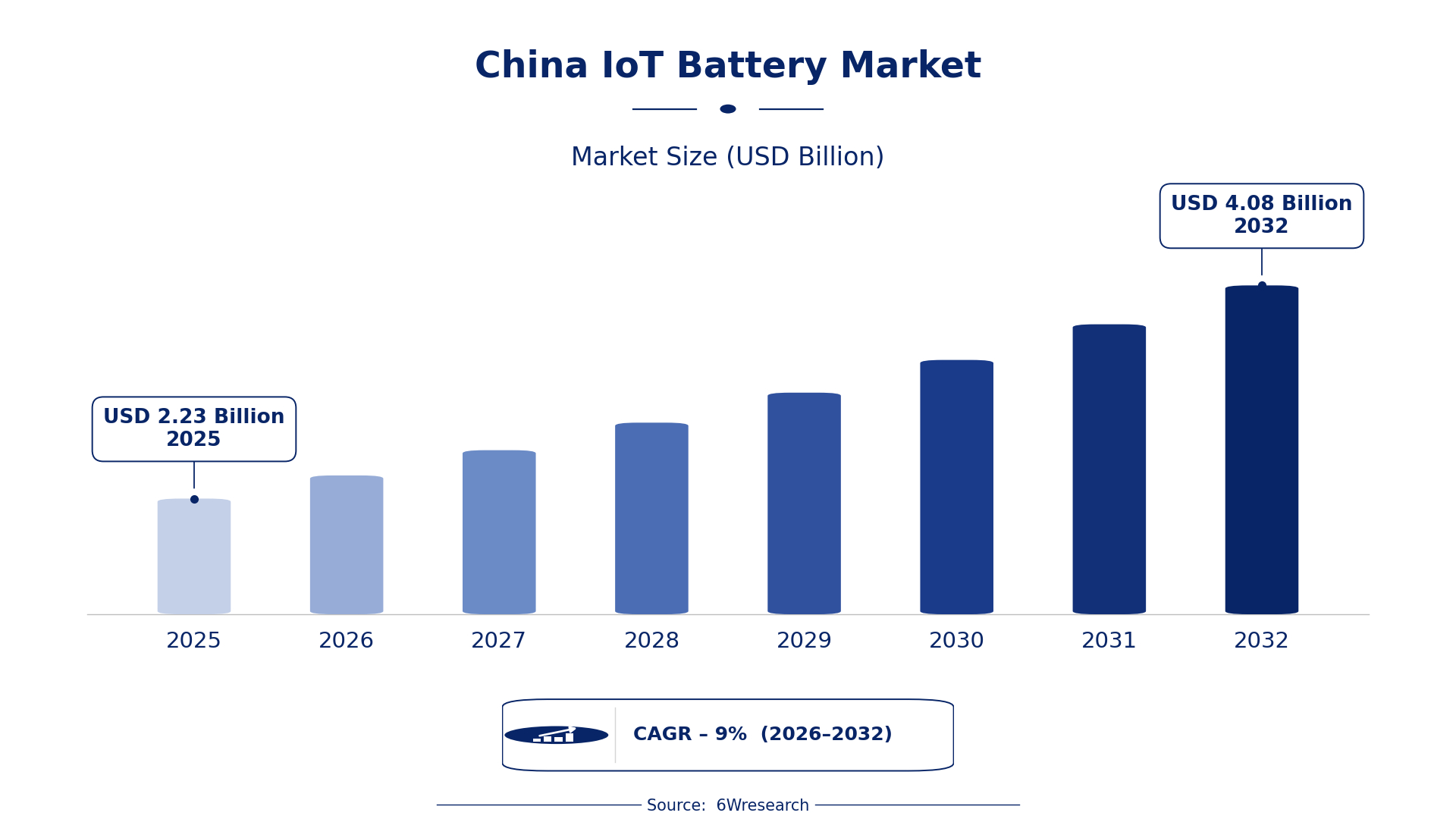
According to 6Wresearch internal database and industry insights, the China IoT Battery Market was valued at USD 2.23 billion in 2025 and is projected to reach USD 4.08 billion by 2032, growing at a CAGR of approximately 9% during 2026–2032.
China IoT Battery Market Highlights
| Report Metric | Details |
| Report Name | China IoT Battery Market |
| Market Size 2025 | USD 2.23 billion |
| Market Size 2032 | USD 4.08 billion |
| Absolute Growth 2025–2032 | USD 1.85 billion |
| CAGR 2026–2032 | 9% |
| Peak Annual Growth | 11.3% in 2031 |
| Forecast Period | 2026–2032 |
| Historical Data | 2022–2025 |
| Base Year | 2025 |
| Leading Battery Type, 2025 | Coin Cell (44% share) |
| Leading Chemistry, 2025 | Lithium-MnO2 (45% share) |
| Leading Application Area, 2025 | Wearables (45% share) |
| Leading Voltage Rating, 2025 | <3V (36% share) |
| Leading End User, 2025 | Consumer Electronics (37% share) |
| Fastest-Growing Battery Type | Thin Film (11.1% CAGR) |
| Fastest-Growing Chemistry | Lithium Polymer (11.8% CAGR) |
| Fastest-Growing Application Area | Smart Labels (11.8% CAGR) |
| Fastest-Growing Voltage Rating | 3–5V (11.2% CAGR) |
| Fastest-Growing End User | RFID Device Makers (11.0% CAGR) |
| Growing Sector | Smart Labels |
| Key End Users | Wearables, Smart Labels, Industrial Sensors, Medical Devices |
China IoT Battery Market Year-wise Growth Rate and Key Drivers (2022–2032)
This graph illustrates the annual growth rates of the market from 2022 to 2032, highlighting a steady upward trajectory and projected market expansion over the forecast period.
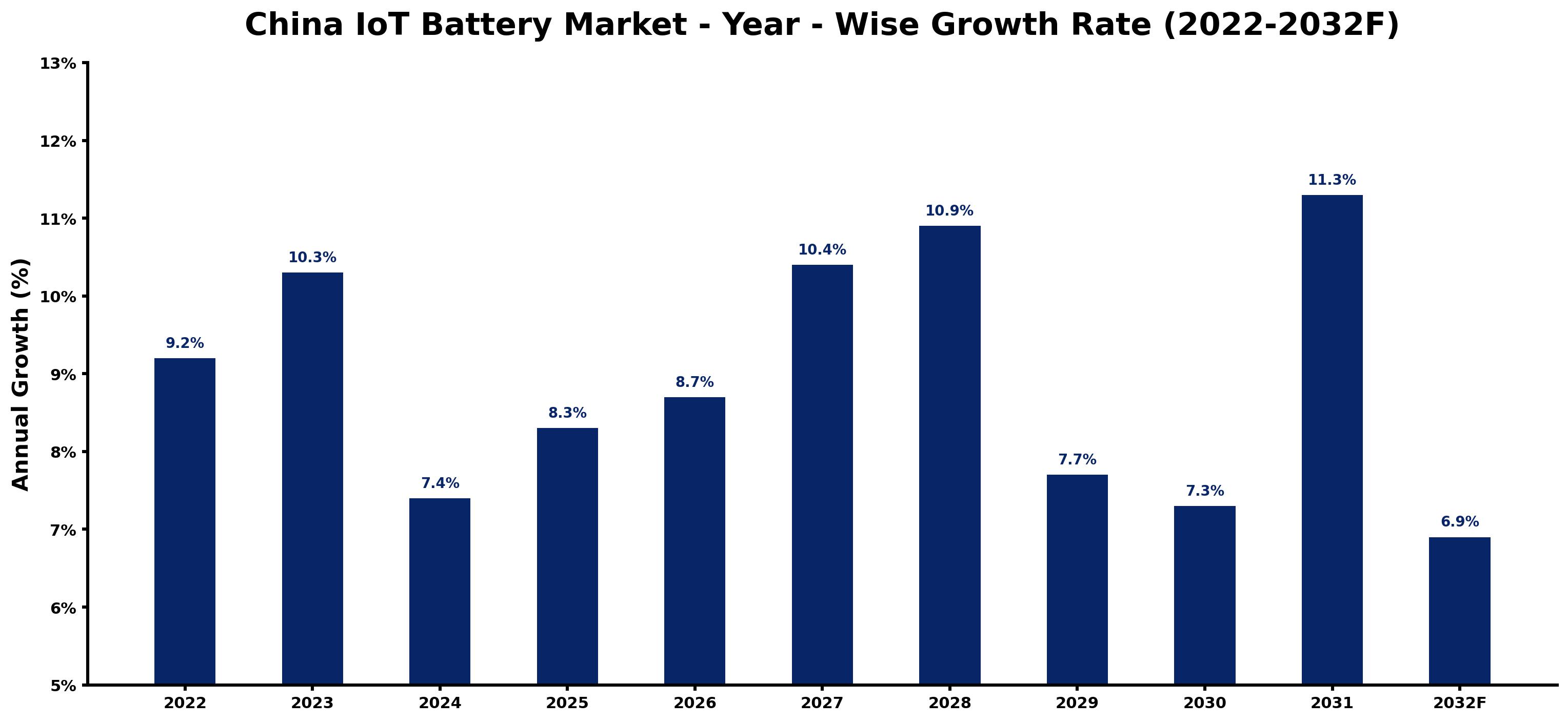
Year by year, the estimates below pair each growth rate with the development that shaped it.
| Year | Estimated Annual Growth (%) | Market Rationale |
| 2022 | 9.2 | The market saw strong demand from consumer electronics and wearables, reflecting established usage patterns. |
| 2023 | 10.3 | Growth accelerated due to increased production of lithium-ion batteries, driven by rising consumer electronics sales. |
| 2024 | 7.4 | The market experienced a slowdown as battery production faced temporary supply chain issues. |
| 2025 | 8.3 | Demand from the wearables sector surged, contributing to a rebound in growth rates. |
| 2026 | 8.7 | The expansion of the IIoT market is expected to stimulate further interest in IoT batteries, increasing demand. |
| 2027 | 10.4 | A growing focus on smart labels will drive increased purchases of thin film batteries, boosting growth. |
| 2028 | 10.9 | Wearables will continue to expand, sustaining high demand for IoT batteries across various applications. |
| 2029 | 7.7 | The market will experience a slowdown as competition intensifies among battery manufacturers. |
| 2030 | 7.3 | Demand growth will moderate as market saturation begins to affect new product introductions. |
| 2031 | 11.3 | The market will peak as innovations in battery technology spur significant new applications. |
| 2032 | 6.9 | Growth is projected to slow as the market stabilises following rapid technological advancements. |
Note: Market size estimations and growth projections presented in this report are based on 6Wresearch's proprietary forecasting methodology, utilizing the latest available industry data, government publications, and primary research inputs.
China IoT Battery Market Synopsis
The China IoT Battery Market includes energy storage devices tailored for Internet of Things applications. Primarily lithium-based, these batteries power a variety of devices such as wearables, smart labels, and industrial sensors. High demand from consumer electronics and the expanding IIoT sector drives the market, supported by initiatives like the 'Made in China 2025' programme. With over 2 billion lithium-ion batteries produced in 2022, the market is set for growth, projected to reach USD 4.08 billion by 2032.
Market Dynamics Impact Analysis (2026–2032)
| Factor | Type | Impact | Primary Segment Affected |
| Increased production capacity for lithium-ion batteries | Driver | High | Coin Cell |
| Rising demand for wearables and smart devices | Driver | High | Wearables |
| Emerging opportunities in smart labels | Opportunity | High | Smart Labels |
| Growing IIoT market requiring advanced battery solutions | Opportunity | High | Industrial Sensors |
| Competition leading to price pressures | Restraint | Medium | Consumer Electronics |
| Regulatory compliance challenges for battery safety standards | Restraint | High | Coin Cell |
| Technological advancements outpacing current manufacturing capabilities | Challenge | High | Rechargeable IoT Cells |
| Supply chain disruptions affecting battery materials | Challenge | Medium | Thin Film |
Evaluation of Drivers in China IoT Battery Market (2026–2032)
Below mentioned are some major drivers and their influence on market dynamics.
| Drivers | Primary Segment Affected | Why It Matters (Evidence) |
| Increased investment in lithium-ion battery production | Coin Cell | China produced over 2 billion lithium-ion batteries in 2022, boosting supply for various applications. |
| Growth in consumer electronics sales | Consumer Electronics | China's population of 1.4 billion drives high demand for consumer electronics, increasing battery purchases. |
| Expansion of the IIoT market | Industrial Sensors | The IIoT market in China is projected to grow to $300 billion by 2025, creating demand for IoT batteries. |
| Rising adoption of wearables | Wearables | The wearables market in China is anticipated to reach 300 million units by 2025, driving battery demand. |
| Technological advancements in battery chemistry | Lithium Polymer | Lithium Polymer batteries are preferred for lightweight designs, driving innovation and demand. |
Growth across the IoT Battery market in China is anchored in increased investment in lithium-ion battery production and the rising demand from consumer electronics. The production of over 2 billion lithium-ion batteries in 2022 supports the needs of various sectors. The IIoT market's anticipated growth to $300 billion by 2025 creates new opportunities for battery applications. A focus on smart labels will drive increased purchases of thin film batteries, further boosting growth. Innovations in battery chemistry, particularly lithium polymer, cater to the lightweight design preferences of modern devices.
Evaluation of Restraints in China IoT Battery Market
The key brakes on demand, and where they bite hardest, are shown below.
| Market Restraint | Primary Segment Affected | Why It Matters (Evidence) |
| Fluctuating raw material prices | Coin Cell | Raw material prices can inflate costs by up to 20%, disrupting budgets for manufacturers. |
| Skills shortages in battery technology | Rechargeable IoT Cells | Skills shortages in Zhejiang province cause delays in production timelines, extending lead times for suppliers. |
| High production costs due to stringent standards | Lithium-MnO2 | Stringent national standards can increase the price of IoT batteries by 15%, impacting affordability. |
| Intense competition among local manufacturers | Consumer Electronics | Competition pressures profit margins, compelling producers to lower prices and limiting investment in new technologies. |
| Supply chain issues affecting production | Thin Film | Temporary supply chain disruptions can lead to delays in battery availability for various applications. |
China IoT Battery Market Challenges
China's IoT battery market faces several challenges, starting with fluctuating raw material prices that can inflate costs by up to 20%, disrupting manufacturers' budgets. Skills shortages in battery technology persist, especially in Zhejiang province, causing delays in production timelines that can extend lead times by several weeks for suppliers. High production costs driven by stringent national standards like GB/T 18287-2020 can raise IoT battery prices by 15%, impacting affordability for end users. Intense competition among local manufacturers pressures profit margins, forcing producers to lower prices and restricting their ability to invest in new technologies.
Trends in the China IoT Battery Market
Below mentioned are some of the trends shaping the China IoT Battery Market growth.
- Shift towards Smart Labels: The adoption of smart labels is increasing, driven by the need for improved supply chain management. The smart labels market is projected to grow significantly, with a CAGR of 11.8% expected through 2026.
- Transition to Lightweight Batteries: There is a noticeable shift towards lightweight battery solutions, particularly lithium polymer, which are preferred in modern devices. This trend is supported by the growing demand for portable electronics, with a projected growth rate of 11.8%.
- Emergence of IIoT Applications: The IIoT sector is rapidly expanding, leading to increased demand for IoT batteries. By 2025, the IIoT market is expected to reach $300 billion, creating substantial opportunities for battery suppliers.
- Prioritisation of Battery Recycling: Battery recycling is becoming a priority as sustainability concerns rise. The 'Battery Recycling and Management Plan' initiated in 2022 aims to improve sustainability in battery production.
Investment Opportunities in the China IoT Battery Market
Below are the investment opportunities with the strongest case in the China IoT Battery Market.
- Partner with IIoT Integrators: Now is an ideal time to collaborate with IIoT integrators who require efficient energy storage solutions. The IIoT market is projected to grow significantly, creating substantial demand for IoT batteries.
- Invest in Smart Label Technologies: Investing in smart label technologies presents a timely opportunity as this segment is anticipated to grow rapidly. The Smart Wearable Device Industry Alliance supports this trend, encouraging innovation in battery applications.
- Focus on Lightweight Battery Designs: The demand for lightweight battery designs is increasing, particularly in consumer electronics. Collaborating with manufacturers in Zhejiang province can facilitate entry into this growing market.
- Engage in Battery Recycling Initiatives: Engaging in battery recycling initiatives is essential as sustainability becomes a focal point. The 'Battery Recycling and Management Plan' aims to improve recycling efforts, benefiting producers and consumers.
Government Initiatives in the China IoT Battery Market
In 2023, the State Administration for Market Regulation updated the 'Standard for Lithium-ion Battery Safety' to improve consumer protection. This measure builds on previous regulations and mandates stricter safety testing and reporting for lithium-ion batteries, ensuring higher standards for producers and better protection for consumers. The 'Battery Recycling and Management Plan', initiated by the National Development and Reform Commission in 2022, aims to enhance sustainability in battery production. This plan provides guidelines for recycling practices and encourages manufacturers to adopt environmentally friendly processes.
The Ministry of Industry and Information Technology's 'New Energy Vehicle Industry Development Plan' launched in 2021 promotes advanced battery technologies. This initiative supports the development of new battery technologies, enabling producers to innovate and meet evolving market demands. Additionally, the National Energy Administration oversees battery production standards, ensuring compliance with safety and quality regulations.
Future Insight of the China IoT Battery Market
By 2032, buyers and suppliers in the China IoT battery market can expect transformative changes driven by the 'Made in China 2025' initiative aimed at enhancing battery technology. The total installed base of IoT devices in China is estimated at 1 billion by 2023, creating substantial demand for IoT batteries. Growth in the IIoT sector will stimulate the need for efficient energy storage solutions, while increased government support for battery recycling programs will promote sustainability among producers. These factors will cultivate a more competitive and innovative market environment.
Market Segmentation Analysis
The analysis below covers each segmentation, its leading category in 2025 and its fastest-growing category through 2032.
By Battery Type – Coin Cell Dominated, Thin Film Expected to Grow Fastest
According to Shubham Deep, Research Manager at 6Wresearch, with a 44% revenue share in 2025, Coin Cell was the largest battery type category. Coin Cell batteries dominate the market share as they are widely used in compact devices like wearables, which are increasingly popular among consumers. Their compact size and efficiency align with the growing demand for portable electronics, especially in urban regions of China. Thin Film is set to record the highest CAGR in this split, 11.1% over 2026–2032. Thin Film batteries are experiencing rapid growth due to their application in ultra-thin products such as smart labels, which are becoming more prevalent in various industries. The surge in IoT technology adoption in everyday items is significantly boosting this segment's expansion. Suppliers should focus on developing Thin Film battery technologies to capture the emerging market opportunities.
By Chemistry – Lithium-MnO2 Dominated, Lithium Polymer Expected to Grow Fastest
Lithium-MnO2 held a 45% share of the China IoT Battery Market by chemistry in 2025. Lithium-MnO2 chemistry holds the largest market share, primarily due to its widespread use in non-rechargeable applications, making it a preferred choice for numerous IoT devices. Its consistent performance and reliability across various conditions reinforce its leading status in the market. Lithium Polymer is projected to grow fastest, at a CAGR of 11.8% during 2026–2032. Lithium Polymer chemistry is rapidly gaining popularity, driven by its lightweight and flexible characteristics that are essential for modern applications. The increasing demand for adaptable battery solutions in consumer electronics is propelling this segment's swift growth. Buyers should consider Lithium Polymer options to meet the rising demand for lightweight and versatile energy solutions.
By Application Area – Wearables Dominated, Smart Labels Expected to Grow Fastest
In 2025, Wearables led the application area split with a 45% share. Wearables are the leading application area for IoT batteries, driven by the growing popularity of fitness trackers and smartwatches among consumers. This segment's growth is further supported by the expanding installed base of IoT devices in China, enhancing consumer engagement. The quickest growth will come from Smart Labels, forecast to expand at a CAGR of 11.8% between 2026 and 2032. Smart Labels are emerging as the fastest-growing application area, utilising IoT technology to enhance product tracking and inventory management. The integration of smart technology in retail and logistics is significantly driving this segment's rapid growth. Suppliers should invest in battery solutions tailored for Smart Labels to capitalise on this expanding market trend.
By Voltage Rating – <3V Dominated, 3–5V Expected to Grow Fastest
<3V accounted for a 36% market share by voltage rating in 2025. The <3V voltage rating is prevalent in many IoT devices, establishing it as the leading segment in the market due to its compatibility with a wide range of applications. This low voltage requirement meets the needs of compact and efficient devices, making it a preferred choice. Over 2026–2032, 3–5V is expected to post the fastest growth, at a CAGR of 11.2%. The 3–5V voltage rating is witnessing rapid growth as it becomes increasingly utilised in various consumer electronics applications, reflecting a shift towards more powerful devices. This trend is driven by the demand for enhanced performance in everyday electronics. Manufacturers should align their products with the 3–5V segment to remain competitive in the evolving market.
By End User – Consumer Electronics Dominated, RFID Device Makers Expected to Grow Fastest
The largest end user category in 2025 was Consumer Electronics, with a 37% share of total revenue. Consumer Electronics is the leading end-user segment for IoT batteries, primarily due to the substantial demand for smart devices among China's large population. Continuous advancements in consumer technology fuel this segment's growth, making it a crucial area for suppliers. RFID Device Makers are set to record the highest CAGR in this split, 11.0% over 2026–2032. RFID Device Makers are the fastest-growing end-user group, increasingly relying on IoT batteries for active RFID applications. The rise in logistics and inventory management solutions is significantly driving this segment's rapid expansion. Suppliers must address the specific needs of RFID Device Makers to leverage the growth potential in this sector.
Key Attractiveness of the Report
- 10 Years of Market Numbers
- Historical Data Starting from 2022 to 2025
- Base Year 2025
- Forecast Data until 2032
- Key Performance Indicators Impacting the Market
- Major Upcoming Developments and Projects
Key Highlights of the Report:
- China IoT Battery Market Outlook
- Market Size of China IoT Battery Market, 2025
- Forecast of China IoT Battery Market, 2032
- Historical Data and Forecast of China IoT Battery Revenues & Volume for the Period 2022 - 2032F
- China IoT Battery Market Trend Evolution
- China IoT Battery Market Drivers and Challenges
- China IoT Battery Price Trends
- China IoT Battery Porter's Five Forces
- China IoT Battery Industry Life Cycle
- Historical Data and Forecast of China IoT Battery Market Revenues & Volume By Battery Type for the Period 2022 - 2032F
- Historical Data and Forecast of China IoT Battery Market Revenues & Volume By Coin Cell for the Period 2022 - 2032F
- Historical Data and Forecast of China IoT Battery Market Revenues & Volume By Thin Film for the Period 2022 - 2032F
- Historical Data and Forecast of China IoT Battery Market Revenues & Volume By Rechargeable IoT Cells for the Period 2022 - 2032F
- Historical Data and Forecast of China IoT Battery Market Revenues & Volume By Zinc-Air for the Period 2022 - 2032F
- Historical Data and Forecast of China IoT Battery Market Revenues & Volume By Chemistry for the Period 2022 - 2032F
- Historical Data and Forecast of China IoT Battery Market Revenues & Volume By Lithium-MnO2 for the Period 2022 - 2032F
- Historical Data and Forecast of China IoT Battery Market Revenues & Volume By Lithium Polymer for the Period 2022 - 2032F
- Historical Data and Forecast of China IoT Battery Market Revenues & Volume By Li-Ion for the Period 2022 - 2032F
- Historical Data and Forecast of China IoT Battery Market Revenues & Volume By Primary Non-Rechargeable for the Period 2022 - 2032F
- Historical Data and Forecast of China IoT Battery Market Revenues & Volume By Application Area for the Period 2022 - 2032F
- Historical Data and Forecast of China IoT Battery Market Revenues & Volume By Wearables for the Period 2022 - 2032F
- Historical Data and Forecast of China IoT Battery Market Revenues & Volume By Smart Labels for the Period 2022 - 2032F
- Historical Data and Forecast of China IoT Battery Market Revenues & Volume By Industrial Sensors for the Period 2022 - 2032F
- Historical Data and Forecast of China IoT Battery Market Revenues & Volume By Medical Devices for the Period 2022 - 2032F
- Historical Data and Forecast of China IoT Battery Market Revenues & Volume By Voltage Rating for the Period 2022 - 2032F
- Historical Data and Forecast of China IoT Battery Market Revenues & Volume By 3V for the Period 2022 - 2032F
- Historical Data and Forecast of China IoT Battery Market Revenues & Volume By 3 5V for the Period 2022 - 2032F
- Historical Data and Forecast of China IoT Battery Market Revenues & Volume By 5 12V for the Period 2022 - 2032F
- Historical Data and Forecast of China IoT Battery Market Revenues & Volume By Low-Drain for the Period 2022 - 2032F
- Historical Data and Forecast of China IoT Battery Market Revenues & Volume By End User for the Period 2022 - 2032F
- Historical Data and Forecast of China IoT Battery Market Revenues & Volume By Consumer Electronics for the Period 2022 - 2032F
- Historical Data and Forecast of China IoT Battery Market Revenues & Volume By RFID Device Makers for the Period 2022 - 2032F
- Historical Data and Forecast of China IoT Battery Market Revenues & Volume By IIoT Integrators for the Period 2022 - 2032F
- Historical Data and Forecast of China IoT Battery Market Revenues & Volume By MedTech OEMs for the Period 2022 - 2032F
- China IoT Battery Import Export Trade Statistics
- Market Opportunity Assessment By Battery Type
- Market Opportunity Assessment By Chemistry
- Market Opportunity Assessment By Application Area
- Market Opportunity Assessment By Voltage Rating
- Market Opportunity Assessment By End User
- China IoT Battery Top Companies Market Share
- China IoT Battery Competitive Benchmarking By Technical and Operational Parameters
- China IoT Battery Company Profiles
- China IoT Battery Key Strategic Recommendations
Market Covered
This report examines the market across the segments below.
By Battery Type
- Coin Cell
- Thin Film
- Rechargeable IoT Cells
- Zinc-Air
By Chemistry
- Lithium-MnO2
- Lithium Polymer
- Li-Ion
- Primary Non-Rechargeable
By Application Area
- Wearables
- Smart Labels
- Industrial Sensors
- Medical Devices
By Voltage Rating
- <3V
- 3–5V
- 5–12V
- Low-Drain
By End User
- Consumer Electronics
- RFID Device Makers
- IIoT Integrators
- MedTech OEMs































