China IoT Communication Market Size & Growth Rate
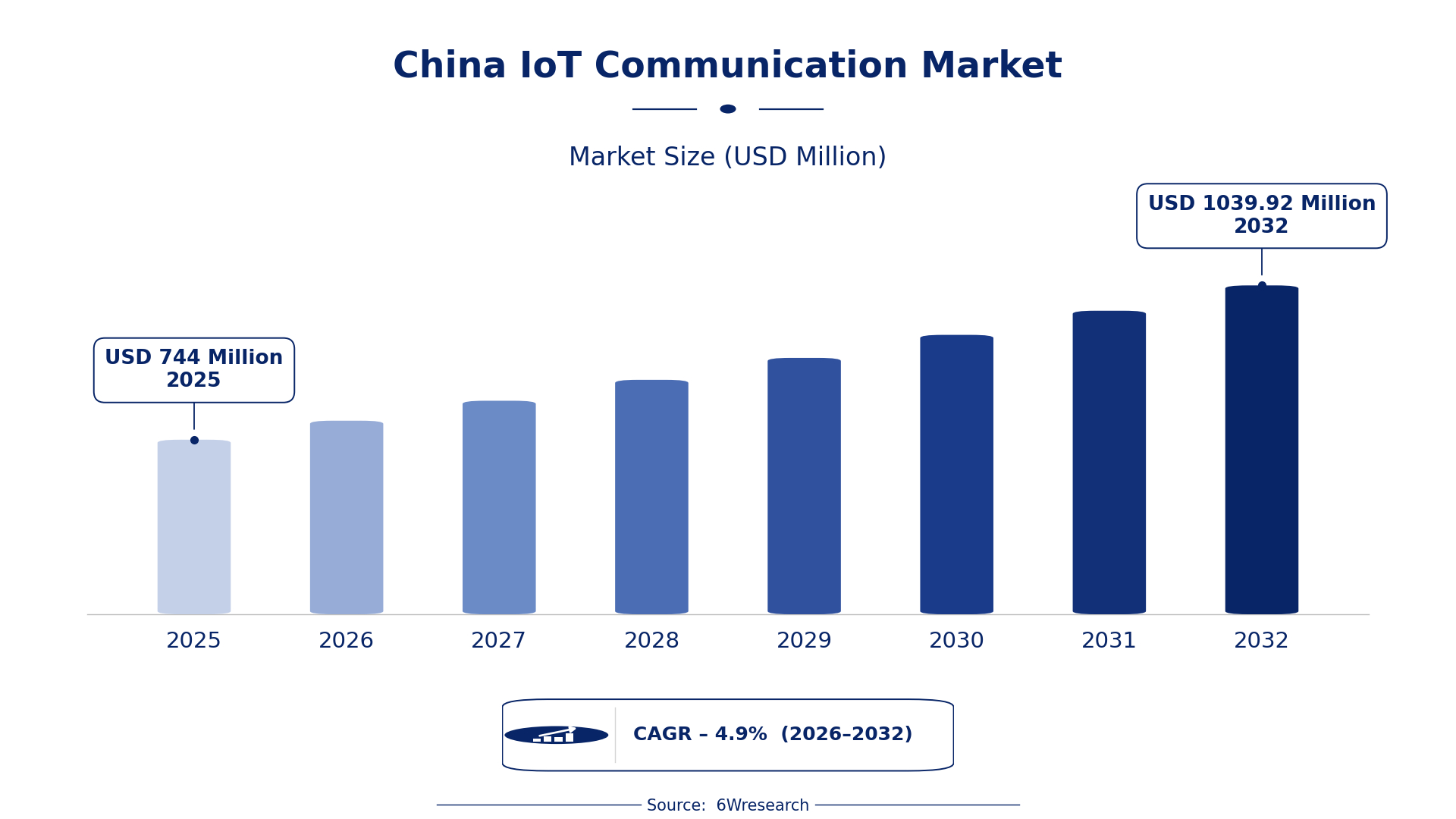
According to 6Wresearch internal database and industry insights, the China IoT Communication Market was valued at USD 744.0 million in 2025 and is projected to reach USD 1,039.92 million by 2032, growing at a CAGR of approximately 4.9% during 2026–2032.
China IoT Communication Market Highlights
| Report Metric | Details |
| Report Name | China IoT Communication Market |
| Market Size 2025 | USD 744.0 million |
| Market Size 2032 | USD 1,039.92 million |
| Absolute Growth 2025–2032 | USD 295.92 million |
| CAGR 2026–2032 | 4.9% |
| Peak Annual Growth | 7.9% in 2032 |
| Forecast Period | 2026–2032 |
| Historical Data | 2022–2025 |
| Base Year | 2025 |
| Leading Communication Protocol, 2025 | MQTT (49% share) |
| Leading Network Type, 2025 | 5G (45% share) |
| Leading Application Scope, 2025 | Home Automation (36% share) |
| Leading Bandwidth Requirement, 2025 | High (55% share) |
| Leading End User, 2025 | Smart Home Companies (34% share) |
| Fastest-Growing Communication Protocol | LWM2M (5.9% CAGR) |
| Fastest-Growing Network Type | NB-IoT (6.7% CAGR) |
| Fastest-Growing Application Scope | Agriculture (7.6% CAGR) |
| Fastest-Growing Bandwidth Requirement | Ultra Low (6.4% CAGR) |
| Fastest-Growing End User | AgriTech Providers (6.0% CAGR) |
| Growing Sector | Smart Home Automation |
| Key End Users | Smart Home Companies, Utility Companies, AgriTech Providers |
China IoT Communication Market Year-wise Growth Rate and Key Drivers (2022–2032)
This graph illustrates the annual growth rates of the market from 2022 to 2032, highlighting a steady upward trajectory and projected market expansion over the forecast period.
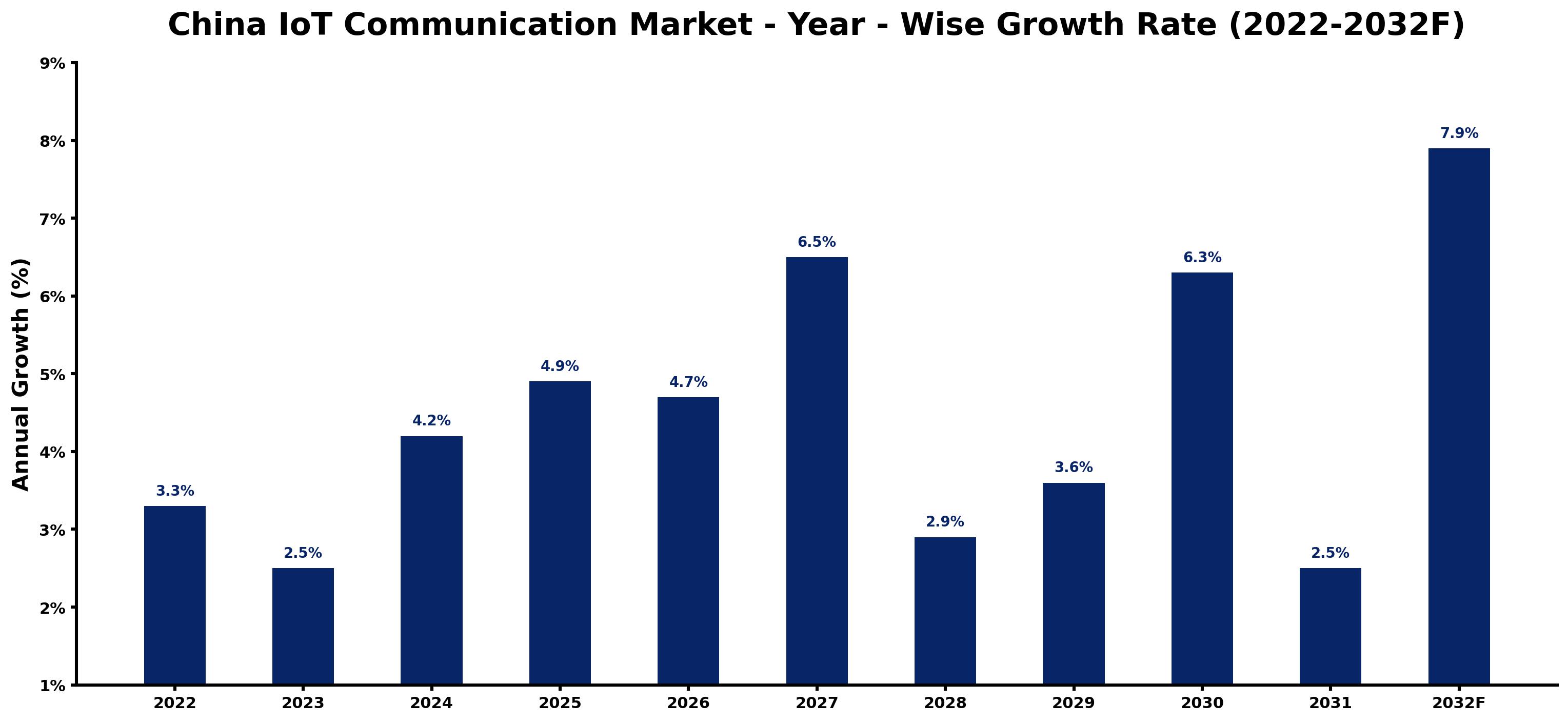
The following table presents the estimated annual growth rate for each year together with the principal factor influencing market performance.
| Year | Estimated Annual Growth (%) | Market Rationale |
| 2022 | 3.3 | The market experienced steady growth, driven by increasing adoption of smart home devices. |
| 2023 | 2.5 | Growth slowed slightly as the 'IoT Development Action Plan' was implemented, focusing on infrastructure improvements. |
| 2024 | 4.2 | The market rebounded with faster growth due to rising demand for agriculture monitoring solutions, supported by the agricultural IoT market expansion. |
| 2025 | 4.9 | Market growth peaked as smart home device adoption surged, reaching high demand levels, particularly in urban areas. |
| 2026 | 4.7 | Growth slowed again as the market began to normalise after rapid expansion in previous years, influenced by regulatory adjustments. |
| 2027 | 6.5 | A faster growth rate emerged, driven by increased investments in smart grid technologies by utility companies. |
| 2028 | 2.9 | Growth slowed once more as the market adjusted to previous rapid expansions in demand, particularly in the smart utilities sector. |
| 2029 | 3.6 | The market saw a rebound in growth due to renewed interest in smart utility solutions, particularly in urban management. |
| 2030 | 6.3 | Growth accelerated again, supported by advancements in 5G technology and its applications in various sectors. |
| 2031 | 2.5 | The market experienced a slowdown as it stabilised after several years of rapid growth, particularly in the smart home segment. |
| 2032 | 7.9 | A faster growth rate is anticipated as the market responds to increasing IoT innovations, particularly in agriculture. |
Note: Market size estimations and growth projections presented in this report are based on 6Wresearch's proprietary forecasting methodology, utilizing the latest available industry data, government publications, and primary research inputs.
China IoT Communication Market Synopsis
IoT Communication in China encompasses technologies that enable devices to connect and communicate over the internet. This includes a range of communication protocols and network types, such as 5G and LPWAN, primarily utilised in smart home automation, agriculture monitoring, and utility management. The China IoT Communication Market is set to reach 1 trillion yuan by 2025, propelled by the swift adoption of smart home devices and substantial investments in IoT infrastructure. By 2023, the number of smart home devices is anticipated to surpass 500 million, reflecting increasing domestic demand and advancements in technology within the sector.
Market Dynamics Impact Analysis (2026–2032)
| Factor | Type | Impact | Primary Segment Affected |
| Increasing adoption of 5G technology enhances connectivity for IoT devices. | Driver | High | 5G |
| Growing demand for smart home automation solutions drives market expansion. | Driver | High | Home Automation |
| High demand for agricultural IoT solutions presents investment opportunities. | Opportunity | High | Agriculture |
| Rising investments in smart grid technologies create new market avenues. | Opportunity | High | Smart Utilities |
| Limited interoperability standards may hinder market growth. | Restraint | Medium | MQTT |
| Slow regulatory approvals for new IoT technologies can delay market entry. | Restraint | Medium | Low |
| Competition among IoT providers can lead to pricing pressures. | Challenge | Medium | MQTT |
| Technological complexities in integrating IoT solutions pose challenges for adoption. | Challenge | Medium | MQTT |
Evaluation of Drivers in China IoT Communication Market (2026–2032)
Below mentioned are some major drivers and their influence on market dynamics.
| Drivers | Primary Segment Affected | Why It Matters (Evidence) |
| Rapid deployment of 5G networks facilitates high-speed communication. | 5G | 5G networks are being deployed in over 300 cities across China, enhancing connectivity for IoT devices. |
| Increased smart home device adoption fuels demand for IoT solutions. | Home Automation | The number of smart home devices in China is expected to exceed 500 million by 2023, driving market growth. |
| Investment in agricultural IoT solutions supports precision farming. | Agriculture | China's agricultural IoT market is expected to grow to 100 billion yuan by 2025, boosting demand. |
| Utility companies are investing in smart grid technologies to improve efficiency. | Smart Utilities | Over 70% of utility companies in China are investing in smart grid technologies, enhancing operational capabilities. |
| The rise of LPWAN technologies enables long-range IoT applications. | LPWAN (LoRa/Sigfox) | LPWAN technologies are being adopted in over 50 cities for smart applications, expanding market reach. |
Expansion of the IoT Communication market in China is driven by rising end-use demand, enhanced connectivity, and growing investments in technology. The rapid rollout of 5G networks across more than 300 cities accelerates communication speeds, aiding IoT device integration. The increasing adoption of smart home devices, expected to exceed 500 million by 2023, fuels market demand. The agricultural IoT market is forecasted to reach 100 billion yuan by 2025, supporting precision farming efforts. Utility companies are heavily investing in smart grid technologies, with over 70% allocating resources to improve operational capabilities.
Evaluation of Restraints in China IoT Communication Market
The table below lists the restraints and the evidence behind each.
| Market Restraint | Primary Segment Affected | Why It Matters (Evidence) |
| Limited interoperability standards can restrict market growth. | MQTT | The lack of unified standards may lead to compatibility issues, affecting device integration and limiting market participation. |
| Slow regulatory approvals for new IoT technologies can delay market entry. | Low | Prolonged approval processes hinder timely deployment of new solutions in the market, affecting producers' ability to innovate. |
| High initial investment costs may deter new entrants in the market. | High | The financial burden of developing IoT infrastructure can limit participation from smaller firms, reducing competition. |
| Technological complexities in integrating IoT solutions pose challenges for adoption. | MQTT | Complex integration processes can lead to increased costs and longer deployment times, affecting buyer satisfaction. |
| Market competition can lead to pricing pressures among providers. | Low | Intense competition may force providers to lower prices, impacting profitability and sustainability. |
China IoT Communication Market Challenges
The China IoT Communication market still has to solve a few problems, and the first is technology integration costs, which can reach up to 20% of project budgets for producers. Many IoT devices lack compatibility with existing systems, leading to deployment delays that can extend timelines for buyers by several months. Skills shortages are also a concern, as over 60% of companies report difficulty finding qualified personnel, which can delay project completion for producers. Regulatory hurdles persist, with compliance to the National IoT Standards System potentially adding six months to the approval process for buyers, hindering timely market entry.
Trends in the China IoT Communication Market
Below mentioned are some of the trends shaping the China IoT Communication Market growth.
- Integration of IoT in Urban Management: China is increasingly incorporating IoT technologies into urban management through smart city initiatives. The 'Smart City Initiative' aims to enhance urban infrastructure by 2025, with considerable investments anticipated in IoT applications that improve service delivery.
- Precision Farming through Agricultural IoT: The agricultural sector is swiftly adopting IoT solutions for precision farming. China's agricultural IoT market is projected to reach 100 billion yuan by 2025, driven by the demand for efficient resource management in agriculture.
- Surge in NB-IoT Connections: The installed base of NB-IoT connections in China is expected to reach 1 billion by 2025. This growth indicates the rising demand for low-power, wide-area connectivity for various IoT applications.
- Adoption of LPWAN Technologies: LPWAN technologies are being embraced in over 50 cities for smart applications. This trend supports long-range, low-power IoT deployments, enhancing connectivity in both urban and rural settings.
Investment Opportunities in the China IoT Communication Market
Several openings in the China IoT Communication Market merit attention from investors.
- Investment in Smart Home Automation: With over 500 million smart home devices anticipated by 2023, investment in smart home automation solutions is timely. Collaborating with smart home companies can facilitate market entry and growth in this expanding sector.
- Focus on Agricultural IoT Solutions: The agricultural IoT market, projected to reach 100 billion yuan by 2025, presents a substantial opportunity. Engaging with AgriTech providers can improve access to this growing sector and stimulate innovation.
- Development of Smart Grid Technologies: The ongoing investments by utility companies in smart grid technologies create avenues for new solutions. Partnering with utility companies can provide entry points into this expanding market, enhancing operational improvements.
- Adoption of LPWAN Technologies: The adoption of LPWAN technologies in over 50 cities reveals a gap for new solutions. Suppliers can enter by offering tailored IoT applications designed for low-power, long-range connectivity.
Government Initiatives in the China IoT Communication Market
The 'Smart City Development Strategy' launched by the State Council in 2020 promotes the integration of IoT in urban planning and management. This initiative aims to improve infrastructure and service delivery across cities. Additionally, the 'National IoT Industry Development Fund' established in 2020 supports startups and innovations in the IoT sector with an initial budget of 10 billion yuan. These measures create a conducive environment for IoT development and encourage investment in new technologies.
The 'IoT Development Action Plan' by the Ministry of Industry and Information Technology, 2021, aims to improve IoT infrastructure and innovation with a target investment of 300 billion yuan by 2025. The National Standardization Administration issued the 'IoT Standardization Framework' in 2022 to guide IoT technology development and interoperability. These frameworks ensure that IoT solutions meet necessary standards, facilitating smoother market entry for new products and benefiting both producers and buyers.
Future Insight of the China IoT Communication Market
The China IoT Communication market is set for robust growth by 2032, driven by the rollout of smart grid technologies and the Smart City Initiative. The installed base of NB-IoT connections is projected to reach 1 billion by 2025, enhancing connectivity for various applications. Increased funding from the National Development and Reform Commission will stimulate innovation in IoT technologies. The Ministry of Industry and Information Technology's IoT Development Action Plan will streamline standards, creating a more efficient environment for both buyers and suppliers.
Market Segmentation Analysis
The analysis below covers each segmentation, its leading category in 2025 and its fastest-growing category through 2032.
By Communication Protocol – MQTT Dominated, LWM2M Expected to Grow Fastest
According to Shubham Deep, Research Manager at 6Wresearch, MQTT took a 49% share of communication protocol in 2025, more than any other category. MQTT holds the largest share in China's IoT Communication Market due to its widespread use for lightweight messaging in various IoT applications. Its efficiency in managing multiple devices makes it a preferred choice for developers focusing on smart home automation. LWM2M is set to record the highest CAGR in this split, 5.9% over 2026–2032. LWM2M is poised for rapid growth as it plays a crucial role in device management, particularly with the expected rise of smart home devices exceeding 500 million by 2023. This segment's expansion highlights the increasing need for effective management of interconnected devices in consumer settings. Suppliers should focus on enhancing MQTT capabilities while also considering LWM2M to meet the growing demand for robust device management solutions.
By Network Type – 5G Dominated, NB-IoT Expected to Grow Fastest
5G accounted for a 45% market share by network type in 2025. 5G commands the largest market share as it enables high-speed communication essential for advanced IoT applications like smart home automation and utility management. The deployment of 5G networks across over 300 cities in China reinforces its leading status in the market. Over 2026–2032, NB-IoT is expected to post the fastest growth, at a CAGR of 6.7%. NB-IoT is set to grow the fastest, primarily due to its optimisation for low-power, wide-area connectivity, which is crucial for applications in agriculture and smart cities. The projected increase to 1 billion NB-IoT connections by 2025 highlights its rising significance in the IoT sector. Buyers should prioritise 5G for high-speed applications while also considering NB-IoT for efficient, low-power connectivity solutions.
By Application Scope – Home Automation Dominated, Agriculture Expected to Grow Fastest
In 2025, Home Automation led the application scope split with a 36% share. Home Automation holds the largest market share due to the increasing adoption of smart home devices, which are becoming essential for modern living. This trend is supported by the government's initiatives to promote IoT technologies in urban settings. Agriculture is projected to grow fastest, at a CAGR of 7.6% during 2026–2032. Agriculture is the fastest-growing application scope, as IoT technologies are increasingly utilised for precision farming and resource management, aligning with the projected growth of China's agricultural IoT market to 100 billion yuan by 2025. Suppliers must innovate in home automation solutions while also developing tailored offerings for the rapidly expanding agricultural sector.
By Bandwidth Requirement – High Dominated, Ultra Low Expected to Grow Fastest
High held a 55% share of the China IoT Communication Market by bandwidth requirement in 2025. High bandwidth requirements dominate the market share as many IoT applications demand substantial data throughput for functionalities like video streaming and real-time monitoring. This trend is particularly pronounced in sectors such as smart home automation, where high data rates are essential. The quickest growth will come from Ultra Low, forecast to expand at a CAGR of 6.4% between 2026 and 2032. Ultra Low bandwidth is rapidly gaining traction, driven by the need for battery-operated IoT devices that require minimal power consumption. This growth aligns with the increasing emphasis on energy-efficient solutions across various applications. Suppliers must ensure their offerings can meet both high and ultra-low bandwidth requirements to satisfy diverse customer needs.
By End User – Smart Home Companies Dominated, AgriTech Providers Expected to Grow Fastest
With a 34% revenue share in 2025, Smart Home Companies was the largest end user category. Smart Home Companies lead the market share as key players in the consumer IoT sector, capitalising on the growing demand for connected devices and home automation solutions. Their significant investments in IoT technologies drive market growth, solidifying their dominant position. AgriTech Providers are set to record the highest CAGR in this split, 6.0% over 2026–2032. AgriTech Providers are the fastest-growing end-user segment, concentrating on integrating IoT solutions to improve agricultural productivity and resource management. This growth is supported by increasing investments in agricultural IoT technologies, showcasing the sector's potential. Suppliers should strengthen partnerships with smart home companies while also exploring opportunities within the AgriTech sector to maximise their market presence.
Key Attractiveness of the Report
- 10 Years of Market Numbers
- Historical Data Starting from 2022 to 2025
- Base Year 2025
- Forecast Data until 2032
- Key Performance Indicators Impacting the Market
- Major Upcoming Developments and Projects
Key Highlights of the Report:
- China IoT Communication Market Outlook
- Market Size of China IoT Communication Market, 2025
- Forecast of China IoT Communication Market, 2032
- Historical Data and Forecast of China IoT Communication Revenues & Volume for the Period 2022 - 2032F
- China IoT Communication Market Trend Evolution
- China IoT Communication Market Drivers and Challenges
- China IoT Communication Price Trends
- China IoT Communication Porter's Five Forces
- China IoT Communication Industry Life Cycle
- Historical Data and Forecast of China IoT Communication Market Revenues & Volume By Communication Protocol for the Period 2022 - 2032F
- Historical Data and Forecast of China IoT Communication Market Revenues & Volume By MQTT for the Period 2022 - 2032F
- Historical Data and Forecast of China IoT Communication Market Revenues & Volume By CoAP for the Period 2022 - 2032F
- Historical Data and Forecast of China IoT Communication Market Revenues & Volume By DDS for the Period 2022 - 2032F
- Historical Data and Forecast of China IoT Communication Market Revenues & Volume By LWM2M for the Period 2022 - 2032F
- Historical Data and Forecast of China IoT Communication Market Revenues & Volume By Network Type for the Period 2022 - 2032F
- Historical Data and Forecast of China IoT Communication Market Revenues & Volume By Wi-Fi/Cellular for the Period 2022 - 2032F
- Historical Data and Forecast of China IoT Communication Market Revenues & Volume By LPWAN (LoRa/Sigfox) for the Period 2022 - 2032F
- Historical Data and Forecast of China IoT Communication Market Revenues & Volume By 5G for the Period 2022 - 2032F
- Historical Data and Forecast of China IoT Communication Market Revenues & Volume By NB-IoT for the Period 2022 - 2032F
- Historical Data and Forecast of China IoT Communication Market Revenues & Volume By Application Scope for the Period 2022 - 2032F
- Historical Data and Forecast of China IoT Communication Market Revenues & Volume By Home Automation for the Period 2022 - 2032F
- Historical Data and Forecast of China IoT Communication Market Revenues & Volume By Agriculture for the Period 2022 - 2032F
- Historical Data and Forecast of China IoT Communication Market Revenues & Volume By Autonomous Vehicles for the Period 2022 - 2032F
- Historical Data and Forecast of China IoT Communication Market Revenues & Volume By Smart Utilities for the Period 2022 - 2032F
- Historical Data and Forecast of China IoT Communication Market Revenues & Volume By Bandwidth Requirement for the Period 2022 - 2032F
- Historical Data and Forecast of China IoT Communication Market Revenues & Volume By Low for the Period 2022 - 2032F
- Historical Data and Forecast of China IoT Communication Market Revenues & Volume By Ultra Low for the Period 2022 - 2032F
- Historical Data and Forecast of China IoT Communication Market Revenues & Volume By High for the Period 2022 - 2032F
- Historical Data and Forecast of China IoT Communication Market Revenues & Volume By Low for the Period 2022 - 2032F
- Historical Data and Forecast of China IoT Communication Market Revenues & Volume By End User for the Period 2022 - 2032F
- Historical Data and Forecast of China IoT Communication Market Revenues & Volume By Smart Home Companies for the Period 2022 - 2032F
- Historical Data and Forecast of China IoT Communication Market Revenues & Volume By AgriTech Providers for the Period 2022 - 2032F
- Historical Data and Forecast of China IoT Communication Market Revenues & Volume By Automotive OEMs for the Period 2022 - 2032F
- Historical Data and Forecast of China IoT Communication Market Revenues & Volume By Utility Companies for the Period 2022 - 2032F
- China IoT Communication Import Export Trade Statistics
- Market Opportunity Assessment By Communication Protocol
- Market Opportunity Assessment By Network Type
- Market Opportunity Assessment By Application Scope
- Market Opportunity Assessment By Bandwidth Requirement
- Market Opportunity Assessment By End User
- China IoT Communication Top Companies Market Share
- China IoT Communication Competitive Benchmarking By Technical and Operational Parameters
- China IoT Communication Company Profiles
- China IoT Communication Key Strategic Recommendations
Market Covered
Segments analysed in this report are listed below.
By Communication Protocol
- MQTT
- CoAP
- DDS
- LWM2M
By Network Type
- Wi-Fi/Cellular
- LPWAN (LoRa/Sigfox)
- 5G
- NB-IoT
By Application Scope
- Home Automation
- Agriculture
- Autonomous Vehicles
- Smart Utilities
By Bandwidth Requirement
- Low
- Ultra Low
- High
By End User
- Smart Home Companies
- AgriTech Providers
- Automotive OEMs
- Utility Companies































