China IoT-Enabled Appliances Market Size & Growth Rate
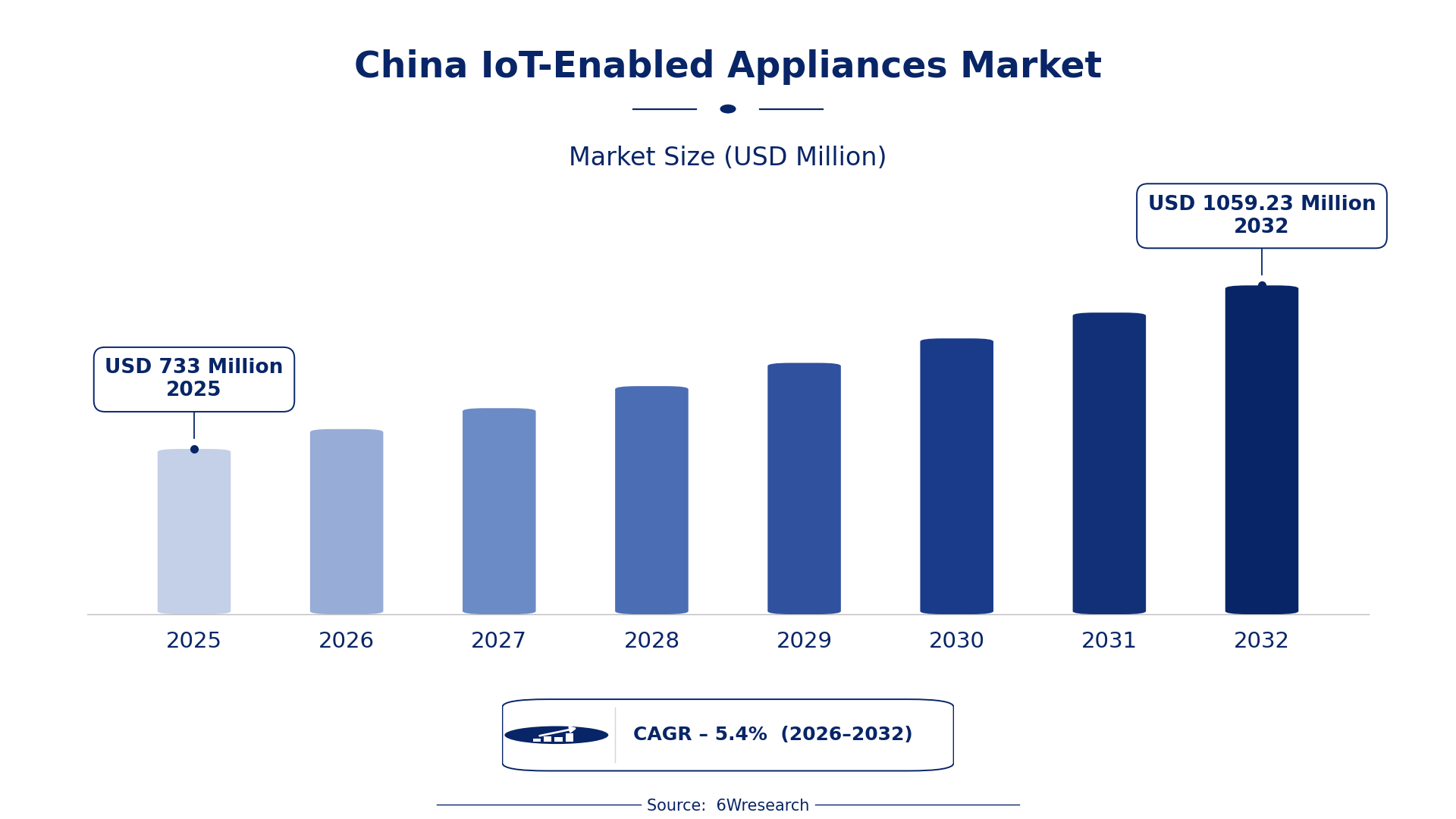
According to 6Wresearch internal database and industry insights, the China IoT-Enabled Appliances Market was valued at USD 733.0 million in 2025 and is projected to reach USD 1,059.23 million by 2032, growing at a CAGR of approximately 5.4% during 2026–2032.
China IoT-Enabled Appliances Market Highlights
| Report Metric | Details |
| Report Name | China IoT-Enabled Appliances Market |
| Market Size 2025 | USD 733.0 million |
| Market Size 2032 | USD 1,059.23 million |
| Absolute Growth 2025–2032 | USD 326.23 million |
| CAGR 2026–2032 | 5.4% |
| Peak Annual Growth | 8.0% in 2032 |
| Forecast Period | 2026–2032 |
| Historical Data | 2022–2025 |
| Base Year | 2025 |
| Leading Appliance Type, 2025 | Smart Refrigerators (38% share) |
| Leading Connectivity Type, 2025 | Wi-Fi (51% share) |
| Leading Control Interface, 2025 | Touchscreen + App (48% share) |
| Leading Energy Efficiency, 2025 | Energy Star Rated (51% share) |
| Leading End User, 2025 | Urban Households (45% share) |
| Fastest-Growing Appliance Type | Connected Ovens (8.0% CAGR) |
| Fastest-Growing Connectivity Type | Zigbee + App (7.0% CAGR) |
| Fastest-Growing Control Interface | Voice + App (6.5% CAGR) |
| Fastest-Growing Energy Efficiency | Load-Sensitive Mode (7.9% CAGR) |
| Fastest-Growing End User | Hospitality Sector (6.6% CAGR) |
| Growing Sector | Hospitality Sector |
| Key End Users | Urban Households, Hospitality Sector, Smart Kitchen Users, Multi-Family Units |
China IoT-Enabled Appliances Market Year-wise Growth Rate and Key Drivers (2022–2032)
This graph illustrates the annual growth rates of the market from 2022 to 2032, highlighting a steady upward trajectory and projected market expansion over the forecast period.
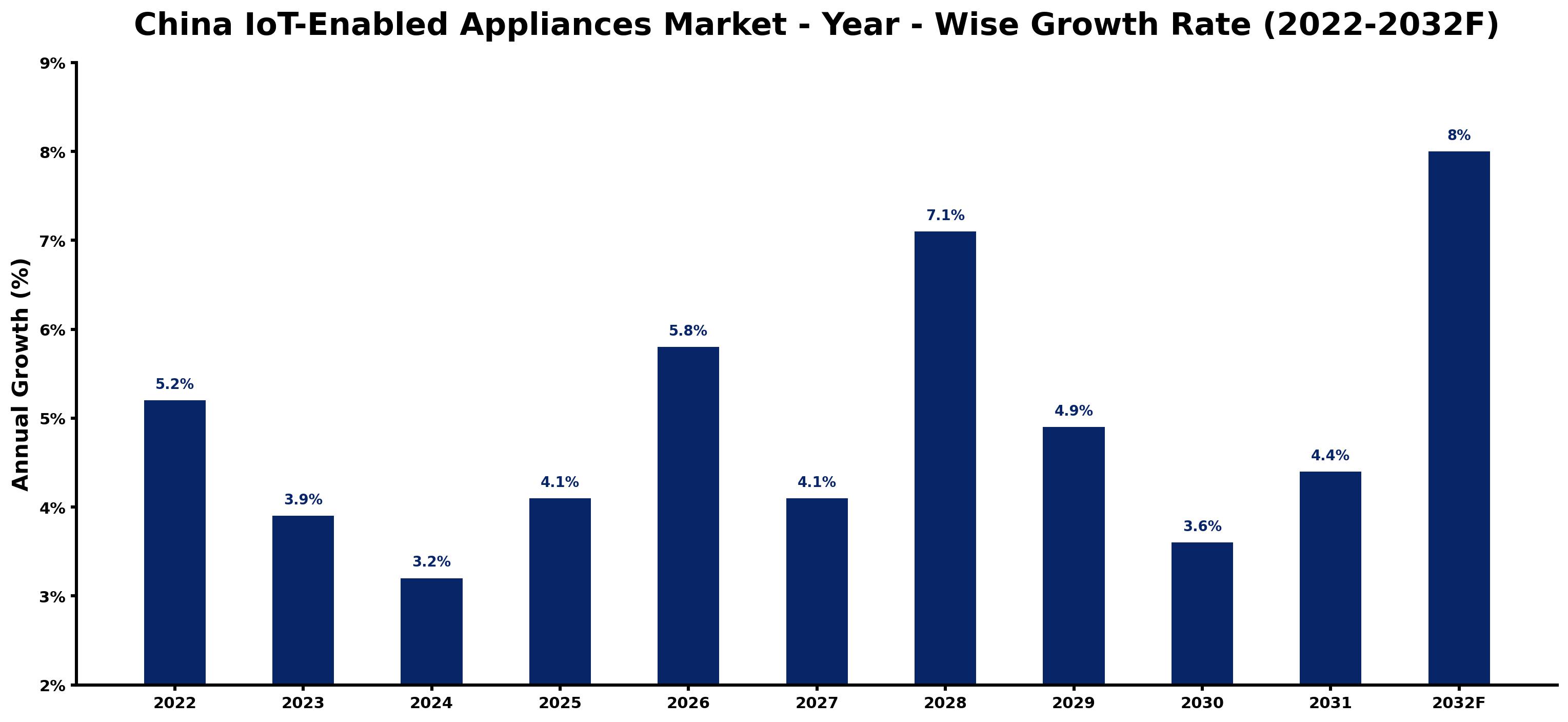
Annual growth estimates for each year appear below with the principal reason behind them, explaining the shifts that set the pace of the market.
| Year | Estimated Annual Growth (%) | Market Rationale |
| 2022 | 5.2 | The market experienced steady growth due to increasing urbanisation and the Smart Home Development Plan's impact. |
| 2023 | 3.9 | Growth slowed as consumers adjusted to new technologies and economic conditions, influenced by the Energy Efficiency Labeling Program. |
| 2024 | 3.2 | Demand continued to decelerate as the Energy Efficiency Labeling Program began to take effect, promoting energy-efficient appliances. |
| 2025 | 4.1 | A resurgence in growth was driven by new residential developments in urban areas, particularly in Beijing and Shanghai. |
| 2026 | 5.8 | The market is expected to see a boost from rising energy efficiency awareness and new product launches in smart appliances. |
| 2027 | 4.1 | Growth is projected to slow again as the market stabilises after previous peaks in urban household adoption. |
| 2028 | 7.1 | A notable increase in demand is expected with the rise of voice-controlled appliances in urban households. |
| 2029 | 4.9 | The market is projected to experience a slowdown as competition intensifies among manufacturers of smart devices. |
| 2030 | 3.6 | Growth is expected to decelerate with consumers becoming more selective in their purchases of IoT-enabled appliances. |
| 2031 | 4.4 | A renewed interest in smart kitchen technologies is projected to spur growth once more, particularly in hospitality. |
| 2032 | 8.0 | The market is expected to peak, driven by widespread adoption of IoT-enabled appliances and energy efficiency initiatives. |
Note: Market size estimations and growth projections presented in this report are based on 6Wresearch's proprietary forecasting methodology, utilizing the latest available industry data, government publications, and primary research inputs.
China IoT-Enabled Appliances Market Synopsis
The IoT-Enabled Appliances Market in China includes smart devices that connect to the internet, enabling remote monitoring and control. These appliances incorporate advanced sensors and connectivity technologies, improving energy efficiency and convenience. The market is expanding due to a growing urban population, which reached approximately 900 million in 2023, alongside the increasing demand for energy-efficient products. The National Energy Administration's Energy Efficiency Labeling Program is supporting this trend, further boosting sales among urban households.
Market Dynamics Impact Analysis (2026–2032)
| Factor | Type | Impact | Primary Segment Affected |
| Increasing urban population driving demand for smart appliances | Driver | High | Smart Refrigerators |
| Rising energy efficiency awareness among consumers | Driver | High | Connected Ovens |
| Growing adoption of energy-efficient appliances | Opportunity | High | Smart Washing Machines |
| Expansion of the hospitality sector adopting smart technologies | Opportunity | Medium | IoT Dishwashers |
| Market saturation leading to slower growth rates | Restraint | High | Smart Refrigerators |
| High initial costs of IoT-enabled appliances for consumers | Restraint | Medium | Connected Ovens |
| Integration challenges with existing home systems | Challenge | High | Smart Washing Machines |
| Consumer hesitance towards new technologies | Challenge | Medium | IoT Dishwashers |
Evaluation of Drivers in China IoT-Enabled Appliances Market (2026–2032)
The main growth drivers and the segments they affect most are set out below.
| Drivers | Primary Segment Affected | Why It Matters (Evidence) |
| Increasing urbanisation drives demand for smart appliances among urban households | Smart Refrigerators | With approximately 900 million urban residents, the need for energy-efficient food preservation solutions rises. |
| Growing energy efficiency awareness encourages consumers to invest in smart appliances | Energy Star Rated | Energy Star certification promotes energy-saving products, influencing purchasing decisions in urban households. |
| Rising consumer demand for convenience boosts the adoption of connected appliances | Connected Ovens | As new residential buildings install more connected ovens, households seek automation in cooking. |
| The popularity of smart home technologies enhances the appeal of IoT-enabled appliances | IoT Dishwashers | Urban households increasingly prefer dishwashers that offer remote operation and efficiency tracking. |
| Government initiatives support the growth of energy-efficient appliances | Smart Washing Machines | Subsidies under the Green Home Initiative make smart washing machines more affordable for consumers. |
Growth in the IoT-Enabled Appliances market in China stems from rising urbanisation, heightened awareness of energy efficiency, and consumer demand for convenience. With the urban population at around 900 million in 2023, the need for smart appliances is on the rise. The average urban household owns 2-3 IoT-enabled appliances, driving demand for smart washing machines. As smart home technologies gain traction, IoT dishwashers are increasingly preferred for their automation features. Connected ovens are becoming standard in new residential buildings, further propelling market growth.
Evaluation of Restraints in China IoT-Enabled Appliances Market
Below mentioned are some major restraints and their influence on market dynamics.
| Market Restraint | Primary Segment Affected | Why It Matters (Evidence) |
| Market saturation leading to slower growth rates | Smart Refrigerators | As more households adopt smart refrigerators, the market is experiencing saturation, limiting further growth. |
| High initial costs of IoT-enabled appliances for consumers | Connected Ovens | The cost of purchasing connected ovens can deter consumers from investing in smart technologies. |
| Integration challenges with existing home systems | Smart Washing Machines | Consumers face difficulties integrating smart washing machines with their current home automation systems. |
| Consumer hesitance towards new technologies | IoT Dishwashers | Some consumers remain cautious about adopting IoT dishwashers due to unfamiliarity with the technology. |
| Limited awareness of energy-efficient options | Smart Refrigerators | Not all consumers are aware of the benefits of energy-efficient smart refrigerators, impacting sales. |
China IoT-Enabled Appliances Market Challenges
The China IoT-Enabled Appliances Market still has to solve a few problems, and the first is high costs for buyers. Urban households face an average expenditure of 30% more for IoT-enabled appliances compared to traditional ones, limiting their adoption. Next, supply chain issues arise from reliance on imported components, which can delay product availability and increase lead times by up to six weeks for suppliers. A skills gap exists in the workforce, as only 25% of technicians are trained to install and maintain these advanced devices, hindering service quality for consumers.
Trends in the China IoT-Enabled Appliances Market
Four trends stand out in the China IoT-Enabled Appliances Market.
- Rise in Energy Star Rated Appliances: In 2023, over 50% of new appliances sold in China were Energy Star Rated, indicating a growing consumer preference for energy-efficient products.
- Increase in Voice-Controlled Appliances: The adoption of voice-controlled appliances is on the rise, with many urban households seeking convenience in their daily tasks, as highlighted by the Smart Home Expo 2023.
- Growing Demand for Smart Kitchen Technologies: The hospitality sector is increasingly embracing smart kitchen technologies, focusing on operational efficiency as more hotels integrate IoT-enabled appliances.
- Expansion of Smart Home Development Initiatives: The Ministry of Industry and Information Technology's Smart Home Development Plan aims to boost IoT integration, targeting a 30% increase in appliance usage by 2025.
Investment Opportunities in the China IoT-Enabled Appliances Market
Below are the investment opportunities with the strongest case in the China IoT-Enabled Appliances Market.
- Supply of Energy-Efficient Appliances: With a target of a 20% increase in adoption by 2025, suppliers can focus on energy-efficient appliances, appealing to urban households seeking sustainability.
- Investment in Smart Kitchen Technologies: The hospitality sector is adopting smart kitchen technologies, creating a demand for suppliers to offer solutions that improve operational efficiency.
- Partnerships for Smart Home Integration: Manufacturers can explore partnerships with local developers to integrate IoT appliances in new residential projects, tapping into the growing urban market.
- Certification for Energy Efficiency: Suppliers can obtain Energy Star certification to attract consumers, as energy-efficient products are increasingly sought after in urban households.
Government Initiatives in the China IoT-Enabled Appliances Market
The Energy Efficiency Labeling Program, initiated by the National Energy Administration in 2021, promotes energy-efficient appliances. This initiative aims for a 20% increase in adoption by 2025, encouraging consumers to opt for smart appliances. Additionally, the Green Home Initiative, launched in 2022, offers subsidies for energy-efficient home appliances, with a budget of 500 million yuan for the first year. These measures enhance market accessibility for smart appliances.
The Smart Home Development Plan, managed by the Ministry of Industry and Information Technology, seeks to improve the integration of IoT technologies in appliances by 2025. This plan supports sector innovation and development, providing funding for research and development projects. Furthermore, the State Administration for Market Regulation updated standards for smart appliances in 2023, ensuring safety and interoperability, benefiting both producers and consumers.
Future Insight of the China IoT-Enabled Appliances Market
The China IoT-Enabled Appliances Market is set to evolve by 2032, driven by several key factors. The government’s Smart Home Development Plan will encourage innovation and integration of new technologies. Energy-efficient appliances will gain traction as the National Energy Administration continues to promote energy-saving initiatives, with over 50% of new appliances expected to be IoT-enabled by 2025. Voice-controlled devices will become more prevalent, improving convenience and accessibility in daily tasks.
Market Segmentation Analysis
The analysis below covers each segmentation, its leading category in 2025 and its fastest-growing category through 2032.
By Appliance Type – Smart Refrigerators Dominated, Connected Ovens Expected to Grow Fastest
According to Shubham Deep, Research Manager at 6Wresearch, Smart Refrigerators held a 38% share of the China IoT-Enabled Appliances Market by appliance type in 2025. Smart refrigerators dominate the market due to their essential role in food preservation and monitoring, particularly in urban households where convenience is key. With over 50% of new appliances sold being IoT-enabled, these devices are becoming integral to modern living. Over 2026–2032, Connected Ovens are expected to post the fastest growth, at a CAGR of 8.0%. Connected ovens are rapidly gaining traction as they offer remote cooking control and recipe management, appealing to tech-savvy consumers looking for convenience. As urban households increasingly seek automation in their cooking processes, this segment is poised for continued growth. Suppliers should focus on enhancing features in connected ovens to meet the rising demand for smart cooking solutions.
By Connectivity Type – Wi-Fi Dominated, Zigbee + App Expected to Grow Fastest
With a 51% revenue share in 2025, Wi-Fi was the largest connectivity type category. Wi-Fi holds the largest market share as it is essential for connecting IoT-enabled appliances to the internet, ensuring seamless integration into smart homes. Its widespread availability and user familiarity make it the preferred choice among consumers. The quickest growth will come from Zigbee + App, forecast to expand at a CAGR of 7.0% between 2026 and 2032. Zigbee combined with app connectivity is gaining momentum due to its low-power consumption, making it ideal for energy-efficient appliances in residential areas. As energy savings become a priority for consumers, this segment is expected to expand quickly. Manufacturers should consider incorporating Zigbee technology to attract environmentally conscious buyers seeking efficient smart home solutions.
By Control Interface – Touchscreen + App Dominated, Voice + App Expected to Grow Fastest
The largest control interface category in 2025 was Touchscreen + App, with a 48% share of total revenue. The touchscreen and app interface lead the market as they facilitate user interaction and control, making appliances intuitive for consumers. This combination is particularly popular among urban households that value convenience and modern technology. Voice + App is set to record the highest CAGR in this split, 6.5% over 2026–2032. Voice-controlled interfaces paired with apps are witnessing the fastest growth, allowing hands-free operation that aligns with the increasing demand for user convenience. This trend is likely to continue as consumers embrace smart home technologies. Developers should invest in voice technology to enhance user experience and attract a broader customer base in the smart appliance market.
By Energy Efficiency – Energy Star Rated Dominated, Load-Sensitive Mode Expected to Grow Fastest
Energy Star Rated accounted for a 51% market share by energy efficiency in 2025. Energy Star rated appliances are preferred for their established energy efficiency and cost savings, appealing to environmentally conscious consumers in urban areas. This certification significantly influences purchasing decisions, making it a key factor in the market. Load-Sensitive Mode is projected to grow fastest, at a CAGR of 7.9% during 2026–2032. Load-sensitive mode is rapidly gaining traction as it optimises energy use based on the load, appealing to consumers focused on reducing energy costs. This feature aligns with the increasing trend towards sustainability in appliance use. Manufacturers should emphasise energy-efficient features to attract buyers prioritising sustainability and cost savings.
By End User – Urban Households Dominated, Hospitality Sector Expected to Grow Fastest
In 2025, Urban Households led the end user split with a 45% share. Urban households represent the largest user base for IoT-enabled appliances, driven by a high concentration of technology adoption and the need for convenience in daily tasks. This demographic is eager to integrate smart solutions into their homes. Over 2026–2032, Hospitality Sector is expected to post the fastest growth, at a CAGR of 6.6%. The hospitality sector is increasingly adopting smart appliances to enhance operational efficiency, reflecting a broader trend towards automation in service industries. This growth indicates a shift in how businesses leverage technology for improved service delivery. Suppliers should tailor their offerings to meet the specific needs of the hospitality sector, capitalising on its growing demand for smart appliance solutions.
Key Attractiveness of the Report
- 10 Years of Market Numbers
- Historical Data Starting from 2022 to 2025
- Base Year 2025
- Forecast Data until 2032
- Key Performance Indicators Impacting the Market
- Major Upcoming Developments and Projects
Key Highlights of the Report:
- China IoT-Enabled Appliances Market Outlook
- Market Size of China IoT-Enabled Appliances Market, 2025
- Forecast of China IoT-Enabled Appliances Market, 2032
- Historical Data and Forecast of China IoT-Enabled Appliances Revenues & Volume for the Period 2022 - 2032F
- China IoT-Enabled Appliances Market Trend Evolution
- China IoT-Enabled Appliances Market Drivers and Challenges
- China IoT-Enabled Appliances Price Trends
- China IoT-Enabled Appliances Porter's Five Forces
- China IoT-Enabled Appliances Industry Life Cycle
- Historical Data and Forecast of China IoT-Enabled Appliances Market Revenues & Volume By Appliance Type for the Period 2022 - 2032F
- Historical Data and Forecast of China IoT-Enabled Appliances Market Revenues & Volume By Smart Refrigerators for the Period 2022 - 2032F
- Historical Data and Forecast of China IoT-Enabled Appliances Market Revenues & Volume By Connected Ovens for the Period 2022 - 2032F
- Historical Data and Forecast of China IoT-Enabled Appliances Market Revenues & Volume By Smart Washing Machines for the Period 2022 - 2032F
- Historical Data and Forecast of China IoT-Enabled Appliances Market Revenues & Volume By IoT Dishwashers for the Period 2022 - 2032F
- Historical Data and Forecast of China IoT-Enabled Appliances Market Revenues & Volume By Connectivity Type for the Period 2022 - 2032F
- Historical Data and Forecast of China IoT-Enabled Appliances Market Revenues & Volume By Wi-Fi for the Period 2022 - 2032F
- Historical Data and Forecast of China IoT-Enabled Appliances Market Revenues & Volume By Bluetooth + Wi-Fi for the Period 2022 - 2032F
- Historical Data and Forecast of China IoT-Enabled Appliances Market Revenues & Volume By Zigbee + App for the Period 2022 - 2032F
- Historical Data and Forecast of China IoT-Enabled Appliances Market Revenues & Volume By NFC + Wi-Fi for the Period 2022 - 2032F
- Historical Data and Forecast of China IoT-Enabled Appliances Market Revenues & Volume By Control Interface for the Period 2022 - 2032F
- Historical Data and Forecast of China IoT-Enabled Appliances Market Revenues & Volume By Touchscreen + App for the Period 2022 - 2032F
- Historical Data and Forecast of China IoT-Enabled Appliances Market Revenues & Volume By Voice + App for the Period 2022 - 2032F
- Historical Data and Forecast of China IoT-Enabled Appliances Market Revenues & Volume By App-Based Scheduling for the Period 2022 - 2032F
- Historical Data and Forecast of China IoT-Enabled Appliances Market Revenues & Volume By Remote Control for the Period 2022 - 2032F
- Historical Data and Forecast of China IoT-Enabled Appliances Market Revenues & Volume By Energy Efficiency for the Period 2022 - 2032F
- Historical Data and Forecast of China IoT-Enabled Appliances Market Revenues & Volume By Energy Star Rated for the Period 2022 - 2032F
- Historical Data and Forecast of China IoT-Enabled Appliances Market Revenues & Volume By Timer/Auto Shutoff for the Period 2022 - 2032F
- Historical Data and Forecast of China IoT-Enabled Appliances Market Revenues & Volume By Load-Sensitive Mode for the Period 2022 - 2032F
- Historical Data and Forecast of China IoT-Enabled Appliances Market Revenues & Volume By Water Monitoring for the Period 2022 - 2032F
- Historical Data and Forecast of China IoT-Enabled Appliances Market Revenues & Volume By End User for the Period 2022 - 2032F
- Historical Data and Forecast of China IoT-Enabled Appliances Market Revenues & Volume By Urban Households for the Period 2022 - 2032F
- Historical Data and Forecast of China IoT-Enabled Appliances Market Revenues & Volume By Smart Kitchen Users for the Period 2022 - 2032F
- Historical Data and Forecast of China IoT-Enabled Appliances Market Revenues & Volume By Multi-Family Units for the Period 2022 - 2032F
- Historical Data and Forecast of China IoT-Enabled Appliances Market Revenues & Volume By Hospitality Sector for the Period 2022 - 2032F
- China IoT-Enabled Appliances Import Export Trade Statistics
- Market Opportunity Assessment By Appliance Type
- Market Opportunity Assessment By Connectivity Type
- Market Opportunity Assessment By Control Interface
- Market Opportunity Assessment By Energy Efficiency
- Market Opportunity Assessment By End User
- China IoT-Enabled Appliances Top Companies Market Share
- China IoT-Enabled Appliances Competitive Benchmarking By Technical and Operational Parameters
- China IoT-Enabled Appliances Company Profiles
- China IoT-Enabled Appliances Key Strategic Recommendations
Market Covered
Segments analysed in this report are listed below.
By Appliance Type
- Smart Refrigerators
- Connected Ovens
- Smart Washing Machines
- IoT Dishwashers
By Connectivity Type
- Wi-Fi
- Bluetooth + Wi-Fi
- Zigbee + App
- NFC + Wi-Fi
By Control Interface
- Touchscreen + App
- Voice + App
- App-Based Scheduling
- Remote Control
By Energy Efficiency
- Energy Star Rated
- Timer/Auto Shutoff
- Load-Sensitive Mode
- Water Monitoring
By End User
- Urban Households
- Smart Kitchen Users
- Multi-Family Units
- Hospitality Sector































