China IoT-Enabled Crop Protection Market Size & Growth Rate
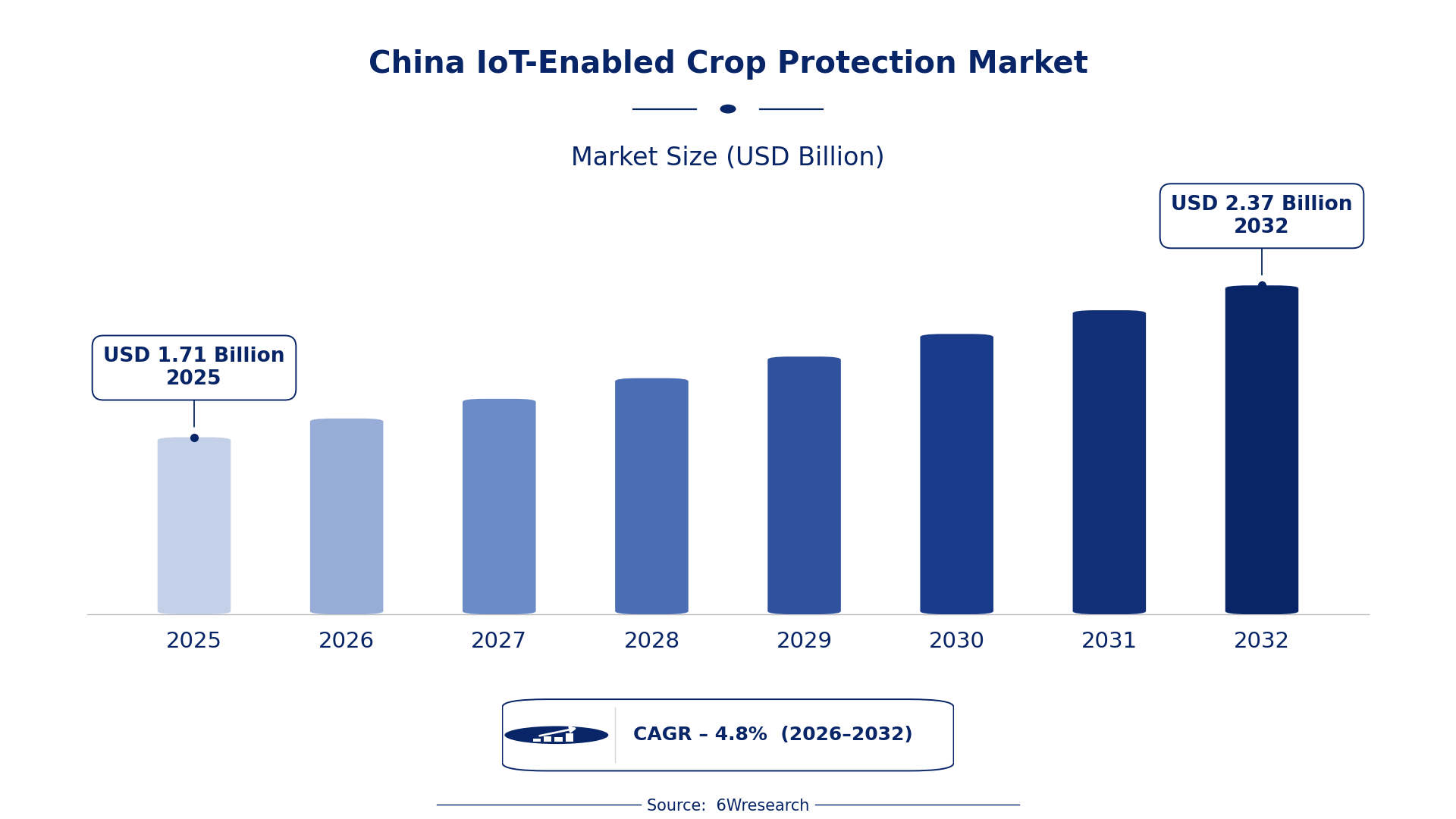
According to 6Wresearch internal database and industry insights, the China IoT-Enabled Crop Protection Market was valued at USD 1.71 billion in 2025 and is projected to reach USD 2.37 billion by 2032, growing at a CAGR of approximately 4.8% during 2026–2032.
China IoT-Enabled Crop Protection Market Highlights
| Report Metric | Details |
| Report Name | China IoT-Enabled Crop Protection Market |
| Market Size 2025 | USD 1.71 billion |
| Market Size 2032 | USD 2.37 billion |
| Absolute Growth 2025–2032 | USD 0.66 billion |
| CAGR 2026–2032 | 4.8% |
| Peak Annual Growth | 6.6% in 2029 |
| Forecast Period | 2026–2032 |
| Historical Data | 2022–2025 |
| Base Year | 2025 |
| Leading Protection Method, 2025 | Pest Detection (50% share) |
| Leading Sensor Type, 2025 | Optical Cameras (42% share) |
| Leading Delivery System, 2025 | Drone Sprayers (50% share) |
| Leading Connectivity, 2025 | Cellular/LoRaWAN (37% share) |
| Leading End User, 2025 | AgriTech Firms (33% share) |
| Fastest-Growing Protection Method | Disease Monitoring (6.8% CAGR) |
| Fastest-Growing Sensor Type | Humidity Sensors (7.2% CAGR) |
| Fastest-Growing Delivery System | Automated Dispensers (6.7% CAGR) |
| Fastest-Growing Connectivity | Wi-Fi + Zigbee (7.2% CAGR) |
| Fastest-Growing End User | Greenhouse Farmers (6.2% CAGR) |
| Growing Sector | AgriTech |
| Key End Users | AgriTech Firms, Greenhouse Farmers, Row Crop Growers, Large Farm Operators |
China IoT-Enabled Crop Protection Market Year-wise Growth Rate and Key Drivers (2022–2032)
This graph illustrates the annual growth rates of the market from 2022 to 2032, highlighting a steady upward trajectory and projected market expansion over the forecast period.
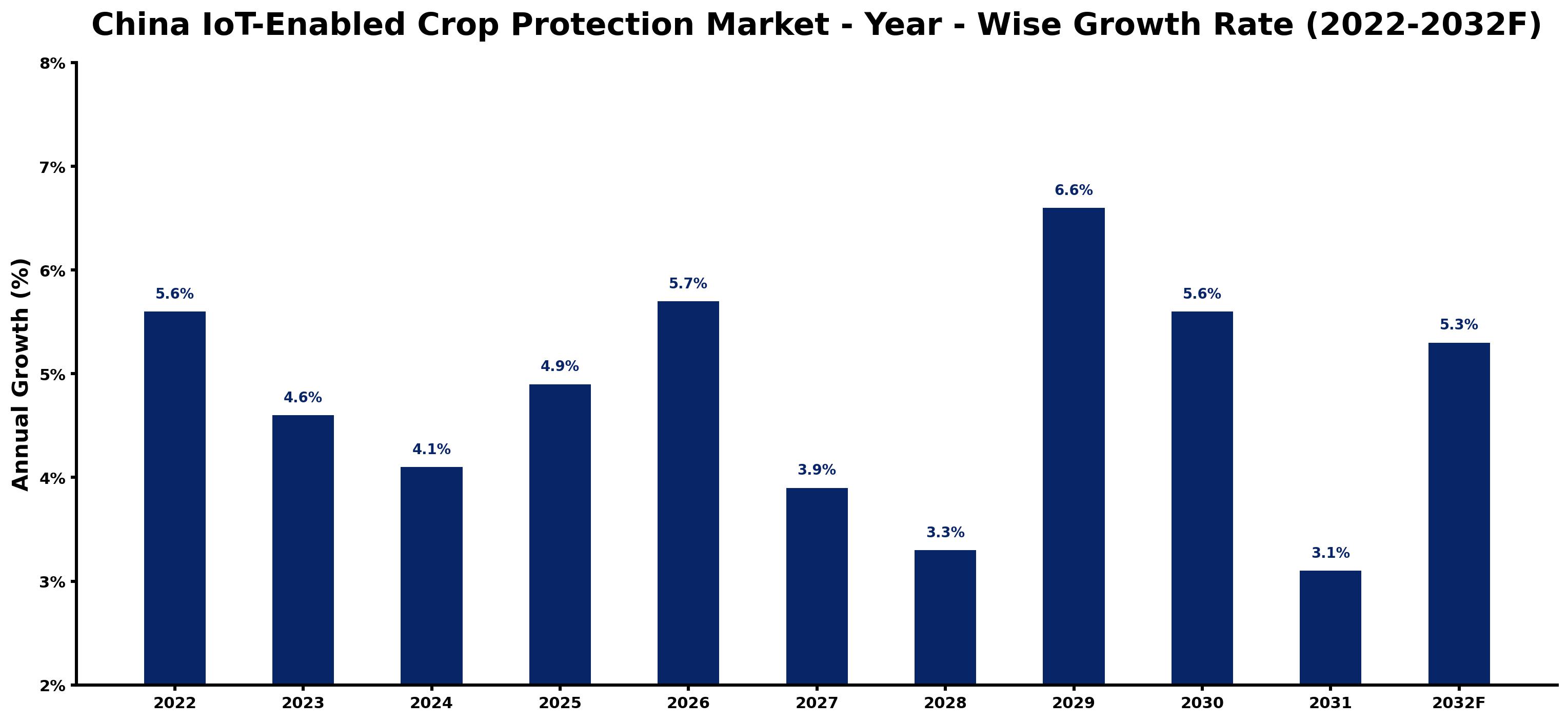
The table below sets out the estimated growth rate for each year and the main factor behind it.
| Year | Estimated Annual Growth (%) | Market Rationale |
| 2022 | 5.6 | The market experienced strong growth due to increased adoption of smart farming technologies. |
| 2023 | 4.6 | Growth slowed as the market adjusted to new technology implementations and user feedback. |
| 2024 | 4.1 | Demand continued to decelerate as the focus shifted towards optimising existing IoT solutions. |
| 2025 | 4.9 | Growth accelerated again as farmers sought efficient solutions amid rising operational costs. |
| 2026 | 5.7 | The market is expected to rebound with increased investments in IoT technologies for crop management. |
| 2027 | 3.9 | Growth is projected to slow as the market faces challenges in integrating new technologies effectively. |
| 2028 | 3.3 | A further slowdown is anticipated as users prioritise cost-effective solutions over new investments. |
| 2029 | 6.6 | The market is expected to peak with a surge in demand for advanced pest detection technologies. |
| 2030 | 5.6 | Growth will decelerate as the market stabilises after the peak demand year. |
| 2031 | 3.1 | The market is projected to continue slowing as buyers become more selective in technology adoption. |
| 2032 | 5.3 | Growth is expected to pick up again as new innovations in IoT crop protection emerge. |
Note: Market size estimations and growth projections presented in this report are based on 6Wresearch's proprietary forecasting methodology, utilizing the latest available industry data, government publications, and primary research inputs.
China IoT-Enabled Crop Protection Market Synopsis
IoT-Enabled Crop Protection in China encompasses technologies that optimise agricultural practices through sensors and data analytics. This includes pest detection, disease monitoring, and optimising pesticide application. The China IoT-Enabled Crop Protection Market is expanding due to increasing food security demands and the adoption of smart farming solutions. With over 10 million IoT devices installed in agriculture as of 2023, AgriTech firms are driving innovation and efficiency in farming practices, leading to notable market growth.
Market Dynamics Impact Analysis (2026–2032)
| Factor | Type | Impact | Primary Segment Affected |
| Increasing adoption of smart farming technologies enhances operational efficiency. | Driver | High | Pest Detection |
| Rising food security concerns drive demand for effective crop management solutions. | Driver | High | Disease Monitoring |
| Investment in precision agriculture technologies is at an all-time high. | Opportunity | High | AgriTech Firms |
| Growing interest in sustainable farming practices opens new market avenues. | Opportunity | High | Greenhouse Farmers |
| High initial costs of IoT systems can deter small-scale farmers from adoption. | Restraint | High | Pesticide Scheduling |
| Limited access to advanced technologies in rural areas restricts growth potential. | Restraint | Medium | Smart Sprayers |
| Buyers face challenges in integrating IoT systems into existing farming practices. | Challenge | High | Optical Cameras |
| Suppliers encounter difficulties in maintaining consistent technology updates and support. | Challenge | Medium | Drone Sprayers |
Evaluation of Drivers in China IoT-Enabled Crop Protection Market (2026–2032)
Key forces behind demand, with the segment each one moves most, are listed below.
| Drivers | Primary Segment Affected | Why It Matters (Evidence) |
| Increased investment in agricultural technology leads to improved crop management. | Pest Detection | The installed base of IoT devices in agriculture reached 10 million units in 2023, prompting farmers to adopt these technologies. |
| Growing food security demands drive the need for efficient farming solutions. | Disease Monitoring | China's population of approximately 1.4 billion necessitates advancements in crop protection to meet food needs. |
| Government initiatives promote the adoption of smart agriculture technologies. | Pesticide Scheduling | The Ministry of Agriculture's plan to increase smart agriculture adoption by 30% in 2023 encourages farmers to implement IoT solutions. |
| Rising awareness of sustainable farming practices boosts demand for smart solutions. | Smart Sprayers | The Green Development Plan for Agriculture (2021-2025) emphasises sustainable practices, increasing interest in IoT technologies. |
| Technological advancements in sensors improve pest detection capabilities. | Optical Cameras | The average yield increase from smart farming technologies is reported to be around 15%, motivating further investment. |
The installed base of IoT devices in agriculture reached 10 million units in 2023, encouraging farmers to adopt these technologies for better crop management. With a population of approximately 1.4 billion, the need for efficient farming solutions is critical. Growing awareness of sustainable farming practices is driving demand for smart solutions, as producers seek to improve productivity and minimise environmental impact.
Evaluation of Restraints in China IoT-Enabled Crop Protection Market
The main factors holding the market back are set out below.
| Market Restraint | Primary Segment Affected | Why It Matters (Evidence) |
| High initial costs of IoT systems deter small-scale farmers from adoption. | Pest Detection | The average farm size in China is about 0.6 hectares, making expensive technology less accessible. |
| Limited access to advanced technologies in rural areas restricts growth potential. | Disease Monitoring | Many rural areas lack the infrastructure necessary to support advanced IoT systems, limiting adoption. |
| Integration challenges with existing farming practices hinder technology adoption. | Pesticide Scheduling | Farmers often struggle to adapt new technologies to traditional methods, delaying benefits and efficiency gains. |
| Inconsistent technology updates create uncertainty for suppliers and buyers. | Smart Sprayers | Buyers may hesitate to invest if they perceive a risk of obsolescence in rapidly changing technology. |
| Data privacy concerns may limit the willingness to adopt IoT solutions. | Optical Cameras | Farmers are wary of sharing sensitive agricultural data with technology providers, impacting trust. |
China IoT-Enabled Crop Protection Market Challenges
Buyers and suppliers in the China IoT-Enabled Crop Protection market encounter a skills shortage, as many farmers lack training in advanced technologies. This gap arises from limited access to agricultural education, delaying IoT adoption by up to two years for smaller farms. Rising costs also challenge producers; the average investment in IoT devices reached approximately 1.5 billion USD in 2022, straining financial resources. Regulatory compliance adds complexity, with adherence to the National Standard for Smart Agriculture increasing operational costs by 15% for farmers. Competition from traditional farming methods persists, as reluctance to adopt new technologies stifles innovation and growth in the market.
Trends in the China IoT-Enabled Crop Protection Market
Several trends are reshaping the China IoT-Enabled Crop Protection Market; the most important are set out below.
- National Standard for Smart Agriculture Drives Adoption: The National Standard for Smart Agriculture (GB/T 40001-2021) is driving the adoption of precision agriculture technologies in China. This standard promotes efficient farming practices, with the agricultural sensor market valued at approximately 1.5 billion USD in 2022.
- Increase in Drone Sprayers Usage: In 2023, Drone Sprayers accounted for 50% of the delivery systems used in crop protection. This trend is reshaping how pesticides are applied, allowing for more efficient coverage of large areas.
- Growth of AgriTech Firms: With over 1,000 registered AgriTech firms in China, the sector is rapidly expanding. This growth is reflected in the increasing demand for IoT-enabled crop protection solutions, particularly in urban farming.
- Emergence of Humidity Sensors: Humidity Sensors are becoming increasingly important in crop protection, with a projected CAGR of 7.2% from 2026 to 2032. Their role in monitoring environmental conditions is vital for optimising crop health.
Investment Opportunities in the China IoT-Enabled Crop Protection Market
Some of the investment opportunities in the China IoT-Enabled Crop Protection Market are mentioned below.
- Supply of Smart Agriculture Solutions: There is a growing opportunity to supply smart agriculture solutions, with the market expected to expand as farmers seek efficiency. The government aims to reduce pesticide use by 20% by 2025, supporting this transition.
- Partnerships with AgriTech Firms: Now is the time to form partnerships with AgriTech firms, which are primary users of IoT solutions. Collaborating can facilitate market entry, especially as these firms expand their technological capabilities in crop protection.
- Investment in Precision Agriculture: Investing in precision agriculture technologies is timely, given the expected growth in this sector. The average yield increase from smart farming technologies is reported to be around 15%, indicating strong demand for innovative solutions.
- Expansion into Greenhouse Farming: The growth of Greenhouse Farmers presents an opportunity to supply advanced IoT solutions. With a projected CAGR of 6.2% from 2026 to 2032, this segment is ripe for investment and technological integration.
Government Initiatives in the China IoT-Enabled Crop Protection Market
The Smart Agriculture Development Plan launched by the Ministry of Agriculture in 2023 allocates 500 million CNY to promote IoT technologies in farming. This initiative aims to improve efficiency and sustainability through the adoption of smart farming practices. Additionally, the Precision Agriculture Initiative introduced in 2022 supports farmers in adopting IoT solutions, with an annual budget of 200 million CNY. These measures are instrumental in driving the integration of advanced technologies in China's agricultural sector, particularly for crop protection.
The IoT in Agriculture Promotion Program, overseen by the Ministry of Science and Technology, funds up to 300 projects by 2025. This program aims to encourage the development and implementation of IoT solutions in agriculture. The National Development and Reform Commission also approved the Agricultural Technology Innovation Strategy in 2022, focusing on enhancing smart farming practices across the country. These agencies play a critical role in facilitating the adoption of innovative agricultural technologies, enabling producers to enhance operational efficiency.
Future Insight of the China IoT-Enabled Crop Protection Market
By 2032, buyers and suppliers in the China IoT-Enabled Crop Protection market can expect substantial changes driven by government initiatives and technological advancements. The Ministry of Agriculture's plan to boost smart agriculture adoption by 30% will enhance operational efficiency across the sector. With the installed base of IoT devices projected to grow to 50 million units, farmers will gain improved pest detection and disease monitoring capabilities. The government's goal to reduce pesticide use by 20% by 2025 will encourage sustainable practices, leading to healthier crop yields and enhanced food security.
Market Segmentation Analysis
Each segment group is reviewed below, with the leader by share and the fastest grower by CAGR.
By Protection Method – Pest Detection Dominated, Disease Monitoring Expected to Grow Fastest
According to Shubham Deep, Research Manager at 6Wresearch, in 2025, Pest Detection led the protection method split with a 50% share. Pest Detection holds the largest share due to its critical role in identifying pest presence and preventing crop damage. This method is essential for AgriTech firms, which rely on accurate pest monitoring to ensure crop health and yield. Disease Monitoring is projected to grow fastest, at a CAGR of 6.8% during 2026–2032. Disease Monitoring is experiencing rapid growth as it is critical for early detection of crop diseases, minimising losses. The increasing adoption of smart farming technologies, which report a 15% average yield increase, drives this segment's expansion. Suppliers should focus on developing advanced disease monitoring solutions to cater to the growing needs of farmers.
By Sensor Type – Optical Cameras Dominated, Humidity Sensors Expected to Grow Fastest
Optical Cameras accounted for a 42% market share by sensor type in 2025. Optical Cameras hold the largest market share due to their extensive use in monitoring crop health and pest activity. Their ability to provide real-time visual data is essential for AgriTech firms focusing on precision agriculture. The quickest growth will come from Humidity Sensors, forecast to expand at a CAGR of 7.2% between 2026 and 2032. Humidity Sensors are rapidly growing because they play a crucial role in assessing environmental conditions that affect crops. The government's initiative to increase smart agriculture adoption by 30% further enhances their significance in optimising farming practices. Buyers should prioritise humidity sensors to improve crop management and effectively respond to environmental changes.
By Delivery System – Drone Sprayers Dominated, Automated Dispensers Expected to Grow Fastest
Drone Sprayers took a 50% share of delivery system in 2025, more than any other category. Drone Sprayers dominate the market share as they are increasingly used for efficient pesticide application over large areas. Their capacity to cover extensive arable land significantly enhances operational efficiency for AgriTech firms. Over 2026–2032, Automated Dispensers are expected to post the fastest growth, at a CAGR of 6.7%. Automated Dispensers are gaining traction due to their ability to dispense pesticides precisely based on sensor data. This trend is driven by the need for accuracy in pesticide application to meet government targets for reducing pesticide use by 20% by 2025. Suppliers must advance automated dispensing technologies to meet the growing demand for precision in crop protection.
By Connectivity – Cellular/LoRaWAN Dominated, Wi-Fi + Zigbee Expected to Grow Fastest
With a 37% revenue share in 2025, Cellular/LoRaWAN was the largest connectivity category. Cellular/LoRaWAN technology captures the largest market share because it is vital for real-time data transmission in remote agricultural areas. This connectivity is crucial for AgriTech firms relying on reliable communication for their IoT devices. Wi-Fi + Zigbee is set to record the highest CAGR in this split, 7.2% over 2026–2032. Wi-Fi + Zigbee is the fastest-growing connectivity solution as it becomes more prevalent for local connectivity in farm environments. The integration of these technologies enhances the effective operation of various IoT devices in agriculture. Buyers should invest in Wi-Fi and Zigbee solutions to strengthen local connectivity and improve overall farm management.
By End User – AgriTech Firms Dominated, Greenhouse Farmers Expected to Grow Fastest
AgriTech Firms held a 33% share of the China IoT-Enabled Crop Protection Market by end user in 2025. AgriTech Firms command the largest market share as they are the primary users of IoT-enabled solutions for crop management. Their focus on efficiency and sustainability drives the demand for advanced crop protection technologies. Greenhouse Farmers are projected to grow fastest, at a CAGR of 6.2% during 2026–2032. Greenhouse Farmers are experiencing the fastest growth as they utilise technology for controlled environment agriculture. The increasing production of greenhouse vegetables, which reached 50 million tons in 2022, fuels this segment's expansion. Suppliers should tailor their offerings to meet the specific needs of greenhouse farmers, who are rapidly adopting IoT technologies.
Key Attractiveness of the Report
- 10 Years of Market Numbers
- Historical Data Starting from 2022 to 2025
- Base Year 2025
- Forecast Data until 2032
- Key Performance Indicators Impacting the Market
- Major Upcoming Developments and Projects
Key Highlights of the Report:
- China IoT-Enabled Crop Protection Market Outlook
- Market Size of China IoT-Enabled Crop Protection Market, 2025
- Forecast of China IoT-Enabled Crop Protection Market, 2032
- Historical Data and Forecast of China IoT-Enabled Crop Protection Revenues & Volume for the Period 2022 - 2032F
- China IoT-Enabled Crop Protection Market Trend Evolution
- China IoT-Enabled Crop Protection Market Drivers and Challenges
- China IoT-Enabled Crop Protection Price Trends
- China IoT-Enabled Crop Protection Porter's Five Forces
- China IoT-Enabled Crop Protection Industry Life Cycle
- Historical Data and Forecast of China IoT-Enabled Crop Protection Market Revenues & Volume By Protection Method for the Period 2022 - 2032F
- Historical Data and Forecast of China IoT-Enabled Crop Protection Market Revenues & Volume By Pest Detection for the Period 2022 - 2032F
- Historical Data and Forecast of China IoT-Enabled Crop Protection Market Revenues & Volume By Disease Monitoring for the Period 2022 - 2032F
- Historical Data and Forecast of China IoT-Enabled Crop Protection Market Revenues & Volume By Pesticide Scheduling for the Period 2022 - 2032F
- Historical Data and Forecast of China IoT-Enabled Crop Protection Market Revenues & Volume By Smart Sprayers for the Period 2022 - 2032F
- Historical Data and Forecast of China IoT-Enabled Crop Protection Market Revenues & Volume By Sensor Type for the Period 2022 - 2032F
- Historical Data and Forecast of China IoT-Enabled Crop Protection Market Revenues & Volume By Optical Cameras for the Period 2022 - 2032F
- Historical Data and Forecast of China IoT-Enabled Crop Protection Market Revenues & Volume By Humidity Sensors for the Period 2022 - 2032F
- Historical Data and Forecast of China IoT-Enabled Crop Protection Market Revenues & Volume By Environmental Sensors for the Period 2022 - 2032F
- Historical Data and Forecast of China IoT-Enabled Crop Protection Market Revenues & Volume By Infrared + GPS Sensors for the Period 2022 - 2032F
- Historical Data and Forecast of China IoT-Enabled Crop Protection Market Revenues & Volume By Delivery System for the Period 2022 - 2032F
- Historical Data and Forecast of China IoT-Enabled Crop Protection Market Revenues & Volume By Drone Sprayers for the Period 2022 - 2032F
- Historical Data and Forecast of China IoT-Enabled Crop Protection Market Revenues & Volume By Automated Dispensers for the Period 2022 - 2032F
- Historical Data and Forecast of China IoT-Enabled Crop Protection Market Revenues & Volume By Soil-Triggered System for the Period 2022 - 2032F
- Historical Data and Forecast of China IoT-Enabled Crop Protection Market Revenues & Volume By Vehicle-Mounted for the Period 2022 - 2032F
- Historical Data and Forecast of China IoT-Enabled Crop Protection Market Revenues & Volume By Connectivity for the Period 2022 - 2032F
- Historical Data and Forecast of China IoT-Enabled Crop Protection Market Revenues & Volume By Cellular/LoRaWAN for the Period 2022 - 2032F
- Historical Data and Forecast of China IoT-Enabled Crop Protection Market Revenues & Volume By Wi-Fi + Zigbee for the Period 2022 - 2032F
- Historical Data and Forecast of China IoT-Enabled Crop Protection Market Revenues & Volume By LPWAN for the Period 2022 - 2032F
- Historical Data and Forecast of China IoT-Enabled Crop Protection Market Revenues & Volume By Bluetooth for the Period 2022 - 2032F
- Historical Data and Forecast of China IoT-Enabled Crop Protection Market Revenues & Volume By End User for the Period 2022 - 2032F
- Historical Data and Forecast of China IoT-Enabled Crop Protection Market Revenues & Volume By AgriTech Firms for the Period 2022 - 2032F
- Historical Data and Forecast of China IoT-Enabled Crop Protection Market Revenues & Volume By Greenhouse Farmers for the Period 2022 - 2032F
- Historical Data and Forecast of China IoT-Enabled Crop Protection Market Revenues & Volume By Row Crop Growers for the Period 2022 - 2032F
- Historical Data and Forecast of China IoT-Enabled Crop Protection Market Revenues & Volume By Large Farm Operators for the Period 2022 - 2032F
- China IoT-Enabled Crop Protection Import Export Trade Statistics
- Market Opportunity Assessment By Protection Method
- Market Opportunity Assessment By Sensor Type
- Market Opportunity Assessment By Delivery System
- Market Opportunity Assessment By Connectivity
- Market Opportunity Assessment By End User
- China IoT-Enabled Crop Protection Top Companies Market Share
- China IoT-Enabled Crop Protection Competitive Benchmarking By Technical and Operational Parameters
- China IoT-Enabled Crop Protection Company Profiles
- China IoT-Enabled Crop Protection Key Strategic Recommendations
Market Covered
This report examines the market across the segments below.
By Protection Method
- Pest Detection
- Disease Monitoring
- Pesticide Scheduling
- Smart Sprayers
By Sensor Type
- Optical Cameras
- Humidity Sensors
- Environmental Sensors
- Infrared + GPS Sensors
By Delivery System
- Drone Sprayers
- Automated Dispensers
- Soil-Triggered System
- Vehicle-Mounted
By Connectivity
- Cellular/LoRaWAN
- Wi-Fi + Zigbee
- LPWAN
- Bluetooth
By End User
- AgriTech Firms
- Greenhouse Farmers
- Row Crop Growers
- Large Farm Operators































