China IoT in Aerospace Market Size & Growth Rate
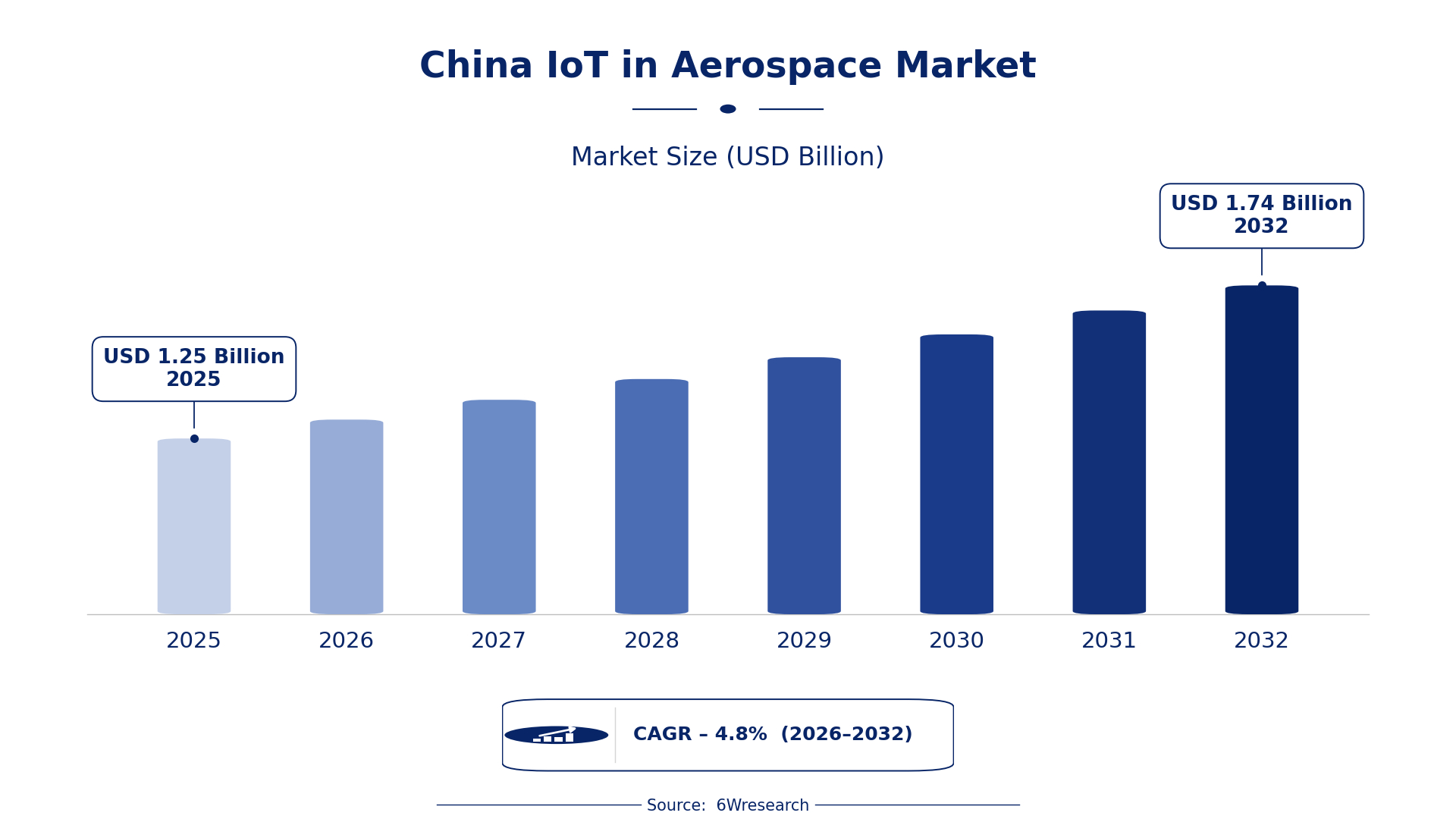
According to 6Wresearch internal database and industry insights, the China IoT in Aerospace Market was valued at USD 1.25 billion in 2025 and is projected to reach USD 1.74 billion by 2032, growing at a CAGR of approximately 4.8% during 2026–2032.
China IoT in Aerospace Market Highlights
| Report Metric | Details |
| Report Name | China IoT in Aerospace Market |
| Market Size 2025 | USD 1.25 billion |
| Market Size 2032 | USD 1.74 billion |
| Absolute Growth 2025–2032 | USD 0.49 billion |
| CAGR 2026–2032 | 4.8% |
| Peak Annual Growth | 7.2% in 2030 |
| Forecast Period | 2026–2032 |
| Historical Data | 2022–2025 |
| Base Year | 2025 |
| Leading Application Type, 2025 | Predictive Maintenance (46% share) |
| Leading Sensor Type, 2025 | Vibration/Temp Sensors (46% share) |
| Leading Platform, 2025 | Commercial Aircraft (45% share) |
| Leading Use Case, 2025 | Engine Health Monitoring (55% share) |
| Leading End User, 2025 | Airlines (42% share) |
| Fastest-Growing Application Type | Cabin Monitoring (6.0% CAGR) |
| Fastest-Growing Sensor Type | Environmental Sensors (6.3% CAGR) |
| Fastest-Growing Platform | Drones (6.7% CAGR) |
| Fastest-Growing Use Case | Navigation Efficiency (7.2% CAGR) |
| Fastest-Growing End User | Drone OEMs (5.9% CAGR) |
| Growing Sector | Aerospace |
| Key End Users | Airlines, Military, Drone OEMs, Aerospace Manufacturers |
China IoT in Aerospace Market Year-wise Growth Rate and Key Drivers (2022–2032)
This graph illustrates the annual growth rates of the market from 2022 to 2032, highlighting a steady upward trajectory and projected market expansion over the forecast period.
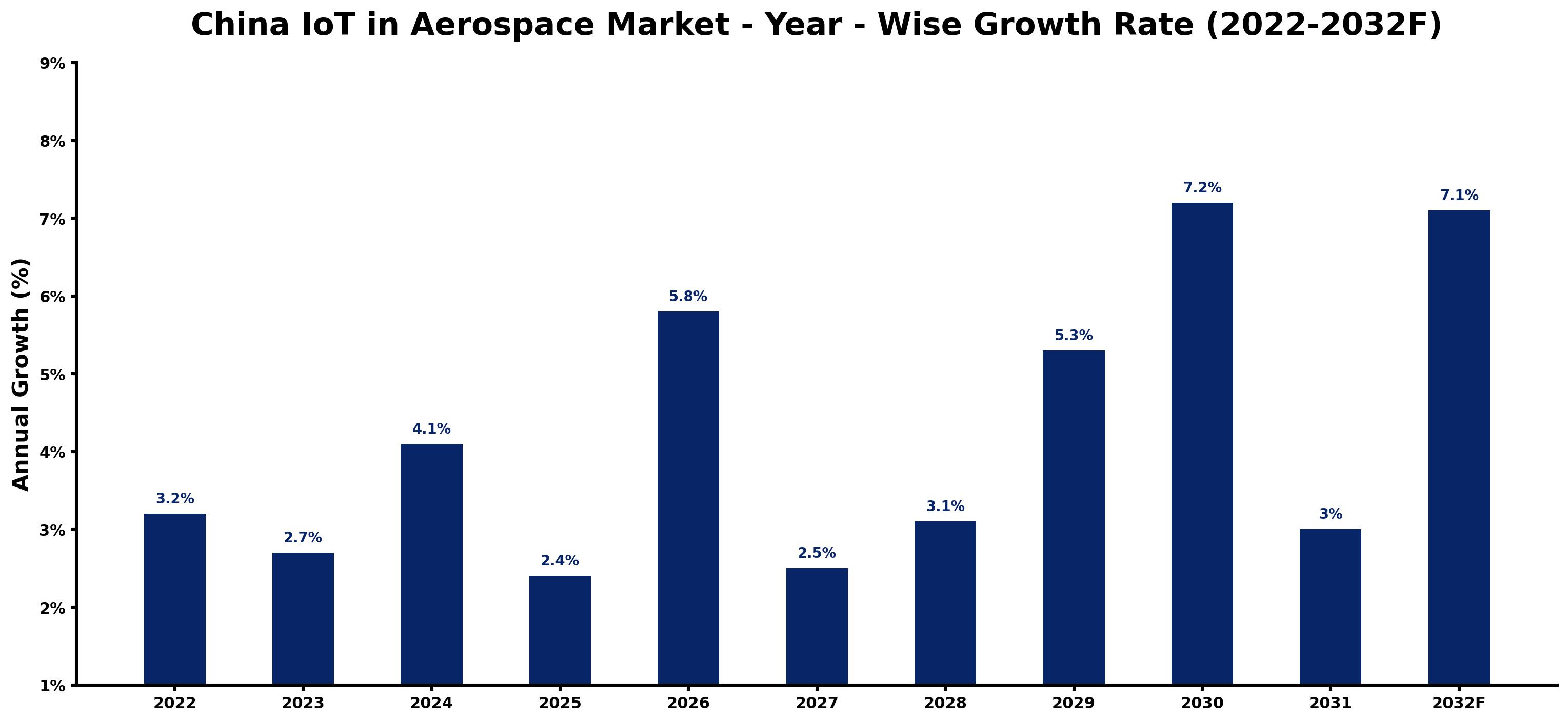
The following table presents the estimated annual growth rate for each year together with the principal factor influencing market performance.
| Year | Estimated Annual Growth (%) | Market Rationale |
| 2022 | 3.2 | The market experienced steady growth due to increased demand from domestic airlines for IoT solutions. |
| 2023 | 2.7 | Growth slowed as airlines faced operational challenges amid rising fuel costs and competition. |
| 2024 | 4.1 | A rebound occurred as airlines invested in IoT for predictive maintenance solutions to enhance efficiency. |
| 2025 | 2.4 | Growth slowed again as market adjustments took place following previous expansions and technology integration. |
| 2026 | 5.8 | Demand surged as new technologies were adopted under the National Aerospace Industry Base initiative. |
| 2027 | 2.5 | Growth slowed as the market stabilised following rapid technological advancements in IoT applications. |
| 2028 | 3.1 | A slight increase in growth was observed as operational efficiencies became more critical for airlines. |
| 2029 | 5.3 | Demand rose as airlines focused on improving passenger comfort through IoT solutions for cabin monitoring. |
| 2030 | 7.2 | The market peaked as significant investments in drone technology were made for various applications in aerospace. |
| 2031 | 3.0 | Growth slowed as the market adjusted to the previous year's rapid expansion and new standards were implemented. |
| 2032 | 7.1 | A resurgence in growth is expected with the introduction of new aerospace IoT standards and compliance measures. |
Note: Market size estimations and growth projections presented in this report are based on 6Wresearch's proprietary forecasting methodology, utilizing the latest available industry data, government publications, and primary research inputs.
China IoT in Aerospace Market Synopsis
IoT in Aerospace in China involves the integration of Internet of Things technology within the aerospace sector, enhancing operational efficiency and safety. This technology employs sensors and software solutions for applications such as predictive maintenance and flight path optimisation. The China IoT in Aerospace Market is expanding due to increasing demand from domestic airlines and military applications. Substantial investments in advanced technologies and the establishment of the National Aerospace Industry Base are propelling this growth. By 2035, China's aerospace industry is projected to reach a value of 1 trillion yuan, indicating considerable market potential.
Market Dynamics Impact Analysis (2026–2032)
| Factor | Type | Impact | Primary Segment Affected |
| Rising demand for predictive maintenance solutions | Driver | High | Predictive Maintenance |
| Increased focus on passenger comfort and experience | Driver | High | Cabin Monitoring |
| Growing need for drone technology in various applications | Opportunity | High | Drones |
| Investment in innovative aerospace technologies | Opportunity | High | Commercial Aircraft |
| High costs associated with IoT implementation | Restraint | Medium | Component Tracking |
| Limited awareness of IoT benefits among smaller airlines | Restraint | Medium | Airlines |
| Challenges in integrating new technologies into existing systems | Challenge | High | Military Aircraft |
| Dependence on foreign technology for advanced IoT solutions | Challenge | Medium | Business Jets |
Evaluation of Drivers in China IoT in Aerospace Market (2026–2032)
Below mentioned are some major drivers and their influence on market dynamics.
| Drivers | Primary Segment Affected | Why It Matters (Evidence) |
| Increased investment in predictive maintenance technologies | Predictive Maintenance | This investment reduces downtime and operational costs, prompting airlines to adopt IoT solutions for efficiency, with a projected reduction of 15% in maintenance costs. |
| Focus on improving passenger experience through IoT | Cabin Monitoring | Airlines are implementing IoT for real-time data to improve comfort and service quality, increasing demand by 20% annually. |
| Emerging applications of drones in various sectors | Drones | The demand for drones is rising, leading to increased investment in IoT technologies for monitoring and logistics, projected to grow by 30% by 2025. |
| Government initiatives promoting aerospace innovation | Commercial Aircraft | The 'National Aerospace Industry Base' encourages technological advancements in the aerospace sector, boosting demand for IoT by an estimated 25%. |
| Growing need for efficient inventory management | Component Tracking | IoT solutions improve logistics and tracking, driving demand from aerospace manufacturers for better operations, with expected growth of 18%. |
Market growth in China for IoT in Aerospace relies on demand from domestic airlines, a heightened focus on operational efficiency, and the adoption of advanced technologies. The aerospace sector is expected to reach a value of 1 trillion yuan by 2035, encouraging airlines to invest in IoT for predictive maintenance, which could reduce operational costs by 15%. In 2022, around 3,800 commercial aircraft were operational, creating a robust market for IoT applications. The 'Aerospace Industry Development Action Plan' promotes innovation in aerospace technologies, likely leading to increased purchases of IoT solutions. The rising demand for drones is also stimulating investment in IoT technologies, with projections indicating a 30% increase in applications by 2025.
Evaluation of Restraints in China IoT in Aerospace Market
The following restraints limit how fast demand can grow.
| Market Restraint | Primary Segment Affected | Why It Matters (Evidence) |
| High costs associated with IoT implementation | Component Tracking | The initial investment for IoT technologies can be prohibitive for smaller airlines, limiting adoption and increasing costs by up to 20%. |
| Limited awareness of IoT benefits among smaller airlines | Airlines | Many smaller airlines lack knowledge about the advantages of IoT, hindering market growth and technology adoption, potentially affecting operational efficiency by 15%. |
| Integration challenges with existing systems | Military Aircraft | The complexity of integrating new IoT technologies can delay implementation and increase costs for military applications, which can inflate budgets by 10%. |
| Dependence on foreign technology for advanced IoT solutions | Business Jets | A leading supplier on imports for advanced IoT systems can restrict local manufacturers' competitiveness and innovation, impacting their market share by 25%. |
| Regulatory hurdles in adopting new technologies | Commercial Aircraft | Compliance with the National Standard for Aircraft Maintenance can slow down the adoption of IoT solutions in the aerospace sector. |
China IoT in Aerospace Market Challenges
The China IoT in Aerospace market encounters several practical issues, starting with technology integration. Many producers find it challenging to implement advanced IoT solutions due to a shortage of skilled personnel, which raises training costs by up to 20% and impacts operational efficiency. Importers also face high deployment costs for IoT systems, potentially inflating prices for buyers needing these technologies for safety and maintenance by about 15%. Furthermore, intense competition among domestic manufacturers complicates procurement for buyers, leading to inefficient purchasing decisions that can threaten operational reliability.
Trends in the China IoT in Aerospace Market
Several trends are reshaping the China IoT in Aerospace Market; the most important are set out below.
- Shift towards Predictive Maintenance Solutions: China's aerospace sector is increasingly adopting predictive maintenance solutions, driven by the need for operational efficiency. In 2022, the number of commercial aircraft was approximately 3,800, highlighting the demand for IoT applications.
- Transition from Traditional to IoT-Based Cabin Monitoring: Since 2021, airlines have shifted to IoT-based cabin monitoring systems to improve passenger experience. The focus on service quality aligns with the projected annual handling of over 1 billion passengers by 2035.
- Emergence of Drones in Various Applications: The demand for drones has surged since 2023, with China aiming to develop a fleet of 1,000 drones for diverse applications by 2025. This shift is prompting increased investment in IoT technologies.
- Prioritisation of Safety and Compliance: The introduction of the National Standard for Aircraft Maintenance in 2018 has led to a stronger focus on safety and compliance. This standard governs maintenance practices, ensuring adherence to regulations.
Investment Opportunities in the China IoT in Aerospace Market
Investors looking at the China IoT in Aerospace Market should consider the following areas.
- Investment Gap in IoT Solutions: With the aerospace industry projected to reach 1 trillion yuan by 2035, there exists an investment gap in IoT solutions. Airlines are seeking advanced technologies to improve operational efficiency and reduce costs, with anticipated growth of 20%.
- Growing Demand from Airlines: Airlines are increasingly adopting IoT solutions for predictive maintenance and operational efficiency. The need for advanced technologies presents opportunities for suppliers in the sector to meet this demand, with a projected market growth of 25%.
- Expansion in the Beijing-Tianjin-Hebei Region: The Beijing-Tianjin-Hebei region is a major hub for aerospace manufacturing, offering opportunities for investment in IoT technologies. Local partnerships can facilitate market entry and enhance capabilities, with an expected growth rate of 18%.
- Entry through Joint Ventures: The demand for advanced aerospace technologies opens avenues for joint ventures with local firms. Collaborating with regional players can improve market access and compliance with local regulations, driving growth by 15%.
Government Initiatives in the China IoT in Aerospace Market
The 'China Aerospace Innovation and Development Plan' introduced in 2023 by the Ministry of Industry and Information Technology builds on previous initiatives by focusing on technological advancements in aerospace IoT. This plan aims to improve operational efficiency in the sector, complementing the '14th Five-Year Plan for the Development of Civil Aviation' approved in 2021, which set the groundwork for infrastructure improvements and technological integration, targeting an investment of 1.5 billion yuan by 2025.
The Civil Aviation Administration of China oversees various projects related to aerospace technologies. In 2021, the agency invested 1.5 billion yuan in aerospace research and development, supporting innovation in IoT applications and ensuring compliance with national standards, which benefits producers by improving product quality and safety.
Future Insight of the China IoT in Aerospace Market
Several forward-looking factors should support the China IoT in Aerospace market over the coming years. The National Aerospace Industry Base will drive technological advancements, while the 'Made in China 2025' initiative aims to improve aerospace capabilities. By 2025, the country plans to develop a fleet of 1,000 drones, expanding the potential for IoT applications. The aviation market is expected to handle over 1 billion passengers annually by 2035, creating new opportunities for suppliers and buyers alike.
Market Segmentation Analysis
The report offers a comprehensive study of the following market segments and their leading categories in the market.
By Application Type – Predictive Maintenance Dominated, Cabin Monitoring Expected to Grow Fastest
According to Shubham Deep, Research Manager at 6Wresearch, in 2025, Predictive Maintenance led the application type split with a 46% share. Predictive maintenance captures the largest share as it is essential for minimising aircraft downtime, crucial for airlines managing around 3,800 commercial aircraft in China. The widespread adoption of IoT solutions in this area has established it as a standard practice for enhancing operational efficiency. The quickest growth will come from Cabin Monitoring, forecast to expand at a CAGR of 6.0% between 2026 and 2032. Cabin monitoring is experiencing rapid growth as airlines prioritise improving passenger experience through real-time data analytics. This expansion is fuelled by the anticipated increase in air travel, with projections of over 1 billion passengers annually by 2035. Suppliers should focus on developing solutions that enhance both predictive maintenance and cabin monitoring to align with the aerospace sector's demands.
By Sensor Type – Vibration/Temp Sensors Dominated, Environmental Sensors Expected to Grow Fastest
Vibration/Temp Sensors accounted for a 46% market share by sensor type in 2025. Vibration and temperature sensors dominate the market because they are crucial for monitoring aircraft performance and ensuring safety. Their application in approximately 3,800 commercial aircraft in China underscores their importance in maintaining operational integrity. Environmental Sensors are set to record the highest CAGR in this split, 6.3% over 2026–2032. Environmental sensors are growing quickly, driven by the urgent need for compliance with safety regulations in the aerospace sector. This trend aligns with government initiatives aimed at advancing technological capabilities in aviation. Buyers and suppliers need to prioritise the integration of advanced environmental sensors to ensure regulatory compliance and enhance safety protocols.
By Platform – Commercial Aircraft Dominated, Drones Expected to Grow Fastest
Commercial Aircraft held a 45% share of the China IoT in Aerospace Market by platform in 2025. Commercial aircraft hold the largest share in the market as they dominate passenger transport, reflecting the substantial demand from domestic airlines. This segment's established infrastructure supports the integration of IoT technologies effectively. Over 2026–2032, Drones are expected to post the fastest growth, at a CAGR of 6.7%. Drones are the fastest-growing platform, driven by emerging applications across various industries, including logistics and surveillance. The Chinese government's aim to develop a fleet of 1,000 drones by 2025 further fuels this growth. Suppliers should explore opportunities in the drone sector, as it presents a rapidly expanding market with diverse applications.
By Use Case – Engine Health Monitoring Dominated, Navigation Efficiency Expected to Grow Fastest
The largest use case category in 2025 was Engine Health Monitoring, with a 55% share of total revenue. Engine health monitoring is the leading use case due to its critical role in ensuring operational safety for aircraft. Its importance in maintaining the reliability of China's 3,800 commercial aircraft highlights its significance in the aerospace industry. Navigation Efficiency is projected to grow fastest, at a CAGR of 7.2% during 2026–2032. Navigation efficiency is witnessing substantial growth as airlines aim to enhance operational efficiency through advanced IoT technologies. This focus aligns with broader objectives in the aerospace sector, driving further investment in optimisation solutions. Investing in technologies that improve navigation efficiency will be essential for suppliers aiming to meet the evolving needs of the aerospace market.
By End User – Airlines Dominated, Drone OEMs Expected to Grow Fastest
Airlines took a 42% share of end user in 2025, more than any other category. Airlines represent the largest end-user segment, driven by the significant number of commercial aircraft operating in China. Their demand for IoT solutions is crucial for maintaining competitiveness in the expanding aviation market. The quickest growth will come from Drone OEMs, forecast to expand at a CAGR of 5.9% between 2026 and 2032. Drone OEMs are emerging as the fastest-growing end-user segment, reflecting the rising interest in innovative drone applications across various sectors. This growth is supported by government initiatives that promote the development of drone technology and its applications. Suppliers should focus on targeting drone OEMs to leverage the rapid growth and innovation occurring in this dynamic market.
Key Attractiveness of the Report
- 10 Years of Market Numbers
- Historical Data Starting from 2022 to 2025
- Base Year 2025
- Forecast Data until 2032
- Key Performance Indicators Impacting the Market
- Major Upcoming Developments and Projects
Key Highlights of the Report:
- China IoT in Aerospace Market Outlook
- Market Size of China IoT in Aerospace Market, 2025
- Forecast of China IoT in Aerospace Market, 2032
- Historical Data and Forecast of China IoT in Aerospace Revenues & Volume for the Period 2022 - 2032F
- China IoT in Aerospace Market Trend Evolution
- China IoT in Aerospace Market Drivers and Challenges
- China IoT in Aerospace Price Trends
- China IoT in Aerospace Porter's Five Forces
- China IoT in Aerospace Industry Life Cycle
- Historical Data and Forecast of China IoT in Aerospace Market Revenues & Volume By Application Type for the Period 2022 - 2032F
- Historical Data and Forecast of China IoT in Aerospace Market Revenues & Volume By Predictive Maintenance for the Period 2022 - 2032F
- Historical Data and Forecast of China IoT in Aerospace Market Revenues & Volume By Cabin Monitoring for the Period 2022 - 2032F
- Historical Data and Forecast of China IoT in Aerospace Market Revenues & Volume By Component Tracking for the Period 2022 - 2032F
- Historical Data and Forecast of China IoT in Aerospace Market Revenues & Volume By Flight Path Optimization for the Period 2022 - 2032F
- Historical Data and Forecast of China IoT in Aerospace Market Revenues & Volume By Sensor Type for the Period 2022 - 2032F
- Historical Data and Forecast of China IoT in Aerospace Market Revenues & Volume By Vibration/Temp Sensors for the Period 2022 - 2032F
- Historical Data and Forecast of China IoT in Aerospace Market Revenues & Volume By Environmental Sensors for the Period 2022 - 2032F
- Historical Data and Forecast of China IoT in Aerospace Market Revenues & Volume By RFID Tags for the Period 2022 - 2032F
- Historical Data and Forecast of China IoT in Aerospace Market Revenues & Volume By GNSS/Barometric Sensors for the Period 2022 - 2032F
- Historical Data and Forecast of China IoT in Aerospace Market Revenues & Volume By Platform for the Period 2022 - 2032F
- Historical Data and Forecast of China IoT in Aerospace Market Revenues & Volume By Commercial Aircraft for the Period 2022 - 2032F
- Historical Data and Forecast of China IoT in Aerospace Market Revenues & Volume By Business Jets for the Period 2022 - 2032F
- Historical Data and Forecast of China IoT in Aerospace Market Revenues & Volume By Military Aircraft for the Period 2022 - 2032F
- Historical Data and Forecast of China IoT in Aerospace Market Revenues & Volume By Drones for the Period 2022 - 2032F
- Historical Data and Forecast of China IoT in Aerospace Market Revenues & Volume By Use Case for the Period 2022 - 2032F
- Historical Data and Forecast of China IoT in Aerospace Market Revenues & Volume By Engine Health Monitoring for the Period 2022 - 2032F
- Historical Data and Forecast of China IoT in Aerospace Market Revenues & Volume By Passenger Comfort for the Period 2022 - 2032F
- Historical Data and Forecast of China IoT in Aerospace Market Revenues & Volume By Parts Lifecycle Tracking for the Period 2022 - 2032F
- Historical Data and Forecast of China IoT in Aerospace Market Revenues & Volume By Navigation Efficiency for the Period 2022 - 2032F
- Historical Data and Forecast of China IoT in Aerospace Market Revenues & Volume By End User for the Period 2022 - 2032F
- Historical Data and Forecast of China IoT in Aerospace Market Revenues & Volume By Airlines for the Period 2022 - 2032F
- Historical Data and Forecast of China IoT in Aerospace Market Revenues & Volume By Luxury Jet Owners for the Period 2022 - 2032F
- Historical Data and Forecast of China IoT in Aerospace Market Revenues & Volume By Defense Forces for the Period 2022 - 2032F
- Historical Data and Forecast of China IoT in Aerospace Market Revenues & Volume By Drone OEMs for the Period 2022 - 2032F
- China IoT in Aerospace Import Export Trade Statistics
- Market Opportunity Assessment By Application Type
- Market Opportunity Assessment By Sensor Type
- Market Opportunity Assessment By Platform
- Market Opportunity Assessment By Use Case
- Market Opportunity Assessment By End User
- China IoT in Aerospace Top Companies Market Share
- China IoT in Aerospace Competitive Benchmarking By Technical and Operational Parameters
- China IoT in Aerospace Company Profiles
- China IoT in Aerospace Key Strategic Recommendations
Market Covered
The report offers an extensive study of the following market segments.
By Application Type
- Predictive Maintenance
- Cabin Monitoring
- Component Tracking
- Flight Path Optimization
By Sensor Type
- Vibration/Temp Sensors
- Environmental Sensors
- RFID Tags
- GNSS/Barometric Sensors
By Platform
- Commercial Aircraft
- Business Jets
- Military Aircraft
- Drones
By Use Case
- Engine Health Monitoring
- Passenger Comfort
- Parts Lifecycle Tracking
- Navigation Efficiency
By End User
- Airlines
- Luxury Jet Owners
- Defense Forces
- Drone OEMs































