China IoT Window Treatment Market Size & Growth Rate
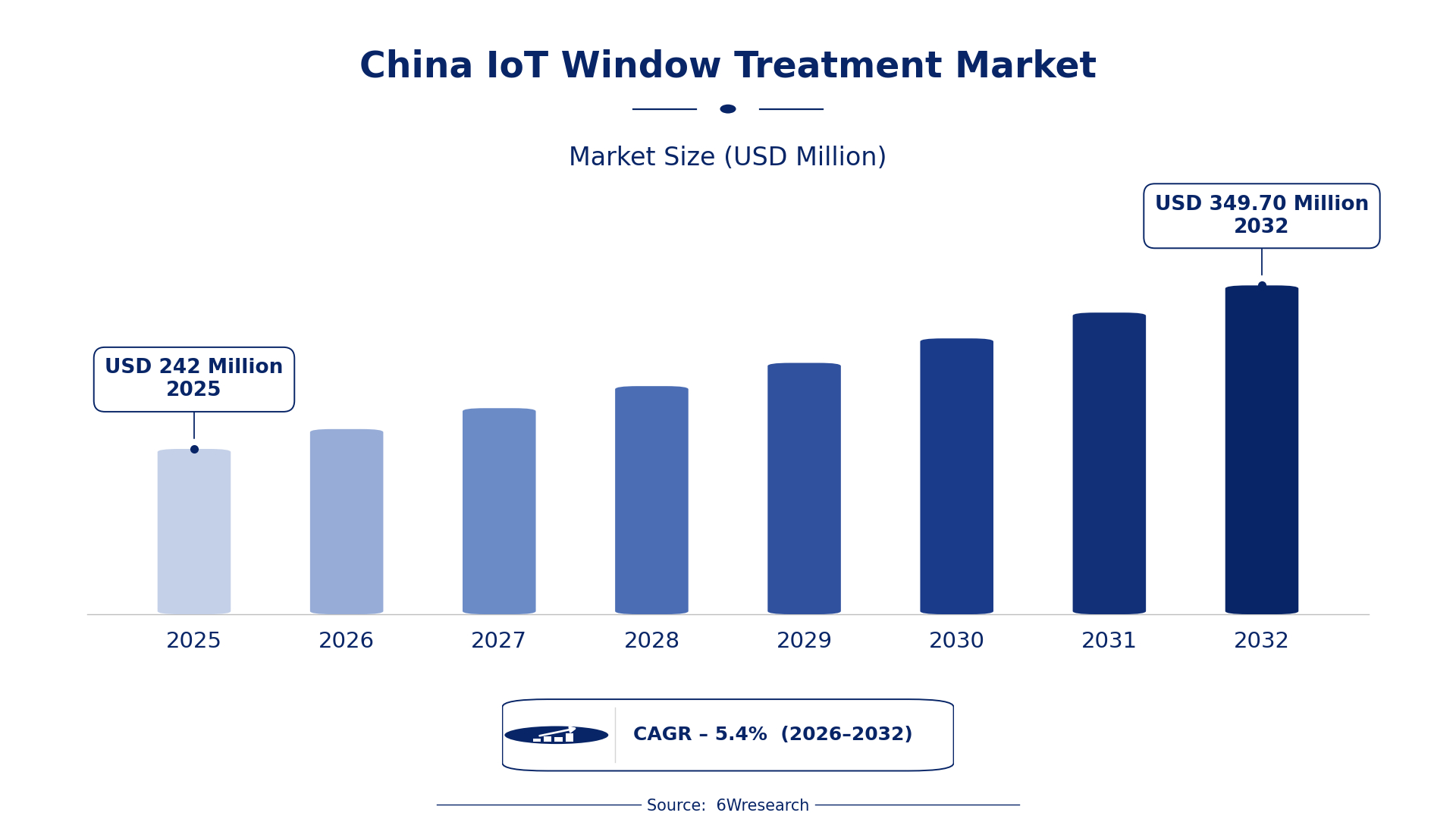
According to 6Wresearch internal database and industry insights, the China IoT Window Treatment Market was valued at USD 242.0 million in 2025 and is projected to reach USD 349.70 million by 2032, growing at a CAGR of approximately 5.4% during 2026–2032.
China IoT Window Treatment Market Highlights
| Report Metric | Details |
| Report Name | China IoT Window Treatment Market |
| Market Size 2025 | USD 242.0 million |
| Market Size 2032 | USD 349.70 million |
| Absolute Growth 2025–2032 | USD 107.70 million |
| CAGR 2026–2032 | 5.4% |
| Peak Annual Growth | 7.5% in 2029 |
| Forecast Period | 2026–2032 |
| Historical Data | 2022–2025 |
| Base Year | 2025 |
| Leading Product Type, 2025 | Smart Blinds (41% share) |
| Leading Control Interface, 2025 | Mobile App (49% share) |
| Leading Connectivity Type, 2025 | Wi-Fi (37% share) |
| Leading Power Source, 2025 | Battery Operated (46% share) |
| Leading End User, 2025 | Residential Users (35% share) |
| Fastest-Growing Product Type | Smart Curtains (7.2% CAGR) |
| Fastest-Growing Connectivity Type | Zigbee (7.8% CAGR) |
| Fastest-Growing Power Source | Wired (6.6% CAGR) |
| Fastest-Growing End User | Smart Home Builders (7.8% CAGR) |
| Growing Sector | Residential Users |
| Key End Users | Homeowners, Smart Home Builders, Residential Users, Office Spaces |
China IoT Window Treatment Market Year-wise Growth Rate and Key Drivers (2022–2032)
This graph illustrates the annual growth rates of the market from 2022 to 2032, highlighting a steady upward trajectory and projected market expansion over the forecast period.
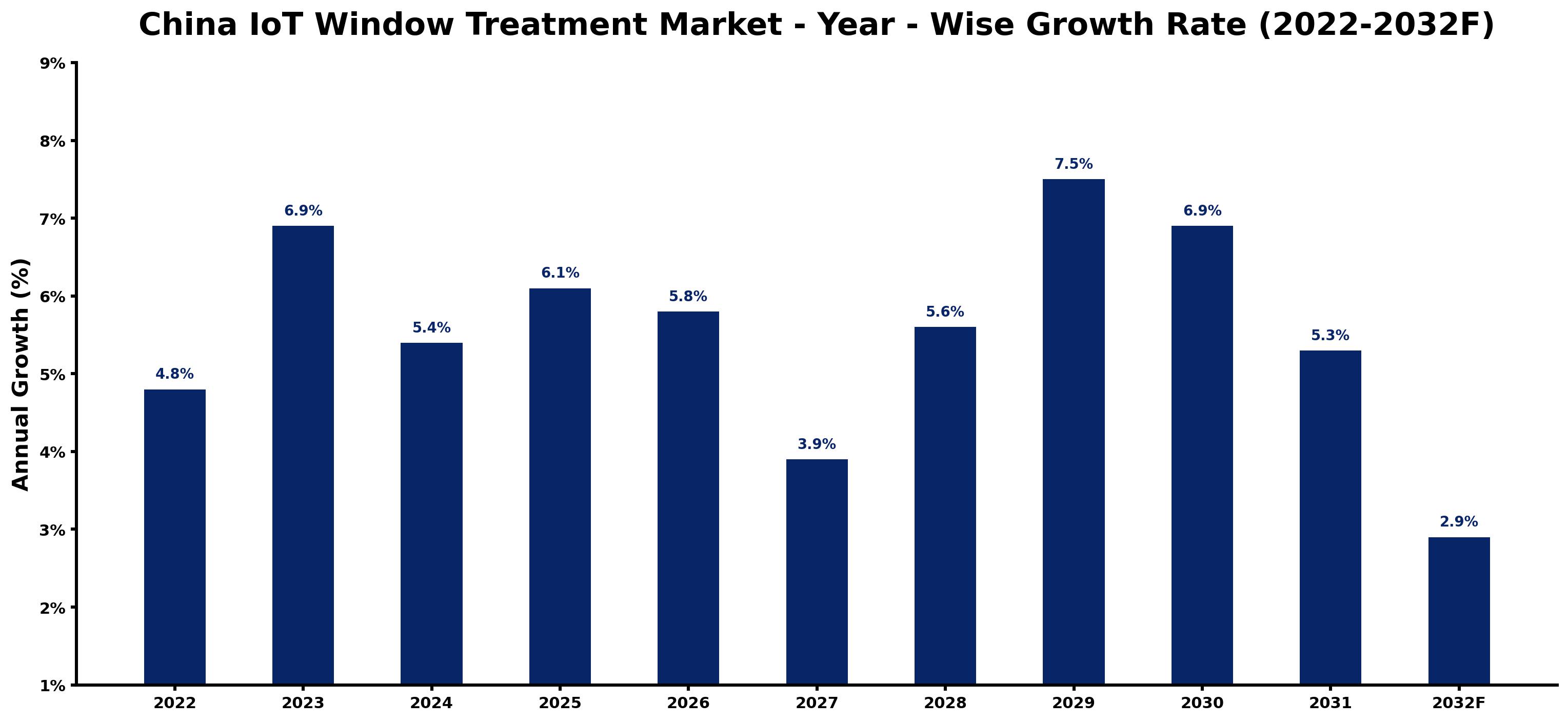
Below, each year's estimated growth is shown next to the factor that most influenced it.
| Year | Estimated Annual Growth (%) | Market Rationale |
| 2022 | 4.8 | The market showed steady growth, driven by increased urbanisation and smart home adoption. |
| 2023 | 6.9 | Demand surged as smart home technologies gained traction among homeowners in urban centres. |
| 2024 | 5.4 | Growth slowed as the market adjusted to higher competition and evolving consumer preferences. |
| 2025 | 6.1 | A resurgence in demand was noted, particularly in luxury residential developments. |
| 2026 | 5.8 | Market growth decelerated as buyers became more selective in their smart home investments. |
| 2027 | 3.9 | The market experienced a further slowdown due to rising costs and supply chain challenges. |
| 2028 | 5.6 | Demand rebounded as energy efficiency became a priority for homeowners and builders. |
| 2029 | 7.5 | Growth peaked as innovative smart window treatments were introduced to the market. |
| 2030 | 6.9 | The market saw a slight slowdown as consumers focused on product reliability and integration. |
| 2031 | 5.3 | Demand continued to slow as buyers sought more cost-effective solutions. |
| 2032 | 2.9 | Growth stabilised as the market matured and competition intensified. |
Note: Market size estimations and growth projections presented in this report are based on 6Wresearch's proprietary forecasting methodology, utilizing the latest available industry data, government publications, and primary research inputs.
China IoT Window Treatment Market Synopsis
IoT Window Treatment Market in China encompasses smart blinds, curtains, and shades equipped with sensors for energy efficiency and home automation. These products are made from materials like fabric and plastic, enhancing privacy and convenience. The market is growing due to increasing urbanisation, with 1.5 billion users in the smart home sector. The 'Smart Living Initiative' and rising demand from residential users are driving new purchases.
Market Dynamics Impact Analysis (2026–2032)
| Factor | Type | Impact | Primary Segment Affected |
| Increasing urbanisation and smart home adoption drive demand for energy-efficient solutions. | Driver | High | Smart Blinds |
| Luxury residential developments are increasingly integrating smart curtains for enhanced living environments. | Driver | High | Smart Curtains |
| Growing demand for energy-efficient products presents opportunities for innovative solutions. | Opportunity | High | Motorized Shades |
| The rise of smart home builders creates a demand for integrated window treatment solutions. | Opportunity | High | Smart Home Builders |
| High installation costs can deter potential buyers from adopting smart window treatments. | Restraint | Medium | Motorized Shades |
| Limited awareness of smart window treatment benefits restricts market growth in rural areas. | Restraint | Medium | Smart Blinds |
| Supply chain disruptions have led to delays in product availability for consumers. | Challenge | High | Smart Curtains |
| Regulatory complexities can slow down the approval process for new product launches. | Challenge | Medium | Motorized Shades |
Evaluation of Drivers in China IoT Window Treatment Market (2026–2032)
The factors lifting demand, and the evidence behind each, are summarised below.
| Drivers | Primary Segment Affected | Why It Matters (Evidence) |
| Rising urbanisation increases the demand for smart home technologies, with 1.5 billion users in 2022. | Smart Blinds | This trend leads to more homeowners seeking energy-efficient solutions to enhance their living spaces. |
| The luxury residential market is expanding, with a growing preference for smart curtains. | Smart Curtains | This shift encourages builders to integrate advanced window treatments into new luxury projects. |
| The increase in energy costs drives demand for motorized shades that improve energy efficiency. | Motorized Shades | Homeowners are investing in solutions that help reduce their energy bills, particularly in urban areas. |
| The popularity of smart home builders is creating a larger market for integrated window treatments. | Smart Home Builders | These builders are increasingly collaborating with technology firms to offer tailored solutions for modern homes. |
| Consumer interest in automation and convenience boosts the adoption of sensor-based automation features. | Sensor-Based Automation | This interest results in higher sales of IoT window treatments with advanced functionalities that enhance user experience. |
Growth across the IoT Window Treatment market in China is anchored in rising urbanisation, increasing energy costs, and the expansion of luxury residential developments. In 2022, the smart home market reached 1.5 billion users, driving demand for energy-efficient solutions. The luxury residential sector is integrating smart curtains, improving living environments. Homeowners are increasingly investing in motorized shades to reduce energy bills, reflecting a shift towards automation and convenience. The popularity of smart home builders is expanding the market for integrated window treatments, as they partner with technology firms for advanced solutions.
Evaluation of Restraints in China IoT Window Treatment Market
The key brakes on demand, and where they bite hardest, are shown below.
| Market Restraint | Primary Segment Affected | Why It Matters (Evidence) |
| High installation costs deter potential buyers, limiting market access for some consumers. | Motorized Shades | This can result in lower adoption rates among budget-conscious homeowners who seek affordable solutions. |
| Limited awareness of smart window treatment benefits restricts market growth in rural areas. | Smart Blinds | Consumers in these regions may not understand the advantages of these technologies, leading to lower sales. |
| Supply chain disruptions have led to delays in product availability for consumers. | Smart Curtains | This can frustrate buyers and lead to lost sales opportunities, particularly in urban markets. |
| Regulatory complexities can slow down the approval process for new product launches. | Motorized Shades | This can delay market entry for new solutions, impacting competitive positioning for manufacturers. |
| Competition from traditional window treatments limits market penetration of smart options. | Smart Blinds | Some consumers prefer familiar products over newer technologies, hindering market growth. |
China IoT Window Treatment Market Challenges
Buyers in the China IoT Window Treatment market face technological limitations, as many products lack essential connectivity features, which reduces their attractiveness and slows market growth. Skills shortages among installers lead to delays in system implementation, increasing installation costs for homeowners and hindering overall market efficiency. The average price of smart blinds, around 1500 RMB per unit, can deter purchases in less affluent urban areas, limiting market penetration. Fluctuating demand from consumers, especially in tier-2 cities, complicates inventory management for suppliers, resulting in excess stock and increased holding costs.
Trends in the China IoT Window Treatment Market
Several trends are reshaping the China IoT Window Treatment Market; the most important are set out below.
- Integration of Smart Technologies in Luxury Homes: Luxury residential developments are increasingly incorporating smart curtains, improving convenience and aesthetics. The average household in China has 3-4 smart devices, including window treatments, indicating a shift towards integrated solutions.
- Growing Popularity of Voice-Controlled Systems: Voice-controlled systems are becoming standard in new smart home projects, improving user experience. The demand for smart window treatments is rising as these systems become more prevalent in residential applications, with a notable increase in installations.
- Rise of Smart Home Builders: Smart home builders are increasingly partnering with tech firms to install IoT window treatments. This trend is supported by the 'Digital China' initiative, which aims to integrate IoT in residential sectors, fostering collaboration between builders and technology providers.
- Shift Towards Energy-Efficient Solutions: Homeowners are increasingly prioritising energy efficiency in their window treatments, resulting in a rise in smart blinds. The market for motorized shades is expanding in tier-1 cities, reflecting this trend with a projected growth rate of 20% annually.
Investment Opportunities in the China IoT Window Treatment Market
Some of the investment opportunities in the China IoT Window Treatment Market are mentioned below.
- Expansion in Tier-1 Cities: Tier-1 cities offer opportunities for smart window treatment suppliers, with a burgeoning market driven by urbanisation. Smart home builders in these regions are actively seeking advanced solutions to meet consumer demands, creating a favourable environment for suppliers.
- Investment in Energy-Efficient Technologies: The demand for energy-efficient window treatments is increasing, particularly with the 'Green Building Action Plan' encouraging such products. Suppliers can target residential users aiming to reduce energy consumption and enhance home efficiency, capitalising on this trend.
- Integration of Smart Technologies: Luxury residential developments represent a key area for investment, with smart curtains gaining popularity. Suppliers can penetrate this market by collaborating with builders to offer tailored solutions that cater to the needs of affluent consumers.
- Focus on Smart Home Builders: Smart home builders are increasingly incorporating IoT window treatments into their projects. This trend is supported by urbanisation, with a marked increase in the number of smart homes, generating demand for innovative window solutions.
Government Initiatives in the China IoT Window Treatment Market
The 'Smart Home Development Plan' launched by the Ministry of Industry and Information Technology in 2021 encourages innovation and investment in smart home technologies. This measure supports producers in developing advanced products that meet evolving consumer demands and safety standards. The updated 'National Standard for Smart Home Systems' in 2021 further improves interoperability, ensuring that products work well together, which is vital for consumer acceptance. The 'Green Building Action Plan' approved by the National Development and Reform Commission in 2022 promotes energy-efficient products like smart window treatments, incentivising manufacturers to adopt sustainable practices.
In 2023, the State Council introduced the 'Digital Economy Development Strategy' to support IoT applications in residential sectors, including window treatments. This initiative aims to boost investment in smart technologies, with the Ministry of Housing and Urban-Rural Development overseeing its implementation. The 'Smart Living Initiative' initiated by the Ministry of Science and Technology in 2022 promotes the adoption of smart home technologies across urban areas, providing funding and resources for innovative projects. These measures enable producers to enhance their offerings and meet market demands effectively.
Future Insight of the China IoT Window Treatment Market
The China IoT Window Treatment market is set to undergo significant evolution by 2032, as the 'Smart Living Initiative' and 'Digital China' programme encourage greater IoT integration in residential settings. The installed base of smart window treatments is estimated to reach 10 million units, reflecting a 20% annual growth in the smart home sector. Increased collaboration between construction firms and technology providers will facilitate the development of more sophisticated product offerings. The focus on energy-efficient technologies, driven by the 'Green Building Action Plan', will further stimulate market growth.
Market Segmentation Analysis
The analysis below covers each segmentation, its leading category in 2025 and its fastest-growing category through 2032.
By Product Type – Smart Blinds Dominated, Smart Curtains Expected to Grow Fastest
According to Shubham Deep, Research Manager at 6Wresearch, Smart Blinds took a 41% share of product type in 2025, more than any other category. Smart blinds command the largest market share in China due to their popularity in urban centres like Beijing and Shanghai, where energy efficiency and home automation are priorities. With an installed base of around 10 million units, they play a crucial role in the smart home landscape. Smart Curtains are set to record the highest CAGR in this split, 7.2% over 2026–2032. Smart curtains are experiencing rapid growth, particularly in luxury residential developments, where their aesthetic appeal complements the demand for functional window treatments. This surge is driven by the increasing adoption of smart technologies in high-end housing projects. Suppliers should focus on enhancing the design and features of smart curtains to tap into the growing luxury market.
By Control Interface – Mobile App Dominated and Is Expected to Record the Fastest Growth
Mobile App held a 49% share of the China IoT Window Treatment Market by control interface in 2025. The mobile app leads the control interface segment, allowing users to manage their smart window treatments effortlessly, which is essential for modern smart home setups. Its widespread adoption reflects the reliance of households on multiple smart devices, necessitating a unified control system. Its lead should widen, with a projected CAGR of 7.1% during 2026–2032, the highest in this split. As the mobile app is also the fastest-growing interface, ongoing advancements will likely improve user experience and further propel the adoption of smart window treatments. This dual role indicates a strong trend towards app-based management solutions. Suppliers should prioritise mobile app development and user interface improvements to maintain a competitive advantage in the smart home sector.
By Connectivity Type – Wi-Fi Dominated, Zigbee Expected to Grow Fastest
The largest connectivity type category in 2025 was Wi-Fi, with a 37% share of total revenue. Wi-Fi is the predominant connectivity type for smart window treatments, providing essential connectivity for users who want to integrate their devices into existing home networks. Its widespread acceptance among consumers supports its leading market share. Zigbee is projected to grow fastest, at a CAGR of 7.8% during 2026–2032. Zigbee is emerging as the fastest-growing connectivity type, particularly among smart home builders who prefer its energy-efficient communication for device networks. This trend indicates a shift towards more specialised connectivity solutions in the market. Manufacturers should consider expanding their product lines to include Zigbee compatibility to meet the evolving preferences of smart home builders.
By Power Source – Battery Operated Dominated, Wired Expected to Grow Fastest
With a 46% revenue share in 2025, Battery Operated was the largest power source category. Battery-operated models are the dominant power source, offering ease of installation and flexibility, making them ideal for retrofitting existing homes with smart window treatments. This convenience is particularly appealing to urban consumers looking to upgrade their living spaces efficiently. The quickest growth will come from Wired, forecast to expand at a CAGR of 6.6% between 2026 and 2032. Wired systems are the fastest-growing segment as smart home builders increasingly favour reliable power sources that ensure consistent operation of smart devices. This trend suggests a shift towards more robust installation practices in new constructions. Suppliers should offer both battery-operated and wired solutions to cater to the diverse installation preferences of consumers and builders.
By End User – Residential Users Dominated, Smart Home Builders Expected to Grow Fastest
Residential Users accounted for a 35% market share by end user in 2025. Residential users represent the largest segment of the market, driven by the rising adoption of smart home technologies among those seeking enhanced energy efficiency and automation. This significant user base is essential for the continued growth of the IoT window treatment market. Smart Home Builders are set to record the highest CAGR in this split, 7.8% over 2026–2032. Smart home builders are the fastest-growing end user segment, integrating smart window treatments into new developments to meet the increasing demand for smart home solutions. This trend underscores the growing collaboration between builders and technology providers. Suppliers should strengthen partnerships with smart home builders to ensure their products are included in new residential projects.
Key Attractiveness of the Report
- 10 Years of Market Numbers
- Historical Data Starting from 2022 to 2025
- Base Year 2025
- Forecast Data until 2032
- Key Performance Indicators Impacting the Market
- Major Upcoming Developments and Projects
Key Highlights of the Report:
- China IoT Window Treatment Market Outlook
- Market Size of China IoT Window Treatment Market, 2025
- Forecast of China IoT Window Treatment Market, 2032
- Historical Data and Forecast of China IoT Window Treatment Revenues & Volume for the Period 2022 - 2032F
- China IoT Window Treatment Market Trend Evolution
- China IoT Window Treatment Market Drivers and Challenges
- China IoT Window Treatment Price Trends
- China IoT Window Treatment Porter's Five Forces
- China IoT Window Treatment Industry Life Cycle
- Historical Data and Forecast of China IoT Window Treatment Market Revenues & Volume By Product Type for the Period 2022 - 2032F
- Historical Data and Forecast of China IoT Window Treatment Market Revenues & Volume By Smart Blinds for the Period 2022 - 2032F
- Historical Data and Forecast of China IoT Window Treatment Market Revenues & Volume By Smart Curtains for the Period 2022 - 2032F
- Historical Data and Forecast of China IoT Window Treatment Market Revenues & Volume By Motorized Shades for the Period 2022 - 2032F
- Historical Data and Forecast of China IoT Window Treatment Market Revenues & Volume By Light-Sensing Blinds for the Period 2022 - 2032F
- Historical Data and Forecast of China IoT Window Treatment Market Revenues & Volume By Control Interface for the Period 2022 - 2032F
- Historical Data and Forecast of China IoT Window Treatment Market Revenues & Volume By Mobile App for the Period 2022 - 2032F
- Historical Data and Forecast of China IoT Window Treatment Market Revenues & Volume By Voice-Controlled for the Period 2022 - 2032F
- Historical Data and Forecast of China IoT Window Treatment Market Revenues & Volume By Remote Control for the Period 2022 - 2032F
- Historical Data and Forecast of China IoT Window Treatment Market Revenues & Volume By Sensor-Based Automation for the Period 2022 - 2032F
- Historical Data and Forecast of China IoT Window Treatment Market Revenues & Volume By Connectivity Type for the Period 2022 - 2032F
- Historical Data and Forecast of China IoT Window Treatment Market Revenues & Volume By Wi-Fi for the Period 2022 - 2032F
- Historical Data and Forecast of China IoT Window Treatment Market Revenues & Volume By Zigbee for the Period 2022 - 2032F
- Historical Data and Forecast of China IoT Window Treatment Market Revenues & Volume By Bluetooth for the Period 2022 - 2032F
- Historical Data and Forecast of China IoT Window Treatment Market Revenues & Volume By LoRa for the Period 2022 - 2032F
- Historical Data and Forecast of China IoT Window Treatment Market Revenues & Volume By Power Source for the Period 2022 - 2032F
- Historical Data and Forecast of China IoT Window Treatment Market Revenues & Volume By Battery Operated for the Period 2022 - 2032F
- Historical Data and Forecast of China IoT Window Treatment Market Revenues & Volume By Solar Powered for the Period 2022 - 2032F
- Historical Data and Forecast of China IoT Window Treatment Market Revenues & Volume By Wired for the Period 2022 - 2032F
- Historical Data and Forecast of China IoT Window Treatment Market Revenues & Volume By Rechargeable Battery for the Period 2022 - 2032F
- Historical Data and Forecast of China IoT Window Treatment Market Revenues & Volume By End User for the Period 2022 - 2032F
- Historical Data and Forecast of China IoT Window Treatment Market Revenues & Volume By Residential Users for the Period 2022 - 2032F
- Historical Data and Forecast of China IoT Window Treatment Market Revenues & Volume By Homeowners for the Period 2022 - 2032F
- Historical Data and Forecast of China IoT Window Treatment Market Revenues & Volume By Office Spaces for the Period 2022 - 2032F
- Historical Data and Forecast of China IoT Window Treatment Market Revenues & Volume By Smart Home Builders for the Period 2022 - 2032F
- China IoT Window Treatment Import Export Trade Statistics
- Market Opportunity Assessment By Product Type
- Market Opportunity Assessment By Control Interface
- Market Opportunity Assessment By Connectivity Type
- Market Opportunity Assessment By Power Source
- Market Opportunity Assessment By End User
- China IoT Window Treatment Top Companies Market Share
- China IoT Window Treatment Competitive Benchmarking By Technical and Operational Parameters
- China IoT Window Treatment Company Profiles
- China IoT Window Treatment Key Strategic Recommendations
Market Covered
Segments analysed in this report are listed below.
By Product Type
- Smart Blinds
- Smart Curtains
- Motorized Shades
- Light-Sensing Blinds
By Control Interface
- Mobile App
- Voice-Controlled
- Remote Control
- Sensor-Based Automation
By Connectivity Type
- Wi-Fi
- Zigbee
- Bluetooth
- LoRa
By Power Source
- Battery Operated
- Solar Powered
- Wired
- Rechargeable Battery
By End User
- Residential Users
- Homeowners
- Office Spaces
- Smart Home Builders































