China Semiconductor LiDAR Module Market Size & Growth Rate
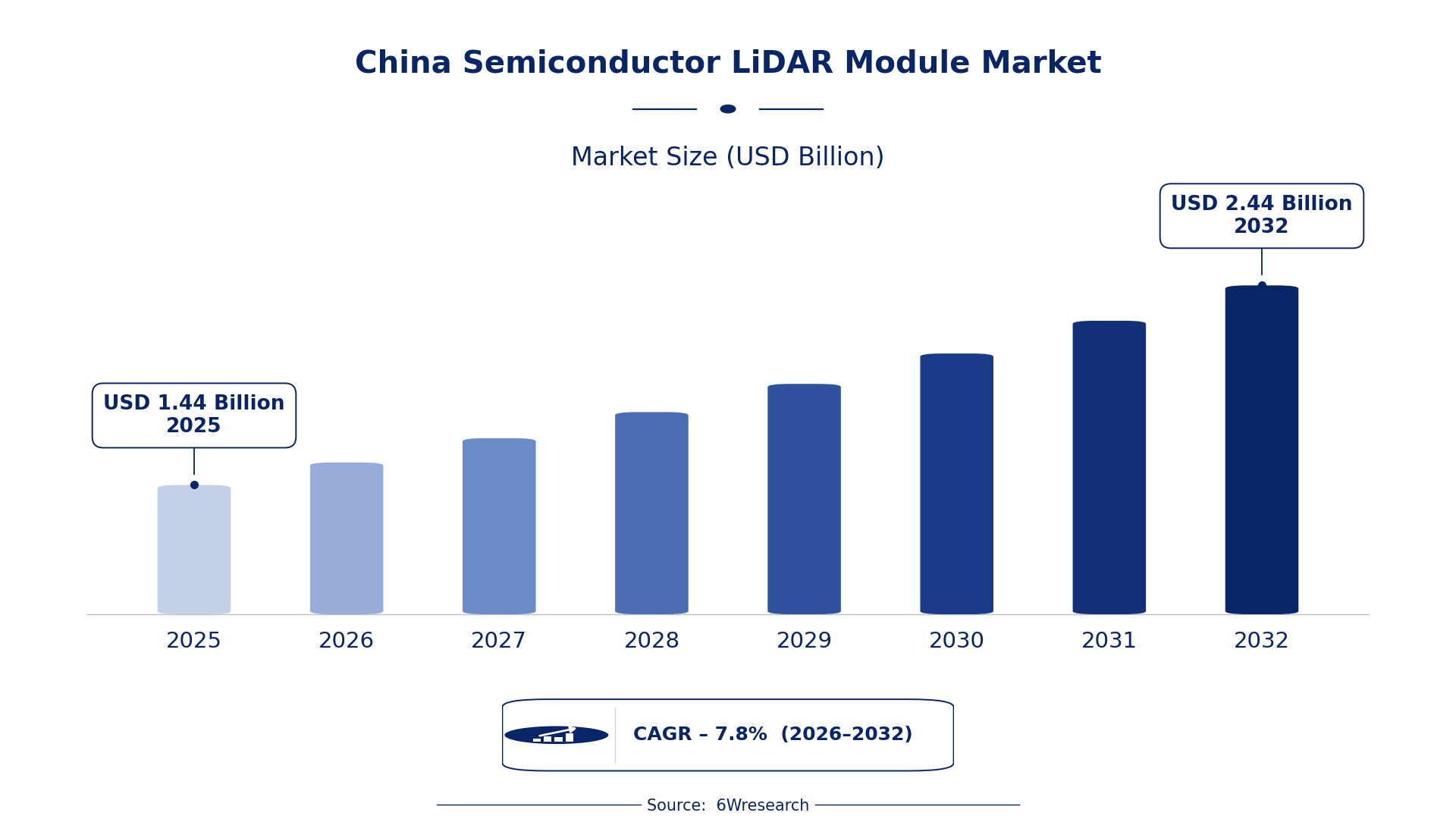
According to 6Wresearch internal database and industry insights, the China Semiconductor LiDAR Module Market was valued at USD 1.44 billion in 2025 and is projected to reach USD 2.44 billion by 2032, growing at a CAGR of approximately 7.8% during 2026–2032.
China Semiconductor LiDAR Module Market Highlights
| Report Metric | Details |
| Report Name | China Semiconductor LiDAR Module Market |
| Market Size 2025 | USD 1.44 billion |
| Market Size 2032 | USD 2.44 billion |
| Absolute Growth 2025–2032 | USD 1 billion |
| CAGR 2026–2032 | 7.8% |
| Peak Annual Growth | 10.2% in 2028 |
| Forecast Period | 2026–2032 |
| Historical Data | 2022–2025 |
| Base Year | 2025 |
| Leading Module Type, 2025 | Flash LiDAR (51% share) |
| Leading Light Source Type, 2025 | Solid-State Laser (39% share) |
| Leading Application Area, 2025 | ADAS (40% share) |
| Leading End User, 2025 | Electric Vehicle Makers (34% share) |
| Fastest-Growing Module Type | Hybrid LiDAR Modules (8.9% CAGR) |
| Fastest-Growing Application Area | Urban Navigation (9.6% CAGR) |
| Fastest-Growing End User | AV Startups (9.4% CAGR) |
| Growing Sector | Electric Vehicles |
| Key End Users | Electric Vehicle Makers, AV Startups, Automation Firms, Robo-Taxi Manufacturers |
China Semiconductor LiDAR Module Market Year-wise Growth Rate and Key Drivers (2022–2032)
This graph illustrates the annual growth rates of the market from 2022 to 2032, highlighting a steady upward trajectory and projected market expansion over the forecast period.
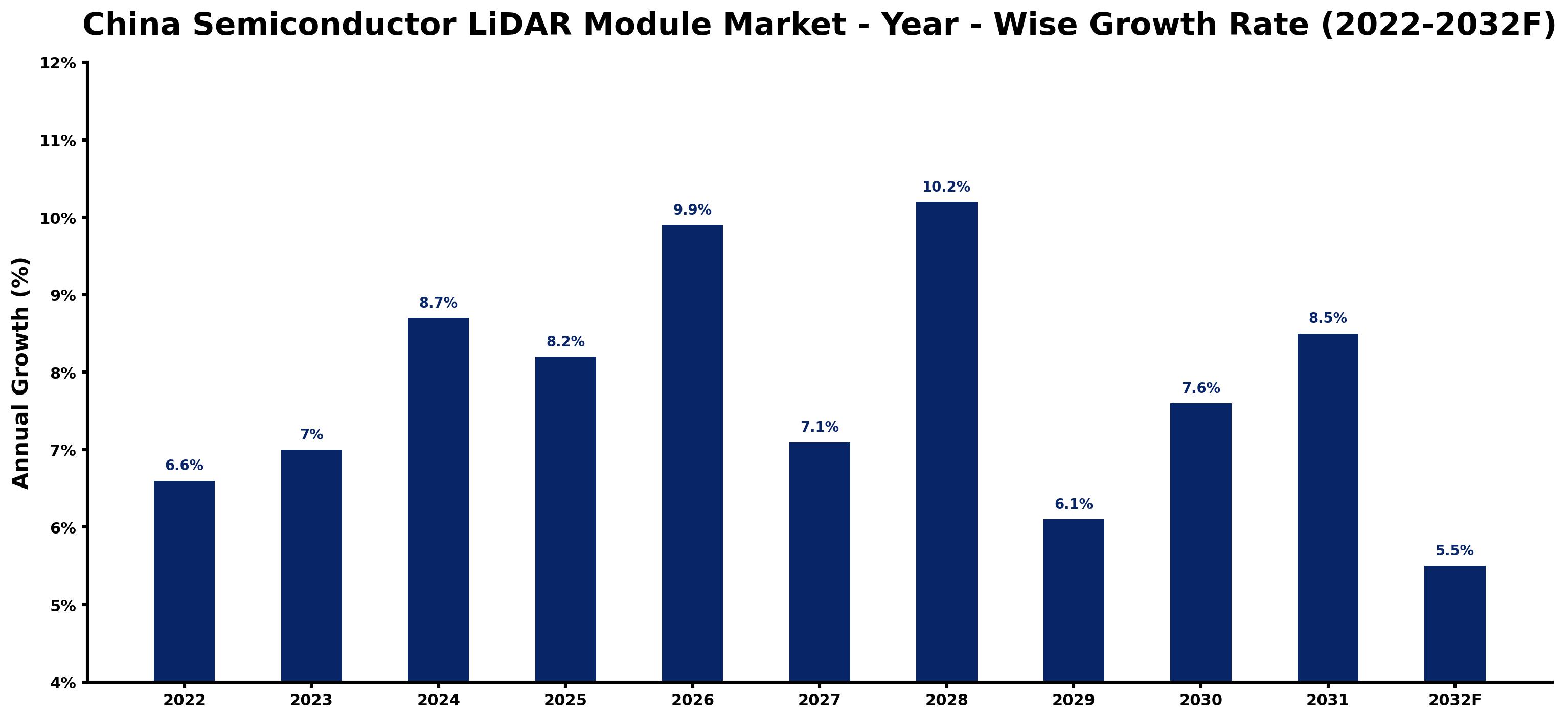
The following table presents the estimated annual growth rate for each year together with the principal factor influencing market performance.
| Year | Estimated Annual Growth (%) | Market Rationale |
| 2022 | 6.6 | The market experienced steady growth due to the increasing adoption of advanced technologies in urban navigation systems. |
| 2023 | 7.0 | Growth accelerated as electric vehicle manufacturers expanded their production capabilities, driving demand for LiDAR modules. |
| 2024 | 8.7 | Demand surged with the implementation of the 'National Standard for LiDAR in Transportation', improving safety and reliability. |
| 2025 | 8.2 | Growth slowed slightly as market adjustments followed rapid expansion in the electric vehicle sector. |
| 2026 | 9.9 | The market is projected to rebound with strong investments in smart city initiatives and infrastructure development. |
| 2027 | 7.1 | A slowdown is anticipated as the market stabilises after previous high growth rates in the autonomous vehicle sector. |
| 2028 | 10.2 | The market is expected to peak due to advancements in semiconductor technology and increased integration in vehicles. |
| 2029 | 6.1 | Growth will decelerate as the market normalises after reaching its peak in LiDAR adoption. |
| 2030 | 7.6 | Demand is projected to increase as urban navigation systems gain traction in smart cities, supported by government initiatives. |
| 2031 | 8.5 | The market will continue to grow as automation firms increasingly adopt LiDAR solutions for improved precision. |
| 2032 | 5.5 | Growth is expected to slow as the market reaches a more sustainable development phase with established technologies. |
Note: Market size estimations and growth projections presented in this report are based on 6Wresearch's proprietary forecasting methodology, utilizing the latest available industry data, government publications, and primary research inputs.
China Semiconductor LiDAR Module Market Synopsis
The China Semiconductor LiDAR Module Market includes advanced sensing devices that measure distances using light through semiconductor technology. These modules play a crucial role in applications such as autonomous vehicles, robotics, and urban navigation systems. The market is growing due to strong demand from domestic electric vehicle manufacturers and automation firms, along with substantial investments in smart city projects.
Market Dynamics Impact Analysis (2026–2032)
| Factor | Type | Impact | Primary Segment Affected |
| Growing investments in smart city projects drive demand for urban navigation systems. | Driver | High | Urban Navigation |
| The increasing number of registered AV startups creates a competitive landscape for LiDAR technology. | Driver | High | Electric Vehicle Makers |
| Expansion of urban infrastructure in the Greater Bay Area presents opportunities for LiDAR integration. | Opportunity | High | Urban Navigation |
| The push for advanced driver-assistance systems in vehicles opens new markets for LiDAR technology. | Opportunity | High | ADAS |
| High development costs for LiDAR technology can limit market penetration. | Restraint | Medium | Flash LiDAR |
| Regulatory compliance requirements may slow down product development timelines. | Restraint | Medium | Solid-State Laser |
| Limited awareness among traditional industries about LiDAR benefits hampers adoption. | Challenge | Medium | Industrial Robots |
| Competition from alternative sensing technologies poses a risk to market growth. | Challenge | Medium | FMCW LiDAR |
Evaluation of Drivers in China Semiconductor LiDAR Module Market (2026–2032)
The table below links each growth driver to the segment it affects and the evidence for it.
| Drivers | Primary Segment Affected | Why It Matters (Evidence) |
| Rising demand for autonomous vehicles | Electric Vehicle Makers | This demand increases the need for reliable LiDAR modules, as evidenced by Flash LiDAR technology used in over 50% of new electric vehicle models. |
| Integration of LiDAR in urban navigation systems | Urban Navigation | Smart city initiatives promote this integration, creating new opportunities for suppliers and enhancing navigation solutions. |
| Expansion of automation in manufacturing | Industrial Robots | The installed base of industrial robots reached 1 million units in 2023, driving the need for precision sensing solutions. |
| Government support for semiconductor technologies | ADAS | The 'Made in China 2025' initiative promotes semiconductor technologies, boosting demand for advanced driver-assistance systems. |
| Growth of electric vehicle production | AV Startups | This growth supports the demand for reliable LiDAR modules, essential for developing autonomous vehicles. |
Market growth for Semiconductor LiDAR Module in China is driven by increasing demand for autonomous vehicles, urban navigation systems, and the expansion of automation in manufacturing. The installed base of industrial robots reached 1 million units in 2023, creating a need for precision sensing solutions. The rise in electric vehicle production is boosting the demand for reliable LiDAR modules, as shown by the use of Flash LiDAR technology in over 50% of new electric vehicle models.
Evaluation of Restraints in China Semiconductor LiDAR Module Market
The table below lists the restraints and the evidence behind each.
| Market Restraint | Primary Segment Affected | Why It Matters (Evidence) |
| High development costs for LiDAR technology can limit market penetration. | Flash LiDAR | Development costs can exceed USD 500,000 for advanced systems, affecting affordability. |
| Regulatory compliance requirements may slow down product development timelines. | Solid-State Laser | Compliance with safety standards can delay product launches by up to six months. |
| Limited awareness among traditional industries about LiDAR benefits hampers adoption. | Industrial Robots | Many manufacturers remain unaware of the advantages of integrating LiDAR, limiting demand. |
| Competition from alternative sensing technologies poses a risk to market growth. | FMCW LiDAR | Emerging technologies may capture market share, impacting LiDAR sales. |
| Market saturation in urban navigation systems could limit future growth. | Urban Navigation | As more solutions enter the market, differentiation becomes challenging. |
China Semiconductor LiDAR Module Market Challenges
The Semiconductor LiDAR Module market in China faces regulatory challenges that can delay product approvals, costing producers up to six months in time and lost revenue. Compliance with standards set by the Ministry of Industry and Information Technology in 2022 requires manufacturers to allocate additional resources, affecting their operational efficiency. Technological pressures arise as producers must invest heavily in R&D to remain competitive, with costs potentially exceeding 20% of their budgets, which can hinder their ability to innovate. Intense competition among over 1,000 registered AV startups drives prices down, reducing profit margins for producers and limiting their capacity to invest in new technologies.
Trends in the China Semiconductor LiDAR Module Market
Below mentioned are some of the trends shaping the China Semiconductor LiDAR Module Market growth.
- Shift from Mechanical to Solid-State LiDAR: A transition from mechanical LiDAR systems to solid-state solutions is occurring, improving reliability and reducing costs. In 2023, solid-state LiDAR accounted for 39% of the market, reflecting this shift.
- Increased Integration of LiDAR in Electric Vehicles: Electric vehicle makers are integrating LiDAR technology into their designs, improving safety and automation. Flash LiDAR technology is used in over 50% of new electric vehicle models, indicating strong demand.
- Expansion of Smart City Projects: Urban areas are adopting smart city initiatives that incorporate advanced navigation systems using LiDAR. The Greater Bay Area is a key region for this development, driving demand for urban navigation solutions.
- Growth of Automation in Manufacturing: The rise of automation in manufacturing is increasing the demand for precision sensing technologies like LiDAR. The installed base of industrial robots in China reached 1 million units in 2023, highlighting this trend.
Investment Opportunities in the China Semiconductor LiDAR Module Market
Some of the investment opportunities in the China Semiconductor LiDAR Module Market are mentioned below.
- Greater Bay Area Development: The Greater Bay Area is becoming a hub for LiDAR technology, with investment opportunities projected to reach USD 1.44 billion by 2025. Local partnerships can facilitate market entry and collaboration.
- Supply of Advanced LiDAR Modules: There is a growing demand for advanced LiDAR modules in electric vehicles, particularly for ADAS applications. Electric vehicle makers are actively seeking reliable suppliers to meet this demand.
- Investment in Smart City Infrastructure: Investment in smart city infrastructure is rising, creating demand for urban navigation solutions. The Chinese government aims for 5G coverage in all major cities by 2025, enhancing LiDAR applications.
- Integration of LiDAR in Automation: The automation sector is increasingly adopting LiDAR for precision tasks. With the installed base of industrial robots reaching 1 million units, suppliers can target this growing market.
Government Initiatives in the China Semiconductor LiDAR Module Market
In 2023, the National Development and Reform Commission launched the 'Smart Transportation Development Plan', which aims to integrate advanced technologies like LiDAR into urban infrastructure. This plan builds upon previous measures by providing a framework for improving transportation systems, thereby promoting innovation and development. The 'National Key R&D Program for Intelligent Transportation Systems', initiated in 2022, supports research and development projects focused on LiDAR technology, enabling manufacturers to access advanced solutions and improve their vehicles' safety and automation features. The 'New Energy Vehicle Industry Development Plan' outlines support for LiDAR integration in electric vehicles, targeting 20% market penetration by 2025, which will significantly benefit producers and buyers alike.
Buyers, particularly electric vehicle manufacturers, benefit from the 'National Key R&D Program for Intelligent Transportation Systems' initiated in 2022. This program funds research and development projects focused on LiDAR technology, enabling manufacturers to access advanced solutions and improve their vehicles' safety and automation features. The Ministry of Industry and Information Technology plays a significant role in approving standards and guidelines for LiDAR systems, ensuring compliance and safety in applications. The 'Green Vehicle Development Program' promotes the use of advanced technologies in electric vehicles, further driving demand for LiDAR modules.
Future Insight of the China Semiconductor LiDAR Module Market
The Semiconductor LiDAR Module market in China is expected to evolve by 2032, driven by the 'Smart Transportation Development Plan' which will enhance infrastructure for autonomous vehicles. The installed base of industrial robots is projected to reach 2 million units, significantly increasing the demand for advanced navigation solutions. With the goal of achieving 5G coverage in all major cities by 2025, LiDAR technology will see improved integration and efficiency, benefiting both buyers and suppliers. The Greater Bay Area will emerge as a key centre for LiDAR development, fostering collaboration and innovation in the sector.
Market Segmentation Analysis
The analysis below covers each segmentation, its leading category in 2025 and its fastest-growing category through 2032.
By Module Type – Flash LiDAR Dominated, Hybrid LiDAR Modules Expected to Grow Fastest
According to Shubham Padhi, Research Analyst at 6Wresearch, in 2025, Flash LiDAR led the module type split with a 51% share. Flash LiDAR holds the largest market share due to its widespread use in high-resolution imaging for autonomous vehicles, which are gaining traction in China. The presence of over 1,000 registered AV startups underscores the strong demand for this advanced technology. Hybrid LiDAR Modules are set to record the highest CAGR in this split, 8.9% over 2026–2032. Hybrid LiDAR Modules are experiencing rapid growth as they combine multiple technologies, making them suitable for diverse urban navigation applications. This adaptability aligns with the increasing focus on smart city initiatives, which drive the need for versatile solutions. Suppliers should focus on enhancing Flash LiDAR capabilities while also exploring Hybrid LiDAR options to meet the growing urban navigation demands.
By Light Source Type – Solid-State Laser Dominated and Is Expected to Record the Fastest Growth
Solid-State Laser accounted for a 39% market share by light source type in 2025. Solid-State Laser dominates the market share because it provides reliable light sources essential for the effective operation of various LiDAR systems. Its consistent performance is particularly important for the expanding electric vehicle sector in China. Its lead should widen, with a projected CAGR of 10.3% during 2026–2032, the highest in this split. Solid-State Laser is both the leading and fastest-growing segment, as it significantly enhances the performance of LiDAR systems. With the rising demand for advanced sensing technologies, this segment is set for continued growth. Buyers should prioritise the integration of Solid-State Laser technologies into their LiDAR systems to guarantee optimal performance and reliability.
By Application Area – ADAS Dominated, Urban Navigation Expected to Grow Fastest
The largest application area category in 2025 was ADAS, with a 40% share of total revenue. ADAS captures the largest market share as it is critical for advanced driver-assistance systems in vehicles, which are increasingly being adopted by electric vehicle manufacturers. The regulatory push for safer driving technologies further solidifies its position. Urban Navigation is projected to grow fastest, at a CAGR of 9.6% during 2026–2032. Urban Navigation is the fastest-growing area, driven by the expansion of smart city initiatives that demand efficient navigation solutions. As urban population density increases, the need for advanced navigation systems becomes more pressing. Suppliers must adapt their offerings to cater to the growing demand for Urban Navigation solutions alongside maintaining their ADAS capabilities.
By End User – Electric Vehicle Makers Dominated, AV Startups Expected to Grow Fastest
Electric Vehicle Makers took a 34% share of end user in 2025, more than any other category. Electric Vehicle Makers represent the largest market share as they are the primary users of LiDAR technology for autonomous driving, reflecting a notable shift towards electric mobility. This growth is further bolstered by government initiatives that support electric vehicles. The quickest growth will come from AV Startups, forecast to expand at a CAGR of 9.4% between 2026 and 2032. AV Startups are the fastest-growing end user segment, heavily relying on LiDAR technology for the development of autonomous vehicles. The surge in startup activity and investment in autonomous driving solutions indicates a bright future for this segment. Suppliers should collaborate with AV Startups to capitalise on the rapid advancements in autonomous vehicle technology and ensure their products meet emerging needs.
Key Attractiveness of the Report
- 10 Years of Market Numbers
- Historical Data Starting from 2022 to 2025
- Base Year 2025
- Forecast Data until 2032
- Key Performance Indicators Impacting the Market
- Major Upcoming Developments and Projects
Key Highlights of the Report:
- China Semiconductor LiDAR Module Market Outlook
- Market Size of China Semiconductor LiDAR Module Market, 2025
- Forecast of China Semiconductor LiDAR Module Market, 2032
- Historical Data and Forecast of China Semiconductor LiDAR Module Revenues & Volume for the Period 2022 - 2032F
- China Semiconductor LiDAR Module Market Trend Evolution
- China Semiconductor LiDAR Module Market Drivers and Challenges
- China Semiconductor LiDAR Module Price Trends
- China Semiconductor LiDAR Module Porter's Five Forces
- China Semiconductor LiDAR Module Industry Life Cycle
- Historical Data and Forecast of China Semiconductor LiDAR Module Market Revenues & Volume By Module Type for the Period 2022 - 2032F
- Historical Data and Forecast of China Semiconductor LiDAR Module Market Revenues & Volume By Flash LiDAR for the Period 2022 - 2032F
- Historical Data and Forecast of China Semiconductor LiDAR Module Market Revenues & Volume By MEMS-Based LiDAR for the Period 2022 - 2032F
- Historical Data and Forecast of China Semiconductor LiDAR Module Market Revenues & Volume By Hybrid LiDAR Modules for the Period 2022 - 2032F
- Historical Data and Forecast of China Semiconductor LiDAR Module Market Revenues & Volume By FMCW LiDAR for the Period 2022 - 2032F
- Historical Data and Forecast of China Semiconductor LiDAR Module Market Revenues & Volume By Light Source Type for the Period 2022 - 2032F
- Historical Data and Forecast of China Semiconductor LiDAR Module Market Revenues & Volume By Solid-State Laser for the Period 2022 - 2032F
- Historical Data and Forecast of China Semiconductor LiDAR Module Market Revenues & Volume By Mechanical Beam Steering for the Period 2022 - 2032F
- Historical Data and Forecast of China Semiconductor LiDAR Module Market Revenues & Volume By Beam Scanning + Flash for the Period 2022 - 2032F
- Historical Data and Forecast of China Semiconductor LiDAR Module Market Revenues & Volume By Frequency Modulation for the Period 2022 - 2032F
- Historical Data and Forecast of China Semiconductor LiDAR Module Market Revenues & Volume By Application Area for the Period 2022 - 2032F
- Historical Data and Forecast of China Semiconductor LiDAR Module Market Revenues & Volume By ADAS for the Period 2022 - 2032F
- Historical Data and Forecast of China Semiconductor LiDAR Module Market Revenues & Volume By Urban Navigation for the Period 2022 - 2032F
- Historical Data and Forecast of China Semiconductor LiDAR Module Market Revenues & Volume By Industrial Robots for the Period 2022 - 2032F
- Historical Data and Forecast of China Semiconductor LiDAR Module Market Revenues & Volume By Long-Range Detection for the Period 2022 - 2032F
- Historical Data and Forecast of China Semiconductor LiDAR Module Market Revenues & Volume By End User for the Period 2022 - 2032F
- Historical Data and Forecast of China Semiconductor LiDAR Module Market Revenues & Volume By Electric Vehicle Makers for the Period 2022 - 2032F
- Historical Data and Forecast of China Semiconductor LiDAR Module Market Revenues & Volume By AV Startups for the Period 2022 - 2032F
- Historical Data and Forecast of China Semiconductor LiDAR Module Market Revenues & Volume By Automation Firms for the Period 2022 - 2032F
- Historical Data and Forecast of China Semiconductor LiDAR Module Market Revenues & Volume By Robo-Taxi Manufacturers for the Period 2022 - 2032F
- China Semiconductor LiDAR Module Import Export Trade Statistics
- Market Opportunity Assessment By Module Type
- Market Opportunity Assessment By Light Source Type
- Market Opportunity Assessment By Application Area
- Market Opportunity Assessment By End User
- China Semiconductor LiDAR Module Top Companies Market Share
- China Semiconductor LiDAR Module Competitive Benchmarking By Technical and Operational Parameters
- China Semiconductor LiDAR Module Company Profiles
- China Semiconductor LiDAR Module Key Strategic Recommendations
Market Covered
The report offers an extensive study of the following market segments.
By Module Type
- Flash LiDAR
- MEMS-Based LiDAR
- Hybrid LiDAR Modules
- FMCW LiDAR
By Light Source Type
- Solid-State Laser
- Mechanical Beam Steering
- Beam Scanning + Flash
- Frequency Modulation
By Application Area
- ADAS
- Urban Navigation
- Industrial Robots
- Long-Range Detection
By End User
- Electric Vehicle Makers
- AV Startups
- Automation Firms
- Robo-Taxi Manufacturers































