China Shipborne Launch Technology Market Size & Growth Rate
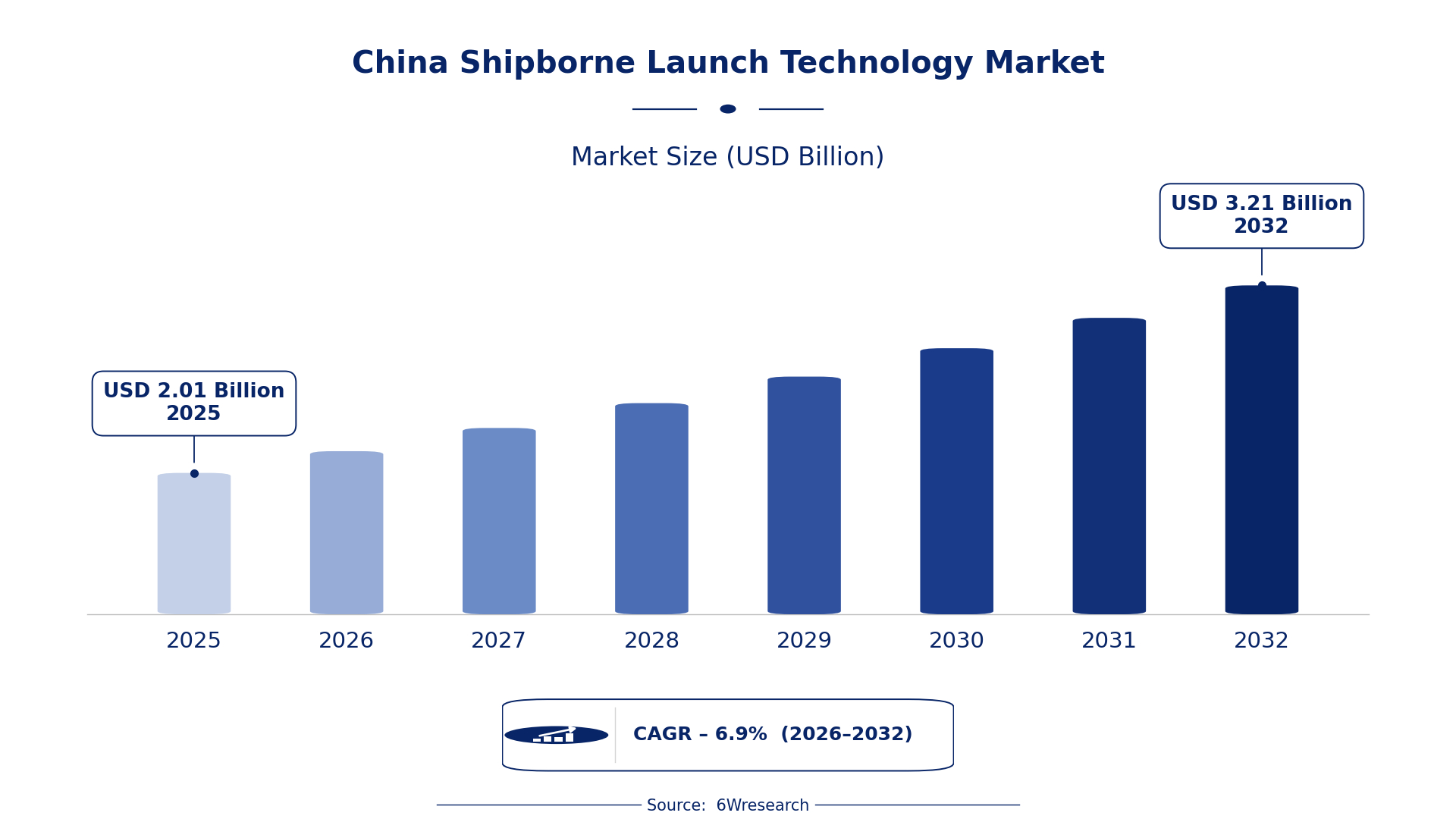
According to 6Wresearch internal database and industry insights, the China Shipborne Launch Technology Market was valued at USD 2.01 billion in 2025 and is projected to reach USD 3.21 billion by 2032, growing at a CAGR of approximately 6.9% during 2026–2032.
China Shipborne Launch Technology Market Highlights
| Report Metric | Details |
| Report Name | China Shipborne Launch Technology Market |
| Market Size 2025 | USD 2.01 billion |
| Market Size 2032 | USD 3.21 billion |
| Absolute Growth 2025–2032 | USD 1.20 billion |
| CAGR 2026–2032 | 6.9% |
| Peak Annual Growth | 10.0% in 2032 |
| Forecast Period | 2026–2032 |
| Historical Data | 2022–2025 |
| Base Year | 2025 |
| Leading Launch System Type, 2025 | Vertical Launch Systems (46% share) |
| Leading Payload Type, 2025 | Missiles (34% share) |
| Leading Ship Platform, 2025 | Aircraft Carriers (42% share) |
| Leading End User, 2025 | Navy (43% share) |
| Fastest-Growing Launch System Type | UAV Launch Platforms (8.1% CAGR) |
| Fastest-Growing Payload Type | Surveillance Drones (9.5% CAGR) |
| Fastest-Growing Ship Platform | Deck Mounted (9.2% CAGR) |
| Fastest-Growing End User | Naval Aviation (9.7% CAGR) |
| Growing Sector | Naval Aviation |
| Key End Users | Navy, Naval Aviation, Military Operators, Marine Defense |
China Shipborne Launch Technology Market Year-wise Growth Rate and Key Drivers (2022–2032)
This graph illustrates the annual growth rates of the market from 2022 to 2032, highlighting a steady upward trajectory and projected market expansion over the forecast period.
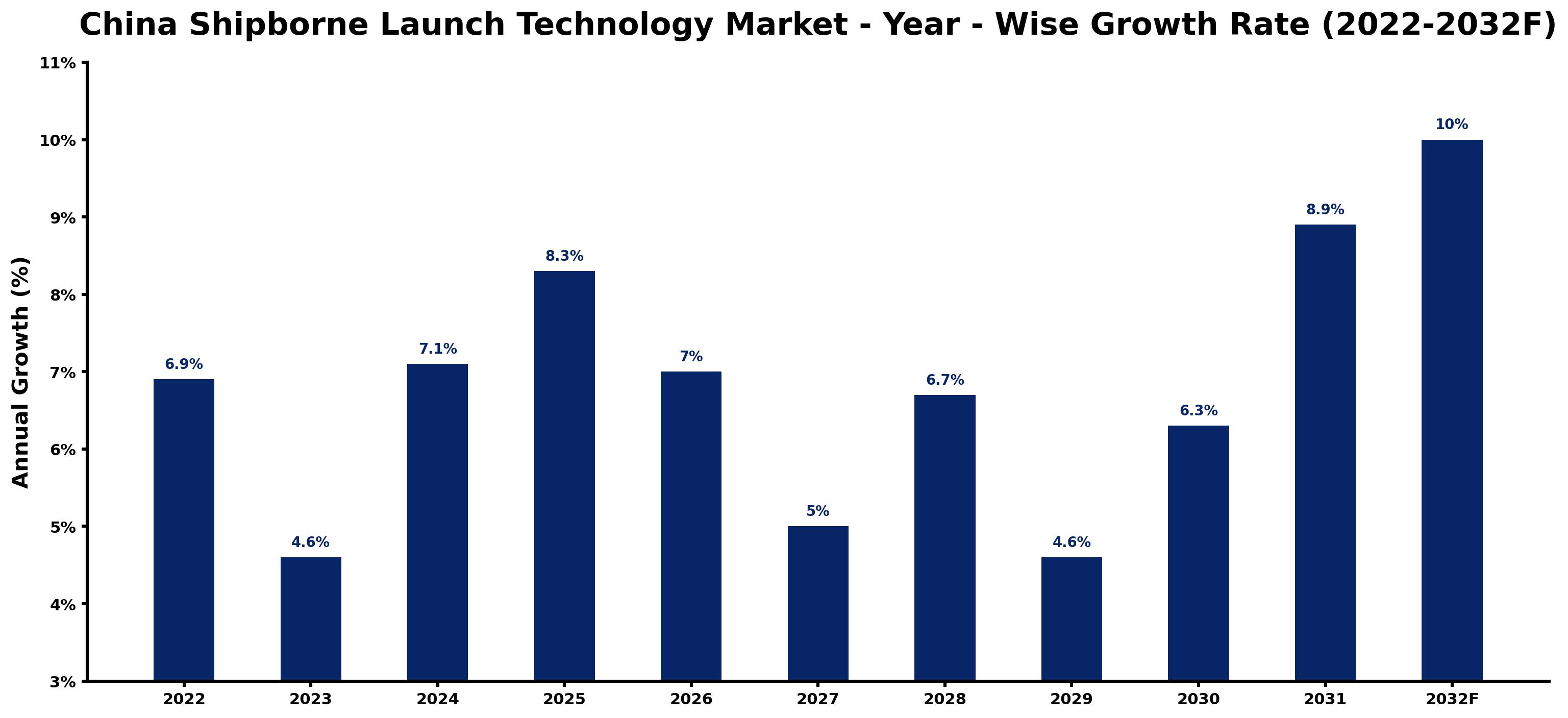
Annual growth estimates for each year appear below with the principal reason behind them, explaining the shifts that set the pace of the market.
| Year | Estimated Annual Growth (%) | Market Rationale |
| 2022 | 6.9 | The market experienced solid growth due to increased military spending and naval expansion initiatives. |
| 2023 | 4.6 | Growth slowed as the focus shifted towards integrating advanced technologies into existing systems. |
| 2024 | 7.1 | Demand surged with the launch of new submarines equipped with modern torpedo systems. |
| 2025 | 8.3 | Growth accelerated as the Navy expanded its aircraft carrier fleet to enhance operational capabilities. |
| 2026 | 7.0 | The market is expected to see a slowdown as investments are redirected towards research and development. |
| 2027 | 5.0 | Demand is projected to continue slowing as budget constraints affect procurement plans for new technologies. |
| 2028 | 6.7 | Growth is expected to rebound with increased naval exercises in the South China Sea stimulating demand. |
| 2029 | 4.6 | A slowdown is projected as the market adjusts to the saturation of certain launch technologies. |
| 2030 | 6.3 | Demand will increase as the Navy prioritises modernisation of existing shipborne systems. |
| 2031 | 8.9 | Growth is expected to pick up as new naval contracts are awarded for advanced launch technologies. |
| 2032 | 10.0 | The market is projected to peak with significant investments in advanced launch systems for naval operations. |
Note: Market size estimations and growth projections presented in this report are based on 6Wresearch's proprietary forecasting methodology, utilizing the latest available industry data, government publications, and primary research inputs.
China Shipborne Launch Technology Market Synopsis
Shipborne Launch Technology in China includes systems for deploying payloads from naval vessels, such as missiles and aircraft. Technologies like vertical launch systems and catapults are crucial for improving naval combat capabilities. The China Shipborne Launch Technology Market is expanding due to increased military investment and the growth of naval forces. In 2023, China's defense budget reached around $230 billion, with a strong focus on naval capabilities. The ongoing Naval Modernization Initiative further fuels demand for advanced shipborne technologies.
Market Dynamics Impact Analysis (2026–2032)
| Factor | Type | Impact | Primary Segment Affected |
| Increased military spending fuels demand for advanced naval technologies. | Driver | High | Vertical Launch Systems |
| Expansion of naval forces drives the need for enhanced launch capabilities. | Driver | High | Catapult Systems |
| Growing demand for UAV operations creates opportunities for innovative launch platforms. | Opportunity | High | UAV Launch Platforms |
| Investment in dual-use technologies opens new markets for shipborne systems. | Opportunity | Medium | Torpedo Launch Tubes |
| Budget constraints limit procurement of advanced systems. | Restraint | High | Missiles |
| Technological integration challenges hinder the adoption of new systems. | Restraint | Medium | Aircraft Carriers |
| Supply chain disruptions affect the availability of critical components. | Challenge | High | Destroyers/Frigates |
| Intense competition in the defense sector pressures pricing and innovation. | Challenge | Medium | Naval Aviation |
Evaluation of Drivers in China Shipborne Launch Technology Market (2026–2032)
The table below links each growth driver to the segment it affects and the evidence for it.
| Drivers | Primary Segment Affected | Why It Matters (Evidence) |
| Increased military spending by the government. | Vertical Launch Systems | China's defense budget for 2023 is approximately $230 billion, driving demand for advanced technologies. |
| Expansion of naval forces boosts operational capabilities. | Catapult Systems | The Chinese Navy aims to increase its aircraft carrier fleet to 6 by 2025, boosting demand for catapult systems. |
| Growing UAV operations in naval aviation units. | UAV Launch Platforms | Naval aviation units have expanded their UAV operations, utilising shipborne platforms for surveillance. |
| Focus on modernization of naval technologies. | Torpedo Launch Tubes | The National Defense Authorization Law emphasizes the modernization of naval technologies, including launch systems. |
| Development of advanced naval technologies through military-civil fusion. | Missiles | The 2023 Military-Civil Fusion Strategy promotes collaboration in developing advanced naval technologies. |
Market growth in China for Shipborne Launch Technology rests on increased military spending, expansion of naval forces, and growing UAV operations. The defense budget for 2023 is approximately $230 billion, which supports the development of advanced technologies. The goal to increase the aircraft carrier fleet to 6 by 2025 drives the need for catapult systems. Naval aviation units are expanding UAV operations, utilising shipborne platforms for reconnaissance missions.
Evaluation of Restraints in China Shipborne Launch Technology Market
The main factors holding the market back are set out below.
| Market Restraint | Primary Segment Affected | Why It Matters (Evidence) |
| Budget constraints limit procurement of advanced systems. | Missiles | China's defense budget allocations may restrict spending on new missile systems, affecting availability. |
| Technological integration challenges hinder the adoption of new systems. | Aircraft Carriers | Complex integration of advanced technologies into existing carriers can delay upgrades and operational readiness. |
| Supply chain disruptions affect the availability of critical components. | Destroyers/Frigates | Global supply chain issues have led to delays in acquiring essential components for naval vessels. |
| Regulatory hurdles slow down the approval process for new technologies. | Naval Aviation | Compliance with national standards can prolong the development and deployment of new systems. |
| Market saturation in certain launch technologies limits growth potential. | UAV Launch Platforms | The rapid adoption of existing UAV technologies may lead to decreased demand for new platforms. |
China Shipborne Launch Technology Market Challenges
Buyers and suppliers in the China Shipborne Launch Technology market face rising production costs, primarily due to the intricate engineering required for advanced launch systems. This complexity can inflate expenses by approximately 20%, directly impacting producers' profit margins. Supply chain challenges arise as reliance on specific materials can delay production timelines by several months, affecting delivery schedules for the Navy. Military buyers encounter operational delays as they await essential systems, which can compromise their strategic readiness. A shortage of skilled engineers further complicates matters; the demand for expertise has surged, creating a talent gap that hampers innovation and development efforts.
Trends in the China Shipborne Launch Technology Market
Buyers and suppliers in the China Shipborne Launch Technology Market are adjusting to the following trends.
- Shift towards Advanced UAV Launch Systems: China is increasingly adopting advanced UAV launch systems to enhance naval reconnaissance capabilities. In 2022, naval aviation units expanded UAV operations, using shipborne platforms for surveillance missions, reflecting a growing emphasis on modern warfare.
- Transition to Enhanced Vertical Launch Systems: The Chinese Navy is moving towards enhanced vertical launch systems for more effective missile deployment. The Type 055 destroyer features advanced vertical launch systems, demonstrating a commitment to modernising naval capabilities with over 300 ships equipped.
- Emergence of Integrated Naval Technologies: Integrated naval technologies are gaining traction in China's defense sector. The National Defense Technology Development Plan 2022 aims to allocate $50 billion towards improving naval launch systems, promoting innovation and collaboration.
- Prioritisation of Maritime Defense Strategies: China's focus on maritime defense strategies is intensifying, particularly in the South China Sea. The 2023 Maritime Security Strategy emphasises advanced launch technologies, ensuring naval forces are well-prepared for regional security.
Investment Opportunities in the China Shipborne Launch Technology Market
Some of the investment opportunities in the China Shipborne Launch Technology Market are mentioned below.
- Dalian Shipbuilding Facility Expansion: Dalian is expanding its shipbuilding capacity with a $500 million investment, addressing the demand for advanced launch systems. This facility aims to support the Navy's growing needs for modern naval technologies.
- $50 Billion Investment in Naval Technologies: The National Defense Technology Development Plan 2022 allocates $50 billion for improving naval launch systems, creating opportunities for suppliers. Collaborating with local manufacturers can facilitate entry into this expanding market.
- Increased Demand from Naval Aviation Units: Naval aviation units are broadening their capabilities, driving demand for advanced launch systems. Suppliers can partner with military operators to meet the needs of this growing segment.
- Focus on South China Sea Operations: The South China Sea is a key operational area for the Chinese Navy, requiring advanced launch technologies. Suppliers should consider forming partnerships with local firms to access this strategic market.
Government Initiatives in the China Shipborne Launch Technology Market
In 2021, the Ministry of National Defense launched the 'Naval Modernization Initiative' to improve shipborne launch capabilities with a focus on advanced technologies and increased funding. This initiative aims to enhance the operational readiness of naval forces by integrating modern systems. It is expected to allocate substantial resources towards research and development, ensuring that the Chinese Navy remains competitive in regional security. It also aims to encourage collaboration between military and civilian sectors to drive innovation in naval technologies. This initiative is a key component of China's broader defense strategy, which prioritises naval power.
The Ministry of National Defense oversees the implementation of the 'Maritime Defense Strategy 2023' to strengthen naval capabilities, including improved shipborne launch systems. This strategy outlines specific funding allocations for the development of advanced technologies and aims to improve the overall effectiveness of naval operations. The Ministry ensures that resources are directed towards priority projects, promoting joint ventures between public and private sectors to accelerate the development of innovative naval solutions. This collaborative approach is expected to yield notable advancements in shipborne launch technologies.
Future Insight of the China Shipborne Launch Technology Market
The China Shipborne Launch Technology market will experience substantial changes by 2032, driven by the focus on dual-use technologies in the 2023 Military-Civil Fusion Strategy. The Chinese Navy aims to expand its aircraft carrier fleet to six by 2025, necessitating advanced launch capabilities. By 2025, the defense budget is projected to reach approximately $250 billion, facilitating the acquisition of cutting-edge systems. The implementation of the National Standard GB/T 12345-2020 will also raise specifications, ensuring alignment with modern naval requirements.
Market Segmentation Analysis
The report offers a comprehensive study of the following market segments and their leading categories in the market.
By Launch System Type – Vertical Launch Systems Dominated, UAV Launch Platforms Expected to Grow Fastest
According to Dhaval Chaurasia, Assistant Manager at 6Wresearch, Vertical Launch Systems held a 46% share of the China Shipborne Launch Technology Market by launch system type in 2025. Vertical Launch Systems hold the largest share as they are crucial for missile deployment from naval vessels, particularly on advanced ships like the Type 055 destroyer. With over 300 ships in China's naval forces equipped with these systems, they play a key role in enhancing combat capabilities. UAV Launch Platforms are projected to grow fastest, at a CAGR of 8.1% during 2026–2032. UAV Launch Platforms are witnessing rapid growth as the Chinese Navy expands its UAV operations, utilising shipborne platforms for surveillance missions. This increasing focus on reconnaissance capabilities is driving the demand for these platforms. Suppliers should prioritise advancements in UAV Launch Platforms to meet the rising demand from the Navy.
By Payload Type – Missiles Dominated, Surveillance Drones Expected to Grow Fastest
Missiles accounted for a 34% market share by payload type in 2025. Missiles dominate the market share as the primary payload for naval launch systems, essential for naval combat effectiveness. The Chinese Navy's emphasis on missile capabilities underscores the significance of this segment in enhancing naval power. Surveillance Drones are set to record the highest CAGR in this split, 9.5% over 2026–2032. Surveillance Drones are the fastest-growing payload type, propelled by the Navy's increasing reliance on drones for reconnaissance missions. This trend highlights the shift towards integrating advanced surveillance technologies into naval operations. Buyers should consider investing in surveillance drone capabilities to enhance operational effectiveness.
By Ship Platform – Aircraft Carriers Dominated, Deck Mounted Expected to Grow Fastest
With a 42% revenue share in 2025, Aircraft Carriers was the largest ship platform category. Aircraft Carriers lead the market share as they are equipped with advanced systems for launching aircraft, which are vital for naval operations. The Chinese Navy's goal to increase its aircraft carrier fleet to six by 2025 underscores their strategic importance. The quickest growth will come from Deck Mounted, forecast to expand at a CAGR of 9.2% between 2026 and 2032. Deck Mounted systems are experiencing rapid growth due to their versatility and application for various launch operations across different platforms. This adaptability is essential for meeting the Navy's expanding operational needs. Suppliers must focus on developing versatile deck-mounted systems to cater to the evolving requirements of the Navy.
By End User – Navy Dominated, Naval Aviation Expected to Grow Fastest
In 2025, Navy led the end user split with a 43% share. The Navy commands the largest market share as the primary user of shipborne launch technologies, which are essential for national defense. Their extensive fleet and ongoing modernization efforts drive demand for advanced systems that enhance operational capabilities. Over 2026–2032, Naval Aviation is expected to post the fastest growth, at a CAGR of 9.7%. Naval Aviation is the fastest-growing end user, increasingly relying on shipborne technologies for operational effectiveness, particularly with the development of the J-15 fighter jet. This trend indicates a strategic shift towards enhancing air capabilities at sea. Buyers in naval aviation should prioritise investments in shipborne launch technologies to maintain operational superiority.
Key Attractiveness of the Report
- 10 Years of Market Numbers
- Historical Data Starting from 2022 to 2025
- Base Year 2025
- Forecast Data until 2032
- Key Performance Indicators Impacting the Market
- Major Upcoming Developments and Projects
Key Highlights of the Report:
- China Shipborne Launch Technology Market Outlook
- Market Size of China Shipborne Launch Technology Market, 2025
- Forecast of China Shipborne Launch Technology Market, 2032
- Historical Data and Forecast of China Shipborne Launch Technology Revenues & Volume for the Period 2022 - 2032F
- China Shipborne Launch Technology Market Trend Evolution
- China Shipborne Launch Technology Market Drivers and Challenges
- China Shipborne Launch Technology Price Trends
- China Shipborne Launch Technology Porter's Five Forces
- China Shipborne Launch Technology Industry Life Cycle
- Historical Data and Forecast of China Shipborne Launch Technology Market Revenues & Volume By Launch System Type for the Period 2022 - 2032F
- Historical Data and Forecast of China Shipborne Launch Technology Market Revenues & Volume By Vertical Launch Systems for the Period 2022 - 2032F
- Historical Data and Forecast of China Shipborne Launch Technology Market Revenues & Volume By Catapult Systems for the Period 2022 - 2032F
- Historical Data and Forecast of China Shipborne Launch Technology Market Revenues & Volume By Torpedo Launch Tubes for the Period 2022 - 2032F
- Historical Data and Forecast of China Shipborne Launch Technology Market Revenues & Volume By UAV Launch Platforms for the Period 2022 - 2032F
- Historical Data and Forecast of China Shipborne Launch Technology Market Revenues & Volume By Payload Type for the Period 2022 - 2032F
- Historical Data and Forecast of China Shipborne Launch Technology Market Revenues & Volume By Missiles for the Period 2022 - 2032F
- Historical Data and Forecast of China Shipborne Launch Technology Market Revenues & Volume By Aircraft for the Period 2022 - 2032F
- Historical Data and Forecast of China Shipborne Launch Technology Market Revenues & Volume By Submarine Weapons for the Period 2022 - 2032F
- Historical Data and Forecast of China Shipborne Launch Technology Market Revenues & Volume By Surveillance Drones for the Period 2022 - 2032F
- Historical Data and Forecast of China Shipborne Launch Technology Market Revenues & Volume By Ship Platform for the Period 2022 - 2032F
- Historical Data and Forecast of China Shipborne Launch Technology Market Revenues & Volume By Destroyers/Frigates for the Period 2022 - 2032F
- Historical Data and Forecast of China Shipborne Launch Technology Market Revenues & Volume By Aircraft Carriers for the Period 2022 - 2032F
- Historical Data and Forecast of China Shipborne Launch Technology Market Revenues & Volume By Submarines for the Period 2022 - 2032F
- Historical Data and Forecast of China Shipborne Launch Technology Market Revenues & Volume By Deck Mounted for the Period 2022 - 2032F
- Historical Data and Forecast of China Shipborne Launch Technology Market Revenues & Volume By End User for the Period 2022 - 2032F
- Historical Data and Forecast of China Shipborne Launch Technology Market Revenues & Volume By Navy for the Period 2022 - 2032F
- Historical Data and Forecast of China Shipborne Launch Technology Market Revenues & Volume By Naval Aviation for the Period 2022 - 2032F
- Historical Data and Forecast of China Shipborne Launch Technology Market Revenues & Volume By Marine Defense for the Period 2022 - 2032F
- Historical Data and Forecast of China Shipborne Launch Technology Market Revenues & Volume By Military Operators for the Period 2022 - 2032F
- China Shipborne Launch Technology Import Export Trade Statistics
- Market Opportunity Assessment By Launch System Type
- Market Opportunity Assessment By Payload Type
- Market Opportunity Assessment By Ship Platform
- Market Opportunity Assessment By End User
- China Shipborne Launch Technology Top Companies Market Share
- China Shipborne Launch Technology Competitive Benchmarking By Technical and Operational Parameters
- China Shipborne Launch Technology Company Profiles
- China Shipborne Launch Technology Key Strategic Recommendations
Market Covered
Segments analysed in this report are listed below.
By Launch System Type
- Vertical Launch Systems
- Catapult Systems
- Torpedo Launch Tubes
- UAV Launch Platforms
By Payload Type
- Missiles
- Aircraft
- Submarine Weapons
- Surveillance Drones
By Ship Platform
- Destroyers/Frigates
- Aircraft Carriers
- Submarines
- Deck Mounted
By End User
- Navy
- Naval Aviation
- Marine Defense
- Military Operators































