China Smart Aviation Systems Market Size & Growth Rate
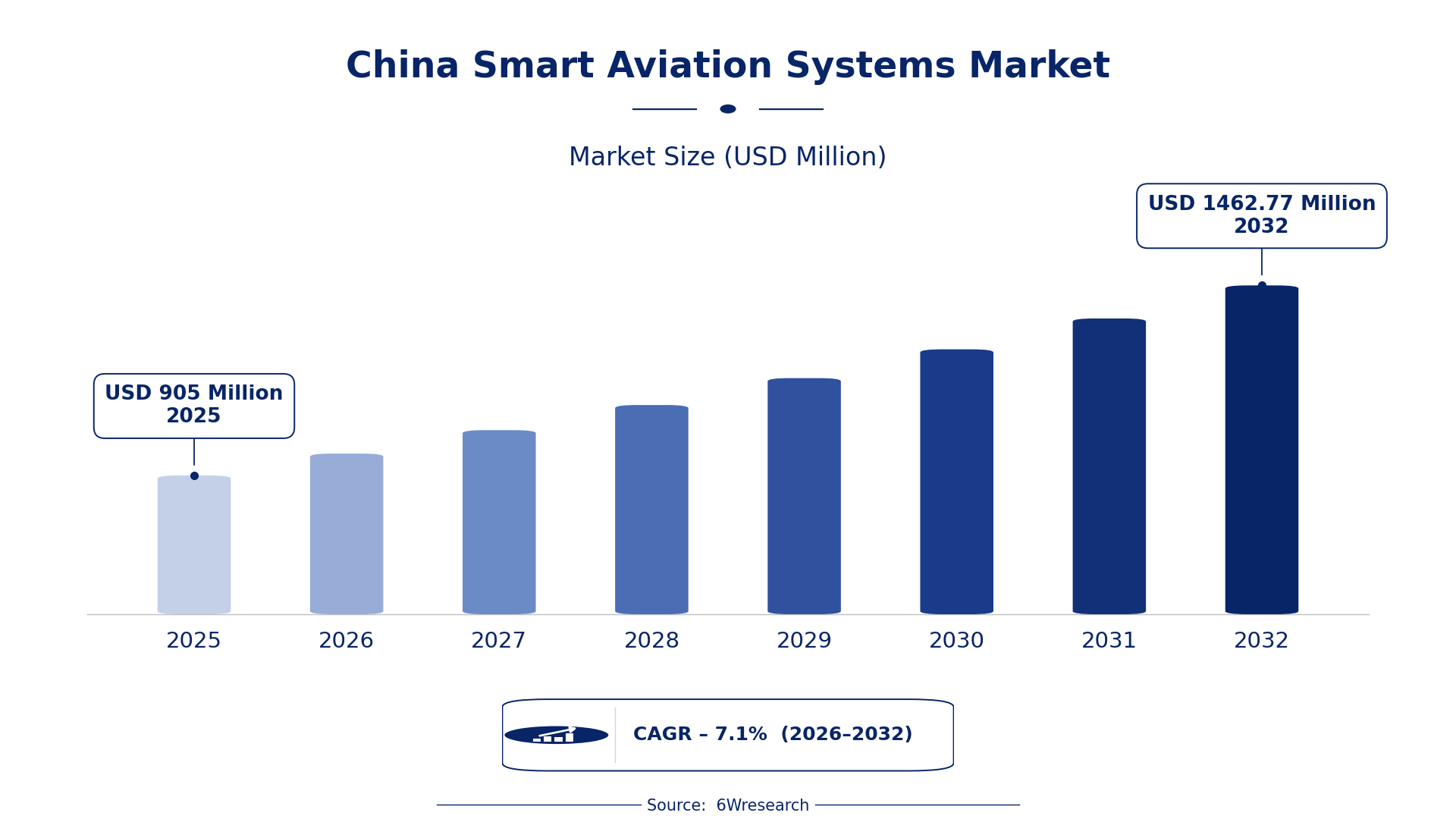
According to 6Wresearch internal database and industry insights, the China Smart Aviation Systems Market was valued at USD 905.0 million in 2025 and is projected to reach USD 1,462.77 million by 2032, growing at a CAGR of approximately 7.1% during 2026–2032.
China Smart Aviation Systems Market Highlights
| Report Metric | Details |
| Report Name | China Smart Aviation Systems Market |
| Market Size 2025 | USD 905.0 million |
| Market Size 2032 | USD 1,462.77 million |
| Absolute Growth 2025–2032 | USD 557.77 million |
| CAGR 2026–2032 | 7.1% |
| Peak Annual Growth | 9.3% in 2028 |
| Forecast Period | 2026–2032 |
| Historical Data | 2022–2025 |
| Base Year | 2025 |
| Leading System Type, 2025 | Predictive Maintenance (39% share) |
| Leading Smart Feature, 2025 | Sensor Data AI (40% share) |
| Leading Aircraft Type, 2025 | Commercial Aircraft (51% share) |
| Leading End User, 2025 | Airlines (52% share) |
| Fastest-Growing System Type | Cabin Automation (8.4% CAGR) |
| Fastest-Growing Aircraft Type | Regional Jets/Private Planes (9.3% CAGR) |
| Fastest-Growing End User | Defense OEMs (8.4% CAGR) |
| Growing Sector | Aviation |
| Key End Users | Airlines, Defense OEMs, Avionics Developers |
China Smart Aviation Systems Market Year-wise Growth Rate and Key Drivers (2022–2032)
This graph illustrates the annual growth rates of the market from 2022 to 2032, highlighting a steady upward trajectory and projected market expansion over the forecast period.
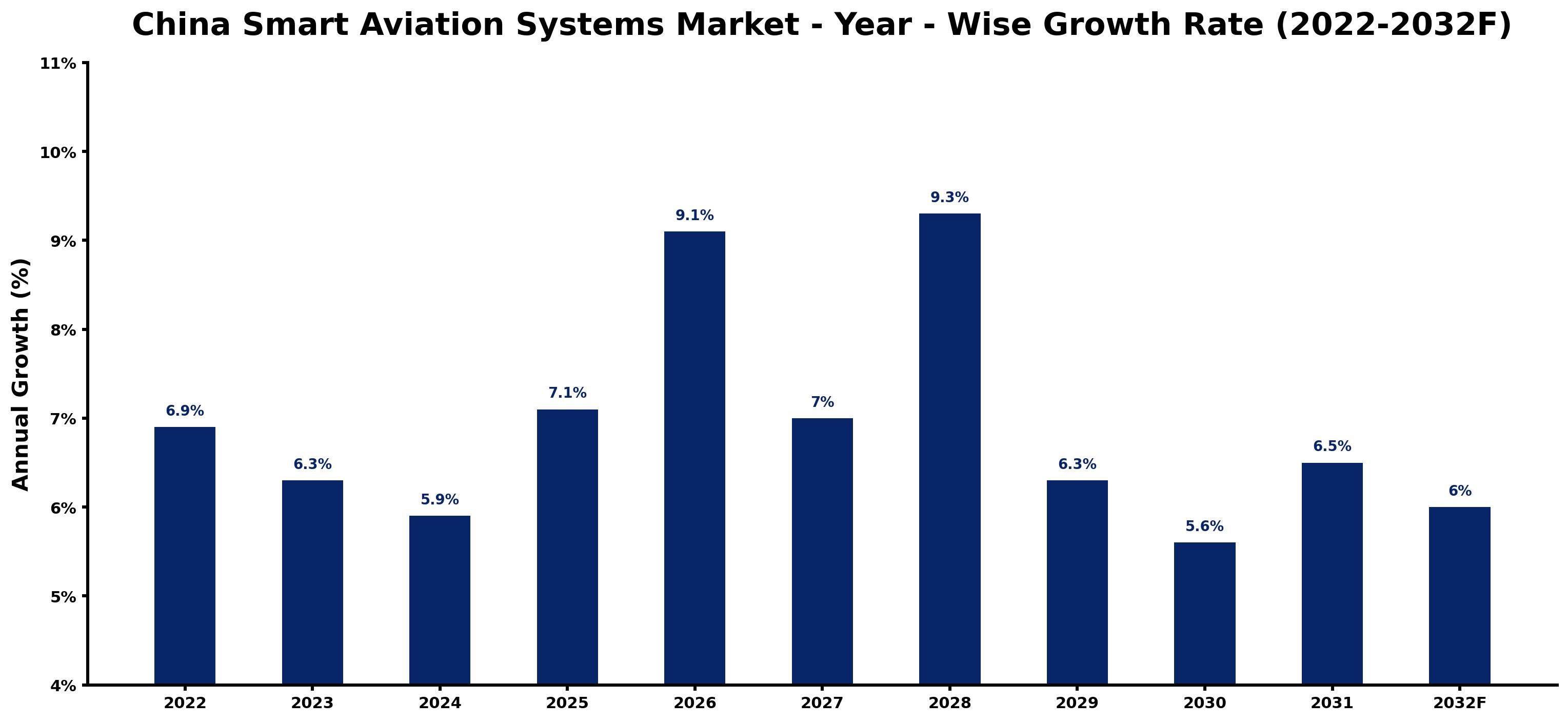
Annual growth estimates for each year appear below with the principal reason behind them, explaining the shifts that set the pace of the market.
| Year | Estimated Annual Growth (%) | Market Rationale |
| 2022 | 6.9 | The aviation market experienced steady growth, driven by increasing domestic air travel demand. |
| 2023 | 6.3 | Growth slowed due to a temporary dip in passenger numbers amid economic adjustments. |
| 2024 | 5.9 | Demand continued to rise as airlines began integrating more advanced technologies into operations. |
| 2025 | 7.1 | A surge in new aircraft deliveries boosted growth, with predictive maintenance becoming standard. |
| 2026 | 9.1 | The market accelerated as airlines invested heavily in smart aviation systems for efficiency. |
| 2027 | 7.0 | Growth slowed slightly as the market adjusted to new technology adoption rates. |
| 2028 | 9.3 | A peak in growth occurred as smart systems became integral to operational strategies. |
| 2029 | 6.3 | Growth decelerated as market saturation began to influence new system implementations. |
| 2030 | 5.6 | Demand continued to rise, but at a slower pace due to increased competition among airlines. |
| 2031 | 6.5 | A rebound in growth occurred as airlines resumed investments in smart technologies. |
| 2032 | 6.0 | Growth slowed as the market stabilised, with a focus on enhancing existing systems. |
Note: Market size estimations and growth projections presented in this report are based on 6Wresearch's proprietary forecasting methodology, utilizing the latest available industry data, government publications, and primary research inputs.
China Smart Aviation Systems Market Synopsis
Smart Aviation Systems in China encompass advanced technologies that enhance aircraft operations and passenger experiences through automation and data analytics. These systems improve safety, efficiency, and comfort in aviation. The China Smart Aviation Systems Market is growing due to rising passenger numbers, projected to reach 1.6 billion by 2030, and significant investments in aviation infrastructure. The National Civil Aviation Development Plan aims to enhance smart aviation systems, driving further demand from airlines and defense sectors. With over 600 airports facilitating extensive air travel, the market is set for continued expansion.
Market Dynamics Impact Analysis (2026–2032)
| Factor | Type | Impact | Primary Segment Affected |
| Increased investment in predictive maintenance technologies is driving demand for smart aviation systems. | Driver | High | Predictive Maintenance |
| Growing focus on safety and efficiency in aviation operations is boosting demand for smart cockpit displays. | Driver | High | Smart Cockpit Displays |
| The integration of advanced technologies in aviation systems presents opportunities for new market entrants. | Opportunity | High | Cabin Automation |
| The expansion of the aviation market creates a demand for innovative smart aviation solutions. | Opportunity | High | Sensor Data AI |
| Supply chain disruptions are affecting the timely delivery of smart aviation systems. | Restraint | High | Predictive Maintenance |
| High costs associated with technology integration can limit market growth for smaller airlines. | Restraint | Medium | Smart Cockpit Displays |
| Regulatory compliance can delay the implementation of new aviation technologies. | Challenge | High | Cabin Automation |
| Competition from international suppliers can hinder the growth of local manufacturers. | Challenge | Medium | Sensor Data AI |
Evaluation of Drivers in China Smart Aviation Systems Market (2026–2032)
Below mentioned are some major drivers and their influence on market dynamics.
| Drivers | Primary Segment Affected | Why It Matters (Evidence) |
| Rising passenger numbers are increasing demand for efficient aviation systems. | Smart Cockpit Displays | China's aviation market is projected to reach 1.6 billion passengers by 2030, prompting airlines to invest in advanced cockpit technologies. |
| Integration of predictive maintenance technologies reduces operational downtime. | Predictive Maintenance | Approximately 70% of new aircraft deliveries are incorporating predictive maintenance, prompting airlines to improve their operational efficiency. |
| Investment in smart aviation technologies is driven by government initiatives. | Cabin Automation | The National Civil Aviation Development Plan aims to improve smart aviation systems, encouraging airlines to adopt new solutions. |
| Growing emphasis on safety standards is pushing airlines to upgrade their systems. | Sensor Data AI | The Aviation Safety Enhancement Program has led to increased adoption of smart technologies for better safety outcomes. |
| Technological advancements are creating new opportunities for system integration. | Smart Cockpit Displays | The introduction of advanced cockpit technologies is expected to improve pilot awareness and operational efficiency. |
Growth across the Smart Aviation Systems market in China is anchored in rising passenger numbers, increased investment in technology, and a focus on safety improvements. The aviation market is projected to reach 1.6 billion passengers by 2030, prompting airlines to adopt advanced systems. Approximately 70% of new aircraft deliveries now include predictive maintenance technologies, which reduce operational downtime.
Evaluation of Restraints in China Smart Aviation Systems Market
Below mentioned are some major restraints and their influence on market dynamics.
| Market Restraint | Primary Segment Affected | Why It Matters (Evidence) |
| Supply chain disruptions are affecting timely deliveries of aviation systems. | Predictive Maintenance | Recent supply chain issues have delayed the rollout of predictive maintenance technologies, impacting operational efficiency for airlines. |
| High integration costs can limit smaller airlines' access to advanced systems. | Smart Cockpit Displays | Many smaller airlines face financial constraints that hinder their ability to invest in expensive cockpit upgrades. |
| Regulatory compliance can slow down the adoption of new technologies. | Cabin Automation | Stringent safety regulations require extensive testing and certification, delaying the implementation of cabin automation systems. |
| Competition from international suppliers can limit local market growth. | Sensor Data AI | Local manufacturers face challenges competing with established international players, impacting their market share. |
| Economic fluctuations can affect airline spending on new technologies. | Smart Cockpit Displays | Economic uncertainties may lead airlines to postpone investments in advanced cockpit technologies. |
China Smart Aviation Systems Market Challenges
China's aviation market faces a technology adoption challenge, with only 30% of existing aircraft equipped with smart aviation systems, limiting operational efficiency for producers. This slow integration leads to maintenance costs for airlines being approximately 15% higher than necessary, which directly impacts their profitability. Intense competition among over 3,000 commercial aircraft operators forces buyers to prioritise cost over advanced features, potentially compromising safety standards. A skills gap exists in the workforce, with over 1 million employees needing further training in smart technologies, delaying the widespread implementation of these systems across the industry.
Trends in the China Smart Aviation Systems Market
Four trends stand out in the China Smart Aviation Systems Market.
- Shift towards Enhanced Passenger Experience: Airlines are increasingly focusing on cabin automation to improve passenger comfort. The National Civil Aviation Development Plan emphasises improving smart aviation systems, leading to a projected increase in cabin automation adoption by 8.4% by 2032.
- Transition from Traditional to Smart Cockpit Displays: Smart cockpit displays are becoming standard in new commercial aircraft models. As of 2023, adoption rates have surged, with over 40% of new aircraft featuring these advanced systems, improving pilot efficiency.
- Emergence of Predictive Maintenance Technologies: Predictive maintenance technologies are gaining traction among airlines. Approximately 70% of new aircraft deliveries now integrate these systems, significantly reducing maintenance costs and downtime.
- Focus on Safety Enhancement Programs: The Aviation Safety Enhancement Program has led to increased investments in smart aviation technologies. This initiative aims to improve safety standards, resulting in a projected growth of 9.3% in related technologies by 2028.
Investment Opportunities in the China Smart Aviation Systems Market
Investors looking at the China Smart Aviation Systems Market should consider the following areas.
- Investment in Cabin Automation Technologies: With the aviation market projected to reach 1.6 billion passengers by 2030, demand for cabin automation technologies is on the rise. Airlines are seeking solutions to enhance passenger experience, creating opportunities for suppliers.
- Expansion of Smart Cockpit Displays: As airlines modernise their fleets, demand for smart cockpit displays is growing. The Beijing-Tianjin-Hebei region is a key hub for aerospace manufacturing, offering opportunities for local manufacturers.
- Development of Sensor Data AI Solutions: The increasing reliance on real-time data analysis provides opportunities for sensor data AI solutions. Airlines are investing in these technologies to boost operational efficiency and decision-making capabilities.
- Partnerships for Predictive Maintenance Solutions: Integrating predictive maintenance technologies is crucial for minimising downtime. Collaborations with airlines and maintenance providers can facilitate market entry and technology adoption.
Government Initiatives in the China Smart Aviation Systems Market
In 2022, the Ministry of Industry and Information Technology launched the 'Smart Aviation Development Strategy' to promote technological advancements in the sector. This strategy aims to improve the integration of smart systems in aviation, encouraging investments from both public and private sectors. Additionally, the 'National Civil Aviation Development Plan 2022-2035' outlines plans to double the number of airports and improve smart aviation systems by 2035, fostering growth in the market. These initiatives are expected to significantly impact the production and adoption of smart aviation technologies.
The National Development and Reform Commission oversees the implementation of various aviation safety programs. The 'Aviation Safety Enhancement Program' established in 2021 focuses on improving safety standards across the industry, ensuring that airlines meet regulatory requirements. Furthermore, the 'Aerospace Innovation Fund', initiated by the National Development and Reform Commission in 2023 with a budget of $500 million, supports research and development in smart aviation technologies. This funding is vital for advancing innovations that improve safety and operational efficiency in the aviation sector.
Future Insight of the China Smart Aviation Systems Market
By 2032, buyers and suppliers in the China Smart Aviation Systems market can expect substantial advancements driven by automation and data analytics. The National Civil Aviation Development Plan will enhance aviation infrastructure, streamlining operations and improving safety. Predictive maintenance technologies will be integrated into 70% of new aircraft deliveries, reducing operational downtime for airlines. The Ministry of Industry and Information Technology will support smart technology initiatives, driving innovation in the sector.
Market Segmentation Analysis
Each segment group is reviewed below, with the leader by share and the fastest grower by CAGR.
By System Type – Predictive Maintenance Dominated, Cabin Automation Expected to Grow Fastest
According to Dhaval Chaurasia, Assistant Manager at 6Wresearch, Predictive Maintenance took a 39% share of system type in 2025, more than any other category. Predictive maintenance holds the largest share due to its essential function in minimising aircraft downtime and cutting maintenance costs. With 70% of new aircraft deliveries incorporating this technology, it is crucial for airlines aiming to improve operational efficiency. Cabin Automation is set to record the highest CAGR in this split, 8.4% over 2026–2032. Cabin automation is experiencing rapid growth as airlines focus on enhancing passenger experience and operational efficiency. The increasing demand for improved in-flight services drives the adoption of these systems, allowing airlines to maintain a competitive advantage. Suppliers should prioritise the development of advanced cabin automation solutions to cater to the growing needs of airlines.
By Smart Feature – Sensor Data AI Dominated and Is Expected to Record the Fastest Growth
Sensor Data AI held a 40% share of the China Smart Aviation Systems Market by smart feature in 2025. Sensor data technology dominates the market as it is vital for real-time data analysis and decision-making in aviation. Its broad application across various smart aviation systems solidifies its role as a key technology for enhancing operational efficiency. Sensor Data AI is also forecast to expand faster than any other category, at a CAGR of 8.2% over 2026–2032. The rapid growth of sensor data technology is propelled by its importance in boosting operational efficiency and passenger experience. As more aviation systems adopt this feature, its market share will continue to expand significantly. Buyers must invest in sensor data technologies to remain competitive in the advancing aviation sector.
By Aircraft Type – Commercial Aircraft Dominated, Regional Jets/Private Planes Expected to Grow Fastest
With a 51% revenue share in 2025, Commercial Aircraft was the largest aircraft type category. Commercial aircraft dominate the market as they represent the primary segment of the aviation industry, catering to the vast passenger demand. With over 3,000 commercial aircraft in operation, this segment's share remains substantial. Regional Jets/Private Planes are projected to grow fastest, at a CAGR of 9.3% during 2026–2032. Regional jets and private planes are gaining traction due to increasing interest in shorter routes and personalised travel experiences. This segment's growth reflects a shift in consumer preferences towards more flexible travel options. Suppliers should consider diversifying their offerings to include regional jets and private planes to capture emerging market opportunities.
By End User – Airlines Dominated, Defense OEMs Expected to Grow Fastest
Airlines accounted for a 52% market share by end user in 2025. Airlines are the primary end users of smart aviation systems, driving the majority of demand in the market. Their focus on improving operational efficiency and passenger experience solidifies their leading position. The quickest growth will come from Defense OEMs, forecast to expand at a CAGR of 8.4% between 2026 and 2032. Defense OEMs are rapidly adopting smart aviation systems to fulfil critical military application needs. This sector's growth reflects increased investment in advanced aviation technologies, highlighting its importance for national security. Suppliers should tailor their solutions to address the specific requirements of both airlines and defense OEMs to maximise market reach.
Key Attractiveness of the Report
- 10 Years of Market Numbers
- Historical Data Starting from 2022 to 2025
- Base Year 2025
- Forecast Data until 2032
- Key Performance Indicators Impacting the Market
- Major Upcoming Developments and Projects
Key Highlights of the Report:
- China Smart Aviation Systems Market Outlook
- Market Size of China Smart Aviation Systems Market, 2025
- Forecast of China Smart Aviation Systems Market, 2032
- Historical Data and Forecast of China Smart Aviation Systems Revenues & Volume for the Period 2022 - 2032F
- China Smart Aviation Systems Market Trend Evolution
- China Smart Aviation Systems Market Drivers and Challenges
- China Smart Aviation Systems Price Trends
- China Smart Aviation Systems Porter's Five Forces
- China Smart Aviation Systems Industry Life Cycle
- Historical Data and Forecast of China Smart Aviation Systems Market Revenues & Volume By System Type for the Period 2022 - 2032F
- Historical Data and Forecast of China Smart Aviation Systems Market Revenues & Volume By Predictive Maintenance for the Period 2022 - 2032F
- Historical Data and Forecast of China Smart Aviation Systems Market Revenues & Volume By Flight Navigation for the Period 2022 - 2032F
- Historical Data and Forecast of China Smart Aviation Systems Market Revenues & Volume By Smart Cockpit Displays for the Period 2022 - 2032F
- Historical Data and Forecast of China Smart Aviation Systems Market Revenues & Volume By Cabin Automation for the Period 2022 - 2032F
- Historical Data and Forecast of China Smart Aviation Systems Market Revenues & Volume By Smart Feature for the Period 2022 - 2032F
- Historical Data and Forecast of China Smart Aviation Systems Market Revenues & Volume By Sensor Data AI for the Period 2022 - 2032F
- Historical Data and Forecast of China Smart Aviation Systems Market Revenues & Volume By Satellite + AI for the Period 2022 - 2032F
- Historical Data and Forecast of China Smart Aviation Systems Market Revenues & Volume By HUD + AR for the Period 2022 - 2032F
- Historical Data and Forecast of China Smart Aviation Systems Market Revenues & Volume By Passenger Comfort for the Period 2022 - 2032F
- Historical Data and Forecast of China Smart Aviation Systems Market Revenues & Volume By Aircraft Type for the Period 2022 - 2032F
- Historical Data and Forecast of China Smart Aviation Systems Market Revenues & Volume By Commercial Aircraft for the Period 2022 - 2032F
- Historical Data and Forecast of China Smart Aviation Systems Market Revenues & Volume By Regional Jets/Private Planes for the Period 2022 - 2032F
- Historical Data and Forecast of China Smart Aviation Systems Market Revenues & Volume By Fighter Aircraft for the Period 2022 - 2032F
- Historical Data and Forecast of China Smart Aviation Systems Market Revenues & Volume By Commercial Jets for the Period 2022 - 2032F
- Historical Data and Forecast of China Smart Aviation Systems Market Revenues & Volume By End User for the Period 2022 - 2032F
- Historical Data and Forecast of China Smart Aviation Systems Market Revenues & Volume By Airlines for the Period 2022 - 2032F
- Historical Data and Forecast of China Smart Aviation Systems Market Revenues & Volume By Avionics Developers for the Period 2022 - 2032F
- Historical Data and Forecast of China Smart Aviation Systems Market Revenues & Volume By Defense OEMs for the Period 2022 - 2032F
- Historical Data and Forecast of China Smart Aviation Systems Market Revenues & Volume By Aerospace Interior Makers for the Period 2022 - 2032F
- China Smart Aviation Systems Import Export Trade Statistics
- Market Opportunity Assessment By System Type
- Market Opportunity Assessment By Smart Feature
- Market Opportunity Assessment By Aircraft Type
- Market Opportunity Assessment By End User
- China Smart Aviation Systems Top Companies Market Share
- China Smart Aviation Systems Competitive Benchmarking By Technical and Operational Parameters
- China Smart Aviation Systems Company Profiles
- China Smart Aviation Systems Key Strategic Recommendations
Market Covered
The report offers an extensive study of the following market segments.
By System Type
- Predictive Maintenance
- Flight Navigation
- Smart Cockpit Displays
- Cabin Automation
By Smart Feature
- Sensor Data AI
- Satellite + AI
- HUD + AR
- Passenger Comfort
By Aircraft Type
- Commercial Aircraft
- Regional Jets/Private Planes
- Fighter Aircraft
- Commercial Jets
By End User
- Airlines
- Avionics Developers
- Defense OEMs
- Aerospace Interior Makers






































