China Soil Microbial Enhancers Market Size & Growth Rate
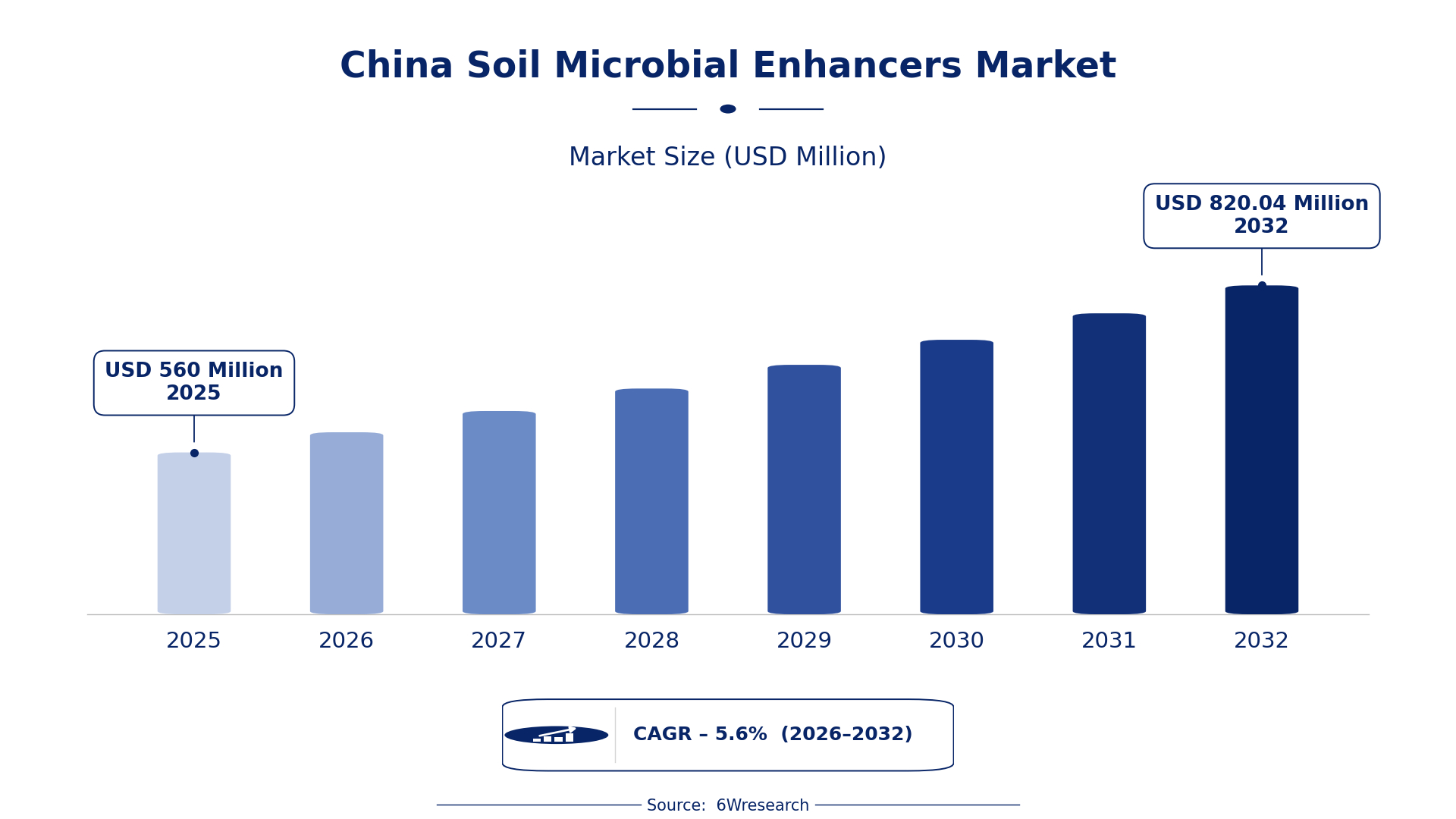
According to 6Wresearch internal database and industry insights, the China Soil Microbial Enhancers Market was valued at USD 560.0 million in 2025 and is projected to reach USD 820.04 million by 2032, growing at a CAGR of approximately 5.6% during 2026–2032.
China Soil Microbial Enhancers Market Highlights
| Report Metric | Details |
| Report Name | China Soil Microbial Enhancers Market |
| Market Size 2025 | USD 560.0 million |
| Market Size 2032 | USD 820.04 million |
| Absolute Growth 2025–2032 | USD 260.04 million |
| CAGR 2026–2032 | 5.6% |
| Peak Annual Growth | 7.8% in 2029 |
| Forecast Period | 2026–2032 |
| Historical Data | 2022–2025 |
| Base Year | 2025 |
| Leading Enhancer Type, 2025 | Nitrogen Fixers (41% share) |
| Leading Microbe Type, 2025 | Rhizobium (51% share) |
| Leading Delivery Method, 2025 | Seed Coating (46% share) |
| Leading End User, 2025 | Legume Farmers (41% share) |
| Fastest-Growing Enhancer Type | Phosphate Solubilizers (7.1% CAGR) |
| Fastest-Growing Microbe Type | Bacillus spp. (8.1% CAGR) |
| Fastest-Growing Delivery Method | Soil Amendment (7.0% CAGR) |
| Fastest-Growing End User | High-Input Farms (7.3% CAGR) |
| Growing Sector | Agriculture |
| Key End Users | Farmers, Agricultural Cooperatives, High-Input Farms, Fertilizer Companies |
China Soil Microbial Enhancers Market Year-wise Growth Rate and Key Drivers (2022–2032)
This graph illustrates the annual growth rates of the market from 2022 to 2032, highlighting a steady upward trajectory and projected market expansion over the forecast period.
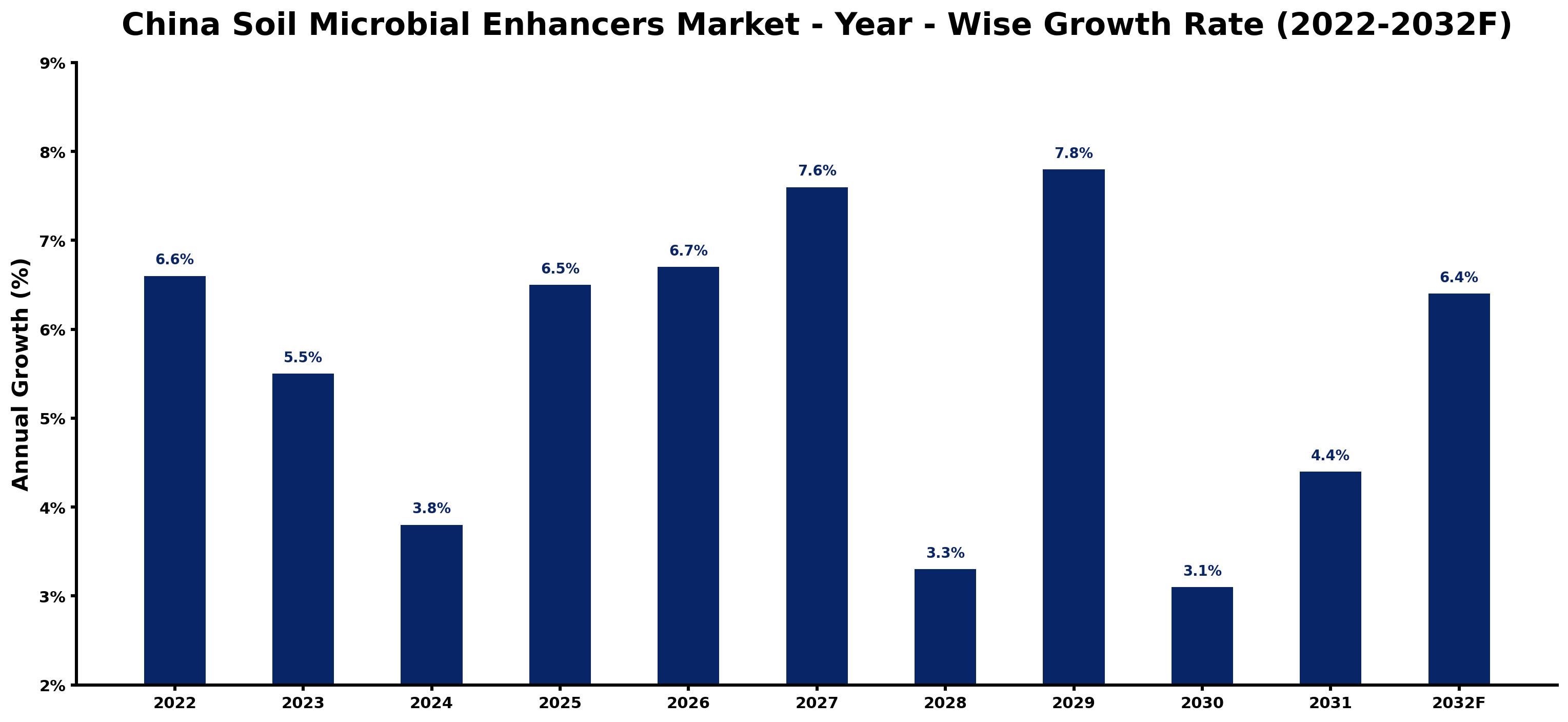
The table below sets out the estimated growth rate for each year and the main factor behind it.
| Year | Estimated Annual Growth (%) | Market Rationale |
| 2022 | 6.6 | The market experienced strong demand due to the National Soil Fertility Improvement Plan encouraging biological product adoption. |
| 2023 | 5.5 | Demand growth slowed as farmers adjusted to the Agricultural Technology Promotion Law promoting sustainable practices. |
| 2024 | 3.8 | The market continued to grow, supported by increasing awareness of the benefits of soil health. |
| 2025 | 6.5 | Growth accelerated as the National Soil Fertility Improvement Plan spurred adoption of biological products. |
| 2026 | 6.7 | The market is expected to see further growth driven by rising interest in sustainable farming methods. |
| 2027 | 7.6 | Demand is projected to surge as farmers recognise the benefits of biological products for crop yields. |
| 2028 | 3.3 | Growth is anticipated to slow again as farmers face challenges in integrating new products into existing systems. |
| 2029 | 7.8 | The market is expected to peak with strong demand from high-input farms adopting biological solutions. |
| 2030 | 3.1 | A slowdown is projected as the Green Agriculture Development Plan begins to influence market dynamics. |
| 2031 | 4.4 | Growth will resume as farmers seek effective solutions to combat soil degradation. |
| 2032 | 6.4 | Demand is expected to stabilise as the market matures, supported by ongoing government initiatives. |
Note: Market size estimations and growth projections presented in this report are based on 6Wresearch's proprietary forecasting methodology, utilizing the latest available industry data, government publications, and primary research inputs.
China Soil Microbial Enhancers Market Synopsis
Soil microbial enhancers in China are biological products that improve soil health and fertility by introducing beneficial microorganisms. These enhancers are produced through fermentation processes involving specific strains of bacteria and fungi, which improve nutrient availability and promote plant growth. The China Soil Microbial Enhancers Market is expanding due to rising demand from domestic farmers and agricultural cooperatives, particularly in regions with intensive farming. The National Soil Fertility Improvement Plan and growing awareness of sustainable practices are driving this growth, with legume cultivation accounting for about 30% of total crop production.
Market Dynamics Impact Analysis (2026–2032)
| Factor | Type | Impact | Primary Segment Affected |
| Rising adoption of microbial enhancers among farmers due to government initiatives. | Driver | High | Nitrogen Fixers |
| Growing awareness of soil health benefits among agricultural cooperatives. | Driver | High | Plant Growth Promoters |
| Increasing demand for sustainable farming practices among high-input farms. | Opportunity | High | High-Input Farms |
| Expansion of agricultural cooperatives seeking innovative soil solutions. | Opportunity | Medium | Legume Farmers |
| Limited awareness of microbial products in less developed regions. | Restraint | Medium | Phosphate Solubilizers |
| Challenges in integrating enhancers into traditional farming practices. | Restraint | High | Antagonistic Microbes |
| Soil Microbial Enhancers Market in China faces a few practical problems, including regulatory hurdles. | Challenge | High | Seed Coating |
| Competition from chemical fertilizers remains a significant challenge for market growth. | Challenge | Medium | Liquid Application |
Evaluation of Drivers in China Soil Microbial Enhancers Market (2026–2032)
The factors lifting demand, and the evidence behind each, are summarised below.
| Drivers | Primary Segment Affected | Why It Matters (Evidence) |
| Government initiatives promoting biological products to improve soil health. | Nitrogen Fixers | The National Soil Fertility Improvement Plan aims to increase adoption by 20% by 2025. |
| Increased awareness of sustainable agriculture practices among farmers. | Plant Growth Promoters | The Ministry of Agriculture and Rural Affairs supports sustainable practices, driving demand. |
| Growing legume cultivation driving demand for nitrogen-fixing products. | Rhizobium | Legume cultivation in China accounts for about 30% of total crop production. |
| Rising interest in organic farming boosting the use of biological products. | Bacillus spp. | The National Standards for Organic Products include guidelines for biological products. |
| Demand from high-input farms seeking to maximise crop yields. | High-Input Farms | High-input farms are increasingly adopting biological products for better productivity. |
Growth in the Soil Microbial Enhancers market in China comes from rising adoption among farmers and agricultural cooperatives. The National Soil Fertility Improvement Plan aims for a 20% increase in adoption by 2025, encouraging the use of nitrogen-fixing products. Legume cultivation, which accounts for about 30% of total crop production, further drives demand for these products. Increased awareness of sustainable practices among farmers leads to higher purchases of biological products. The Fertilizer Industry Association's advocacy for sustainable practices supports a favourable environment for market growth.
Evaluation of Restraints in China Soil Microbial Enhancers Market
The table below lists the restraints and the evidence behind each.
| Market Restraint | Primary Segment Affected | Why It Matters (Evidence) |
| Limited awareness of biological products among farmers in rural areas. | Phosphate Solubilizers | In less developed regions, farmers often lack information about the benefits of biological products. |
| Integration challenges with traditional farming methods hinder adoption. | Antagonistic Microbes | Farmers face difficulties in incorporating new products into established practices. |
| Regulatory hurdles can delay product approvals and market entry. | Seed Coating | Strict regulations around agricultural products can slow the introduction of new biological products. |
| Competition from chemical fertilizers impacts market share. | Liquid Application | Farmers often prefer established chemical solutions over newer biological products. |
| Cost of biological products may deter some farmers from adoption. | Soil Amendment | Higher initial costs can limit the willingness of small-scale farmers to invest. |
China Soil Microbial Enhancers Market Challenges
The China Soil Microbial Enhancers Market faces a few practical problems, starting with supply chain disruptions that hinder product availability. Farmers in the Yangtze River Delta experience delays in receiving soil microbial products, leading to a 20% reduction in crop yields during critical planting seasons. A shortage of skilled agricultural workers complicates the effective application of these products, as only 40% of farmers possess adequate training, resulting in inefficient use and wasted resources. Regulatory hurdles arise from the ISO 22000 standard, which requires extensive testing, delaying product launches by up to six months for suppliers. Competition from synthetic fertilizers intensifies, with prices often undercutting microbial products, making it challenging for producers to maintain market share.
Trends in the China Soil Microbial Enhancers Market
Several trends are reshaping the China Soil Microbial Enhancers Market; the most important are set out below.
- Increase in Adoption of Soil Amendments: In 2023, the Green Agriculture Development Plan allocated 300 million yuan to promote biological products in high-input farming regions. This funding is expected to support the adoption of soil amendments, leading to improved crop yields.
- Shift Towards Sustainable Practices: The Yangtze River Delta is experiencing a shift towards sustainable agricultural practices, with a focus on biological products. This region is a key area for microbial product usage, reflecting a growing trend in sustainable farming.
- Growing Focus on Disease Suppression: Trichoderma spp. is increasingly recognised for its role in disease suppression in crops. This trend is supported by the Fertilizer Industry Association of China, promoting biological solutions for healthier crops.
- Legume Farmers Embracing Biological Solutions: Legume Farmers are increasingly adopting nitrogen-fixing products to improve yields. This trend is significant as legume cultivation accounts for about 30% of total crop production in China.
Investment Opportunities in the China Soil Microbial Enhancers Market
Several openings in the China Soil Microbial Enhancers Market merit attention from investors.
- High-Input Farms Seeking Effective Solutions: High-input farms are increasingly looking for effective biological products to maximise yields. With 500 million yuan allocated for agricultural innovation in 2023, suppliers can enter through partnerships with local agricultural cooperatives.
- Legume Farmers Needing Enhanced Productivity: Legume Farmers represent a significant opportunity as they seek to improve productivity. With 30% of total crop production, suppliers can provide nitrogen-fixing products to meet this demand.
- Expansion of Soil Amendments in Agriculture: The soil amendment segment is growing rapidly, driven by increased awareness of soil health. Suppliers can target this segment by collaborating with agricultural technology firms to enhance product visibility.
- Government Support for Sustainable Practices: The Chinese government allocated 500 million yuan for agricultural innovation in 2023. This funding presents an opportunity for suppliers to align their products with government initiatives and gain market access.
Government Initiatives in the China Soil Microbial Enhancers Market
The National Soil Fertility Improvement Plan, launched by the Ministry of Agriculture and Rural Affairs in 2021, aims to improve soil health through biological products. This plan targets a 20% increase in adoption of biological products by 2025, encouraging farmers to utilise these products for improved soil fertility. Additionally, the Agricultural Technology Promotion Law was updated in 2022 to promote the use of biological products, focusing on sustainable agricultural practices and supporting the shift towards eco-friendly farming methods.
The Soil Health Monitoring Program established in 2021 assesses the impact of biological products on soil quality. This program helps farmers understand the benefits of using biological products and encourages adoption. The Green Agriculture Development Plan, initiated in 2023, allocates 300 million yuan to promote biological products in high-input farming regions, providing funding for research and development of new solutions.
Future Insight of the China Soil Microbial Enhancers Market
The China Soil Microbial Enhancers Market will evolve by 2032, driven by several forward-looking factors. The National Soil Fertility Improvement Plan promotes the adoption of microbial products, potentially benefiting 120 million hectares of arable land. Government funding of 500 million yuan for agricultural innovation will encourage research into new microbial strains and application methods. Advocacy for sustainable practices by the Fertilizer Industry Association will boost demand among environmentally conscious farmers. Increased awareness of soil health will likely lead to greater integration of microbial products into traditional farming practices.
Market Segmentation Analysis
The report offers a comprehensive study of the following market segments and their leading categories in the market.
By Enhancer Type – Nitrogen Fixers Dominated, Phosphate Solubilizers Expected to Grow Fastest
According to Summon Dutta, Assistant Manager at 6Wresearch, Nitrogen Fixers held a 41% share of the China Soil Microbial Enhancers Market by enhancer type in 2025. Nitrogen fixers dominate the China Soil Microbial Enhancers Market due to their essential function in increasing nitrogen availability for crops. This is particularly important in the Yangtze River Delta, where intensive farming practices require effective nutrient management to sustain high yields. Phosphate Solubilizers are projected to grow fastest, at a CAGR of 7.1% during 2026–2032. Phosphate solubilizers are experiencing rapid growth as they address the increasing demand for accessible phosphorus in soils, especially in high-demand agricultural regions. The government's promotion of sustainable agricultural practices further accelerates this segment's expansion. Suppliers should focus on developing and marketing phosphate solubilizers to meet the growing needs of the agricultural sector.
By Microbe Type – Rhizobium Dominated, Bacillus spp. Expected to Grow Fastest
Rhizobium took a 51% share of microbe type in 2025, more than any other category. Rhizobium holds the largest market share due to its vital role in fixing atmospheric nitrogen in leguminous crops, which are a significant part of China's agricultural output. This is particularly relevant as legume cultivation accounts for about 30% of total crop production in the country. The quickest growth will come from Bacillus spp., forecast to expand at a CAGR of 8.1% between 2026 and 2032. Bacillus spp. is the fastest-growing segment because it effectively promotes plant growth and suppresses diseases, making it highly desirable in modern farming. The increased government funding for agricultural innovation supports this trend. Buyers should consider integrating Bacillus spp. into their farming practices to improve crop resilience and productivity.
By Delivery Method – Seed Coating Dominated, Soil Amendment Expected to Grow Fastest
In 2025, Seed Coating led the delivery method split with a 46% share. Seed coating leads in market share as it allows for the direct application of enhancers to seeds, ensuring better germination and establishment. This method is particularly effective for small farm sizes, which average around 0.6 hectares in China, enhancing its appeal to farmers. Soil Amendment is set to record the highest CAGR in this split, 7.0% over 2026–2032. Soil amendment is the fastest-growing delivery method, as it directly incorporates enhancers into the soil, leading to improved fertility and overall soil health. The focus on soil amendments in the 14th Five-Year Plan for Agriculture drives this segment's growth. Suppliers must invest in soil amendment technologies to align with the increasing emphasis on soil health in agricultural policies.
By End User – Legume Farmers Dominated, High-Input Farms Expected to Grow Fastest
The largest end user category in 2025 was Legume Farmers, with a 41% share of total revenue. Legume farmers represent the largest market share as they directly benefit from nitrogen-fixing enhancers, which are crucial for their crop yields. This is especially pertinent in regions with significant legume production, driving consistent demand for these products. Over 2026–2032, High-Input Farms are expected to post the fastest growth, at a CAGR of 7.3%. High-input farms are the fastest-growing segment as they strive to maximise crop yield through the use of microbial enhancers. The trend towards intensive farming practices further propels this segment's growth. Suppliers should target high-input farms with tailored solutions to meet their specific productivity requirements.
Key Attractiveness of the Report
- 10 Years of Market Numbers
- Historical Data Starting from 2022 to 2025
- Base Year 2025
- Forecast Data until 2032
- Key Performance Indicators Impacting the Market
- Major Upcoming Developments and Projects
Key Highlights of the Report:
- China Soil Microbial Enhancers Market Outlook
- Market Size of China Soil Microbial Enhancers Market, 2025
- Forecast of China Soil Microbial Enhancers Market, 2032
- Historical Data and Forecast of China Soil Microbial Enhancers Revenues & Volume for the Period 2022 - 2032F
- China Soil Microbial Enhancers Market Trend Evolution
- China Soil Microbial Enhancers Market Drivers and Challenges
- China Soil Microbial Enhancers Price Trends
- China Soil Microbial Enhancers Porter's Five Forces
- China Soil Microbial Enhancers Industry Life Cycle
- Historical Data and Forecast of China Soil Microbial Enhancers Market Revenues & Volume By Enhancer Type for the Period 2022 - 2032F
- Historical Data and Forecast of China Soil Microbial Enhancers Market Revenues & Volume By Nitrogen Fixers for the Period 2022 - 2032F
- Historical Data and Forecast of China Soil Microbial Enhancers Market Revenues & Volume By Phosphate Solubilizers for the Period 2022 - 2032F
- Historical Data and Forecast of China Soil Microbial Enhancers Market Revenues & Volume By Plant Growth Promoters for the Period 2022 - 2032F
- Historical Data and Forecast of China Soil Microbial Enhancers Market Revenues & Volume By Antagonistic Microbes for the Period 2022 - 2032F
- Historical Data and Forecast of China Soil Microbial Enhancers Market Revenues & Volume By Microbe Type for the Period 2022 - 2032F
- Historical Data and Forecast of China Soil Microbial Enhancers Market Revenues & Volume By Rhizobium for the Period 2022 - 2032F
- Historical Data and Forecast of China Soil Microbial Enhancers Market Revenues & Volume By Bacillus spp. for the Period 2022 - 2032F
- Historical Data and Forecast of China Soil Microbial Enhancers Market Revenues & Volume By Trichoderma spp. for the Period 2022 - 2032F
- Historical Data and Forecast of China Soil Microbial Enhancers Market Revenues & Volume By Pseudomonas for the Period 2022 - 2032F
- Historical Data and Forecast of China Soil Microbial Enhancers Market Revenues & Volume By Delivery Method for the Period 2022 - 2032F
- Historical Data and Forecast of China Soil Microbial Enhancers Market Revenues & Volume By Seed Coating for the Period 2022 - 2032F
- Historical Data and Forecast of China Soil Microbial Enhancers Market Revenues & Volume By Soil Amendment for the Period 2022 - 2032F
- Historical Data and Forecast of China Soil Microbial Enhancers Market Revenues & Volume By Liquid Application for the Period 2022 - 2032F
- Historical Data and Forecast of China Soil Microbial Enhancers Market Revenues & Volume By Root Dip for the Period 2022 - 2032F
- Historical Data and Forecast of China Soil Microbial Enhancers Market Revenues & Volume By End User for the Period 2022 - 2032F
- Historical Data and Forecast of China Soil Microbial Enhancers Market Revenues & Volume By Legume Farmers for the Period 2022 - 2032F
- Historical Data and Forecast of China Soil Microbial Enhancers Market Revenues & Volume By Fertilizer Companies for the Period 2022 - 2032F
- Historical Data and Forecast of China Soil Microbial Enhancers Market Revenues & Volume By High-Input Farms for the Period 2022 - 2032F
- Historical Data and Forecast of China Soil Microbial Enhancers Market Revenues & Volume By Disease-Prone Regions for the Period 2022 - 2032F
- China Soil Microbial Enhancers Import Export Trade Statistics
- Market Opportunity Assessment By Enhancer Type
- Market Opportunity Assessment By Microbe Type
- Market Opportunity Assessment By Delivery Method
- Market Opportunity Assessment By End User
- China Soil Microbial Enhancers Top Companies Market Share
- China Soil Microbial Enhancers Competitive Benchmarking By Technical and Operational Parameters
- China Soil Microbial Enhancers Company Profiles
- China Soil Microbial Enhancers Key Strategic Recommendations
Market Covered
This report examines the market across the segments below.
By Enhancer Type
- Nitrogen Fixers
- Phosphate Solubilizers
- Plant Growth Promoters
- Antagonistic Microbes
By Microbe Type
- Rhizobium
- Bacillus spp.
- Trichoderma spp.
- Pseudomonas
By Delivery Method
- Seed Coating
- Soil Amendment
- Liquid Application
- Root Dip
By End User
- Legume Farmers
- Fertilizer Companies
- High-Input Farms
- Disease-Prone Regions































