China Space Systems Market Size & Growth Rate
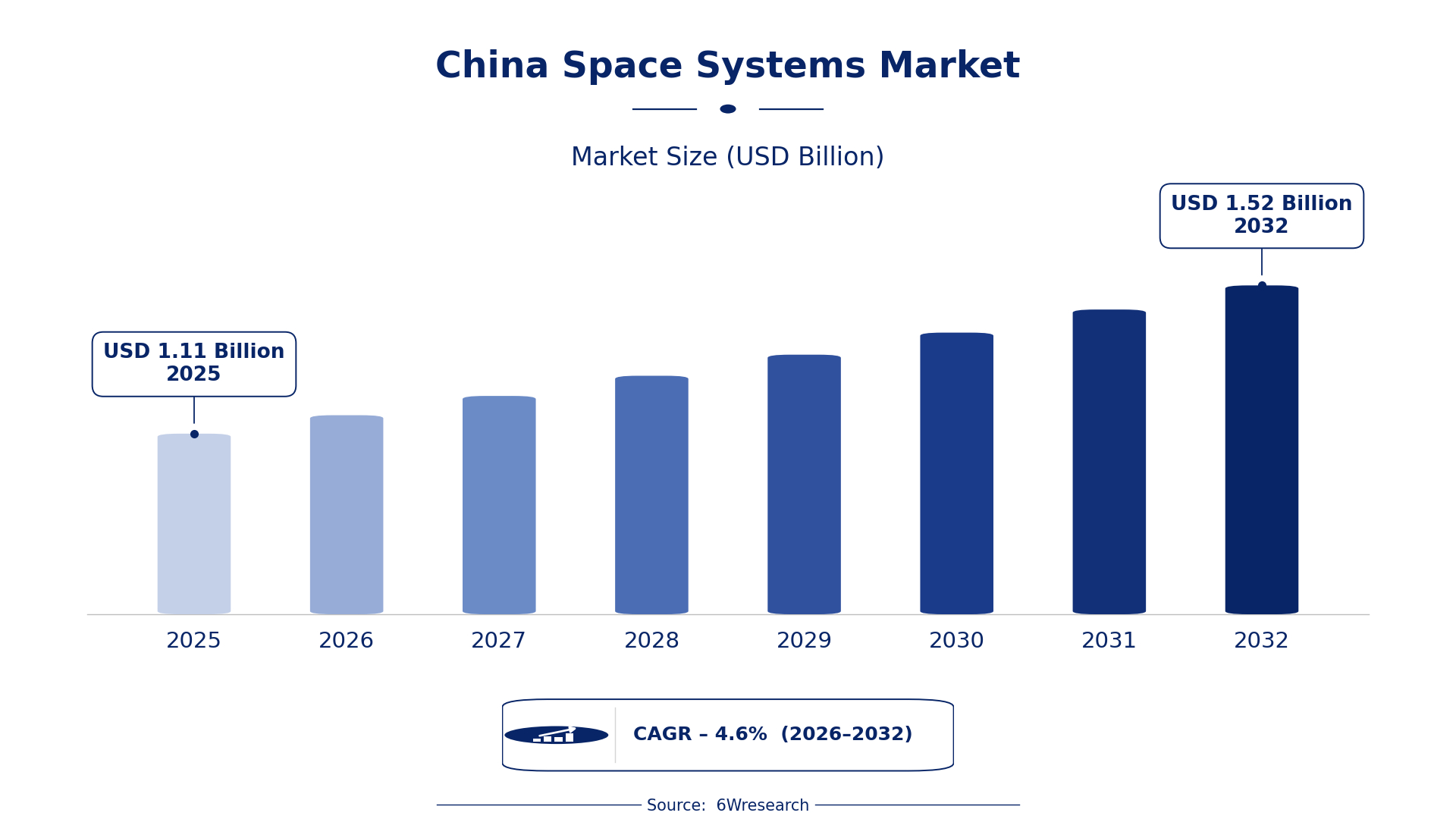
According to 6Wresearch internal database and industry insights, the China Space Systems Market was valued at USD 1.11 billion in 2025 and is projected to reach USD 1.52 billion by 2032, growing at a CAGR of approximately 4.6% during 2026–2032.
China Space Systems Market Highlights
| Report Metric | Details |
| Report Name | China Space Systems Market |
| Market Size 2025 | USD 1.11 billion |
| Market Size 2032 | USD 1.52 billion |
| Absolute Growth 2025–2032 | USD 0.41 billion |
| CAGR 2026–2032 | 4.6% |
| Peak Annual Growth | 6.7% in 2031 |
| Forecast Period | 2026–2032 |
| Historical Data | 2022–2025 |
| Base Year | 2025 |
| Leading System Type, 2025 | Satellite Systems (42% share) |
| Leading Operational Domain, 2025 | Orbital (47% share) |
| Leading Functionality, 2025 | Communication/Navigation (41% share) |
| Leading End User, 2025 | Commercial Operators (36% share) |
| Fastest-Growing System Type | Avionics Systems (7.0% CAGR) |
| Fastest-Growing Operational Domain | Deep Space (5.8% CAGR) |
| Fastest-Growing End User | Spacecraft OEMs (6.6% CAGR) |
| Growing Sector | Satellite Systems |
| Key End Users | Commercial Operators, Spacecraft OEMs, Launch Service Providers |
China Space Systems Market Year-wise Growth Rate and Key Drivers (2022–2032)
This graph illustrates the annual growth rates of the market from 2022 to 2032, highlighting a steady upward trajectory and projected market expansion over the forecast period.
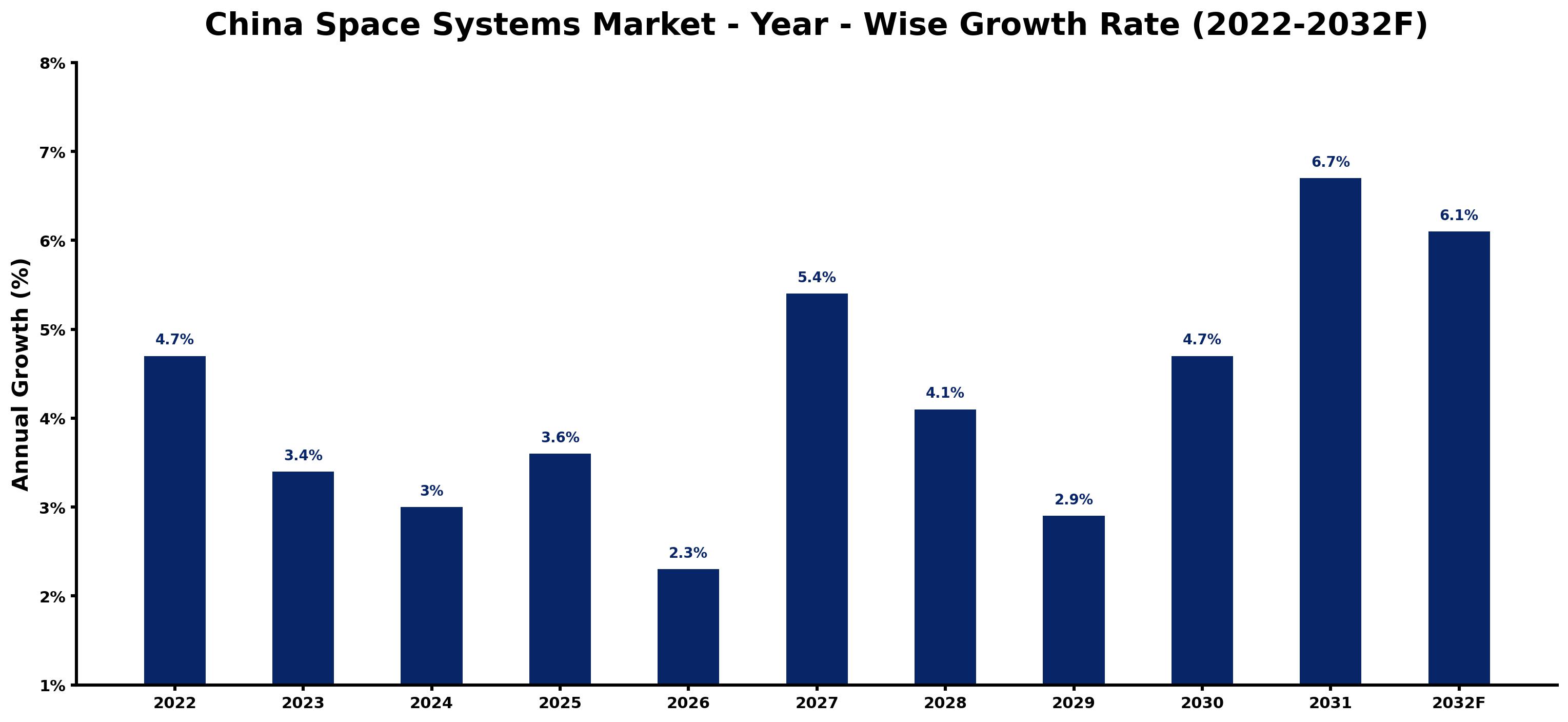
The following table presents the estimated annual growth rate for each year together with the principal factor influencing market performance.
| Year | Estimated Annual Growth (%) | Market Rationale |
| 2022 | 4.7 | The market experienced strong activity due to the successful Tianwen-1 mission to Mars. |
| 2023 | 3.4 | Growth slowed as the focus shifted towards enhancing satellite technology capabilities. |
| 2024 | 3.0 | The market continued to grow, albeit at a slower pace, as investments in space infrastructure increased. |
| 2025 | 3.6 | Demand picked up as the Tiangong space station became fully operational, attracting international collaboration. |
| 2026 | 2.3 | Growth slowed again as the market adjusted to new regulatory frameworks and standards. |
| 2027 | 5.4 | A resurgence in demand occurred as private sector participation in space activities expanded significantly. |
| 2028 | 4.1 | Market growth slowed as competition intensified among domestic space operators. |
| 2029 | 2.9 | Demand continued to slow as the market faced challenges in scaling up production capacities. |
| 2030 | 4.7 | Growth accelerated as plans for a lunar research station gained traction and funding. |
| 2031 | 6.7 | The market peaked with significant investments in deep space exploration initiatives and technologies. |
| 2032 | 6.1 | Growth moderated slightly as the market stabilised after the peak in investment and activity. |
Note: Market size estimations and growth projections presented in this report are based on 6Wresearch's proprietary forecasting methodology, utilizing the latest available industry data, government publications, and primary research inputs.
China Space Systems Market Synopsis
The Space Systems market in China includes technologies for satellite communications, space exploration, and scientific research. These systems emerge from advanced engineering processes, incorporating materials science and software development. By 2030, the market is anticipated to reach 1 trillion yuan, fuelled by rising domestic and international demand for satellite communications and scientific research. Key milestones, such as the successful Tianwen-1 mission and the operational BeiDou Navigation Satellite System, highlight this growth. The establishment of the Tiangong space station further solidifies China's standing in the global space industry.
Market Dynamics Impact Analysis (2026–2032)
| Factor | Type | Impact | Primary Segment Affected |
| Increasing investments in satellite technology and infrastructure development | Driver | High | Satellite Systems |
| Growing demand for global positioning services and navigation systems | Driver | High | Communication/Navigation |
| Expansion of private sector participation in space activities | Opportunity | High | Commercial Operators |
| Emerging international collaborations for joint space missions | Opportunity | High | Spacecraft OEMs |
| Regulatory hurdles slowing down project approvals | Restraint | High | Propulsion Systems |
| High costs associated with advanced space technologies | Restraint | Medium | Avionics Systems |
| Limited access to advanced materials and technologies | Challenge | High | Environmental Systems |
| Competition from established international space agencies | Challenge | Medium | Launch Service Providers |
Evaluation of Drivers in China Space Systems Market (2026–2032)
The main growth drivers and the segments they affect most are set out below.
| Drivers | Primary Segment Affected | Why It Matters (Evidence) |
| Growing domestic demand for satellite communications and data services | Satellite Systems | China launched over 50 rockets in 2022, boosting satellite deployment and operations, increasing market activity. |
| Increased investment in space exploration initiatives | Deep Space | China's plans for a lunar research station by 2025 are driving demand for deep space technologies and capabilities. |
| Expansion of the BeiDou Navigation Satellite System | Communication/Navigation | The operational BeiDou system provides global positioning services, increasing user adoption and demand for navigation solutions. |
| Rising international collaboration in space missions | Space Station Partners | Partnerships with over 20 countries for joint missions are expanding market opportunities and fostering technological exchange. |
| Advancements in propulsion technologies | Propulsion Systems | The 2023 Space Technology Innovation Plan allocates funding for research in propulsion technologies, aiming to improve launch efficiency and reduce costs. |
The Space Systems market in China is expanding as increasing investments in satellite technology, growing domestic demand for satellite communications, and advancements in propulsion technologies drive growth. China's space budget is projected to exceed $10 billion annually by 2025, reflecting substantial investment in space capabilities. The successful Tianwen-1 mission to Mars demonstrates China's commitment to deep space exploration, further stimulating demand for advanced space systems. Collaborations with over 20 countries for joint missions are also expanding market opportunities, boosting overall growth potential.
Evaluation of Restraints in China Space Systems Market
The key brakes on demand, and where they bite hardest, are shown below.
| Market Restraint | Primary Segment Affected | Why It Matters (Evidence) |
| Regulatory hurdles slowing down project approvals | Propulsion Systems | The Space Industry Promotion Law of 2022 has made approvals more complex, delaying project timelines. |
| High costs associated with advanced space technologies | Avionics Systems | The investment required for R&D limits the number of new projects being initiated, affecting profitability. |
| Limited access to advanced materials and technologies | Environmental Systems | Restrictions on technology transfers hinder the development of new space solutions, impacting project timelines. |
| Competition from established international space agencies | Launch Service Providers | Established players often have greater resources, making it difficult for new entrants to compete effectively in the market. |
| Market saturation in certain segments | Satellite Systems | The rapid increase in satellite deployments has led to a crowded market, affecting profitability for new entrants. |
China Space Systems Market Challenges
The China Space Systems Market encounters significant costs for buyers, primarily due to the expensive materials and advanced engineering needed for spacecraft manufacturing, inflating project budgets by up to 30%. Supply chain disruptions arise from reliance on international suppliers for critical components, leading to delays of several months that hinder timely satellite launches for producers. Regulatory hurdles complicate matters, as compliance with the National Standard for Spacecraft Design extends manufacturing timelines and increases costs for manufacturers. Uncertain government funding creates instability, with the projected space budget needing to exceed $10 billion by 2025, complicating long-term planning for suppliers.
Trends in the China Space Systems Market
Four trends stand out in the China Space Systems Market.
- National Space Development Plan Emphasising Satellite Technology: The National Space Development Plan launched in 2021 focuses on improving satellite technology capabilities, with a target to increase satellite deployment efficiency by 2025, supporting commercial operators.
- Commercial Operators Increasingly Engaging in Joint Missions: Commercial Operators are now actively participating in international collaborations, with over 20 partnerships established to share resources and expertise in space missions, boosting market growth.
- Shift Towards Deep Space Exploration Initiatives: Since 2021, China has prioritised deep space exploration, with the Chang'e 6 mission planned for 2024 to return lunar samples, enhancing its exploration capabilities and attracting investment.
- Investment in Propulsion Technologies Gaining Momentum: The 2023 Space Technology Innovation Plan allocates funding for advanced propulsion technologies, aiming to improve launch efficiency and reduce operational costs, benefiting various stakeholders.
Investment Opportunities in the China Space Systems Market
Some of the investment opportunities in the China Space Systems Market are mentioned below.
- Commercial Operators Seeking Advanced Satellite Solutions: With China's space industry projected to reach 1 trillion yuan by 2030, there is an opportunity for suppliers of advanced satellite systems to meet increasing demand for communication services.
- Timing Aligns with Increased Government Funding: As China's space budget is set to exceed $10 billion annually by 2025, there is a ripe opportunity for investment in new space technologies and services, particularly in propulsion.
- Growing Demand for Navigation Services: The operational BeiDou Navigation Satellite System presents a gap for new entrants to supply new navigation solutions, enhancing service offerings for users across various sectors.
- Potential in Spacecraft Manufacturing Sector: With the rise of Spacecraft OEMs, there is an opportunity to supply components and systems, particularly as demand for new spacecraft increases, driven by international collaborations.
Government Initiatives in the China Space Systems Market
The National Space Development Plan (CNSA, 2021) aims to enhance China's capabilities in satellite technology and deep space exploration by 2025, focusing on international cooperation. This plan sets clear targets for satellite deployment and encourages private sector involvement, streamlining processes for new projects. The Space Industry Promotion Law (National People's Congress, 2022) supports this by encouraging private sector participation and simplifying regulatory requirements for space activities, which benefits producers. Additionally, the National Standard for Spacecraft Design (GB/T 12345-2020) ensures safety and quality in spacecraft manufacturing, improving reliability in space operations. The 2023 National Space Innovation Program allocates funding for research in propulsion technologies, aiming to improve launch efficiency and reduce costs, which is vital for the industry.
Commercial Operators benefit from the funding allocated through the 2023 National Space Innovation Program, which supports research in propulsion technologies. This initiative aims to improve launch efficiency and reduce costs, making it easier for operators to enter the market with new technologies. The National Space Administration oversees these programs, ensuring that funding is directed towards projects that align with national goals, fostering innovation and growth in the space sector.
Future Insight of the China Space Systems Market
Several forward-looking factors should support the China Space Systems Market over the coming years. The completion of the Tiangong space station will facilitate international collaborations and scientific research, broadening the market's appeal. The establishment of a lunar research station by 2025 will advance deep space exploration initiatives. Innovations in satellite technology, as outlined in the 2023 Space Technology Innovation Plan, will drive efficiency in the sector, with the space industry projected to reach a market size of 1 trillion yuan by 2030.
Market Segmentation Analysis
Each segment group is reviewed below, with the leader by share and the fastest grower by CAGR.
By System Type – Satellite Systems Dominated, Avionics Systems Expected to Grow Fastest
According to Summon Dutta, Assistant Manager at 6Wresearch, Satellite Systems held a 42% share of the China Space Systems Market by system type in 2025. Satellite systems dominate the market share due to their critical role in communication and data transmission for various applications. The BeiDou Navigation Satellite System is a prime example, significantly enhancing China's global positioning capabilities and supporting numerous sectors. The quickest growth will come from Avionics Systems, forecast to expand at a CAGR of 7.0% between 2026 and 2032. Avionics systems are experiencing rapid growth, driven by their essential function in navigation and control for increasingly complex space missions. The upcoming manned missions to Mars by 2033 will further escalate the demand for advanced avionics technologies. Suppliers should focus on developing avionics technologies to meet the rising requirements of future space missions.
By Operational Domain – Orbital Dominated, Deep Space Expected to Grow Fastest
Orbital accounted for a 47% market share by operational domain in 2025. Orbital operations hold the largest market share as they are vital for satellite operations in low Earth orbit, which is a primary focus for many space initiatives. The successful launch of over 50 rockets in 2022 underscores the robust activity and investments in this domain. Deep Space is set to record the highest CAGR in this split, 5.8% over 2026–2032. Deep space operations are set for rapid growth, fuelled by ambitious missions like the Chang'e 6 lunar sample return scheduled for 2024. This commitment to deep space exploration highlights China's strategy to expand its capabilities beyond Earth's orbit. Buyers should prepare for an increase in offerings related to deep space technologies as the market continues to develop.
By Functionality – Communication/Navigation Dominated and Is Expected to Record the Fastest Growth
Communication/Navigation took a 41% share of functionality in 2025, more than any other category. Communication/navigation functionalities command the largest market share, as they are essential for effective spacecraft operation and coordination. The operational success of the BeiDou system exemplifies its integral role in providing reliable navigation services across various applications. Communication/Navigation is also forecast to expand faster than any other category, at a CAGR of 6.3% over 2026–2032. The communication/navigation segment is also the fastest-growing, driven by the increasing demand for dependable communication systems alongside the expansion of space missions. Recent conferences have highlighted the critical importance of satellite communications, further propelling this segment's growth. Suppliers need to invest in advanced communication technologies to satisfy the escalating demand within the market.
By End User – Commercial Operators Dominated, Spacecraft OEMs Expected to Grow Fastest
With a 36% revenue share in 2025, Commercial Operators was the largest end user category. Commercial operators represent the largest share as they are significant users of satellite systems for a wide range of applications, including telecommunications and broadcasting. Their considerable investments in satellite technology underline their crucial role in the overall market. Over 2026–2032, Spacecraft OEMs are expected to post the fastest growth, at a CAGR of 6.6%. Spacecraft OEMs are the fastest-growing segment, propelled by the rising need for advanced manufacturing capabilities in the space sector. The increasing number of partnerships for joint missions indicates a growing demand for spacecraft components and systems. Suppliers should align their strategies to address the evolving needs of spacecraft OEMs as the market continues to expand.
Key Attractiveness of the Report
- 10 Years of Market Numbers
- Historical Data Starting from 2022 to 2025
- Base Year 2025
- Forecast Data until 2032
- Key Performance Indicators Impacting the Market
- Major Upcoming Developments and Projects
Key Highlights of the Report:
- China Space Systems Market Outlook
- Market Size of China Space Systems Market, 2025
- Forecast of China Space Systems Market, 2032
- Historical Data and Forecast of China Space Systems Revenues & Volume for the Period 2022 - 2032F
- China Space Systems Market Trend Evolution
- China Space Systems Market Drivers and Challenges
- China Space Systems Price Trends
- China Space Systems Porter's Five Forces
- China Space Systems Industry Life Cycle
- Historical Data and Forecast of China Space Systems Market Revenues & Volume By System Type for the Period 2022 - 2032F
- Historical Data and Forecast of China Space Systems Market Revenues & Volume By Satellite Systems for the Period 2022 - 2032F
- Historical Data and Forecast of China Space Systems Market Revenues & Volume By Propulsion Systems for the Period 2022 - 2032F
- Historical Data and Forecast of China Space Systems Market Revenues & Volume By Avionics Systems for the Period 2022 - 2032F
- Historical Data and Forecast of China Space Systems Market Revenues & Volume By Environmental Systems for the Period 2022 - 2032F
- Historical Data and Forecast of China Space Systems Market Revenues & Volume By Operational Domain for the Period 2022 - 2032F
- Historical Data and Forecast of China Space Systems Market Revenues & Volume By Orbital for the Period 2022 - 2032F
- Historical Data and Forecast of China Space Systems Market Revenues & Volume By Deep Space for the Period 2022 - 2032F
- Historical Data and Forecast of China Space Systems Market Revenues & Volume By In-Mission for the Period 2022 - 2032F
- Historical Data and Forecast of China Space Systems Market Revenues & Volume By Habitats for the Period 2022 - 2032F
- Historical Data and Forecast of China Space Systems Market Revenues & Volume By Functionality for the Period 2022 - 2032F
- Historical Data and Forecast of China Space Systems Market Revenues & Volume By Communication/Navigation for the Period 2022 - 2032F
- Historical Data and Forecast of China Space Systems Market Revenues & Volume By Movement/Control for the Period 2022 - 2032F
- Historical Data and Forecast of China Space Systems Market Revenues & Volume By Control/Navigation for the Period 2022 - 2032F
- Historical Data and Forecast of China Space Systems Market Revenues & Volume By Life Support for the Period 2022 - 2032F
- Historical Data and Forecast of China Space Systems Market Revenues & Volume By End User for the Period 2022 - 2032F
- Historical Data and Forecast of China Space Systems Market Revenues & Volume By Commercial Operators for the Period 2022 - 2032F
- Historical Data and Forecast of China Space Systems Market Revenues & Volume By Spacecraft OEMs for the Period 2022 - 2032F
- Historical Data and Forecast of China Space Systems Market Revenues & Volume By Launch Service Providers for the Period 2022 - 2032F
- Historical Data and Forecast of China Space Systems Market Revenues & Volume By Space Station Partners for the Period 2022 - 2032F
- China Space Systems Import Export Trade Statistics
- Market Opportunity Assessment By System Type
- Market Opportunity Assessment By Operational Domain
- Market Opportunity Assessment By Functionality
- Market Opportunity Assessment By End User
- China Space Systems Top Companies Market Share
- China Space Systems Competitive Benchmarking By Technical and Operational Parameters
- China Space Systems Company Profiles
- China Space Systems Key Strategic Recommendations
Market Covered
Segments analysed in this report are listed below.
By System Type
- Satellite Systems
- Propulsion Systems
- Avionics Systems
- Environmental Systems
By Operational Domain
- Orbital
- Deep Space
- In-Mission
- Habitats
By Functionality
- Communication/Navigation
- Movement/Control
- Control/Navigation
- Life Support
By End User
- Commercial Operators
- Spacecraft OEMs
- Launch Service Providers
- Space Station Partners































