China Strategic Weapons Market Size & Growth Rate
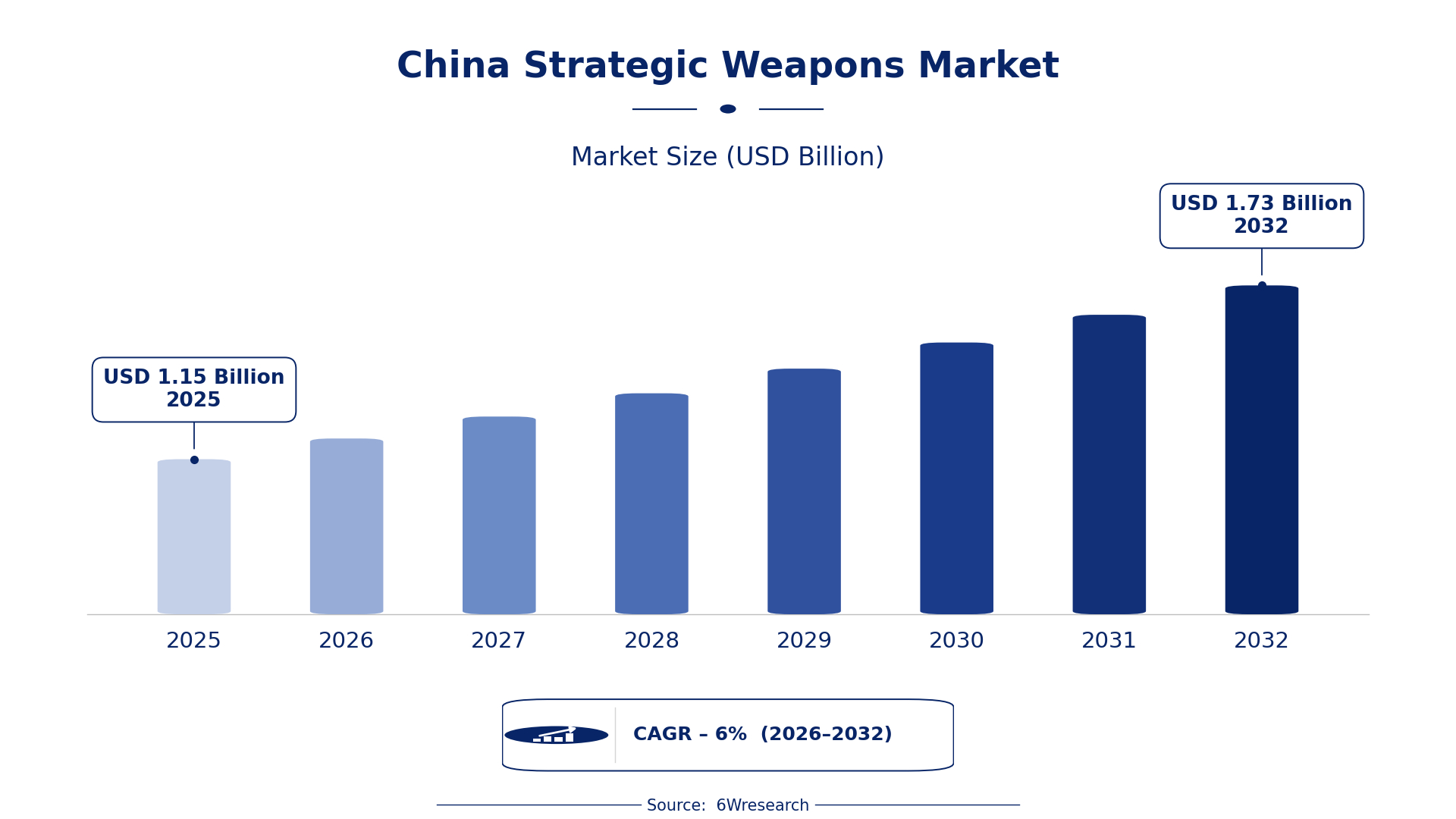
According to 6Wresearch internal database and industry insights, the China Strategic Weapons Market was valued at USD 1.15 billion in 2025 and is projected to reach USD 1.73 billion by 2032, growing at a CAGR of approximately 6% during 2026–2032.
China Strategic Weapons Market Highlights
| Report Metric | Details |
| Report Name | China Strategic Weapons Market |
| Market Size 2025 | USD 1.15 billion |
| Market Size 2032 | USD 1.73 billion |
| Absolute Growth 2025–2032 | USD 0.58 billion |
| CAGR 2026–2032 | 6% |
| Peak Annual Growth | 8.0% in 2030 |
| Forecast Period | 2026–2032 |
| Historical Data | 2022–2025 |
| Base Year | 2025 |
| Leading Weapon Type, 2025 | Ballistic Missiles (35% share) |
| Leading Deployment Platform, 2025 | Land-Based (37% share) |
| Leading Guidance System, 2025 | Satellite-Guided (39% share) |
| Leading End User, 2025 | Defense Forces (50% share) |
| Fastest-Growing Weapon Type | Hypersonic Weapons (7.6% CAGR) |
| Fastest-Growing Deployment Platform | Submarine-Launched (7.3% CAGR) |
| Fastest-Growing Guidance System | Advanced Navigation (8.3% CAGR) |
| Fastest-Growing End User | Strategic Defense Programs (8.7% CAGR) |
| Growing Sector | Defense |
| Key End Users | Defense Forces, National Defense Agencies, Military Contractors |
China Strategic Weapons Market Year-wise Growth Rate and Key Drivers (2022–2032)
This graph illustrates the annual growth rates of the market from 2022 to 2032, highlighting a steady upward trajectory and projected market expansion over the forecast period.
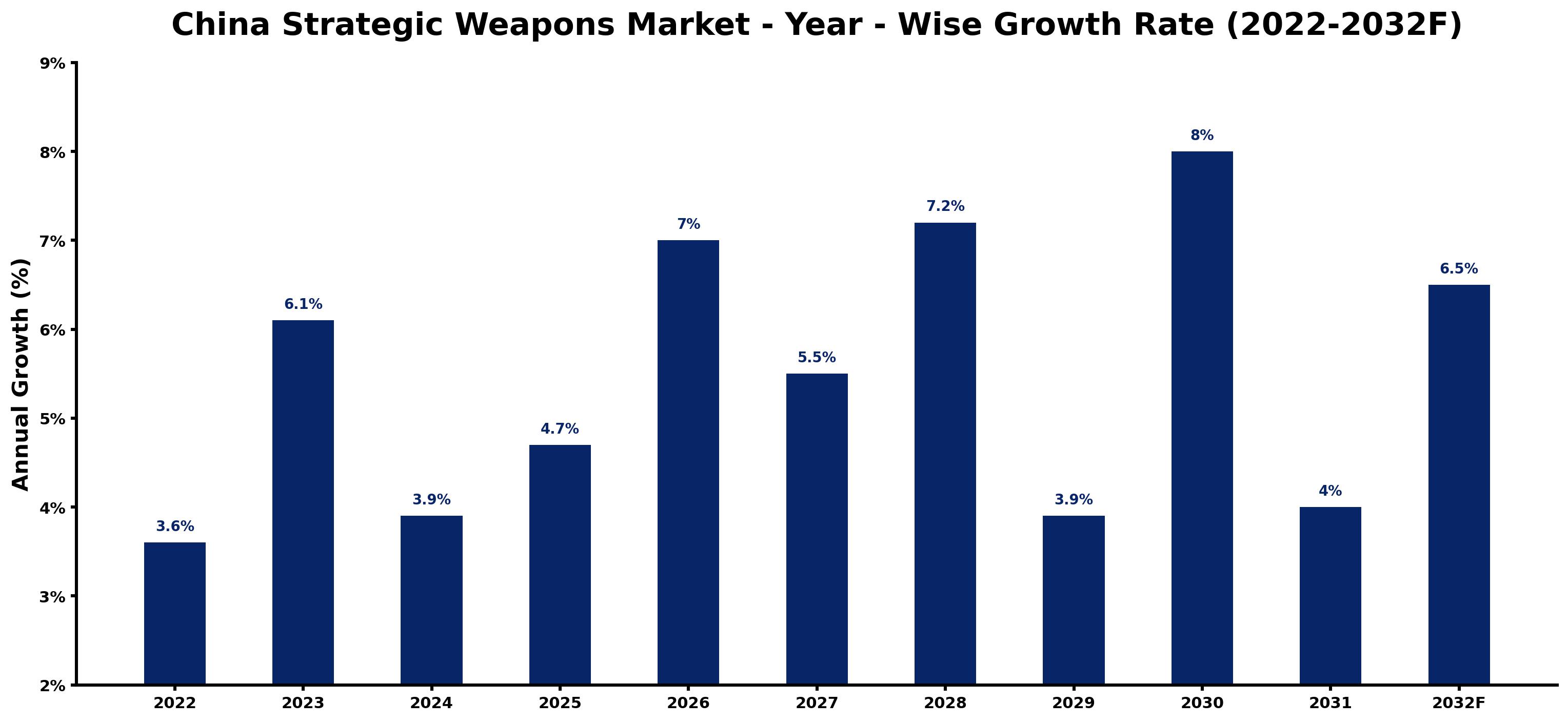
The following table presents the estimated annual growth rate for each year together with the principal factor influencing market performance.
| Year | Estimated Annual Growth (%) | Market Rationale |
| 2022 | 3.6 | The market experienced steady growth, supported by ongoing military modernization efforts in the Beijing Military Region. |
| 2023 | 6.1 | Demand increased due to heightened military spending and strategic initiatives outlined in the 2021 National Defense Strategy. |
| 2024 | 3.9 | Growth slowed as the market adjusted to previous high levels of investment in missile systems. |
| 2025 | 4.7 | A resurgence in military funding led to faster growth compared to the previous year, particularly in hypersonic weapons development. |
| 2026 | 7.0 | The introduction of new technologies under the Strategic Weapons Development Plan is expected to spur demand for advanced systems. |
| 2027 | 5.5 | Growth is projected to slow as the market stabilizes after rapid advancements in missile technology. |
| 2028 | 7.2 | Increased focus on hypersonic weapons will drive growth faster than in prior years, following successful tests of the DF-ZF glide vehicle since 2021. |
| 2029 | 3.9 | The market is expected to experience a slowdown as previous investments begin to mature and require consolidation. |
| 2030 | 8.0 | A peak in growth is anticipated, driven by advancements in missile technology and capabilities, particularly in ICBMs. |
| 2031 | 4.0 | Growth is expected to slow as the market begins to normalize after the peak year of 2030. |
| 2032 | 6.5 | Demand is projected to rise again, supported by ongoing modernization and strategic initiatives from the Ministry of National Defense. |
Note: Market size estimations and growth projections presented in this report are based on 6Wresearch's proprietary forecasting methodology, utilizing the latest available industry data, government publications, and primary research inputs.
China Strategic Weapons Market Synopsis
Strategic Weapons in China includes advanced military technologies designed for deterrence and defense, such as ballistic and cruise missiles. These systems are developed through intricate engineering processes and play crucial roles in national defense and geopolitical stability. The China Strategic Weapons Market is expanding due to military spending, which reached approximately $250 billion in 2022, alongside continuous modernization efforts. The emphasis on hypersonic technology and missile defense systems is further stimulating demand among defense forces. The introduction of the Strategic Weapons Development Plan in 2022 underscores the commitment to strengthening deterrence capabilities.
Market Dynamics Impact Analysis (2026–2032)
| Factor | Type | Impact | Primary Segment Affected |
| Increased military spending supports the development of advanced ballistic missile systems. | Driver | High | Ballistic Missiles |
| The push for hypersonic technology drives demand for next-generation weapons. | Driver | High | Hypersonic Weapons |
| The need for enhanced missile defense systems presents investment opportunities. | Opportunity | Medium | ICBMs |
| The focus on hypersonic technology creates opportunities for innovation and development. | Opportunity | High | Hypersonic Weapons |
| Limited funding for research and development hampers innovation in missile technology. | Restraint | High | Cruise Missiles |
| Supply chain disruptions can impact the availability of critical components for strategic weapons. | Restraint | High | ICBMs |
| Geopolitical tensions may lead to increased scrutiny and regulation of military technologies. | Challenge | High | Land-Based |
| Competition from other countries in missile technology can constrain market growth. | Challenge | Medium | Submarine-Launched |
Evaluation of Drivers in China Strategic Weapons Market (2026–2032)
The table below links each growth driver to the segment it affects and the evidence for it.
| Drivers | Primary Segment Affected | Why It Matters (Evidence) |
| Increased military spending supports the development of advanced ballistic missile systems. | Ballistic Missiles | China's military spending reached approximately $250 billion in 2022, which increases investment in deterrent capabilities. |
| The push for hypersonic technology drives demand for next-generation weapons. | Hypersonic Weapons | The successful launch of hypersonic weapons since 2021 has prompted further investment in this area. |
| The establishment of the Strategic Weapons Development Plan improves capabilities. | ICBMs | This plan focuses on improving deterrence capabilities, which increases procurement of ICBMs. |
| Growing geopolitical tensions necessitate advanced missile defense systems. | Cruise Missiles | The 2022 White Paper on National Defense emphasizes the importance of strategic deterrence in military strategy. |
| The integration of advanced navigation technologies improves weapon system accuracy. | Satellite-Guided | Investments in satellite-guided systems improve operational effectiveness in military engagements. |
Growth in the Strategic Weapons market in China comes from expanding military budgets, technological advancements, and rising geopolitical tensions. China's military spending reached approximately $250 billion in 2022, which boosts investment in advanced ballistic missile systems. The successful launch of hypersonic weapons since 2021 has prompted further investment in this area, enhancing deterrence capabilities. The emphasis on strategic deterrence in the 2022 White Paper highlights the need for advanced missile systems, while the establishment of the Strategic Weapons Development Plan is expected to improve procurement processes. Increased funding for research and development will drive demand from national defense forces seeking enhanced capabilities.
Evaluation of Restraints in China Strategic Weapons Market
The following restraints limit how fast demand can grow.
| Market Restraint | Primary Segment Affected | Why It Matters (Evidence) |
| Limited funding for research and development hampers innovation in missile technology. | Hypersonic Weapons | Funding constraints can delay the development of advanced hypersonic systems, affecting competitiveness. |
| Geopolitical tensions may lead to increased scrutiny and regulation of military technologies. | Land-Based | Regulatory hurdles can slow down the deployment of land-based strategic weapons systems. |
| Competition from other countries in missile technology can constrain market growth. | Submarine-Launched | Rival nations' advancements in submarine-launched systems can limit market opportunities. |
| Supply chain disruptions can impact the availability of critical components for strategic weapons. | ICBMs | Disruptions in global supply chains can delay production timelines for ICBM systems. |
| A lack of skilled workforce in advanced military technologies can hinder development. | Ballistic Missiles | The shortage of qualified engineers affects the pace of innovation in ballistic missile systems. |
China Strategic Weapons Market Challenges
The China Strategic Weapons Market grapples with high development costs, which can exceed billions for advanced systems, limiting producers' ability to invest in innovation. This financial burden results in slower production rates, delaying the delivery of critical military capabilities to buyers. Supply chain issues further complicate matters; reliance on specific materials can postpone projects by up to six months, impacting timely system deployment for the military. Regulatory hurdles also pose challenges, as stringent oversight from the Ministry of National Defense can prolong approval processes, causing additional delays for both producers and buyers.
Trends in the China Strategic Weapons Market
Below mentioned are some of the trends shaping the China Strategic Weapons Market growth.
- Shift towards Hypersonic Weapons Development: China is increasingly prioritising hypersonic weapons, with the first successful launch taking place in 2021. This shift is backed by the 2022 Strategic Weapons Development Plan, which allocates resources to develop these capabilities.
- Increased Integration of Advanced Navigation Systems: The market is experiencing a trend towards advanced navigation technologies, with a projected growth rate of 8.3% for Advanced Navigation systems. This trend is driven by the demand for improved accuracy in military operations.
- Expansion of Land-Based Strategic Weapons: The deployment of land-based strategic weapons continues to dominate, accounting for 37% of the market share in 2025. This trend is supported by the strategic importance of the Beijing Military Region for military operations.
- Growing Emphasis on Missile Defense Systems: The focus on missile defense systems is intensifying, driven by the National Defense Authorization Act of 2021. This act allocated funding for the development of next-generation missile defense technologies.
Investment Opportunities in the China Strategic Weapons Market
Some of the investment opportunities in the China Strategic Weapons Market are mentioned below.
- Joint Ventures for Technology Development: The current focus on hypersonic technology presents opportunities for joint ventures with local firms. Collaborating with national defense agencies can drive innovation in missile systems, especially in regions like Beijing.
- Investment in Advanced Navigation Technologies: There is a gap in advanced navigation systems, with a projected growth rate of 8.3%. Investing in this area can benefit military contractors looking to improve system accuracy.
- Approval Pathways for New Missile Systems: The 2022 Defense Budget Report allocated funds for next-generation missile systems. Engaging with the Ministry of National Defense can facilitate approvals for new technologies.
- Focus on Submarine-Launched Capabilities: The growing demand for submarine-launched systems, projected to grow at 7.3%, presents a timely investment opportunity. Collaborating with naval defense sectors can support market entry.
Government Initiatives in the China Strategic Weapons Market
The 2022 Strategic Weapons Development Plan aims to improve China's deterrence capabilities, particularly in hypersonic technology. This measure builds on the 2021 National Defense Strategy, which emphasized modernization and technological innovation. The new plan allocates funding for research and development, ensuring that strategic weapons systems remain competitive. The Ministry of National Defense oversees these initiatives, ensuring alignment with national security objectives. This approach is expected to yield advancements in military capabilities over the coming years.
In 2022, the Defense Technology Innovation Program was launched, allocating approximately $500 million to promote research in advanced military technologies. The Ministry of Industry and Information Technology administers this program, focusing on improving strategic weapons development. This initiative supports collaboration between military and civilian sectors, fostering innovation in weapon systems. Additionally, the National Defense Science and Technology Agency oversees research projects related to missile systems, ensuring that advancements align with national defense priorities. These efforts are vital for maintaining technological superiority in strategic capabilities.
Future Insight of the China Strategic Weapons Market
The China Strategic Weapons Market is set for significant evolution by 2032, driven by advancements in missile defense systems and hypersonic technology. Funding from the National Defense Authorization Act will support research and development, leading to the creation of more advanced weaponry. The Strategic Support Force will bolster capabilities in space and cyber domains, strengthening national security. By 2032, China's military spending is expected to surpass $300 billion, reflecting ongoing modernization efforts and ensuring the country maintains its strategic edge.
Market Segmentation Analysis
Each segment group is reviewed below, with the leader by share and the fastest grower by CAGR.
By Weapon Type – Ballistic Missiles Dominated, Hypersonic Weapons Expected to Grow Fastest
According to Summon Dutta, Assistant Manager at 6Wresearch, the largest weapon type category in 2025 was Ballistic Missiles, with a 35% share of total revenue. Ballistic missiles are integral to China's deterrence strategy, serving as the primary means of delivering nuclear payloads. Their extensive development, with over 1,000 units, ensures they maintain a dominant share in the strategic weapons market. Over 2026–2032, Hypersonic Weapons are expected to post the fastest growth, at a CAGR of 7.6%. Hypersonic weapons are gaining traction, highlighted by the successful tests of the DF-ZF glide vehicle, which enhances their strategic significance. Their capability to evade missile defenses and provide rapid response is driving notable growth in this segment. Suppliers should prioritise hypersonic technology advancements to cater to the increasing demand for next-generation military capabilities.
By Deployment Platform – Land-Based Dominated, Submarine-Launched Expected to Grow Fastest
In 2025, Land-Based led the deployment platform split with a 37% share. Land-based platforms are the most common method for deploying strategic weapons, providing a solid infrastructure for missile systems. This widespread utilisation solidifies their substantial share in China's military strategy and operational effectiveness. Submarine-Launched is set to record the highest CAGR in this split, 7.3% over 2026–2032. Submarine-launched systems are increasingly recognised for their stealth and second-strike capabilities, which are critical in modern warfare. This focus on stealth is accelerating their adoption and enhancing their market position. Buyers must invest in submarine-launched systems to bolster their strategic deterrence capabilities.
By Guidance System – Satellite-Guided Dominated, Advanced Navigation Expected to Grow Fastest
Satellite-Guided took a 39% share of guidance system in 2025, more than any other category. Satellite-guided systems are essential for modern strategic operations, offering crucial precision and reliability for targeting. Their established role in military applications ensures they dominate the guidance systems market share. Advanced Navigation is projected to grow fastest, at a CAGR of 8.3% during 2026–2032. Advanced navigation technologies are improving reliability across diverse operational conditions, making them increasingly attractive for military applications. This trend is expected to drive their rapid adoption and increase their market share. Suppliers should focus on developing advanced navigation technologies to capture the growing market share.
By End User – Defense Forces Dominated, Strategic Defense Programs Expected to Grow Fastest
With a 50% revenue share in 2025, Defense Forces was the largest end user category. Defense forces are the primary users of strategic weapons, directly integrating them into national defense strategies. Their significant role in military operations guarantees they hold a considerable share of the market. The quickest growth will come from Strategic Defense Programs, forecast to expand at a CAGR of 8.7% between 2026 and 2032. Strategic defense programs are evolving to incorporate a range of defense technologies, reflecting a shift towards comprehensive security solutions. This integration is propelling accelerated growth in this segment and enhancing its market relevance. Buyers should align their procurement strategies with the growing emphasis on integrated defense solutions to strengthen national security.
Key Attractiveness of the Report
- 10 Years of Market Numbers
- Historical Data Starting from 2022 to 2025
- Base Year 2025
- Forecast Data until 2032
- Key Performance Indicators Impacting the Market
- Major Upcoming Developments and Projects
Key Highlights of the Report:
- China Strategic Weapons Market Outlook
- Market Size of China Strategic Weapons Market, 2025
- Forecast of China Strategic Weapons Market, 2032
- Historical Data and Forecast of China Strategic Weapons Revenues & Volume for the Period 2022 - 2032F
- China Strategic Weapons Market Trend Evolution
- China Strategic Weapons Market Drivers and Challenges
- China Strategic Weapons Price Trends
- China Strategic Weapons Porter's Five Forces
- China Strategic Weapons Industry Life Cycle
- Historical Data and Forecast of China Strategic Weapons Market Revenues & Volume By Weapon Type for the Period 2022 - 2032F
- Historical Data and Forecast of China Strategic Weapons Market Revenues & Volume By Ballistic Missiles for the Period 2022 - 2032F
- Historical Data and Forecast of China Strategic Weapons Market Revenues & Volume By Cruise Missiles for the Period 2022 - 2032F
- Historical Data and Forecast of China Strategic Weapons Market Revenues & Volume By ICBMs for the Period 2022 - 2032F
- Historical Data and Forecast of China Strategic Weapons Market Revenues & Volume By Hypersonic Weapons for the Period 2022 - 2032F
- Historical Data and Forecast of China Strategic Weapons Market Revenues & Volume By Deployment Platform for the Period 2022 - 2032F
- Historical Data and Forecast of China Strategic Weapons Market Revenues & Volume By Land-Based for the Period 2022 - 2032F
- Historical Data and Forecast of China Strategic Weapons Market Revenues & Volume By Airborne for the Period 2022 - 2032F
- Historical Data and Forecast of China Strategic Weapons Market Revenues & Volume By Submarine-Launched for the Period 2022 - 2032F
- Historical Data and Forecast of China Strategic Weapons Market Revenues & Volume By Space-Enabled for the Period 2022 - 2032F
- Historical Data and Forecast of China Strategic Weapons Market Revenues & Volume By Guidance System for the Period 2022 - 2032F
- Historical Data and Forecast of China Strategic Weapons Market Revenues & Volume By Inertial/Nuclear for the Period 2022 - 2032F
- Historical Data and Forecast of China Strategic Weapons Market Revenues & Volume By GPS/Laser-Guided for the Period 2022 - 2032F
- Historical Data and Forecast of China Strategic Weapons Market Revenues & Volume By Satellite-Guided for the Period 2022 - 2032F
- Historical Data and Forecast of China Strategic Weapons Market Revenues & Volume By Advanced Navigation for the Period 2022 - 2032F
- Historical Data and Forecast of China Strategic Weapons Market Revenues & Volume By End User for the Period 2022 - 2032F
- Historical Data and Forecast of China Strategic Weapons Market Revenues & Volume By Defense Forces for the Period 2022 - 2032F
- Historical Data and Forecast of China Strategic Weapons Market Revenues & Volume By Military Contractors for the Period 2022 - 2032F
- Historical Data and Forecast of China Strategic Weapons Market Revenues & Volume By National Defense Agencies for the Period 2022 - 2032F
- Historical Data and Forecast of China Strategic Weapons Market Revenues & Volume By Strategic Defense Programs for the Period 2022 - 2032F
- China Strategic Weapons Import Export Trade Statistics
- Market Opportunity Assessment By Weapon Type
- Market Opportunity Assessment By Deployment Platform
- Market Opportunity Assessment By Guidance System
- Market Opportunity Assessment By End User
- China Strategic Weapons Top Companies Market Share
- China Strategic Weapons Competitive Benchmarking By Technical and Operational Parameters
- China Strategic Weapons Company Profiles
- China Strategic Weapons Key Strategic Recommendations
Market Covered
Segments analysed in this report are listed below.
By Weapon Type
- Ballistic Missiles
- Cruise Missiles
- ICBMs
- Hypersonic Weapons
By Deployment Platform
- Land-Based
- Airborne
- Submarine-Launched
- Space-Enabled
By Guidance System
- Inertial/Nuclear
- GPS/Laser-Guided
- Satellite-Guided
- Advanced Navigation
By End User
- Defense Forces
- Military Contractors
- National Defense Agencies
- Strategic Defense Programs































