China Stroke Prevention Market Size & Growth Rate
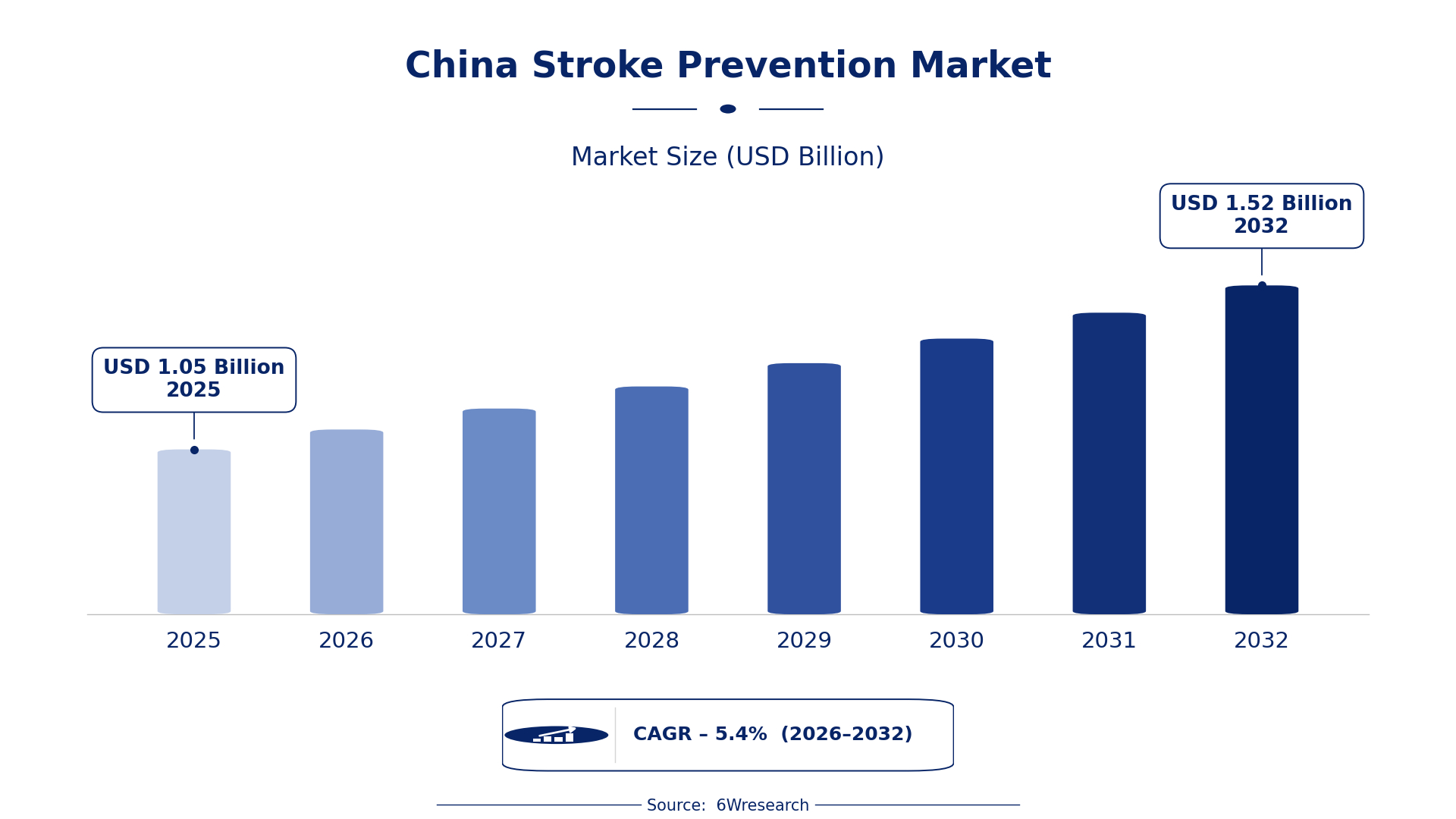
According to 6Wresearch internal database and industry insights, the China Stroke Prevention Market was valued at USD 1.05 billion in 2025 and is projected to reach USD 1.52 billion by 2032, growing at a CAGR of approximately 5.4% during 2026–2032.
China Stroke Prevention Market Highlights
| Report Metric | Details |
| Report Name | China Stroke Prevention Market |
| Market Size 2025 | USD 1.05 billion |
| Market Size 2032 | USD 1.52 billion |
| Absolute Growth 2025–2032 | USD 0.47 billion |
| CAGR 2026–2032 | 5.4% |
| Peak Annual Growth | 7.2% in 2029 |
| Forecast Period | 2026–2032 |
| Historical Data | 2022–2025 |
| Base Year | 2025 |
| Leading Intervention Type, 2025 | Medication Therapy (40% share) |
| Leading Risk Group, 2025 | High Blood Pressure (40% share) |
| Leading Delivery Channel, 2025 | Public Health Programs (41% share) |
| Leading End User, 2025 | Cardiologists (45% share) |
| Fastest-Growing Intervention Type | Wearable Monitoring (8.1% CAGR) |
| Fastest-Growing Risk Group | High-Risk Adults (7.9% CAGR) |
| Fastest-Growing Delivery Channel | Research Institutions (7.6% CAGR) |
| Fastest-Growing End User | Preventive Health Providers (7.9% CAGR) |
| Growing Sector | Preventive Health Providers |
| Key End Users | Cardiologists, Preventive Health Providers, Clinical Labs, Wellness Centers |
China Stroke Prevention Market Year-wise Growth Rate and Key Drivers (2022–2032)
This graph illustrates the annual growth rates of the market from 2022 to 2032, highlighting a steady upward trajectory and projected market expansion over the forecast period.
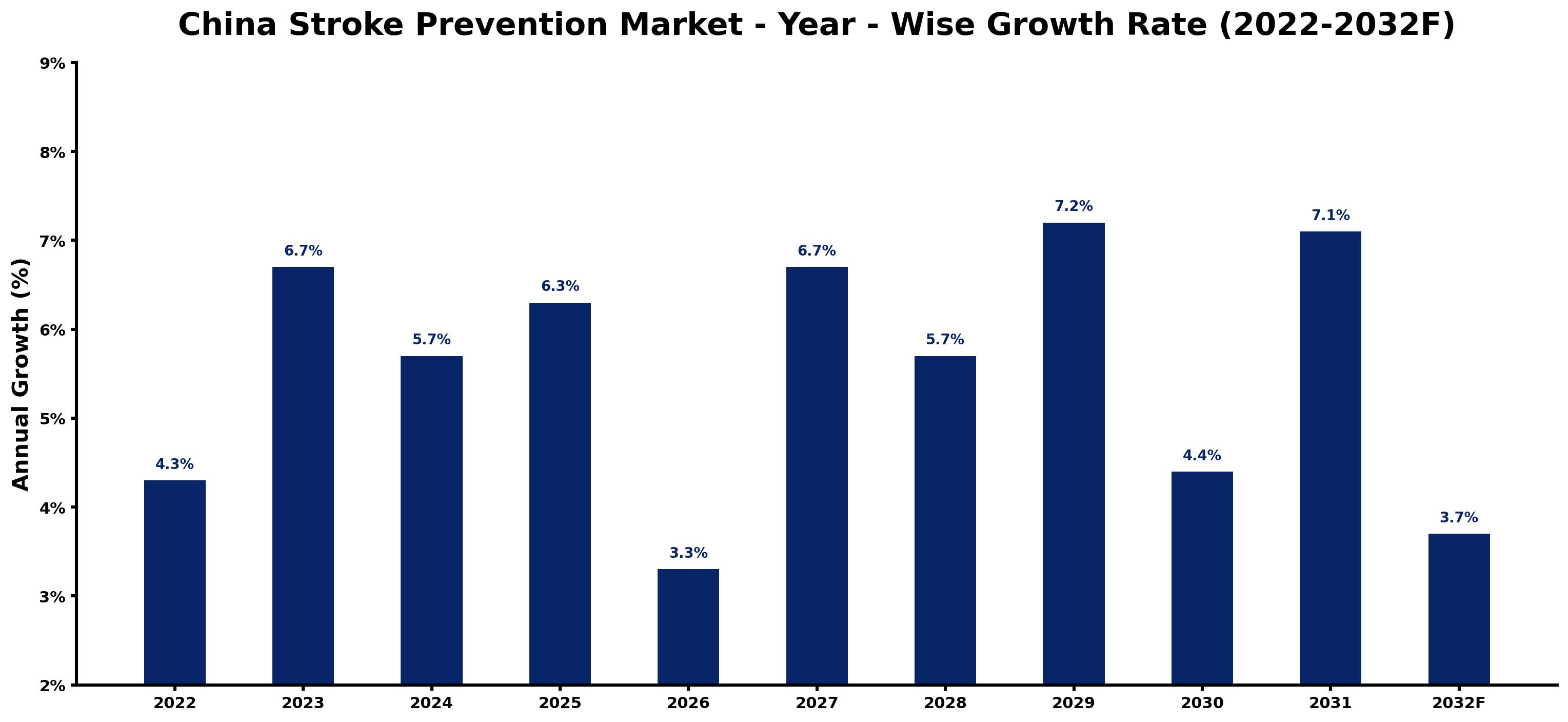
The table below sets out the estimated growth rate for each year and the main factor behind it.
| Year | Estimated Annual Growth (%) | Market Rationale |
| 2022 | 4.3 | The market experienced steady growth due to the 'Healthy China Action Plan' promoting stroke prevention initiatives. |
| 2023 | 6.7 | Demand rose as awareness of hypertension management increased among the population through public health campaigns. |
| 2024 | 5.7 | Growth slowed as the market adjusted to previous high demand levels following heightened awareness. |
| 2025 | 6.3 | The market saw renewed growth driven by public health campaigns targeting stroke prevention education. |
| 2026 | 3.3 | Growth is expected to slow as the market stabilises after peak demand levels from prior years. |
| 2027 | 6.7 | Demand will increase as new wearable technologies gain popularity among high-risk adults requiring monitoring. |
| 2028 | 5.7 | Growth is projected to slow due to market maturation and increased competition among healthcare providers. |
| 2029 | 7.2 | The market is expected to peak as new therapies and programs gain traction among healthcare professionals. |
| 2030 | 4.4 | Growth will slow as the market adjusts to the saturation of certain segments in stroke prevention services. |
| 2031 | 7.1 | Demand is projected to surge again as preventive health providers expand their services and outreach. |
| 2032 | 3.7 | Growth is expected to slow as the market reaches a more stable phase with established practices. |
Note: Market size estimations and growth projections presented in this report are based on 6Wresearch's proprietary forecasting methodology, utilizing the latest available industry data, government publications, and primary research inputs.
China Stroke Prevention Market Synopsis
Stroke Prevention in China encompasses lifestyle management, medication therapy, and wearable monitoring technologies aimed at reducing stroke incidence. The China Stroke Prevention Market is expanding due to the increasing prevalence of hypertension and the launch of the 'Healthy China 2030' initiative, which targets a 20% reduction in stroke rates by 2030. Public health campaigns are educating millions on stroke prevention, further driving market demand and engagement.
Market Dynamics Impact Analysis (2026–2032)
| Factor | Type | Impact | Primary Segment Affected |
| Increasing prevalence of hypertension drives demand for effective management solutions. | Driver | High | High Blood Pressure |
| Expansion of public health programs enhances community awareness and access. | Driver | High | Public Health Programs |
| Rising adoption of wearable health technologies presents significant growth potential. | Opportunity | High | Wearable Monitoring |
| The elderly population requires tailored stroke prevention services, creating a demand gap. | Opportunity | High | Elderly Population |
| Limited funding for stroke prevention programs can hinder outreach efforts. | Restraint | High | Public Health Programs |
| High costs associated with advanced medication therapies may restrict access for some patients. | Restraint | Medium | Medication Therapy |
| Approval delays for new stroke prevention technologies can slow market entry. | Challenge | High | Wearable Monitoring |
| Competition among healthcare providers may limit market share for new entrants. | Challenge | Medium | Cardiologists |
Evaluation of Drivers in China Stroke Prevention Market (2026–2032)
The main growth drivers and the segments they affect most are set out below.
| Drivers | Primary Segment Affected | Why It Matters (Evidence) |
| Growing number of hypertension cases increases demand for management solutions. | High Blood Pressure | Approximately 330 million people in China have hypertension, necessitating effective treatment options. |
| Public health initiatives boost awareness and access to preventive measures. | Public Health Programs | The 'Healthy China 2030' initiative aims to educate 200 million people on stroke prevention by 2025. |
| Wearable technology adoption improves real-time health monitoring for high-risk individuals. | Wearable Monitoring | Adoption of wearable health technology has increased by 30% among high-risk adults in the last two years. |
| Research institutions are developing innovative therapies to enhance stroke prevention. | Research Institutions | Over 150 ongoing studies related to stroke prevention are currently being conducted in China. |
| Increased focus on elderly populations drives demand for targeted prevention programs. | Elderly Population | Over 40% of stroke patients in China are aged 60 and above, highlighting the need for specialized programs. |
The prevalence of hypertension affects approximately 330 million individuals, necessitating effective management solutions. Research institutions are conducting over 150 studies focused on new therapies, further boosting market growth. The adoption of wearable health technology has surged by 30% among high-risk adults, enhancing monitoring capabilities and encouraging proactive health management.
Evaluation of Restraints in China Stroke Prevention Market
Below mentioned are some major restraints and their influence on market dynamics.
| Market Restraint | Primary Segment Affected | Why It Matters (Evidence) |
| Limited funding for stroke prevention initiatives restricts outreach and education efforts. | Public Health Programs | In 2022, the Ministry of Health allocated a budget of 500 million RMB for stroke prevention programs. |
| High costs of medication therapies may limit access for some patients. | Medication Therapy | The expense of advanced therapies can deter patients from seeking necessary treatment options. |
| Approval delays for new technologies can slow market entry and innovation. | Wearable Monitoring | Regulatory processes can extend timelines for bringing new products to market, impacting availability. |
| Competition among healthcare providers may limit market share for new entrants. | Cardiologists | Established providers may dominate the market, making it challenging for newcomers to gain traction. |
| Public health campaigns may not reach all demographics effectively, limiting impact. | Public Health Programs | Educational efforts often focus on urban areas, leaving rural populations underserved and uninformed. |
China Stroke Prevention Market Challenges
Buyers in the China stroke prevention market face regulatory hurdles, as compliance with evolving health guidelines can delay product approvals, costing suppliers up to six months in market entry time. Local manufacturers intensify competition, resulting in price reductions that can shrink profit margins by around 15% annually for suppliers. Inconsistent technology adoption leaves many buyers without access to the latest wearable health devices, complicating hypertension management for 330 million individuals. Public health campaigns often miss key demographics, leaving over 200 million people unaware of stroke prevention strategies, which limits growth potential for the market.
Trends in the China Stroke Prevention Market
The trends below show where the China Stroke Prevention Market is heading.
- Shift from Traditional to Wearable Health Technologies: Since 2021, there has been a notable shift towards wearable health technologies for stroke prevention. Adoption has increased by 30% among high-risk adults, allowing for real-time health tracking and intervention.
- Growing Focus on Elderly Stroke Prevention: The emphasis on stroke prevention for the elderly population has intensified, with over 40% of stroke patients aged 60 and above. This demographic shift necessitates tailored prevention programs and services.
- Increased Public Health Campaigns: Public health campaigns have expanded significantly since 2020, aiming to educate 200 million people on stroke prevention by 2025. This initiative is important for raising awareness and reducing stroke incidence.
- Rise of Community Health Initiatives: The 'Stroke Prevention and Control Program' initiated in 2023 has enhanced community health education and screening efforts, supported by a budget of 300 million RMB, fostering local engagement in prevention.
Investment Opportunities in the China Stroke Prevention Market
The following opportunities in the China Stroke Prevention Market pair current demand with a clear way in.
- Gap in Elderly Stroke Prevention Services: With over 40% of stroke patients aged 60 and above, there is a gap in tailored prevention services. Investing in programs targeting this demographic can yield high returns in health outcomes.
- Partnerships with Research Institutions: Collaborating with research institutions can facilitate the development of effective stroke prevention therapies. This approach can lead to solutions for high-risk populations requiring targeted interventions.
- Expansion of Public Health Programs: The 'Healthy China 2030' initiative presents an opportunity to enhance public health programs focused on stroke prevention. Engaging local partners can improve outreach and effectiveness in communities.
- Investment in Wearable Health Technologies: The increasing adoption of wearable health technologies indicates a growing market. Suppliers can enter by partnering with health tech firms or obtaining necessary certifications to facilitate access.
Government Initiatives in the China Stroke Prevention Market
The 'Stroke Prevention and Control Program' initiated in 2023 enhances existing public health efforts by providing resources for community health education and screening. This program aims to reduce stroke incidence through targeted initiatives, supported by a budget of 300 million RMB. The 'Healthy China Action Plan (2019-2030)' complements these efforts by focusing on prevention and education, with a target to reduce stroke rates by 20% by 2030, significantly impacting stroke prevention strategies across the country.
The National Health Commission plays a key role in approving and funding stroke prevention initiatives. It oversees the 'National Clinical Research Center for Neurological Diseases', which promotes research and improves prevention strategies, ensuring ongoing advancements in stroke care. This agency's efforts are vital for enhancing local health services and fostering new approaches to stroke prevention.
Future Insight of the China Stroke Prevention Market
The China stroke prevention market will undergo significant changes by 2032, driven by the 'Healthy China 2030' initiative aiming for a 20% reduction in stroke incidence. Investment in over 1,000 stroke centers will improve emergency response capabilities, benefiting both buyers and suppliers. The adoption of ISO 9001 standards in hospitals will elevate care quality, fostering greater patient trust. Increased use of wearable health technology, which has risen by 30% among high-risk individuals, will empower users to actively manage their health, stimulating market demand.
Market Segmentation Analysis
The report offers a comprehensive study of the following market segments and their leading categories in the market.
By Intervention Type – Medication Therapy Dominated, Wearable Monitoring Expected to Grow Fastest
According to Summon Dutta, Assistant Manager at 6Wresearch, with a 40% revenue share in 2025, Medication Therapy was the largest intervention type category. Medication therapy holds the largest share in the China Stroke Prevention Market due to its critical role in managing hypertension, which affects around 330 million individuals. This extensive prevalence necessitates effective medication strategies to mitigate stroke risks across the population. Over 2026–2032, Wearable Monitoring is expected to post the fastest growth, at a CAGR of 8.1%. Wearable monitoring is experiencing rapid growth as it enables real-time health tracking, essential for stroke prevention in high-risk individuals. The adoption of wearable health technology has surged by 30% among high-risk adults in the last two years, indicating a shift towards proactive health management. Suppliers should explore integrating medication therapy with wearable technologies to meet consumer demands for comprehensive stroke prevention solutions.
By Risk Group – High Blood Pressure Dominated, High-Risk Adults Expected to Grow Fastest
In 2025, High Blood Pressure led the risk group split with a 40% share. High blood pressure is the leading risk group in the China Stroke Prevention Market, being a primary risk factor for strokes that requires consistent management. The substantial number of affected individuals highlights the urgent need for targeted interventions to tackle this critical health issue. High-Risk Adults are projected to grow fastest, at a CAGR of 7.9% during 2026–2032. High-risk adults represent the fastest-growing segment, comprising individuals with multiple risk factors that require immediate intervention. Their increasing focus on preventive measures will likely drive further growth in this area, underscoring the importance of tailored strategies. Suppliers should concentrate on developing targeted offerings that cater to the specific needs of high-risk adults, ensuring effective prevention strategies are accessible.
By Delivery Channel – Public Health Programs Dominated, Research Institutions Expected to Grow Fastest
Public Health Programs took a 41% share of delivery channel in 2025, more than any other category. Public health programs dominate the market share as they are essential for implementing community-wide stroke prevention initiatives. The Chinese government's commitment to reducing stroke incidence through these programs emphasises their significance in public health strategy. The quickest growth will come from Research Institutions, forecast to expand at a CAGR of 7.6% between 2026 and 2032. Research institutions are the fastest-growing delivery channel, playing a vital role in developing new stroke prevention strategies and therapies. With over 150 ongoing studies, their contributions are crucial for advancing the field and improving health outcomes. This indicates that suppliers should collaborate with research institutions to leverage new findings and enhance their product offerings.
By End User – Cardiologists Dominated, Preventive Health Providers Expected to Grow Fastest
Cardiologists held a 45% share of the China Stroke Prevention Market by end user in 2025. Cardiologists lead the market share as they are the specialists responsible for managing stroke risk factors and treatment, making them pivotal in stroke prevention efforts. Their expertise is essential for addressing the needs of patients at risk, particularly those with hypertension. Preventive Health Providers are set to record the highest CAGR in this split, 7.9% over 2026–2032. Preventive health providers are the fastest-growing end user group, focusing on early intervention and risk assessment to prevent strokes. Their increasing emphasis on proactive health measures reflects a broader shift towards prevention in healthcare practices. This suggests that suppliers should engage with preventive health providers to develop targeted solutions that support early intervention strategies.
Key Attractiveness of the Report
- 10 Years of Market Numbers
- Historical Data Starting from 2022 to 2025
- Base Year 2025
- Forecast Data until 2032
- Key Performance Indicators Impacting the Market
- Major Upcoming Developments and Projects
Key Highlights of the Report:
- China Stroke Prevention Market Outlook
- Market Size of China Stroke Prevention Market, 2025
- Forecast of China Stroke Prevention Market, 2032
- Historical Data and Forecast of China Stroke Prevention Revenues & Volume for the Period 2022 - 2032F
- China Stroke Prevention Market Trend Evolution
- China Stroke Prevention Market Drivers and Challenges
- China Stroke Prevention Price Trends
- China Stroke Prevention Porter's Five Forces
- China Stroke Prevention Industry Life Cycle
- Historical Data and Forecast of China Stroke Prevention Market Revenues & Volume By Intervention Type for the Period 2022 - 2032F
- Historical Data and Forecast of China Stroke Prevention Market Revenues & Volume By Lifestyle Management for the Period 2022 - 2032F
- Historical Data and Forecast of China Stroke Prevention Market Revenues & Volume By Medication Therapy for the Period 2022 - 2032F
- Historical Data and Forecast of China Stroke Prevention Market Revenues & Volume By Wearable Monitoring for the Period 2022 - 2032F
- Historical Data and Forecast of China Stroke Prevention Market Revenues & Volume By Vaccination Research for the Period 2022 - 2032F
- Historical Data and Forecast of China Stroke Prevention Market Revenues & Volume By Risk Group for the Period 2022 - 2032F
- Historical Data and Forecast of China Stroke Prevention Market Revenues & Volume By High Blood Pressure for the Period 2022 - 2032F
- Historical Data and Forecast of China Stroke Prevention Market Revenues & Volume By Atrial Fibrillation for the Period 2022 - 2032F
- Historical Data and Forecast of China Stroke Prevention Market Revenues & Volume By Elderly Population for the Period 2022 - 2032F
- Historical Data and Forecast of China Stroke Prevention Market Revenues & Volume By High-Risk Adults for the Period 2022 - 2032F
- Historical Data and Forecast of China Stroke Prevention Market Revenues & Volume By Delivery Channel for the Period 2022 - 2032F
- Historical Data and Forecast of China Stroke Prevention Market Revenues & Volume By Public Health Programs for the Period 2022 - 2032F
- Historical Data and Forecast of China Stroke Prevention Market Revenues & Volume By Hospitals for the Period 2022 - 2032F
- Historical Data and Forecast of China Stroke Prevention Market Revenues & Volume By Online Retailers for the Period 2022 - 2032F
- Historical Data and Forecast of China Stroke Prevention Market Revenues & Volume By Research Institutions for the Period 2022 - 2032F
- Historical Data and Forecast of China Stroke Prevention Market Revenues & Volume By End User for the Period 2022 - 2032F
- Historical Data and Forecast of China Stroke Prevention Market Revenues & Volume By Wellness Centers for the Period 2022 - 2032F
- Historical Data and Forecast of China Stroke Prevention Market Revenues & Volume By Cardiologists for the Period 2022 - 2032F
- Historical Data and Forecast of China Stroke Prevention Market Revenues & Volume By Preventive Health Providers for the Period 2022 - 2032F
- Historical Data and Forecast of China Stroke Prevention Market Revenues & Volume By Clinical Labs for the Period 2022 - 2032F
- China Stroke Prevention Import Export Trade Statistics
- Market Opportunity Assessment By Intervention Type
- Market Opportunity Assessment By Risk Group
- Market Opportunity Assessment By Delivery Channel
- Market Opportunity Assessment By End User
- China Stroke Prevention Top Companies Market Share
- China Stroke Prevention Competitive Benchmarking By Technical and Operational Parameters
- China Stroke Prevention Company Profiles
- China Stroke Prevention Key Strategic Recommendations
Market Covered
This report examines the market across the segments below.
By Intervention Type
- Lifestyle Management
- Medication Therapy
- Wearable Monitoring
- Vaccination Research
By Risk Group
- High Blood Pressure
- Atrial Fibrillation
- Elderly Population
- High-Risk Adults
By Delivery Channel
- Public Health Programs
- Hospitals
- Online Retailers
- Research Institutions
By End User
- Wellness Centers
- Cardiologists
- Preventive Health Providers
- Clinical Labs































