China Structural Alloy Market Size & Growth Rate
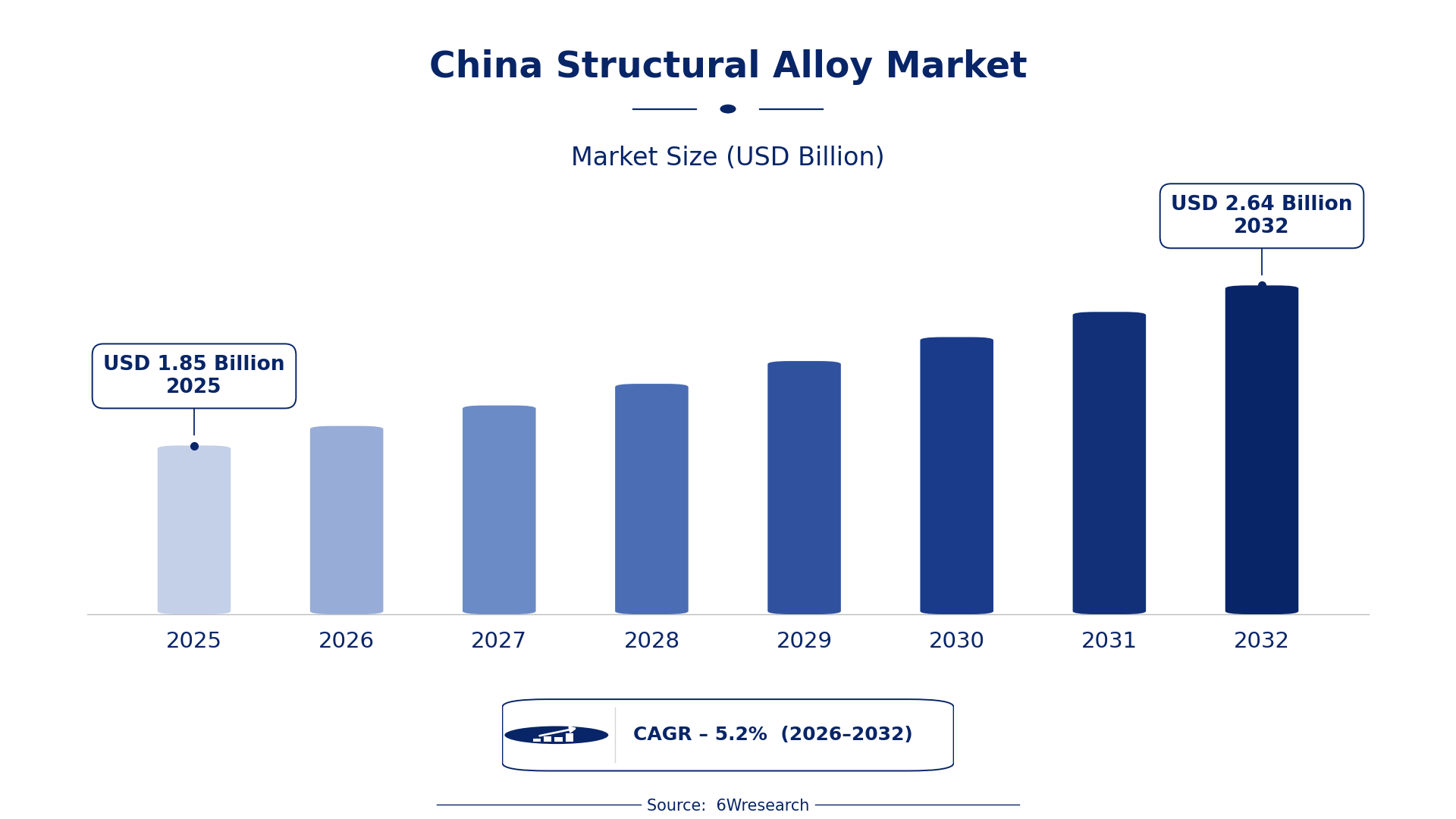
According to 6Wresearch internal database and industry insights, the China Structural Alloy Market was valued at USD 1.85 billion in 2025 and is projected to reach USD 2.64 billion by 2032, growing at a CAGR of approximately 5.2% during 2026–2032.
China Structural Alloy Market Highlights
| Report Metric | Details |
| Report Name | China Structural Alloy Market |
| Market Size 2025 | USD 1.85 billion |
| Market Size 2032 | USD 2.64 billion |
| Absolute Growth 2025–2032 | USD 0.79 billion |
| CAGR 2026–2032 | 5.2% |
| Peak Annual Growth | 7.0% in 2027 |
| Forecast Period | 2026–2032 |
| Historical Data | 2022–2025 |
| Base Year | 2025 |
| Leading Alloy Type, 2025 | Steel Alloys (37% share) |
| Leading Base Material, 2025 | Carbon Steel (39% share) |
| Leading Application Area, 2025 | Construction Supports (33% share) |
| Leading End User, 2025 | Vehicle OEMs (48% share) |
| Fastest-Growing Alloy Type | Titanium Alloys (7.7% CAGR) |
| Fastest-Growing Base Material | Titanium (7.0% CAGR) |
| Fastest-Growing Application Area | Medical Implants (7.2% CAGR) |
| Fastest-Growing End User | Biomedical Firms (6.8% CAGR) |
| Growing Sector | automotive manufacturing |
| Key End Users | automotive manufacturers, aerospace firms, biomedical companies, construction contractors |
China Structural Alloy Market Year-wise Growth Rate and Key Drivers (2022–2032)
This graph illustrates the annual growth rates of the market from 2022 to 2032, highlighting a steady upward trajectory and projected market expansion over the forecast period.
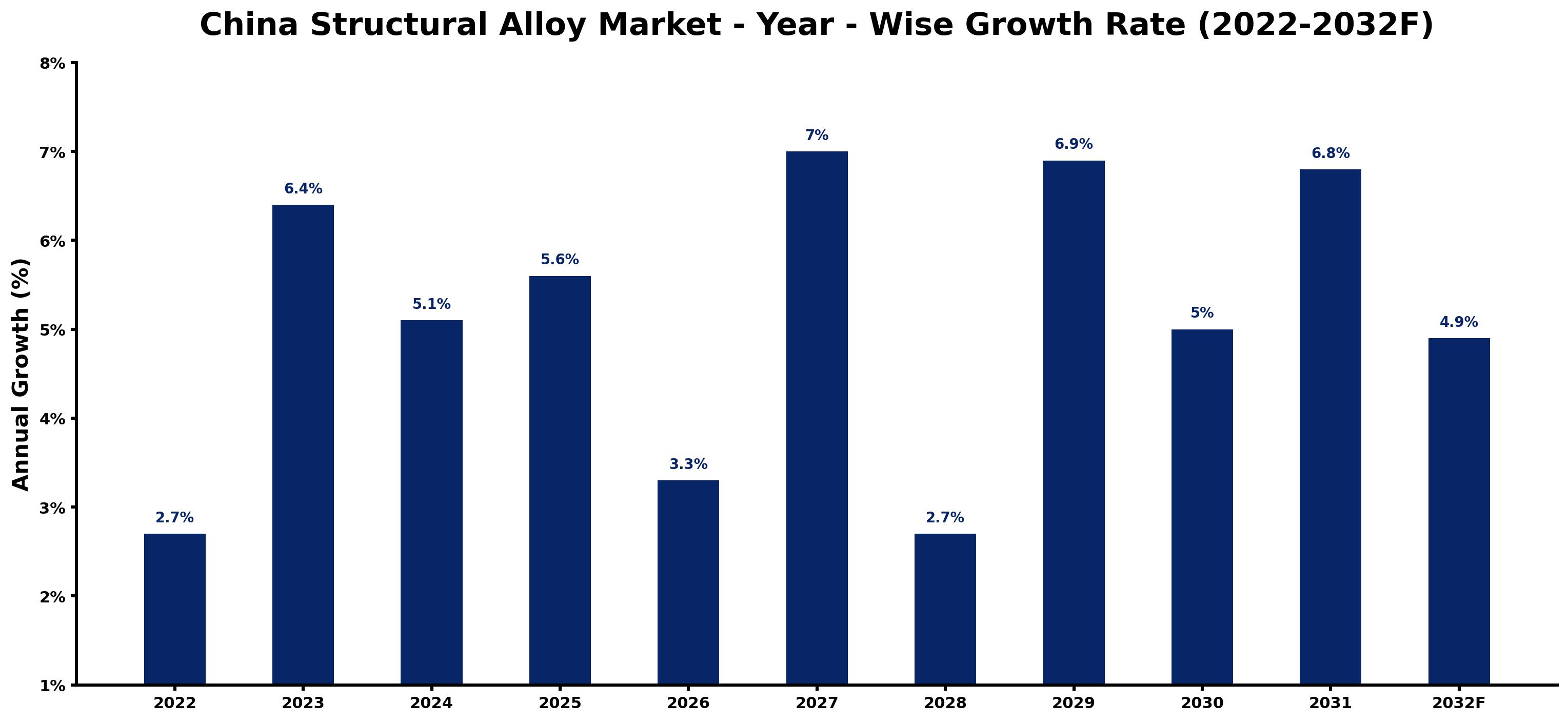
Each row of the following table gives one year's estimated growth and the event or demand shift that explains it.
| Year | Estimated Annual Growth (%) | Market Rationale |
| 2022 | 2.7 | The market experienced initial growth due to rising demand from the construction sector. |
| 2023 | 6.4 | The aerospace sector's expansion significantly boosted the market's growth rate. |
| 2024 | 5.1 | Demand growth slowed as construction projects faced delays and regulatory hurdles. |
| 2025 | 5.6 | Increased automotive production led to a resurgence in alloy demand. |
| 2026 | 3.3 | Growth slowed as manufacturers faced challenges in sourcing raw materials. |
| 2027 | 7.0 | A surge in aerospace requirements drove the market to its peak growth rate. |
| 2028 | 2.7 | Demand growth decelerated as the market stabilised after peak levels. |
| 2029 | 6.9 | The automotive sector's recovery spurred renewed interest in structural alloys. |
| 2030 | 5.0 | Growth slowed as the market adjusted to previous high demand levels. |
| 2031 | 6.8 | A strong push from biomedical firms led to a faster growth rate. |
| 2032 | 4.9 | The market growth rate slowed as demand stabilised across sectors. |
Note: Market size estimations and growth projections presented in this report are based on 6Wresearch's proprietary forecasting methodology, utilizing the latest available industry data, government publications, and primary research inputs.
China Structural Alloy Market Synopsis
The Structural Alloy Market in China includes advanced materials such as aluminium, titanium, magnesium, and steel, designed for strength and durability. These alloys play a crucial role in aerospace components, automotive structures, and construction materials. The market is expanding due to strong demand from the automotive and aerospace sectors, with the automotive industry producing over 25 million vehicles each year. Investment in infrastructure and the ongoing development of lightweight materials further fuel this growth.
Market Dynamics Impact Analysis (2026–2032)
| Factor | Type | Impact | Primary Segment Affected |
| Rising demand from the automotive sector drives the need for lightweight materials. | Driver | High | Aluminum Alloys |
| Increased aerospace production necessitates high-performance alloys for components. | Driver | High | Titanium Alloys |
| The construction sector's growth presents opportunities for new projects. | Opportunity | High | Steel Alloys |
| Growing biomedical applications for titanium alloys create new market potential. | Opportunity | Medium | Titanium Alloys |
| Supply chain disruptions affect the availability of raw materials for production. | Restraint | High | Magnesium Alloys |
| Regulatory compliance can increase production costs and timelines. | Restraint | Medium | Aluminum Alloys |
| Manufacturers face challenges in meeting evolving quality standards. | Challenge | High | Steel Alloys |
| Competition from alternative materials can limit market share. | Challenge | Medium | Magnesium Alloys |
Evaluation of Drivers in China Structural Alloy Market (2026–2032)
Key forces behind demand, with the segment each one moves most, are listed below.
| Drivers | Primary Segment Affected | Why It Matters (Evidence) |
| Increased automotive production drives demand for aluminum alloys. | Aluminum Alloys | The automotive industry produced over 25 million vehicles in 2022, leading to higher aluminum alloy purchases. |
| Aerospace sector growth boosts titanium alloy requirements. | Titanium Alloys | The aerospace sector is projected to require 1.5 million tons of aluminum alloys by 2025, increasing titanium alloy demand. |
| Construction sector expansion increases demand for steel alloys. | Steel Alloys | China's construction sector is expected to grow by 5% annually, driving steel alloy usage. |
| Biomedical applications for titanium alloys are expanding. | Titanium Alloys | Over 300 biomedical firms in China utilize titanium alloys for implants, creating new opportunities. |
| Investment in lightweight materials increases magnesium alloy demand. | Magnesium Alloys | The National Development and Reform Commission supports lightweight material development, boosting magnesium alloy usage. |
Growth in the Structural Alloy market in China is driven by increasing end-use demand from the automotive and aerospace sectors. The automotive industry, producing over 25 million vehicles annually, is boosting the need for aluminium alloys. At the same time, the aerospace sector is expected to require 1.5 million tons of aluminium alloys by 2025, further propelling growth. The construction sector is anticipated to grow by 5% each year, increasing the demand for steel alloys. Additionally, more than 300 biomedical firms in China are ramping up their use of titanium alloys for implants, creating new opportunities in the market.
Evaluation of Restraints in China Structural Alloy Market
The table below lists the restraints and the evidence behind each.
| Market Restraint | Primary Segment Affected | Why It Matters (Evidence) |
| Supply chain disruptions hinder raw material availability. | Magnesium Alloys | Manufacturers faced challenges in sourcing magnesium, affecting production schedules and leading to delays. |
| Regulatory compliance increases production costs. | Aluminum Alloys | Compliance with the National Standard GB/T 5237-2020 raises operational expenses for manufacturers. |
| Evolving quality standards challenge manufacturers. | Steel Alloys | Manufacturers must adapt to updated specifications, increasing operational complexity and costs. |
| Competition from alternative materials limits market growth. | Titanium Alloys | The rise of composite materials in aerospace applications poses a threat to titanium alloy demand. |
| Market fluctuations can affect investment decisions. | Aluminum Alloys | Economic uncertainties lead to cautious spending in the construction sector, impacting alloy purchases. |
China Structural Alloy Market Challenges
Buyers and suppliers in the China Structural Alloy Market face intense competition from global manufacturers, forcing local producers to cut prices and squeeze profit margins. A lack of skilled workers in advanced manufacturing techniques limits production capabilities, leading to project delays for automotive and aerospace clients. Supply chain disruptions, particularly in sourcing raw materials like titanium and aluminum, can stall operations for over 300 biomedical firms reliant on these supplies. Rising compliance costs associated with standards such as GB/T 5237-2020 increase operational expenses for manufacturers, ultimately pushing prices higher for end users in the construction and automotive sectors.
Trends in the China Structural Alloy Market
Four trends stand out in the China Structural Alloy Market.
- Shift towards Lightweight Automotive Frames: Vehicle OEMs are increasingly adopting magnesium alloys for automotive frames to improve fuel efficiency. In 2022, the automotive sector produced over 25 million vehicles, driving this trend.
- Transition to High-Performance Alloys in Aerospace: The aerospace sector is transitioning towards titanium alloys for their strength-to-weight ratio. By 2025, it is projected to require 1.5 million tons of aluminium alloys, reflecting this shift.
- Emerging Demand for Biomedical Applications: Biomedical firms are prioritising titanium alloys for implants due to their biocompatibility. Over 300 biomedical firms in China are utilising these materials, indicating a growing market.
- Focus on Sustainable Construction Materials: Construction supports are increasingly incorporating recycled aluminium alloys to meet sustainability goals. China's construction sector is expected to grow by 5% annually, further promoting this trend.
Investment Opportunities in the China Structural Alloy Market
Below are the investment opportunities with the strongest case in the China Structural Alloy Market.
- Investment in Automotive Manufacturing Hubs: The Shanghai region is a hub for automotive manufacturing, with a growing demand for lightweight materials. Investing in local partnerships can provide access to this expanding market.
- Entry into Biomedical Material Supply Chains: With over 300 biomedical firms operating, there is an opportunity for titanium alloy suppliers. Establishing joint ventures can facilitate entry into this sector and meet demand.
- Development of Advanced Construction Materials: The construction sector's expected 5% annual growth presents opportunities for innovative structural alloys. Collaborating with infrastructure contractors can help capture this demand effectively.
- Expansion of Aerospace Component Production: The aerospace sector's projected need for 1.5 million tons of aluminium alloys by 2025 highlights a gap in supply. Manufacturers can enter this market through certifications and partnerships.
Government Initiatives in the China Structural Alloy Market
In 2023, the 'National Standard for Titanium Alloys' was updated by the Standardization Administration of China to improve quality control in biomedical applications. This measure builds on previous regulations, ensuring that manufacturers meet higher standards for titanium alloy production, which is vital for the biomedical sector. The '14th Five-Year Plan for National Economic and Social Development' launched in 2021 also supports advanced material production, focusing on structural alloys. These initiatives collectively aim to improve the quality and availability of structural alloys in China.
The Ministry of Industry and Information Technology oversees the 'Materials Innovation Action Plan', which funds research into high-performance alloys. This initiative encourages manufacturers to innovate and improve production processes. Additionally, the 'National Key Research and Development Program' supports projects that enhance alloy manufacturing technologies, benefiting producers in the structural alloy market. These schemes provide essential funding and resources to ensure that manufacturers can meet the increasing demand for advanced materials.
Future Insight of the China Structural Alloy Market
The China Structural Alloy Market will undergo notable transformations by 2032, driven by the Advanced Materials Development Plan aimed at improving alloy production. The aerospace sector is set to increasingly favour lightweight materials, with demand for aluminium alloys expected to surge. As the construction sector grows at 5% annually, suppliers will need to respond effectively to evolving market needs. The focus on ISO 9001 certification will raise quality benchmarks, ensuring buyers receive more dependable products.
Market Segmentation Analysis
The report offers a comprehensive study of the following market segments and their leading categories in the market.
By Alloy Type – Steel Alloys Dominated, Titanium Alloys Expected to Grow Fastest
According to Summon Dutta, Assistant Manager at 6Wresearch, the largest alloy type category in 2025 was Steel Alloys, with a 37% share of total revenue. Steel alloys dominate the China Structural Alloy Market due to their essential role in construction supports and heavy machinery, with a production of 35 million tons in 2022 highlighting their widespread use. This robust demand from the construction sector solidifies steel's leading position in the market. Titanium Alloys are projected to grow fastest, at a CAGR of 7.7% during 2026–2032. Titanium alloys are experiencing rapid growth, primarily driven by their critical applications in aerospace and medical implants, which require superior strength-to-weight ratios. The aerospace sector's projected need for 1.5 million tons of aluminum alloys by 2025 indicates a shift towards advanced materials like titanium, further boosting its market position. Suppliers should focus on expanding their titanium alloy offerings to meet the increasing demand in aerospace and medical applications.
By Base Material – Carbon Steel Dominated, Titanium Expected to Grow Fastest
With a 39% revenue share in 2025, Carbon Steel was the largest base material category. Carbon steel holds the largest share in the market due to its extensive applications in construction and manufacturing, making it a vital material for various projects. Its strong presence in infrastructure initiatives reinforces its dominance in the structural alloy sector. Over 2026–2032, Titanium is expected to post the fastest growth, at a CAGR of 7.0%. Titanium is poised for the fastest growth, spurred by rising demand in high-performance applications such as aerospace and biomedical sectors. The advancements in lightweight material technologies facilitate titanium's swift adoption across these industries. Buyers should consider investing in titanium materials to stay competitive in sectors that prioritise lightweight and durable solutions.
By Application Area – Construction Supports Dominated, Medical Implants Expected to Grow Fastest
Construction Supports accounted for a 33% market share by application area in 2025. Construction supports are the leading application area, crucial for building infrastructure that is experiencing significant growth in China. The anticipated annual growth of 5% in the construction sector underscores the sustained demand for structural alloys in this segment. The quickest growth will come from Medical Implants, forecast to expand at a CAGR of 7.2% between 2026 and 2032. Medical implants are the fastest-growing application area, largely due to the increasing number of biomedical firms in China that require high-performance materials for implants. The rising focus on healthcare and advanced medical technologies drives this growing demand. Suppliers must adapt their product lines to cater to the expanding medical implant market while ensuring compliance with industry standards.
By End User – Vehicle OEMs Dominated, Biomedical Firms Expected to Grow Fastest
Vehicle OEMs took a 48% share of end user in 2025, more than any other category. Vehicle OEMs represent the largest share of the market, driven by China's position as the world's largest automotive producer, with over 25 million vehicles manufactured annually. This high production volume necessitates substantial quantities of structural alloys for various vehicle components, reinforcing OEMs' leading role. Biomedical Firms are set to record the highest CAGR in this split, 6.8% over 2026–2032. Biomedical firms are the fastest-growing end users, with the demand for titanium alloys in medical applications continuing to rise. The presence of over 300 biomedical firms in China presents a significant market opportunity for suppliers looking to expand their reach. Suppliers should target biomedical firms to capitalise on the growing demand for advanced materials in medical applications.
Key Attractiveness of the Report
- 10 Years of Market Numbers
- Historical Data Starting from 2022 to 2025
- Base Year 2025
- Forecast Data until 2032
- Key Performance Indicators Impacting the Market
- Major Upcoming Developments and Projects
Key Highlights of the Report:
- China Structural Alloy Market Outlook
- Market Size of China Structural Alloy Market, 2025
- Forecast of China Structural Alloy Market, 2032
- Historical Data and Forecast of China Structural Alloy Revenues & Volume for the Period 2022 - 2032F
- China Structural Alloy Market Trend Evolution
- China Structural Alloy Market Drivers and Challenges
- China Structural Alloy Price Trends
- China Structural Alloy Porter's Five Forces
- China Structural Alloy Industry Life Cycle
- Historical Data and Forecast of China Structural Alloy Market Revenues & Volume By Alloy Type for the Period 2022 - 2032F
- Historical Data and Forecast of China Structural Alloy Market Revenues & Volume By Aluminum Alloys for the Period 2022 - 2032F
- Historical Data and Forecast of China Structural Alloy Market Revenues & Volume By Titanium Alloys for the Period 2022 - 2032F
- Historical Data and Forecast of China Structural Alloy Market Revenues & Volume By Magnesium Alloys for the Period 2022 - 2032F
- Historical Data and Forecast of China Structural Alloy Market Revenues & Volume By Steel Alloys for the Period 2022 - 2032F
- Historical Data and Forecast of China Structural Alloy Market Revenues & Volume By Base Material for the Period 2022 - 2032F
- Historical Data and Forecast of China Structural Alloy Market Revenues & Volume By Aluminum for the Period 2022 - 2032F
- Historical Data and Forecast of China Structural Alloy Market Revenues & Volume By Titanium for the Period 2022 - 2032F
- Historical Data and Forecast of China Structural Alloy Market Revenues & Volume By Magnesium for the Period 2022 - 2032F
- Historical Data and Forecast of China Structural Alloy Market Revenues & Volume By Carbon Steel for the Period 2022 - 2032F
- Historical Data and Forecast of China Structural Alloy Market Revenues & Volume By Application Area for the Period 2022 - 2032F
- Historical Data and Forecast of China Structural Alloy Market Revenues & Volume By Aerospace Panels for the Period 2022 - 2032F
- Historical Data and Forecast of China Structural Alloy Market Revenues & Volume By Medical Implants for the Period 2022 - 2032F
- Historical Data and Forecast of China Structural Alloy Market Revenues & Volume By Automotive Frames for the Period 2022 - 2032F
- Historical Data and Forecast of China Structural Alloy Market Revenues & Volume By Construction Supports for the Period 2022 - 2032F
- Historical Data and Forecast of China Structural Alloy Market Revenues & Volume By End User for the Period 2022 - 2032F
- Historical Data and Forecast of China Structural Alloy Market Revenues & Volume By Aircraft Manufacturers for the Period 2022 - 2032F
- Historical Data and Forecast of China Structural Alloy Market Revenues & Volume By Biomedical Firms for the Period 2022 - 2032F
- Historical Data and Forecast of China Structural Alloy Market Revenues & Volume By Vehicle OEMs for the Period 2022 - 2032F
- Historical Data and Forecast of China Structural Alloy Market Revenues & Volume By Infrastructure Contractors for the Period 2022 - 2032F
- China Structural Alloy Import Export Trade Statistics
- Market Opportunity Assessment By Alloy Type
- Market Opportunity Assessment By Base Material
- Market Opportunity Assessment By Application Area
- Market Opportunity Assessment By End User
- China Structural Alloy Top Companies Market Share
- China Structural Alloy Competitive Benchmarking By Technical and Operational Parameters
- China Structural Alloy Company Profiles
- China Structural Alloy Key Strategic Recommendations
Market Covered
Segments analysed in this report are listed below.
By Alloy Type
- Aluminum Alloys
- Titanium Alloys
- Magnesium Alloys
- Steel Alloys
By Base Material
- Aluminum
- Titanium
- Magnesium
- Carbon Steel
By Application Area
- Aerospace Panels
- Medical Implants
- Automotive Frames
- Construction Supports
By End User
- Aircraft Manufacturers
- Biomedical Firms
- Vehicle OEMs
- Infrastructure Contractors































