China Structural Metal Market Size & Growth Rate
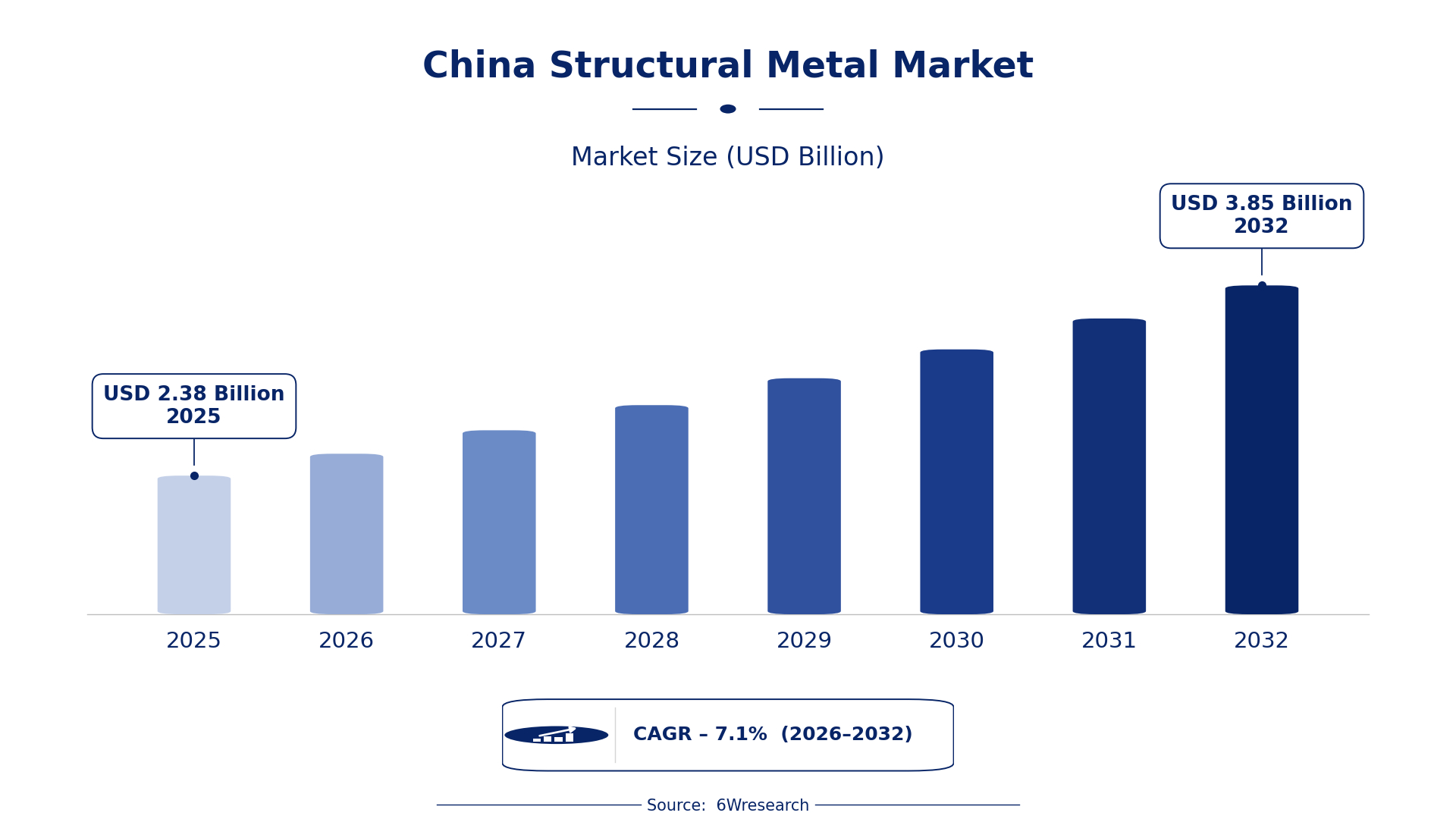
According to 6Wresearch internal database and industry insights, the China Structural Metal Market was valued at USD 2.38 billion in 2025 and is projected to reach USD 3.85 billion by 2032, growing at a CAGR of approximately 7.1% during 2026–2032.
China Structural Metal Market Highlights
| Report Metric | Details |
| Report Name | China Structural Metal Market |
| Market Size 2025 | USD 2.38 billion |
| Market Size 2032 | USD 3.85 billion |
| Absolute Growth 2025–2032 | USD 1.47 billion |
| CAGR 2026–2032 | 7.1% |
| Peak Annual Growth | 9.4% in 2029 |
| Forecast Period | 2026–2032 |
| Historical Data | 2022–2025 |
| Base Year | 2025 |
| Leading Metal Type, 2025 | Structural Steel (39% share) |
| Leading Product Form, 2025 | I-Beams (37% share) |
| Leading Application Area, 2025 | Building Frameworks (43% share) |
| Leading End User, 2025 | Construction Firms (40% share) |
| Fastest-Growing Metal Type | Aluminum (9.7% CAGR) |
| Fastest-Growing Product Form | Channels & Angles (9.2% CAGR) |
| Fastest-Growing Application Area | Bridges (9.0% CAGR) |
| Fastest-Growing End User | Infrastructure Developers (8.8% CAGR) |
| Growing Sector | Construction |
| Key End Users | Construction Firms, Infrastructure Developers, Engineering Contractors |
China Structural Metal Market Year-wise Growth Rate and Key Drivers (2022–2032)
This graph illustrates the annual growth rates of the market from 2022 to 2032, highlighting a steady upward trajectory and projected market expansion over the forecast period.
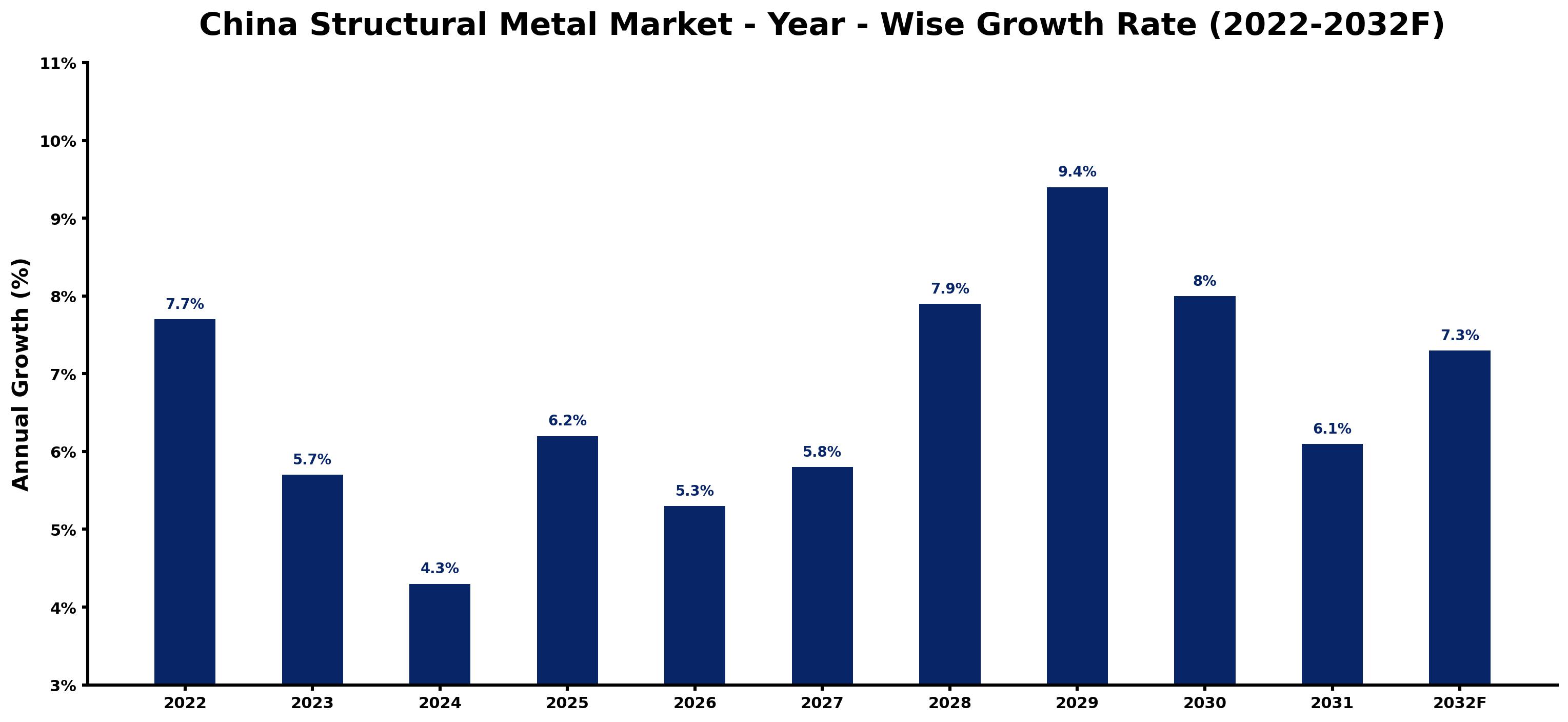
Each row of the following table gives one year's estimated growth and the event or demand shift that explains it.
| Year | Estimated Annual Growth (%) | Market Rationale |
| 2022 | 7.7 | The construction sector in China was strong, supporting high demand for structural metal. |
| 2023 | 5.7 | Demand growth slowed due to the National Building Energy Efficiency Improvement Plan affecting project timelines. |
| 2024 | 4.3 | Construction firms faced project delays and resource allocation issues, impacting demand for structural metal. |
| 2025 | 6.2 | An increase in infrastructure spending led to a rebound in structural metal demand. |
| 2026 | 5.3 | Growth moderated as the market adjusted to new building regulations and standards. |
| 2027 | 5.8 | Demand picked up again with rising investments in urban infrastructure projects. |
| 2028 | 7.9 | Infrastructure development surged, boosting demand for structural metal. |
| 2029 | 9.4 | Peak growth is expected as major projects in the Yangtze River Delta commence. |
| 2030 | 8.0 | Growth is projected to slow slightly as the market stabilises after peak project completions. |
| 2031 | 6.1 | A further slowdown is anticipated as the market adjusts to new supply chain dynamics. |
| 2032 | 7.3 | Demand is expected to rise again with ongoing urbanisation and infrastructure investments. |
Note: Market size estimations and growth projections presented in this report are based on 6Wresearch's proprietary forecasting methodology, utilizing the latest available industry data, government publications, and primary research inputs.
China Structural Metal Market Synopsis
The China Structural Metal Market encompasses materials such as structural steel, aluminum, and stainless steel, primarily used in construction and infrastructure projects. The industry is currently experiencing a shift towards improved building safety standards and increased infrastructure investments. The market is expanding due to rising domestic construction demand and substantial government investment in infrastructure, with a projected size of USD 3.85 billion by 2032. The construction sector employs over 50 million workers, driving further demand for structural metal.
Market Dynamics Impact Analysis (2026–2032)
| Factor | Type | Impact | Primary Segment Affected |
| Rising domestic construction demand is driving the need for structural metal. | Driver | High | Structural Steel |
| Increased infrastructure investments are creating new projects requiring structural metal. | Driver | High | Rebar |
| The ongoing urbanisation trend presents opportunities for structural metal suppliers. | Opportunity | High | Building Frameworks |
| The government's investment in infrastructure projects creates demand for structural metal. | Opportunity | High | Bridges |
| Regulatory compliance costs can limit profit margins for producers. | Restraint | Medium | Aluminum |
| Market fluctuations in raw material prices can affect production costs. | Restraint | Medium | Stainless Steel |
| Supply chain disruptions can delay project timelines and increase costs. | Challenge | High | I-Beams |
| Competition from alternative materials may impact market share. | Challenge | Medium | Channels & Angles |
Evaluation of Drivers in China Structural Metal Market (2026–2032)
The factors lifting demand, and the evidence behind each, are summarised below.
| Drivers | Primary Segment Affected | Why It Matters (Evidence) |
| Increased government investment in infrastructure projects drives demand for structural metal. | Rebar | The government aims to invest 10 trillion yuan in infrastructure by 2030, boosting demand for rebar in construction. |
| Rising domestic construction demand supports the need for structural steel. | Structural Steel | China's construction industry is projected to grow by 5% annually until 2025, increasing structural steel requirements. |
| Urbanisation trends are creating opportunities for building frameworks. | Building Frameworks | The Yangtze River Delta is a major hub for construction, driving demand for building frameworks. |
| The introduction of new safety standards is increasing demand for structural metal. | I-Beams | The National Standard GB/T 1591-2008 governs the quality of structural steel, ensuring safety in construction. |
| Infrastructure development projects require substantial quantities of structural metal. | Bridges | The Beijing-Tianjin-Hebei region is a key area for infrastructure development, increasing bridge construction needs. |
The Structural Metal market in China is expanding as rising domestic construction demand, increased investment in infrastructure, and urbanisation trends drive growth. In 2022, structural steel production reached 1,000 million tons, reflecting strong activity. New safety standards under GB/T 1591-2008 are also increasing the demand for structural metal, ensuring higher quality in projects. The construction sector employs over 50 million workers, further supporting this upward trend.
Evaluation of Restraints in China Structural Metal Market
The following restraints limit how fast demand can grow.
| Market Restraint | Primary Segment Affected | Why It Matters (Evidence) |
| Regulatory compliance costs can limit profit margins for producers. | Aluminum | Compliance with the National Standard GB/T 1591-2008 increases production costs for aluminum producers. |
| Market fluctuations in raw material prices can affect production costs. | Stainless Steel | Volatility in raw material prices impacts the cost structure for stainless steel manufacturers. |
| Supply chain disruptions can delay project timelines and increase costs. | I-Beams | Recent global supply chain issues have led to delays in the availability of I-Beams. |
| Competition from alternative materials may impact market share. | Channels & Angles | The rise of composite materials in construction poses a challenge to traditional channels and angles. |
| Limited recycling facilities can constrain the supply of structural metals. | Rebar | The recent government plan to enhance recycling has yet to fully materialise, affecting rebar availability. |
China Structural Metal Market Challenges
The China Structural Metal Market still has to solve a few problems, starting with rising costs for buyers. In 2022, structural steel production reached 1,000 million tons, but fluctuating raw material prices can inflate project budgets by up to 20%. Technology adoption lags behind, as many producers rely on outdated methods, which delays production efficiency and extends delivery timelines for construction firms. A shortage of skilled workers is apparent, with over 50 million employed in the construction sector, leading to project delays due to insufficient trained personnel. Supply chain disruptions arise, as compliance with standards like GB/T 1591-2008 can prolong project approval processes for infrastructure developers.
Trends in the China Structural Metal Market
Four trends stand out in the China Structural Metal Market.
- Shift from Traditional to Sustainable Materials: Since 2023, the construction sector is increasingly adopting sustainable materials, driven by the updated Green Building Action Plan. This shift is expected to boost the demand for recycled structural metals, with the government aiming for a 20% reduction in energy consumption by 2025.
- Transition from Steel to Aluminium in Specific Applications: Beginning in 2026, construction firms are increasingly using aluminium for lightweight applications, particularly in residential buildings. This trend is reflected by a projected CAGR of 9.7% for aluminium production, indicating its growing acceptance in the market.
- Emergence of Smart Construction Technologies: In 2023, the integration of smart technologies in construction is gaining traction, improving project efficiency. This trend is evidenced by the government's focus on innovative construction methods, leading to increased demand for structural metal.
- Rise of Modular Construction Techniques: Starting in 2025, modular construction techniques are becoming popular, improving construction speed and efficiency. This trend is driven by the growing need for rapid urbanisation solutions, with structural metal playing a key role.
Investment Opportunities in the China Structural Metal Market
Several openings in the China Structural Metal Market merit attention from investors.
- Investment in Recycled Structural Metals: With the government's focus on recycling, there is an opportunity to supply recycled structural metals. The demand for rebar is projected at 200 million tons annually, creating a need for sustainable sourcing.
- Supply of Lightweight Aluminium Components: The increasing preference for lightweight materials in construction presents an opportunity to supply aluminium components. With aluminium production reaching approximately 38 million tons in 2022, suppliers can enter through partnerships with construction firms.
- Expansion into Smart Construction Solutions: The shift towards smart technologies in construction creates an opportunity for suppliers of innovative structural metal solutions. The timing is ideal as the government promotes efficiency in construction projects, encouraging investment in new technologies.
- Development of Modular Construction Facilities: The rise of modular construction techniques necessitates the development of dedicated facilities for structural metal production. With the construction sector expected to grow by 5% annually until 2025, this is a timely investment opportunity.
Government Initiatives in the China Structural Metal Market
In 2023, the government approved the 'Green Building Action Plan', promoting sustainable materials in construction. This builds on previous measures like the 'National Building Energy Efficiency Improvement Plan' from 2021, which aimed for a 20% reduction in energy consumption by 2025. These initiatives ensure that producers must adapt their materials and processes to meet new sustainability standards, improving the overall quality of structural metal used in construction.
In 2022, the National Development and Reform Commission introduced the 'Infrastructure Investment Promotion Plan', allocating significant funding to boost construction projects. This plan is administered by various agencies, including the Ministry of Housing and Urban-Rural Development, which oversees approvals for construction projects. The funding aims to enhance infrastructure development, directly impacting the demand for structural metal in various sectors.
Future Insight of the China Structural Metal Market
The China Structural Metal Market is set to transform by 2032, driven by several key factors. The government plans substantial investments in infrastructure, aiming to allocate 10 trillion yuan by 2030, which will boost demand for structural metals. New initiatives to improve building safety standards will elevate quality assurance across the sector. Enhanced recycling programs for structural metals will create a more efficient supply chain. As the construction industry is expected to grow by 5% annually until 2025, buyers and suppliers need to adapt to these evolving requirements.
Market Segmentation Analysis
The report offers a comprehensive study of the following market segments and their leading categories in the market.
By Metal Type – Structural Steel Dominated, Aluminum Expected to Grow Fastest
According to Summon Dutta, Assistant Manager at 6Wresearch, Structural Steel took a 39% share of metal type in 2025, more than any other category. Structural steel holds the largest market share in China due to its essential role in building frameworks and ensuring structural integrity. The extensive production of 1,000 million tons in 2022 highlights its critical application in various construction projects. The quickest growth will come from Aluminum, forecast to expand at a CAGR of 9.7% between 2026 and 2032. Aluminum is witnessing rapid growth, particularly in lightweight applications, driven by the government's significant infrastructure investments. This trend is expected to accelerate as the demand for aluminium in construction continues to rise. Suppliers should enhance their aluminium offerings to capture the growing demand across multiple sectors.
By Product Form – I-Beams Dominated, Channels & Angles Expected to Grow Fastest
With a 37% revenue share in 2025, I-Beams was the largest product form category. I-beams dominate the market share as they are widely utilised for structural support in buildings and bridges, making them vital in construction. Their robust design ensures safety and durability, which are paramount in the industry. Over 2026–2032, Channels & Angles are expected to post the fastest growth, at a CAGR of 9.2%. Channels and angles are experiencing the fastest growth due to their versatility in framing and structural support across various applications. The increasing number of construction projects, especially in urban areas, is significantly driving this demand. Suppliers should consider expanding their product lines to include more channels and angles to capitalise on this growing market.
By Application Area – Building Frameworks Dominated, Bridges Expected to Grow Fastest
The largest application area category in 2025 was Building Frameworks, with a 43% share of total revenue. Building frameworks represent the largest share as they are foundational for constructing both residential and commercial buildings. The ongoing urbanisation in China drives a continuous need for robust building frameworks, solidifying their market position. Bridges are projected to grow fastest, at a CAGR of 9.0% during 2026–2032. Bridges are the fastest-growing application area, essential for maintaining structural integrity in bridge constructions. The government's focus on infrastructure development and substantial planned investments will further accelerate this growth. This suggests that suppliers should prioritise their offerings for bridge construction to align with increasing infrastructure investments.
By End User – Construction Firms Dominated, Infrastructure Developers Expected to Grow Fastest
Construction Firms accounted for a 40% market share by end user in 2025. Construction firms lead the market share as the primary consumers of structural metal across various projects in China. Their extensive involvement in both residential and commercial developments solidifies their dominant position in the market. Infrastructure Developers are set to record the highest CAGR in this split, 8.8% over 2026–2032. Infrastructure developers are the fastest-growing end user group, significantly utilising structural metal in large-scale infrastructure projects. The government's ambitious infrastructure investment plan is a key driver for this rapid growth, reflecting a shift in demand. This indicates that suppliers should tailor their marketing strategies to better serve the needs of infrastructure developers.
Key Attractiveness of the Report
- 10 Years of Market Numbers
- Historical Data Starting from 2022 to 2025
- Base Year 2025
- Forecast Data until 2032
- Key Performance Indicators Impacting the Market
- Major Upcoming Developments and Projects
Key Highlights of the Report:
- China Structural Metal Market Outlook
- Market Size of China Structural Metal Market, 2025
- Forecast of China Structural Metal Market, 2032
- Historical Data and Forecast of China Structural Metal Revenues & Volume for the Period 2022 - 2032F
- China Structural Metal Market Trend Evolution
- China Structural Metal Market Drivers and Challenges
- China Structural Metal Price Trends
- China Structural Metal Porter's Five Forces
- China Structural Metal Industry Life Cycle
- Historical Data and Forecast of China Structural Metal Market Revenues & Volume By Metal Type for the Period 2022 - 2032F
- Historical Data and Forecast of China Structural Metal Market Revenues & Volume By Structural Steel for the Period 2022 - 2032F
- Historical Data and Forecast of China Structural Metal Market Revenues & Volume By Aluminum for the Period 2022 - 2032F
- Historical Data and Forecast of China Structural Metal Market Revenues & Volume By Stainless Steel for the Period 2022 - 2032F
- Historical Data and Forecast of China Structural Metal Market Revenues & Volume By Rebar for the Period 2022 - 2032F
- Historical Data and Forecast of China Structural Metal Market Revenues & Volume By Product Form for the Period 2022 - 2032F
- Historical Data and Forecast of China Structural Metal Market Revenues & Volume By I-Beams for the Period 2022 - 2032F
- Historical Data and Forecast of China Structural Metal Market Revenues & Volume By Channels & Angles for the Period 2022 - 2032F
- Historical Data and Forecast of China Structural Metal Market Revenues & Volume By Plates for the Period 2022 - 2032F
- Historical Data and Forecast of China Structural Metal Market Revenues & Volume By Rods for the Period 2022 - 2032F
- Historical Data and Forecast of China Structural Metal Market Revenues & Volume By Application Area for the Period 2022 - 2032F
- Historical Data and Forecast of China Structural Metal Market Revenues & Volume By Building Frameworks for the Period 2022 - 2032F
- Historical Data and Forecast of China Structural Metal Market Revenues & Volume By Bridges for the Period 2022 - 2032F
- Historical Data and Forecast of China Structural Metal Market Revenues & Volume By Industrial Platforms for the Period 2022 - 2032F
- Historical Data and Forecast of China Structural Metal Market Revenues & Volume By Concrete Reinforcement for the Period 2022 - 2032F
- Historical Data and Forecast of China Structural Metal Market Revenues & Volume By End User for the Period 2022 - 2032F
- Historical Data and Forecast of China Structural Metal Market Revenues & Volume By Construction Firms for the Period 2022 - 2032F
- Historical Data and Forecast of China Structural Metal Market Revenues & Volume By Infrastructure Developers for the Period 2022 - 2032F
- Historical Data and Forecast of China Structural Metal Market Revenues & Volume By Engineering Contractors for the Period 2022 - 2032F
- Historical Data and Forecast of China Structural Metal Market Revenues & Volume By Civil Engineers for the Period 2022 - 2032F
- China Structural Metal Import Export Trade Statistics
- Market Opportunity Assessment By Metal Type
- Market Opportunity Assessment By Product Form
- Market Opportunity Assessment By Application Area
- Market Opportunity Assessment By End User
- China Structural Metal Top Companies Market Share
- China Structural Metal Competitive Benchmarking By Technical and Operational Parameters
- China Structural Metal Company Profiles
- China Structural Metal Key Strategic Recommendations
Market Covered
Segments analysed in this report are listed below.
By Metal Type
- Structural Steel
- Aluminum
- Stainless Steel
- Rebar
By Product Form
- I-Beams
- Channels & Angles
- Plates
- Rods
By Application Area
- Building Frameworks
- Bridges
- Industrial Platforms
- Concrete Reinforcement
By End User
- Construction Firms
- Infrastructure Developers
- Engineering Contractors
- Civil Engineers































