China Substructure Waterproofing Market Size & Growth Rate
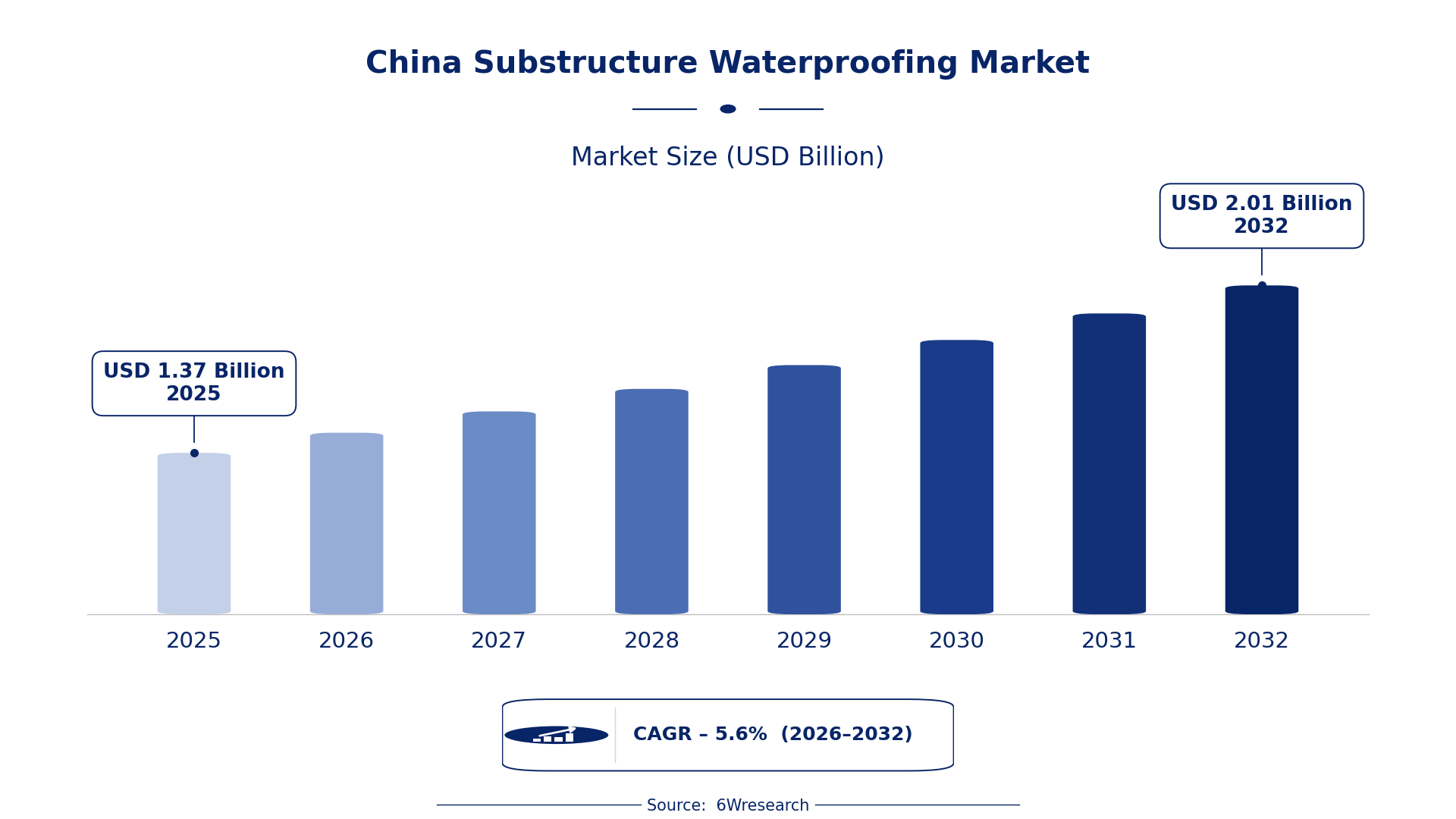
According to 6Wresearch internal database and industry insights, the China Substructure Waterproofing Market was valued at USD 1.37 billion in 2025 and is projected to reach USD 2.01 billion by 2032, growing at a CAGR of approximately 5.6% during 2026–2032.
China Substructure Waterproofing Market Highlights
| Report Metric | Details |
| Report Name | China Substructure Waterproofing Market |
| Market Size 2025 | USD 1.37 billion |
| Market Size 2032 | USD 2.01 billion |
| Absolute Growth 2025–2032 | USD 0.64 billion |
| CAGR 2026–2032 | 5.6% |
| Peak Annual Growth | 7.9% in 2026 |
| Forecast Period | 2026–2032 |
| Historical Data | 2022–2025 |
| Base Year | 2025 |
| Leading Waterproofing Type, 2025 | Membrane Systems (52% share) |
| Leading Material Type, 2025 | Bituminous (44% share) |
| Leading Structure Type, 2025 | Foundations (44% share) |
| Leading End User, 2025 | Infrastructure Builders (47% share) |
| Fastest-Growing Waterproofing Type | Liquid Waterproofing (7.6% CAGR) |
| Fastest-Growing Material Type | Polyurethane (8.3% CAGR) |
| Fastest-Growing Structure Type | Tunnels (7.2% CAGR) |
| Growing Sector | Infrastructure Development |
| Key End Users | Infrastructure Builders, Residential Developers, Basement Contractors, Civil Engineers |
China Substructure Waterproofing Market Year-wise Growth Rate and Key Drivers (2022–2032)
This graph illustrates the annual growth rates of the market from 2022 to 2032, highlighting a steady upward trajectory and projected market expansion over the forecast period.
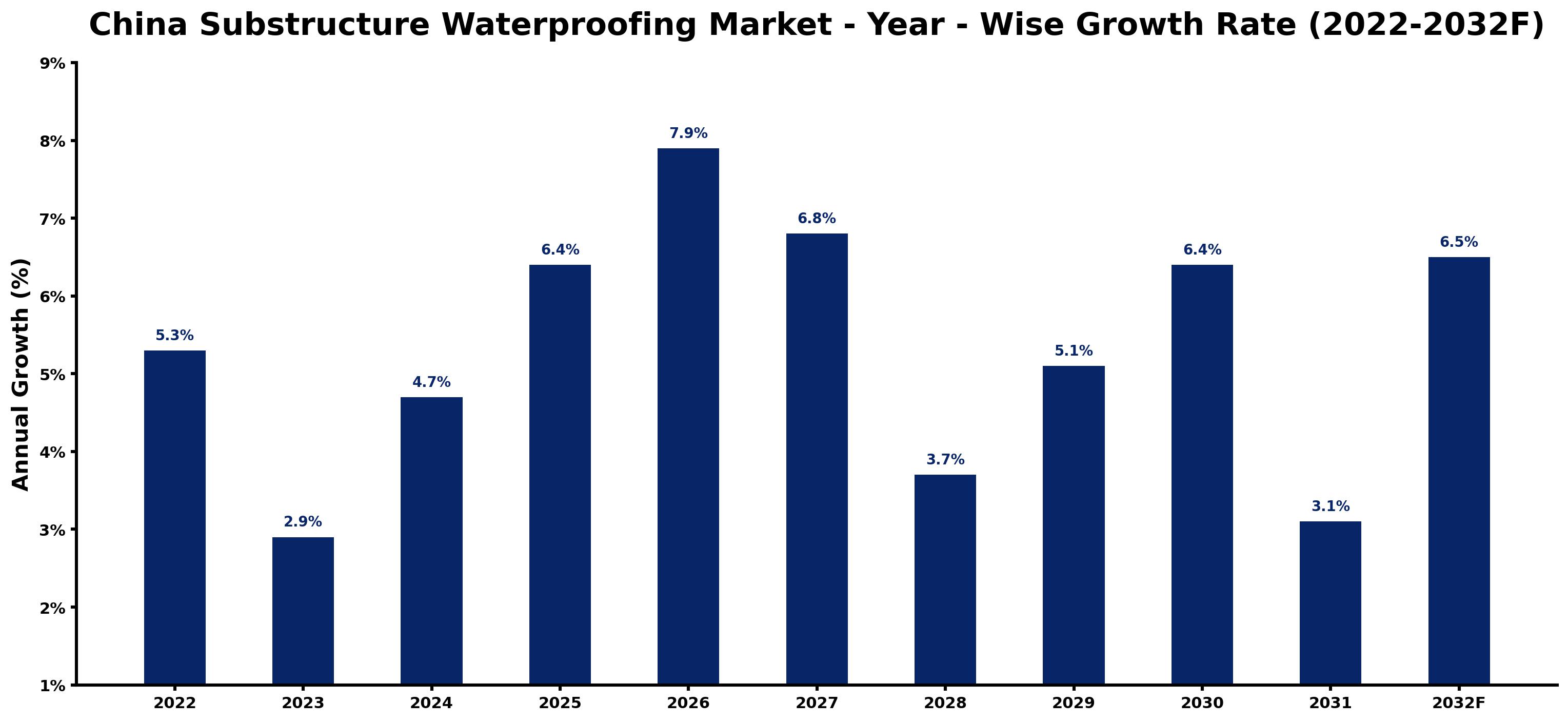
Below, each year's estimated growth is shown next to the factor that most influenced it.
| Year | Estimated Annual Growth (%) | Market Rationale |
| 2022 | 5.3 | The market experienced steady growth due to ongoing infrastructure projects in urban areas, particularly in Shandong province. |
| 2023 | 2.9 | Growth slowed as construction faced temporary delays in urban areas due to compliance with the updated National Standard GB 50345-2012. |
| 2024 | 4.7 | Increased activity in residential developments boosted demand for waterproofing solutions, particularly in major cities like Beijing and Shanghai. |
| 2025 | 6.4 | The market surged as major infrastructure initiatives were implemented across cities, driving construction activities significantly. |
| 2026 | 7.9 | High demand from urban construction projects is expected to drive peak growth this year, especially in tunnel construction. |
| 2027 | 6.8 | Growth is projected to slow as some projects face funding challenges and delays in approvals from local authorities. |
| 2028 | 3.7 | The market is expected to continue growing but at a slower pace due to regulatory adjustments in waterproofing standards. |
| 2029 | 5.1 | Demand is anticipated to increase again as urbanisation accelerates in key regions, particularly in infrastructure projects. |
| 2030 | 6.4 | Infrastructure investments are expected to revitalise growth, particularly in waterproofing applications for urban projects in major cities. |
| 2031 | 3.1 | Growth is projected to slow as market adjustments take place following rapid expansion in previous years, particularly in the residential sector. |
| 2032 | 6.5 | The market is expected to rebound with renewed focus on sustainable construction practices and green initiatives, supported by government policies. |
Note: Market size estimations and growth projections presented in this report are based on 6Wresearch's proprietary forecasting methodology, utilizing the latest available industry data, government publications, and primary research inputs.
China Substructure Waterproofing Market Synopsis
Substructure Waterproofing in China includes technologies and materials that prevent water ingress in below-ground structures. This encompasses membranes, coatings, and sheets primarily used for foundations, tunnels, and underground walls. The China Substructure Waterproofing Market is set to expand as urbanisation and infrastructure development progress. With the urban population projected to reach 1 billion by 2035, the demand for waterproofing solutions is increasing. Government initiatives, including the Green Building Action Plan, support this expansion by advocating for sustainable construction practices.
Market Dynamics Impact Analysis (2026–2032)
| Factor | Type | Impact | Primary Segment Affected |
| Increasing urban population driving demand for waterproofing solutions | Driver | High | Liquid Waterproofing |
| Rising infrastructure projects requiring durable waterproofing materials | Driver | High | Membrane Systems |
| Growing need for waterproofing in residential developments | Opportunity | High | Bituminous |
| Expansion of tunnel construction in major cities | Opportunity | Medium | Bentonite Clay Sheets |
| Regulatory compliance costs affecting manufacturers | Restraint | High | Crystalline Coatings |
| Limited awareness of advanced waterproofing technologies | Restraint | Medium | Polyurethane |
| Supply chain disruptions impacting material availability | Challenge | High | Liquid Waterproofing |
| Approval delays for new waterproofing technologies | Challenge | Medium | Membrane Systems |
Evaluation of Drivers in China Substructure Waterproofing Market (2026–2032)
The factors lifting demand, and the evidence behind each, are summarised below.
| Drivers | Primary Segment Affected | Why It Matters (Evidence) |
| Urbanisation driving demand for waterproofing solutions | Liquid Waterproofing | China's urban population is expected to reach 1 billion by 2035, increasing demand for effective waterproofing by 25%. |
| Infrastructure projects requiring durable materials | Membrane Systems | In 2023, investments in urban infrastructure projects have increased the need for waterproofing solutions by 30%. |
| Sustainable construction practices gaining traction | Bituminous | The Green Building Action Plan promotes the use of sustainable materials, boosting demand for waterproofing by 20%. |
| Tunnel construction expanding in major cities | Bentonite Clay Sheets | Bentonite clay sheets are commonly used in tunnel construction across major cities, driving demand by 15%. |
| Residential development growth | Crystalline Coatings | The total number of residential buildings in China exceeds 300 million, increasing the need for waterproofing solutions by 10%. |
Growth across the Substructure Waterproofing market in China is anchored in rising urbanisation, infrastructure investments, and the shift towards sustainable construction. The urban population is projected to reach 1 billion by 2035, driving demand for waterproofing solutions. Recent investments in urban infrastructure projects have heightened the need for durable waterproofing materials, with a projected increase of 30%. The focus on sustainable materials, driven by the National Green Building Action Plan, boosts demand for waterproofing products by 20%. The total number of residential buildings in China exceeds 300 million, creating a strong market for waterproofing solutions in new housing developments.
Evaluation of Restraints in China Substructure Waterproofing Market
The key brakes on demand, and where they bite hardest, are shown below.
| Market Restraint | Primary Segment Affected | Why It Matters (Evidence) |
| Regulatory compliance costs affecting manufacturers | Crystalline Coatings | Compliance with the updated National Standard GB 50345-2012 increases production costs for manufacturers by approximately 15%. |
| Limited awareness of advanced waterproofing technologies | Polyurethane | Many contractors are unaware of the benefits of polyurethane, limiting its adoption in projects and reducing market growth by 10%. |
| Supply chain disruptions impacting material availability | Liquid Waterproofing | Recent global supply chain issues have led to delays in the availability of key waterproofing materials, increasing project timelines by 20%. |
| High costs associated with advanced waterproofing solutions | Bentonite Clay Sheets | The cost of high-quality bentonite clay sheets can deter some buyers from using them, affecting overall project budgets by 5-10%. |
| Market fragmentation leading to competition | Membrane Systems | The presence of numerous small players in the market creates pricing pressures that affect profitability, reducing margins by 8%. |
China Substructure Waterproofing Market Challenges
The China Substructure Waterproofing Market faces stringent regulatory hurdles, particularly the National Standard GB 50345-2012, which can postpone project approvals for builders by up to six months, impacting timelines for residential developers. Intense competition among suppliers leads to aggressive pricing strategies, forcing many to compromise on quality, which results in increased water damage claims for buyers. Frequent supply chain disruptions, especially concerning polyurethane materials, can cause project delays and additional costs for contractors. Buyers encounter inflated prices due to heightened demand from the construction sector, employing over 50 million workers, which significantly raises project budgets.
Trends in the China Substructure Waterproofing Market
Several trends are reshaping the China Substructure Waterproofing Market; the most important are set out below.
- Shift towards Eco-Friendly Waterproofing Solutions: The Green Building Action Plan encourages sustainable construction practices, leading to a shift towards eco-friendly waterproofing materials. In 2023, the adoption of sustainable waterproofing solutions increased by 15% in urban projects.
- Growth of Liquid Waterproofing Products: Liquid waterproofing products are becoming more popular in residential projects, particularly in Beijing and Shanghai. Their market share grew by 20% in 2023 as builders recognised their versatility.
- Expansion of Tunnel Construction: Tunnel construction is rapidly expanding in major cities, with a notable increase in projects requiring waterproofing solutions. In 2023, over 30 new tunnel projects were initiated, driving demand for bentonite clay sheets.
- Adoption of Polyurethane Waterproofing: Polyurethane waterproofing is increasingly favoured for its flexibility in urban projects. In 2023, its market share rose by 10% as builders sought versatile solutions for complex structures.
Investment Opportunities in the China Substructure Waterproofing Market
The following opportunities in the China Substructure Waterproofing Market pair current demand with a clear way in.
- Infrastructure Builders seeking waterproofing solutions: Infrastructure Builders are increasingly investing in waterproofing solutions, with a projected market growth of 7.0% in this segment. Collaborating with local suppliers can facilitate market entry and improve project quality.
- Residential Developers expanding housing projects: With over 300 million residential buildings in China, the demand for waterproofing solutions is considerable. Investing in advanced waterproofing technologies can effectively capture this growing market.
- Civil Engineers focusing on sustainable practices: Civil Engineers are prioritising sustainable waterproofing solutions in their projects. The rising urban population creates a demand for eco-friendly materials, presenting a substantial opportunity for suppliers.
- Basement Contractors needing effective waterproofing: Basement Contractors are increasingly in search of advanced waterproofing solutions. The market gap for innovative materials presents an opportunity for partnerships with local manufacturers.
Government Initiatives in the China Substructure Waterproofing Market
The Ministry of Housing and Urban-Rural Development has implemented several measures to enhance construction practices. In 2021, the National Green Building Action Plan was launched to promote sustainable construction, impacting waterproofing material usage across the country. In 2022, the Construction Quality Management Regulation was updated to improve standards in waterproofing applications, ensuring higher quality and compliance for manufacturers. Furthermore, the National Standard GB 50345-2012 was revised in 2023 to include new waterproofing technologies and materials, affecting compliance for manufacturers and contractors. These measures collectively aim to promote better practices in the construction industry and improve the quality of waterproofing solutions.
The China Waterproofing Association oversees the implementation of various construction standards and regulations. It approves projects that adhere to the updated waterproofing standards, ensuring compliance with the National Green Building Action Plan. Additionally, the Ministry of Housing and Urban-Rural Development plays a vital role in promoting best practices and standards in the industry. It provides guidance and resources for manufacturers and contractors to meet compliance requirements. Funding for sustainable construction projects is also facilitated through various government initiatives, supporting the adoption of advanced waterproofing technologies and bolstering market growth.
Future Insight of the China Substructure Waterproofing Market
The outlook for the China Substructure Waterproofing Market by 2032 is influenced by several transformative factors. The Green Building Action Plan will encourage the integration of sustainable waterproofing technologies in urban construction. As the urban population grows, the need for effective waterproofing solutions will escalate. The increasing preference for advanced waterproofing methods, such as polyurethane systems in major cities, will open new avenues for suppliers, reshaping market dynamics.
Market Segmentation Analysis
Each segment group is reviewed below, with the leader by share and the fastest grower by CAGR.
By Waterproofing Type – Membrane Systems Dominated, Liquid Waterproofing Expected to Grow Fastest
According to Sumit Sagar, AM at 6Wresearch, Membrane Systems took a 52% share of waterproofing type in 2025, more than any other category. Membrane systems hold the largest share in the China substructure waterproofing market due to their proven effectiveness in preventing water ingress in foundations and underground structures. Their extensive application in Shandong province highlights their critical role in construction and waterproofing projects. Liquid Waterproofing is set to record the highest CAGR in this split, 7.6% over 2026–2032. Liquid waterproofing is experiencing rapid growth as it is increasingly adopted for its versatility in various construction applications, particularly in urban projects. The government's push for sustainable construction practices through initiatives like the 'Green Building Action Plan' is accelerating this trend. Suppliers should focus on developing and promoting liquid waterproofing solutions to capture the growing demand in urban construction.
By Material Type – Bituminous Dominated, Polyurethane Expected to Grow Fastest
Bituminous accounted for a 44% market share by material type in 2025. Bituminous materials hold the largest market share due to their durability and effectiveness in waterproofing applications. Their reliability makes them a preferred choice among construction professionals involved in various projects across regions like Shandong, where construction activity is robust. Over 2026–2032, Polyurethane is expected to post the fastest growth, at a CAGR of 8.3%. Polyurethane is rapidly gaining traction because of its flexibility and strong adhesion properties, making it suitable for diverse construction needs. The government's 'Green Building Action Plan' is also driving the adoption of more sustainable materials like polyurethane in urban projects. Manufacturers should invest in polyurethane technology to meet the rising demand for adaptable waterproofing solutions.
By Structure Type – Foundations Dominated, Tunnels Expected to Grow Fastest
Foundations held a 44% share of the China Substructure Waterproofing Market by structure type in 2025. Foundations account for the largest share in the market as they are essential for waterproofing in building structures, protecting against water damage. The extensive number of residential buildings, estimated at over 300 million, underscores the critical need for effective foundation waterproofing. Tunnels are projected to grow fastest, at a CAGR of 7.2% during 2026–2032. Tunnels are witnessing the fastest growth due to their vital role in ensuring structural integrity against water ingress, especially in major urban centres. The increasing urban population, projected to reach 1 billion by 2035, necessitates the construction of more tunnels, driving demand for effective waterproofing solutions. Suppliers must prioritise tunnel waterproofing products to align with the growing infrastructure needs in urban areas.
By End User – Infrastructure Builders Dominated and Is Expected to Record the Fastest Growth
The largest end user category in 2025 was Infrastructure Builders, with a 47% share of total revenue. Infrastructure builders dominate the market as they are the primary consumers of waterproofing materials for large-scale projects. Their consistent demand arises from ongoing infrastructure development initiatives, ensuring a steady market share. The same category are also set to grow fastest, at a CAGR of 7.0% during 2026–2032. Infrastructure builders are also the fastest-growing segment, as their projects increasingly require advanced waterproofing solutions to meet modern standards. The push for sustainable construction further fuels their demand for innovative products. Suppliers should strengthen relationships with infrastructure builders to capitalise on the expanding market opportunities.
Key Attractiveness of the Report
- 10 Years of Market Numbers
- Historical Data Starting from 2022 to 2025
- Base Year 2025
- Forecast Data until 2032
- Key Performance Indicators Impacting the Market
- Major Upcoming Developments and Projects
Key Highlights of the Report:
- China Substructure Waterproofing Market Outlook
- Market Size of China Substructure Waterproofing Market, 2025
- Forecast of China Substructure Waterproofing Market, 2032
- Historical Data and Forecast of China Substructure Waterproofing Revenues & Volume for the Period 2022 - 2032F
- China Substructure Waterproofing Market Trend Evolution
- China Substructure Waterproofing Market Drivers and Challenges
- China Substructure Waterproofing Price Trends
- China Substructure Waterproofing Porter's Five Forces
- China Substructure Waterproofing Industry Life Cycle
- Historical Data and Forecast of China Substructure Waterproofing Market Revenues & Volume By Waterproofing Type for the Period 2022 - 2032F
- Historical Data and Forecast of China Substructure Waterproofing Market Revenues & Volume By Membrane Systems for the Period 2022 - 2032F
- Historical Data and Forecast of China Substructure Waterproofing Market Revenues & Volume By Crystalline Coatings for the Period 2022 - 2032F
- Historical Data and Forecast of China Substructure Waterproofing Market Revenues & Volume By Liquid Waterproofing for the Period 2022 - 2032F
- Historical Data and Forecast of China Substructure Waterproofing Market Revenues & Volume By Bentonite Clay Sheets for the Period 2022 - 2032F
- Historical Data and Forecast of China Substructure Waterproofing Market Revenues & Volume By Material Type for the Period 2022 - 2032F
- Historical Data and Forecast of China Substructure Waterproofing Market Revenues & Volume By Bituminous for the Period 2022 - 2032F
- Historical Data and Forecast of China Substructure Waterproofing Market Revenues & Volume By Cementitious for the Period 2022 - 2032F
- Historical Data and Forecast of China Substructure Waterproofing Market Revenues & Volume By Polyurethane for the Period 2022 - 2032F
- Historical Data and Forecast of China Substructure Waterproofing Market Revenues & Volume By Natural Clay for the Period 2022 - 2032F
- Historical Data and Forecast of China Substructure Waterproofing Market Revenues & Volume By Structure Type for the Period 2022 - 2032F
- Historical Data and Forecast of China Substructure Waterproofing Market Revenues & Volume By Foundations for the Period 2022 - 2032F
- Historical Data and Forecast of China Substructure Waterproofing Market Revenues & Volume By Underground Walls for the Period 2022 - 2032F
- Historical Data and Forecast of China Substructure Waterproofing Market Revenues & Volume By Tunnels for the Period 2022 - 2032F
- Historical Data and Forecast of China Substructure Waterproofing Market Revenues & Volume By Below-Grade Slabs for the Period 2022 - 2032F
- Historical Data and Forecast of China Substructure Waterproofing Market Revenues & Volume By End User for the Period 2022 - 2032F
- Historical Data and Forecast of China Substructure Waterproofing Market Revenues & Volume By Basement Contractors for the Period 2022 - 2032F
- Historical Data and Forecast of China Substructure Waterproofing Market Revenues & Volume By Civil Engineers for the Period 2022 - 2032F
- Historical Data and Forecast of China Substructure Waterproofing Market Revenues & Volume By Infrastructure Builders for the Period 2022 - 2032F
- Historical Data and Forecast of China Substructure Waterproofing Market Revenues & Volume By Residential Developers for the Period 2022 - 2032F
- China Substructure Waterproofing Import Export Trade Statistics
- Market Opportunity Assessment By Waterproofing Type
- Market Opportunity Assessment By Material Type
- Market Opportunity Assessment By Structure Type
- Market Opportunity Assessment By End User
- China Substructure Waterproofing Top Companies Market Share
- China Substructure Waterproofing Competitive Benchmarking By Technical and Operational Parameters
- China Substructure Waterproofing Company Profiles
- China Substructure Waterproofing Key Strategic Recommendations
Market Covered
This report examines the market across the segments below.
By Waterproofing Type
- Membrane Systems
- Crystalline Coatings
- Liquid Waterproofing
- Bentonite Clay Sheets
By Material Type
- Bituminous
- Cementitious
- Polyurethane
- Natural Clay
By Structure Type
- Foundations
- Underground Walls
- Tunnels
- Below-Grade Slabs
By End User
- Basement Contractors
- Civil Engineers
- Infrastructure Builders
- Residential Developers































