China Sunscreen Ingredient Market Size & Growth Rate
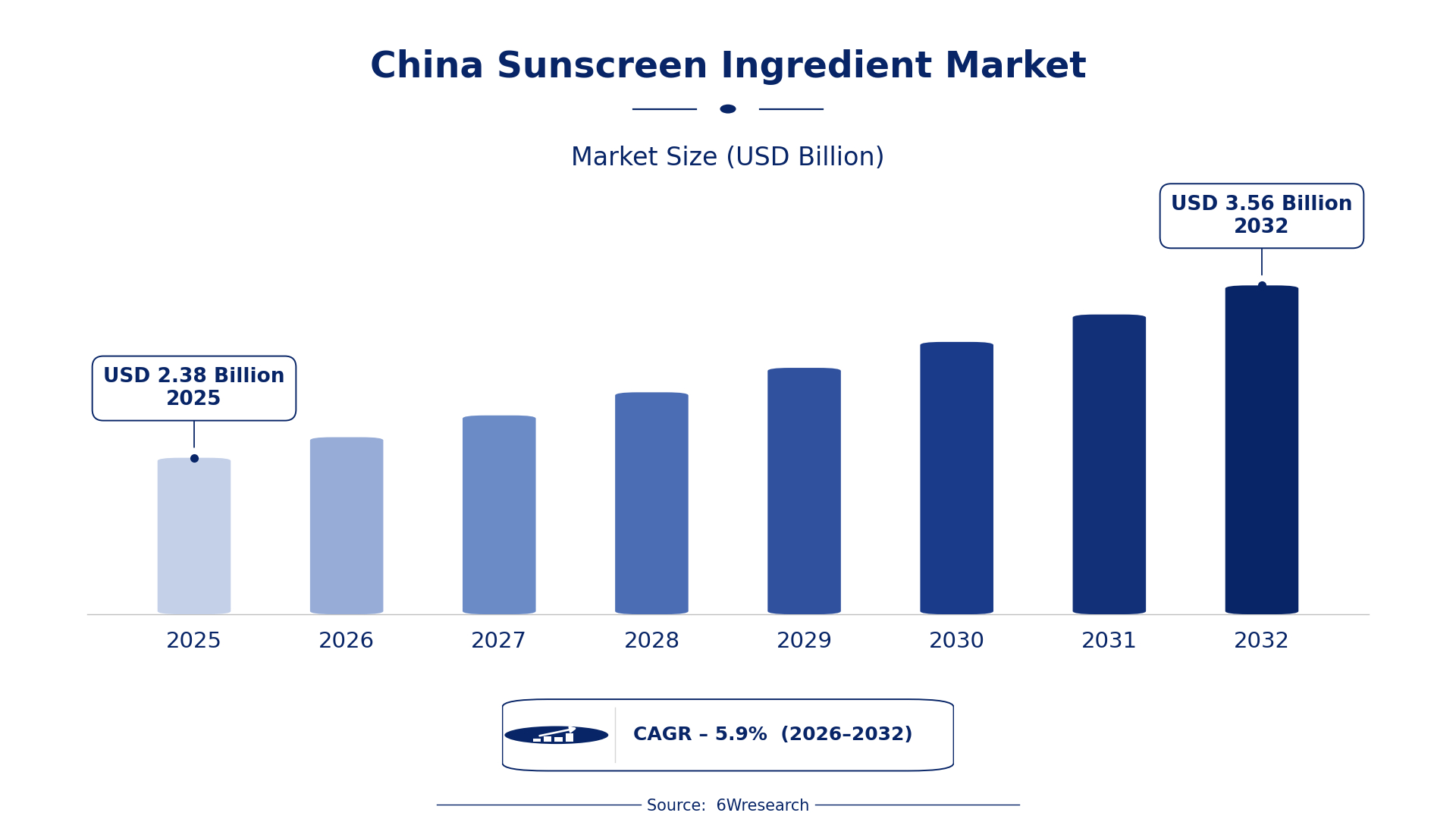
According to 6Wresearch internal database and industry insights, the China Sunscreen Ingredient Market was valued at USD 2.38 billion in 2025 and is projected to reach USD 3.56 billion by 2032, growing at a CAGR of approximately 5.9% during 2026–2032.
China Sunscreen Ingredient Market Highlights
| Report Metric | Details |
| Report Name | China Sunscreen Ingredient Market |
| Market Size 2025 | USD 2.38 billion |
| Market Size 2032 | USD 3.56 billion |
| Absolute Growth 2025–2032 | USD 1.18 billion |
| CAGR 2026–2032 | 5.9% |
| Peak Annual Growth | 8.0% in 2029 |
| Forecast Period | 2026–2032 |
| Historical Data | 2022–2025 |
| Base Year | 2025 |
| Leading Ingredient Type, 2025 | Zinc Oxide (38% share) |
| Leading Source Type, 2025 | Mineral (55% share) |
| Leading Function, 2025 | Physical Block (55% share) |
| Leading End User, 2025 | Sunscreen Manufacturers (40% share) |
| Fastest-Growing Ingredient Type | Octinoxate (8.4% CAGR) |
| Fastest-Growing Source Type | Chemical (7.4% CAGR) |
| Fastest-Growing Function | UV-B Filter (7.1% CAGR) |
| Fastest-Growing End User | Cosmetic Industry (7.8% CAGR) |
| Growing Sector | Natural Skincare Brands |
| Key End Users | Sunscreen Manufacturers, Cosmetic Industry, Natural Skincare Brands, Sun Care Product Developers |
China Sunscreen Ingredient Market Year-wise Growth Rate and Key Drivers (2022–2032)
This graph illustrates the annual growth rates of the market from 2022 to 2032, highlighting a steady upward trajectory and projected market expansion over the forecast period.
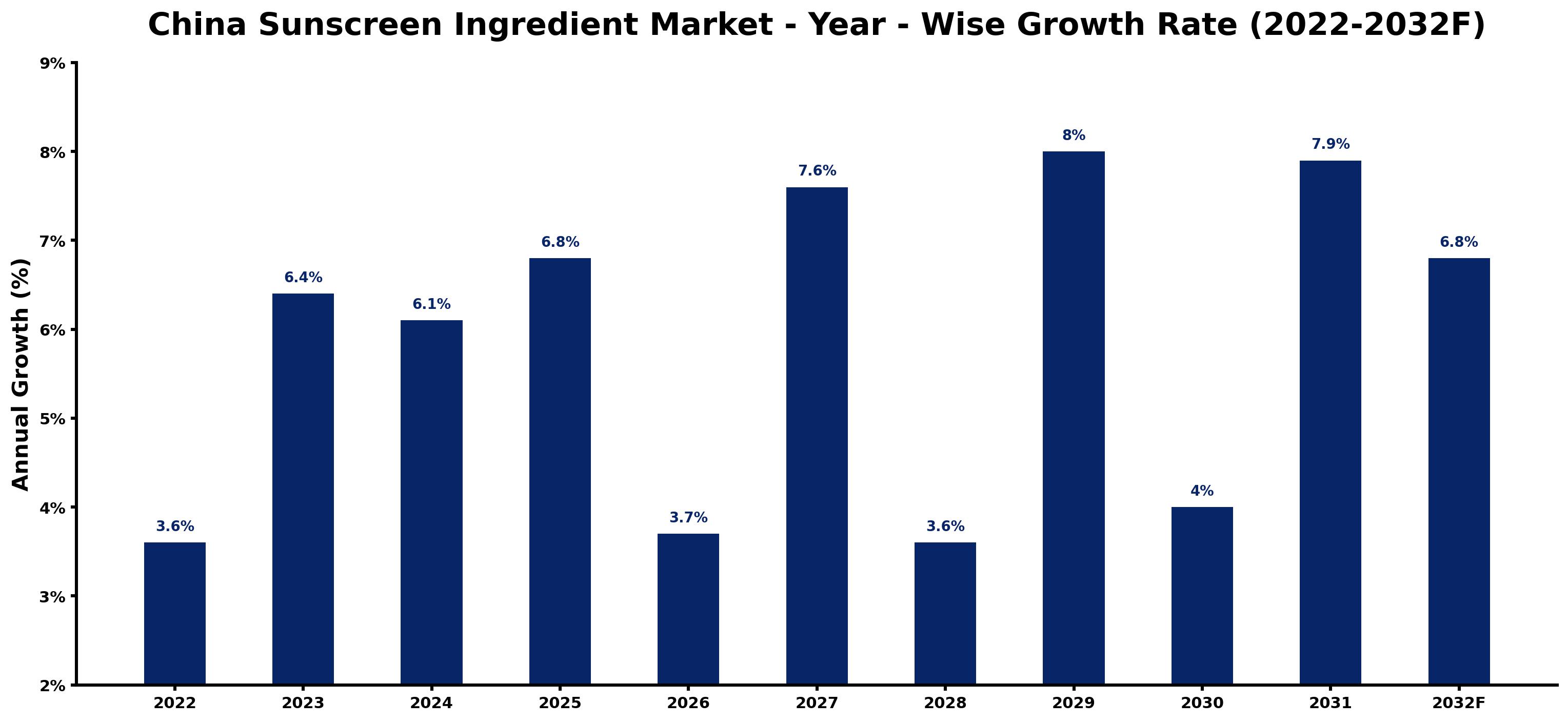
The following table presents the estimated annual growth rate for each year together with the principal factor influencing market performance.
| Year | Estimated Annual Growth (%) | Market Rationale |
| 2022 | 3.6 | The market showed steady activity with established local manufacturers and consumer interest in sun protection products. |
| 2023 | 6.4 | Demand from the cosmetic industry increased as awareness of sun protection rose among urban consumers. |
| 2024 | 6.1 | Growth slowed slightly due to the introduction of new regulations affecting product formulations. |
| 2025 | 6.8 | The market experienced a resurgence driven by the rising popularity of natural skincare products. |
| 2026 | 3.7 | Growth is expected to decelerate as the market begins to normalise after previous rapid expansions. |
| 2027 | 7.6 | Demand is projected to surge again, fuelled by innovative formulations and heightened consumer awareness. |
| 2028 | 3.6 | Growth is expected to slow as market saturation begins to impact new product introductions. |
| 2029 | 8.0 | The market is projected to peak, propelled by a surge in broad-spectrum sunscreen formulations. |
| 2030 | 4.0 | Growth is expected to slow as the market stabilises after reaching peak demand levels. |
| 2031 | 7.9 | A renewed interest in eco-friendly products will drive growth as consumers shift preferences. |
| 2032 | 6.8 | The market will continue to grow, supported by ongoing public health campaigns promoting sun safety. |
Note: Market size estimations and growth projections presented in this report are based on 6Wresearch's proprietary forecasting methodology, utilizing the latest available industry data, government publications, and primary research inputs.
China Sunscreen Ingredient Market Synopsis
The Sunscreen Ingredient Market in China encompasses compounds used to protect skin from UV radiation. These ingredients are primarily derived from chemical synthesis or mineral extraction and are essential in sunscreens, cosmetics, and skincare products. The market is growing due to increased consumer awareness and demand from local manufacturers. In 2022, the sunscreen market was valued at approximately 30 billion yuan, driven by a growing population and rising health consciousness regarding sun protection. Key buyer groups include sunscreen manufacturers and natural skincare brands, both of which are expanding their product offerings to meet consumer demand.
Market Dynamics Impact Analysis (2026–2032)
| Factor | Type | Impact | Primary Segment Affected |
| Growing consumer awareness of sun safety and skin protection | Driver | High | Sunscreen Manufacturers |
| Rising demand for natural skincare products | Driver | High | Natural Skincare Brands |
| Increasing investment in eco-friendly formulations | Opportunity | High | Cosmetic Industry |
| Expansion of production facilities in key regions | Opportunity | Medium | Sunscreen Manufacturers |
| Regulatory compliance costs for new formulations | Restraint | High | Cosmetic Industry |
| Market saturation limiting new entrants | Restraint | Medium | Natural Skincare Brands |
| High production costs impacting profit margins | Challenge | High | Sunscreen Manufacturers |
| Intense competition among local manufacturers | Challenge | Medium | Cosmetic Industry |
Evaluation of Drivers in China Sunscreen Ingredient Market (2026–2032)
The factors lifting demand, and the evidence behind each, are summarised below.
| Drivers | Primary Segment Affected | Why It Matters (Evidence) |
| Increased consumer awareness of UV protection benefits | Sunscreen Manufacturers | This awareness drives higher sales of sunscreen products, with over 70% of urban consumers recognising the importance of sun safety. |
| Growing popularity of natural skincare brands | Natural Skincare Brands | Natural products have seen a 25% increase in launches since 2020, leading to higher demand for mineral-based sunscreen ingredients. |
| Investment in new sunscreen formulations | Cosmetic Industry | The introduction of broad-spectrum filters is driving product differentiation and increasing consumer purchases. |
| Government initiatives promoting eco-friendly products | Natural Skincare Brands | Subsidies for eco-friendly cosmetics encourage more brands to enter the market, increasing ingredient demand. |
| Rising exports of sunscreen products | Sunscreen Manufacturers | Exports increased by 20% in 2023, prompting manufacturers to enhance production to meet international demand. |
Market growth in China for Sunscreen Ingredient rests on increased consumer awareness of UV protection benefits, rising popularity of natural skincare brands, and investment in new formulations. Approximately 70% of urban consumers recognise the importance of sun safety, driving higher sales of sunscreen products. The cosmetic industry has seen a 25% increase in natural product launches since 2020, leading to higher demand for mineral-based ingredients.
Evaluation of Restraints in China Sunscreen Ingredient Market
The table below lists the restraints and the evidence behind each.
| Market Restraint | Primary Segment Affected | Why It Matters (Evidence) |
| Regulatory compliance costs for new formulations | Cosmetic Industry | Compliance with standards like GB/T 38800-2020 increases production costs, impacting profit margins for manufacturers. |
| Market saturation limiting new entrants | Natural Skincare Brands | With many brands already established, new entrants face challenges in gaining market share. |
| Limited access to advanced formulation technologies | Natural Skincare Brands | Smaller brands may struggle to access the latest technologies, hindering product development. |
| High production costs impacting profit margins | Sunscreen Manufacturers | Rising costs of raw materials and compliance can squeeze profit margins, affecting overall profitability. |
| Intense competition among local manufacturers | Cosmetic Industry | The competitive environment forces brands to lower prices, impacting revenue for manufacturers. |
China Sunscreen Ingredient Market Challenges
The China sunscreen ingredient market encounters a skills shortage, with over 200,000 professionals needed for formulation yet insufficient training programs available, hindering production capabilities. Regulatory hurdles arise from strict national standards such as GB/T 38800-2020, causing delays in product approvals for manufacturers and reducing their competitiveness. High production costs stem from the necessity for premium raw materials, inflating prices for local producers and ultimately burdening consumers. Limited technological adoption in formulation processes restricts innovation, leaving buyers with fewer effective sun protection options.
Trends in the China Sunscreen Ingredient Market
The trends below show where the China Sunscreen Ingredient Market is heading.
- Shift towards Eco-Friendly Formulations: The Guangdong province is seeing a shift towards eco-friendly sunscreen formulations, with natural skincare brands gaining traction. In 2023, there was a 25% increase in product launches, reflecting a growing consumer preference for sustainable options.
- Increase in Broad-Spectrum Sunscreens: The demand for broad-spectrum sunscreens is on the rise as consumers become more aware of UV protection. National regulations now require broad-spectrum filters in all sunscreen products sold in China, driving innovation in formulations.
- Growth of Exports in Sunscreen Products: Exports of sunscreen products from China rose by 20% in 2023, indicating a growing international market. This trend encourages local manufacturers to improve production capabilities and meet global standards.
- Emergence of Innovative Ingredients: There is a notable increase in the use of ingredients like Avobenzone, which accounted for 15% of the market share in 2023. This trend supports the development of more effective sunscreen formulations.
Investment Opportunities in the China Sunscreen Ingredient Market
The following opportunities in the China Sunscreen Ingredient Market pair current demand with a clear way in.
- Partnerships with Natural Skincare Brands: Now is an ideal time for partnerships with natural skincare brands focusing on eco-friendly formulations. The Guangdong province is a hub for such brands, presenting opportunities for ingredient suppliers.
- Investment in Production Facilities in Guangdong: Investing in production facilities in Guangdong can yield high returns, as it is a major hub for sunscreen manufacturing. The region hosts numerous manufacturers, creating a vibrant supply chain.
- Collaboration with Cosmetic Industry Innovators: Collaborating with innovators in the cosmetic industry can lead to the development of unique sunscreen products. The rising demand for unique formulations presents a timely opportunity for ingredient suppliers.
- Certification for Eco-Friendly Products: Obtaining eco-friendly certifications can open doors to new markets, especially among environmentally conscious consumers. The growing trend towards sustainability in China supports this opportunity.
Government Initiatives in the China Sunscreen Ingredient Market
The national standard GB 2760-2014 mandates specific requirements for sunscreen products, ensuring safety and efficacy. This regulation impacts producers by necessitating compliance with testing and certification processes, ultimately influencing product formulation and marketing strategies.
In 2023, the Ministry of Industry and Information Technology initiated a program to support natural skincare brands, providing funding and resources for development. This initiative encourages innovation and assists smaller brands in entering the market, promoting growth in the sunscreen ingredient sector.
Future Insight of the China Sunscreen Ingredient Market
Several forward-looking factors are expected to support the China sunscreen ingredient market over the coming years. A projected 10% annual growth in UV filter demand will drive suppliers to diversify their offerings and innovate. The government's push for eco-friendly cosmetic products is likely to lead to a surge in new product launches, expanding choices for consumers. Increased public health campaigns by the National Health Commission will raise awareness of sun safety, encouraging higher sunscreen usage among the urban population.
Market Segmentation Analysis
The report offers a comprehensive study of the following market segments and their leading categories in the market.
By Ingredient Type – Zinc Oxide Dominated, Octinoxate Expected to Grow Fastest
According to Sumit Sagar, AM at 6Wresearch, Zinc Oxide took a 38% share of ingredient type in 2025, more than any other category. Zinc oxide leads the market due to its essential role in over 60% of sunscreens produced in China, effectively acting as a physical blocker against UV rays. Its widespread use is supported by compliance with national standards, ensuring safety and efficacy for consumers. Octinoxate is set to record the highest CAGR in this split, 8.4% over 2026–2032. Octinoxate is rapidly gaining traction as it serves as a critical UV-B filter in formulations, aligning with the increasing consumer demand for effective sun protection. This ingredient's growth is further driven by heightened awareness of the importance of UV filters in skincare products. Suppliers should prioritise the production of zinc oxide and octinoxate to capitalise on the growing demand within the sunscreen ingredient market.
By Source Type – Mineral Dominated, Chemical Expected to Grow Fastest
Mineral held a 55% share of the China Sunscreen Ingredient Market by source type in 2025. Mineral ingredients dominate the market as they are preferred for their natural properties and are widely used in formulations aimed at skin protection. The trend towards natural skincare products has solidified mineral ingredients' position in the market. Over 2026–2032, Chemical is expected to post the fastest growth, at a CAGR of 7.4%. Chemical sources are gaining traction due to their effectiveness in synthetic sunscreen products, which cater to a broader range of consumer preferences. The rapid innovation in chemical formulations is driving their adoption among manufacturers looking for performance. Buyers should consider sourcing both mineral and chemical ingredients to diversify their product offerings and meet varied consumer needs.
By Function – Physical Block Dominated, UV-B Filter Expected to Grow Fastest
In 2025, Physical Block led the function split with a 55% share. The physical block function dominates the market as it is vital for creating protective barriers on the skin, which is essential for consumers seeking reliable sun protection. This function is particularly significant in sunscreens that comply with national health standards, ensuring consumer trust. UV-B Filter is projected to grow fastest, at a CAGR of 7.1% during 2026–2032. The UV-B filter function is witnessing the fastest growth, driven by its critical role in protecting against harmful UV-B rays, increasingly recognised for their damaging effects. The rising consumer awareness of sun safety is stimulating demand for products featuring this function. Suppliers must focus on developing products with physical block and UV-B filter functions to meet consumer preferences and comply with regulatory standards.
By End User – Sunscreen Manufacturers Dominated, Cosmetic Industry Expected to Grow Fastest
Sunscreen Manufacturers accounted for a 40% market share by end user in 2025. Sunscreen manufacturers hold the largest share as they are the primary users of sunscreen ingredients, directly influencing the demand for various formulations. Their established production capabilities and market presence create a consistent need for effective ingredients in the market. The quickest growth will come from Cosmetic Industry, forecast to expand at a CAGR of 7.8% between 2026 and 2032. The cosmetic industry is the fastest-growing end user, incorporating sunscreen ingredients into a diverse range of products, reflecting the increasing consumer interest in multifunctional beauty offerings. The rise in sunscreen exports highlights the expanding market for these ingredients beyond traditional applications. Manufacturers should target the cosmetic industry to broaden their market reach and leverage the trend of integrating sunscreen ingredients into various beauty products.
Key Attractiveness of the Report
- 10 Years of Market Numbers
- Historical Data Starting from 2022 to 2025
- Base Year 2025
- Forecast Data until 2032
- Key Performance Indicators Impacting the Market
- Major Upcoming Developments and Projects
Key Highlights of the Report:
- China Sunscreen Ingredient Market Outlook
- Market Size of China Sunscreen Ingredient Market, 2025
- Forecast of China Sunscreen Ingredient Market, 2032
- Historical Data and Forecast of China Sunscreen Ingredient Revenues & Volume for the Period 2022 - 2032F
- China Sunscreen Ingredient Market Trend Evolution
- China Sunscreen Ingredient Market Drivers and Challenges
- China Sunscreen Ingredient Price Trends
- China Sunscreen Ingredient Porter's Five Forces
- China Sunscreen Ingredient Industry Life Cycle
- Historical Data and Forecast of China Sunscreen Ingredient Market Revenues & Volume By Ingredient Type for the Period 2022 - 2032F
- Historical Data and Forecast of China Sunscreen Ingredient Market Revenues & Volume By Zinc Oxide for the Period 2022 - 2032F
- Historical Data and Forecast of China Sunscreen Ingredient Market Revenues & Volume By Octinoxate for the Period 2022 - 2032F
- Historical Data and Forecast of China Sunscreen Ingredient Market Revenues & Volume By Titanium Dioxide for the Period 2022 - 2032F
- Historical Data and Forecast of China Sunscreen Ingredient Market Revenues & Volume By Avobenzone for the Period 2022 - 2032F
- Historical Data and Forecast of China Sunscreen Ingredient Market Revenues & Volume By Source Type for the Period 2022 - 2032F
- Historical Data and Forecast of China Sunscreen Ingredient Market Revenues & Volume By Mineral for the Period 2022 - 2032F
- Historical Data and Forecast of China Sunscreen Ingredient Market Revenues & Volume By Chemical for the Period 2022 - 2032F
- Historical Data and Forecast of China Sunscreen Ingredient Market Revenues & Volume By Mineral for the Period 2022 - 2032F
- Historical Data and Forecast of China Sunscreen Ingredient Market Revenues & Volume By Chemical for the Period 2022 - 2032F
- Historical Data and Forecast of China Sunscreen Ingredient Market Revenues & Volume By Function for the Period 2022 - 2032F
- Historical Data and Forecast of China Sunscreen Ingredient Market Revenues & Volume By Physical Block for the Period 2022 - 2032F
- Historical Data and Forecast of China Sunscreen Ingredient Market Revenues & Volume By UV-B Filter for the Period 2022 - 2032F
- Historical Data and Forecast of China Sunscreen Ingredient Market Revenues & Volume By Broad-Spectrum Filter for the Period 2022 - 2032F
- Historical Data and Forecast of China Sunscreen Ingredient Market Revenues & Volume By UV-A Filter for the Period 2022 - 2032F
- Historical Data and Forecast of China Sunscreen Ingredient Market Revenues & Volume By End User for the Period 2022 - 2032F
- Historical Data and Forecast of China Sunscreen Ingredient Market Revenues & Volume By Sunscreen Manufacturers for the Period 2022 - 2032F
- Historical Data and Forecast of China Sunscreen Ingredient Market Revenues & Volume By Cosmetic Industry for the Period 2022 - 2032F
- Historical Data and Forecast of China Sunscreen Ingredient Market Revenues & Volume By Natural Skincare Brands for the Period 2022 - 2032F
- Historical Data and Forecast of China Sunscreen Ingredient Market Revenues & Volume By Sun Care Product Developers for the Period 2022 - 2032F
- China Sunscreen Ingredient Import Export Trade Statistics
- Market Opportunity Assessment By Ingredient Type
- Market Opportunity Assessment By Source Type
- Market Opportunity Assessment By Function
- Market Opportunity Assessment By End User
- China Sunscreen Ingredient Top Companies Market Share
- China Sunscreen Ingredient Competitive Benchmarking By Technical and Operational Parameters
- China Sunscreen Ingredient Company Profiles
- China Sunscreen Ingredient Key Strategic Recommendations
Market Covered
Segments analysed in this report are listed below.
By Ingredient Type
- Zinc Oxide
- Octinoxate
- Titanium Dioxide
- Avobenzone
By Source Type
- Mineral
- Chemical
By Function
- Physical Block
- UV-B Filter
- Broad-Spectrum Filter
- UV-A Filter
By End User
- Sunscreen Manufacturers
- Cosmetic Industry
- Natural Skincare Brands
- Sun Care Product Developers































