China Telecom Optical Components Market Size & Growth Rate
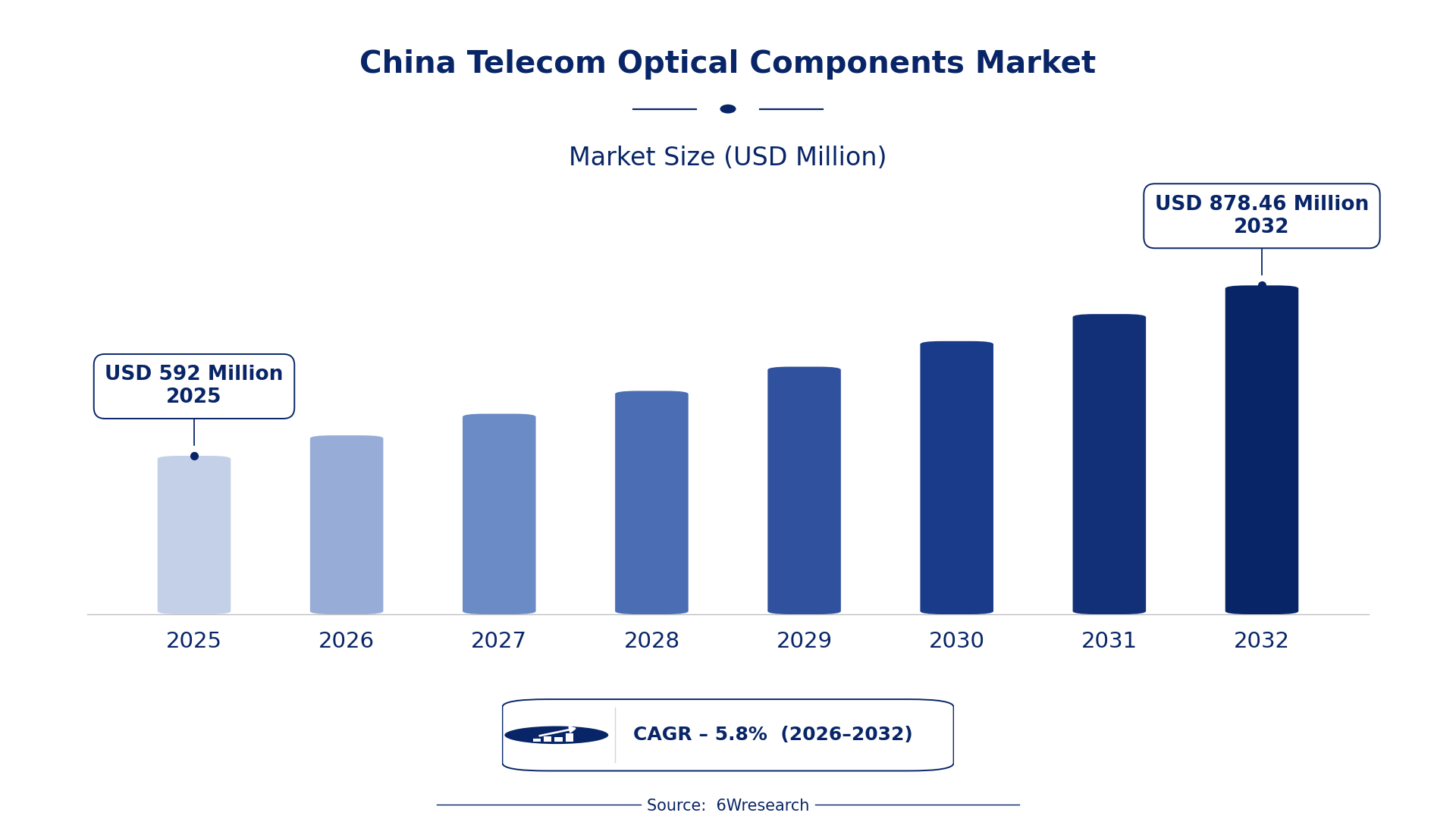
According to 6Wresearch internal database and industry insights, the China Telecom Optical Components Market was valued at USD 592.0 million in 2025 and is projected to reach USD 878.46 million by 2032, growing at a CAGR of approximately 5.8% during 2026–2032.
China Telecom Optical Components Market Highlights
| Report Metric | Details |
| Report Name | China Telecom Optical Components Market |
| Market Size 2025 | USD 592.0 million |
| Market Size 2032 | USD 878.46 million |
| Absolute Growth 2025–2032 | USD 286.46 million |
| CAGR 2026–2032 | 5.8% |
| Peak Annual Growth | 8.0% in 2029 |
| Forecast Period | 2026–2032 |
| Historical Data | 2022–2025 |
| Base Year | 2025 |
| Leading Optical Components Type, 2025 | Optical Transceivers (41% share) |
| Leading Product Type, 2025 | SFP/QSFP Modules (54% share) |
| Leading Component Type, 2025 | DWDM/Coherent (39% share) |
| Leading Distribution Channel, 2025 | OEM Supply (43% share) |
| Leading End User Industry, 2025 | Data Centers (44% share) |
| Fastest-Growing Optical Components Type | Optical Amplifiers (8.5% CAGR) |
| Fastest-Growing Product Type | EDFA/Raman (8.5% CAGR) |
| Fastest-Growing Component Type | Long-Haul (8.5% CAGR) |
| Fastest-Growing Distribution Channel | Component Distributors (6.9% CAGR) |
| Fastest-Growing End User Industry | Metro Networks (7.1% CAGR) |
| Growing Sector | Metro Networks |
| Key End Users | Data Centers, Metro Networks, Telecom Exchanges, Enterprise Networks |
China Telecom Optical Components Market Year-wise Growth Rate and Key Drivers (2022–2032)
This graph illustrates the annual growth rates of the market from 2022 to 2032, highlighting a steady upward trajectory and projected market expansion over the forecast period.
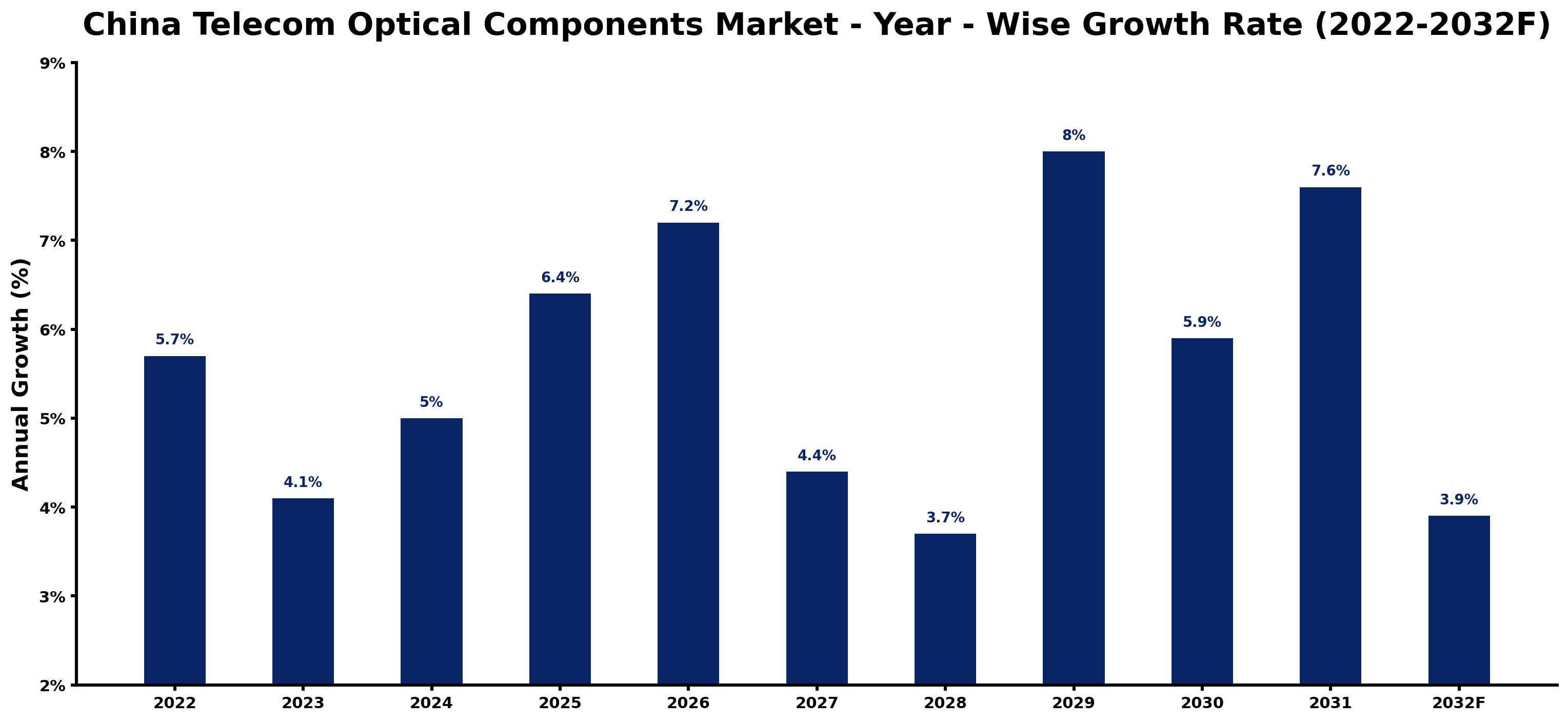
Year by year, the estimates below pair each growth rate with the development that shaped it.
| Year | Estimated Annual Growth (%) | Market Rationale |
| 2022 | 5.7 | The market experienced a steady growth rate due to ongoing infrastructure investments. |
| 2023 | 4.1 | Growth slowed as some projects faced delays, yet demand remained strong. |
| 2024 | 5.0 | A rebound in growth occurred as new data centers were established across the country. |
| 2025 | 6.4 | Increased installations of optical fiber propelled growth to its historical peak. |
| 2026 | 7.2 | The introduction of new telecom standards further stimulated market demand. |
| 2027 | 4.4 | Growth slowed as the market adjusted to previous high levels of activity. |
| 2028 | 3.7 | Continued investments in digital infrastructure contributed to a further slowdown. |
| 2029 | 8.0 | A surge in demand for high-capacity networks drove growth to its peak annual rate. |
| 2030 | 5.9 | A slight slowdown occurred as the market stabilised after rapid growth. |
| 2031 | 7.6 | Demand for advanced optical components increased, leading to a faster growth rate. |
| 2032 | 3.9 | Growth slowed as the market matured, but demand for upgrades remained. |
Note: Market size estimations and growth projections presented in this report are based on 6Wresearch's proprietary forecasting methodology, utilizing the latest available industry data, government publications, and primary research inputs.
China Telecom Optical Components Market Synopsis
Telecom Optical Components in China are crucial devices for data transmission over optical fibre networks. These components improve data transfer rates and support high-capacity networks. The China Telecom Optical Components Market is expanding due to the growth of data centres and substantial investments in digital infrastructure. With over 1,000 data centres currently operational, the demand for optical components is projected to increase. Government initiatives, including the 2023 National Broadband Plan, are also stimulating new demand.
Market Dynamics Impact Analysis (2026–2032)
| Factor | Type | Impact | Primary Segment Affected |
| Rising demand for high-capacity networks due to increased data consumption | Driver | High | Optical Transceivers |
| Expansion of data centers across the country | Driver | High | Data Centers |
| Investment in digital infrastructure upgrades | Opportunity | High | Optical Amplifiers |
| Growing need for efficient data transmission solutions | Opportunity | High | Optical Switches |
| Supply chain disruptions affecting component availability | Restraint | High | Optical Cables & Connectors |
| High production costs for advanced optical components | Restraint | Medium | SFP/QSFP Modules |
| Technological advancements requiring constant updates | Challenge | High | DWDM/Coherent |
| Intense competition among suppliers affecting pricing | Challenge | Medium | OEM Supply |
Evaluation of Drivers in China Telecom Optical Components Market (2026–2032)
Key forces behind demand, with the segment each one moves most, are listed below.
| Drivers | Primary Segment Affected | Why It Matters (Evidence) |
| Rising demand for high-capacity networks | Optical Transceivers | The establishment of over 1,000 data centers has intensified the need for optical transceivers, which improve data transfer capabilities. |
| Expansion of digital infrastructure investments | Optical Amplifiers | The 2023 National Broadband Plan aims to improve fiber coverage, increasing demand for optical amplifiers significantly. |
| Technological advancements in telecommunications | Optical Switches | Technological advancements are driving the adoption of optical switches, essential for efficient data routing. |
| Increased production capacity of optical cables | SFP/QSFP Modules | With optical cable production capacity reaching 300 million kilometers, the market is well-positioned to meet the growing demand for SFP/QSFP modules. |
| Growth in urban data communication | Metro Networks | The Yangtze River Delta region is a key area for telecom investments, boosting demand for components that support metro networks. |
Market growth for Telecom Optical Components in China is driven by the rising need for high-capacity networks, the expansion of data centres, and considerable investments in digital infrastructure. The establishment of over 1,000 data centres has heightened the demand for optical transceivers, which enhance data transfer capabilities. The 2023 National Broadband Plan aims to improve fibre coverage, leading to a significant increase in demand for optical amplifiers. Technological advancements in telecommunications are also encouraging the adoption of optical switches, which are necessary for efficient data routing. With optical cable production capacity reaching 300 million kilometres, the market is well-equipped to satisfy the growing demand for SFP/QSFP modules, essential for high-speed connections.
Evaluation of Restraints in China Telecom Optical Components Market
Below mentioned are some major restraints and their influence on market dynamics.
| Market Restraint | Primary Segment Affected | Why It Matters (Evidence) |
| Supply chain disruptions affecting component availability | Optical Cables & Connectors | These disruptions can delay projects and increase lead times for buyers, impacting overall market growth by up to 15%. |
| High production costs for advanced optical components | SFP/QSFP Modules | Manufacturers face challenges in maintaining profitability, which can lead to higher prices for buyers by approximately 10%. |
| Regulatory compliance requirements for telecom components | DWDM/Coherent | Producers must invest in testing and certification, increasing operational costs and affecting pricing by around 5%. |
| Limited availability of skilled workforce in the sector | Optical Amplifiers | A shortage of skilled professionals can hinder production capabilities, leading to a potential 20% decrease in output. |
| Market saturation in certain regions | Optical Transceivers | As competition intensifies, price wars may erode margins for suppliers, potentially reducing profits by 10% annually. |
China Telecom Optical Components Market Challenges
The China Telecom Optical Components market still has to solve a few problems, starting with high costs from outdated technology, which can raise production expenses by 20% for manufacturers. Regulatory hurdles complicate compliance, as the Ministry of Industry and Information Technology enforces strict standards that can delay product launches by up to six months for producers. Skills shortages in precision engineering lead to increased training costs, which can rise by 15% for companies trying to upskill their workforce. Intense competition among suppliers drives prices down, forcing producers to sacrifice profit margins, which can shrink by 10% annually.
Trends in the China Telecom Optical Components Market
The trends below show where the China Telecom Optical Components Market is heading.
- Shift towards Standardised Optical Components: The implementation of the GB/T 28828-2012 standard has improved the quality of optical components in China. This standardisation is projected to enhance interoperability and performance across networks, benefiting both suppliers and buyers.
- Data Centers Prioritising High-Speed Connections: Data centres are increasingly adopting SFP/QSFP modules to meet the demand for high-speed data transfer. With over 1,000 data centres in China, this shift is driving substantial investments in optical components, estimated at $200 million annually.
- Metro Networks Expanding to Meet Urban Demand: The Yangtze River Delta region is experiencing rapid expansion of metro networks, necessitating more optical switches. This growth is projected to create substantial demand for efficient data routing solutions, potentially increasing market size by 15%.
- Telecom Exchanges Upgrading Infrastructure: Shanghai, home to the largest concentration of telecom exchanges, is undergoing infrastructure upgrades to improve service quality. This initiative is expected to increase demand for optical amplifiers and transceivers by approximately 20%.
Investment Opportunities in the China Telecom Optical Components Market
Some of the investment opportunities in the China Telecom Optical Components Market are mentioned below.
- Supply of Optical Amplifiers: With the National Broadband Plan allocating $500 million for telecom upgrades, there is a strong opportunity to supply optical amplifiers to enhance network performance in rural areas.
- Investment in SFP/QSFP Modules: The demand for SFP/QSFP modules is rising, driven by over 1,000 data centers. Suppliers can enter this market by partnering with local distributors to meet the growing needs.
- Distribution of Optical Components: Component distributors are expanding their reach, with a projected growth rate of 6.9%. Investing in distribution channels in the Beijing-Tianjin-Hebei region can tap into this demand.
- Production of Optical Transceivers: The optical transceiver segment is expected to grow significantly. Suppliers should consider joint ventures with local manufacturers to enhance production capabilities.
Government Initiatives in the China Telecom Optical Components Market
The 2023 National Broadband Plan aims to expand fibre coverage to rural areas, significantly impacting the demand for optical components. This initiative is expected to allocate $500 million towards telecom infrastructure upgrades, benefiting producers and buyers alike by improving access to high-speed networks.
The Ministry of Industry and Information Technology oversees compliance with telecom standards. The agency's efforts in enforcing the GB/T 28828-2012 standard ensure that optical components meet quality requirements, which helps buyers trust the products they purchase.
Future Insight of the China Telecom Optical Components Market
The China Telecom Optical Components market will undergo substantial changes by 2032, primarily driven by the 2023 National Broadband Plan, which aims to expand fibre coverage to rural areas. This initiative will stimulate investments in advanced technologies, improving data transfer rates and network capacity. The implementation of the GB/T 28828-2012 standard will streamline production processes, enhancing quality across the board. As a result, buyers can expect more reliable components, while suppliers will benefit from increased demand stemming from the $500 million allocated for telecom infrastructure upgrades.
Market Segmentation Analysis
Each segment group is reviewed below, with the leader by share and the fastest grower by CAGR.
By Optical Components Type – Optical Transceivers Dominated, Optical Amplifiers Expected to Grow Fastest
According to Sumit Sagar, AM at 6Wresearch, with a 41% revenue share in 2025, Optical Transceivers was the largest optical components type category. Optical Transceivers dominate the market share due to their critical role in data transmission across extensive networks, particularly in over 1,000 data centers throughout China. Their necessity for enhancing data transfer rates solidifies their position as a vital component in high-capacity telecom infrastructures. Optical Amplifiers are set to record the highest CAGR in this split, 8.5% over 2026–2032. The rapid growth of Optical Amplifiers is attributed to the heightened demand for long-distance communication, as evidenced by the installation of 1.4 million kilometers of optical fiber in 2022. This expansion underscores the need for stronger signal amplification to ensure reliable data transmission over vast distances. Suppliers should focus on developing advanced Optical Amplifiers to meet the increasing requirements for long-distance communication.
By Product Type – SFP/QSFP Modules Dominated, EDFA/Raman Expected to Grow Fastest
SFP/QSFP Modules accounted for a 54% market share by product type in 2025. SFP/QSFP Modules lead the market share by facilitating high-speed data connections that are essential for modern telecommunications. Their widespread use in data centers and telecom networks highlights their importance for efficient data transfer. Over 2026–2032, EDFA/Raman is expected to post the fastest growth, at a CAGR of 8.5%. The growth of EDFA/Raman modules is propelled by the rising demand for amplifying optical signals in long-haul transmission, particularly as urban data networks expand. This need for enhanced signal strength is crucial for telecom providers upgrading their infrastructure. Suppliers must prioritise the development of EDFA/Raman modules to align with the growing demand for efficient long-haul optical signal amplification.
By Component Type – DWDM/Coherent Dominated, Long-Haul Expected to Grow Fastest
DWDM/Coherent took a 39% share of component type in 2025, more than any other category. DWDM/Coherent technology captures the largest market share due to its capability to significantly increase bandwidth in fibre networks, which is vital for data-heavy applications. Its implementation in major telecom projects across China reinforces its leading position in the market. The quickest growth will come from Long-Haul, forecast to expand at a CAGR of 8.5% between 2026 and 2032. Long-Haul components are experiencing rapid growth as they are essential for supporting long-distance data transmission, especially with the expansion of metro networks. This trend reflects the increasing demand for efficient data transfer over extensive distances. Suppliers must concentrate on enhancing Long-Haul technologies to address the rising demand for effective long-distance data communication solutions.
By Distribution Channel – OEM Supply Dominated, Component Distributors Expected to Grow Fastest
The largest distribution channel category in 2025 was OEM Supply, with a 43% share of total revenue. OEM Supply commands the largest share in the market as it provides essential components to manufacturers of telecom equipment, ensuring a reliable supply chain. This channel's importance is highlighted by its role in supporting the robust telecom infrastructure across China. Component Distributors are projected to grow fastest, at a CAGR of 6.9% during 2026–2032. Component Distributors are witnessing the fastest growth as they serve a diverse range of users requiring optical components for various applications. This trend indicates the increasing complexity and demand for tailored solutions within the telecom sector. Suppliers should consider strengthening partnerships with Component Distributors to effectively reach a broader customer base in the telecom market.
By End User Industry – Data Centers Dominated, Metro Networks Expected to Grow Fastest
Data Centers held a 44% share of the China Telecom Optical Components Market by end user industry in 2025. Data Centers dominate the market share as they are critical for data processing and storage, driving the demand for optical components in telecommunications. Their prevalence in urban areas further solidifies their importance in the overall telecom infrastructure. Metro Networks are set to record the highest CAGR in this split, 7.1% over 2026–2032. Metro Networks are experiencing the fastest growth due to the rising need for efficient urban data communication solutions. This demand is spurred by the ongoing investments in digital infrastructure across metropolitan regions. Suppliers should strategically target the Metro Networks segment to capitalise on the growing urban communication needs in the telecom industry.
Key Attractiveness of the Report
- 10 Years of Market Numbers
- Historical Data Starting from 2022 to 2025
- Base Year 2025
- Forecast Data until 2032
- Key Performance Indicators Impacting the Market
- Major Upcoming Developments and Projects
Key Highlights of the Report:
- China Telecom Optical Components Market Outlook
- Market Size of China Telecom Optical Components Market, 2025
- Forecast of China Telecom Optical Components Market, 2032
- Historical Data and Forecast of China Telecom Optical Components Revenues & Volume for the Period 2022 - 2032F
- China Telecom Optical Components Market Trend Evolution
- China Telecom Optical Components Market Drivers and Challenges
- China Telecom Optical Components Price Trends
- China Telecom Optical Components Porter's Five Forces
- China Telecom Optical Components Industry Life Cycle
- Historical Data and Forecast of China Telecom Optical Components Market Revenues & Volume By Optical Components Type for the Period 2022 - 2032F
- Historical Data and Forecast of China Telecom Optical Components Market Revenues & Volume By Optical Transceivers for the Period 2022 - 2032F
- Historical Data and Forecast of China Telecom Optical Components Market Revenues & Volume By Optical Amplifiers for the Period 2022 - 2032F
- Historical Data and Forecast of China Telecom Optical Components Market Revenues & Volume By Optical Switches for the Period 2022 - 2032F
- Historical Data and Forecast of China Telecom Optical Components Market Revenues & Volume By Optical Cables & Connectors for the Period 2022 - 2032F
- Historical Data and Forecast of China Telecom Optical Components Market Revenues & Volume By Product Type for the Period 2022 - 2032F
- Historical Data and Forecast of China Telecom Optical Components Market Revenues & Volume By SFP/QSFP Modules for the Period 2022 - 2032F
- Historical Data and Forecast of China Telecom Optical Components Market Revenues & Volume By EDFA/Raman for the Period 2022 - 2032F
- Historical Data and Forecast of China Telecom Optical Components Market Revenues & Volume By OXC/MEMS for the Period 2022 - 2032F
- Historical Data and Forecast of China Telecom Optical Components Market Revenues & Volume By Patch Cords/Plugs for the Period 2022 - 2032F
- Historical Data and Forecast of China Telecom Optical Components Market Revenues & Volume By Component Type for the Period 2022 - 2032F
- Historical Data and Forecast of China Telecom Optical Components Market Revenues & Volume By DWDM/Coherent for the Period 2022 - 2032F
- Historical Data and Forecast of China Telecom Optical Components Market Revenues & Volume By Long-Haul for the Period 2022 - 2032F
- Historical Data and Forecast of China Telecom Optical Components Market Revenues & Volume By Photonic Layer for the Period 2022 - 2032F
- Historical Data and Forecast of China Telecom Optical Components Market Revenues & Volume By Fiber/Connector for the Period 2022 - 2032F
- Historical Data and Forecast of China Telecom Optical Components Market Revenues & Volume By Distribution Channel for the Period 2022 - 2032F
- Historical Data and Forecast of China Telecom Optical Components Market Revenues & Volume By OEM Supply for the Period 2022 - 2032F
- Historical Data and Forecast of China Telecom Optical Components Market Revenues & Volume By Component Distributors for the Period 2022 - 2032F
- Historical Data and Forecast of China Telecom Optical Components Market Revenues & Volume By Optical Vendors for the Period 2022 - 2032F
- Historical Data and Forecast of China Telecom Optical Components Market Revenues & Volume By Retail + Online for the Period 2022 - 2032F
- Historical Data and Forecast of China Telecom Optical Components Market Revenues & Volume By End User Industry for the Period 2022 - 2032F
- Historical Data and Forecast of China Telecom Optical Components Market Revenues & Volume By Data Centers for the Period 2022 - 2032F
- Historical Data and Forecast of China Telecom Optical Components Market Revenues & Volume By Metro Networks for the Period 2022 - 2032F
- Historical Data and Forecast of China Telecom Optical Components Market Revenues & Volume By Telecom Exchanges for the Period 2022 - 2032F
- Historical Data and Forecast of China Telecom Optical Components Market Revenues & Volume By Enterprise Networks for the Period 2022 - 2032F
- China Telecom Optical Components Import Export Trade Statistics
- Market Opportunity Assessment By Optical Components Type
- Market Opportunity Assessment By Product Type
- Market Opportunity Assessment By Component Type
- Market Opportunity Assessment By Distribution Channel
- Market Opportunity Assessment By End User Industry
- China Telecom Optical Components Top Companies Market Share
- China Telecom Optical Components Competitive Benchmarking By Technical and Operational Parameters
- China Telecom Optical Components Company Profiles
- China Telecom Optical Components Key Strategic Recommendations
Market Covered
This report examines the market across the segments below.
By Optical Components Type
- Optical Transceivers
- Optical Amplifiers
- Optical Switches
- Optical Cables & Connectors
By Product Type
- SFP/QSFP Modules
- EDFA/Raman
- OXC/MEMS
- Patch Cords/Plugs
By Component Type
- DWDM/Coherent
- Long-Haul
- Photonic Layer
- Fiber/Connector
By Distribution Channel
- OEM Supply
- Component Distributors
- Optical Vendors
- Retail + Online
By End User Industry
- Data Centers
- Metro Networks
- Telecom Exchanges
- Enterprise Networks































