China Terminal Automation Systems Market Size & Growth Rate
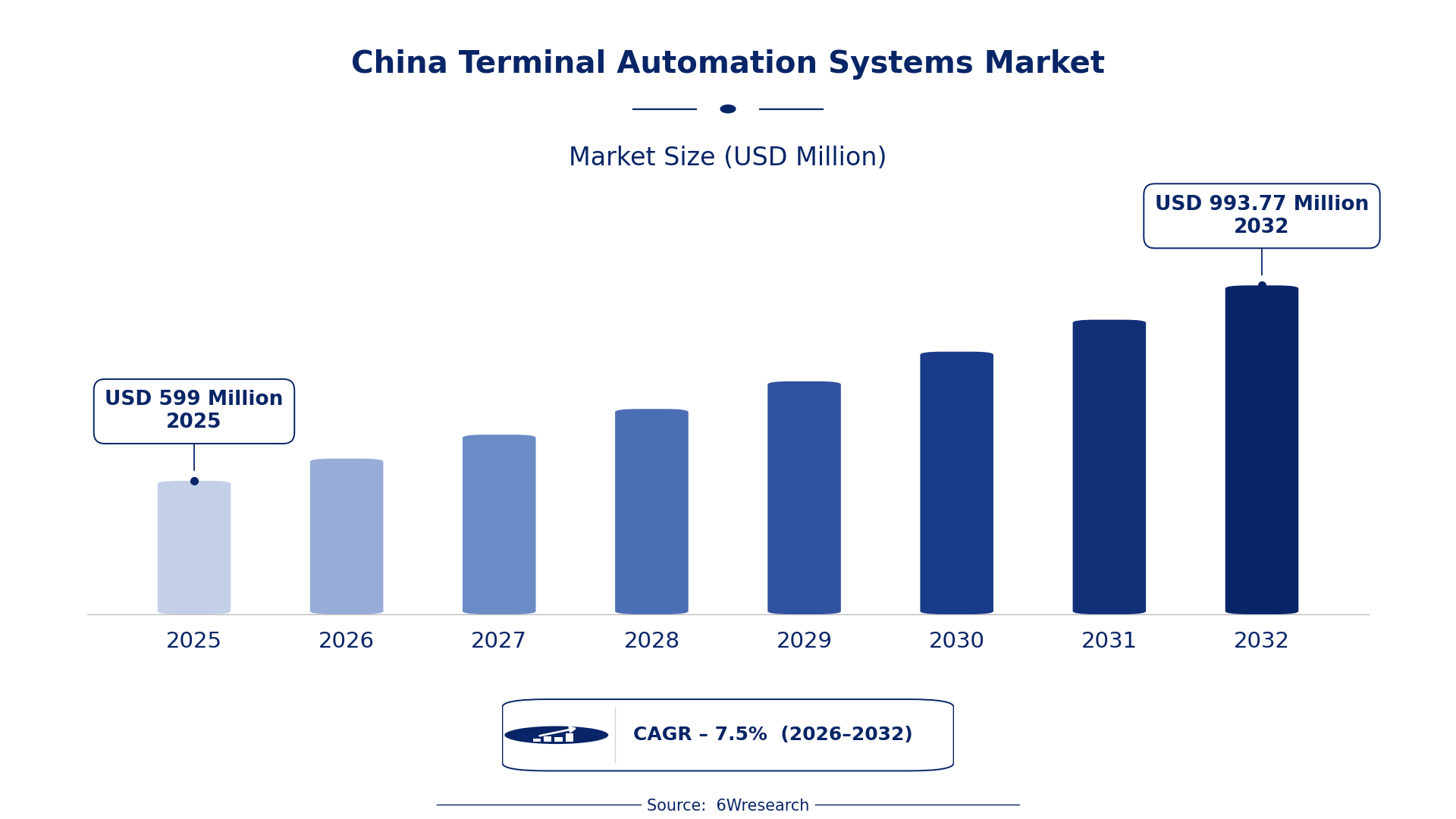
According to 6Wresearch internal database and industry insights, the China Terminal Automation Systems Market was valued at USD 599.0 million in 2025 and is projected to reach USD 993.77 million by 2032, growing at a CAGR of approximately 7.5% during 2026–2032.
China Terminal Automation Systems Market Highlights
| Report Metric | Details |
| Report Name | China Terminal Automation Systems Market |
| Market Size 2025 | USD 599.0 million |
| Market Size 2032 | USD 993.77 million |
| Absolute Growth 2025–2032 | USD 394.77 million |
| CAGR 2026–2032 | 7.5% |
| Peak Annual Growth | 9.7% in 2031 |
| Forecast Period | 2026–2032 |
| Historical Data | 2022–2025 |
| Base Year | 2025 |
| Leading Automation Level, 2025 | Fully Automated Terminals (47% share) |
| Leading Component Type, 2025 | SCADA/PLC (41% share) |
| Leading Fuel Type, 2025 | Oil/Gas/LNG (41% share) |
| Leading End User, 2025 | Energy Distributors (47% share) |
| Fastest-Growing Automation Level | IoT-Connected Solutions (8.8% CAGR) |
| Fastest-Growing Component Type | Real-Time Monitoring (10.0% CAGR) |
| Fastest-Growing Fuel Type | Crude + Refined (10.0% CAGR) |
| Fastest-Growing End User | Refining Plants (9.0% CAGR) |
| Growing Sector | Energy sector |
| Key End Users | Energy Distributors, Refining Plants, Port Authorities, Storage Operators |
China Terminal Automation Systems Market Year-wise Growth Rate and Key Drivers (2022–2032)
This graph illustrates the annual growth rates of the market from 2022 to 2032, highlighting a steady upward trajectory and projected market expansion over the forecast period.
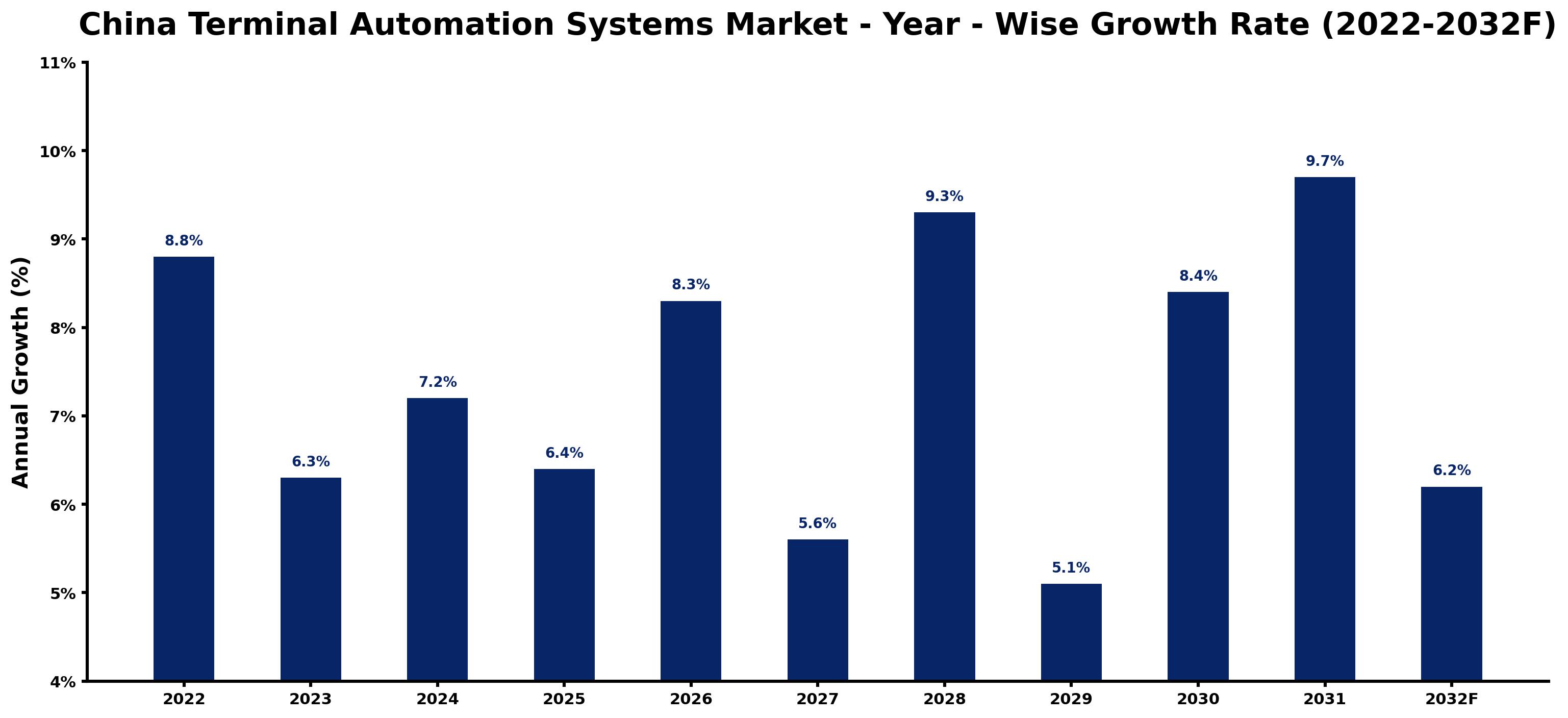
Below, each year's estimated growth is shown next to the factor that most influenced it.
| Year | Estimated Annual Growth (%) | Market Rationale |
| 2022 | 8.8 | The market experienced strong demand due to ongoing industrial activities in the energy sector. |
| 2023 | 6.3 | Growth slowed as market adjustments occurred following rapid expansion in the previous year. |
| 2024 | 7.2 | Increased investments in terminal automation led to a recovery in growth rates. |
| 2025 | 6.4 | Demand moderated as companies focused on optimising existing systems rather than new installations. |
| 2026 | 8.3 | A resurgence in energy demand drove growth as infrastructure projects ramped up. |
| 2027 | 5.6 | Growth slowed as the market adjusted to the previous year's rapid expansion. |
| 2028 | 9.3 | Technological advancements in IoT solutions spurred renewed interest in automation. |
| 2029 | 5.1 | Growth slowed as market saturation began to affect new system installations. |
| 2030 | 8.4 | Increased refining capacity led to higher demand for automation systems in terminals. |
| 2031 | 9.7 | The market peaked as major projects in the Yangtze River Delta region advanced. |
| 2032 | 6.2 | Growth slowed as the market stabilised after reaching its peak in the previous year. |
Note: Market size estimations and growth projections presented in this report are based on 6Wresearch's proprietary forecasting methodology, utilizing the latest available industry data, government publications, and primary research inputs.
China Terminal Automation Systems Market Synopsis
Terminal Automation Systems in China utilise advanced technologies to manage terminal operations within the energy sector. These systems improve efficiency and safety through integrated software and hardware solutions. The China Terminal Automation Systems Market is expanding due to rising energy demand and substantial investments in infrastructure. The ongoing development of the Yangtze River Delta region further fuels this demand. Government initiatives are also encouraging automation to improve operational efficiency across terminals.
Market Dynamics Impact Analysis (2026–2032)
| Factor | Type | Impact | Primary Segment Affected |
| Increasing energy demand from industrial activities drives the need for efficient terminal operations. | Driver | High | Fully Automated Terminals |
| Technological advancements in IoT solutions enhance real-time monitoring capabilities. | Driver | High | IoT-Connected Solutions |
| Growing investment in terminal infrastructure creates opportunities for automation suppliers. | Opportunity | High | Energy Distributors |
| The push for reduced operational costs encourages the adoption of automation systems. | Opportunity | High | Refining Plants |
| High initial investment costs for automation systems deter some potential buyers. | Restraint | Medium | Semi-Automated Systems |
| Regulatory compliance requirements can slow down the implementation of new systems. | Restraint | Medium | SCADA/PLC |
| Limited skilled workforce in automation technology can hinder market growth. | Challenge | High | Fully Automated Terminals |
| Technological integration issues may delay the adoption of new systems. | Challenge | Medium | IoT-Connected Solutions |
Evaluation of Drivers in China Terminal Automation Systems Market (2026–2032)
The factors lifting demand, and the evidence behind each, are summarised below.
| Drivers | Primary Segment Affected | Why It Matters (Evidence) |
| Rising energy demand necessitates efficient terminal operations. | Energy Distributors | The increase in energy consumption leads to more investments in terminal automation systems, with the total installed base projected to exceed 10,000 units by 2025. |
| Advancements in IoT technologies improve operational efficiency. | IoT-Connected Solutions | These technologies allow for better data management and real-time monitoring, driving demand as 70% of new terminal projects integrate real-time monitoring systems. |
| Government initiatives promote automation in energy distribution. | Fully Automated Terminals | Programs aimed at improving efficiency encourage investments in automation systems, targeting a 20% increase in efficiency by 2025. |
| Growing refining capacity increases the need for terminal automation. | Refining Plants | As refining capacity expands to 18 million barrels per day, efficient terminal operations become essential to manage logistics. |
| Focus on reducing operational costs drives automation adoption. | Semi-Automated Systems | Companies seek to cut costs, prompting investments in automation technologies to achieve a 15% reduction in operational costs by 2025. |
Growth in the Terminal Automation Systems market in China comes from rising energy demand, technological advancements, and investments in infrastructure. The energy sector's consumption is projected to increase, leading to more investments in terminal automation systems, with over 10,000 units expected by 2025. Technological advancements in IoT solutions improve operational efficiency, allowing for better data management and real-time monitoring. The growing refining capacity necessitates efficient terminal operations, further driving demand for automation systems as refining capacity reaches 18 million barrels per day.
Evaluation of Restraints in China Terminal Automation Systems Market
Below mentioned are some major restraints and their influence on market dynamics.
| Market Restraint | Primary Segment Affected | Why It Matters (Evidence) |
| High initial investment costs deter potential buyers from adopting automation systems. | Semi-Automated Systems | The upfront costs associated with automation can be a barrier for smaller operators. |
| Regulatory compliance requirements slow down system implementation. | SCADA/PLC | Meeting compliance standards can delay the deployment of new automation technologies, impacting timelines. |
| Limited skilled workforce in automation technology hinders market growth. | Fully Automated Terminals | A shortage of qualified personnel can restrict the effective implementation of automation systems, affecting efficiency. |
| Technological integration issues may delay the adoption of new systems. | IoT-Connected Solutions | Challenges in integrating new technologies with existing systems can slow down progress and increase costs. |
| Market saturation limits new installations of terminal automation systems. | Energy Distributors | As the market matures, the demand for new systems may decline, impacting growth. |
China Terminal Automation Systems Market Challenges
Terminal operators in the China Terminal Automation Systems market encounter several challenges. Competition from international suppliers with advanced technologies can limit local operators' market share, as they struggle to compete with lower prices. Rising implementation costs may increase operational expenses by up to 15%, putting pressure on terminal operators' budgets. Technological disparities persist, with only 70% of new projects incorporating real-time monitoring systems, leaving others less efficient. Regulatory compliance adds complexity, as the State Administration for Market Regulation enforces strict standards that can delay project approvals and raise costs for terminal operators.
Trends in the China Terminal Automation Systems Market
Four trends stand out in the China Terminal Automation Systems Market.
- Shift towards IoT-Connected Solutions in Terminal Operations: The Ministry of Transport's 'Port Modernization Initiative' promotes IoT technologies in terminal operations, with 70% of new projects integrating real-time monitoring systems. This shift improves operational efficiency and responsiveness.
- Increased Adoption of Fully Automated Terminals: The National Energy Administration's 'Clean Energy Development Program' encourages the adoption of fully automated systems, targeting a 30% reduction in emissions by 2030. This trend is expected to drive substantial investments in automation technologies.
- Energy Distributors Focusing on Efficiency: Energy distributors are increasingly prioritising automation to enhance operational efficiency, with a projected 15% reduction in operational costs by 2025. This focus creates opportunities for suppliers of automation technologies.
- Growing Refining Capacity Driving Automation: China's refining capacity reached 18 million barrels per day in 2023, prompting heightened demand for terminal automation systems. This growth is a key factor in the market's expansion.
Investment Opportunities in the China Terminal Automation Systems Market
Several openings in the China Terminal Automation Systems Market merit attention from investors.
- Investment in Fully Automated Terminals: With a projected market size of USD 993.77 million by 2032, there is a strong opportunity to invest in fully automated terminals. Energy distributors are increasingly seeking these solutions to improve operational efficiency.
- Supply of IoT-Connected Solutions: The growing demand for IoT technologies in terminal operations presents a lucrative opportunity. Refining plants are looking to adopt these solutions to improve real-time data access and operational responsiveness, enhancing their operations.
- Focus on Reducing Operational Costs: The government's target to reduce operational costs by 15% through automation by 2025 creates investment opportunities. Suppliers can partner with energy distributors to provide automation technologies that meet these goals.
- Development of Real-Time Monitoring Systems: The integration of real-time monitoring systems into new terminal projects is essential. Port authorities are actively seeking these solutions to improve safety and efficiency in their operations.
Government Initiatives in the China Terminal Automation Systems Market
The 'Smart Energy Development Plan' launched by the National Development and Reform Commission in 2021 aims to improve automation in the energy sector. This initiative targets a 20% increase in efficiency by 2025, driving investments in terminal automation systems. Furthermore, the 'Digital Transformation Strategy' introduced by the Ministry of Industry and Information Technology in 2022 promotes IoT solutions in terminal operations, focusing on energy efficiency improvements. These measures support the growth of the terminal automation market by encouraging technological advancements and operational improvements.
In 2023, the National Energy Administration's 'Clean Energy Development Program' encourages the adoption of automated systems in energy distribution, aiming for a 30% reduction in emissions by 2030. The Ministry of Transport's 'Port Modernization Initiative' aims to integrate advanced automation technologies in all major ports by 2025, improving operational efficiency. The State Administration for Market Regulation oversees compliance with national standards for terminal automation, ensuring that producers meet quality requirements. This oversight helps maintain high operational standards across the industry.
Future Insight of the China Terminal Automation Systems Market
The China Terminal Automation Systems market will experience notable changes by 2032, driven by the government's push for automation in energy distribution. The National Energy Administration's initiative aims to increase the installed base of terminal automation systems to over 15,000 units, addressing rising energy demands. IoT integration will become standard in terminal operations, improving efficiency and safety. As refining capacity continues to grow, adopting advanced automation technologies will be crucial for terminal operators to remain competitive in the energy sector.
Market Segmentation Analysis
Each segment group is reviewed below, with the leader by share and the fastest grower by CAGR.
By Automation Level – Fully Automated Terminals Dominated, IoT-Connected Solutions Expected to Grow Fastest
According to Vasudha, AM at 6Wresearch, with a 47% revenue share in 2025, Fully Automated Terminals was the largest automation level category. Fully automated terminals lead the market due to their capacity to enhance operational efficiency and safety in terminal operations. The Yangtze River Delta, a vital industrial region, features numerous fully automated terminals that exemplify this trend. Over 2026–2032, IoT-Connected Solutions are expected to post the fastest growth, at a CAGR of 8.8%. IoT-connected solutions are on the rise as they provide essential real-time data access and operational responsiveness, which are critical for modern terminal operations. The government's push to integrate IoT in port operations further fuels this growth. Suppliers should prioritise the development of IoT solutions to meet the increasing demand for enhanced terminal automation.
By Component Type – SCADA/PLC Dominated, Real-Time Monitoring Expected to Grow Fastest
The largest component type category in 2025 was SCADA/PLC, with a 41% share of total revenue. SCADA/PLC systems command the largest share as they are crucial for effectively monitoring and controlling terminal operations. Their extensive use across China's terminals highlights their importance in achieving operational success. The quickest growth will come from Real-Time Monitoring, forecast to expand at a CAGR of 10.0% between 2026 and 2032. Real-time monitoring systems are experiencing the fastest growth because they are vital for ensuring safety and efficiency in terminal operations. The integration of these systems into 70% of new terminal projects underscores their increasing significance. Buyers should focus on investing in real-time monitoring technologies to improve safety and operational efficiency.
By Fuel Type – Oil/Gas/LNG Dominated, Crude + Refined Expected to Grow Fastest
Oil/Gas/LNG accounted for a 41% market share by fuel type in 2025. Oil, gas, and LNG represent the primary fuels managed through terminal automation systems, which are essential for the energy sector's operations. The substantial refining capacity in China drives the demand for these automation solutions. Crude + Refined is set to record the highest CAGR in this split, 10.0% over 2026–2032. Crude and refined products are witnessing the fastest growth as terminal automation systems increasingly manage these key products. The rising need for efficient logistics in the refining sector contributes to this trend. Suppliers must align their offerings with the growing emphasis on crude and refined product automation to capture market share.
By End User – Energy Distributors Dominated, Refining Plants Expected to Grow Fastest
In 2025, Energy Distributors led the end user split with a 47% share. Energy distributors represent the largest share of end users for terminal automation systems, as they require these systems for efficient operations across their networks. The ongoing industrial activities in China further solidify their position as major consumers. Refining Plants are projected to grow fastest, at a CAGR of 9.0% during 2026–2032. Refining plants are the fastest-growing end users, utilising automation systems to manage terminal logistics effectively. The Petrochemical Industry Association's report indicates a notable rise in automation adoption among these plants, driving their rapid growth. Suppliers should tailor their solutions to meet the specific needs of refining plants to seize growth opportunities.
Key Attractiveness of the Report
- 10 Years of Market Numbers
- Historical Data Starting from 2022 to 2025
- Base Year 2025
- Forecast Data until 2032
- Key Performance Indicators Impacting the Market
- Major Upcoming Developments and Projects
Key Highlights of the Report:
- China Terminal Automation Systems Market Outlook
- Market Size of China Terminal Automation Systems Market, 2025
- Forecast of China Terminal Automation Systems Market, 2032
- Historical Data and Forecast of China Terminal Automation Systems Revenues & Volume for the Period 2022 - 2032F
- China Terminal Automation Systems Market Trend Evolution
- China Terminal Automation Systems Market Drivers and Challenges
- China Terminal Automation Systems Price Trends
- China Terminal Automation Systems Porter's Five Forces
- China Terminal Automation Systems Industry Life Cycle
- Historical Data and Forecast of China Terminal Automation Systems Market Revenues & Volume By Automation Level for the Period 2022 - 2032F
- Historical Data and Forecast of China Terminal Automation Systems Market Revenues & Volume By Fully Automated Terminals for the Period 2022 - 2032F
- Historical Data and Forecast of China Terminal Automation Systems Market Revenues & Volume By Semi-Automated Systems for the Period 2022 - 2032F
- Historical Data and Forecast of China Terminal Automation Systems Market Revenues & Volume By Integrated ERP Terminals for the Period 2022 - 2032F
- Historical Data and Forecast of China Terminal Automation Systems Market Revenues & Volume By IoT-Connected Solutions for the Period 2022 - 2032F
- Historical Data and Forecast of China Terminal Automation Systems Market Revenues & Volume By Component Type for the Period 2022 - 2032F
- Historical Data and Forecast of China Terminal Automation Systems Market Revenues & Volume By SCADA/PLC for the Period 2022 - 2032F
- Historical Data and Forecast of China Terminal Automation Systems Market Revenues & Volume By Flow Meters/Valves for the Period 2022 - 2032F
- Historical Data and Forecast of China Terminal Automation Systems Market Revenues & Volume By Loading/Dispatch Software for the Period 2022 - 2032F
- Historical Data and Forecast of China Terminal Automation Systems Market Revenues & Volume By Real-Time Monitoring for the Period 2022 - 2032F
- Historical Data and Forecast of China Terminal Automation Systems Market Revenues & Volume By Fuel Type for the Period 2022 - 2032F
- Historical Data and Forecast of China Terminal Automation Systems Market Revenues & Volume By Oil/Gas/LNG for the Period 2022 - 2032F
- Historical Data and Forecast of China Terminal Automation Systems Market Revenues & Volume By Petrochemicals for the Period 2022 - 2032F
- Historical Data and Forecast of China Terminal Automation Systems Market Revenues & Volume By Multiple for the Period 2022 - 2032F
- Historical Data and Forecast of China Terminal Automation Systems Market Revenues & Volume By Crude + Refined for the Period 2022 - 2032F
- Historical Data and Forecast of China Terminal Automation Systems Market Revenues & Volume By End User for the Period 2022 - 2032F
- Historical Data and Forecast of China Terminal Automation Systems Market Revenues & Volume By Energy Distributors for the Period 2022 - 2032F
- Historical Data and Forecast of China Terminal Automation Systems Market Revenues & Volume By Refining Plants for the Period 2022 - 2032F
- Historical Data and Forecast of China Terminal Automation Systems Market Revenues & Volume By Port Authorities for the Period 2022 - 2032F
- Historical Data and Forecast of China Terminal Automation Systems Market Revenues & Volume By Storage Operators for the Period 2022 - 2032F
- China Terminal Automation Systems Import Export Trade Statistics
- Market Opportunity Assessment By Automation Level
- Market Opportunity Assessment By Component Type
- Market Opportunity Assessment By Fuel Type
- Market Opportunity Assessment By End User
- China Terminal Automation Systems Top Companies Market Share
- China Terminal Automation Systems Competitive Benchmarking By Technical and Operational Parameters
- China Terminal Automation Systems Company Profiles
- China Terminal Automation Systems Key Strategic Recommendations
Market Covered
The report offers an extensive study of the following market segments.
By Automation Level
- Fully Automated Terminals
- Semi-Automated Systems
- Integrated ERP Terminals
- IoT-Connected Solutions
By Component Type
- SCADA/PLC
- Flow Meters/Valves
- Loading/Dispatch Software
- Real-Time Monitoring
By Fuel Type
- Oil/Gas/LNG
- Petrochemicals
- Multiple
- Crude + Refined
By End User
- Energy Distributors
- Refining Plants
- Port Authorities
- Storage Operators































