China Textile Automation Equipment Market Size & Growth Rate
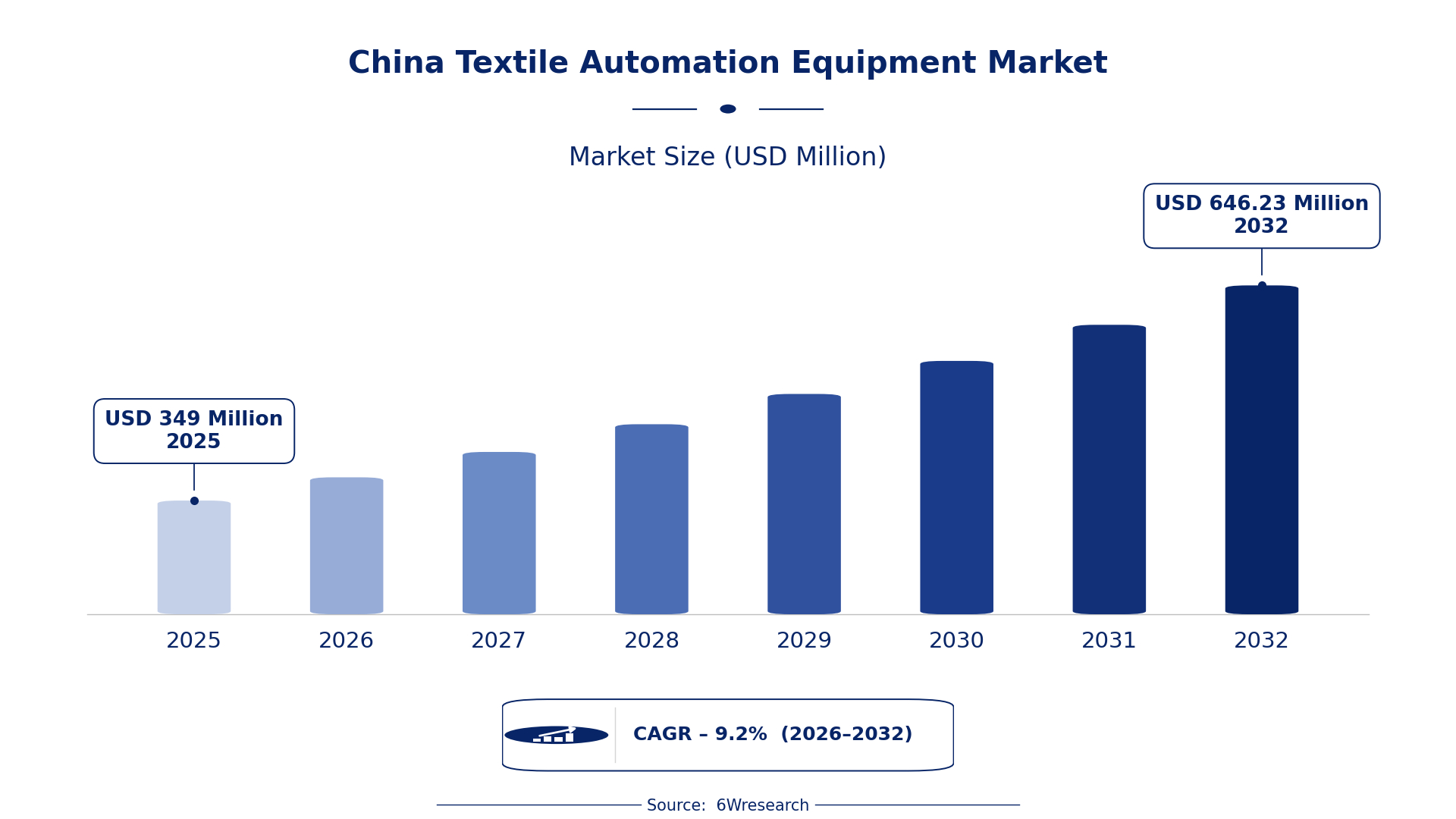
According to 6Wresearch internal database and industry insights, the China Textile Automation Equipment Market was valued at USD 349.0 million in 2025 and is projected to reach USD 646.23 million by 2032, growing at a CAGR of approximately 9.2% during 2026–2032.
China Textile Automation Equipment Market Highlights
| Report Metric | Details |
| Report Name | China Textile Automation Equipment Market |
| Market Size 2025 | USD 349.0 million |
| Market Size 2032 | USD 646.23 million |
| Absolute Growth 2025–2032 | USD 297.23 million |
| CAGR 2026–2032 | 9.2% |
| Peak Annual Growth | 11.3% in 2029 |
| Forecast Period | 2026–2032 |
| Historical Data | 2022–2025 |
| Base Year | 2025 |
| Leading Textile Automation Equip., 2025 | Knitting Machines (49% share) |
| Leading Product Type, 2025 | Circular/Flat Knitter (45% share) |
| Leading Machinery Type, 2025 | Computerized Knitting (41% share) |
| Leading Distribution Channel, 2025 | OEM Manufacturers (46% share) |
| Leading End User Industry, 2025 | Hosiery/Textile Mills (36% share) |
| Fastest-Growing Textile Automation Equip. | Textile Cutting Robots (11.3% CAGR) |
| Fastest-Growing Product Type | Laser/Knife Cutters (11.9% CAGR) |
| Fastest-Growing Machinery Type | Robotic Automation (10.9% CAGR) |
| Fastest-Growing Distribution Channel | Machinery Integrators (11.3% CAGR) |
| Fastest-Growing End User Industry | Technical Textiles (10.8% CAGR) |
| Growing Sector | Technical Textiles |
| Key End Users | Hosiery/Textile Mills, Apparel Mills, Technical Textiles, Upholstery & Footwear |
China Textile Automation Equipment Market Year-wise Growth Rate and Key Drivers (2022–2032)
This graph illustrates the annual growth rates of the market from 2022 to 2032, highlighting a steady upward trajectory and projected market expansion over the forecast period.
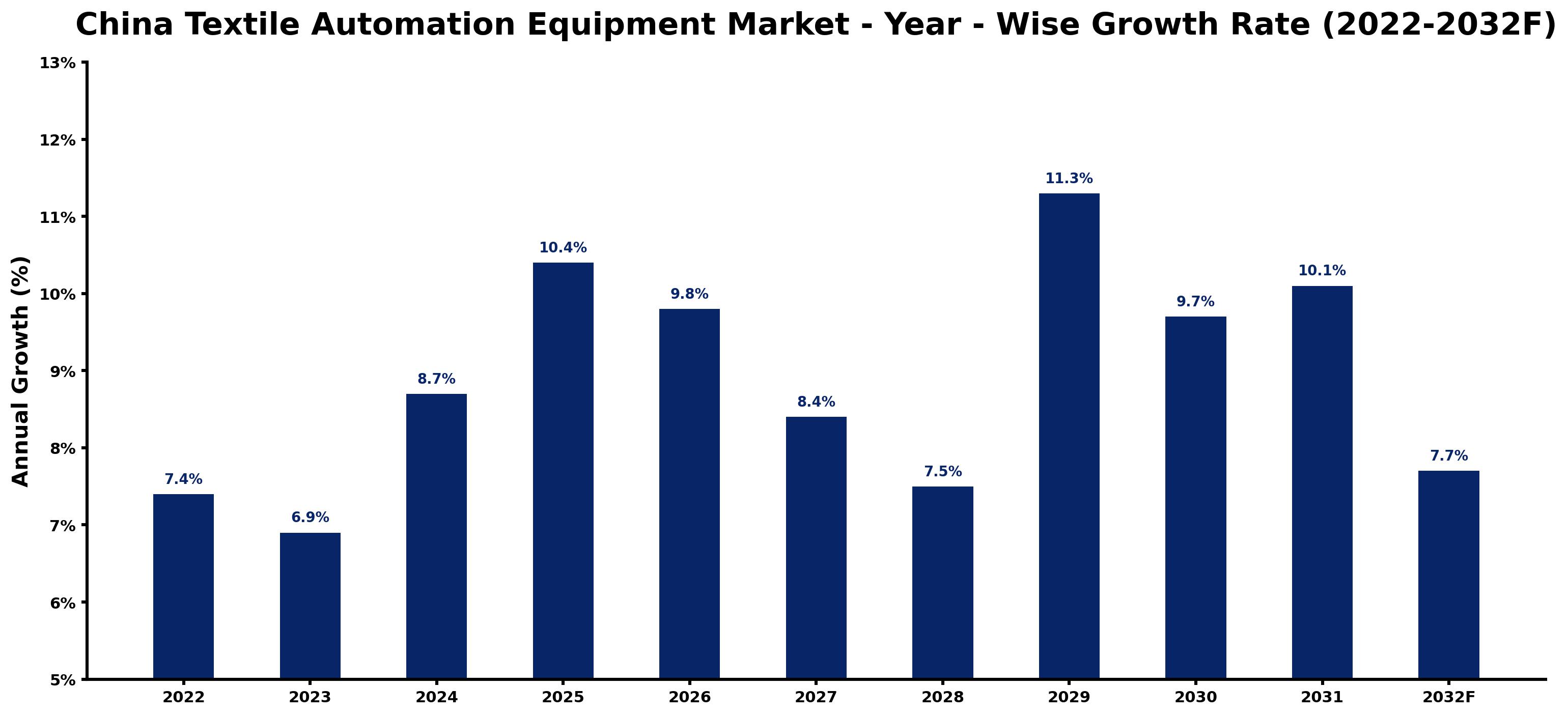
Below, each year's estimated growth is shown next to the factor that most influenced it.
| Year | Estimated Annual Growth (%) | Market Rationale |
| 2022 | 7.4 | The textile industry produced over 50 million tons, driving automation demand. |
| 2023 | 6.9 | Demand for automation slowed due to the implementation of the 'Textile Industry Digital Transformation Plan'. |
| 2024 | 8.7 | Increased demand for automated dyeing lines boosted market activity as production levels rose. |
| 2025 | 10.4 | The textile industry peaked in production, enhancing the need for automation technologies. |
| 2026 | 9.8 | A slower growth rate is projected as companies adjust to new automation standards. |
| 2027 | 8.4 | Demand for automation is expected to continue growing, driven by modernization efforts. |
| 2028 | 7.5 | Market growth is projected to slow as manufacturers adapt to evolving technologies. |
| 2029 | 11.3 | The peak growth year is driven by the implementation of the 'Textile Industry Upgrading Plan'. |
| 2030 | 9.7 | The market growth rate is expected to decrease as firms consolidate their automation investments. |
| 2031 | 10.1 | Demand for textile automation equipment is projected to rise as production levels increase. |
| 2032 | 7.7 | Growth is expected to slow as the market stabilises after rapid investments. |
Note: Market size estimations and growth projections presented in this report are based on 6Wresearch's proprietary forecasting methodology, utilizing the latest available industry data, government publications, and primary research inputs.
China Textile Automation Equipment Market Synopsis
Textile Automation Equipment in China refers to machinery that automates processes such as knitting and weaving. These machines improve efficiency and precision in textile production, significantly increasing production speed and reducing labour costs. The China Textile Automation Equipment Market is expanding due to strong domestic demand and ongoing investments in modernisation. In 2022, the textile industry produced over 50 million tons of textiles, driving the need for advanced automation solutions. The 'Textile Industry Upgrading Plan' is a key initiative promoting automation across the sector.
Market Dynamics Impact Analysis (2026–2032)
| Factor | Type | Impact | Primary Segment Affected |
| Growing domestic demand for automated textile solutions | Driver | High | Knitting Machines |
| Increased investment in modernization of textile facilities | Driver | High | Dyeing & Finishing Lines |
| Significant gap in automated dyeing lines | Opportunity | High | Dyeing & Finishing Lines |
| Rising demand for specialized textile machinery | Opportunity | High | Technical Textiles |
| High initial investment costs for automation technologies | Restraint | Medium | Knitting Machines |
| Limited availability of skilled workforce for operating advanced machinery | Restraint | Medium | Robotic Automation |
| Textile Automation Equipment Market in China faces high initial costs | Challenge | High | Knitting Machines |
| Technological integration challenges in existing textile facilities | Challenge | Medium | Computerized Knitting |
Evaluation of Drivers in China Textile Automation Equipment Market (2026–2032)
The table below links each growth driver to the segment it affects and the evidence for it.
| Drivers | Primary Segment Affected | Why It Matters (Evidence) |
| Increased production efficiency through automation | Dyeing & Finishing Lines | This leads to higher output and reduced labor costs, with a notable increase in demand for automated dyeing lines. |
| Growing investments in modern textile facilities | Knitting Machines | This is driven by the need to improve production capabilities, with over 1,000 hosiery mills adopting automation. |
| Rising demand for high-quality textiles | Technical Textiles | This sector's growth is supported by specialized machinery, with a significant increase in production volumes. |
| Implementation of the 'Textile Industry Upgrading Plan' | Robotic Automation | This initiative aims to boost automation levels in the industry, promoting investment in robotics. |
| Expansion of the apparel sector in Zhejiang province | Apparel Mills | The region's growth leads to increased demand for textile automation equipment. |
Expansion of the Textile Automation Equipment market in China is backed by increased production efficiency and growing investments in modernization. The textile industry produced over 50 million tons in 2022, driving demand for advanced machinery. In Jiangsu province, over 1,000 hosiery mills are adopting automation technologies, increasing output and reducing costs. The technical textiles sector is expanding, necessitating specialized machinery to meet rising quality standards. The implementation of the 'Textile Industry Upgrading Plan' promotes further investment in robotic automation.
Evaluation of Restraints in China Textile Automation Equipment Market
The main factors holding the market back are set out below.
| Market Restraint | Primary Segment Affected | Why It Matters (Evidence) |
| High initial costs of automation technologies | Knitting Machines | This limits adoption among smaller manufacturers, who struggle with upfront investments. |
| Limited skilled workforce for advanced machinery operation | Robotic Automation | This shortage affects production efficiency, with over 30% of firms reporting difficulties in finding qualified technicians. |
| Technological integration challenges in existing facilities | Computerized Knitting | Many facilities face difficulties in upgrading systems without disrupting operations. |
| Regulatory compliance costs for safety standards | Dyeing & Finishing Lines | Compliance with National Standard GB/T 22864-2009 adds to operational expenses. |
| Market saturation in certain automation segments | Knitting Machines | This leads to slower growth as manufacturers consolidate existing technologies. |
China Textile Automation Equipment Market Challenges
The China Textile Automation Equipment Market faces several practical problems, with supply chain disruptions causing lead times for machinery to increase by up to 20% this year. These delays stem from global logistics issues, impacting producers who rely on timely deliveries to meet production schedules. Competition from lower-cost manufacturers in Southeast Asia is intensifying, compelling local suppliers to reduce prices by an average of 10%, which threatens profit margins. Buyers are grappling with rising costs, as demand for automated dyeing lines has surged by 15%, pushing equipment prices higher. A skills gap persists, with over 30% of textile firms struggling to find qualified technicians for advanced machinery, hindering productivity.
Trends in the China Textile Automation Equipment Market
The trends below show where the China Textile Automation Equipment Market is heading.
- Shift towards Smart Manufacturing: The 'Textile Industry Digital Transformation Plan' launched in 2021 promotes smart manufacturing in textiles, improving efficiency. This initiative is projected to increase automation adoption by 30% by 2025.
- Increased Focus on Eco-Friendly Processes: Textile companies are prioritising eco-friendly automated processes, driven by the 'Green Manufacturing Initiative' introduced in 2020. This shift is expected to increase demand for sustainable dyeing technologies.
- Rise of Technical Textiles: The demand for specialised machinery in technical textiles has surged since 2022, with a CAGR of 10.8%. This trend is reshaping the market as manufacturers adapt to new consumer preferences.
- Growing Automation in Apparel Mills: Apparel mills in Zhejiang province are increasingly adopting robotic solutions, reflecting a broader trend towards automation. This shift is expected to improve production efficiency by 20%.
Investment Opportunities in the China Textile Automation Equipment Market
Below are the investment opportunities with the strongest case in the China Textile Automation Equipment Market.
- $200 million funding for automation adoption: The Ministry of Finance allocated $200 million in 2022 to support textile manufacturers adopting automation technologies. This funding creates opportunities for suppliers of advanced machinery and systems integration.
- Supply of specialized robotic solutions: With the rise of technical textiles, there is a growing opportunity to supply specialised robotic solutions. Manufacturers in technical textiles are increasingly seeking automation to improve production efficiency.
- Partnerships with local manufacturers: Now is an ideal time to enter the market through partnerships with local manufacturers. Collaborating with established players can facilitate access to the growing demand for textile automation.
- Investment in automation technologies: The increasing demand for automated dyeing lines, which has risen significantly, presents a substantial investment opportunity. Suppliers can target hosiery mills looking to modernise their operations.
Government Initiatives in the China Textile Automation Equipment Market
The 'Textile Industry Digital Transformation Plan' launched by the Ministry of Industry and Information Technology in 2021 promotes smart manufacturing in textiles. This measure encourages manufacturers to adopt advanced automation technologies, improving productivity and competitiveness. The '13th Five-Year Plan for the Textile Industry' aims to increase automation levels by 30% by 2025, overseen by the National Development and Reform Commission. This strategic plan sets clear targets for modernisation and technological advancement in the sector, benefiting producers and buyers alike.
The Ministry of Finance's funding scheme supports textile manufacturers in adopting automation technologies. In 2022, $200 million was allocated to assist firms in upgrading their operations, ensuring they remain competitive. The 'Green Manufacturing Initiative' encourages eco-friendly practices in textile production, promoting sustainability. Agencies like the Ministry of Ecology and Environment oversee these efforts, ensuring compliance with environmental standards.
Future Insight of the China Textile Automation Equipment Market
By 2032, suppliers and buyers in the China Textile Automation Equipment Market can expect substantial advancements driven by government initiatives like the 'Textile Industry Upgrading Plan' and 'Made in China 2025'. These programmes will boost automation capabilities, enabling producers to improve efficiency and cut costs. The installed base of knitting machines, exceeding 2 million units, will likely see considerable upgrades, enhancing production quality. The annual China International Textile Machinery Exhibition will showcase ongoing innovations, ensuring the market adapts to evolving industry demands.
Market Segmentation Analysis
The report offers a comprehensive study of the following market segments and their leading categories in the market.
By Textile Automation Equip. – Knitting Machines Dominated, Textile Cutting Robots Expected to Grow Fastest
According to Vasudha, AM at 6Wresearch, Knitting Machines held a 49% share of the China Textile Automation Equipment Market by textile automation equip. in 2025. Knitting machines hold the largest market share as they are essential for fabric production, with over 2 million units installed in China. The Jiangsu province, a leading textile manufacturing hub, heavily relies on these machines to meet its substantial production needs. The quickest growth will come from Textile Cutting Robots, forecast to expand at a CAGR of 11.3% between 2026 and 2032. Textile cutting robots are experiencing rapid growth, driven by a 15% increase in demand for automated dyeing lines that require precise cutting. The government's 'Textile Industry Upgrading Plan' further propels this shift towards enhanced automation in the sector. Suppliers should focus on advancing knitting machines and cutting robots to capitalise on the expanding market opportunities.
By Product Type – Circular/Flat Knitter Dominated, Laser/Knife Cutters Expected to Grow Fastest
In 2025, Circular/Flat Knitter led the product type split with a 45% share. Circular and flat knitters dominate the market due to their extensive application in producing various knit fabrics, making them indispensable for textile mills. Their efficiency and versatility significantly contribute to their strong market share in textile automation equipment. Laser/Knife Cutters are projected to grow fastest, at a CAGR of 11.9% during 2026–2032. Laser and knife cutters are the fastest-growing product type, driven by their ability to improve cutting precision, which is increasingly demanded in textile production. This trend aligns with the industry's focus on quality and accuracy in manufacturing. Buyers should invest in advanced cutting technologies to enhance production efficiency and improve product quality.
By Machinery Type – Computerized Knitting Dominated, Robotic Automation Expected to Grow Fastest
Computerized Knitting took a 41% share of machinery type in 2025, more than any other category. Computerized knitting machines lead the market as they significantly boost automation in knitting processes, making them a preferred choice among textile manufacturers. Their widespread adoption highlights a robust installed base across the industry. Over 2026–2032, Robotic Automation is expected to post the fastest growth, at a CAGR of 10.9%. Robotic automation is rapidly gaining popularity as manufacturers seek to integrate robotics for improved efficiency in textile production. This trend indicates a broader movement towards more automated solutions within the sector. Suppliers must innovate in robotic technologies to meet the growing demand for automation in textile manufacturing.
By Distribution Channel – OEM Manufacturers Dominated, Machinery Integrators Expected to Grow Fastest
The largest distribution channel category in 2025 was OEM Manufacturers, with a 46% share of total revenue. OEM manufacturers command the largest market share as they directly supply machinery to textile producers, ensuring a steady flow of equipment to meet production requirements. Their established relationships with textile mills reinforce their position in the market. Machinery Integrators are set to record the highest CAGR in this split, 11.3% over 2026–2032. Machinery integrators are emerging as the fastest-growing distribution channel, as they combine various systems to enhance operational efficiency, appealing to manufacturers seeking comprehensive solutions. This trend responds to the need for streamlined processes in the textile sector. Suppliers should build partnerships with machinery integrators to expand their market reach.
By End User Industry – Hosiery/Textile Mills Dominated, Technical Textiles Expected to Grow Fastest
With a 36% revenue share in 2025, Hosiery/Textile Mills was the largest end user industry category. Hosiery and textile mills represent the largest end-user segment, being the primary consumers of textile automation equipment in China. Their significant production volumes generate robust demand for advanced automation solutions in the industry. The quickest growth will come from Technical Textiles, forecast to expand at a CAGR of 10.8% between 2026 and 2032. Technical textiles are the fastest-growing end-user sector, driven by the increasing need for specialised machinery to address diverse applications. This growth reflects the changing demands within the textile market. Buyers in the technical textiles sector should seek advanced machinery options to remain competitive and meet market needs.
Key Attractiveness of the Report
- 10 Years of Market Numbers
- Historical Data Starting from 2022 to 2025
- Base Year 2025
- Forecast Data until 2032
- Key Performance Indicators Impacting the Market
- Major Upcoming Developments and Projects
Key Highlights of the Report:
- China Textile Automation Equipment Market Outlook
- Market Size of China Textile Automation Equipment Market, 2025
- Forecast of China Textile Automation Equipment Market, 2032
- Historical Data and Forecast of China Textile Automation Equipment Revenues & Volume for the Period 2022 - 2032F
- China Textile Automation Equipment Market Trend Evolution
- China Textile Automation Equipment Market Drivers and Challenges
- China Textile Automation Equipment Price Trends
- China Textile Automation Equipment Porter's Five Forces
- China Textile Automation Equipment Industry Life Cycle
- Historical Data and Forecast of China Textile Automation Equipment Market Revenues & Volume By Textile Automation Equip. for the Period 2022 - 2032F
- Historical Data and Forecast of China Textile Automation Equipment Market Revenues & Volume By Knitting Machines for the Period 2022 - 2032F
- Historical Data and Forecast of China Textile Automation Equipment Market Revenues & Volume By Weaving Looms for the Period 2022 - 2032F
- Historical Data and Forecast of China Textile Automation Equipment Market Revenues & Volume By Dyeing & Finishing Lines for the Period 2022 - 2032F
- Historical Data and Forecast of China Textile Automation Equipment Market Revenues & Volume By Textile Cutting Robots for the Period 2022 - 2032F
- Historical Data and Forecast of China Textile Automation Equipment Market Revenues & Volume By Product Type for the Period 2022 - 2032F
- Historical Data and Forecast of China Textile Automation Equipment Market Revenues & Volume By Circular/Flat Knitter for the Period 2022 - 2032F
- Historical Data and Forecast of China Textile Automation Equipment Market Revenues & Volume By Rapier/Jacquard Looms for the Period 2022 - 2032F
- Historical Data and Forecast of China Textile Automation Equipment Market Revenues & Volume By Continuous Lines for the Period 2022 - 2032F
- Historical Data and Forecast of China Textile Automation Equipment Market Revenues & Volume By Laser/Knife Cutters for the Period 2022 - 2032F
- Historical Data and Forecast of China Textile Automation Equipment Market Revenues & Volume By Machinery Type for the Period 2022 - 2032F
- Historical Data and Forecast of China Textile Automation Equipment Market Revenues & Volume By Computerized Knitting for the Period 2022 - 2032F
- Historical Data and Forecast of China Textile Automation Equipment Market Revenues & Volume By NC-Controlled Looms for the Period 2022 - 2032F
- Historical Data and Forecast of China Textile Automation Equipment Market Revenues & Volume By Automated Dye Baths for the Period 2022 - 2032F
- Historical Data and Forecast of China Textile Automation Equipment Market Revenues & Volume By Robotic Automation for the Period 2022 - 2032F
- Historical Data and Forecast of China Textile Automation Equipment Market Revenues & Volume By Distribution Channel for the Period 2022 - 2032F
- Historical Data and Forecast of China Textile Automation Equipment Market Revenues & Volume By OEM Manufacturers for the Period 2022 - 2032F
- Historical Data and Forecast of China Textile Automation Equipment Market Revenues & Volume By Industrial Distributors for the Period 2022 - 2032F
- Historical Data and Forecast of China Textile Automation Equipment Market Revenues & Volume By Machinery Integrators for the Period 2022 - 2032F
- Historical Data and Forecast of China Textile Automation Equipment Market Revenues & Volume By Robotics Integrators for the Period 2022 - 2032F
- Historical Data and Forecast of China Textile Automation Equipment Market Revenues & Volume By End User Industry for the Period 2022 - 2032F
- Historical Data and Forecast of China Textile Automation Equipment Market Revenues & Volume By Hosiery/Textile Mills for the Period 2022 - 2032F
- Historical Data and Forecast of China Textile Automation Equipment Market Revenues & Volume By Apparel Mills for the Period 2022 - 2032F
- Historical Data and Forecast of China Textile Automation Equipment Market Revenues & Volume By Technical Textiles for the Period 2022 - 2032F
- Historical Data and Forecast of China Textile Automation Equipment Market Revenues & Volume By Upholstery & Footwear for the Period 2022 - 2032F
- China Textile Automation Equipment Import Export Trade Statistics
- Market Opportunity Assessment By Textile Automation Equip.
- Market Opportunity Assessment By Product Type
- Market Opportunity Assessment By Machinery Type
- Market Opportunity Assessment By Distribution Channel
- Market Opportunity Assessment By End User Industry
- China Textile Automation Equipment Top Companies Market Share
- China Textile Automation Equipment Competitive Benchmarking By Technical and Operational Parameters
- China Textile Automation Equipment Company Profiles
- China Textile Automation Equipment Key Strategic Recommendations
Market Covered
This report examines the market across the segments below.
By Textile Automation Equip.
- Knitting Machines
- Weaving Looms
- Dyeing & Finishing Lines
- Textile Cutting Robots
By Product Type
- Circular/Flat Knitter
- Rapier/Jacquard Looms
- Continuous Lines
- Laser/Knife Cutters
By Machinery Type
- Computerized Knitting
- NC-Controlled Looms
- Automated Dye Baths
- Robotic Automation
By Distribution Channel
- OEM Manufacturers
- Industrial Distributors
- Machinery Integrators
- Robotics Integrators
By End User Industry
- Hosiery/Textile Mills
- Apparel Mills
- Technical Textiles
- Upholstery & Footwear































