India Textile Automation Equipment Market Size & Growth Rate
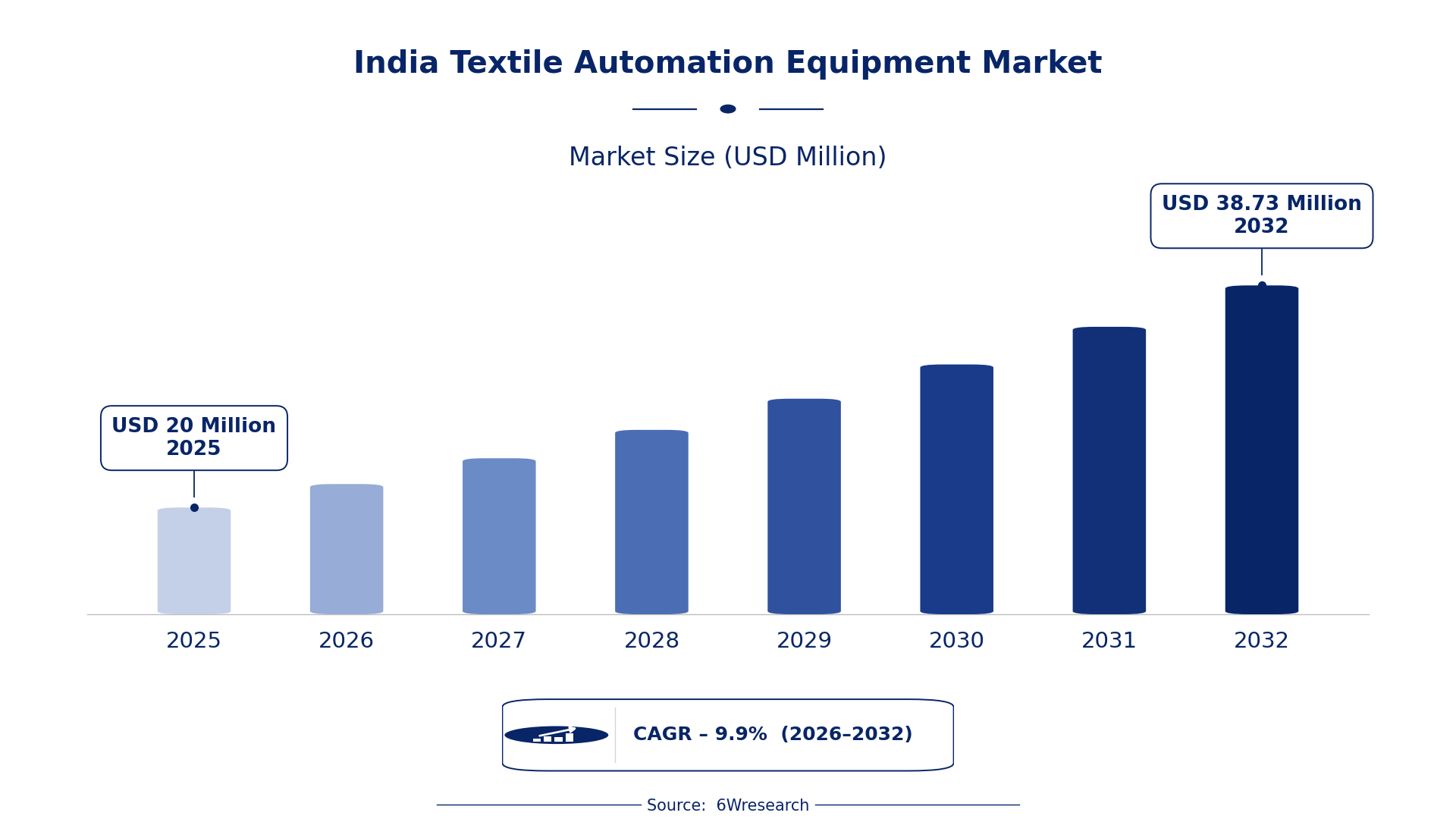
According to 6Wresearch internal database and industry insights, the India Textile Automation Equipment Market was valued at USD 20.0 million in 2025 and is projected to reach USD 38.73 million by 2032, growing at a CAGR of approximately 9.9% during 2026–2032.
India Textile Automation Equipment Market Highlights
| Report Metric | Details |
| Report Name | India Textile Automation Equipment Market |
| Market Size 2025 | USD 20.0 million |
| Market Size 2032 | USD 38.73 million |
| Absolute Growth 2025–2032 | USD 18.73 million |
| CAGR 2026–2032 | 9.9% |
| Peak Annual Growth | 12.1% in 2030 |
| Forecast Period | 2026–2032 |
| Historical Data | 2022–2025 |
| Base Year | 2025 |
| Leading Textile Automation Equip., 2025 | Knitting Machines (38% share) |
| Leading Product Type, 2025 | Circular/Flat Knitter (34% share) |
| Leading Machinery Type, 2025 | Computerized Knitting (43% share) |
| Leading Distribution Channel, 2025 | OEM Manufacturers (37% share) |
| Leading End User Industry, 2025 | Hosiery/Textile Mills (49% share) |
| Fastest-Growing Textile Automation Equip. | Textile Cutting Robots (11.3% CAGR) |
| Fastest-Growing Product Type | Laser/Knife Cutters (11.3% CAGR) |
| Fastest-Growing Machinery Type | Robotic Automation (11.9% CAGR) |
| Fastest-Growing Distribution Channel | Machinery Integrators (12.6% CAGR) |
| Fastest-Growing End User Industry | Technical Textiles (12.5% CAGR) |
| Growing Sector | Technical Textiles |
| Key End Users | Hosiery/Textile Mills, Apparel Mills, Technical Textiles, Upholstery & Footwear |
India Textile Automation Equipment Market Year-wise Growth Rate and Key Drivers (2022–2032)
This graph illustrates the annual growth rates of the market from 2022 to 2032, highlighting a steady upward trajectory and projected market expansion over the forecast period.
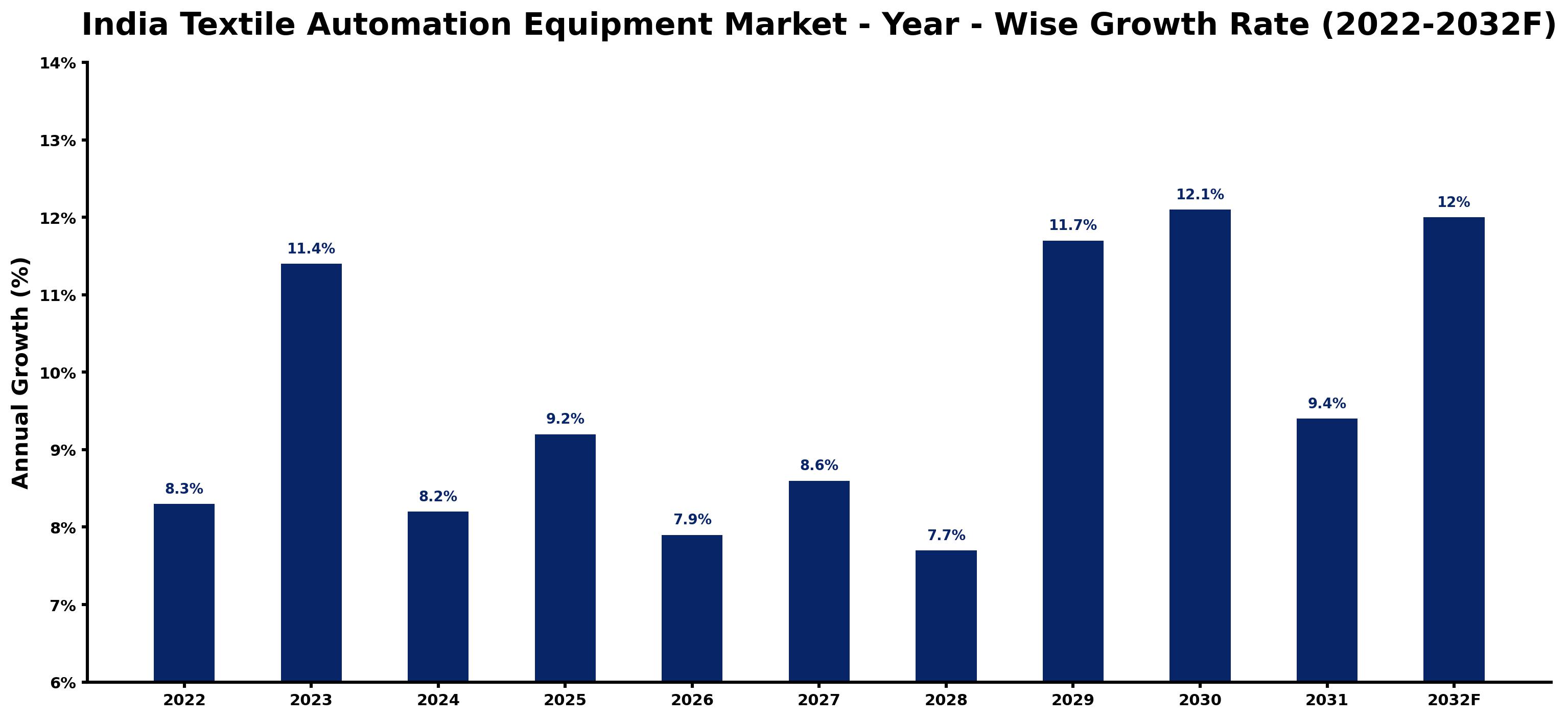
The following table presents the estimated annual growth rate for each year together with the principal factor influencing market performance.
| Year | Estimated Annual Growth (%) | Market Rationale |
| 2022 | 8.3 | The market experienced steady growth due to ongoing demand from textile mills. |
| 2023 | 11.4 | Growth accelerated as the 'Production-Linked Incentive Scheme' attracted investments. |
| 2024 | 8.2 | A slowdown occurred as demand stabilised following the previous year's surge. |
| 2025 | 9.2 | Growth resumed as modernization efforts in textile machinery gained traction. |
| 2026 | 7.9 | The market saw a slowdown as competition increased among manufacturers. |
| 2027 | 8.6 | Demand rose again, driven by the expansion of technical textiles. |
| 2028 | 7.7 | A slowdown was noted as the market adjusted to new production standards. |
| 2029 | 11.7 | Growth accelerated with rising demand for automated solutions in textiles. |
| 2030 | 12.1 | The market peaked due to heightened investments in robotic automation. |
| 2031 | 9.4 | A slowdown occurred as companies focused on consolidating their market positions. |
| 2032 | 12.0 | Growth is expected to rise again as sustainability becomes a priority. |
Note: Market size estimations and growth projections presented in this report are based on 6Wresearch's proprietary forecasting methodology, utilizing the latest available industry data, government publications, and primary research inputs.
India Textile Automation Equipment Market Synopsis
Textile Automation Equipment in India includes machinery that automates processes in textile manufacturing, such as knitting and weaving. These advanced machines improve production efficiency and lower labour costs. The India Textile Automation Equipment Market is growing due to increasing demand for sustainable production methods and government initiatives like the 'Production-Linked Incentive Scheme'. With over 45 million people employed in the textile sector, the market is set for further expansion as domestic users pursue modern solutions to enhance competitiveness.
Market Dynamics Impact Analysis (2026–2032)
| Factor | Type | Impact | Primary Segment Affected |
| Increasing investments in modern textile machinery are driving demand. | Driver | High | Knitting Machines |
| The rise in technical textiles is creating new opportunities for automation. | Driver | High | Technical Textiles |
| The market gap for advanced automation solutions is significant, especially in textile mills. | Opportunity | High | Hosiery/Textile Mills |
| The growing demand for sustainable production methods presents an investment opportunity. | Opportunity | High | Apparel Mills |
| High initial costs of automation equipment can deter small manufacturers. | Restraint | Medium | Textile Cutting Robots |
| The complexity of integrating new technologies can slow adoption rates. | Restraint | Medium | Robotic Automation |
| Competition among manufacturers is intensifying, affecting pricing strategies. | Challenge | High | Computerized Knitting |
| Supply chain disruptions can delay equipment availability for buyers. | Challenge | Medium | Dyeing & Finishing Lines |
Evaluation of Drivers in India Textile Automation Equipment Market (2026–2032)
The main growth drivers and the segments they affect most are set out below.
| Drivers | Primary Segment Affected | Why It Matters (Evidence) |
| Rising investments in textile machinery modernization boost demand. | Knitting Machines | The 'Technology Upgradation Fund Scheme' provides financial assistance for modernization, encouraging mills to invest in new equipment. |
| Growing end-use demand for technical textiles drives automation needs. | Technical Textiles | The technical textiles sector is projected to reach $23 billion by 2024, prompting increased machinery purchases. |
| Government incentives support local manufacturing capabilities. | Dyeing & Finishing Lines | The 'Production-Linked Incentive Scheme' encourages investment in automation, leading to higher equipment demand among manufacturers. |
| Increased focus on sustainability drives demand for efficient machinery. | Textile Cutting Robots | The push for sustainable production methods leads textile mills to adopt advanced cutting technologies to reduce waste. |
| Expanding export opportunities for textiles increase automation needs. | Computerized Knitting | India exported textiles worth $44 billion in 2022, prompting mills to upgrade their machinery to meet international standards. |
The 'Technology Upgradation Fund Scheme' provides financial support, encouraging mills to improve their operations. The focus on sustainability further boosts the requirement for efficient textile cutting robots, as mills seek to reduce waste and improve production processes. Strong export performance, with textiles worth $44 billion exported in 2022, compels manufacturers to upgrade their equipment to meet international standards.
Evaluation of Restraints in India Textile Automation Equipment Market
The table below lists the restraints and the evidence behind each.
| Market Restraint | Primary Segment Affected | Why It Matters (Evidence) |
| High initial costs of automation equipment can limit small manufacturers' participation. | Knitting Machines | The average investment required for advanced knitting machinery can exceed several million dollars. |
| Complex integration of new technologies can slow down adoption rates. | Robotic Automation | Many manufacturers lack the expertise to seamlessly integrate robotics into existing workflows. |
| Supply chain disruptions can delay the availability of critical components. | Dyeing & Finishing Lines | Recent global supply chain issues have led to extended lead times for essential machinery parts. |
| Competition among manufacturers can lead to price wars, affecting profitability. | Computerized Knitting | As more players enter the market, pricing strategies become aggressive, squeezing margins. |
| Regulatory compliance can increase operational costs for manufacturers. | Textile Cutting Robots | Adhering to safety and performance standards set by the Bureau of Indian Standards requires additional investments. |
India Textile Automation Equipment Market Challenges
The India Textile Automation Equipment Market still has to solve a few problems, starting with high initial costs that buyers encounter when investing in advanced machinery. These costs can reach up to 30% more than traditional equipment, making it challenging for smaller textile mills to modernise. Local suppliers face intense competition from cheaper imports, which forces them to lower prices and can compromise quality for buyers. A shortage of skilled workers limits technology adoption, delaying production efficiency improvements for manufacturers. Compliance with safety norms set by the Bureau of Indian Standards can increase operational costs, impacting profitability for producers.
Trends in the India Textile Automation Equipment Market
Buyers and suppliers in the India Textile Automation Equipment Market are adjusting to the following trends.
- Shift towards Sustainable Production Methods: Hosiery/Textile Mills are increasingly adopting sustainable production technologies, with a focus on reducing waste. In 2022, the market saw a 15% increase in the adoption of eco-friendly dyeing processes.
- Transition from Manual to Automated Processes: Since 2021, the trend towards automation has accelerated, with many mills replacing manual operations with automated solutions. The adoption of robotic automation has increased by 20% in textile manufacturing.
- Emergence of Technical Textiles: The technical textiles sector is gaining traction, with a projected market value of $23 billion by 2024. This growth is driving demand for specialized machinery that meets advanced production needs.
- Prioritisation of Robotics in Textile Manufacturing: In Tamil Nadu, the integration of robotics in textile production is on the rise, with a 30% increase in robotic automation installations since 2021. This shift improves efficiency and reduces labor costs.
Investment Opportunities in the India Textile Automation Equipment Market
Investors looking at the India Textile Automation Equipment Market should consider the following areas.
- $23 Billion Market Gap in Technical Textiles: With the technical textiles market projected to reach $23 billion by 2024, there is a notable opportunity for suppliers to offer advanced machinery. Targeting apparel mills can facilitate entry into this expanding sector.
- Growing Demand for Sustainable Machinery: The rising focus on sustainability offers an opportunity for investment in eco-friendly textile automation solutions. Suppliers can collaborate with hosiery mills to effectively meet this demand.
- Need for Modernization in Textile Mills: As many textile mills aim to modernise, there is a gap in the supply of advanced machinery. Partnering with local manufacturers can ease market entry and improve competitiveness.
- Expansion of the 'Production-Linked Incentive Scheme': The government's expansion of the 'Production-Linked Incentive Scheme' presents a timely opportunity for investors. Engaging with textile mills can help leverage this initiative for mutual benefit.
Government Initiatives in the India Textile Automation Equipment Market
The 'Production-Linked Incentive Scheme' launched by the Ministry of Textiles in 2021 encourages domestic manufacturing capabilities, promoting investments in textile machinery. This measure aims to boost the overall competitiveness of the textile sector by providing financial incentives to manufacturers who modernize their equipment. Additionally, the 'National Textile Policy', being revised in 2023, promotes sustainable practices and innovation, further supporting the industry's growth.
The Ministry of Textiles oversees various schemes, including the 'Technology Upgradation Fund Scheme', which provides financial assistance for modernizing textile machinery. This scheme has funded numerous projects aimed at improving production efficiency. Furthermore, the 'Skill India Mission' includes training programs for textile machinery operation, ensuring a skilled workforce is available to support the industry. These initiatives collectively aim to strengthen the textile sector's capabilities and competitiveness.
Future Insight of the India Textile Automation Equipment Market
By 2032, buyers and suppliers in the India Textile Automation Equipment Market will experience changes driven by government initiatives like the 'Production-Linked Incentive Scheme' and 'Atmanirbhar Bharat', which will bolster local manufacturing capabilities. The emphasis on sustainable production methods will fuel demand for advanced machinery. The technical textiles market is projected to grow significantly, with exports reaching $44 billion, indicating a greater need for automation. These developments will create a more competitive and technologically advanced textile manufacturing environment.
Market Segmentation Analysis
The analysis below covers each segmentation, its leading category in 2025 and its fastest-growing category through 2032.
By Textile Automation Equip. – Knitting Machines Dominated, Textile Cutting Robots Expected to Grow Fastest
According to Vasudha, AM at 6Wresearch, with a 38% revenue share in 2025, Knitting Machines was the largest textile automation equip. category. Knitting machines command the largest market share due to their essential role in producing knitted fabrics, which are widely utilised in various textile applications. Their strong presence in key textile-producing regions like Tamil Nadu and Gujarat highlights their significance in the Indian textile industry. The quickest growth will come from Textile Cutting Robots, forecast to expand at a CAGR of 11.3% between 2026 and 2032. Textile cutting robots are experiencing rapid growth as they significantly improve cutting accuracy and speed, which are vital for modern textile production. The industry's shift towards sustainable production methods further propels this segment's expansion, ensuring its continued prominence. Suppliers should focus on enhancing textile cutting robot technologies to meet the rising demand for precision in textile manufacturing.
By Product Type – Circular/Flat Knitter Dominated, Laser/Knife Cutters Expected to Grow Fastest
The largest product type category in 2025 was Circular/Flat Knitter, with a 34% share of total revenue. Circular and flat knitters lead the product type segment, as they are versatile and extensively employed for a range of knitting applications in the textile industry. Their established usage in textile mills contributes substantially to their market share, reflecting their importance in production processes. Over 2026–2032, Laser/Knife Cutters are expected to post the fastest growth, at a CAGR of 11.3%. Laser and knife cutters are witnessing the fastest growth because they enhance precision in fabric cutting, aligning with the industry's automation trends. This increasing demand for efficiency and quality in production processes drives their rapid market expansion. Buyers should prioritise investment in advanced cutting technologies to improve production efficiency and product quality.
By Machinery Type – Computerized Knitting Dominated, Robotic Automation Expected to Grow Fastest
Computerized Knitting held a 43% share of the India Textile Automation Equipment Market by machinery type in 2025. Computerized knitting machinery holds the largest share due to its ability to increase automation in knitting processes, which is essential for meeting production demands. The widespread adoption of computerized systems in textile mills underpins its market leadership. Robotic Automation is projected to grow fastest, at a CAGR of 11.9% during 2026–2032. Robotic automation is the fastest-growing machinery type, integrating robotics for improved efficiency in textile manufacturing. As the industry leans towards automation, this segment is set to gain a larger market share. Suppliers must innovate in robotic automation solutions to cater to the increasing demand for efficiency in textile production.
By Distribution Channel – OEM Manufacturers Dominated, Machinery Integrators Expected to Grow Fastest
OEM Manufacturers took a 37% share of distribution channel in 2025, more than any other category. OEM manufacturers dominate the distribution channel segment by supplying critical machinery directly to textile producers, establishing a reliable revenue stream. Their strong relationships with textile mills reinforce their leading market position, ensuring consistent demand for their products. Machinery Integrators are set to record the highest CAGR in this split, 12.6% over 2026–2032. Machinery integrators are the fastest-growing distribution channel, offering integrated solutions that significantly enhance efficiency in textile production. The rising trend towards automation is increasing the demand for comprehensive machinery integration services. Buyers should consider partnerships with machinery integrators to optimise their textile manufacturing processes.
By End User Industry – Hosiery/Textile Mills Dominated, Technical Textiles Expected to Grow Fastest
In 2025, Hosiery/Textile Mills led the end user industry split with a 49% share. Hosiery and textile mills are the primary users of automation equipment, representing the largest share in the end user industry segment. Their operational scale and reliance on automation for production efficiency solidify their dominant market position. The quickest growth will come from Technical Textiles, forecast to expand at a CAGR of 12.5% between 2026 and 2032. The technical textiles sector is the fastest-growing end user industry, utilising automation to meet the demand for specialised textile products. The projected growth of this market to $23 billion by 2024 underscores its increasing significance in the textile landscape. Suppliers should concentrate on the technical textiles sector to leverage its rapid growth and rising automation needs.
Key Attractiveness of the Report
- 10 Years of Market Numbers
- Historical Data Starting from 2022 to 2025
- Base Year 2025
- Forecast Data until 2032
- Key Performance Indicators Impacting the Market
- Major Upcoming Developments and Projects
Key Highlights of the Report:
- India Textile Automation Equipment Market Outlook
- Market Size of India Textile Automation Equipment Market, 2025
- Forecast of India Textile Automation Equipment Market, 2032
- Historical Data and Forecast of India Textile Automation Equipment Revenues & Volume for the Period 2022 - 2032F
- India Textile Automation Equipment Market Trend Evolution
- India Textile Automation Equipment Market Drivers and Challenges
- India Textile Automation Equipment Price Trends
- India Textile Automation Equipment Porter's Five Forces
- India Textile Automation Equipment Industry Life Cycle
- Historical Data and Forecast of India Textile Automation Equipment Market Revenues & Volume By Textile Automation Equip. for the Period 2022 - 2032F
- Historical Data and Forecast of India Textile Automation Equipment Market Revenues & Volume By Knitting Machines for the Period 2022 - 2032F
- Historical Data and Forecast of India Textile Automation Equipment Market Revenues & Volume By Weaving Looms for the Period 2022 - 2032F
- Historical Data and Forecast of India Textile Automation Equipment Market Revenues & Volume By Dyeing & Finishing Lines for the Period 2022 - 2032F
- Historical Data and Forecast of India Textile Automation Equipment Market Revenues & Volume By Textile Cutting Robots for the Period 2022 - 2032F
- Historical Data and Forecast of India Textile Automation Equipment Market Revenues & Volume By Product Type for the Period 2022 - 2032F
- Historical Data and Forecast of India Textile Automation Equipment Market Revenues & Volume By Circular/Flat Knitter for the Period 2022 - 2032F
- Historical Data and Forecast of India Textile Automation Equipment Market Revenues & Volume By Rapier/Jacquard Looms for the Period 2022 - 2032F
- Historical Data and Forecast of India Textile Automation Equipment Market Revenues & Volume By Continuous Lines for the Period 2022 - 2032F
- Historical Data and Forecast of India Textile Automation Equipment Market Revenues & Volume By Laser/Knife Cutters for the Period 2022 - 2032F
- Historical Data and Forecast of India Textile Automation Equipment Market Revenues & Volume By Machinery Type for the Period 2022 - 2032F
- Historical Data and Forecast of India Textile Automation Equipment Market Revenues & Volume By Computerized Knitting for the Period 2022 - 2032F
- Historical Data and Forecast of India Textile Automation Equipment Market Revenues & Volume By NC-Controlled Looms for the Period 2022 - 2032F
- Historical Data and Forecast of India Textile Automation Equipment Market Revenues & Volume By Automated Dye Baths for the Period 2022 - 2032F
- Historical Data and Forecast of India Textile Automation Equipment Market Revenues & Volume By Robotic Automation for the Period 2022 - 2032F
- Historical Data and Forecast of India Textile Automation Equipment Market Revenues & Volume By Distribution Channel for the Period 2022 - 2032F
- Historical Data and Forecast of India Textile Automation Equipment Market Revenues & Volume By OEM Manufacturers for the Period 2022 - 2032F
- Historical Data and Forecast of India Textile Automation Equipment Market Revenues & Volume By Industrial Distributors for the Period 2022 - 2032F
- Historical Data and Forecast of India Textile Automation Equipment Market Revenues & Volume By Machinery Integrators for the Period 2022 - 2032F
- Historical Data and Forecast of India Textile Automation Equipment Market Revenues & Volume By Robotics Integrators for the Period 2022 - 2032F
- Historical Data and Forecast of India Textile Automation Equipment Market Revenues & Volume By End User Industry for the Period 2022 - 2032F
- Historical Data and Forecast of India Textile Automation Equipment Market Revenues & Volume By Hosiery/Textile Mills for the Period 2022 - 2032F
- Historical Data and Forecast of India Textile Automation Equipment Market Revenues & Volume By Apparel Mills for the Period 2022 - 2032F
- Historical Data and Forecast of India Textile Automation Equipment Market Revenues & Volume By Technical Textiles for the Period 2022 - 2032F
- Historical Data and Forecast of India Textile Automation Equipment Market Revenues & Volume By Upholstery & Footwear for the Period 2022 - 2032F
- India Textile Automation Equipment Import Export Trade Statistics
- Market Opportunity Assessment By Textile Automation Equip.
- Market Opportunity Assessment By Product Type
- Market Opportunity Assessment By Machinery Type
- Market Opportunity Assessment By Distribution Channel
- Market Opportunity Assessment By End User Industry
- India Textile Automation Equipment Top Companies Market Share
- India Textile Automation Equipment Competitive Benchmarking By Technical and Operational Parameters
- India Textile Automation Equipment Company Profiles
- India Textile Automation Equipment Key Strategic Recommendations
Market Covered
Segments analysed in this report are listed below.
By Textile Automation Equip.
- Knitting Machines
- Weaving Looms
- Dyeing & Finishing Lines
- Textile Cutting Robots
By Product Type
- Circular/Flat Knitter
- Rapier/Jacquard Looms
- Continuous Lines
- Laser/Knife Cutters
By Machinery Type
- Computerized Knitting
- NC-Controlled Looms
- Automated Dye Baths
- Robotic Automation
By Distribution Channel
- OEM Manufacturers
- Industrial Distributors
- Machinery Integrators
- Robotics Integrators
By End User Industry
- Hosiery/Textile Mills
- Apparel Mills
- Technical Textiles
- Upholstery & Footwear































