China Textile Bleaching Market Size & Growth Rate
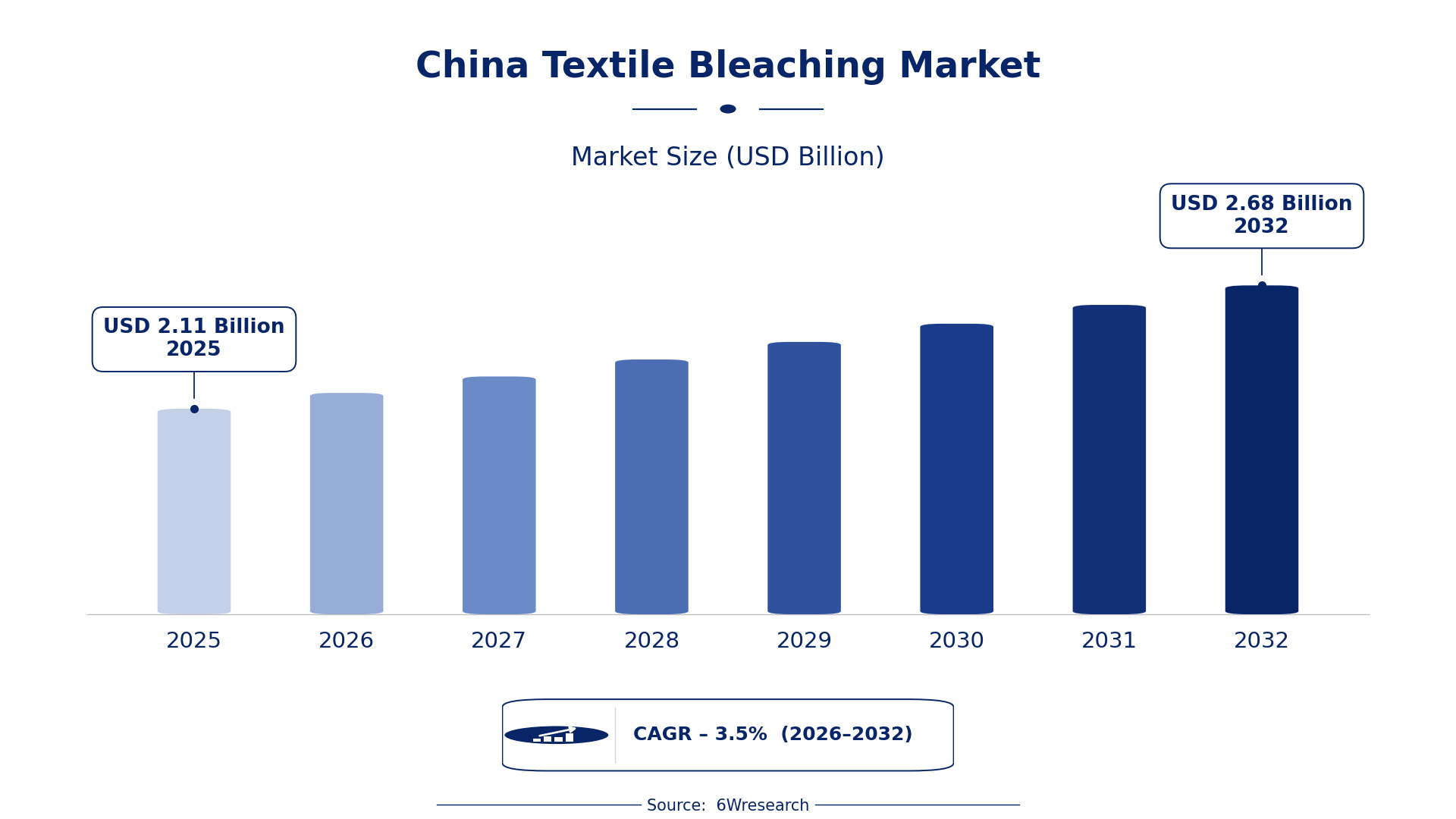
According to 6Wresearch internal database and industry insights, the China Textile Bleaching Market was valued at USD 2.11 billion in 2025 and is projected to reach USD 2.68 billion by 2032, growing at a CAGR of approximately 3.5% during 2026–2032.
China Textile Bleaching Market Highlights
| Report Metric | Details |
| Report Name | China Textile Bleaching Market |
| Market Size 2025 | USD 2.11 billion |
| Market Size 2032 | USD 2.68 billion |
| Absolute Growth 2025–2032 | USD 0.57 billion |
| CAGR 2026–2032 | 3.5% |
| Peak Annual Growth | 5.9% in 2029 |
| Forecast Period | 2026–2032 |
| Historical Data | 2022–2025 |
| Base Year | 2025 |
| Leading Textile Bleaching, 2025 | Industrial Bleach Liquids (42% share) |
| Leading Product Type, 2025 | Hydrogen Peroxide (47% share) |
| Leading Bleaching Agent, 2025 | Pulp-Based Bleaching (44% share) |
| Leading Distribution Channel, 2025 | Chemical Distributors (49% share) |
| Leading End User Industry, 2025 | Textile Mills (44% share) |
| Fastest-Growing Textile Bleaching | Ozone Bleaching Systems (5.5% CAGR) |
| Fastest-Growing Product Type | Sodium Percarbonate (5.4% CAGR) |
| Fastest-Growing Bleaching Agent | Powder Additives (6.1% CAGR) |
| Fastest-Growing End User Industry | Eco‑Textile Sector (4.8% CAGR) |
| Growing Sector | Eco-Textile Sector |
| Key End Users | Textile Mills, Apparel Manufacturers, Chemical Distributors, Eco-Textile Sector |
China Textile Bleaching Market Year-wise Growth Rate and Key Drivers (2022–2032)
This graph illustrates the annual growth rates of the market from 2022 to 2032, highlighting a steady upward trajectory and projected market expansion over the forecast period.
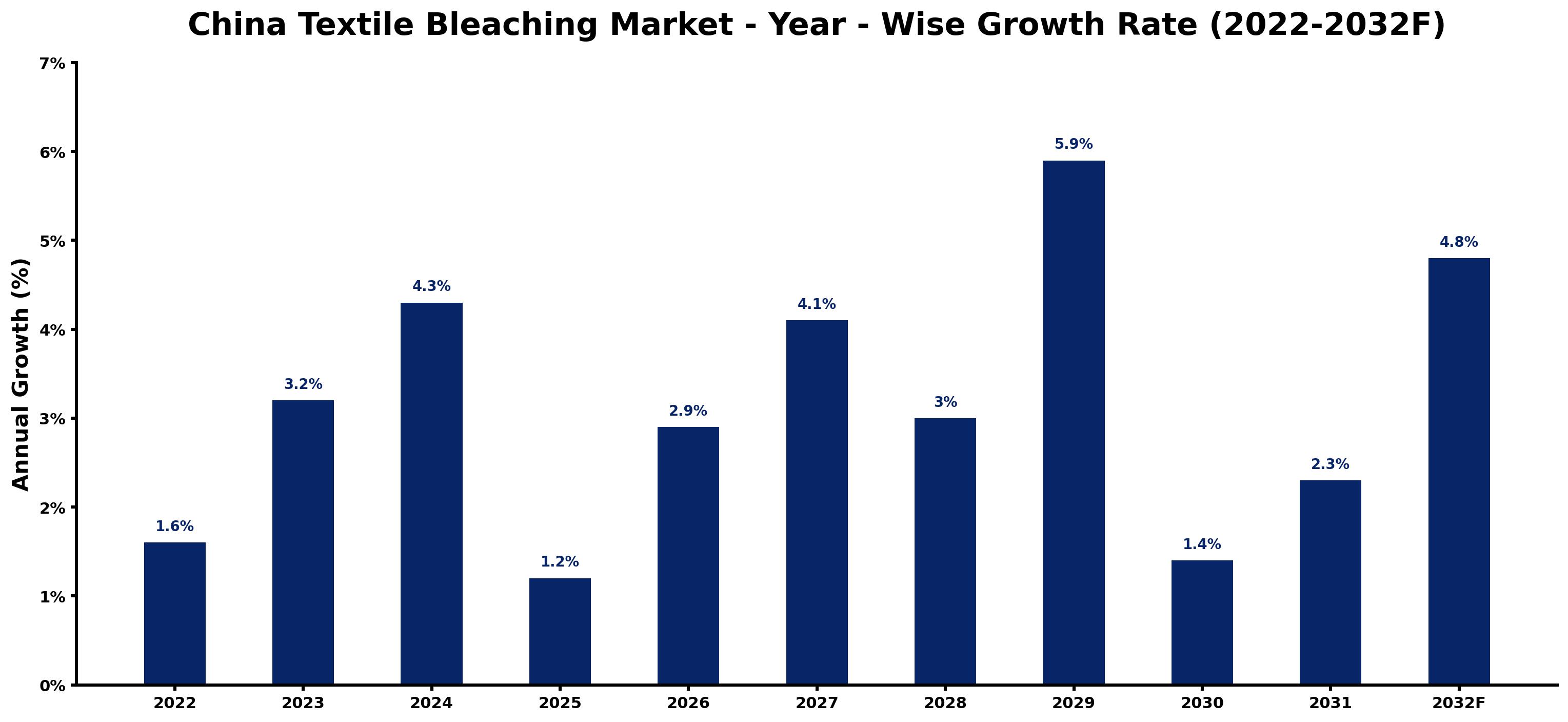
The table below sets out the estimated growth rate for each year and the main factor behind it.
| Year | Estimated Annual Growth (%) | Market Rationale |
| 2022 | 1.6 | The textile industry employed over 30 million people, sustaining demand for bleaching agents. |
| 2023 | 3.2 | Increased textile exports boosted the usage of bleaching agents across the sector. |
| 2024 | 4.3 | The textile sector's output reached approximately 1 trillion yuan, driving higher demand for bleaching agents. |
| 2025 | 1.2 | Growth slowed as the market adjusted to the new 'Textile Industry Green Development Plan' and its requirements. |
| 2026 | 2.9 | The adoption of eco-friendly practices is expected to positively influence purchasing decisions in the textile sector. |
| 2027 | 4.1 | Demand for hydrogen peroxide in textile production is projected to increase as manufacturers modernise their facilities. |
| 2028 | 3.0 | Sodium percarbonate is expected to gain traction, impacting the growth rate of bleaching agents in textile production. |
| 2029 | 5.9 | The introduction of the Green Textile Initiative will spur higher demand for sustainable bleaching solutions. |
| 2030 | 1.4 | Growth is projected to slow as manufacturers face challenges in meeting new environmental regulations. |
| 2031 | 2.3 | Investment in sustainable textile technologies is expected to drive demand for eco-friendly bleaching agents. |
| 2032 | 4.8 | The textile sector's output is expected to rise, further increasing the need for bleaching agents. |
Note: Market size estimations and growth projections presented in this report are based on 6Wresearch's proprietary forecasting methodology, utilizing the latest available industry data, government publications, and primary research inputs.
China Textile Bleaching Market Synopsis
Textile Bleaching in China involves chemical processes to remove colour from fabrics, primarily using agents like hydrogen peroxide and sodium percarbonate. This sector supports over 30 million jobs and produces around 60% of the world's textiles. The China Textile Bleaching Market is expanding due to increased domestic demand and exports, with the textile sector's output reaching approximately 1 trillion yuan in 2022. Government initiatives, such as the Green Textile Initiative, promote sustainable practices, driving further demand for eco-friendly bleaching solutions.
Market Dynamics Impact Analysis (2026–2032)
| Factor | Type | Impact | Primary Segment Affected |
| Increased investments in eco-friendly technologies drive demand for sustainable bleaching solutions, benefiting manufacturers focusing on modernisation. | Driver | High | Hydrogen Peroxide |
| Rising textile production and exports lead to higher consumption of bleaching agents, particularly in textile mills and apparel manufacturing. | Driver | High | Textile Mills |
| The shift towards eco-friendly bleaching systems presents opportunities for suppliers to introduce innovative products and solutions. | Opportunity | High | Ozone Bleaching Systems |
| Growing demand for sustainable practices creates a market for sodium percarbonate as an eco-friendly bleaching agent. | Opportunity | High | Sodium Percarbonate |
| Increasing prices of bleaching agents raise production costs for textile mills, affecting profitability. | Restraint | High | Industrial Bleach Liquids |
| Regulatory challenges due to the government's target to reduce chemical use by 20% by 2025 complicate sourcing strategies for buyers. | Restraint | High | Chemical Distributors |
| A shortage of skilled workers limits the adoption of advanced bleaching technologies, delaying efficiency gains for suppliers. | Challenge | Medium | Equipment Vendors |
| Limited access to modern bleaching systems constrains operational capabilities for manufacturers, affecting their competitiveness. | Challenge | Medium | Specialty Suppliers |
Evaluation of Drivers in China Textile Bleaching Market (2026–2032)
Below mentioned are some major drivers and their influence on market dynamics.
| Drivers | Primary Segment Affected | Why It Matters (Evidence) |
| Increased textile production in the Yangtze River Delta region boosts demand for bleaching agents. | Hydrogen Peroxide | The region produces around 60% of China's textiles, leading to higher consumption of bleaching agents. |
| The rise in eco-friendly textile manufacturing drives demand for sustainable bleaching solutions. | Sodium Percarbonate | Manufacturers are increasingly adopting eco-friendly practices, increasing the use of sodium percarbonate. |
| The government's Green Textile Initiative promotes the use of sustainable bleaching processes. | Ozone Bleaching Systems | This initiative encourages manufacturers to adopt ozone bleaching technologies, enhancing sustainability in production. |
| Growing exports of textiles to international markets increase the need for bleaching agents. | Powder Bleaching Agents | As exports rise, manufacturers require more bleaching agents to meet international quality standards. |
| Investment in modernisation of textile mills enhances the demand for efficient bleaching solutions. | Industrial Bleach Liquids | Upgraded facilities require advanced bleaching agents to improve production efficiency. |
The Textile Bleaching market in China is growing on the back of increased textile production, rising exports, and significant investments in eco-friendly technologies. The textile sector's output reached approximately 1 trillion yuan in 2022, leading to higher consumption of bleaching agents. As textile mills modernise their facilities, the need for efficient bleaching solutions continues to rise, reflecting a shift towards eco-friendly options in production. This modernisation is expected to enhance the demand for hydrogen peroxide and sodium percarbonate as primary bleaching agents.
Evaluation of Restraints in China Textile Bleaching Market
The key brakes on demand, and where they bite hardest, are shown below.
| Market Restraint | Primary Segment Affected | Why It Matters (Evidence) |
| Stricter environmental regulations limit the use of certain bleaching agents. | Hydrogen Peroxide | The government has set targets to reduce chemical use in textiles by 20% by 2025, impacting production. |
| Fluctuating prices of raw materials affect the cost of bleaching agents. | Powder Bleaching Agents | Increased costs can lead to reduced profit margins for manufacturers, affecting their competitiveness. |
| Limited awareness of eco-friendly bleaching options among smaller manufacturers. | Industrial Bleach Liquids | Smaller textile mills may resist adopting new technologies due to perceived costs and complexity. |
| Supply chain disruptions can delay the availability of bleaching agents. | Chemical Distributors | Global supply chain issues have affected the timely delivery of raw materials, impacting production schedules. |
| Competition from alternative bleaching methods can hinder market growth. | Ozone Bleaching Systems | Alternative processes may offer lower environmental impact, attracting manufacturers towards those options. |
China Textile Bleaching Market Challenges
The China Textile Bleaching Market faces high costs stemming from increasing prices of bleaching agents, which can raise production expenses for textile mills. A shortage of skilled workers limits the adoption of advanced bleaching technologies, resulting in slower efficiency gains for suppliers. Limited access to modern bleaching systems, such as ozone technology, constrains operational capabilities for manufacturers, delaying their ability to meet market demands. Buyers encounter regulatory challenges as the government aims to cut chemical use in textiles by 20% by 2025, complicating sourcing strategies and potentially raising operational costs by up to 15%.
Trends in the China Textile Bleaching Market
Four trends stand out in the China Textile Bleaching Market.
- Shift Towards Sustainable Bleaching Practices: China is increasingly adopting sustainable bleaching practices, driven by the government's Green Textile Initiative. This initiative aims to reduce chemical use in textiles by 20% by 2025, encouraging manufacturers to explore eco-friendly options.
- Rise of Sodium Percarbonate in Textile Production: Sodium percarbonate is gaining traction as an eco-friendly bleaching agent, particularly among textile mills. Its adoption is projected to grow, reflecting a shift towards sustainable practices in the industry.
- Increased Investment in Ozone Bleaching Systems: Ozone bleaching systems are becoming more popular in textile processing, with the Ministry of Ecology and Environment promoting their use. This trend is supported by the growing demand for environmentally friendly solutions in the textile sector.
- Expansion of Chemical Distribution Channels: Chemical distributors are increasing their role in the textile bleaching market, holding a 49% share in 2025. This growth reflects the increasing need for efficient supply chains to meet rising demand for bleaching agents.
Investment Opportunities in the China Textile Bleaching Market
Several openings in the China Textile Bleaching Market merit attention from investors.
- Investment in Eco-Friendly Technologies: Now is the time to invest in eco-friendly bleaching solutions, as the government promotes sustainable practices. The Green Textile Initiative aims to reduce chemical use by 20% by 2025, creating opportunities for suppliers of sustainable agents.
- Growing Demand in the Eco-Textile Sector: The eco-textile sector is expanding rapidly, with a projected increase in demand for sustainable products. Suppliers can enter this market by partnering with textile mills focused on eco-friendly practices.
- Enhancing Distribution Channels for Bleaching Agents: The need for efficient distribution channels is vital, especially as chemical distributors hold a significant market share. Establishing partnerships with local distributors can improve market access and supply reliability.
- Focus on Sodium Percarbonate Production: With sodium percarbonate's rising popularity, there is a gap in production capacity. Suppliers can invest in production facilities to meet the increasing demand from textile manufacturers.
Government Initiatives in the China Textile Bleaching Market
The Ministry of Industry and Information Technology launched the 'Textile Industry Green Development Plan' in 2022 to promote sustainable practices and reduce pollution. This plan encourages manufacturers to adopt eco-friendly technologies, impacting the production of bleaching agents. Additionally, the National Development and Reform Commission approved the 'Textile Industry Modernization Action Plan' in 2021, aiming to improve production efficiency and sustainability in the textile sector. This plan supports investments in modernisation, which is essential for the bleaching market. Furthermore, the Ministry of Ecology and Environment initiated the 'Green Manufacturing System' in 2020, promoting resource recycling and eco-friendly processes in textile production, benefiting the overall industry.
The National Development and Reform Commission's 'Textile Industry Modernization Action Plan' allocates funding for sustainable technology adoption, focusing on reducing chemical use. The Ministry of Ecology and Environment's 'Green Manufacturing System' encourages the implementation of eco-friendly processes in textile production. This initiative promotes resource recycling and supports manufacturers in transitioning to sustainable practices, ultimately benefiting the textile bleaching market. In 2023, the government introduced the 'Circular Economy Development Strategy' to enhance resource recycling in the textile sector, further supporting sustainable practices.
Future Insight of the China Textile Bleaching Market
The outlook for the China Textile Bleaching Market by 2032 will be shaped by several key developments. The Green Textile Initiative will drive manufacturers to embrace eco-friendly practices, enhancing sustainability efforts. Adoption of ISO 14001 standards is expected to rise, improving environmental management across the sector. Support from the Ministry of Ecology and Environment for advanced bleaching systems will modernise production methods, while the market's output is projected to reach approximately 1.2 trillion yuan, reflecting strong demand for textile bleaching.
Market Segmentation Analysis
Each segment group is reviewed below, with the leader by share and the fastest grower by CAGR.
By Textile Bleaching – Industrial Bleach Liquids Dominated, Ozone Bleaching Systems Expected to Grow Fastest
According to Vasudha, AM at 6Wresearch, Industrial Bleach Liquids took a 42% share of textile bleaching in 2025, more than any other category. Industrial Bleach Liquids dominate the China Textile Bleaching Market because they are essential for effective textile processing, widely used across numerous textile mills. The significant employment of over 30 million people in the textile industry underlines the consistent demand for these liquids. The quickest growth will come from Ozone Bleaching Systems, forecast to expand at a CAGR of 5.5% between 2026 and 2032. Ozone Bleaching Systems are projected to grow rapidly as the government promotes eco-friendly practices through initiatives like the 'Green Textile Initiative'. This focus on sustainability is likely to drive adoption of ozone systems in textile manufacturing, further enhancing their market position. Suppliers must focus on eco-friendly solutions to meet the increasing demand from manufacturers prioritising sustainable practices.
By Product Type – Hydrogen Peroxide Dominated, Sodium Percarbonate Expected to Grow Fastest
The largest product type category in 2025 was Hydrogen Peroxide, with a 47% share of total revenue. Hydrogen Peroxide holds the largest share in the market as the primary bleaching agent in textile production, integral for achieving desired whiteness and brightness in fabrics. Its widespread use in textile mills reinforces its dominant market position. Sodium Percarbonate is projected to grow fastest, at a CAGR of 5.4% during 2026–2032. Sodium Percarbonate is witnessing the fastest growth due to its eco-friendly properties, appealing to manufacturers aiming to reduce chemical usage. As sustainability becomes a priority, the adoption of sodium percarbonate is expected to increase significantly among textile producers. Buyers should consider integrating eco-friendly bleaching agents to align with the industry's shift towards sustainability.
By Bleaching Agent – Pulp-Based Bleaching Dominated, Powder Additives Expected to Grow Fastest
With a 44% revenue share in 2025, Pulp-Based Bleaching was the largest bleaching agent category. Pulp-Based Bleaching maintains a notable share in the market, primarily due to its historical application across various industries, although it is not the main focus for textile bleaching. Its contributions to overall bleaching processes in textiles ensure its continued relevance in the market. Powder Additives are set to record the highest CAGR in this split, 6.1% over 2026–2032. Powder Additives are rapidly gaining traction as they enhance the efficiency of existing bleaching processes. As manufacturers seek to optimise their operations, the demand for these additives is anticipated to rise significantly. Suppliers should explore opportunities to provide advanced powder additives to meet the needs of textile manufacturers aiming for operational efficiency.
By Distribution Channel – Chemical Distributors Dominated and Is Expected to Record the Fastest Growth
Chemical Distributors accounted for a 49% market share by distribution channel in 2025. Chemical Distributors are the leading channel for supplying bleaching agents, ensuring that textile manufacturers have consistent access to necessary chemicals. Their established networks and relationships with producers make them integral to the supply chain. Chemical Distributors are also forecast to expand faster than any other category, at a CAGR of 5.0% over 2026–2032. Chemical Distributors also represent the fastest-growing segment, as their role in facilitating access to eco-friendly products becomes increasingly important. As demand for sustainable solutions rises, these distributors are well-positioned to capitalise on this trend. Suppliers must strengthen partnerships with chemical distributors to effectively reach textile manufacturers seeking sustainable bleaching solutions.
By End User Industry – Textile Mills Dominated, Eco‑Textile Sector Expected to Grow Fastest
Textile Mills held a 44% share of the China Textile Bleaching Market by end user industry in 2025. Textile Mills are the largest consumers of bleaching agents, primarily due to their extensive production processes that require effective bleaching. The scale of operations in this sector ensures a steady demand for bleaching solutions. The quickest growth will come from Eco‑Textile Sector, forecast to expand at a CAGR of 4.8% between 2026 and 2032. The Eco‑Textile Sector is growing rapidly as more manufacturers focus on sustainable practices and environmentally friendly products. This shift reflects a broader trend in consumer preferences towards eco-conscious textiles, driving demand in this segment. Buyers in the textile industry should prioritise partnerships with eco-friendly suppliers to align with market trends and consumer expectations.
Key Attractiveness of the Report
- 10 Years of Market Numbers
- Historical Data Starting from 2022 to 2025
- Base Year 2025
- Forecast Data until 2032
- Key Performance Indicators Impacting the Market
- Major Upcoming Developments and Projects
Key Highlights of the Report:
- China Textile Bleaching Market Outlook
- Market Size of China Textile Bleaching Market, 2025
- Forecast of China Textile Bleaching Market, 2032
- Historical Data and Forecast of China Textile Bleaching Revenues & Volume for the Period 2022 - 2032F
- China Textile Bleaching Market Trend Evolution
- China Textile Bleaching Market Drivers and Challenges
- China Textile Bleaching Price Trends
- China Textile Bleaching Porter's Five Forces
- China Textile Bleaching Industry Life Cycle
- Historical Data and Forecast of China Textile Bleaching Market Revenues & Volume By Textile Bleaching for the Period 2022 - 2032F
- Historical Data and Forecast of China Textile Bleaching Market Revenues & Volume By Industrial Bleach Liquids for the Period 2022 - 2032F
- Historical Data and Forecast of China Textile Bleaching Market Revenues & Volume By Powder Bleaching Agents for the Period 2022 - 2032F
- Historical Data and Forecast of China Textile Bleaching Market Revenues & Volume By Ozone Bleaching Systems for the Period 2022 - 2032F
- Historical Data and Forecast of China Textile Bleaching Market Revenues & Volume By Enzyme Bleaching Processes for the Period 2022 - 2032F
- Historical Data and Forecast of China Textile Bleaching Market Revenues & Volume By Product Type for the Period 2022 - 2032F
- Historical Data and Forecast of China Textile Bleaching Market Revenues & Volume By Hydrogen Peroxide for the Period 2022 - 2032F
- Historical Data and Forecast of China Textile Bleaching Market Revenues & Volume By Sodium Percarbonate for the Period 2022 - 2032F
- Historical Data and Forecast of China Textile Bleaching Market Revenues & Volume By Ozone Generators for the Period 2022 - 2032F
- Historical Data and Forecast of China Textile Bleaching Market Revenues & Volume By Bio-Bleaching Kits for the Period 2022 - 2032F
- Historical Data and Forecast of China Textile Bleaching Market Revenues & Volume By Bleaching Agent for the Period 2022 - 2032F
- Historical Data and Forecast of China Textile Bleaching Market Revenues & Volume By Pulp-Based Bleaching for the Period 2022 - 2032F
- Historical Data and Forecast of China Textile Bleaching Market Revenues & Volume By Powder Additives for the Period 2022 - 2032F
- Historical Data and Forecast of China Textile Bleaching Market Revenues & Volume By Ozone Gas for the Period 2022 - 2032F
- Historical Data and Forecast of China Textile Bleaching Market Revenues & Volume By Catalase/Glucose Oxidase for the Period 2022 - 2032F
- Historical Data and Forecast of China Textile Bleaching Market Revenues & Volume By Distribution Channel for the Period 2022 - 2032F
- Historical Data and Forecast of China Textile Bleaching Market Revenues & Volume By Chemical Distributors for the Period 2022 - 2032F
- Historical Data and Forecast of China Textile Bleaching Market Revenues & Volume By Industrial Retailers for the Period 2022 - 2032F
- Historical Data and Forecast of China Textile Bleaching Market Revenues & Volume By Equipment Vendors for the Period 2022 - 2032F
- Historical Data and Forecast of China Textile Bleaching Market Revenues & Volume By Specialty Suppliers for the Period 2022 - 2032F
- Historical Data and Forecast of China Textile Bleaching Market Revenues & Volume By End User Industry for the Period 2022 - 2032F
- Historical Data and Forecast of China Textile Bleaching Market Revenues & Volume By Textile Mills for the Period 2022 - 2032F
- Historical Data and Forecast of China Textile Bleaching Market Revenues & Volume By Home Textile Finishing for the Period 2022 - 2032F
- Historical Data and Forecast of China Textile Bleaching Market Revenues & Volume By Apparel Manufacturers for the Period 2022 - 2032F
- Historical Data and Forecast of China Textile Bleaching Market Revenues & Volume By Eco Textile Sector for the Period 2022 - 2032F
- China Textile Bleaching Import Export Trade Statistics
- Market Opportunity Assessment By Textile Bleaching
- Market Opportunity Assessment By Product Type
- Market Opportunity Assessment By Bleaching Agent
- Market Opportunity Assessment By Distribution Channel
- Market Opportunity Assessment By End User Industry
- China Textile Bleaching Top Companies Market Share
- China Textile Bleaching Competitive Benchmarking By Technical and Operational Parameters
- China Textile Bleaching Company Profiles
- China Textile Bleaching Key Strategic Recommendations
Market Covered
The report offers an extensive study of the following market segments.
By Textile Bleaching
- Industrial Bleach Liquids
- Powder Bleaching Agents
- Ozone Bleaching Systems
- Enzyme Bleaching Processes
By Product Type
- Hydrogen Peroxide
- Sodium Percarbonate
- Ozone Generators
- Bio-Bleaching Kits
By Bleaching Agent
- Pulp-Based Bleaching
- Powder Additives
- Ozone Gas
- Catalase/Glucose Oxidase
By Distribution Channel
- Chemical Distributors
- Industrial Retailers
- Equipment Vendors
- Specialty Suppliers
By End User Industry
- Textile Mills
- Home Textile Finishing
- Apparel Manufacturers
- Eco‑Textile Sector































