India Textile Bleaching Market Size & Growth Rate
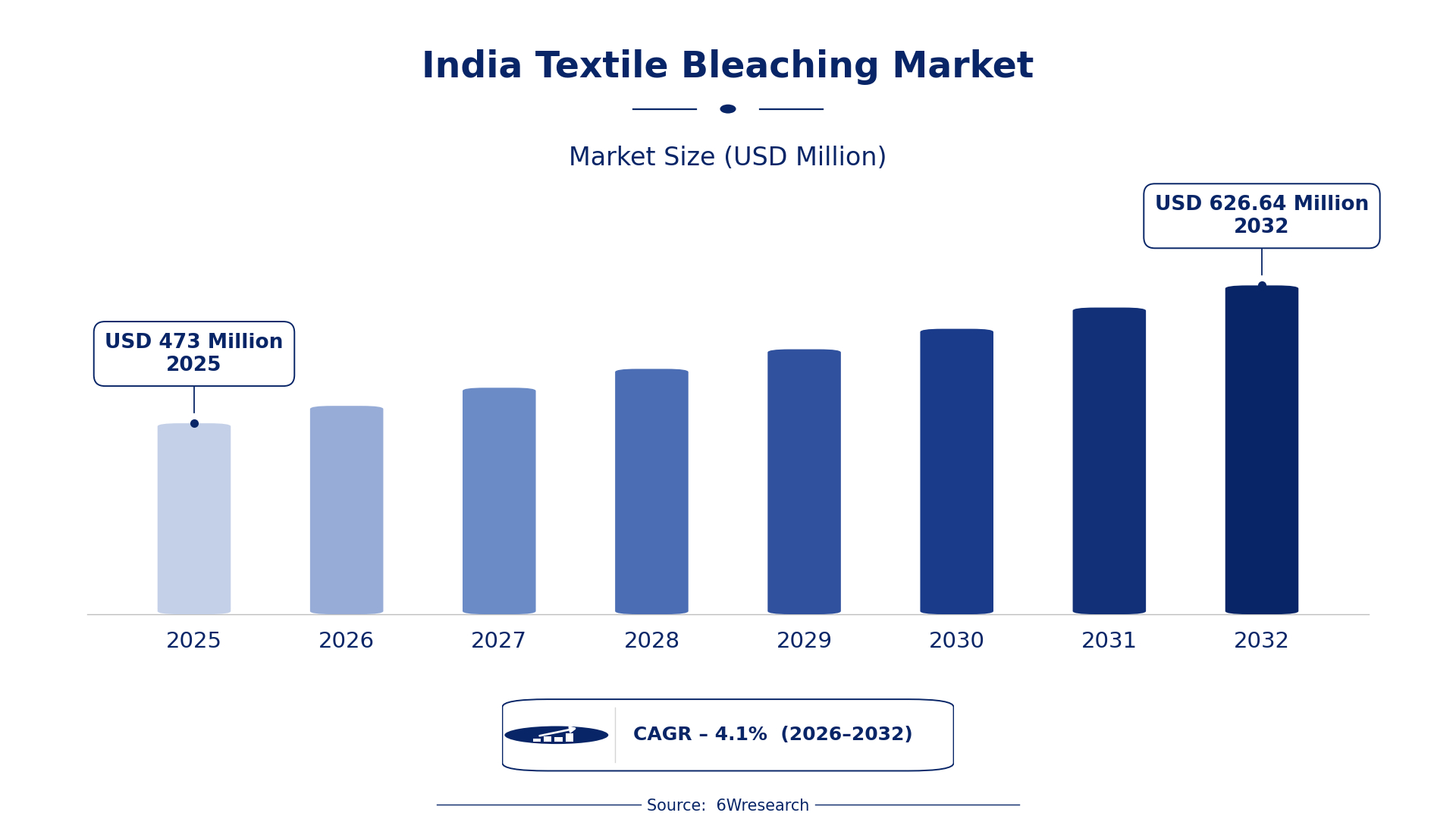
According to 6Wresearch internal database and industry insights, the India Textile Bleaching Market was valued at USD 473.0 million in 2025 and is projected to reach USD 626.64 million by 2032, growing at a CAGR of approximately 4.1% during 2026–2032.
India Textile Bleaching Market Highlights
| Report Metric | Details |
| Report Name | India Textile Bleaching Market |
| Market Size 2025 | USD 473.0 million |
| Market Size 2032 | USD 626.64 million |
| Absolute Growth 2025–2032 | USD 153.64 million |
| CAGR 2026–2032 | 4.1% |
| Peak Annual Growth | 6.3% in 2028 |
| Forecast Period | 2026–2032 |
| Historical Data | 2022–2025 |
| Base Year | 2025 |
| Leading Textile Bleaching, 2025 | Industrial Bleach Liquids (51% share) |
| Leading Product Type, 2025 | Hydrogen Peroxide (44% share) |
| Leading Bleaching Agent, 2025 | Ozone Gas (47% share) |
| Leading Distribution Channel, 2025 | Chemical Distributors (40% share) |
| Leading End User Industry, 2025 | Textile Mills (38% share) |
| Fastest-Growing Textile Bleaching | Ozone Bleaching Systems (5.5% CAGR) |
| Fastest-Growing Product Type | Bio-Bleaching Kits (5.6% CAGR) |
| Fastest-Growing Bleaching Agent | Catalase/Glucose Oxidase (6.6% CAGR) |
| Fastest-Growing Distribution Channel | Specialty Suppliers (5.6% CAGR) |
| Fastest-Growing End User Industry | Eco‑Textile Sector (6.8% CAGR) |
| Growing Sector | Eco-Textile Sector |
| Key End Users | Textile Mills, Apparel Manufacturers, Chemical Distributors, Specialty Suppliers |
India Textile Bleaching Market Year-wise Growth Rate and Key Drivers (2022–2032)
This graph illustrates the annual growth rates of the market from 2022 to 2032, highlighting a steady upward trajectory and projected market expansion over the forecast period.
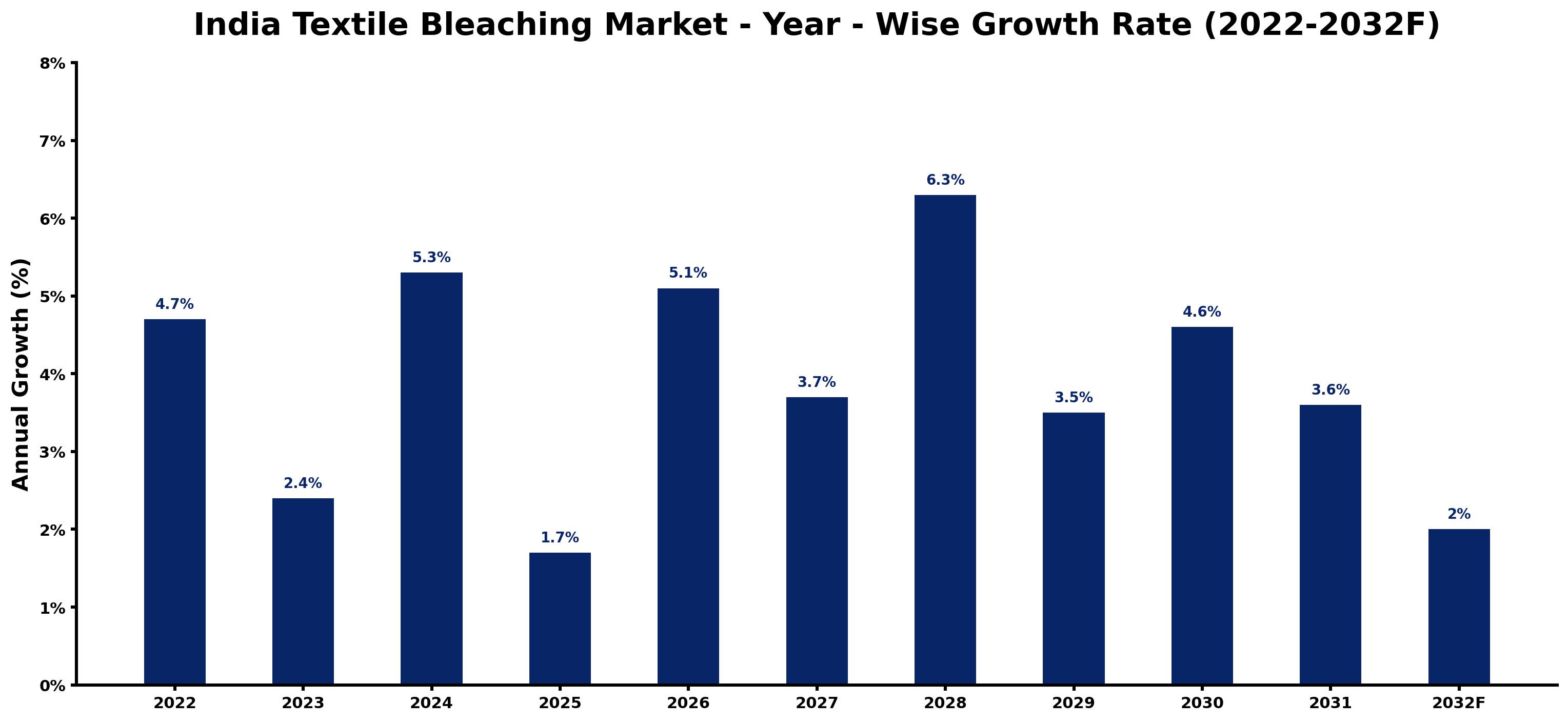
Below, each year's estimated growth is shown next to the factor that most influenced it.
| Year | Estimated Annual Growth (%) | Market Rationale |
| 2022 | 4.7 | The market experienced steady growth due to ongoing demand from textile mills for bleaching agents. |
| 2023 | 2.4 | Demand slowed as textile mills faced temporary production challenges from supply chain disruptions. |
| 2024 | 5.3 | Increased orders from apparel manufacturers and the adoption of new technologies drove demand. |
| 2025 | 1.7 | Growth slowed again as production practices adjusted to market conditions. |
| 2026 | 5.1 | A rebound is expected as the textile sector embraces new technologies for efficiency. |
| 2027 | 3.7 | Growth is projected to slow as mills adapt to sustainability standards and practices. |
| 2028 | 6.3 | A peak in demand will be driven by rising exports and increased production capacity. |
| 2029 | 3.5 | Growth is expected to slow as market conditions normalise after previous peaks. |
| 2030 | 4.6 | Demand will rise again as eco-friendly practices gain traction among manufacturers. |
| 2031 | 3.6 | Growth is projected to slow as the market adjusts to evolving sustainability standards. |
| 2032 | 2.0 | A slight slowdown is expected as the market stabilises after rapid growth in previous years. |
Note: Market size estimations and growth projections presented in this report are based on 6Wresearch's proprietary forecasting methodology, utilizing the latest available industry data, government publications, and primary research inputs.
India Textile Bleaching Market Synopsis
Textile Bleaching in India involves using chemical agents to remove colour from fabrics, primarily through hydrogen peroxide and sodium percarbonate. This process prepares textiles for dyeing and finishing, ensuring high-quality end products. The India Textile Bleaching Market is expanding due to strong demand from domestic textile mills and apparel manufacturers. With over 2,000 textile mills operating, the market is supported by initiatives promoting sustainable practices and innovation in the sector. The Eco-Textile sector is gaining traction, further driving the need for effective bleaching solutions.
Market Dynamics Impact Analysis (2026–2032)
| Factor | Type | Impact | Primary Segment Affected |
| Growing demand from textile mills for effective bleaching agents. | Driver | High | Hydrogen Peroxide |
| Increased adoption of eco-friendly bleaching agents by manufacturers. | Driver | High | Sodium Percarbonate |
| Emerging demand for sustainable bleaching solutions in the Eco-Textile sector. | Opportunity | Medium | Eco‑Textile Sector |
| The rise of specialty suppliers catering to niche markets. | Opportunity | Medium | Specialty Suppliers |
| Challenges in sourcing eco-friendly materials for bleaching processes. | Restraint | High | Ozone Bleaching Systems |
| Regulatory compliance costs associated with bleaching agents. | Restraint | High | Industrial Bleach Liquids |
| The Textile Bleaching market in India faces technology adoption issues. | Challenge | High | Enzyme Bleaching Processes |
| Limited awareness of sustainable practices among smaller manufacturers. | Challenge | Medium | Powder Bleaching Agents |
Evaluation of Drivers in India Textile Bleaching Market (2026–2032)
Key forces behind demand, with the segment each one moves most, are listed below.
| Drivers | Primary Segment Affected | Why It Matters (Evidence) |
| High demand for hydrogen peroxide as a primary bleaching agent. | Hydrogen Peroxide | Used in 70% of textile processes, driving consistent purchases from textile mills for effective bleaching. |
| Growing interest in sodium percarbonate for its eco-friendly profile. | Sodium Percarbonate | Preferred by manufacturers aiming for sustainable practices in textile production, leading to increased purchases. |
| Textile mills are investing in advanced bleaching technologies. | Industrial Bleach Liquids | This investment supports higher production capacities and operational efficiency in textile processing, enhancing output. |
| The Eco-Textile sector is expanding rapidly due to sustainability trends. | Eco‑Textile Sector | This growth increases demand for eco-friendly bleaching solutions among manufacturers, driving purchases. |
| Chemical distributors are improving supply chain efficiency for bleaching agents. | Chemical Distributors | Their role ensures timely delivery of essential materials to manufacturers, supporting production schedules. |
Growth in the Textile Bleaching market in India comes from rising demand from textile mills, which are increasingly adopting hydrogen peroxide for effective bleaching. Approximately 70% of textile processes utilise this agent, leading to consistent purchases. The market is also shifting towards sodium percarbonate, driven by its eco-friendly profile, appealing to manufacturers focused on sustainability. Textile mills are investing in advanced bleaching technologies, which supports higher production capacities. The Eco-Textile sector is expanding, promoting the use of effective bleaching solutions, while chemical distributors improve supply chain efficiency, ensuring timely delivery of essential materials to manufacturers.
Evaluation of Restraints in India Textile Bleaching Market
Below mentioned are some major restraints and their influence on market dynamics.
| Market Restraint | Primary Segment Affected | Why It Matters (Evidence) |
| High costs associated with sourcing eco-friendly bleaching materials. | Ozone Bleaching Systems | This raises operational costs for manufacturers seeking sustainable options, affecting their market competitiveness. |
| Regulatory compliance costs for bleaching agents can be substantial. | Industrial Bleach Liquids | These expenses limit profit margins for textile manufacturers, hindering their ability to invest in new technologies. |
| Limited technology adoption in smaller textile mills hampers operational efficiency. | Enzyme Bleaching Processes | This leads to slower production rates and higher operational costs for these mills. |
| Market awareness of sustainable practices remains low among smaller players. | Powder Bleaching Agents | This restricts the growth potential for eco-friendly bleaching solutions, impacting overall market expansion. |
| Challenges in maintaining consistent quality of bleaching agents. | Hydrogen Peroxide | This affects production reliability for textile manufacturers, resulting in potential quality issues in finished products. |
India Textile Bleaching Market Challenges
The India Textile Bleaching Market faces a notable technological challenge, as 70% of textile processes depend on hydrogen peroxide, which is costly and raises environmental concerns. A skills gap exists, with over 45 million workers in the textile industry, many lacking training in modern bleaching techniques, which hampers production efficiency. Rising costs of bleaching agents, particularly sodium percarbonate, are tightening budgets for textile mills, leading to increased production expenses. Intense competition from global markets impacts local producers, as over 60% of India's textile output is exported, compelling them to innovate and reduce costs to remain competitive.
Trends in the India Textile Bleaching Market
Several trends are reshaping the India Textile Bleaching Market; the most important are set out below.
- Shift towards Eco-Friendly Bleaching Solutions: Since 2020, the Eco-Textile sector has gained momentum, with a growing focus on sustainable practices. Approximately 60% of textile production is now aimed at eco-friendly markets, prompting suppliers to adapt their offerings accordingly.
- Emergence of Advanced Bleaching Technologies: The 'Technology Mission on Technical Textiles' launched in 2021 has spurred innovation in bleaching technologies. This initiative, with a budget of ₹1,480 crores, is expected to drive R&D capabilities in the textile sector.
- Increased Demand for Specialty Suppliers: In 2023, specialty suppliers began to play a crucial role in the market, catering to niche demands. Their share is projected to grow by 5.6% as manufacturers seek tailored solutions.
- Adoption of ISO 14001 Standards: Since 2021, many textile manufacturers have adopted ISO 14001 for environmental management. This standard encourages sustainable practices, aligning with the growing consumer demand for eco-friendly products.
Investment Opportunities in the India Textile Bleaching Market
Several openings in the India Textile Bleaching Market merit attention from investors.
- Gap in Eco-Friendly Bleaching Solutions: With the Eco-Textile sector expected to grow, there is an opportunity for suppliers of sustainable bleaching agents. Targeting textile mills in Maharashtra could yield high returns as they pursue greener solutions.
- Investment in Advanced Bleaching Technologies: The introduction of new bleaching technologies presents an investment opportunity. Collaborating with textile mills in Tamil Nadu can facilitate entry into this growing market segment.
- Rising Demand for Sodium Percarbonate: The growing interest in sodium percarbonate offers a valuable opportunity for suppliers. Engaging with apparel manufacturers can help establish a foothold in this expanding market.
- Partnerships with Chemical Distributors: Forming partnerships with chemical distributors can broaden market reach. This strategy is particularly effective in regions with a high concentration of textile mills.
Government Initiatives in the India Textile Bleaching Market
The 'National Textile Policy 2021' aims to improve the textile sector's global competitiveness by focusing on sustainability and innovation. This policy encourages manufacturers to adopt eco-friendly practices and invest in advanced technologies, thereby improving their market position. The initiative also seeks to increase the sector's contribution to GDP by 2025, fostering growth in textile production and exports. The 'Production Linked Incentive Scheme' for textiles, announced in 2021, supports domestic manufacturing with a target of ₹10,683 crores over five years, incentivising local production and job creation.
The 'Technology Mission on Technical Textiles' was launched in 2021, with a budget allocation of ₹1,480 crores over five years. The Ministry of Textiles oversees this initiative, promoting research and development in textile technologies. This funding supports projects that improve efficiency and sustainability in textile processes, benefiting manufacturers across the country. The 'Atmanirbhar Bharat Abhiyan' includes measures to boost local textile production and reduce dependency on imports, further supporting the industry's growth.
Future Insight of the India Textile Bleaching Market
Several forward-looking factors should support the India Textile Bleaching Market in the coming years. The 'Technology Mission on Technical Textiles' launched in 2021 will drive advancements in bleaching processes, improving operational efficiency. Adoption of ISO 14001 standards will encourage manufacturers to implement sustainable practices, appealing to environmentally conscious buyers. By 2025, the textile industry is projected to contribute significantly to GDP, opening new opportunities for suppliers. The 'Skill India' initiative will equip the workforce with modern techniques, strengthening the industry's overall capabilities.
Market Segmentation Analysis
The report offers a comprehensive study of the following market segments and their leading categories in the market.
By Textile Bleaching – Industrial Bleach Liquids Dominated, Ozone Bleaching Systems Expected to Grow Fastest
According to Vasudha, AM at 6Wresearch, in 2025, Industrial Bleach Liquids led the textile bleaching split with a 51% share. Industrial Bleach Liquids dominate the market due to their widespread use in over 2,000 textile mills in India, which rely on these agents for effective bleaching. Their strong presence is particularly noted in Tamil Nadu and Gujarat, where the demand for efficient bleaching processes is high. Ozone Bleaching Systems are projected to grow fastest, at a CAGR of 5.5% during 2026–2032. Ozone Bleaching Systems are gaining traction as a fast-growing segment, spurred by increasing regulatory support for eco-friendly practices. The rise of initiatives under the Eco-Textile sector indicates that manufacturers are likely to adopt this technology more widely, further widening the gap with traditional methods. Suppliers must focus on developing eco-friendly bleaching solutions to meet the rising demand for sustainable practices in the textile industry.
By Product Type – Hydrogen Peroxide Dominated, Bio-Bleaching Kits Expected to Grow Fastest
Hydrogen Peroxide held a 44% share of the India Textile Bleaching Market by product type in 2025. Hydrogen Peroxide is the primary bleaching agent in India's textile mills, accounting for 70% of textile processes due to its effectiveness and reliability. Its established use in various textile applications solidifies its dominant market share. The quickest growth will come from Bio-Bleaching Kits, forecast to expand at a CAGR of 5.6% between 2026 and 2032. Bio-Bleaching Kits are emerging as a response to the rising demand for sustainable practices, with small-scale operations increasingly adopting these eco-friendly solutions. This trend is expected to gain momentum as environmental concerns grow among consumers and manufacturers alike. Buyers are likely to seek more sustainable options, prompting suppliers to innovate and diversify their product offerings.
By Bleaching Agent – Ozone Gas Dominated, Catalase/Glucose Oxidase Expected to Grow Fastest
Ozone Gas took a 47% share of bleaching agent in 2025, more than any other category. Ozone Gas, while currently a minor player, is noted for its potential in sustainable bleaching applications, attracting interest from manufacturers looking to reduce chemical usage. Its limited application reflects the ongoing challenges in technology adoption within the industry. Catalase/Glucose Oxidase is set to record the highest CAGR in this split, 6.6% over 2026–2032. Catalase/Glucose Oxidase is being explored in specific enzyme-based processes, driven by a niche demand for alternative bleaching methods. As awareness of enzyme technologies increases, this segment may see gradual uptake among eco-conscious producers. Suppliers should consider investing in enzyme technologies to capture the growing interest in sustainable bleaching solutions.
By Distribution Channel – Chemical Distributors Dominated, Specialty Suppliers Expected to Grow Fastest
Chemical Distributors accounted for a 40% market share by distribution channel in 2025. Chemical Distributors hold a significant market share as they are crucial for supplying bleaching agents to textile manufacturers, ensuring a consistent flow of products. Their established networks and industry relationships solidify their role as key players in the distribution of bleaching agents. Over 2026–2032, Specialty Suppliers are expected to post the fastest growth, at a CAGR of 5.6%. Specialty Suppliers are experiencing rapid growth by catering to niche markets that require specific bleaching solutions. This trend highlights the need for suppliers to adapt to changing customer preferences and offer tailored services. Suppliers should consider diversifying their distribution strategies to include specialty channels, addressing the unique needs of various customer segments.
By End User Industry – Textile Mills Dominated, Eco‑Textile Sector Expected to Grow Fastest
The largest end user industry category in 2025 was Textile Mills, with a 38% share of total revenue. Textile Mills are the largest consumers of bleaching agents, using them extensively in fabric processing to satisfy both domestic and export demands. Their central role in the textile supply chain reinforces their dominant market share, accounting for a substantial portion of overall consumption. Eco‑Textile Sector is projected to grow fastest, at a CAGR of 6.8% during 2026–2032. The Eco‑Textile Sector is expanding quickly, driven by a growing consumer preference for sustainable practices and government initiatives that promote eco-friendly methods. This shift indicates a significant move towards greener production processes within the textile industry. Suppliers should align their product offerings with the sustainability trends in the Eco-Textile Sector to capitalise on emerging market opportunities.
Key Attractiveness of the Report
- 10 Years of Market Numbers
- Historical Data Starting from 2022 to 2025
- Base Year 2025
- Forecast Data until 2032
- Key Performance Indicators Impacting the Market
- Major Upcoming Developments and Projects
Key Highlights of the Report:
- India Textile Bleaching Market Outlook
- Market Size of India Textile Bleaching Market, 2025
- Forecast of India Textile Bleaching Market, 2032
- Historical Data and Forecast of India Textile Bleaching Revenues & Volume for the Period 2022 - 2032F
- India Textile Bleaching Market Trend Evolution
- India Textile Bleaching Market Drivers and Challenges
- India Textile Bleaching Price Trends
- India Textile Bleaching Porter's Five Forces
- India Textile Bleaching Industry Life Cycle
- Historical Data and Forecast of India Textile Bleaching Market Revenues & Volume By Textile Bleaching for the Period 2022 - 2032F
- Historical Data and Forecast of India Textile Bleaching Market Revenues & Volume By Industrial Bleach Liquids for the Period 2022 - 2032F
- Historical Data and Forecast of India Textile Bleaching Market Revenues & Volume By Powder Bleaching Agents for the Period 2022 - 2032F
- Historical Data and Forecast of India Textile Bleaching Market Revenues & Volume By Ozone Bleaching Systems for the Period 2022 - 2032F
- Historical Data and Forecast of India Textile Bleaching Market Revenues & Volume By Enzyme Bleaching Processes for the Period 2022 - 2032F
- Historical Data and Forecast of India Textile Bleaching Market Revenues & Volume By Product Type for the Period 2022 - 2032F
- Historical Data and Forecast of India Textile Bleaching Market Revenues & Volume By Hydrogen Peroxide for the Period 2022 - 2032F
- Historical Data and Forecast of India Textile Bleaching Market Revenues & Volume By Sodium Percarbonate for the Period 2022 - 2032F
- Historical Data and Forecast of India Textile Bleaching Market Revenues & Volume By Ozone Generators for the Period 2022 - 2032F
- Historical Data and Forecast of India Textile Bleaching Market Revenues & Volume By Bio-Bleaching Kits for the Period 2022 - 2032F
- Historical Data and Forecast of India Textile Bleaching Market Revenues & Volume By Bleaching Agent for the Period 2022 - 2032F
- Historical Data and Forecast of India Textile Bleaching Market Revenues & Volume By Pulp-Based Bleaching for the Period 2022 - 2032F
- Historical Data and Forecast of India Textile Bleaching Market Revenues & Volume By Powder Additives for the Period 2022 - 2032F
- Historical Data and Forecast of India Textile Bleaching Market Revenues & Volume By Ozone Gas for the Period 2022 - 2032F
- Historical Data and Forecast of India Textile Bleaching Market Revenues & Volume By Catalase/Glucose Oxidase for the Period 2022 - 2032F
- Historical Data and Forecast of India Textile Bleaching Market Revenues & Volume By Distribution Channel for the Period 2022 - 2032F
- Historical Data and Forecast of India Textile Bleaching Market Revenues & Volume By Chemical Distributors for the Period 2022 - 2032F
- Historical Data and Forecast of India Textile Bleaching Market Revenues & Volume By Industrial Retailers for the Period 2022 - 2032F
- Historical Data and Forecast of India Textile Bleaching Market Revenues & Volume By Equipment Vendors for the Period 2022 - 2032F
- Historical Data and Forecast of India Textile Bleaching Market Revenues & Volume By Specialty Suppliers for the Period 2022 - 2032F
- Historical Data and Forecast of India Textile Bleaching Market Revenues & Volume By End User Industry for the Period 2022 - 2032F
- Historical Data and Forecast of India Textile Bleaching Market Revenues & Volume By Textile Mills for the Period 2022 - 2032F
- Historical Data and Forecast of India Textile Bleaching Market Revenues & Volume By Home Textile Finishing for the Period 2022 - 2032F
- Historical Data and Forecast of India Textile Bleaching Market Revenues & Volume By Apparel Manufacturers for the Period 2022 - 2032F
- Historical Data and Forecast of India Textile Bleaching Market Revenues & Volume By Eco Textile Sector for the Period 2022 - 2032F
- India Textile Bleaching Import Export Trade Statistics
- Market Opportunity Assessment By Textile Bleaching
- Market Opportunity Assessment By Product Type
- Market Opportunity Assessment By Bleaching Agent
- Market Opportunity Assessment By Distribution Channel
- Market Opportunity Assessment By End User Industry
- India Textile Bleaching Top Companies Market Share
- India Textile Bleaching Competitive Benchmarking By Technical and Operational Parameters
- India Textile Bleaching Company Profiles
- India Textile Bleaching Key Strategic Recommendations
Market Covered
The report offers an extensive study of the following market segments.
By Textile Bleaching
- Industrial Bleach Liquids
- Powder Bleaching Agents
- Ozone Bleaching Systems
- Enzyme Bleaching Processes
By Product Type
- Hydrogen Peroxide
- Sodium Percarbonate
- Ozone Generators
- Bio-Bleaching Kits
By Bleaching Agent
- Pulp-Based Bleaching
- Powder Additives
- Ozone Gas
- Catalase/Glucose Oxidase
By Distribution Channel
- Chemical Distributors
- Industrial Retailers
- Equipment Vendors
- Specialty Suppliers
By End User Industry
- Textile Mills
- Home Textile Finishing
- Apparel Manufacturers
- Eco‑Textile Sector































