China Textile Processing Chemicals Market Size & Growth Rate
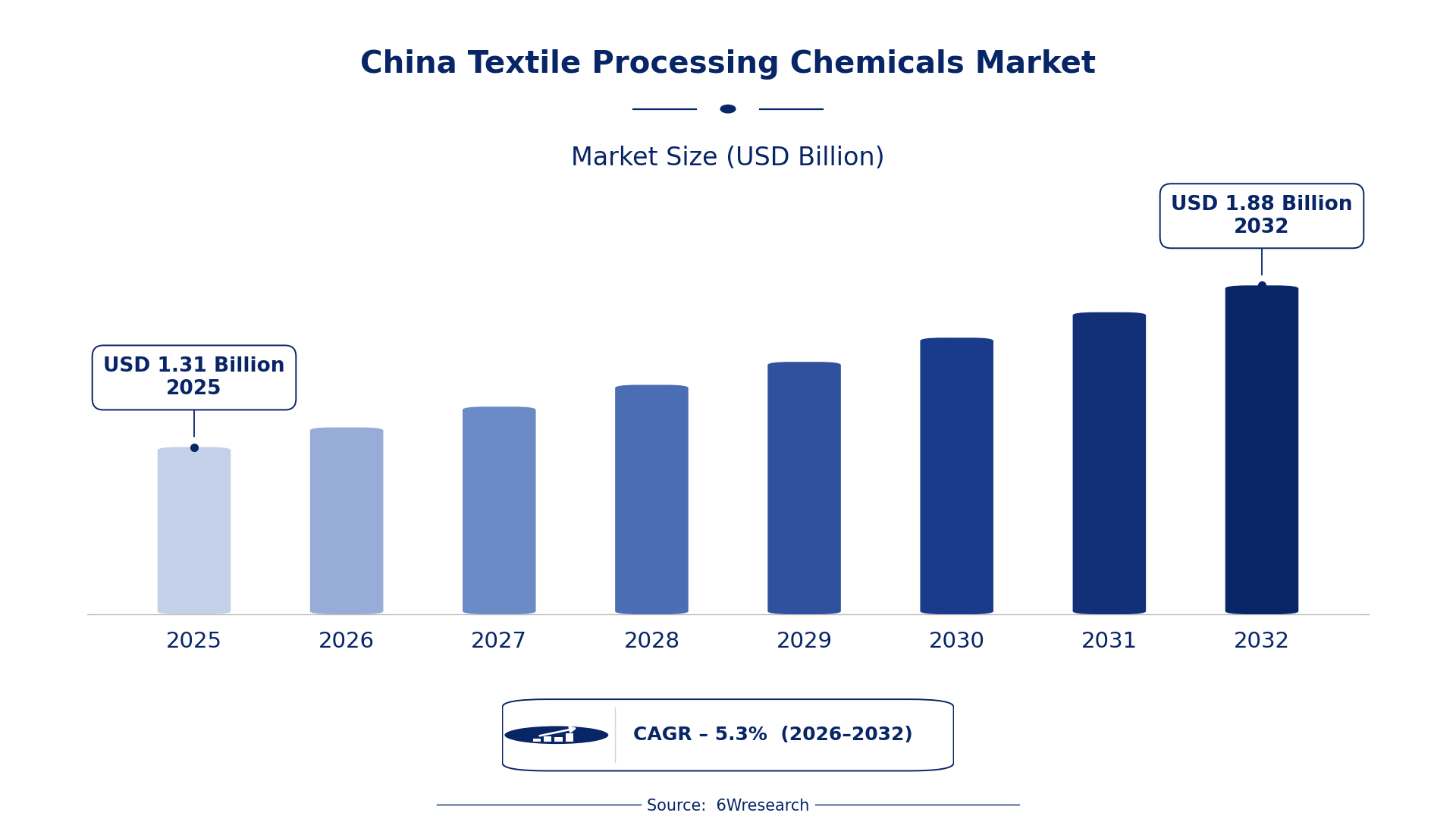
According to 6Wresearch internal database and industry insights, the China Textile Processing Chemicals Market was valued at USD 1.31 billion in 2025 and is projected to reach USD 1.88 billion by 2032, growing at a CAGR of approximately 5.3% during 2026–2032.
China Textile Processing Chemicals Market Highlights
| Report Metric | Details |
| Report Name | China Textile Processing Chemicals Market |
| Market Size 2025 | USD 1.31 billion |
| Market Size 2032 | USD 1.88 billion |
| Absolute Growth 2025–2032 | USD 0.57 billion |
| CAGR 2026–2032 | 5.3% |
| Peak Annual Growth | 7.1% in 2031 |
| Forecast Period | 2026–2032 |
| Historical Data | 2022–2025 |
| Base Year | 2025 |
| Leading Textile Processing Chem., 2025 | Scouring & Degreasing Agents (45% share) |
| Leading Product Type, 2025 | Fabric Finishes (41% share) |
| Leading Chemical Function, 2025 | Oil & Wax Removal (40% share) |
| Leading Distribution Channel, 2025 | Chemical Distributors (51% share) |
| Leading End User Industry, 2025 | Textile Mills (46% share) |
| Fastest-Growing Textile Processing Chem. | Flame Retardants (6.7% CAGR) |
| Fastest-Growing Chemical Function | Safety Enhancement (8.0% CAGR) |
| Fastest-Growing Distribution Channel | Specialty Suppliers (6.5% CAGR) |
| Fastest-Growing End User Industry | Technical Textile Mills (7.4% CAGR) |
| Growing Sector | Technical Textile Mills |
| Key End Users | Textile Mills, Apparel Factories, Technical Textile Mills |
China Textile Processing Chemicals Market Year-wise Growth Rate and Key Drivers (2022–2032)
This graph illustrates the annual growth rates of the market from 2022 to 2032, highlighting a steady upward trajectory and projected market expansion over the forecast period.
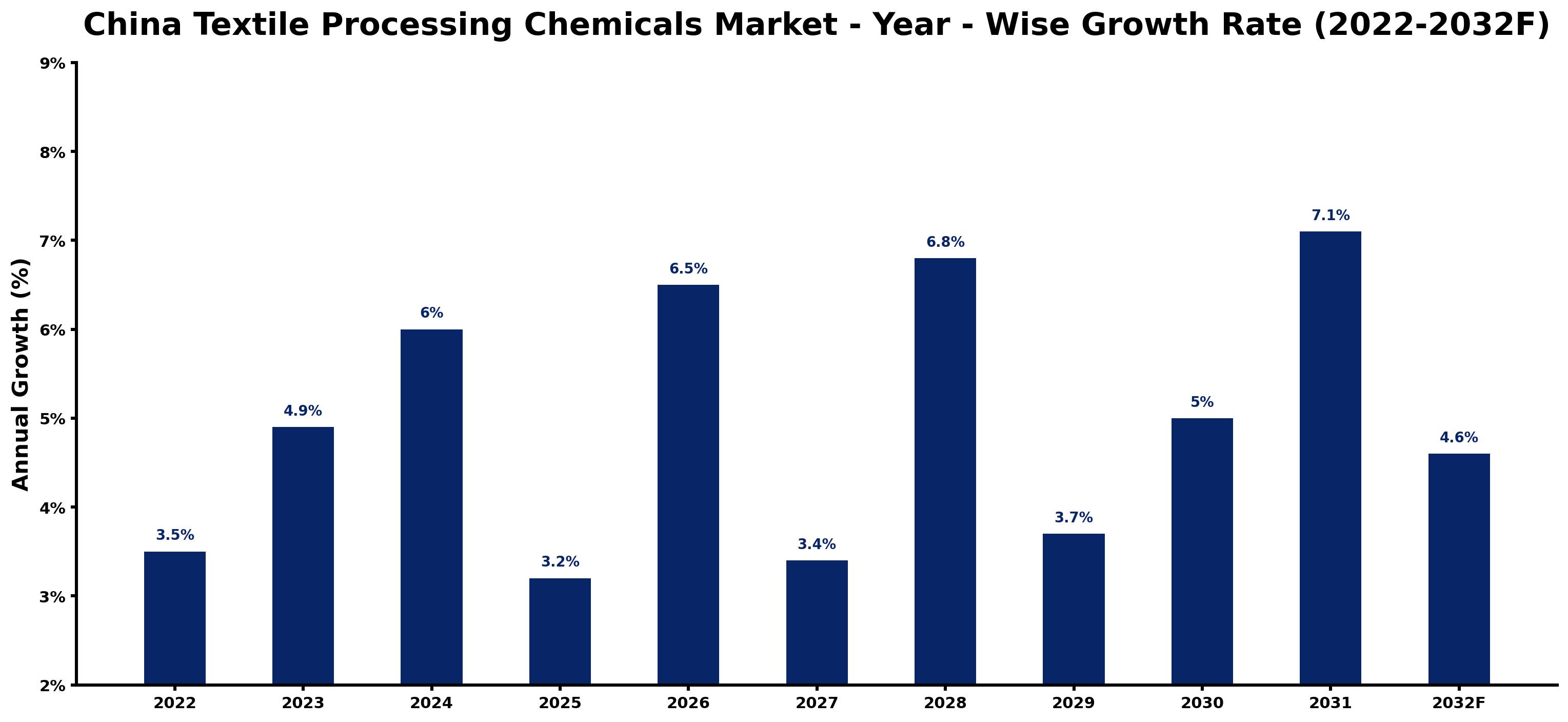
Below, each year's estimated growth is shown next to the factor that most influenced it.
| Year | Estimated Annual Growth (%) | Market Rationale |
| 2022 | 3.5 | The market experienced steady growth as domestic textile mills maintained production levels. |
| 2023 | 4.9 | Demand increased due to rising production in apparel factories across the country. |
| 2024 | 6.0 | Growth accelerated as textile mills adopted new processing technologies. |
| 2025 | 3.2 | The market saw a slowdown as safety regulations began to tighten. |
| 2026 | 6.5 | A resurgence in demand occurred as flame retardant usage rose due to regulations. |
| 2027 | 3.4 | Growth slowed again as manufacturers adjusted to new compliance requirements. |
| 2028 | 6.8 | Demand picked up as the Technical Textile Mills segment expanded rapidly. |
| 2029 | 3.7 | The market slowed as some mills faced operational challenges amid rising costs. |
| 2030 | 5.0 | Growth resumed as investments in sustainable practices gained traction. |
| 2031 | 7.1 | The peak year saw demand driven by the 'Textile Industry Development Plan'. |
| 2032 | 4.6 | Growth slowed as the market stabilised following a period of rapid expansion. |
Note: Market size estimations and growth projections presented in this report are based on 6Wresearch's proprietary forecasting methodology, utilizing the latest available industry data, government publications, and primary research inputs.
China Textile Processing Chemicals Market Synopsis
Textile Processing Chemicals in China are specialized formulations used in fabric processing and finishing. These chemicals improve properties such as softness, durability, and safety. The China Textile Processing Chemicals Market is growing due to increasing demand from domestic textile mills and apparel factories. In 2022, the industry produced over 30 million tons of fabric, highlighting the scale of demand. The ongoing push for sustainable practices, driven by government initiatives, is stimulating market growth.
Market Dynamics Impact Analysis (2026–2032)
| Factor | Type | Impact | Primary Segment Affected |
| Increased demand for eco-friendly formulations is driving growth in the market. | Driver | High | Fabric Finishes |
| The rise in production of technical textiles is creating new opportunities. | Opportunity | High | Technical Textile Mills |
| Tightening safety regulations are increasing the need for compliant products. | Restraint | High | Flame Retardants |
| Limited awareness of eco-friendly options among smaller producers restricts market growth. | Restraint | Medium | Scouring & Degreasing Agents |
| The need for specialized chemical formulations presents a growing market segment. | Opportunity | Medium | Safety Enhancement |
| Compliance costs are rising for manufacturers, impacting profitability. | Challenge | Medium | Flame Retardants |
| Competition from imported chemicals is limiting market growth. | Restraint | Medium | Oil & Wax Removal |
| The market faces challenges in sourcing raw materials due to environmental regulations. | Challenge | High | Chemical Distributors |
Evaluation of Drivers in China Textile Processing Chemicals Market (2026–2032)
Below mentioned are some major drivers and their influence on market dynamics.
| Drivers | Primary Segment Affected | Why It Matters (Evidence) |
| Growing production in the apparel sector increases demand for processing chemicals. | Textile Mills | In 2022, over 20 million workers were employed in the textile sector, driving higher chemical usage. |
| Rising safety standards are driving demand for flame retardants in textiles. | Flame Retardants | Projected increases in flame retardant demand are linked to stricter regulations. |
| Technological advancements in textile processing are improving chemical efficacy. | Safety Enhancement | The adoption of eco-friendly practices is ensuring higher quality standards. |
| The push for sustainable practices is leading to increased adoption of eco-friendly chemicals. | Fabric Finishes | The 'Green Textile Initiative' promotes sustainable chemical use, boosting demand for compliant products. |
| The expansion of technical textile production is creating new market opportunities. | Technical Textile Mills | This segment is expected to grow significantly due to innovation and investment. |
The Textile Processing Chemicals market in China is growing on the back of rising production in the apparel sector, increasing safety standards, and technological advancements. In 2022, over 30 million tons of fabric were produced, driving demand for processing chemicals. The push for sustainable practices is further stimulating market growth. Adoption of eco-friendly practices among manufacturers ensures higher quality, which is essential for compliance with evolving standards. As a result, the market is experiencing strong demand from textile mills and technical textile producers.
Evaluation of Restraints in China Textile Processing Chemicals Market
Below mentioned are some major restraints and their influence on market dynamics.
| Market Restraint | Primary Segment Affected | Why It Matters (Evidence) |
| Compliance costs are rising due to new safety regulations, impacting profitability. | Flame Retardants | Manufacturers must invest in compliance measures, increasing operational costs. |
| Competition from imported chemicals pressures local manufacturers to reduce prices. | Oil & Wax Removal | Imported alternatives may offer lower prices, affecting local sales. |
| Sourcing raw materials is becoming more challenging due to environmental regulations. | Chemical Distributors | Stricter regulations limit access to essential chemicals for production. |
| Fluctuating prices of raw materials can disrupt production schedules. | Fabric Softeners | Price volatility affects budgeting and planning for manufacturers. |
| Limited awareness of eco-friendly options among smaller producers restricts market growth. | Scouring & Degreasing Agents | Smaller textile mills may not prioritize sustainable practices due to cost concerns. |
China Textile Processing Chemicals Market Challenges
The China Textile Processing Chemicals Market encounters several practical challenges, starting with rising production costs for manufacturers. Increased raw material prices have elevated expenses, prompting textile mills to reassess their budgets and potentially reducing output by up to 15%. Technology adoption presents another obstacle, as many producers find it difficult to integrate advanced chemical formulations, delaying product development by several months and limiting competitiveness. Skills shortages in the workforce add complexity, as a lack of trained personnel can hinder the effective use of new technologies, impacting productivity for over 20 million workers. Supply chain disruptions can lead to delays for importers, affecting their ability to meet customer demand and maintain inventory levels, resulting in potential revenue losses of around $500 million.
Trends in the China Textile Processing Chemicals Market
Buyers and suppliers in the China Textile Processing Chemicals Market are adjusting to the following trends.
- Shift towards Eco-Friendly Chemical Formulations: The 'Green Textile Initiative' launched in 2021 promotes sustainable chemical use in textile processing. This initiative is projected to lead to a 30% increase in the adoption of eco-friendly formulations by 2025.
- Transition from Traditional to Technical Textiles: Since 2022, there has been a notable shift towards technical textiles, driven by innovation and market demand. The Technical Textile Mills segment is anticipated to grow at a CAGR of 7.4% over the next five years.
- Emergence of Safety-Enhanced Products: The demand for flame retardants has surged due to stricter safety regulations introduced in 2022. This trend is likely to increase the market share of flame retardants significantly by 2025.
- Growing Importance of Certification Standards: ISO 9001 certification has gained traction among manufacturers since 2021, improving product quality. Approximately 70% of textile chemical producers are now certified, ensuring compliance with international standards.
Investment Opportunities in the China Textile Processing Chemicals Market
Several openings in the China Textile Processing Chemicals Market merit attention from investors.
- Partnerships with Local Distributors: Collaborating with local chemical distributors can facilitate market entry. The Jiangsu province, a major hub for textile processing chemicals, presents a significant opportunity for partnerships.
- Investing in Eco-Friendly Chemical Production: With the growing demand for sustainable chemicals, investing in eco-friendly production facilities is vital. The 'Textile Industry Development Plan' aims to enhance competitiveness by 2025.
- Expansion into Technical Textile Production: The Technical Textile Mills segment is projected to see substantial growth, creating opportunities for suppliers. Investing in specialised chemical formulations can meet this rising demand.
- Certification for Eco-Friendly Products: Obtaining certifications for eco-friendly products can open new markets. The China National Textile and Apparel Council actively promotes the use of sustainable chemicals.
Government Initiatives in the China Textile Processing Chemicals Market
The regulatory framework for textile processing chemicals in China has evolved in recent years. The National Standard for Textile Chemicals (GB 18401), revised in 2022, sets stringent safety and environmental standards for chemical usage. The 'Textile Industry Development Plan', initiated by the Ministry of Industry and Information Technology in 2021, aims to improve the competitiveness of the textile sector by 2025. These measures ensure that manufacturers comply with safety regulations while promoting sustainable practices in the industry.
In 2021, the Ministry of Ecology and Environment launched the 'Green Textile Initiative', which encourages sustainable chemical use in textile processing. This initiative aims to reduce the environmental impact of textile production and is supported by various funding schemes. The State Administration for Market Regulation introduced a compliance framework in 2023, focusing on quality control and safety for textile chemical manufacturers. These agencies play a key role in ensuring that the industry adheres to safety and environmental standards.
Future Insight of the China Textile Processing Chemicals Market
The China Textile Processing Chemicals Market will undergo notable changes by 2032, primarily due to the implementation of stricter safety regulations and the adoption of eco-friendly practices. The updated National Standard for Textile Chemicals will compel manufacturers to innovate and comply with new safety requirements, enhancing product safety. The ongoing Textile Industry Development Plan will encourage buyers to shift towards greener chemical options, aligning with global sustainability trends. With the demand for flame retardants projected to rise, suppliers will need to invest in research and development to meet market expectations.
Market Segmentation Analysis
Each segment group is reviewed below, with the leader by share and the fastest grower by CAGR.
By Textile Processing Chem. – Scouring & Degreasing Agents Dominated, Flame Retardants Expected to Grow Fastest
According to Vasudha, AM at 6Wresearch, Scouring & Degreasing Agents accounted for a 45% market share by textile processing chem. in 2025. Scouring and degreasing agents hold the largest share as they are crucial for cleaning fabrics before dyeing, with approximately 70% of textile mills in China relying on them. This essential role in the textile processing workflow, particularly in the Jiangsu province, solidifies their market leadership. Flame Retardants are set to record the highest CAGR in this split, 6.7% over 2026–2032. The flame retardants segment is experiencing rapid growth due to increased demand stemming from stricter safety regulations in textiles. This focus on safety is likely to drive further adoption of flame retardants across various textile applications, widening the lead of scouring and degreasing agents. Suppliers should focus on developing compliant flame retardant products to meet the rising safety demands in the textile industry.
By Product Type – Fabric Finishes Dominated and Is Expected to Record the Fastest Growth
With a 41% revenue share in 2025, Fabric Finishes was the largest product type category. Fabric finishes dominate the market share as they are vital for improving the final appearance and performance of fabrics, making them indispensable in textile processing. Their widespread application across various fabric types ensures consistent demand from manufacturers. The same category are also set to grow fastest, at a CAGR of 7.1% during 2026–2032. Fabric finishes are also the fastest growing segment, propelled by innovations in textile technology that enhance fabric properties and prompt manufacturers to adopt advanced finishing techniques. This dual role as both leader and fastest highlights the segment's critical position in meeting consumer preferences. Buyers will benefit from investing in advanced fabric finishes that elevate product quality and enhance market competitiveness.
By Chemical Function – Oil & Wax Removal Dominated, Safety Enhancement Expected to Grow Fastest
In 2025, Oil & Wax Removal led the chemical function split with a 40% share. Oil and wax removal agents capture the largest share due to their necessity in preparing fabrics for further processing, ensuring textiles are clean and ready for dyeing. This fundamental function in the textile production process reinforces their importance among manufacturers. Over 2026–2032, Safety Enhancement is expected to post the fastest growth, at a CAGR of 8.0%. Safety enhancement chemicals are emerging as the fastest growing segment, driven by the need for compliance with updated safety regulations in the textile industry. As these standards evolve, the demand for safety enhancement chemicals is expected to rise significantly. Suppliers must prioritise the development of safety enhancement chemicals to align with regulatory changes and meet market needs.
By Distribution Channel – Chemical Distributors Dominated, Specialty Suppliers Expected to Grow Fastest
The largest distribution channel category in 2025 was Chemical Distributors, with a 51% share of total revenue. Chemical distributors hold the largest market share as they effectively facilitate the supply of textile processing chemicals to manufacturers across China. Their established networks and relationships with textile mills ensure a consistent flow of necessary products. The quickest growth will come from Specialty Suppliers, forecast to expand at a CAGR of 6.5% between 2026 and 2032. Specialty suppliers are the fastest growing distribution channel, focusing on niche markets within textile processing that require specific chemical solutions. This targeted approach allows them to cater to unique customer needs, driving their rapid expansion. Manufacturers should consider partnerships with specialty suppliers to access tailored solutions that meet specific processing requirements.
By End User Industry – Textile Mills Dominated, Technical Textile Mills Expected to Grow Fastest
Textile Mills held a 46% share of the China Textile Processing Chemicals Market by end user industry in 2025. Textile mills represent the largest share of the market as the primary users of processing chemicals in fabric production, forming the backbone of the textile supply chain. Their substantial operational scale and volume of fabric produced contribute significantly to their dominant position. Technical Textile Mills are set to record the highest CAGR in this split, 7.4% over 2026–2032. Technical textile mills are experiencing the fastest growth due to their focus on specialised textile production that requires advanced chemicals. As innovation in technical textiles progresses, this segment is well-positioned for further expansion. Investing in advanced processing chemicals tailored for technical textile applications will be essential for suppliers looking to seize emerging market opportunities.
Key Attractiveness of the Report
- 10 Years of Market Numbers
- Historical Data Starting from 2022 to 2025
- Base Year 2025
- Forecast Data until 2032
- Key Performance Indicators Impacting the Market
- Major Upcoming Developments and Projects
Key Highlights of the Report:
- China Textile Processing Chemicals Market Outlook
- Market Size of China Textile Processing Chemicals Market, 2025
- Forecast of China Textile Processing Chemicals Market, 2032
- Historical Data and Forecast of China Textile Processing Chemicals Revenues & Volume for the Period 2022 - 2032F
- China Textile Processing Chemicals Market Trend Evolution
- China Textile Processing Chemicals Market Drivers and Challenges
- China Textile Processing Chemicals Price Trends
- China Textile Processing Chemicals Porter's Five Forces
- China Textile Processing Chemicals Industry Life Cycle
- Historical Data and Forecast of China Textile Processing Chemicals Market Revenues & Volume By Textile Processing Chem. for the Period 2022 - 2032F
- Historical Data and Forecast of China Textile Processing Chemicals Market Revenues & Volume By Scouring & Degreasing Agents for the Period 2022 - 2032F
- Historical Data and Forecast of China Textile Processing Chemicals Market Revenues & Volume By Anti-Static Finishes for the Period 2022 - 2032F
- Historical Data and Forecast of China Textile Processing Chemicals Market Revenues & Volume By Softening Agents for the Period 2022 - 2032F
- Historical Data and Forecast of China Textile Processing Chemicals Market Revenues & Volume By Flame Retardants for the Period 2022 - 2032F
- Historical Data and Forecast of China Textile Processing Chemicals Market Revenues & Volume By Product Type for the Period 2022 - 2032F
- Historical Data and Forecast of China Textile Processing Chemicals Market Revenues & Volume By Detergents for the Period 2022 - 2032F
- Historical Data and Forecast of China Textile Processing Chemicals Market Revenues & Volume By Fabric Finishes for the Period 2022 - 2032F
- Historical Data and Forecast of China Textile Processing Chemicals Market Revenues & Volume By Fabric Softeners for the Period 2022 - 2032F
- Historical Data and Forecast of China Textile Processing Chemicals Market Revenues & Volume By FR Finishes for the Period 2022 - 2032F
- Historical Data and Forecast of China Textile Processing Chemicals Market Revenues & Volume By Chemical Function for the Period 2022 - 2032F
- Historical Data and Forecast of China Textile Processing Chemicals Market Revenues & Volume By Oil & Wax Removal for the Period 2022 - 2032F
- Historical Data and Forecast of China Textile Processing Chemicals Market Revenues & Volume By Charge Control for the Period 2022 - 2032F
- Historical Data and Forecast of China Textile Processing Chemicals Market Revenues & Volume By Hand Feel Enhancers for the Period 2022 - 2032F
- Historical Data and Forecast of China Textile Processing Chemicals Market Revenues & Volume By Safety Enhancement for the Period 2022 - 2032F
- Historical Data and Forecast of China Textile Processing Chemicals Market Revenues & Volume By Distribution Channel for the Period 2022 - 2032F
- Historical Data and Forecast of China Textile Processing Chemicals Market Revenues & Volume By Chemical Distributors for the Period 2022 - 2032F
- Historical Data and Forecast of China Textile Processing Chemicals Market Revenues & Volume By Direct Sales for the Period 2022 - 2032F
- Historical Data and Forecast of China Textile Processing Chemicals Market Revenues & Volume By Industrial Retailers for the Period 2022 - 2032F
- Historical Data and Forecast of China Textile Processing Chemicals Market Revenues & Volume By Specialty Suppliers for the Period 2022 - 2032F
- Historical Data and Forecast of China Textile Processing Chemicals Market Revenues & Volume By End User Industry for the Period 2022 - 2032F
- Historical Data and Forecast of China Textile Processing Chemicals Market Revenues & Volume By Textile Mills for the Period 2022 - 2032F
- Historical Data and Forecast of China Textile Processing Chemicals Market Revenues & Volume By Apparel Factories for the Period 2022 - 2032F
- Historical Data and Forecast of China Textile Processing Chemicals Market Revenues & Volume By Home Textile Makers for the Period 2022 - 2032F
- Historical Data and Forecast of China Textile Processing Chemicals Market Revenues & Volume By Technical Textile Mills for the Period 2022 - 2032F
- China Textile Processing Chemicals Import Export Trade Statistics
- Market Opportunity Assessment By Textile Processing Chem.
- Market Opportunity Assessment By Product Type
- Market Opportunity Assessment By Chemical Function
- Market Opportunity Assessment By Distribution Channel
- Market Opportunity Assessment By End User Industry
- China Textile Processing Chemicals Top Companies Market Share
- China Textile Processing Chemicals Competitive Benchmarking By Technical and Operational Parameters
- China Textile Processing Chemicals Company Profiles
- China Textile Processing Chemicals Key Strategic Recommendations
Market Covered
Segments analysed in this report are listed below.
By Textile Processing Chem.
- Scouring & Degreasing Agents
- Anti-Static Finishes
- Softening Agents
- Flame Retardants
By Product Type
- Detergents
- Fabric Finishes
- Fabric Softeners
- FR Finishes
By Chemical Function
- Oil & Wax Removal
- Charge Control
- Hand Feel Enhancers
- Safety Enhancement
By Distribution Channel
- Chemical Distributors
- Direct Sales
- Industrial Retailers
- Specialty Suppliers
By End User Industry
- Textile Mills
- Apparel Factories
- Home Textile Makers
- Technical Textile Mills































