China Textiles Dyeing & Printing Chemicals Market Size & Growth Rate
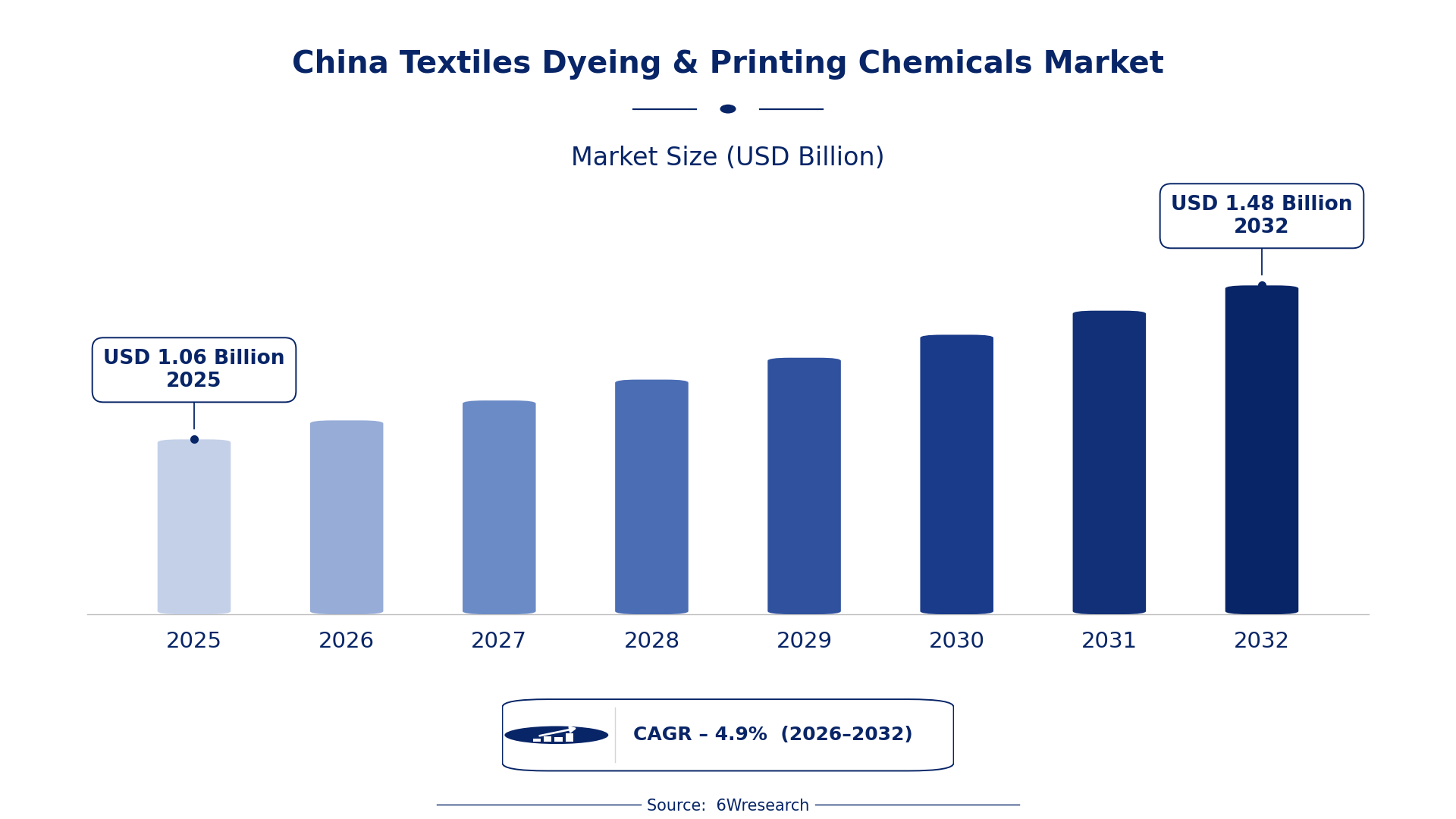
According to 6Wresearch internal database and industry insights, the China Textiles Dyeing & Printing Chemicals Market was valued at USD 1.06 billion in 2025 and is projected to reach USD 1.48 billion by 2032, growing at a CAGR of approximately 4.9% during 2026–2032.
China Textiles Dyeing & Printing Chemicals Market Highlights
| Report Metric | Details |
| Report Name | China Textiles Dyeing & Printing Chemicals Market |
| Market Size 2025 | USD 1.06 billion |
| Market Size 2032 | USD 1.48 billion |
| Absolute Growth 2025–2032 | USD 0.42 billion |
| CAGR 2026–2032 | 4.9% |
| Peak Annual Growth | 7.0% in 2026 |
| Forecast Period | 2026–2032 |
| Historical Data | 2022–2025 |
| Base Year | 2025 |
| Leading Dye & Printing Chemicals, 2025 | Reactive & Vat Dyes (42% share) |
| Leading Product Type, 2025 | Fiber Reactive Dyes (38% share) |
| Leading Chemistry Type, 2025 | Reactive Chemistry (45% share) |
| Leading Distribution Channel, 2025 | Chemical Distributors (43% share) |
| Leading End User Industry, 2025 | Cotton Apparel (44% share) |
| Fastest-Growing Dye & Printing Chemicals | Digital Printing Inks (7.6% CAGR) |
| Fastest-Growing Product Type | DTG Textile Inks (7.0% CAGR) |
| Fastest-Growing Distribution Channel | Online Platforms (7.6% CAGR) |
| Fastest-Growing End User Industry | Fashion Printing Labs (6.8% CAGR) |
| Growing Sector | Fashion Printing Labs |
| Key End Users | Cotton Apparel, Home Furnishing, Fashion Printing Labs, Textile Printers |
China Textiles Dyeing & Printing Chemicals Market Year-wise Growth Rate and Key Drivers (2022–2032)
This graph illustrates the annual growth rates of the market from 2022 to 2032, highlighting a steady upward trajectory and projected market expansion over the forecast period.
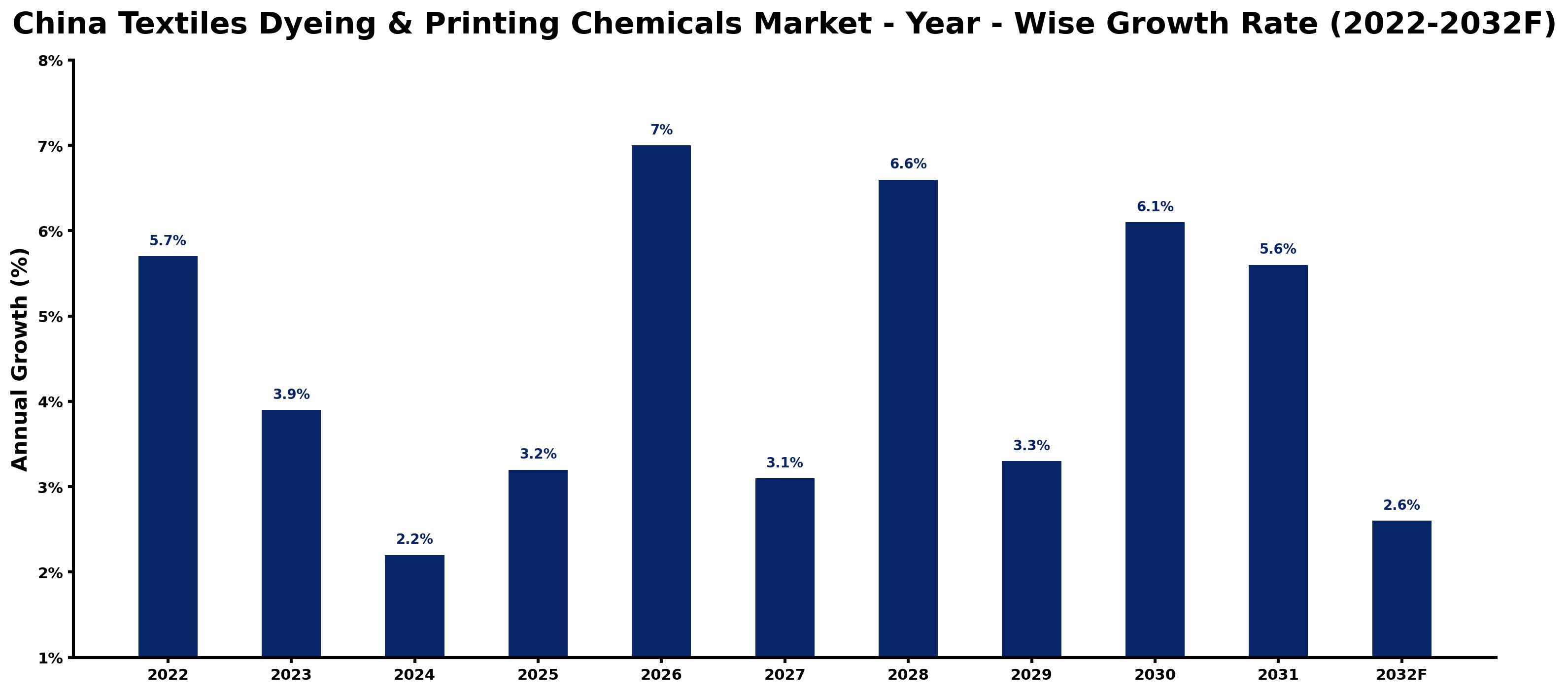
Each row of the following table gives one year's estimated growth and the event or demand shift that explains it.
| Year | Estimated Annual Growth (%) | Market Rationale |
| 2022 | 5.7 | The textile industry employed over 25 million workers, driving demand for dyeing chemicals. |
| 2023 | 3.9 | Growth slowed as the market adjusted to the impact of the 'Green Manufacturing' initiative. |
| 2024 | 2.2 | Demand continued to slow, influenced by the adoption of ISO 14001 standards in manufacturing. |
| 2025 | 3.2 | A rebound occurred as textile exports reached 300 billion USD, boosting chemical purchases. |
| 2026 | 7.0 | Rapid growth was driven by a surge in digital printing technology adoption, expected to reach 30%. |
| 2027 | 3.1 | Growth slowed again as manufacturers faced challenges in meeting stricter environmental regulations. |
| 2028 | 6.6 | An increase in demand was supported by the rising popularity of pigment inks for their benefits. |
| 2029 | 3.3 | Market growth slowed, reflecting adjustments to the new standards in the dyeing sector. |
| 2030 | 6.1 | Growth accelerated as the 'Textile Industry Development Plan' aimed for a 20% efficiency increase. |
| 2031 | 5.6 | A slowdown occurred as the market adjusted to the new production targets set by the government. |
| 2032 | 2.6 | Growth continued to slow as the industry adapts to evolving environmental regulations. |
Note: Market size estimations and growth projections presented in this report are based on 6Wresearch's proprietary forecasting methodology, utilizing the latest available industry data, government publications, and primary research inputs.
China Textiles Dyeing & Printing Chemicals Market Synopsis
Textiles Dyeing & Printing Chemicals Market in China includes specialised chemical formulations designed for dyeing and printing textiles. These chemicals are created through intricate processes involving dyes, pigments, and auxiliaries, primarily aimed at enhancing colour and patterns. The market is expanding due to strong domestic demand from local manufacturers and exports, with the textile industry generating over 1 trillion CNY in value. The shift towards sustainable practices and the rise of digital printing technologies are further driving new demand.
Market Dynamics Impact Analysis (2026–2032)
| Factor | Type | Impact | Primary Segment Affected |
| Rising textile exports drive demand for dyeing chemicals, with exports reaching 300 billion USD in 2022. | Driver | High | Reactive & Vat Dyes |
| The shift towards digital printing technologies increases the need for specialized inks, expected to reach 30% adoption by 2025. | Driver | High | Digital Printing Inks |
| The growing focus on sustainability creates opportunities for eco-friendly dyeing processes, supported by the 'Green Manufacturing' initiative. | Opportunity | High | Fixatives & Auxiliaries |
| Investment in digital printing technologies offers new avenues for suppliers, with a subsidy program of 100 million CNY initiated in 2022. | Opportunity | High | Digital Printing Inks |
| Stricter environmental regulations may limit the types of chemicals that can be used in dyeing processes, affecting production. | Restraint | High | Reactive & Vat Dyes |
| The high cost of compliance with new standards can deter smaller manufacturers from entering the market. | Restraint | Medium | Pigment & Disperse Dyes |
| Competition from international suppliers may pressure local manufacturers to innovate and reduce costs. | Challenge | High | Reactive & Vat Dyes |
| The need for continuous investment in technology can strain financial resources for smaller textile manufacturers. | Challenge | Medium | Digital Printing Inks |
Evaluation of Drivers in China Textiles Dyeing & Printing Chemicals Market (2026–2032)
The factors lifting demand, and the evidence behind each, are summarised below.
| Drivers | Primary Segment Affected | Why It Matters (Evidence) |
| Increased textile exports drive demand for dyeing chemicals, with exports reaching 300 billion USD in 2022. | Reactive & Vat Dyes | This surge in exports leads to higher purchases of dyeing chemicals by manufacturers. |
| The adoption of digital printing technology is projected to reach 30% by 2025, increasing demand for specialized inks. | Digital Printing Inks | As manufacturers adopt digital printing, they require more advanced inks to meet production needs. |
| Sustainable practices are gaining traction, particularly through the 'Green Manufacturing' initiative. | Fixatives & Auxiliaries | This initiative encourages the use of eco-friendly chemicals, boosting demand for compliant products. |
| Government subsidies for digital printing technologies support investment in new equipment and materials. | Digital Printing Inks | Manufacturers are incentivised to upgrade technology, leading to increased purchases of compliant inks. |
| The textile industry's significant production value exceeding 1 trillion CNY fosters a strong demand for dyeing chemicals. | Reactive & Vat Dyes | High production levels necessitate a steady supply of dyeing chemicals for ongoing operations. |
Growth across the Textiles Dyeing & Printing Chemicals market in China is anchored in rising textile exports, the adoption of digital printing technologies, and a strong focus on sustainability. The textile industry produced over 1 trillion CNY in value, driving demand for dyeing chemicals. Digital printing technology is expected to reach 30% adoption by 2025, increasing the need for specialized inks.
Evaluation of Restraints in China Textiles Dyeing & Printing Chemicals Market
The main factors holding the market back are set out below.
| Market Restraint | Primary Segment Affected | Why It Matters (Evidence) |
| Stricter environmental regulations limit the use of certain chemicals, impacting production. | Reactive & Vat Dyes | Compliance with these regulations can reduce the range of chemicals available for dyeing, affecting production efficiency. |
| High compliance costs deter smaller manufacturers from entering the market. | Pigment & Disperse Dyes | Smaller players may struggle to meet the financial requirements imposed by new standards, limiting competition. |
| Increased competition from international suppliers pressures local manufacturers to innovate. | Reactive & Vat Dyes | This competition can lead to price wars, affecting profit margins for local producers and their sustainability efforts. |
| The need for continuous investment in technology strains financial resources for smaller manufacturers. | Digital Printing Inks | Smaller companies may find it challenging to keep up with technological advancements, limiting their market presence. |
| Market fluctuations can lead to unpredictable demand for dyeing chemicals, affecting supply chains. | Reactive & Vat Dyes | Volatility in textile production can create uncertainty in chemical purchasing, complicating inventory management. |
China Textiles Dyeing & Printing Chemicals Market Challenges
Buyers in the China textiles dyeing and printing chemicals market are contending with rising costs from fluctuating raw material prices, which could elevate production expenses by up to 15% this year. Competition intensifies as local manufacturers aim to satisfy the demand for sustainable practices, prompting some to lower prices and squeeze profit margins. Supply chain disruptions in Jiangsu and Zhejiang provinces can delay deliveries by several weeks, affecting production schedules for textile manufacturers. Furthermore, buyers face challenges in transitioning to digital printing technologies, necessitating considerable investment and training, which may increase costs by up to 20% in the short term.
Trends in the China Textiles Dyeing & Printing Chemicals Market
The trends below show where the China Textiles Dyeing & Printing Chemicals Market is heading.
- Shift towards Eco-Friendly Practices in Jiangsu and Zhejiang: The textile industry in Jiangsu and Zhejiang is progressively adopting eco-friendly dyeing processes as part of the 'Green Manufacturing' initiative. This transition is supported by a budget of 500 million CNY aimed at promoting sustainable practices.
- Digital Printing Technology Adoption Reaches 30%: By 2025, digital printing technology in the textile sector is expected to achieve 30% adoption, transforming production methods. This shift is driven by the demand for faster and more efficient printing solutions.
- Growing Preference for Pigment Inks: Pigment inks are gaining popularity due to their environmental benefits and vibrant colours. This trend is clear as manufacturers increasingly switch to these inks for their dyeing processes, with a notable rise in usage anticipated.
- Increased Focus on Production Efficiency: The 'Textile Industry Development Plan (2021-2025)' aims for a 20% increase in production efficiency by 2025. This emphasis on efficiency is prompting manufacturers to invest in advanced dyeing technologies to achieve their targets.
Investment Opportunities in the China Textiles Dyeing & Printing Chemicals Market
Investors looking at the China Textiles Dyeing & Printing Chemicals Market should consider the following areas.
- Rising Demand for Sustainable Chemicals: With the textile industry increasingly prioritising sustainability, there is a growing need for eco-friendly dyeing chemicals. Manufacturers in Jiangsu and Zhejiang are seeking compliant products to align with new standards.
- Investment in Digital Printing Technologies: The textile sector is pursuing advanced digital printing solutions, especially as government subsidies encourage upgrades. This presents an opportunity for suppliers to provide compliant inks and equipment.
- Expansion of Cotton Apparel Production: As cotton apparel remains a key end-use sector, suppliers can target manufacturers looking to improve their dyeing processes. The market's production value exceeding 1 trillion CNY underscores this opportunity.
- Growth in Home Furnishing Applications: The home furnishing sector is expanding, generating demand for dyeing chemicals tailored for this market. Suppliers can explore partnerships with manufacturers committed to sustainable practices.
Government Initiatives in the China Textiles Dyeing & Printing Chemicals Market
The 'National Standard for Textile Dyeing and Finishing' was updated in 2023 to introduce stricter environmental regulations for chemical usage. This measure builds on previous laws by enforcing compliance and promoting sustainable practices within the industry. The updated standards require manufacturers to adjust their processes to meet new environmental criteria, ensuring a more sustainable production approach.
The Ministry of Industry and Information Technology oversees the implementation of the 'Textile Industry Development Plan (2021-2025)', which aims for a 20% increase in production efficiency by 2025. This plan supports manufacturers in adopting advanced technologies and improving competitiveness, enabling them to better meet market demands and enhance their operational capabilities.
Future Insight of the China Textiles Dyeing & Printing Chemicals Market
The China textiles dyeing and printing chemicals market will experience notable changes by 2032, driven by the increasing adoption of digital printing technologies projected to reach 30% by 2025. The government's 'Textile Industry Development Plan (2021-2025)' aims to improve competitiveness and promote sustainable practices, benefiting both buyers and suppliers. As the demand for pigment inks rises due to their environmental advantages, the market will shift towards eco-friendly formulations. China's textile exports, valued at 300 billion USD in 2022, will continue to drive the need for innovative dyeing solutions.
Market Segmentation Analysis
The report offers a comprehensive study of the following market segments and their leading categories in the market.
By Dye & Printing Chemicals – Reactive & Vat Dyes Dominated, Digital Printing Inks Expected to Grow Fastest
According to Vasudha, AM at 6Wresearch, the largest dye & printing chemicals category in 2025 was Reactive & Vat Dyes, with a 42% share of total revenue. Reactive and vat dyes dominate the market due to their extensive use in traditional dyeing processes, particularly in regions like Jiangsu and Zhejiang. This segment's stronghold is further supported by the substantial textile production value in China, exceeding 1 trillion CNY. Digital Printing Inks are set to record the highest CAGR in this split, 7.6% over 2026–2032. Digital printing inks are gaining traction as the textile industry shifts towards modern printing technologies, with adoption rates expected to reach 30% by 2025. This transition is driven by the demand for more vibrant colours and environmentally friendly options. Suppliers should focus on developing sustainable solutions to meet the growing demand for digital printing technologies.
By Product Type – Fiber Reactive Dyes Dominated, DTG Textile Inks Expected to Grow Fastest
Fiber Reactive Dyes accounted for a 38% market share by product type in 2025. Fiber reactive dyes hold the largest market share due to their essential function in dyeing cotton and other cellulosic fibers, which are prevalent in textiles. Their widespread use across numerous textile applications solidifies their importance among manufacturers in China. Over 2026–2032, DTG Textile Inks are expected to post the fastest growth, at a CAGR of 7.0%. DTG textile inks are experiencing rapid growth, fuelled by the rising adoption of direct-to-garment printing technologies that meet the increasing demand for customised textile products. This segment's expansion is likely to continue as consumer preferences shift towards personalised fashion items. Suppliers should prioritise the development of DTG technologies to align with the growing demand for customised textiles.
By Chemistry Type – Reactive Chemistry Dominated and Is Expected to Record the Fastest Growth
In 2025, Reactive Chemistry led the chemistry type split with a 45% share. Reactive chemistry leads the market as it is essential for the effectiveness of reactive dyes, which provide vibrant and durable colours in textiles. This chemistry type is vital for meeting the stringent quality standards set by the textile industry. Reactive Chemistry is also forecast to expand faster than any other category, at a CAGR of 6.8% over 2026–2032. The growth of reactive chemistry is set to continue as it underpins both reactive dyes and digital printing technologies, ensuring consistent quality and performance. Its prominence will likely increase as sustainability becomes a focal point in textile production. Suppliers need to innovate within reactive chemistry to stay competitive in the evolving market.
By Distribution Channel – Chemical Distributors Dominated, Online Platforms Expected to Grow Fastest
With a 43% revenue share in 2025, Chemical Distributors was the largest distribution channel category. Chemical distributors are crucial in the textile chemicals supply chain, ensuring manufacturers have access to vital products. Their established networks and strong relationships with local producers significantly contribute to their market share. The quickest growth will come from Online Platforms, forecast to expand at a CAGR of 7.6% between 2026 and 2032. Online platforms are emerging as a significant purchasing channel for chemicals, particularly among smaller manufacturers who value convenience and competitive pricing. This trend indicates a shift in buyer behaviour towards digital procurement solutions. Suppliers should enhance their online presence to attract the increasing number of buyers opting for digital purchasing options.
By End User Industry – Cotton Apparel Dominated, Fashion Printing Labs Expected to Grow Fastest
Cotton Apparel held a 44% share of the China Textiles Dyeing & Printing Chemicals Market by end user industry in 2025. Cotton apparel is the dominant end-use sector for dyeing and printing chemicals, driven by substantial demand for cotton textiles in both domestic and export markets. The large workforce and production capacity within this sector reinforce its market share. Fashion Printing Labs are set to record the highest CAGR in this split, 6.8% over 2026–2032. Fashion printing labs are rapidly expanding as they specialise in producing printed textiles for the fashion industry, which increasingly prioritises unique designs. This growth aligns with the rising trend towards personalised fashion offerings. Buyers in the fashion sector should explore partnerships with printing labs to elevate their product offerings.
Key Attractiveness of the Report
- 10 Years of Market Numbers
- Historical Data Starting from 2022 to 2025
- Base Year 2025
- Forecast Data until 2032
- Key Performance Indicators Impacting the Market
- Major Upcoming Developments and Projects
Key Highlights of the Report:
- China Textiles Dyeing & Printing Chemicals Market Outlook
- Market Size of China Textiles Dyeing & Printing Chemicals Market, 2025
- Forecast of China Textiles Dyeing & Printing Chemicals Market, 2032
- Historical Data and Forecast of China Textiles Dyeing & Printing Chemicals Revenues & Volume for the Period 2022 - 2032F
- China Textiles Dyeing & Printing Chemicals Market Trend Evolution
- China Textiles Dyeing & Printing Chemicals Market Drivers and Challenges
- China Textiles Dyeing & Printing Chemicals Price Trends
- China Textiles Dyeing & Printing Chemicals Porter's Five Forces
- China Textiles Dyeing & Printing Chemicals Industry Life Cycle
- Historical Data and Forecast of China Textiles Dyeing & Printing Chemicals Market Revenues & Volume By Dye & Printing Chemicals for the Period 2022 - 2032F
- Historical Data and Forecast of China Textiles Dyeing & Printing Chemicals Market Revenues & Volume By Reactive & Vat Dyes for the Period 2022 - 2032F
- Historical Data and Forecast of China Textiles Dyeing & Printing Chemicals Market Revenues & Volume By Pigment & Disperse Dyes for the Period 2022 - 2032F
- Historical Data and Forecast of China Textiles Dyeing & Printing Chemicals Market Revenues & Volume By Digital Printing Inks for the Period 2022 - 2032F
- Historical Data and Forecast of China Textiles Dyeing & Printing Chemicals Market Revenues & Volume By Fixatives & Auxiliaries for the Period 2022 - 2032F
- Historical Data and Forecast of China Textiles Dyeing & Printing Chemicals Market Revenues & Volume By Product Type for the Period 2022 - 2032F
- Historical Data and Forecast of China Textiles Dyeing & Printing Chemicals Market Revenues & Volume By Fiber Reactive Dyes for the Period 2022 - 2032F
- Historical Data and Forecast of China Textiles Dyeing & Printing Chemicals Market Revenues & Volume By Pigmented Systems for the Period 2022 - 2032F
- Historical Data and Forecast of China Textiles Dyeing & Printing Chemicals Market Revenues & Volume By DTG Textile Inks for the Period 2022 - 2032F
- Historical Data and Forecast of China Textiles Dyeing & Printing Chemicals Market Revenues & Volume By Print Enhancers for the Period 2022 - 2032F
- Historical Data and Forecast of China Textiles Dyeing & Printing Chemicals Market Revenues & Volume By Chemistry Type for the Period 2022 - 2032F
- Historical Data and Forecast of China Textiles Dyeing & Printing Chemicals Market Revenues & Volume By Reactive Chemistry for the Period 2022 - 2032F
- Historical Data and Forecast of China Textiles Dyeing & Printing Chemicals Market Revenues & Volume By Polyester Coloration for the Period 2022 - 2032F
- Historical Data and Forecast of China Textiles Dyeing & Printing Chemicals Market Revenues & Volume By Pigment/Inorganic Inks for the Period 2022 - 2032F
- Historical Data and Forecast of China Textiles Dyeing & Printing Chemicals Market Revenues & Volume By Resin & Binder Chem. for the Period 2022 - 2032F
- Historical Data and Forecast of China Textiles Dyeing & Printing Chemicals Market Revenues & Volume By Distribution Channel for the Period 2022 - 2032F
- Historical Data and Forecast of China Textiles Dyeing & Printing Chemicals Market Revenues & Volume By Chemical Distributors for the Period 2022 - 2032F
- Historical Data and Forecast of China Textiles Dyeing & Printing Chemicals Market Revenues & Volume By Industrial Retailers for the Period 2022 - 2032F
- Historical Data and Forecast of China Textiles Dyeing & Printing Chemicals Market Revenues & Volume By Online Platforms for the Period 2022 - 2032F
- Historical Data and Forecast of China Textiles Dyeing & Printing Chemicals Market Revenues & Volume By Specialty Suppliers for the Period 2022 - 2032F
- Historical Data and Forecast of China Textiles Dyeing & Printing Chemicals Market Revenues & Volume By End User Industry for the Period 2022 - 2032F
- Historical Data and Forecast of China Textiles Dyeing & Printing Chemicals Market Revenues & Volume By Cotton Apparel for the Period 2022 - 2032F
- Historical Data and Forecast of China Textiles Dyeing & Printing Chemicals Market Revenues & Volume By Home Furnishing for the Period 2022 - 2032F
- Historical Data and Forecast of China Textiles Dyeing & Printing Chemicals Market Revenues & Volume By Fashion Printing Labs for the Period 2022 - 2032F
- Historical Data and Forecast of China Textiles Dyeing & Printing Chemicals Market Revenues & Volume By Textile Printers for the Period 2022 - 2032F
- China Textiles Dyeing & Printing Chemicals Import Export Trade Statistics
- Market Opportunity Assessment By Dye & Printing Chemicals
- Market Opportunity Assessment By Product Type
- Market Opportunity Assessment By Chemistry Type
- Market Opportunity Assessment By Distribution Channel
- Market Opportunity Assessment By End User Industry
- China Textiles Dyeing & Printing Chemicals Top Companies Market Share
- China Textiles Dyeing & Printing Chemicals Competitive Benchmarking By Technical and Operational Parameters
- China Textiles Dyeing & Printing Chemicals Company Profiles
- China Textiles Dyeing & Printing Chemicals Key Strategic Recommendations
Market Covered
The report offers an extensive study of the following market segments.
By Dye & Printing Chemicals
- Reactive & Vat Dyes
- Pigment & Disperse Dyes
- Digital Printing Inks
- Fixatives & Auxiliaries
By Product Type
- Fiber Reactive Dyes
- Pigmented Systems
- DTG Textile Inks
- Print Enhancers
By Chemistry Type
- Reactive Chemistry
- Polyester Coloration
- Pigment/Inorganic Inks
- Resin & Binder Chem.
By Distribution Channel
- Chemical Distributors
- Industrial Retailers
- Online Platforms
- Specialty Suppliers
By End User Industry
- Cotton Apparel
- Home Furnishing
- Fashion Printing Labs
- Textile Printers































