China Threat Intelligence AI Market Size & Growth Rate
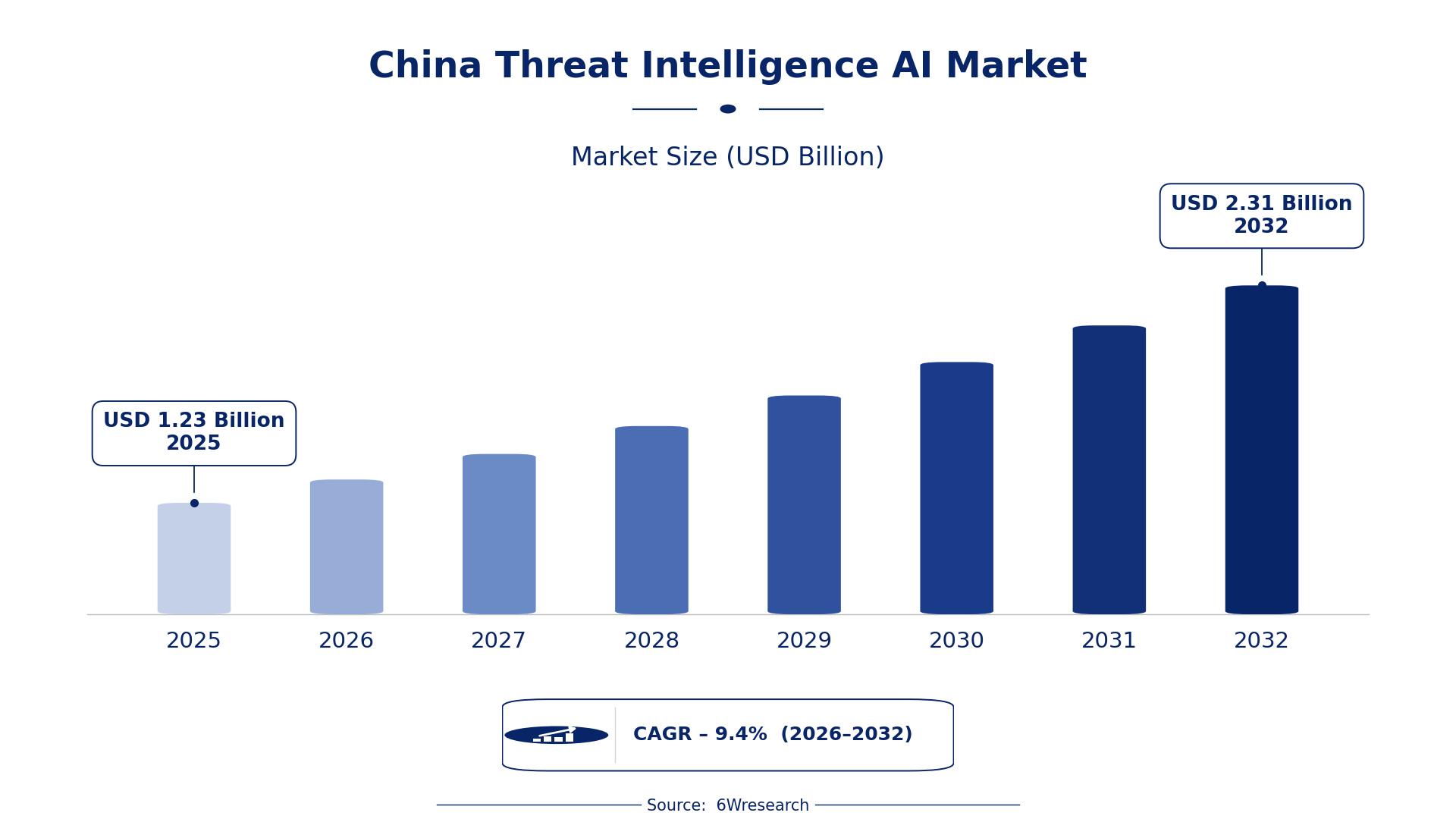
According to 6Wresearch internal database and industry insights, the China Threat Intelligence AI Market was valued at USD 1.23 billion in 2025 and is projected to reach USD 2.31 billion by 2032, growing at a CAGR of approximately 9.4% during 2026–2032.
China Threat Intelligence AI Market Highlights
| Report Metric | Details |
| Report Name | China Threat Intelligence AI Market |
| Market Size 2025 | USD 1.23 billion |
| Market Size 2032 | USD 2.31 billion |
| Absolute Growth 2025–2032 | USD 1.08 billion |
| CAGR 2026–2032 | 9.4% |
| Peak Annual Growth | 10.9% in 2032 |
| Forecast Period | 2026–2032 |
| Historical Data | 2022–2025 |
| Base Year | 2025 |
| Leading Intelligence Type, 2025 | Tactical Intelligence (39% share) |
| Leading Data Source, 2025 | Real-Time Alerts (51% share) |
| Leading AI Methodology, 2025 | Machine Learning (45% share) |
| Leading End User, 2025 | SOC Teams (41% share) |
| Fastest-Growing Intelligence Type | Operational Intelligence (11.6% CAGR) |
| Fastest-Growing Data Source | Dark Web Monitoring (11.8% CAGR) |
| Fastest-Growing AI Methodology | Predictive Analytics (11.3% CAGR) |
| Fastest-Growing End User | Cybersecurity Researchers (11.1% CAGR) |
| Growing Sector | Cybersecurity Researchers |
| Key End Users | SOC Teams, CISOs, Cybersecurity Researchers, Security Vendors |
China Threat Intelligence AI Market Year-wise Growth Rate and Key Drivers (2022–2032)
This graph illustrates the annual growth rates of the market from 2022 to 2032, highlighting a steady upward trajectory and projected market expansion over the forecast period.
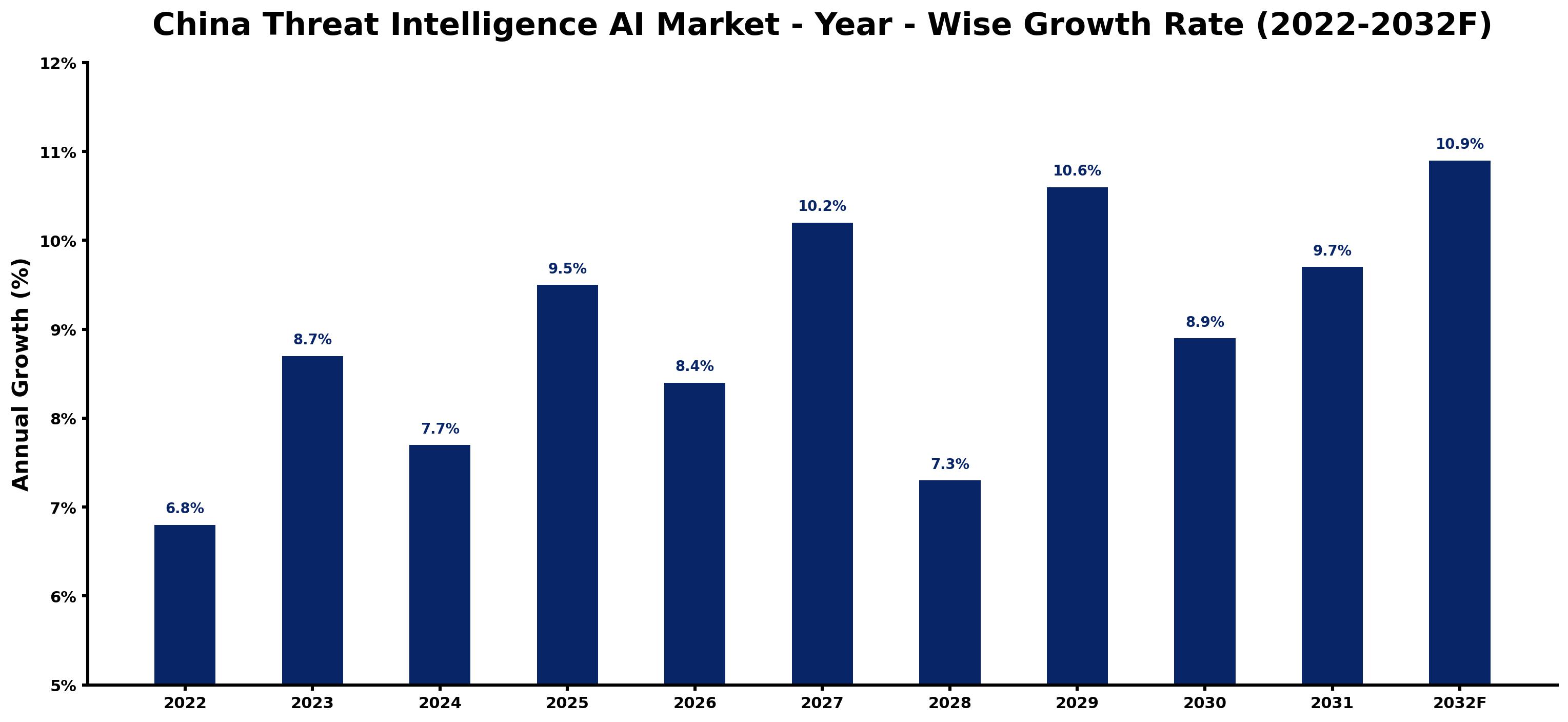
The following table presents the estimated annual growth rate for each year together with the principal factor influencing market performance.
| Year | Estimated Annual Growth (%) | Market Rationale |
| 2022 | 6.8 | The market experienced steady growth as cybersecurity incidents surged, prompting increased investment in threat intelligence solutions. |
| 2023 | 8.7 | Demand accelerated due to the National Cybersecurity Strategy emphasising the importance of threat intelligence capabilities across industries. |
| 2024 | 7.7 | Growth slowed as enterprises began to implement existing solutions, leading to a temporary plateau in new investments. |
| 2025 | 9.5 | A rise in cybersecurity incidents drove faster adoption of threat intelligence AI technologies among enterprises. |
| 2026 | 8.4 | The market is expected to see a slowdown as companies focus on optimising existing threat intelligence frameworks and solutions. |
| 2027 | 10.2 | Rising cyber threats and the need for real-time data analytics will spur faster growth in the sector. |
| 2028 | 7.3 | Growth is projected to decelerate as the market matures, with established players solidifying their positions and reducing rapid expansion. |
| 2029 | 10.6 | Increased funding for cybersecurity initiatives will revitalise demand for advanced threat intelligence solutions. |
| 2030 | 8.9 | The market growth rate is expected to slow as competition intensifies, prompting firms to focus on differentiation and innovation. |
| 2031 | 9.7 | Demand will surge again as organisations seek to strengthen their cybersecurity postures in response to evolving threats. |
| 2032 | 10.9 | The market is projected to reach its peak growth as the need for sophisticated threat intelligence solutions becomes critical for all sectors. |
Note: Market size estimations and growth projections presented in this report are based on 6Wresearch's proprietary forecasting methodology, utilizing the latest available industry data, government publications, and primary research inputs.
China Threat Intelligence AI Market Synopsis
Threat Intelligence AI in China encompasses technologies that analyse and predict cyber threats using artificial intelligence. This includes real-time threat assessments and vulnerability identification, essential for improving cybersecurity measures. The China Threat Intelligence AI Market is expanding rapidly, driven by increasing cybersecurity incidents and government initiatives promoting advanced security solutions. Over 60% of enterprises have adopted AI-driven security technologies, reflecting a strong shift towards proactive cybersecurity strategies. Key regions like Beijing and Shanghai are at the forefront of this growth, fostering innovation and development.
Market Dynamics Impact Analysis (2026–2032)
| Factor | Type | Impact | Primary Segment Affected |
| Increasing cybersecurity incidents necessitate advanced threat detection solutions. | Driver | High | Operational Intelligence |
| Growing adoption of AI technologies in security solutions enhances market potential. | Driver | High | Machine Learning |
| Rising demand for real-time threat detection creates opportunities for new entrants. | Opportunity | High | Real-Time Alerts |
| Investment in cybersecurity training programmes opens new avenues for service providers. | Opportunity | Medium | Cybersecurity Researchers |
| High costs of implementing advanced threat intelligence solutions may deter smaller firms. | Restraint | High | Technical Intelligence |
| Limited awareness of threat intelligence benefits restricts market growth in certain sectors. | Restraint | Medium | Strategic Intelligence |
| Competition among cybersecurity firms leads to pricing pressures, affecting profitability. | Challenge | High | Security Vendors |
| Rapid technological advancements require continuous investment, straining resources for firms. | Challenge | Medium | SOC Teams |
Evaluation of Drivers in China Threat Intelligence AI Market (2026–2032)
The factors lifting demand, and the evidence behind each, are summarised below.
| Drivers | Primary Segment Affected | Why It Matters (Evidence) |
| Rising cybersecurity incidents drive demand for immediate threat response solutions. | Real-Time Alerts | In 2022, cybersecurity incidents in China increased by 30%, prompting enterprises to invest in real-time threat detection. |
| Adoption of AI technologies improves the efficiency of threat intelligence solutions. | Machine Learning | Over 60% of enterprises have adopted AI-driven security solutions, increasing demand for machine learning capabilities. |
| Government initiatives promote the integration of threat intelligence frameworks across sectors. | Strategic Intelligence | The National Cybersecurity Strategy emphasises the importance of threat intelligence, encouraging organisations to invest in these solutions. |
| Growing focus on compliance with cybersecurity regulations boosts demand for security measures. | Technical Intelligence | The Cybersecurity Law mandates critical infrastructure sectors to implement threat intelligence frameworks, driving market growth. |
| Investment in cybersecurity talent development increases the availability of skilled professionals. | Operational Intelligence | The Cybersecurity Talent Development Program aims to train 100,000 professionals by 2025, supporting industry growth. |
In 2022, cybersecurity incidents increased by 30%, prompting enterprises to invest in real-time threat detection, especially in regions like Beijing and Shanghai. Over 60% of enterprises have integrated AI-driven security technologies, which improves their threat detection capabilities. Investment in developing cybersecurity talent supports the industry's expansion, ensuring a skilled workforce is available to tackle emerging challenges.
Evaluation of Restraints in China Threat Intelligence AI Market
The main factors holding the market back are set out below.
| Market Restraint | Primary Segment Affected | Why It Matters (Evidence) |
| High implementation costs deter smaller firms from adopting advanced solutions. | Technical Intelligence | The costs associated with deploying sophisticated threat intelligence platforms can exceed ¥1 million, limiting access for smaller enterprises. |
| Limited understanding of threat intelligence benefits restricts adoption in various sectors. | Strategic Intelligence | Many organisations lack awareness of how threat intelligence can improve their cybersecurity posture, hindering market growth. |
| Intense competition leads to pricing pressures, affecting profit margins for providers. | Security Vendors | As more firms enter the market, aggressive pricing strategies can erode profitability for existing players. |
| Rapid technological advancements require continuous investment, straining resources for firms. | SOC Teams | Firms must invest heavily in the latest technologies to remain competitive, which can divert funds from other critical areas. |
| Regulatory compliance challenges can slow down implementation timelines. | Operational Intelligence | Organisations must navigate complex compliance requirements, delaying the deployment of threat intelligence solutions. |
China Threat Intelligence AI Market Challenges
Buyers in the China Threat Intelligence AI market face intense competition, as over 1,000 cybersecurity firms compete for market share, which reduces profit margins for smaller entities. Technology adoption is uneven; while 60% of larger enterprises implement AI-driven security solutions, many smaller firms lack the resources to do so, leaving them vulnerable to cyber threats. Compliance with the Cybersecurity Law of 2017 imposes strict security measures, causing delays and increasing operational costs for organizations that struggle to meet these requirements. The rising expenses tied to maintaining threat intelligence platforms, with government funding reaching ¥1 billion, limit smaller firms' ability to invest in essential upgrades and innovations.
Trends in the China Threat Intelligence AI Market
Several trends are reshaping the China Threat Intelligence AI Market; the most important are set out below.
- Shift towards Real-Time Threat Detection: The National Cybersecurity Strategy initiated a shift towards real-time threat detection solutions in 2022, with over 60% of enterprises adopting AI-driven security technologies. This trend improves the ability of organisations to respond swiftly to cyber threats.
- Emergence of Predictive Analytics in Threat Intelligence: Since 2023, predictive analytics has gained traction among cybersecurity researchers, with a projected CAGR of 11.3% through 2032. This shift enables organisations to anticipate future threats based on historical data, improving their security posture.
- Increased Focus on Cybersecurity Training: The Cybersecurity Talent Development Program, launched in 2021, aims to train 100,000 professionals by 2025. This initiative addresses the skills gap in the industry, improving the overall effectiveness of threat intelligence solutions.
- Adoption of Standardised Threat Intelligence Frameworks: The establishment of the National Standard for Cybersecurity Threat Intelligence in 2020 has standardised practices for threat intelligence sharing. This framework facilitates better collaboration among cybersecurity firms and improves overall market efficiency.
Investment Opportunities in the China Threat Intelligence AI Market
Some of the investment opportunities in the China Threat Intelligence AI Market are mentioned below.
- SOC Teams: SOC teams require advanced threat intelligence solutions to improve incident response. The market for these solutions is projected to expand as demand grows for real-time data analysis, particularly in major cities like Beijing.
- Cybersecurity Vendors: With the anticipated rise in cybersecurity incidents, vendors can invest in developing advanced threat intelligence tools. The increasing need for effective solutions presents a valuable opportunity for suppliers in the market.
- Cybersecurity Researchers: Cybersecurity researchers are seeking advanced analytics tools to enrich their studies. The demand for predictive analytics solutions is on the rise, creating opportunities for suppliers to offer tailored products.
- Government Agencies: Government agencies are aiming to implement standardised threat intelligence frameworks. Suppliers can enter this market by collaborating with local firms to meet the growing demand for compliance with national standards.
Government Initiatives in the China Threat Intelligence AI Market
The Cybersecurity Law of 2017 mandates organisations to implement security measures, impacting buyers in the Threat Intelligence AI market. This law requires critical infrastructure sectors to adopt threat intelligence frameworks, ensuring national security. Compliance necessitates investment in advanced technologies and solutions, driving demand for threat intelligence AI products.
The Cybersecurity Innovation Fund, launched in 2021 with a budget of ¥500 million, supports AI-driven security technologies. This fund strengthens the cybersecurity capabilities of organisations across various sectors, facilitating the adoption of advanced threat intelligence solutions.
Future Insight of the China Threat Intelligence AI Market
The China Threat Intelligence AI market is set for transformation by 2032, with several key initiatives shaping its future. The National Cybersecurity Strategy will highlight the importance of threat intelligence, encouraging broader adoption across various sectors. The Ministry of Industry and Information Technology's programme to enhance cybersecurity capabilities will stimulate innovation, particularly in key regions like Beijing and Shanghai. The Cybersecurity Talent Development Program aims to train 100,000 professionals by 2025, which will bolster the industry's ability to combat evolving cyber threats.
Market Segmentation Analysis
The analysis below covers each segmentation, its leading category in 2025 and its fastest-growing category through 2032.
By Intelligence Type – Tactical Intelligence Dominated, Operational Intelligence Expected to Grow Fastest
According to Vasudha, AM at 6Wresearch, Tactical Intelligence accounted for a 39% market share by intelligence type in 2025. Tactical Intelligence holds the largest share because it provides immediate insights for threat response, particularly crucial in sectors like finance and government. Its real-time capabilities enable organisations to respond swiftly to potential threats, ensuring robust security measures are effectively implemented. The quickest growth will come from Operational Intelligence, forecast to expand at a CAGR of 11.6% between 2026 and 2032. Operational Intelligence is growing rapidly as it supports daily security operations and incident management, spurred by the 30% increase in cyber incidents in 2022. This trend indicates a sustained demand for effective operational strategies in cybersecurity, further solidifying Tactical Intelligence's leading position. Suppliers should enhance their offerings to support the operational needs of security teams, ensuring they remain competitive.
By Data Source – Real-Time Alerts Dominated, Dark Web Monitoring Expected to Grow Fastest
The largest data source category in 2025 was Real-Time Alerts, with a 51% share of total revenue. Real-Time Alerts dominate the market share due to their critical role in immediate threat detection and response, allowing organisations to act quickly against potential breaches. This capability is particularly vital for industries such as finance, where timely action is essential to prevent losses. Dark Web Monitoring is projected to grow fastest, at a CAGR of 11.8% during 2026–2032. Dark Web Monitoring is experiencing rapid growth as it is essential for identifying emerging threats and vulnerabilities, reflecting the need for proactive cybersecurity measures. The increasing sophistication of cybercriminals further fuels this demand for effective monitoring solutions. Buyers must invest in comprehensive monitoring solutions to effectively manage and mitigate potential threats.
By AI Methodology – Machine Learning Dominated, Predictive Analytics Expected to Grow Fastest
Machine Learning took a 45% share of ai methodology in 2025, more than any other category. Machine Learning commands the largest share as it automates threat detection processes, enabling efficient analysis of extensive data sets. This methodology is widely adopted across various sectors, significantly enhancing overall cybersecurity effectiveness and response times. Predictive Analytics is set to record the highest CAGR in this split, 11.3% over 2026–2032. Predictive Analytics is the fastest-growing segment, helping organisations anticipate future threats based on historical data. The complexity of cyber threats necessitates advanced analytics to predict and effectively mitigate risks, which reinforces the importance of Machine Learning in the market. Suppliers should focus on integrating predictive capabilities into their solutions to meet evolving market demands.
By End User – SOC Teams Dominated, Cybersecurity Researchers Expected to Grow Fastest
With a 41% revenue share in 2025, SOC Teams was the largest end user category. SOC Teams represent the largest share as they are the primary users of threat intelligence for incident response, making them vital to organisational security frameworks. Their importance is particularly pronounced in sectors like finance and healthcare, where data protection is critical for compliance and trust. Over 2026–2032, Cybersecurity Researchers are expected to post the fastest growth, at a CAGR of 11.1%. Cybersecurity Researchers are the fastest-growing end user group, utilising threat intelligence for both academic and practical research. The emphasis on enhanced cybersecurity education and training, supported by government initiatives, is driving this growth and highlighting the need for tailored solutions. Vendors should tailor their solutions to meet the specific needs of cybersecurity researchers to capture this emerging market.
Key Attractiveness of the Report
- 10 Years of Market Numbers
- Historical Data Starting from 2022 to 2025
- Base Year 2025
- Forecast Data until 2032
- Key Performance Indicators Impacting the Market
- Major Upcoming Developments and Projects
Key Highlights of the Report:
- China Threat Intelligence AI Market Outlook
- Market Size of China Threat Intelligence AI Market, 2025
- Forecast of China Threat Intelligence AI Market, 2032
- Historical Data and Forecast of China Threat Intelligence AI Revenues & Volume for the Period 2022 - 2032F
- China Threat Intelligence AI Market Trend Evolution
- China Threat Intelligence AI Market Drivers and Challenges
- China Threat Intelligence AI Price Trends
- China Threat Intelligence AI Porter's Five Forces
- China Threat Intelligence AI Industry Life Cycle
- Historical Data and Forecast of China Threat Intelligence AI Market Revenues & Volume By Intelligence Type for the Period 2022 - 2032F
- Historical Data and Forecast of China Threat Intelligence AI Market Revenues & Volume By Tactical Intelligence for the Period 2022 - 2032F
- Historical Data and Forecast of China Threat Intelligence AI Market Revenues & Volume By Strategic Intelligence for the Period 2022 - 2032F
- Historical Data and Forecast of China Threat Intelligence AI Market Revenues & Volume By Operational Intelligence for the Period 2022 - 2032F
- Historical Data and Forecast of China Threat Intelligence AI Market Revenues & Volume By Technical Intelligence for the Period 2022 - 2032F
- Historical Data and Forecast of China Threat Intelligence AI Market Revenues & Volume By Data Source for the Period 2022 - 2032F
- Historical Data and Forecast of China Threat Intelligence AI Market Revenues & Volume By IPs, URLs for the Period 2022 - 2032F
- Historical Data and Forecast of China Threat Intelligence AI Market Revenues & Volume By Dark Web Monitoring for the Period 2022 - 2032F
- Historical Data and Forecast of China Threat Intelligence AI Market Revenues & Volume By Real-Time Alerts for the Period 2022 - 2032F
- Historical Data and Forecast of China Threat Intelligence AI Market Revenues & Volume By Malware Code Analysis for the Period 2022 - 2032F
- Historical Data and Forecast of China Threat Intelligence AI Market Revenues & Volume By AI Methodology for the Period 2022 - 2032F
- Historical Data and Forecast of China Threat Intelligence AI Market Revenues & Volume By Machine Learning for the Period 2022 - 2032F
- Historical Data and Forecast of China Threat Intelligence AI Market Revenues & Volume By Predictive Analytics for the Period 2022 - 2032F
- Historical Data and Forecast of China Threat Intelligence AI Market Revenues & Volume By Deep Learning Classification for the Period 2022 - 2032F
- Historical Data and Forecast of China Threat Intelligence AI Market Revenues & Volume By Threat Modeling AI for the Period 2022 - 2032F
- Historical Data and Forecast of China Threat Intelligence AI Market Revenues & Volume By End User for the Period 2022 - 2032F
- Historical Data and Forecast of China Threat Intelligence AI Market Revenues & Volume By SOC Teams for the Period 2022 - 2032F
- Historical Data and Forecast of China Threat Intelligence AI Market Revenues & Volume By CISOs for the Period 2022 - 2032F
- Historical Data and Forecast of China Threat Intelligence AI Market Revenues & Volume By Security Vendors for the Period 2022 - 2032F
- Historical Data and Forecast of China Threat Intelligence AI Market Revenues & Volume By Cybersecurity Researchers for the Period 2022 - 2032F
- China Threat Intelligence AI Import Export Trade Statistics
- Market Opportunity Assessment By Intelligence Type
- Market Opportunity Assessment By Data Source
- Market Opportunity Assessment By AI Methodology
- Market Opportunity Assessment By End User
- China Threat Intelligence AI Top Companies Market Share
- China Threat Intelligence AI Competitive Benchmarking By Technical and Operational Parameters
- China Threat Intelligence AI Company Profiles
- China Threat Intelligence AI Key Strategic Recommendations
Market Covered
The report offers an extensive study of the following market segments.
By Intelligence Type
- Tactical Intelligence
- Strategic Intelligence
- Operational Intelligence
- Technical Intelligence
By Data Source
- IPs
- URLs
- Dark Web Monitoring
- Real-Time Alerts
- Malware Code Analysis
By AI Methodology
- Machine Learning
- Predictive Analytics
- Deep Learning Classification
- Threat Modeling AI
By End User
- SOC Teams
- CISOs
- Security Vendors
- Cybersecurity Researchers































