China Thrombolytic Therapy Market Size & Growth Rate
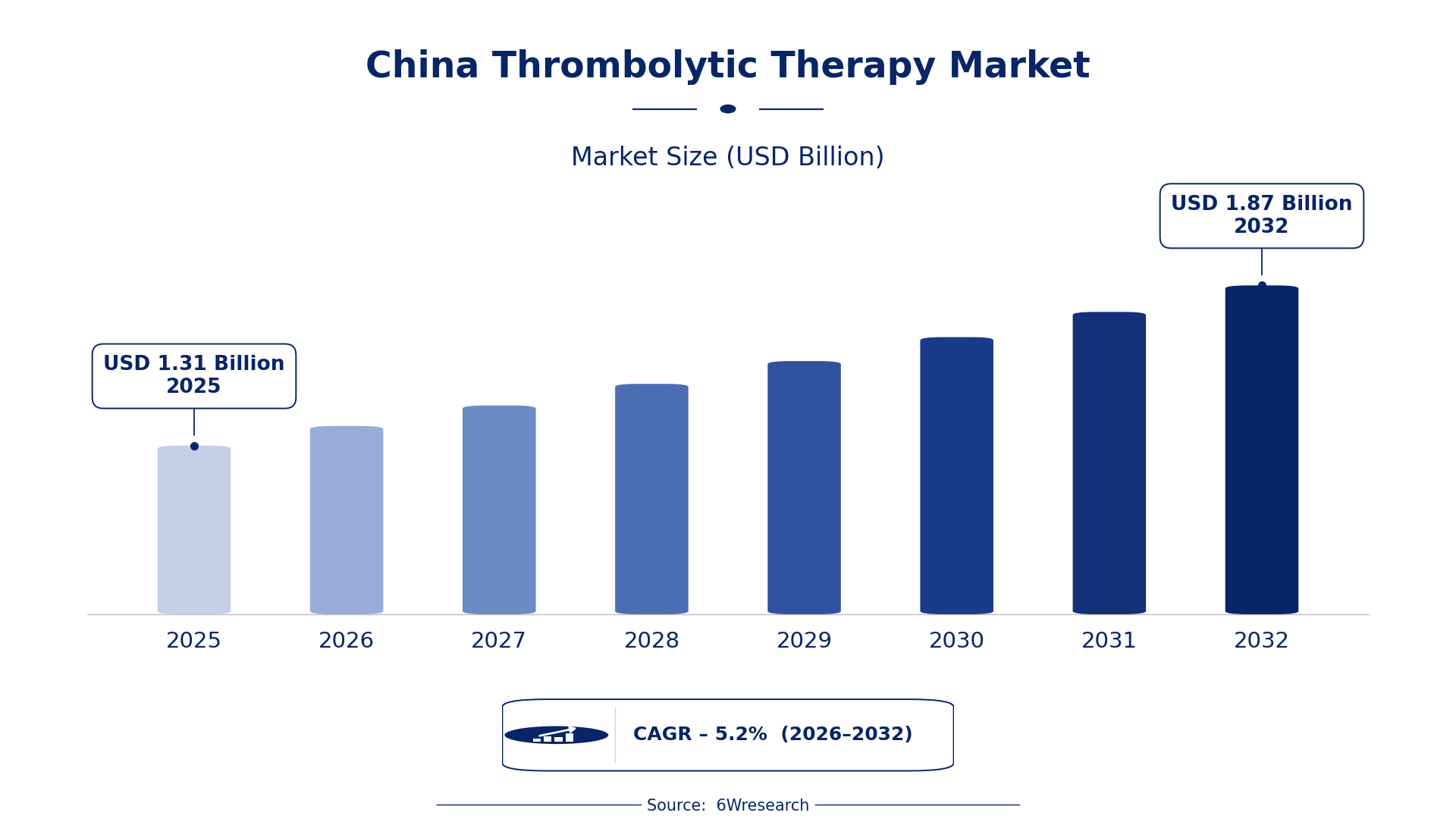
According to 6Wresearch internal database and industry insights, the China Thrombolytic Therapy Market was valued at USD 1.31 billion in 2025 and is projected to reach USD 1.87 billion by 2032, growing at a CAGR of approximately 5.2% during 2026–2032.
China Thrombolytic Therapy Market Highlights
| Report Metric | Details |
| Report Name | China Thrombolytic Therapy Market |
| Market Size 2025 | USD 1.31 billion |
| Market Size 2032 | USD 1.87 billion |
| Absolute Growth 2025–2032 | USD 0.56 billion |
| CAGR 2026–2032 | 5.2% |
| Peak Annual Growth | 6.8% in 2027 |
| Forecast Period | 2026–2032 |
| Historical Data | 2022–2025 |
| Base Year | 2025 |
| Leading Drug Type, 2025 | tPA (Alteplase) (45% share) |
| Leading Delivery Method, 2025 | IV Infusion (40% share) |
| Leading Application Indication, 2025 | Acute Stroke (47% share) |
| Leading End User, 2025 | Hospitals (42% share) |
| Fastest-Growing Drug Type | Streptokinase (6.4% CAGR) |
| Fastest-Growing Delivery Method | Intravenous Injection (7.2% CAGR) |
| Fastest-Growing Application Indication | Myocardial Infarction (7.6% CAGR) |
| Fastest-Growing End User | Cardiac Centers (7.2% CAGR) |
| Growing Sector | Emergency Services |
| Key End Users | Hospitals, Cardiac Centers, Emergency Services, Critical Care Units |
China Thrombolytic Therapy Market Year-wise Growth Rate and Key Drivers (2022–2032)
This graph illustrates the annual growth rates of the market from 2022 to 2032, highlighting a steady upward trajectory and projected market expansion over the forecast period.
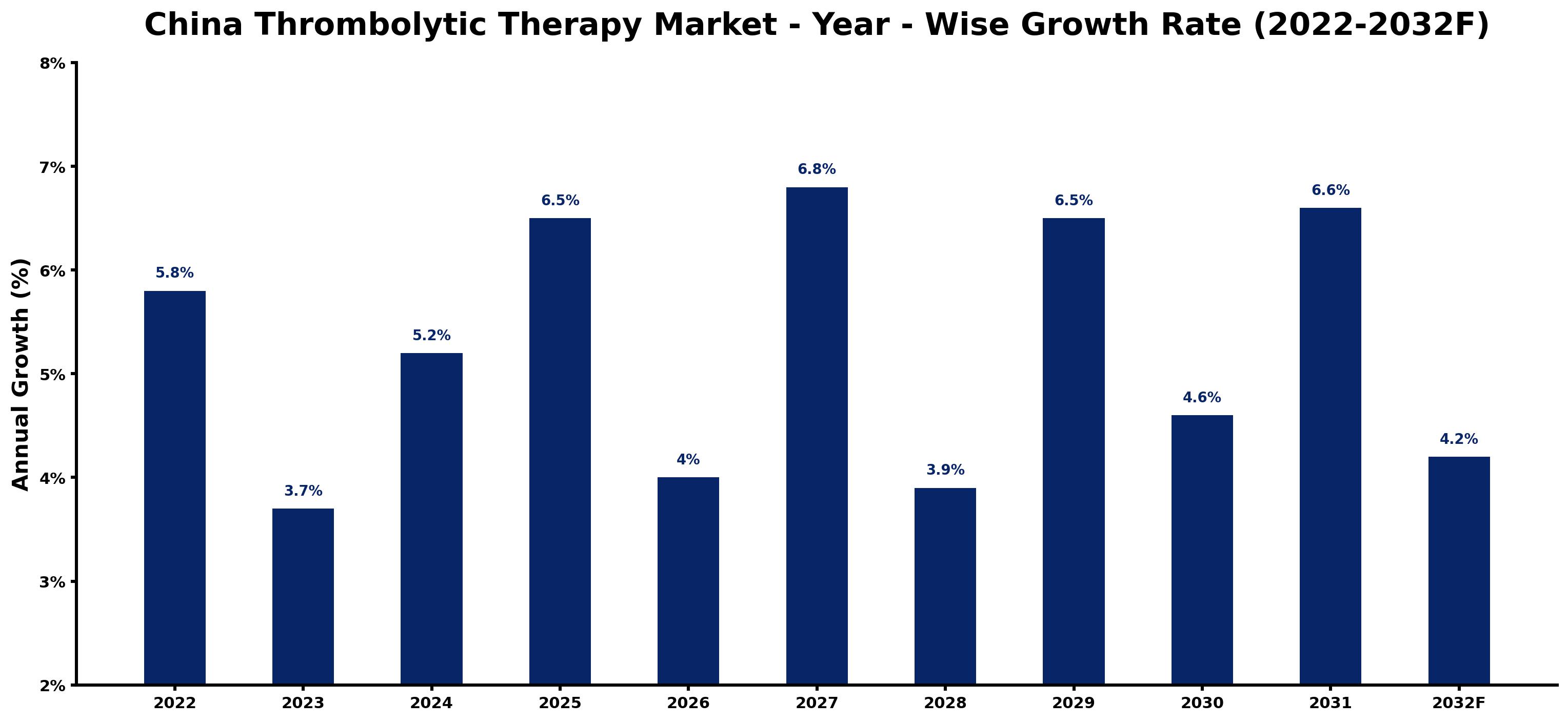
The following table presents the estimated annual growth rate for each year together with the principal factor influencing market performance.
| Year | Estimated Annual Growth (%) | Market Rationale |
| 2022 | 5.8 | The first year showed strong demand from hospitals and emergency services. |
| 2023 | 3.7 | Growth slowed as awareness campaigns were introduced, impacting immediate demand. |
| 2024 | 5.2 | Demand increased with more hospitals adopting thrombolytic therapy protocols. |
| 2025 | 6.5 | Growth accelerated as urban access to therapy improved. |
| 2026 | 4.0 | Growth is expected to slow due to changes in therapy administration practices. |
| 2027 | 6.8 | Demand is projected to surge as hospitals expand their thrombolytic therapy capabilities. |
| 2028 | 3.9 | Growth is anticipated to slow as the Chinese Stroke Association's guidelines are implemented. |
| 2029 | 6.5 | Demand is expected to increase as more cardiac centers adopt advanced thrombolytic techniques. |
| 2030 | 4.6 | Growth will slow as the market reaches a more mature phase with ongoing clinical trials. |
| 2031 | 6.6 | Demand is projected to rise again as new training programs for emergency services are launched. |
| 2032 | 4.2 | Growth is expected to slow as the market approaches saturation in urban areas. |
Note: Market size estimations and growth projections presented in this report are based on 6Wresearch's proprietary forecasting methodology, utilizing the latest available industry data, government publications, and primary research inputs.
China Thrombolytic Therapy Market Synopsis
Thrombolytic Therapy in China involves the use of drugs to dissolve blood clots, primarily for treating acute strokes and heart attacks. This therapy is produced through biochemical processes that yield specific enzymes. In 2022, over 1 million patients received thrombolytic therapy, reflecting strong demand driven by hospitals and emergency services. The China Thrombolytic Therapy Market is expanding due to increased access in urban areas and government awareness campaigns, alongside the establishment of specialized cardiac centers in major cities.
Market Dynamics Impact Analysis (2026–2032)
| Factor | Type | Impact | Primary Segment Affected |
| Growing urban access to thrombolytic therapy is driving demand in hospitals. | Driver | High | Hospitals |
| Increased training programs for emergency services enhance therapy administration. | Driver | High | Emergency Services |
| The rise in acute stroke prevalence presents a significant opportunity for suppliers. | Opportunity | High | Acute Stroke |
| Investment in cardiac centers is expanding the market for thrombolytic therapy. | Opportunity | High | Cardiac Centers |
| Limited awareness of thrombolytic therapy in rural areas restrains market growth. | Restraint | Medium | Emergency Services |
| Regulatory hurdles in drug approval can delay market entry for new therapies. | Restraint | Medium | tPA (Alteplase) |
| Training shortages for emergency responders can hinder effective therapy delivery. | Challenge | High | Emergency Services |
| High costs of thrombolytic agents may limit access for some hospitals. | Challenge | Medium | Hospitals |
Evaluation of Drivers in China Thrombolytic Therapy Market (2026–2032)
The factors lifting demand, and the evidence behind each, are summarised below.
| Drivers | Primary Segment Affected | Why It Matters (Evidence) |
| Increased hospital adoption of thrombolytic protocols drives demand for tPA. | tPA (Alteplase) | In 2022, over 1 million patients received thrombolytic therapy, boosting hospital purchases. |
| Growing prevalence of acute strokes increases demand for thrombolytic agents. | Acute Stroke | The prevalence of acute stroke in urban areas is estimated at 200 per 100,000 people. |
| Emergency services are expanding their capabilities to administer thrombolytic therapy. | Emergency Services | Emergency services in 30 provinces are equipped to administer thrombolytic therapy. |
| Investment in specialized cardiac centers boosts the demand for thrombolytic treatments. | Cardiac Centers | Major cities have established specialized cardiac centers, improving service availability. |
| Clinical trials for new thrombolytic agents are increasing market interest. | tPA (Alteplase) | Ongoing clinical trials in several provinces are expected to introduce new agents. |
Market growth in China for Thrombolytic Therapy rests on rising end-use demand from hospitals and emergency services, alongside a responsive supply chain. In 2022, over 1 million patients received thrombolytic therapy, which boosts hospital purchases. The prevalence of acute strokes is estimated at 200 per 100,000 people, driving demand for effective treatments. Emergency services across multiple provinces are equipped to administer thrombolytic therapy, improving accessibility. Investment in specialized cardiac centers in major cities expands service availability, further increasing demand for thrombolytic agents.
Evaluation of Restraints in China Thrombolytic Therapy Market
Below mentioned are some major restraints and their influence on market dynamics.
| Market Restraint | Primary Segment Affected | Why It Matters (Evidence) |
| Limited awareness of thrombolytic therapy in rural areas restricts market growth. | Emergency Services | Awareness campaigns are still developing, affecting rural emergency service capabilities. |
| Regulatory hurdles in drug approval can delay market entry for new therapies. | tPA (Alteplase) | The National Drug Administration oversees approvals, which can take time, impacting availability. |
| Insufficient training programs lead to delays in therapy administration in critical situations. | Emergency Services | Training shortages for emergency responders can hinder effective therapy delivery. |
| High costs of thrombolytic agents may limit access for some hospitals. | Hospitals | Budget constraints in smaller hospitals restrict their ability to procure necessary therapies. |
| Market saturation in urban areas may slow growth in established regions. | Hospitals | As urban hospitals reach capacity, growth potential diminishes in these areas. |
China Thrombolytic Therapy Market Challenges
Buyers and suppliers in the China thrombolytic therapy market face regulatory hurdles due to the National Drug Administration's lengthy approval processes for new agents, which can delay market entry by up to 18 months for producers. Supply chain issues arise from limited domestic production of thrombolytic agents, resulting in shortages that raise costs for hospitals, particularly in rural regions where access is already limited. Competition for advanced thrombolytic therapy equipment among hospitals escalates prices, making it challenging for smaller facilities to invest in essential technology. Skills shortages in administering thrombolytic therapy remain a concern, as training programs are still being implemented, affecting timely treatment for over 1 million patients each year.
Trends in the China Thrombolytic Therapy Market
Several trends are reshaping the China Thrombolytic Therapy Market; the most important are set out below.
- Shift towards Improved Emergency Response Training: In 2023, the Ministry of Health launched a campaign to improve thrombolytic therapy awareness. This initiative aims to enhance training for emergency responders, leading to better patient outcomes in acute stroke cases.
- Increase in Specialized Cardiac Centers: Major cities like Beijing and Shanghai are establishing specialized cardiac centers, with over 5,000 thrombolytic therapy units installed. This growth supports more effective treatment options for myocardial infarction.
- Adoption of New Thrombolytic Agents: Ongoing clinical trials for new thrombolytic agents are expected to diversify treatment options. This trend is anticipated to improve patient care and increase market competition.
- Expansion of Thrombolytic Therapy in Rural Areas: The average population in urban areas has increased access to thrombolytic therapy since 2020. Efforts are underway to extend these services to rural regions, improving overall healthcare access.
Investment Opportunities in the China Thrombolytic Therapy Market
Some of the investment opportunities in the China Thrombolytic Therapy Market are mentioned below.
- Growing Demand for Acute Stroke Treatment: With the prevalence of acute stroke at 200 per 100,000 people, there is an opportunity for suppliers to meet this demand. Hospitals are the primary buyers, and partnerships with local distributors can facilitate entry.
- Investment in Training Programs: In 2023, the government allocated funding for training programs in thrombolytic therapy administration. This presents an opportunity for educational institutions to develop specialized training services for emergency responders.
- Expansion into Cardiac Centers: As cardiac centers grow, suppliers can focus on providing advanced thrombolytic agents. Collaborating with these facilities can strengthen market presence and meet increasing demand.
- Rural Market Development: With urban areas seeing increased access, there is a gap in rural thrombolytic therapy availability. Targeting rural hospitals through partnerships can help bridge this gap and expand market reach.
Government Initiatives in the China Thrombolytic Therapy Market
The National Health Commission has established standards for thrombolytic therapy management since 2020, promoting best practices in hospitals. The Essential Medicines List includes thrombolytic therapy, ensuring its availability. In 2021, the National Drug Administration began overseeing the approval of thrombolytic agents, streamlining the regulatory process for new therapies.
The National Health Commission funds training programs for emergency responders to improve thrombolytic therapy administration. The Chinese Stroke Association provides guidelines for the appropriate use of thrombolytic therapy, ensuring compliance with established standards. These initiatives aim to improve the overall effectiveness of thrombolytic therapy in the healthcare system.
Future Insight of the China Thrombolytic Therapy Market
The China thrombolytic therapy market will experience notable transformations by 2032, primarily driven by advancements in treatment protocols from ongoing clinical trials for new thrombolytic agents. The National Health Commission's promotion of thrombolytic therapy standards will standardise practices across healthcare facilities, ensuring consistent patient care. Emergency services across 30 provinces are expected to enhance their capabilities, with response times aiming for under 45 minutes. Increased funding for training programs will improve the skills of healthcare professionals, facilitating better patient outcomes.
Market Segmentation Analysis
Each segment group is reviewed below, with the leader by share and the fastest grower by CAGR.
By Drug Type – tPA (Alteplase) Dominated, Streptokinase Expected to Grow Fastest
According to Vasudha, AM at 6Wresearch, tPA (Alteplase) held a 45% share of the China Thrombolytic Therapy Market by drug type in 2025. tPA is the most widely used thrombolytic agent in China, particularly for treating acute strokes, which constitute a major use case for thrombolytic therapy. Its established presence in hospitals, supported by guidelines from the Chinese Medical Association, ensures a robust installed base and consistent demand. Streptokinase is projected to grow fastest, at a CAGR of 6.4% during 2026–2032. Streptokinase is experiencing rapid growth due to its common application in treating myocardial infarction, which is on the rise. The ongoing clinical trials for new formulations are further driving interest and adoption in this segment. Suppliers should enhance the availability and awareness of Streptokinase to capitalise on its growth potential.
By Delivery Method – IV Infusion Dominated, Intravenous Injection Expected to Grow Fastest
In 2025, IV Infusion led the delivery method split with a 40% share. IV Infusion is the standard method for administering thrombolytics, ensuring effective delivery in critical situations. Its widespread adoption in hospitals across urban areas reinforces its dominant market share and reliability in acute care settings. The quickest growth will come from Intravenous Injection, forecast to expand at a CAGR of 7.2% between 2026 and 2032. Intravenous Injection is gaining popularity as a rapid delivery method, particularly in emergency situations where time is critical. The increasing focus on quick response times in major cities is propelling this segment's growth. Buyers should consider the efficiency of delivery methods when selecting thrombolytic therapies to optimise patient outcomes.
By Application Indication – Acute Stroke Dominated, Myocardial Infarction Expected to Grow Fastest
Acute Stroke accounted for a 47% market share by application indication in 2025. Acute Stroke is the primary application for thrombolytic therapy, reflecting the high incidence of strokes in urban populations. The backing of national health initiatives reinforces its significance in treatment protocols. Over 2026–2032, Myocardial Infarction is expected to post the fastest growth, at a CAGR of 7.6%. Myocardial Infarction is seeing accelerated growth as awareness of heart conditions rises, coupled with the establishment of specialised cardiac centres. This shift indicates a broader acceptance of thrombolytic therapy for diverse indications. Providers must align their offerings with the rising demand for therapies addressing myocardial infarction to stay competitive.
By End User – Hospitals Dominated, Cardiac Centers Expected to Grow Fastest
The largest end user category in 2025 was Hospitals, with a 42% share of total revenue. Hospitals serve as the primary facilities for administering thrombolytic therapy, with over 5,000 units of related equipment installed nationwide. Their essential role in acute care solidifies their substantial market share in the thrombolytic therapy sector. Cardiac Centers are set to record the highest CAGR in this split, 7.2% over 2026–2032. Cardiac Centers are expanding quickly as they focus on treating heart conditions, reflecting a growing emphasis on cardiovascular health. This trend is expected to accelerate as more facilities adopt advanced thrombolytic therapies. Suppliers should target cardiac centres with tailored solutions to meet the increasing demand for specialised thrombolytic treatments.
Key Attractiveness of the Report
- 10 Years of Market Numbers
- Historical Data Starting from 2022 to 2025
- Base Year 2025
- Forecast Data until 2032
- Key Performance Indicators Impacting the Market
- Major Upcoming Developments and Projects
Key Highlights of the Report:
- China Thrombolytic Therapy Market Outlook
- Market Size of China Thrombolytic Therapy Market, 2025
- Forecast of China Thrombolytic Therapy Market, 2032
- Historical Data and Forecast of China Thrombolytic Therapy Revenues & Volume for the Period 2022 - 2032F
- China Thrombolytic Therapy Market Trend Evolution
- China Thrombolytic Therapy Market Drivers and Challenges
- China Thrombolytic Therapy Price Trends
- China Thrombolytic Therapy Porter's Five Forces
- China Thrombolytic Therapy Industry Life Cycle
- Historical Data and Forecast of China Thrombolytic Therapy Market Revenues & Volume By Drug Type for the Period 2022 - 2032F
- Historical Data and Forecast of China Thrombolytic Therapy Market Revenues & Volume By tPA (Alteplase) for the Period 2022 - 2032F
- Historical Data and Forecast of China Thrombolytic Therapy Market Revenues & Volume By Streptokinase for the Period 2022 - 2032F
- Historical Data and Forecast of China Thrombolytic Therapy Market Revenues & Volume By Tenecteplase for the Period 2022 - 2032F
- Historical Data and Forecast of China Thrombolytic Therapy Market Revenues & Volume By Reteplase for the Period 2022 - 2032F
- Historical Data and Forecast of China Thrombolytic Therapy Market Revenues & Volume By Delivery Method for the Period 2022 - 2032F
- Historical Data and Forecast of China Thrombolytic Therapy Market Revenues & Volume By IV Infusion for the Period 2022 - 2032F
- Historical Data and Forecast of China Thrombolytic Therapy Market Revenues & Volume By Intravenous Injection for the Period 2022 - 2032F
- Historical Data and Forecast of China Thrombolytic Therapy Market Revenues & Volume By Single Bolus for the Period 2022 - 2032F
- Historical Data and Forecast of China Thrombolytic Therapy Market Revenues & Volume By Multiple Bolus for the Period 2022 - 2032F
- Historical Data and Forecast of China Thrombolytic Therapy Market Revenues & Volume By Application Indication for the Period 2022 - 2032F
- Historical Data and Forecast of China Thrombolytic Therapy Market Revenues & Volume By Acute Stroke for the Period 2022 - 2032F
- Historical Data and Forecast of China Thrombolytic Therapy Market Revenues & Volume By Myocardial Infarction for the Period 2022 - 2032F
- Historical Data and Forecast of China Thrombolytic Therapy Market Revenues & Volume By Pulmonary Embolism for the Period 2022 - 2032F
- Historical Data and Forecast of China Thrombolytic Therapy Market Revenues & Volume By Arterial Blockage for the Period 2022 - 2032F
- Historical Data and Forecast of China Thrombolytic Therapy Market Revenues & Volume By End User for the Period 2022 - 2032F
- Historical Data and Forecast of China Thrombolytic Therapy Market Revenues & Volume By Hospitals for the Period 2022 - 2032F
- Historical Data and Forecast of China Thrombolytic Therapy Market Revenues & Volume By Cardiac Centers for the Period 2022 - 2032F
- Historical Data and Forecast of China Thrombolytic Therapy Market Revenues & Volume By Critical Care Units for the Period 2022 - 2032F
- Historical Data and Forecast of China Thrombolytic Therapy Market Revenues & Volume By Emergency Services for the Period 2022 - 2032F
- China Thrombolytic Therapy Import Export Trade Statistics
- Market Opportunity Assessment By Drug Type
- Market Opportunity Assessment By Delivery Method
- Market Opportunity Assessment By Application Indication
- Market Opportunity Assessment By End User
- China Thrombolytic Therapy Top Companies Market Share
- China Thrombolytic Therapy Competitive Benchmarking By Technical and Operational Parameters
- China Thrombolytic Therapy Company Profiles
- China Thrombolytic Therapy Key Strategic Recommendations
Market Covered
This report examines the market across the segments below.
By Drug Type
- tPA (Alteplase)
- Streptokinase
- Tenecteplase
- Reteplase
By Delivery Method
- IV Infusion
- Intravenous Injection
- Single Bolus
- Multiple Bolus
By Application Indication
- Acute Stroke
- Myocardial Infarction
- Pulmonary Embolism
- Arterial Blockage
By End User
- Hospitals
- Cardiac Centers
- Critical Care Units
- Emergency Services































